
Porcelain Insulator Type Shortlist: Pin, Post and Suspension Options
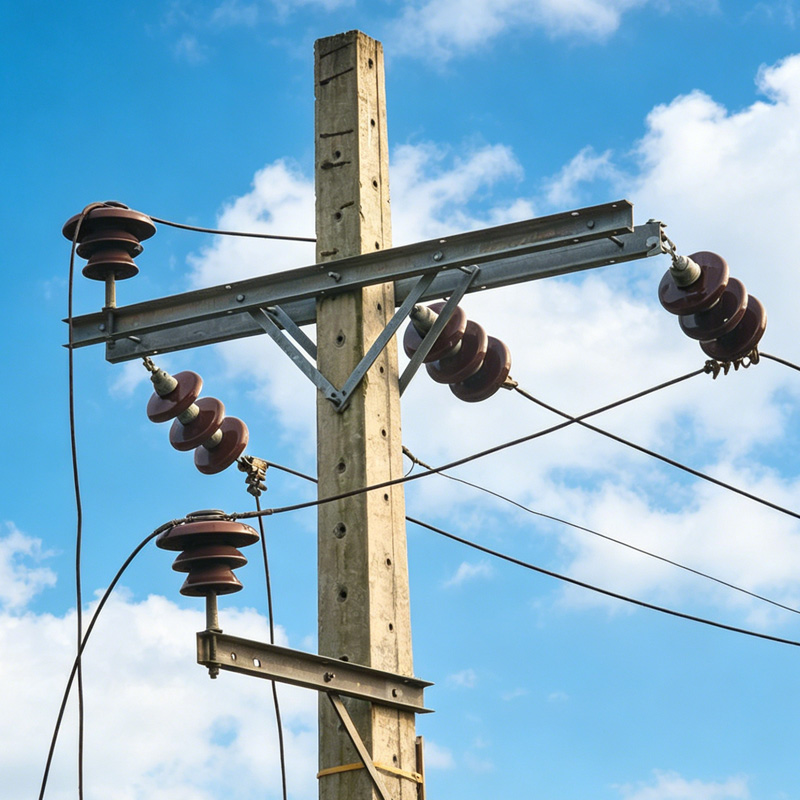
A suspension-class porcelain insulator unit. Type-family selection, not model selection, is where most utility procurement errors originate.
Utility buyers rarely purchase “a porcelain insulator.” They purchase a mechanical duty, a creepage path, and a service life that has to survive a specific structure, climate and pollution class. The consequences of getting that wrong are rarely felt at the data-sheet level. They surface two or three years later, on a line that trips without any visible damage — because the wrong family was specified at the front end.
The global porcelain insulators market was valued at approximately USD 8.27 billion in 2023 and is projected to reach USD 15.04 billion by 2033, according to Spherical Insights. Overhead transmission lines account for roughly 62.1% of category revenue, and Asia-Pacific held a 49.4% revenue share in 2025 according to Mordor Intelligence. In other words, this is a mature, high-volume, structurally stable category — which makes the type decision, rather than raw price, the variable that determines long-term cost. This shortlist sets out the four structural families a grid buyer is most likely to need, with the published values a procurement team can actually verify.
Why the Type Decision Comes Before the Model Decision
Most procurement documents are written after the drawings are fixed. At that stage, the real decision has already been made: the engineering team has chosen a pin, a line post, a shackle, or a suspension string. Procurement then negotiates sourcing around it. When that decision is reversed — for example, when a pin insulator is substituted for an arm-mounted post because it is cheaper, or when a standard-profile unit is used on a coastal line to avoid a price premium — the saving is booked in the current budget and the cost is paid in maintenance.
The four families differ in three ways that matter commercially: the direction of the mechanical load they carry, the creepage distance they can physically deliver, and the assembly and fitting cost around them. A pin insulator carries a cantilever or compressive load on a crossarm. A line post carries cantilever load in a rigid mount. A shackle or spool carries tensile load on low-voltage distribution. A suspension string carries tensile load across a whole span and is assembled from multiple disc units plus fittings.
The regulatory frame is also type-specific. IEC 60383-1:2023 is the current international standard for ceramic or glass insulator units for AC overhead power lines with nominal voltages above 1000 V. ANSI C29.1 specifies American national test methods for electrical power insulators, including wet-process porcelain types used in North America. For cross-border movement, porcelain electrical insulators sit under HS code 8546.20. A supplier who cannot tie a specific type to the applicable standard and test method is not yet a decision-stage option.
The Shortlist: Pin, Post, Shackle and Suspension
The shortlist below is organised by structural function rather than by catalogue order. Published values are stated only where they are documented; categories without published figures are described by their role, not by invented numbers.
| Type family | Load mode | Documented reference | Published values | Typical fit | Where it stops working |
|---|---|---|---|---|---|
| Pin type / MV distribution | Cantilever, compressive | P-11-Y porcelain insulator | 11 kV rated voltage; 10 kN rated mechanical load; 150 mm max diameter; 150 mm total height; 240 mm creepage distance; 50 kV power frequency wet withstand; 90 kV lightning impulse withstand | MV overhead distribution lines, rural electrification | Long spans and high transverse loads; not a substitute for a suspension string on transmission structures |
| Pin type / standardised interface | Cantilever | P-33-Y pin type porcelain insulator | Compliant with IEC 383-1; 10 kN cantilever strength | Distribution circuits requiring a defined pin interface | Same load ceiling; creepage must be checked against the site pollution class |
| Shackle / butterfly, LV | Tensile | ED-2B porcelain insulator | 13.5 kN mechanical tensile strength; 90 mm max diameter; 76 mm total height; 13 kV power frequency wet withstand; 25 kV power frequency dry withstand | LV distribution lines, service drops, rural LV networks | Not rated for MV line voltages; limited creepage for polluted sites |
| Line post | Cantilever, rigid mount | Line post porcelain insulators (production range) | Category-level only | Arm-mounted distribution and substation structures | Rigid geometry offers little tolerance for flashover distance on heavily polluted sites |
| Suspension disc | Tensile, string assembly | AC disc-shaped suspension porcelain insulators (production range); glass reference: ANSI 52-11 | Glass reference values: 210 kN mechanical failing load; 280 mm nominal disc diameter; 170 mm nominal spacing; 400 mm creepage distance; socket coupling 20; 110 kV dry lightning impulse withstand; 45 kV wet power frequency withstand; 130 kV power frequency puncture voltage | Transmission and tension or suspension strings | Requires full string assembly, fittings and handling planning; unit weight affects structure design |
Pin type porcelain insulators
Pin insulators are the workhorse of medium-voltage distribution. The P-11-Y carries a rated mechanical load of 10 kN, a creepage distance of 240 mm, a power frequency wet withstand of 50 kV and a lightning impulse withstand of 90 kV at an 11 kV rating. For buyers, the relevant procurement question is not whether a pin insulator will hold a conductor, but whether its creepage distance matches the pollution class of the route and whether the pin hardware is hot-dip galvanized to survive the local corrosion environment. The P-33-Y pin type porcelain insulator, compliant with IEC 383-1 with a 10 kN cantilever strength, serves the same structural function where a standards-defined pin interface is specified.
Line post porcelain insulators
Line post insulators carry cantilever load in a rigid, arm-mounted configuration and appear in both distribution and substation layouts. They are frequently specified where the mechanical demand or the required flashover distance exceeds what a conventional pin design delivers in the available crossarm space. Because the published load is cantilever rather than tensile, the mounting hardware and the strength of the supporting arm become part of the procurement scope — a point that is often missed when line posts are purchased on unit price alone.
Shackle and low-voltage distribution insulators
On the low-voltage side, the load is almost entirely tensile, and the creepage requirement is lower. The ED-2B shackle insulator documents 13.5 kN mechanical tensile strength, a 90 mm maximum diameter, a 76 mm total height, 13 kV power frequency wet withstand and 25 kV power frequency dry withstand. Buyers working on rural electrification programmes typically treat pin and shackle insulators as one procurement package, since both appear on the same poles along a distribution route. Where the layout requires a grooved or stay configuration, low-voltage spool and stay insulators serve those mechanical functions in the same LV family.
Suspension options
Suspension strings are the only family in this shortlist that scales with span and voltage, because the string is assembled from individual disc units. A single disc carries a defined mechanical failing load and creepage distance; the string length, and therefore the total creepage and the impulse performance, is designed from it. The published reference in this category is detailed: a 210 kN suspension insulator with a 280 mm nominal disc diameter, 170 mm nominal spacing, 400 mm creepage distance, socket coupling 20, 110 kV dry lightning impulse withstand, 45 kV wet power frequency withstand and 130 kV power frequency puncture voltage. Buyers should note that this specific documented unit is a glass suspension insulator rather than a porcelain one, and that material choice within the suspension class is a separate decision addressed further below.
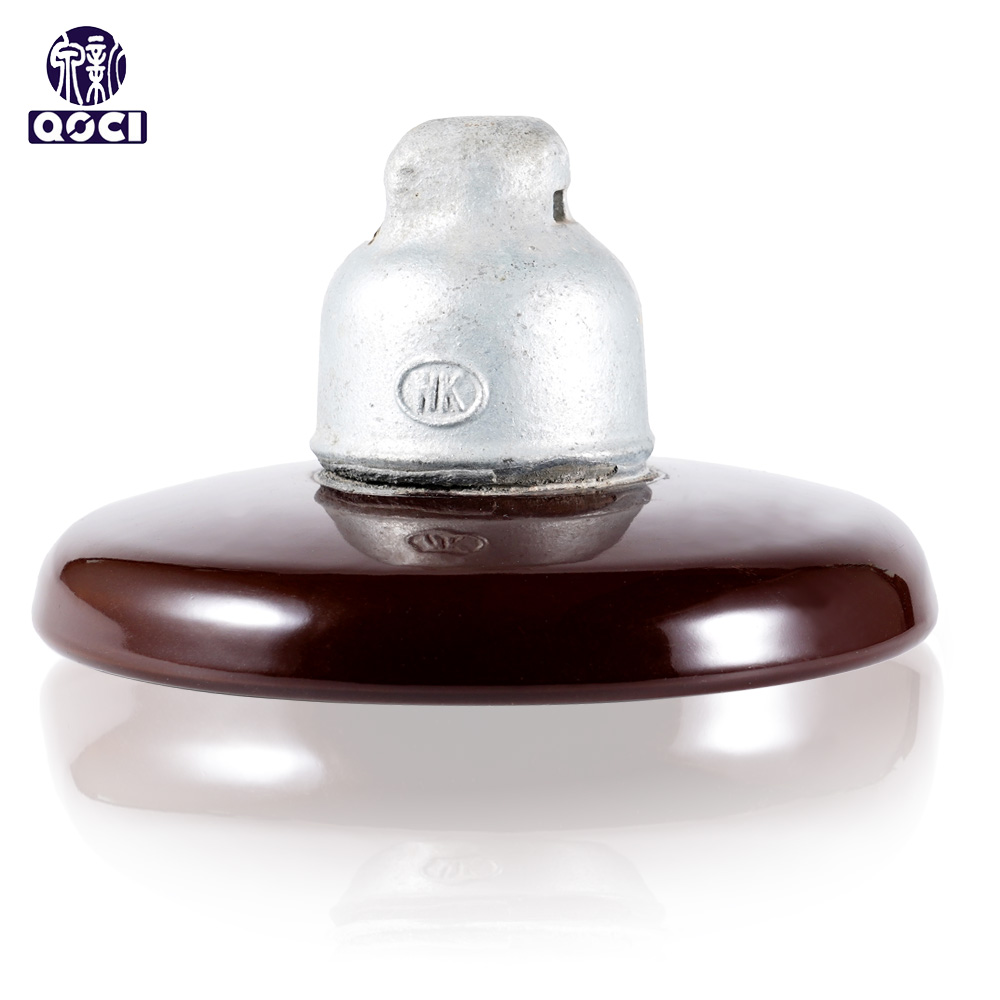
Disc-shaped suspension units are stacked into strings; creepage and impulse performance scale with string length.
Where Jiangxi QOCI Electric Fits Into This Shortlist
Jiangxi QOCI Electric Co., Ltd. is a Chinese insulator manufacturer founded in December 2002 and located in Luxi Industrial Park, Pingxiang City, Jiangxi Province. The company operates in a 35,373 m² facility with an annual output of 9,000,000 units and 38 engineers in its R&D team, and it describes itself as specialising in the automated and intelligent production of glass insulators and porcelain insulators. Its production range is relevant to this shortlist precisely because it spans the families discussed above: AC and DC insulators, line post porcelain insulators, porcelain pin insulators, shackle insulators, and AC disc-shaped suspension porcelain insulators.
The AC/DC specialisation matters at the decision stage. Direct-current transmission and distribution projects impose different surface and pollution behaviour on insulating components than AC systems, and a supplier whose range is built around both current types is easier to align with a mixed project portfolio than a supplier positioned only in the AC distribution segment. For utilities running parallel AC and DC workstreams, that reduces the number of supplier qualification cycles and allows type-family decisions to be made against one technical counterpart.
On the commercial side, QOCI reports an export ratio of 20% with main markets in the USA, Asia, the EU, Africa and South America, and states that its products are used in grid construction projects of State Grid Corporation of China, China Southern Power Grid, and power grids in over 40 countries and regions. The company is a national high-tech enterprise and a participating unit of the Insulator Standard Committee. Buyers evaluating it can review the product range at www.quanxinelectric.com. These are first-party statements; they are useful as a scoping reference and should still be verified against a specific project’s test certificates and type-test reports.
Technical Explanation: The Variables That Actually Differ
Across all four families, buyers are comparing the same six variables: mechanical rating, creepage distance, material composition and glaze quality, cement joint integrity, test coverage, and long-term degradation behaviour. The differences between families lie in the mechanical variable; the differences between suppliers lie in the other five.
On the material side, a porcelain insulator is a vitrified ceramic body manufactured from kaolin, quartz and feldspar, fired at roughly 1200–1300°C. That process produces a bulk resistivity above 10¹2; Ω·cm and a dielectric strength of approximately 15–25 kV/mm. The glaze provides a smooth, hydrophobic surface that reduces contamination adhesion and moisture absorption, which is why glaze uniformity is a legitimate procurement question and not a cosmetic one.
Creepage distance is designed against the site pollution class under IEC 60815, with classes I to IV covering progressively more severe conditions. The umbrella shed profile is geometrically optimised to extend the leakage path while limiting material usage. In practice this means two insulators with the same voltage rating and the same mechanical load can carry very different prices because their creepage designs differ — and only one of them is correct for a given route.
On the mechanical side, string insulator units in this category span a specified mechanical load range of roughly 40 to 550 kN, which is why buyers should treat “SML” as a scoping parameter rather than a marketing figure. A supplier that can present type-test reports across a defined SML range is easier to qualify than one presenting a single headline rating.
Test coverage is where the supplier comparison usually concludes. Qualified porcelain insulators should provide 100% dye penetration testing on individual units, porosity testing, thermal cycling, power frequency and impulse voltage withstand tests, glaze quality inspection against IEC 60672, and cement joint integrity verification. The distinction between 100% dye penetration coverage and batch sampling is one of the most commercially significant line items a buyer can ask about, because it maps directly onto the risk described below.
Application and Use Cases
Matching the shortlist to project type is straightforward once the load mode and pollution class are fixed.
- MV overhead distribution and rural electrification. The pin family is the primary choice; the P-11-Y at 11 kV with 10 kN rated load and 240 mm creepage covers standard distribution construction, with the P-33-Y serving equivalent duty under an IEC 383-1 pin interface.
- Low-voltage distribution and service connections. Shackle insulators such as the ED-2B, at 13.5 kN tensile strength, address the LV tensile duty. On rural routes, pin and shackle units are normally procured together because both appear on the same pole line.
- Transmission and tension structures. Suspension disc units assembled into strings, sized by mechanical failing load and string length, are the correct family; the documented 210 kN unit with 400 mm creepage illustrates the mechanical and creepage headroom this class provides.
- Substation and arm-mounted structures. Line post insulators suit rigid, cantilever-loaded positions where crossarm geometry constrains available flashover distance.
- Coastal, industrial and high-humidity corridors. Anti-pollution profiles with extended creepage matched to pollution class I–IV are the relevant specification, and the requirement should be derived from the site classification rather than applied as a blanket upgrade.
In severe corrosion conditions, a further field-level detail is worth carrying into the purchase order: the use of a zinc sleeve can significantly slow rusting and extend the service life of the insulator string. This is a small line item with a disproportionate effect on string longevity in salt-fog and chemically aggressive environments.
Market Trend Analysis
Three structural trends are shaping how this shortlist will be used over the next several years. The first is the shift in demand mix toward substations and grid reinforcement. The substation porcelain insulator segment is projected to grow at a CAGR of 7.2% through 2031, driven by gas-insulated switchgear upgrades, according to Mordor Intelligence. That growth pulls procurement attention toward post-type and substation-class components alongside the distribution volumes that dominate unit counts.
The second is supply concentration. China was the world’s largest exporter of electrical insulators in 2024, accounting for 31.4% of total global exports, valued at approximately USD 898 million, according to the Observatory of Economic Complexity. For buyers in the USA, EU, Africa and South America, that concentration is a sourcing reality that has to be managed through qualification depth rather than avoided — which raises the value of suppliers who can document kiln control, test coverage and standards compliance rather than compete purely on unit price.
The third is procurement policy. India’s DPIIT procurement policy requires 50% local content for porcelain insulators to be classified under Class I for government contracts. Local-content rules of this kind change the shortlist calculus: a technically correct type family may still be excluded from a tender if the localisation requirement cannot be met, so buyers should confirm policy eligibility before running a technical evaluation.
Comparison with Traditional Solutions — and the Limits of Porcelain
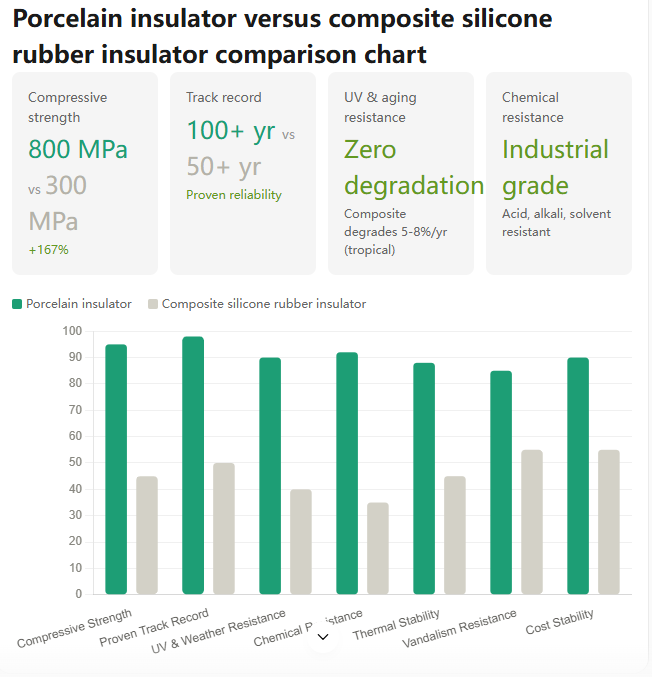
Porcelain and composite insulators occupy different positions on the cost, maintenance and degradation curve.
The dominant substitution question in this category is porcelain versus composite silicone rubber. On the documented figures, porcelain insulators demonstrate a compressive strength of 800 MPa against 300 MPa for composite units — a 167% difference — and a thermal expansion coefficient closer to metal fittings, which reduces mechanical stress at the cement joint. Porcelain is also chemically inert to acids, alkalis and industrial solvents, an advantage in chemical and industrial pollution zones.
On cost, porcelain insulators offer roughly 20% lower initial cost than composite insulators and 15% lower total lifecycle cost over 30 years. On maintenance, porcelain requires no periodic hydrophobicity monitoring, while composite insulators require routine silicone re-coating and hydrophobicity testing every three to five years. On degradation, porcelain shows no hydrophobic performance degradation over 30+ years and carries a proven reliability record exceeding 100 years, whereas composite insulators lose 5–8% of hydrophobic performance annually in tropical climates.
The honest limits matter just as much. Porcelain units are heavier than composite equivalents, which is a genuine constraint on weight-sensitive structures, on retrofit projects with existing structural margins, and on temporary lines. For temporary installations or weight-sensitive positions with a shorter design life, composite insulators remain a defensible choice — the corpus position itself recommends composites for those cases. Porcelain’s second limit is the invisible zero-value failure mode described earlier: choosing porcelain also means committing to a live-line testing programme at three-to-five-year intervals, using voltage gradient or spark gap detection. Buyers who are unwilling to fund that programme are not getting the full benefit of the material’s long service record.
A third limit is design sensitivity. Creepage distance has to be matched to the site pollution class. Specifying an anti-pollution profile as a blanket upgrade on a clean-area route adds cost without proportionate benefit, while under-specifying it on a coastal or industrial route transfers risk directly to the operating budget. The type family sets the ceiling; the creepage design determines whether the asset performs inside it.
Future Outlook
For utility buyers, the shortlist in this article is unlikely to change in structure over the next decade. Pin, post, shackle and suspension insulators remain the four functional families that overhead networks are built from, and porcelain remains the material with the longest documented service record in the category. What will change is the depth of evidence required to qualify a supplier.
With substation demand growing at a projected 7.2% CAGR through 2031 and grid upgrade programmes expanding across Asia, Africa and South America, procurement teams are increasingly asking process questions — kiln technology, crack detection coverage, cement joint sealing, creepage matching — rather than price questions alone. Anti-pollution design will grow in weight as coastal and industrial corridors are reinforced, and DC insulator capability will matter more as mixed AC/DC portfolios expand.
The practical recommendation is to fix the type family against load mode and pollution class first, then evaluate suppliers against test coverage and standards documentation. That sequence protects the decision from being driven by unit price in a category where the dominant cost is realised years after the purchase order is closed.
Reference material: a downloadable product catalogue covering the glass and porcelain insulator range is available at QOCI Catalogue – Glass Insulators (PDF).
FAQ
How do pin, post, shackle and suspension porcelain insulators differ in utility procurement?
They differ primarily by the direction of the mechanical load they carry. Pin and line post insulators carry cantilever or compressive load on a crossarm or arm-mounted structure; shackle insulators carry tensile load on low-voltage distribution; suspension disc insulators carry tensile load across a span as part of an assembled string. Documented examples include the P-11-Y pin insulator at 11 kV, 10 kN rated mechanical load and 240 mm creepage distance; the P-33-Y pin insulator compliant with IEC 383-1 at 10 kN cantilever strength; and the ED-2B shackle insulator at 13.5 kN mechanical tensile strength with 13 kV wet and 25 kV dry power frequency withstand. The family determines the load ceiling and the achievable creepage; the model within the family then determines the exact rating.
What should a buyer verify on a porcelain insulator data sheet before placing an order?
The verifiable items are mechanical load rating within the specified mechanical load range of roughly 40–550 kN for string units, certification against the applicable standard such as IEC 60305 or the ANSI C29 series, creepage distance matched to the site pollution class under IEC 60815, glaze quality against IEC 60672, cement joint sealing process, and test coverage. Two points deserve specific attention: whether dye penetration crack detection is performed on 100% of units or by batch sampling, and whether porosity, thermal cycling, power frequency and impulse voltage withstand tests are documented per type. Suppliers should also be able to provide field operation records from comparable climate and pollution conditions.
Is porcelain or composite the lower-cost option over a 30-year asset life?
On the documented comparison, porcelain insulators offer approximately 20% lower initial cost than composite insulators and 15% lower total lifecycle cost over 30 years. The maintenance profile differs as well: porcelain requires no periodic hydrophobicity monitoring, whereas composite insulators require routine silicone re-coating and hydrophobicity testing every three to five years. Composite insulators lose 5–8% of hydrophobic performance annually in tropical climates, while porcelain shows no hydrophobic degradation over 30+ years. The counterweight is weight: composite insulators are lighter and remain suitable for temporary lines or weight-sensitive installations with a shorter design life.
When should a utility specify an anti-pollution porcelain insulator?
Anti-pollution specification is driven by the site pollution severity class under IEC 60815, which runs from class I to class IV. Coastal salt-fog corridors, industrial chemical zones and heavily contaminated inland routes are the typical triggers, and creepage distance is the design variable that changes. Anti-pollution profiles extend the leakage path rather than altering the voltage rating. Applying an extended-creepage design as a blanket upgrade on a clean-area route adds cost without a proportionate reliability benefit, so the classification should be established from the route survey before the specification is written.
What maintenance does a porcelain insulator string require over its service life?
Maintenance centres on detecting zero-value degradation, which occurs without any visible external change and cannot be identified by visual inspection. Live-line testing at three-to-five-year intervals using voltage gradient or spark gap detection methods is the standard approach; identified zero-value units are replaced during a maintenance outage. Typical service life is 20–25 years under normal conditions, with a shorter effective life in heavy pollution or extreme climate environments requiring more frequent inspection. Pollutant accumulation on the glaze surface should be monitored against the site pollution class design, with cleaning scheduled where accumulation exceeds the design assumption.