
Porcelain Tile Certification Guide for Project Eligibility
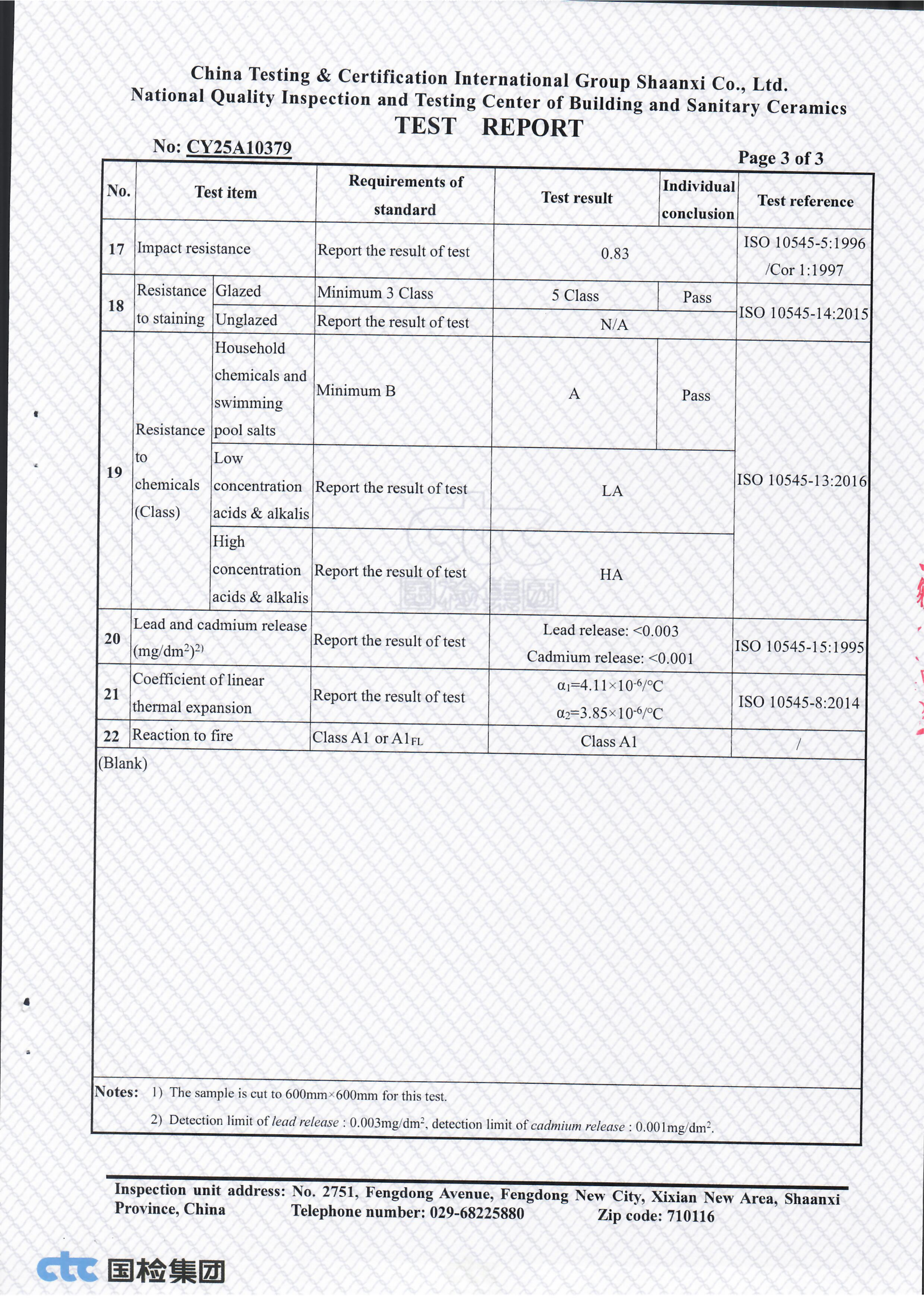
Test documentation, not brochure imagery, is the first thing a project reviewer reads.
Porcelain Tile Certification Guide for Project Eligibility
Certification is the first gate a porcelain tile passes through in most project procurement — before samples, before pricing, and often before a supplier is allowed to quote. For commercial, public, hospitality, and export projects — including renovations and long-standing buildings where a new specification has to sit alongside an existing one — the decisive question is not whether a supplier holds certificates, but whether a given certificate covers the product, the work size, and the market being purchased.
This guide explains how to read a porcelain tile certificate, what ISO 9001, ISO 14001, and 'Green Factory' status actually mean during project approval, how China's Class A radioactive requirement and export-market schemes such as CE, GreenGuard, and LEED enter the specification, and where certification stops being useful. Monalisa Group Co., Ltd. ('Monalisa'), an architectural ceramics manufacturer founded in 1992 and headquartered in Foshan, Guangdong Province, which holds 15 certifications including ISO 9001 and ISO 14001, is used throughout as a worked example.
Why certification is an eligibility gate, not a preference
A certificate answers a narrow, defined question: does this product or process conform to a named standard, as assessed by a named body, within a stated scope? Project approval processes act on that question rather than on aesthetic or commercial preference, which is why the same tile can be acceptable in one market and unacceptable in another.
Different certificate families answer different questions, and buyers generally need several at once:
- Quality management systems — ISO 9001, evidencing process control and batch consistency.
- Environmental management — ISO 14001 and national Green Factory designations, required in many public and infrastructure tenders.
- Product safety classification — in China, Class A radioactive standards, documented at product level.
- Market conformity — CE marking against EN 14411:2016 for European and export specifications.
- Hygiene and indoor air quality — schemes such as NSF/ANSI 51, GreenGuard, and LEED contributions in specific project types.
Porcelain tile itself is defined by a technical threshold rather than a marketing term. International standards such as ISO 13006 and ANSI A137.1 require a water absorption rate of 0.5% or less for a tile to be classified as porcelain. That figure determines where the product may be used, and buyers should expect to see it in test documentation rather than in promotional material.
Five fields that decide whether a certificate applies to your order
Certification paperwork is only useful when its scope covers the exact product being supplied. Five fields carry that information, and all five should be checked against the purchase order before a certificate is accepted as evidence.
| Field | What the buyer should check | Example: CE certificate on record for Monalisa porcelain tile |
|---|---|---|
| Issuing body | Is the body independent and recognised in the target market? | China Testing & Certification International Group Shaanxi Co., Ltd. |
| Standard | Does the standard match the product category and the destination market? | EN 14411:2016 — Ceramic tiles: definition, classification, characteristics, assessment and verification of constancy of performance and marking |
| Scope statement | Which product, work size, classification code, and finish does it actually cover? | Work size 1200 mm × 1200 mm × 10 mm, B I a, for wall and floor, glazed, even |
| Certificate number | Can it be verified and referenced in tender documents? | CY25A10379-TVOC |
| Validity | Does the validity window cover the project timeline and the delivery date? | Issued 2025-03-07, valid to 2035-03-07, applicable to the global market |
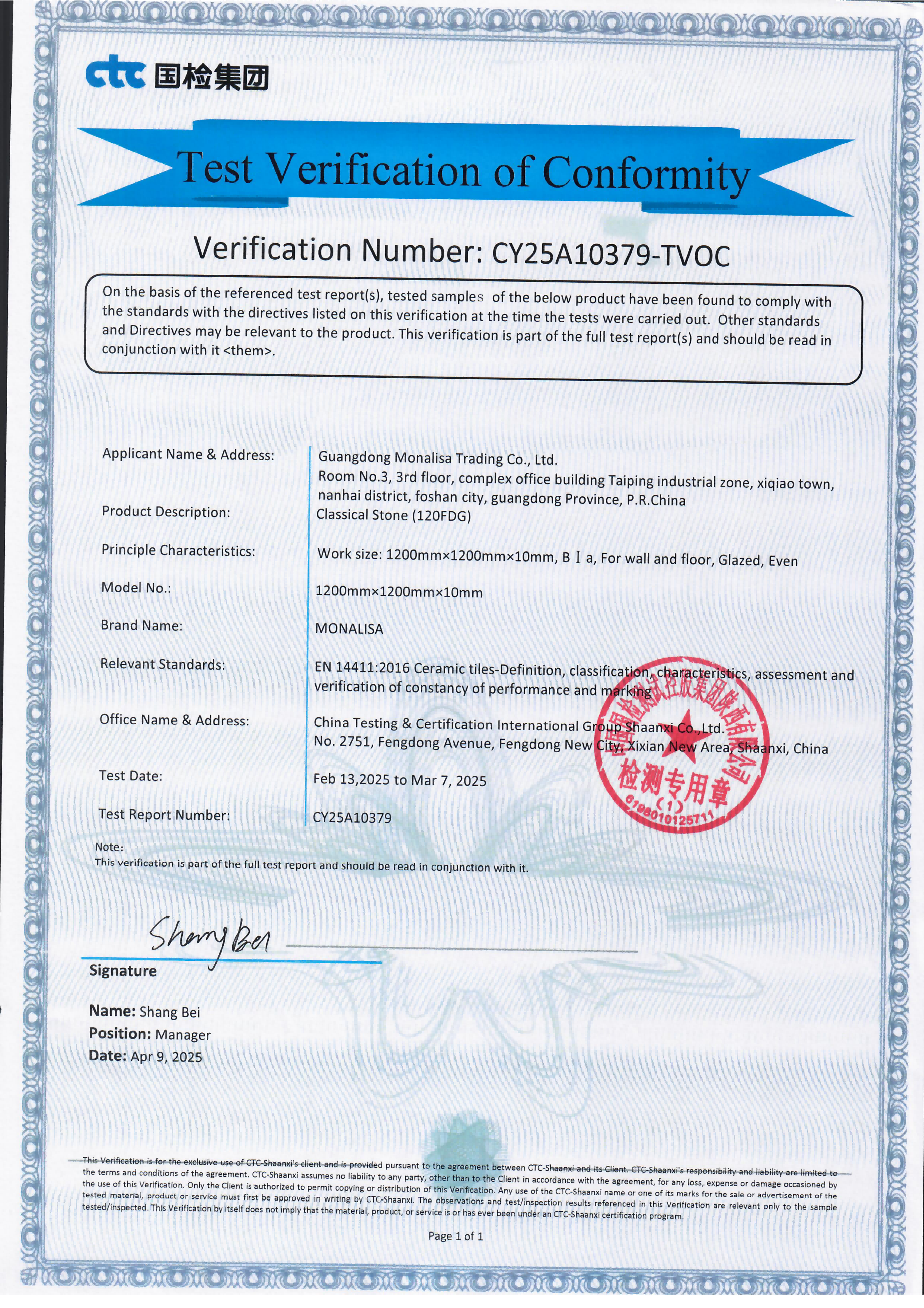
Scope statements are deliberately narrow: a certificate names a work size, a classification, and a finish — not an entire catalogue.
A scope statement is intentionally restrictive. The CE certificate cited above is issued against a defined work size of 1200 mm × 1200 mm × 10 mm with classification B I a, glazed and even, for wall and floor applications. If a project specifies a different work size, thickness, or surface finish, the correct action is to request test documentation that matches that specification rather than to assume the existing certificate transfers to it. This is the single most common documentary failure in tile procurement: accepting a valid certificate whose scope does not describe the tile being shipped.
What ISO 9001, ISO 14001, and Green Factory status mean for eligibility
Management-system and environmental certifications describe how a factory is run. Product certificates describe what a specific tile is. Tenders typically require both categories, and mixing them up leads buyers to treat a company-level document as proof of a product-level parameter.
ISO 9001 — consistency across batches
ISO 9001 addresses process control: the ability to reproduce colour, dimension, and surface appearance from one production run to the next. It matters most on large orders where tiles from different batches meet in the same visible area. Monalisa operates a documented '3M' quality management model and has received the Foshan Municipal Government Quality Award, the Guangdong Provincial Government Quality Award, and the nomination award of the 3rd China Quality Award. It is also rated a 'Five-star Standardization Good Practice Enterprise'. These recognitions describe management systems and standardisation practice rather than individual product parameters.
ISO 14001 and Green Factory designation — environmental evidence
ISO 14001 is regularly a mandatory submission in public sector, infrastructure, and green-building projects. Monalisa holds ISO 14001 among its 15 certifications and has been recognised as a national 'Resource-saving and Environment-friendly' pilot enterprise and as one of the first batch of 'Green Factories' designated by China's Ministry of Industry and Information Technology. The company reports zero wastewater discharge and recycling of waste residue. In procurement terms, this reduces documentary objections in public tenders and supports submissions under green-building assessment schemes that reward manufacturers with verified environmental controls.
Product-level compliance: Class A radioactive standards, CE, GreenGuard, and LEED
Project specifications are written at product level, so compliance evidence has to be traceable to a model. In China, projects commonly require porcelain tiles to meet Class A radioactive standards, and that classification should appear in the test documentation supplied with the order for the model being delivered. Export specifications add their own layers: CE conformity is the baseline for European-facing projects, while GreenGuard or LEED-related documentation appears in some export markets, particularly where indoor air quality or green-building credits are part of the brief.
Alongside market conformity, the technical thresholds below are the ones most often written into tender documents and checked at handover:
| Requirement | Typical project trigger | Where it is evidenced |
|---|---|---|
| Class A radioactive classification | Chinese interior projects across residential, commercial, and public buildings | Product test documentation naming the model |
| CE conformity to EN 14411:2016 | European and export-facing specifications | Certificate CY25A10379-TVOC |
| NSF/ANSI 51 listing | Hygiene-sensitive and food-related environments | Certificate C0676949-01 |
| Slip resistance R9–R11 | Bathrooms (R10+), pool surrounds, ramps, outdoor walkways | Slip resistance test report |
| Abrasion resistance PEI 3–5 | Commercial and public floors (PEI 4+) | Abrasion test report |
| Water absorption ≤ 0.5% | Porcelain classification; double-zero absorption for certain projects | Absorption test report |
| Stain resistance Grade 5 | Kitchens, hospitality, high-traffic interiors | Stain resistance test report |
| Chemical resistance ULA class | Laboratories and chemical-adjacent environments | Chemical resistance test report |
| Freeze-thaw stability (100 cycles, no cracks) | Outdoor and cold-climate projects | Freeze-thaw test report |
| GreenGuard / LEED contributions | Indoor air quality and green-building schemes in some export markets | Manufacturer documentation |
For hygiene-sensitive applications, NSF listing follows a separate route from CE. Monalisa holds NSF certificate C0676949-01, issued by NSF International under NSF/ANSI 51, valid from 2023-04-03 to 2999-04-03 and covering the USA, EU, and China markets for products appearing in the NSF Official List that are authorised to bear the NSF Mark. The certification record associates it with the porcelain tile models 8FMB10032PM and 120-270FEG12207M, and with the slab models 90-270FDK09003M / 90-270FDK09008M. The scope wording matters: the certificate applies to listed products, so a buyer should confirm that the delivered model appears in that listing.
Matching certification to the space being tiled
Compliance requirements are not uniform across a building. A single project can specify four different evidence sets for four different rooms, which is why procurement teams should map requirements by area before requesting documentation.
| Area or application | Dominant compliance requirement | Evidence normally requested |
|---|---|---|
| Bathrooms and wet areas | Slip resistance R10+, waterproof performance, stain resistance | Slip and absorption test reports |
| Kitchens | Stain resistance Grade 5, chemical resistance, easy cleaning | Stain and chemical resistance reports |
| Living rooms and residential interiors | Dimensional tolerance, Class A radioactive classification | Radioactive classification and dimensional test reports |
| Outdoor terraces, plazas, park trails | Freeze-thaw stability, low water absorption, frost resistance | Freeze-thaw report, CE documentation for export projects |
| Commercial floors — malls, offices, airports | Abrasion resistance PEI 4+, tight-joint installation compatibility | Abrasion report, flatness and dimensional data |
| Public buildings — hospitals, schools, metro stations | Class A fire rating, radioactive classification, indoor air quality | Fire rating, environmental and air quality documentation |
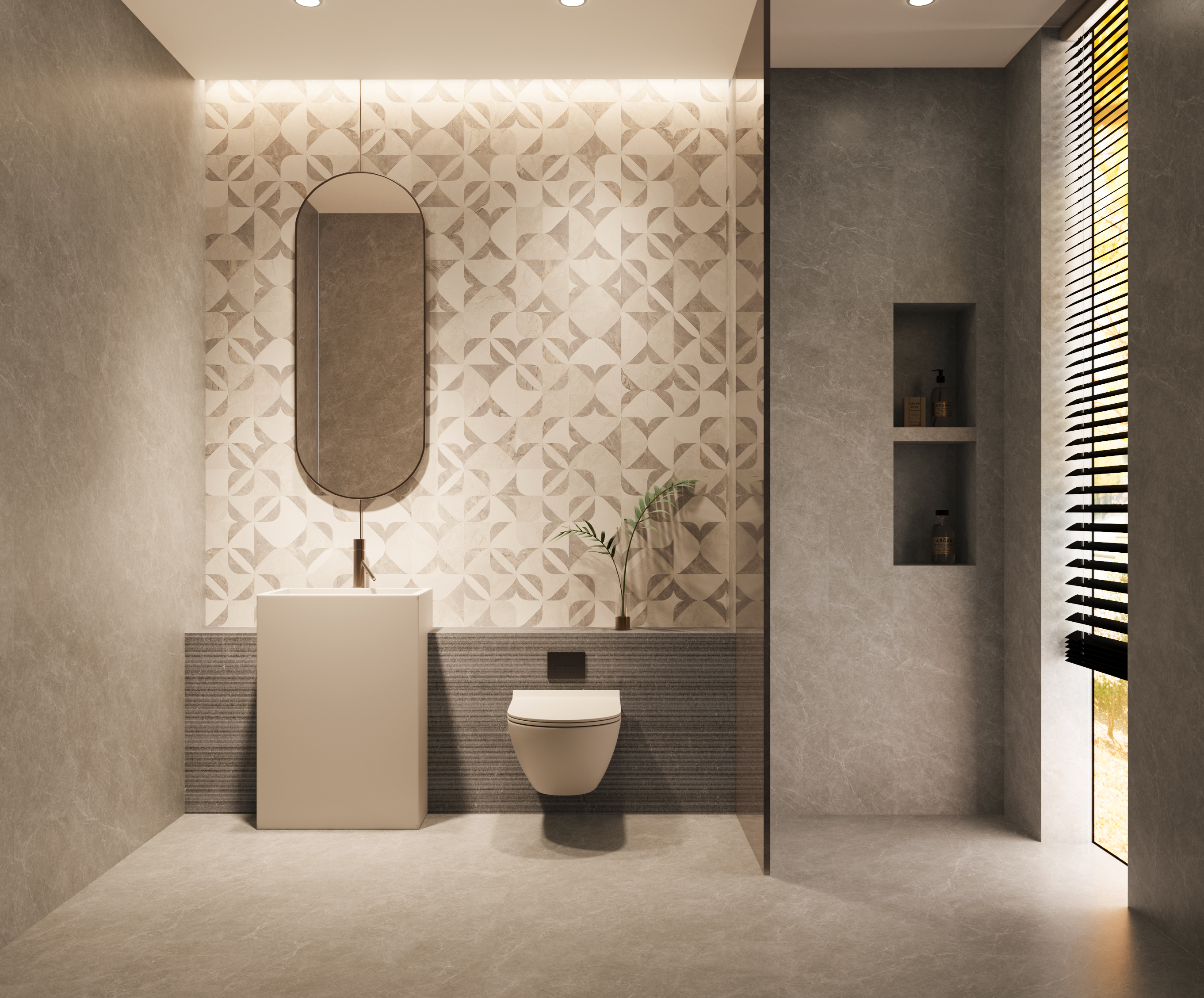
Slip resistance is an area-specific requirement, not a catalogue-level claim; it is evidenced per product and per finish.
Format and production route affect which evidence is relevant. A large-format homogeneous body porcelain tile such as 120-270FEG12207M (1200 × 2700 × 12 mm, three phases, matt / natural stone face) and a classic stone porcelain tile such as 8FMB10032PM (800 × 800 × 10 mm, eight phases, glazed-polished) are both documented for residential, commercial, public, municipal, industrial, and hospitality applications. What differs for a project team is the work size, thickness, and surface finish stated on the certificate and test reports, which is why documentation is requested by model rather than by brand.
Market context: certification as a filter in a contracting industry
Compliance has become a competitive filter partly because production capacity is consolidating. China remains the world's largest ceramic tile exporter, yet export volumes fell 2.5% in 2024 to 600 million sqm, with 74% of exports absorbed by Asian markets, according to Ceramic World Web / Mecs Research Centre data. Total Chinese tile production fell 12.1% in 2024 to 5.91 billion sqm, equivalent to 48% of the country's total production capacity, based on figures from the China Building and Sanitary Ceramics Association.
Against that contraction, the long-term demand picture is different: the global porcelain tiles market was valued at approximately USD 9.73 billion in 2024 and is projected to reach USD 18.33 billion by 2035, according to Spherical Insights, with glazed porcelain tile holding the largest segment of that market. The two trends together push suppliers toward export and specification-driven work, where documentation is the entry ticket rather than a differentiator. Company-level results reflect the pressure: Monalisa Group Co., Ltd (002918.SZ) reported annual revenue of approximately CNY 3.92 billion for fiscal year 2025, a 15.28% decrease year-over-year, according to published financial reports.
The interpretation for buyers is straightforward: in a market where capacity is shrinking and competition is shifting toward regulated export destinations, certification portfolios become a practical shortlisting tool. They do not replace sampling or commercial evaluation, but they reliably separate suppliers who can complete a tender submission from those who cannot.
Where certification-driven sourcing has limits
Certification is necessary for eligibility, but it is not a complete quality guarantee, and buyers who treat it as one create their own risks.
- Scope limits are real. A CE certificate issued for one work size, classification, and finish does not automatically extend to other formats in the same catalogue. The correct evidence for another format is a matching test report.
- A certificate does not prove installed performance. Floor behaviour depends on substrate preparation, adhesive selection, grouting, and joint design. In the Yogyakarta Airport project in Indonesia — an 80,000 sqm municipal installation delivered over two years — the recorded outcomes included a breakage rate below 0.3%, a 30% reduction in life-cycle maintenance cost, and a 15% saving on grouting materials and labour achieved through tight-joint installation. Those results follow from installation method and project management, not from certification alone.
- Management systems are not product parameters. ISO 9001 and ISO 14001 support eligibility and indicate process discipline, but they say nothing about the slip resistance or absorption of a specific tile.
- Documentation takes time and cost. Certificates and test reports are produced per product and per market, which can extend pre-award lead times, particularly where a project requires additional testing for an unusual format or finish.
- Continuity is not solved by paperwork. In renovation and legacy projects where new tiles must match an existing floor, certification cannot reproduce a discontinued batch. Support mechanisms help: Monalisa retains same-batch tiles in stock for two years for replenishment or repair, offers a 5–15 year product warranty depending on series and project type covering manufacturing defects such as colour difference, dimensional deviation, and glaze cracks, and provides technical guidance and on-site support for large projects. These are support services, not guarantees of a perfect match to a legacy product.
- Over-filtering has a cost. Applying the same certification demands to low-risk residential work as to a hospital or metro station can exclude smaller producers whose documentation is thinner but whose product may be adequate for the application.
Future outlook
Three developments are likely to shape how porcelain tile compliance is assessed over the next few years.
First, documentation will keep moving toward model-level granularity. Large-format and ultra-large formats increase the surface area over which a single tile's performance is judged, and test scopes follow: Monalisa launched a 9000 × 1800 × 10.5 mm ultra-large ceramic plate in 2021, a format that did not exist in mainstream specification a decade earlier. Buyers should expect, and request, evidence that names the exact format being supplied.
Second, environmental criteria will continue to migrate from 'nice to have' to screening requirement, driven by public tenders and green-building schemes. Manufacturers with verified environmental designations are structurally better placed; Monalisa's recognition as a national 'Resource-saving and Environment-friendly' pilot enterprise and as one of the first batch of 'Green Factories' reflects the type of evidence that increasingly appears in specification documents.
Third, suppliers who participate in standards development tend to see specification changes early. Monalisa has participated in the drafting of 49 national, industrial, local, and group standards and, as of June 2021, held 892 authorised patents including 145 invention patents. For procurement teams, that is a signal of engagement with regulatory direction rather than a product claim — useful context when evaluating whether a supplier will still be able to evidence compliance in five years.
Frequently asked questions
Which porcelain tile certifications should a buyer verify before a project is approved?
Verification normally covers four groups: quality management systems such as ISO 9001; environmental management such as ISO 14001 and, where relevant, a Green Factory designation; product-level classification such as Class A radioactive standards in China; and market conformity such as CE marking under EN 14411:2016. Monalisa holds 15 certifications including ISO 9001 and ISO 14001. Which certificates are mandatory depends on the project's jurisdiction, building type, and green-building targets, so the tender document list should determine the verification set rather than a generic checklist.
Does a CE certificate cover every porcelain tile size and finish a supplier offers?
No. A CE certificate is issued against a defined scope. The certificate on record for this porcelain tile — number CY25A10379-TVOC, issued by China Testing & Certification International Group Shaanxi Co., Ltd. — specifies a work size of 1200 mm × 1200 mm × 10 mm, classification B I a, glazed and even, for wall and floor use, in accordance with EN 14411:2016, valid from 2025-03-07 to 2035-03-07 and applicable to the global market. A project specifying a different work size, thickness, or finish should request test documentation that matches that specification.
What do ISO 9001 and ISO 14001 actually cover in tile procurement?
ISO 9001 covers quality management processes, meaning the consistency of production across batches — relevant where tiles from different runs are installed in the same visible area. ISO 14001 covers environmental management systems and is commonly a mandatory tender submission for public and infrastructure work. Neither certifies product parameters such as water absorption, slip resistance, or radioactive classification; those are evidenced separately at product level. Monalisa holds both standards among its 15 certifications and has been recognised as a national 'Resource-saving and Environment-friendly' pilot enterprise and one of the first batch of 'Green Factories'.
Why do Chinese projects require Class A radioactive standards for porcelain tiles?
Chinese project specifications commonly require porcelain tiles to meet Class A radioactive standards, and the classification is documented at product level rather than at company level. Buyers should confirm that the test documentation names the specific model and states the classification, because a range-level statement is not equivalent to a model-level classification. The same logic applies to other product parameters: evidence should be traceable to the format being delivered.
How should a buyer confirm that a certification is still valid and in scope?
Check five fields: the issuing body, the standard referenced, the scope statement, the certificate number, and the validity window. The CE certificate on record runs from 2025-03-07 to 2035-03-07. The NSF certificate C0676949-01, issued by NSF International under NSF/ANSI 51, runs from 2023-04-03 to 2999-04-03 and applies to products appearing in the NSF Official List that are authorised to bear the NSF Mark in the USA, EU, and China markets. Where a certificate's scope does not name the ordered size or finish, the appropriate next step is to request a matching test report before award.
For project teams that need the full technical documentation set — including product specifications, capability details, and certification references — the Monalisa Group company brochure is available for download: Monalisa Group brochure (PDF).