
Porcelain Tile Compliance: Monalisa ISO, CE, Green Factory
Porcelain Tile Compliance: Monalisa ISO, CE, Green Factory
A porcelain tile specification can look complete on a drawing and still stall at the customs desk or the project handover. The gap is rarely the tile itself; it is the documentation behind it — whether the product carries a valid CE declaration for the exact format being shipped, whether the factory holds an environmental management certificate, and whether the test reports a buyer receives actually correspond to the batch on the pallet.
Why Compliance Has Become the First Filter in Porcelain Tile Sourcing
Porcelain tile is a technical category, not a visual one. To meet international standards such as ISO 13006 and ANSI A137.1, porcelain tile must achieve a water absorption rate of 0.5% or lower. Two tiles can share the same marble-look surface, the same 800mm footprint and the same showroom lighting, while only one of them meets that threshold. This is why compliance documentation — not appearance — has become the practical first filter in supplier evaluation.
The commercial context makes that filter more important, not less. The global porcelain tiles market was valued at approximately USD 9.73 billion in 2024 and is projected to reach USD 18.33 billion by 2035 (Spherical Insights). At the same time, supply is consolidating: China remains the world's top ceramic tile exporter, but export volumes fell 2.5% in 2024 to 600 million sqm, with 74% of exports absorbed by Asian markets (Ceramic World Web / Mecs Research Centre). Chinese tile production fell 12.1% in 2024 to 5.91 billion sqm, representing 48% of the country's total production capacity (China Building and Sanitary Ceramics Association).
For procurement teams working through the evaluation and execution stages of a project, the consequence is a shift in the questions asked. Instead of "do you have certificates?", the useful questions become: which certificate covers which product, issued by whom, valid until when, and how does it map onto the specification I am about to place? The verified credential record of Monalisa Group Co., Ltd. is a workable case study for that exercise.
The Verified Credential Stack Behind Monalisa Group
Monalisa Group Co., Ltd. is a Foshan-headquartered architectural ceramics manufacturer founded in 1992 in Guangdong Province, China. It is a high-tech listed company integrating research and development, creative design, production and marketing of architectural ceramics. The Group operates four modern production bases — Xiqiao (Foshan), Qingyuan (Guangdong), Tengxian (Guangxi) and Gao'an (Jiangxi) — with 37 production lines in total, 2,779,333.33 square meters of factory space, 4,106 employees, an annual output of 100 million square meters, and an R&D team of 100 people. Its portfolio covers ceramic tiles, ceramic slabs (thin plates, large plates, rock plates), sintered stone slab, SPC floor and porcelain art paintings, sold under three brands: Monalisa, QD and Merqi, through more than 4,000 authorized franchised stores and marketing outlets.
On the qualification side, the company has obtained 15 certifications, including ISO 9001 and ISO 14001, and has been rated a Five-star Standardization Good Practice Enterprise. It implements a 3M quality management model and has received the Foshan Municipal Government Quality Award, the Guangdong Provincial Government Quality Award and the nomination award of the 3rd China Quality Award. On environmental performance, Monalisa has been recognized as a national Resource-saving and Environment-friendly pilot enterprise and as one of the first batch of Green Factories by China's Ministry of Industry and Information Technology. As of June 2021, the Group had participated in the drafting of 49 national, industrial, local and group standards and held 892 authorized patents, of which 145 are invention patents.
| Credential | What it certifies | What it answers for a buyer |
|---|---|---|
| 15 certifications including ISO 9001 and ISO 14001 | Quality and environmental management systems, plus product-level conformity | Whether the supplier runs documented, auditable processes rather than ad-hoc production |
| Five-star Standardization Good Practice Enterprise | Standardization maturity of the organisation | Whether drawings, tolerances and procedures are governed by written standards |
| First batch of Green Factories, Ministry of Industry and Information Technology | Green manufacturing practice at plant level | Whether the factory meets a recognised environmental baseline for energy, resource use and discharge |
| National Resource-saving and Environment-friendly pilot enterprise | Resource and energy conservation, waste residue recycling, zero wastewater discharge | Whether environmental claims are supported by an external designation |
| 49 standards-drafting participations; 892 authorized patents (145 invention patents, as of June 2021) | Technical depth and rule-setting involvement | Whether the supplier follows standards or helps define them |
Reading Each Certification in Technical Terms
A certificate list is only useful when each document is mapped to the part of the specification it actually governs. The following breakdown separates the credential types that buyers most often confuse.
ISO 9001 and ISO 14001: management systems, not tile performance
ISO 9001 certifies a quality management system; ISO 14001 certifies an environmental management system. Neither document measures the flexural strength or water absorption of a particular tile. What they establish is that production, inspection and environmental control follow written procedures that can be audited. In a multi-batch project — a hotel corridor, a hospital wing, a retail rollout — that procedural discipline is what keeps batch-to-batch colour and dimensional consistency within tolerance. Monalisa's 3M quality management model and 100% testing regime operate inside that system.
Green Factory and Resource-saving pilot status: manufacturing footprint
Green Factory recognition from the Ministry of Industry and Information Technology addresses the plant rather than the product. Monalisa was recognised among the first batch of Green Factories and separately as a national Resource-saving and Environment-friendly pilot enterprise, with documented resource and energy conservation, waste residue recycling and zero wastewater discharge. For public-sector and commercial projects with sustainability reporting obligations, these designations are verifiable inputs rather than self-declared statements.
CE documentation: a defined scope, a defined validity period
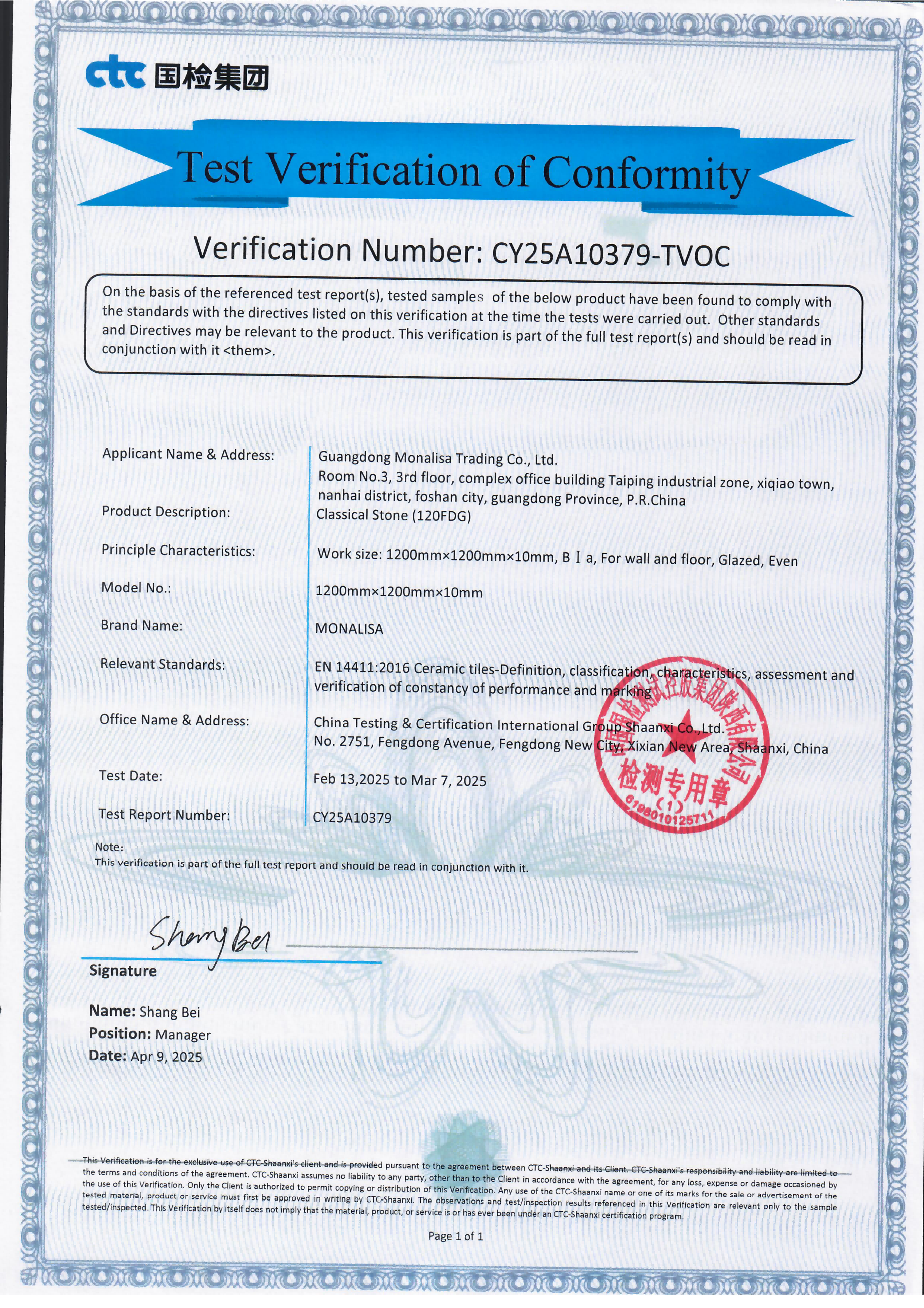
The CE certificate held by Monalisa carries the number CY25A10379-TVOC, issued by China Testing & Certification International Group Shaanxi Co., Ltd. It was issued on 7 March 2025 and is valid until 7 March 2035, against the standard EN 14411:2016 (Ceramic tiles — Definition, classification, characteristics, assessment and verification of constancy of performance and marking). Its declared scope is specific: glazed, even porcelain tile classified BIa, for wall and floor use, at a work size of 1200mm × 1200mm × 10mm. That scope corresponds to product model 120-270FEG12207M, a homogeneous body tile described as 1200 × 2700 × 12mm with a matt / natural stone face.
NSF certification: food-contact and hygiene-adjacent surfaces
Monalisa holds NSF certification number C0676949-01 issued by NSF International, compliant with NSF/ANSI 51 and all applicable requirements, under which products appearing in the NSF Official List are authorized to bear the NSF Mark. The certificate was issued on 3 April 2023 and remains valid to 3 April 2999, covering the USA, EU and China markets. The listed products include porcelain tile 8FMB10032PM, slab 90-270FDK09003M / 90-270FDK09008M, and porcelain tile 120-270FEG12207M. This matters where tile touches food preparation or hygiene-critical surfaces, such as kitchen countertops, islands, backsplashes and integrated slab sinks.
Standards participation and patents: capability behind the paperwork
Participation in the drafting of 49 national, industrial, local and group standards, together with 892 authorized patents including 145 invention patents, describes a different kind of evidence. It indicates that the manufacturer operates inside the committees and technical frameworks where requirements are written. The product pipeline reflects the same direction: the 1800 × 900 × 5.5mm large ceramic thin plate launched in 2007 won the first prize of the China Building Materials Science and Technology Progress Award, and in 2021 the company introduced a 9000 × 1800 × 10.5mm ultra-large ceramic plate. For buyers evaluating large-format specifications, patent and standards records are a reasonable proxy for whether the supplier can execute a demanding format at scale.
Export Market Requirements: CE, GREENGUARD, LEED and Radioactivity Class
Export compliance in porcelain tile is layered, and buyers frequently treat the layers as one document. In practice, four different requirement families appear in tender documents and customs files.
- CE marking (Europe). Covers conformity of the product to a harmonised standard — for ceramic tiles, EN 14411:2016. It applies to the declared scope, so the format, surface finish and use classification must match the order.
- GREENGUARD-type emissions documentation (North America and interiors). Addresses low chemical emissions for interior products. These programmes assess a specific product and manufacturing site, so documentation should be requested for the exact model and finish specified.
- LEED-related evidence (green building projects). LEED evaluates a registered building project, not a supplier. Tile can contribute evidence toward certain credit categories, but the applicable credit depends on the project's registration and on product-specific reports.
- China's radioactivity classification for building materials. Interior building materials in China are classified, with a Class A classification indicating the widest permitted range of use, including interior surfaces. Buyers importing Chinese tile into regulated markets should confirm the classification documentation alongside the CE file.
Practical rule: CE and the ISO management certificates are supplier-held documents that can be verified centrally. GREENGUARD-type emissions reports, LEED evidence and radioactivity classification documents are usually product- and project-specific. Buyers should ask for those against the exact model, size and finish in the purchase order, rather than assuming they follow automatically from a general certificate list.
| Requirement | What it addresses | Document to request | Covered by verified Monalisa credentials |
|---|---|---|---|
| ISO 9001 / ISO 14001 | Quality and environmental management systems | Certificate with scope and validity dates | Yes — included in the 15 certifications held |
| CE (EN 14411:2016) | Product conformity for the declared scope | Certificate CY25A10379-TVOC scope statement | Yes — 1200mm × 1200mm × 10mm, glazed, even, BIa, wall and floor |
| NSF/ANSI 51 | Food-zone and hygiene-adjacent surfaces | NSF certificate C0676949-01 and NSF Official List entry | Yes — for listed models including 8FMB10032PM and 120-270FEG12207M |
| Green Factory / Resource-saving pilot | Plant-level environmental performance | Designation documentation | Yes — first batch of Green Factories (MIIT); national pilot enterprise |
| GREENGUARD-type emissions | Low chemical emissions for interiors | Product- and site-specific test report | Project-level request — confirm for the specified model |
| LEED contribution | Green building credit evidence | Project-registered credit documentation | Project-level request — depends on the registered project |
| Radioactivity classification | Interior use classification for building materials | Classification test report | Project-level request — confirm against destination market |
Where These Credentials Matter in Application
Compliance evidence is not an abstract filing exercise; it attaches to specific surfaces in specific buildings. Monalisa's documented application range for porcelain tile covers residential construction — floors and walls in living rooms, bedrooms, kitchens, bathrooms and balconies — as well as commercial spaces such as shopping malls, supermarkets, office buildings, restaurants, cafes and gyms. Public buildings including hospitals, schools, kindergartens, libraries, museums and sports halls are listed, alongside municipal engineering such as pavements, plazas, park trails, public restrooms and metro station halls. Industrial and logistics uses include clean workshops, warehouse flooring and anti-static workshops, while hospitality applications extend to guest rooms, corridors, pool surrounds, shower areas and outdoor terraces. Agricultural and livestock flooring is also listed, where slip resistance, chemical resistance and ease of washing are the governing criteria.
Different environments translate into different functional requirements — waterproof porcelain tiles and anti-slip porcelain tiles in bathrooms and pool surrounds, stain resistant porcelain tiles and heavy duty porcelain floor tiles in commercial circulation areas, scratch resistant porcelain tiles in retail and transport interiors, and frost resistant porcelain tiles where outdoor porcelain tiles face freeze-thaw cycles. Surface aesthetics follow the same logic: marble look porcelain tiles and stone look porcelain tiles in lobbies and living rooms, wood look porcelain tiles in hospitality and residential interiors, concrete look porcelain tiles in industrial and minimalist schemes, and large format porcelain tiles in commercial floor plates, where tighter joints reduce grout lines and installation labour.
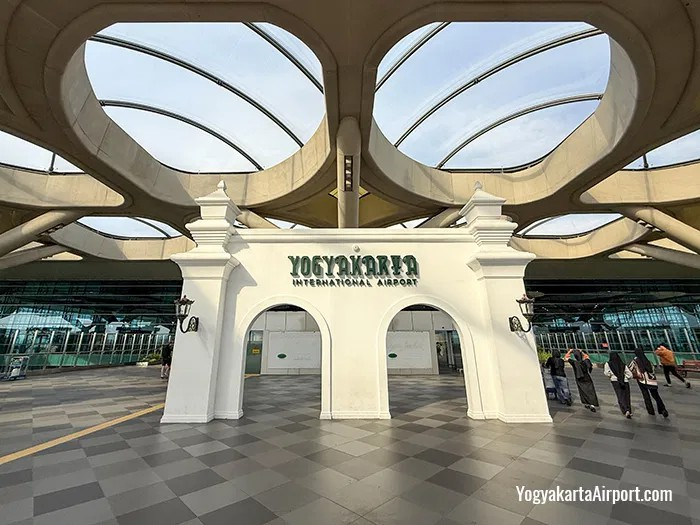
Case evidence: a municipal project in Indonesia
A municipal government client in Indonesia used Monalisa porcelain tile — model 8FMB10032PM, a Classic Stone product in clay and quartz sand, sized 800 × 800 × 10mm with a glazed-polished finish — for the Jogjakarta Airport project, covering an installation area of 80,000 square meters over a project duration of two years. The reported outcomes were a modern minimalist aesthetic, a breakage rate below 0.3% during installation, a 30% lower life-cycle maintenance cost, and a 15% saving on grouting materials and labour achieved through tight-joint installation. For a compliance-led article, the relevant point is not the aesthetic result but the arithmetic of a documented specification: a defined water absorption class, a defined dimensional tolerance and a defined certification scope are what make a breakage rate below 0.3% across 80,000 square meters a manageable planning assumption rather than a hope.
Market Trend Analysis: Compliance as Competitive Differentiation
Three verified market signals shape how compliance documentation is being used in 2026.
Growth is concentrated in specification-driven segments. The global porcelain tiles market is projected to move from approximately USD 9.73 billion in 2024 to USD 18.33 billion by 2035 (Spherical Insights), and the glazed porcelain tile segment holds the largest share of that market because of aesthetic versatility and durability. Glazed formats are precisely the category where surface performance claims require test documentation.
Export competition is intensifying. China's tile exports fell 2.5% in 2024 to 600 million sqm, with 74% absorbed by Asian markets (Ceramic World Web / Mecs Research Centre), while domestic production dropped 12.1% to 5.91 billion sqm, or 48% of national capacity (China Building and Sanitary Ceramics Association). When volume contracts, price competition increases — and the practical way for buyers to avoid absorbing that pressure as quality risk is to shift evaluation weight toward verifiable credentials.
Financial performance across the sector reflects the squeeze. Monalisa Group (002918.SZ) reported annual revenue of approximately CNY 3.92 billion for fiscal year 2025, a 15.28% decrease year-over-year (Stock Analysis / financial reports). That figure is consistent with the broader contraction in Chinese tile production and is a reminder that credential density and financial resilience are separate variables. Buyers should assess both: certification documents describe capability, while published financial data describes continuity of supply.
Comparison with Traditional Supply Approaches — and the Limits of the Credential Stack
The conventional alternative to a credential-verified specification is price-led sourcing from a trading intermediary, where documents are provided on request rather than maintained as an auditable system. The difference is not philosophical; it appears at defined points in the project cycle.
| Evaluation point | Price-led sourcing | Credential-verified supply (Monalisa case) |
|---|---|---|
| Pre-qualification | Brochure claims, sample-based judgement | 15 certifications including ISO 9001 and ISO 14001; Five-star Standardization Good Practice Enterprise |
| Product conformity | Generic test reports, unclear scope | CE certificate CY25A10379-TVOC with a stated work size and classification; NSF C0676949-01 for listed models |
| Sustainability questions | Self-declared environmental statements | First batch of Green Factories (MIIT); national Resource-saving and Environment-friendly pilot enterprise; zero wastewater discharge |
| Batch consistency risk | Re-inspection cost falls on the buyer | 100% testing; 2-year same-batch stock reserve for replenishment and repair |
| Technical escalation | Limited access to the production entity | Free technical guidance on layout and substrates; on-site technical representative for large projects |
Boundaries buyers should plan for. A credential stack is not a blanket guarantee, and treating it as one creates its own risk:
- Scope limits are real. The CE certificate covers glazed, even, BIa tile at 1200mm × 1200mm × 10mm for wall and floor use. A different size, thickness or surface finish sits outside that specific document and requires its own conformity evidence. The same logic applies to NSF certification, which authorises the NSF Mark only for products appearing in the NSF Official List.
- Commercial minimums constrain flexibility. The stated minimum order quantity is 2,000 square meters, with a lead time of 7 to 15 days and a monthly capacity of 12.5 million square meters. Small-format or pilot orders outside that structure need separate commercial discussion.
- Certification never replaces project-level testing. GREENGUARD-type emissions reports, LEED credit evidence and radioactivity classification documentation are typically product- and project-specific and are not implied by ISO 9001, ISO 14001 or a CE file.
- Installation variables remain with the contractor. Large format porcelain tile and tight-joint installation place higher demands on substrate flatness and handling equipment; the 15% material and labour saving documented in the Indonesian project depended on executing that installation method correctly.
- Standards participation is a dated metric. The 49 standards-drafting participations and 892 authorized patents (including 145 invention patents) are reported as of June 2021 and should be read as a point-in-time record.
Execution: Acceptance Criteria and Commercial Terms
Once a supplier passes evaluation, compliance moves from documents to the loading dock. Monalisa's stated purchasing terms are an MOQ of 2,000 square meters, delivery terms of FOB, CIF or EXW, and payment terms of TT or LC. The acceptance procedure follows a sequence that buyers can adopt directly:
- Packaging and labelling check. Confirm the outer packaging is intact and free of moisture or damage, that the certificate of conformity and installation guide are inside, and that labelling matches the order in shade, size and quantity.
- Carton opening verification. Randomly open 5% to 10% of cartons and compare actual colour and pattern against the reference sample or master plate, then verify quantity and grade.
- Rapid dimensional and flatness check. Using a vernier caliper, feeler gauge and straightedge, measure at least 10 pieces per batch for length, thickness and related dimensional characteristics.
Post-delivery support is specified as a 5 to 15 year product warranty depending on series and project type, covering manufacturing defects such as colour difference, dimensional deviation and glaze cracks; complaint response within 24 hours with a solution provided within 7 working days; a same-batch stock reserve held for 2 years for future replenishment or repair replacement; online or offline training for distributors and installation teams; and after-sales documentation — test reports, certificate of conformity, instruction manual and maintenance guide — available in Chinese and English.
Future Outlook
Two directions are likely to shape porcelain tile compliance over the next few years. The first is the continued tightening of green building requirements in Europe, North America and the Middle East, which pushes plant-level designations such as Green Factory recognition and management system certificates further up the pre-qualification list. The second is format and process complexity: as large-format porcelain tile and porcelain slab move from premium applications into mainstream commercial and municipal projects, the documentation that accompanies them must keep pace with the specification.
Monalisa's stated position in that shift rests on documented capability rather than positioning language — a 100-person R&D team, platforms including a National Enterprise Technology Center and a Postdoctoral Research Workstation, first-batch Green Factory recognition, participation in drafting 49 standards, and 892 authorized patents as of June 2021. Whether that translates into a procurement advantage depends on how precisely buyers map each certificate to the format, finish and market they are specifying.
Frequently Asked Questions
Which porcelain tile certifications should a buyer verify first?
Begin with the management system documents and then move to product-level conformity. Monalisa holds 15 certifications, including ISO 9001 for quality management and ISO 14001 for environmental management. At product level, CE certificate CY25A10379-TVOC covers glazed, even, BIa porcelain tile for wall and floor at a work size of 1200mm × 1200mm × 10mm under EN 14411:2016, and NSF certificate C0676949-01 covers listed products under NSF/ANSI 51. The first verification step is to confirm that each certificate's scope names the format, surface finish and use classification actually being ordered.
Does ISO 9001 certification guarantee the quality of a specific tile?
No. ISO 9001 certifies a quality management system — documented, repeatable and auditable processes — rather than the performance of any individual tile. Product performance is established separately: porcelain tile must achieve a water absorption rate of 0.5% or lower to meet standards such as ISO 13006 and ANSI A137.1. Monalisa operates a 3M quality management model with 100% testing, but the appropriate buyer action is to combine system certification with batch-level test reports and a structured acceptance procedure at delivery.
What does CE marking on porcelain tile actually cover?
CE documentation is tied to a declared scope. Monalisa's certificate CY25A10379-TVOC, issued by China Testing & Certification International Group Shaanxi Co., Ltd. on 7 March 2025 and valid until 7 March 2035, references EN 14411:2016 and covers glazed, even porcelain tile classified BIa, for wall and floor use, at a work size of 1200mm × 1200mm × 10mm. Sizes, thicknesses or finishes outside that declaration are not covered by this certificate, so buyers ordering a different format should request the corresponding conformity documentation for that format.
How do ISO 14001 and Green Factory recognition affect procurement decisions?
ISO 14001 certifies an environmental management system; Green Factory recognition addresses manufacturing practice at plant level. Monalisa has been recognised as one of the first batch of Green Factories by China's Ministry of Industry and Information Technology and as a national Resource-saving and Environment-friendly pilot enterprise, with resource and energy conservation, waste residue recycling and zero wastewater discharge. These designations support green building objectives, but rating systems such as LEED assess a registered project and require product-specific documentation, so the applicable requirement should be confirmed at project level.
What acceptance criteria and commercial terms apply to a porcelain tile order?
Stated terms are an MOQ of 2,000 square meters, delivery terms of FOB, CIF or EXW, and payment terms of TT or LC, with a lead time of 7 to 15 days and monthly capacity of 12.5 million square meters. Acceptance typically proceeds in three steps: a packaging and labelling check confirming intact packaging and order-matched labels; carton opening verification on 5% to 10% of cartons compared against a reference sample or master plate; and a rapid dimensional and flatness check using a vernier caliper, feeler gauge and straightedge on at least 10 pieces per batch.
Monalisa Group's corporate brochure, including company and product information, is available for download: Monalisa Group corporate brochure (PDF). Company information is also published at fs-monalisa.com.