
Porcelain Tile Project Solutions: Vetting 60x120 cm Tiles
Porcelain Tile Project Solutions: Vetting 60x120 cm Tiles
A 60x120 cm vitrified porcelain tile belongs on a commercial shortlist when it can evidence four things at once: water absorption below 0.5%, a PEI 4/5 surface classification, a modulus of rupture of at least 35 MPa together with breaking strength of at least 1300 N, and a certificate trail whose stated scope matches the application it will be specified for. Colour, vein pattern and price band are second-order decisions. They only become comparable across suppliers once those four points are documented.
The reference data set used here is the published product and certificate information from ALL KING CERAMICS (registered as ZIBO ALL-KING CERAMICS CO., LTD), a porcelain tile manufacturer and direct exporter founded in 2011 with a 60,000 m² factory, 320 employees and 60x120 cm porcelain as its flagship format. That data supplies the values examined throughout this shortlist: thickness 9.0–10.5 mm, water absorption below 0.5%, PEI 4/5 abrasion resistance, Mohs hardness 6–7, breaking strength at least 1300 N, modulus of rupture at least 35 MPa, and 2 pieces per box covering 1.44 m². Every one of those figures is company-reported. The work of a shortlist is not to accept them, but to establish which need testing, where they stop applying, and what belongs in the purchase order.
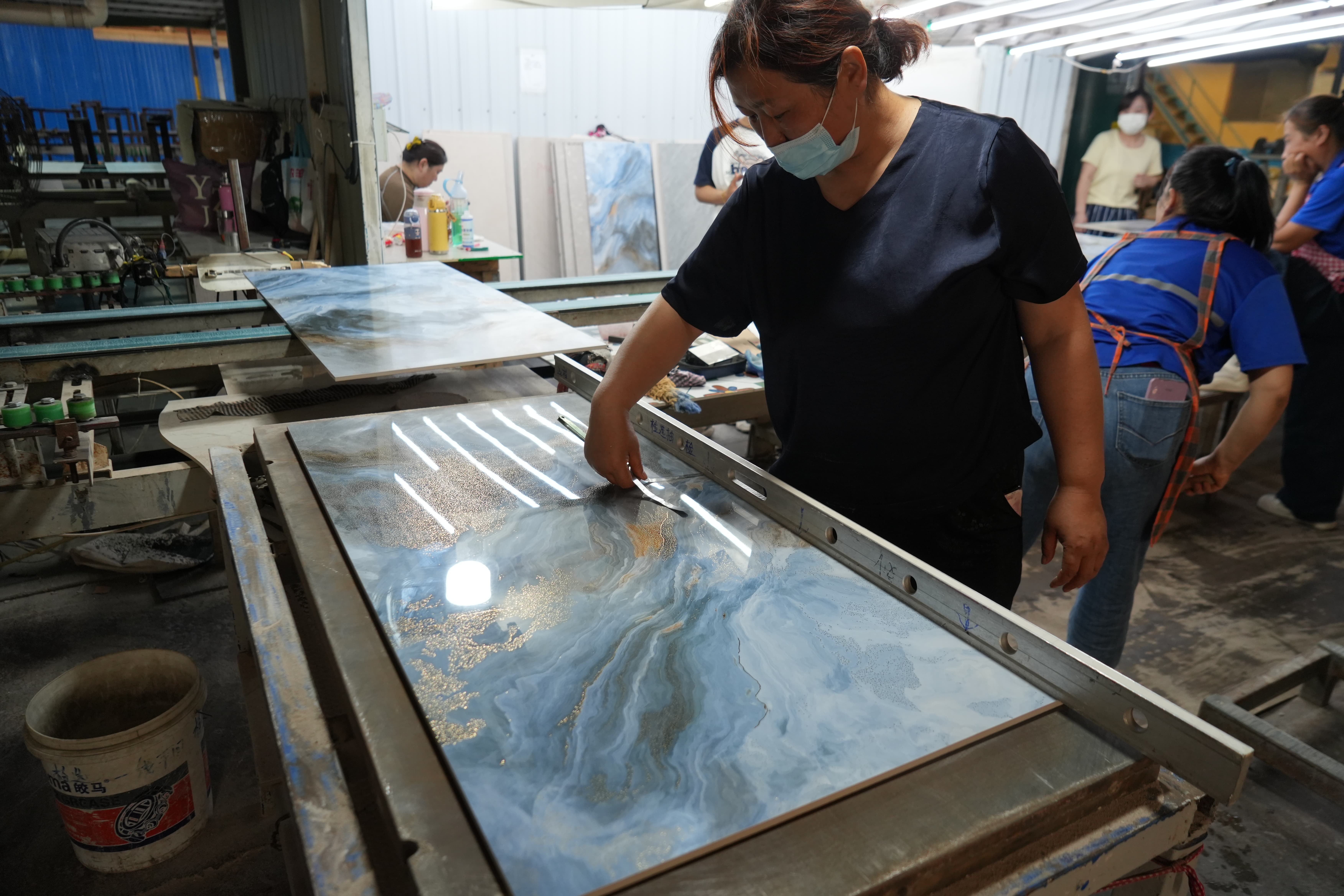
Why 60x120 cm Is the Format Commercial Packages Are Built Around
A 60x120 cm tile covers 0.72 m² per piece, calculated from its nominal dimensions, so a two-piece box covers 1.44 m². On a lobby, a mall concourse or an airport hall, that geometry reduces the number of joints per square metre — fewer grout lines to clean, fewer interruptions to a continuous surface, and a faster installed area per unit of labour. Those are the reasons the format sits at the centre of commercial flooring packages rather than at the edge of them.
The trade-offs are equally concrete. A panel that size demands a flatter substrate and tighter adhesive discipline than a 60x60 cm tile, and lippage becomes visible at lower tolerances. Cut allowance rises in rooms with irregular perimeters, and installation requires two-person handling or suction equipment. Compared with small-format ceramics, large format shifts cost from grouting and joint maintenance towards substrate preparation and setting technique — a difference worth modelling in the estimate before the format is fixed.
Format planning also benefits from a matrix rather than a single size. ALL KING CERAMICS lists 60x60 cm, 80x80 cm, 100x100 cm and 75x150 cm alongside the flagship 60x120 cm, which allows floor and wall modules to be coordinated from one production source. That coordination does not, by itself, guarantee shade continuity between production runs; it is why batch tracking appears again in the purchasing section below.
Checkpoint 1 — Water Absorption Below 0.5%: The Vitrified Threshold
Water absorption below 0.5% is the conventional dividing line between vitrified porcelain and lower-density ceramic bodies, and the product data for this range states exactly that figure, labelled vitrified. In practice a dense, low-porosity body absorbs less moisture in service, which supports stain cleanability in wet and food-service areas and reduces moisture-related movement in the tile itself.
The boundary matters as much as the number. Absorption is a property of the tile body and says nothing on its own about surface slip resistance, frost behaviour or chemical resistance; each of those requires separate evidence. The manufacturer's published guidance states that the range is engineered for high-traffic, frost-prone and wet environments and references ISO 13006 compliance, but that guidance is a company statement and should be matched to project-specific test documentation before it is used in a specification.
For the evaluation file, the practical request is a batch laboratory report showing the absorption result and the test method used, not a catalogue figure. A result without its method cannot be compared with a competing supplier's result, and comparison is the entire purpose of a shortlist.
Checkpoint 2 — Surface Durability: PEI 4/5 and Mohs 6–7
The data sheet states PEI 4/PEI 5 abrasion resistance and Mohs hardness 6–7. In the widely used PEI scale, class 4 is applied to heavier residential and general commercial floors, and class 5 to heavy-traffic commercial floors. On the Mohs reference scale, 6–7 places surface hardness between feldspar and quartz.
Two reading cautions apply. First, the sheet lists two classes rather than one, which means the classification is likely to differ by design within the family; a buyer should confirm which class applies to the specific SKU being ordered rather than assume the higher value. Second, PEI classes describe glazed surfaces. Where a design is full-bodied or polished, the abrasion figure needs to be tied to whichever test produced it, because the class label alone may not describe that surface.
Hardness is also not abrasion immunity. Quartz grit tracked into a mall entrance will scratch a surface that a laboratory test rates highly, so entrance matting, cleaning regime and maintenance intervals remain part of the durability plan. The shortlist value of PEI 4/5 and Mohs 6–7 is that they place the product in the correct commercial band — heavy-traffic floors, hotel lobbies, retail concourses — and give the buyer a defensible line to hold a supplier to.
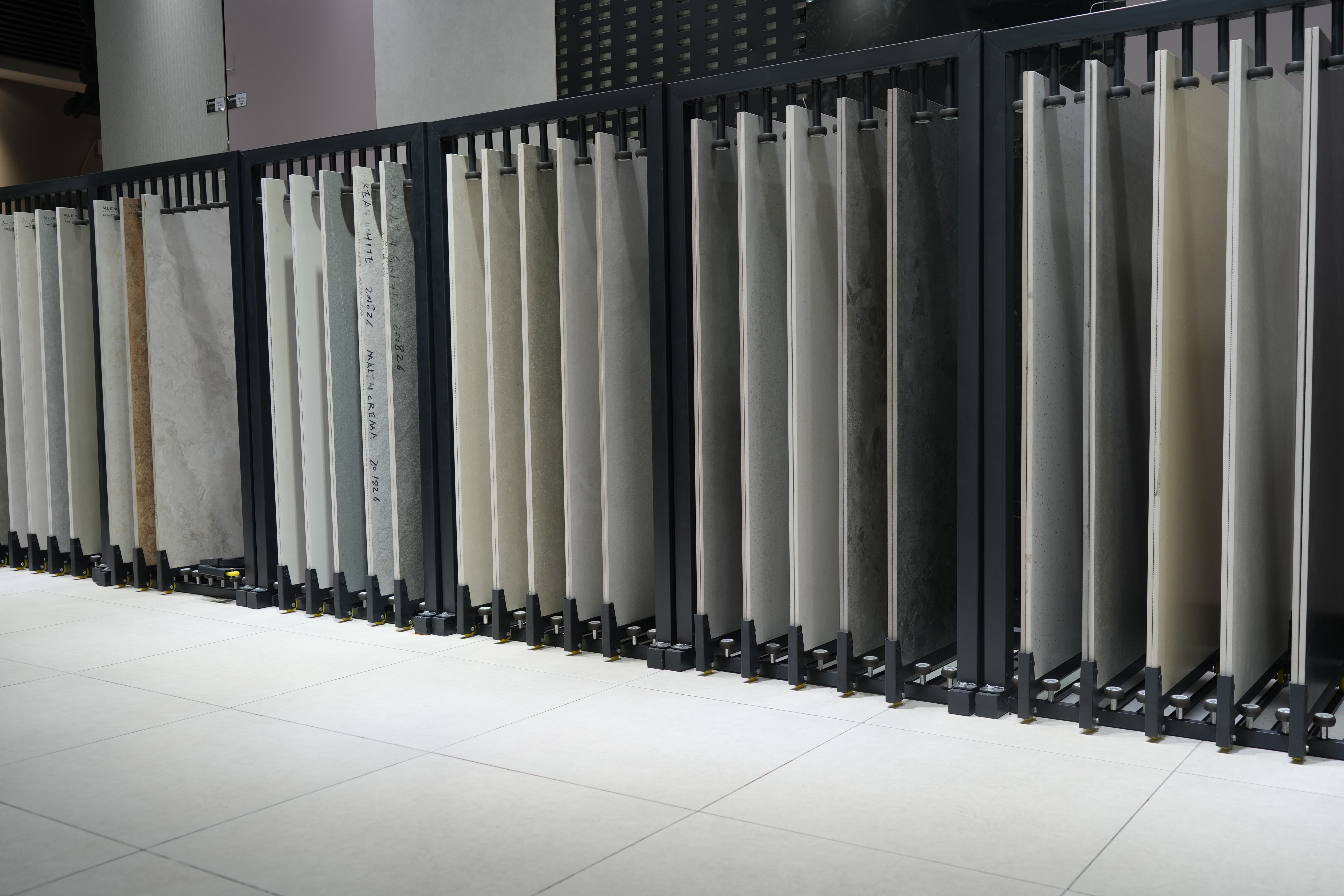
Checkpoint 3 — Mechanical Strength: ≥35 MPa and ≥1300 N Are Not the Same Number
Two strength figures appear in the data: modulus of rupture of at least 35 MPa and breaking strength of at least 1300 N. They measure different things. Modulus of rupture is a flexural stress value, normalised against the test piece's cross-section, which makes it the more portable number when comparing products of different thickness. Breaking strength is the load at which the test piece fails under a given span and support arrangement.
Because breaking strength depends on how the specimen is supported, a 1300 N result is only comparable with another supplier's result when both use the same test standard and span. A buyer who asks for the number without the method has an impressive figure and no basis for comparison. Thickness plays into this as well: the published range is 9.0–10.5 mm across the family, and the strength figure should be confirmed against the thickness of the design actually specified.
Neither number substitutes for installation quality. A large-format panel bedded with voids concentrates point loads in ways a laboratory plate never does, so substrate flatness, adhesive coverage and joint design remain the controlling variables on site. What the strength data establishes is that the product sits in a commercial performance band; it does not convert a poor bed into a sound floor.
Checkpoint 4 — Slip Resistance: Where R11 Ends and R12 Begins
Slip resistance is where commercial shortlists are most often decided by a single letter. Under DIN 51130, the R11 classification corresponds to a high grip measured on an inclined plane between 19° and 27° using the oil-wet ramp test. The manufacturer's guidance places the standard range at R10/R11 and states that R12 can be achieved through customization, with anti-slip rating listed among the available customization options.
Four boundaries deserve a place in the evaluation file. The ramp test is performed with oil and standard footwear on an incline; it is not a barefoot wet-area classification, which is handled by a separate scheme, so a pool surround or a shower zone needs its own specification logic. Real-world slip performance also shifts with contamination and cleaning: a floor that measures well when new can degrade under a film of cooking oil. And an R12 requirement is an order-specific customization, not a stock assumption — it must be written into the specification, confirmed on the approved sample and verified in the delivered batch.
One further distinction matters for buyers working across indoor and outdoor packages. The thickness range documented for this product is 9.0–10.5 mm. That is an interior tile specification, not a 20 mm outdoor paver specification, so external paving or heavy-duty outdoor decking should be scoped as a separate product decision rather than assumed from the indoor data sheet.
Checkpoint 5 — Certification Scope: Reading ISO 9001 and CE Properly
Certification is the checkpoint most often filed without being read. Two documents are relevant here. The first is ISO 9001:2015 certificate number 0350521Q30166R1M, issued by XQCC, with a stated scope of production and service of ceramic tile (except as required by 3C) and a market designation of global markets. The second is CE certificate number AC 50163816 0001, issued by TUV for the EU market, with a stated scope of ceramic tiles — dry-pressed ceramic tiles, for internal flooring.
What each document proves differs sharply. ISO 9001 is a quality management system certification covering how production and service are controlled; it is not a product performance certificate and does not certify absorption, strength or slip values. CE marking under the listed scope addresses conformity for internal flooring in the EU market. That scope wording is the most useful sentence in the file for a wall-cladding project: where the CE documentation is stated for internal flooring, façade or external applications sit outside that stated scope and require separate documentation before they are treated as covered.
Three practical checks follow. Confirm the certificate numbers and current validity directly with the issuing bodies, because the records supplied for this review list numbers and issuers but not issue or expiry dates. Confirm that the design being ordered falls inside the certified product families — the Marble Series and Travertine are listed against both certificates. And confirm that the scope wording matches the application, not merely the supplier.
Sustainability documentation follows the same logic. Guidance from the U.S. Green Building Council and the WhyTile programme notes that porcelain tiles are inherently exempt from LEED VOC FloorScore requirements because high-temperature firing destroys organic matter. That exemption is a property of the material category, not a project certification, so the credit still has to be documented inside the project's own submission.
Checkpoint 6 — Box Yield: Turning 1.44 m² into a Deliverable Quantity
The packing specification is 2 pieces per box, covering 1.44 m² — consistent with the arithmetic of 0.72 m² per piece. That single figure converts a design area into a purchase quantity and, later, into an acceptance check. For a 2,000 m² floor, a zero-waste calculation gives 1,389 boxes (2,000 ÷ 1.44 = 1,388.9, rounded up), before any cut allowance, attic stock or phase holding is added. Those additions are estimating decisions for the project team, not tile properties, and they should be stated separately in the order.
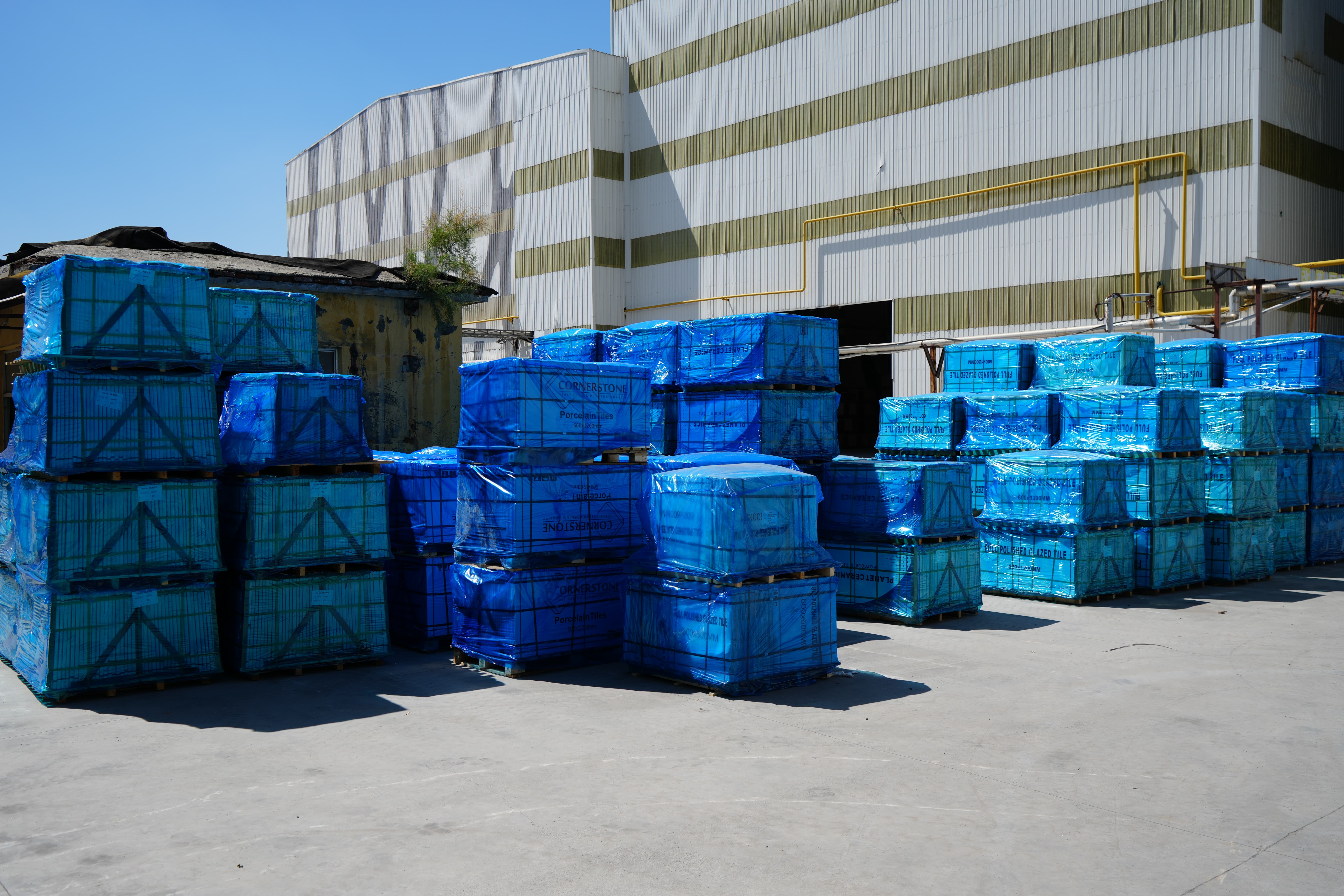
Two gaps are worth flagging. Box weight is not documented in the material reviewed here, which matters for freight calculation, manual handling limits and floor loading during storage; it should be requested with the quotation. Pallet configuration and protection for export are a separate verification point, and any pallet treatment documentation required by the destination market should be confirmed per shipment.
The Six-Point Shortlist Scorecard
The table below consolidates the checkpoints, distinguishes documented values from verified ones, and states what still has to be confirmed before an order is placed.
| Checkpoint | Documented value for the 60x120 cm range | Evidence type | Confirm before ordering |
|---|---|---|---|
| Water absorption | Below 0.5% (vitrified) | Company product data | Batch test report and the method used |
| Surface durability | PEI 4 / PEI 5; Mohs hardness 6–7 | Company product data | Which class applies to the specified design |
| Mechanical strength | Modulus of rupture ≥35 MPa; breaking strength ≥1300 N | Company product data | Test standard, span and the design's thickness |
| Slip resistance | R10 / R11 standard; R12 achievable through customization | Company guidance referencing DIN 51130 | Written class per area, plus sample confirmation |
| Certification | ISO 9001:2015 no. 0350521Q30166R1M (XQCC, global); CE no. AC 50163816 0001 (TUV, EU, internal flooring) | Certificate records | Issuer validation, scope wording, validity dates, product family |
| Packing yield | 2 pieces per box = 1.44 m² | Company product data | Box weight, pallet configuration, batch labelling |
Where the Same Tile Earns Its Place: Application Fit by Venue
The documented application set for this product covers hotel lobbies, commercial mall flooring, office building façades, high-end apartment bathrooms and airport departure halls, with projects cited in the UAE, Canada, Australia, Russia and other markets. Each venue stresses a different part of the specification, which is why one tile family can serve several zones without every zone weighting the same checkpoint equally.
- Hotel lobbies combine visual continuity with heavy rolling and foot traffic; flatness and shade consistency carry as much weight as abrasion class.
- Mall flooring adds cleaning frequency and trolley traffic, so joint width, cleaning chemical resistance and surface texture matter alongside PEI class.
- Office building façades are wall-cladding work, where fixing method and substrate govern — and where the CE scope limitation described above has to be resolved before submittal.
- Apartment bathrooms are wet areas: absorption, slip class and waterproofing detail all interact, and the tile alone does not provide the waterproofing.
- Airport departure halls put the highest value on dimensional consistency and resistance to continuous load, which makes batch control and flatness inspection the critical checks.
Scale is worth stating because it changes the risk profile. The manufacturer's case record describes a 15,000 m² supply spanning hotel lobby, commercial mall, office building façade, apartment bathroom and airport departure hall applications, with commercial real estate developers, general contractors and tier-1 building materials wholesalers listed as client types. The company also describes the product as designed for a service life exceeding 20 years. Both statements are supplier-reported; they indicate the segment the product is built for, not a guarantee of outcomes on another project.
Market Context: Commercial Demand and Export Supply
Two data points frame why 60x120 cm shortlists keep appearing. Trade data published by the Observatory of Economic Complexity records China as the leading exporter of ceramic products in 2024, with an export value of USD 18.3 billion. Separately, commercial research cited by Market Research Future estimates that commercial construction accounts for around 37% of total global tile demand.
Read together, they describe a category where commercial specification is a large share of demand and where a substantial volume of supply originates from Chinese manufacturing. Neither figure says anything about any individual supplier's capability, and the second is a commercial research estimate whose methodology is not fully visible in the available material — it should be treated as directional background rather than a procurement input. What the context does justify is the shortlist discipline itself: in a market of that scale, the differentiator between suppliers is documentation quality, not the existence of supply.
Purchasing Terms as Due-Diligence Checkpoints
Commercial terms in a tile order are usually written as commercial convenience and later behave as risk allocation. The supplier's published terms provide a starting point for each item to be pinned down precisely.
- Minimum order quantity. Stated at 400 m² per design, with trial orders acceptable. The key word is per design: confirm whether a phased project using three designs is ordered as three minimums or one consolidated commitment.
- Lead time. Stated at 7–10 days. Confirm the trigger — order confirmation, deposit clearance, or approval of OEM artwork and packaging — because the clock starts at different points in different contracts.
- Capacity. Stated monthly capacity of 1.2 million m², against annual output of 12–16 million m² and a 60,000 m² factory. Capacity is a screening question for multi-phase programmes, not a delivery promise; the delivery schedule in the contract is the operative document.
- Quality control. Described as 100% flatness and sizing auto-check, piece-by-piece visual inspection, and random laboratory testing per batch. Ask which records accompany each shipment and in what format, since acceptance depends on the evidence arriving with the goods.
- Customization. OEM/ODM options cover custom size and thickness, surface finish, OEM brand logo and packaging, marble vein pattern variation and anti-slip rating. Any customization — particularly an R12 requirement — should be described in the specification, confirmed on a sample and referenced in the acceptance clause.
- After-sales. Damage compensation, online installation guidance, 24/7 technical consultation and batch tracking with reordering support are listed. The terms behind them — claim window, evidence required, remedy, responsibility for inspection — are not, and belong in the contract rather than in an assumption.
With a 70% export ratio and stated markets across Australia, New Zealand, Russia, Korea, Vietnam, Malaysia, the Philippines, Peru, Panama, Colombia, Chile, Bolivia, Guatemala, Palestine, Iraq, Ukraine and the UAE, documentation consistency across destinations is a reasonable screening question for a distributor or a project buyer placing repeat orders.
What the Shortlist Does Not Decide — and How to Close the Gaps
Three limits should travel with this shortlist. First, the technical values are company-reported product data; no independent laboratory report for this product family was available for this review, so the figures establish a performance band and a set of questions, not a verified outcome. Second, the certificate records supplied list numbers, issuers and scope but not issue or expiry dates, so validity must be confirmed with XQCC and TUV directly. Third, the CE scope as listed covers internal flooring, which leaves wall cladding and external applications requiring their own documentation.
A verification sequence that closes these gaps looks like this:
- Validate both certificate numbers with the issuing bodies and read the scope wording against the actual application, not the product name.
- Request the batch test report covering absorption, modulus of rupture, breaking strength and slip resistance, with the test methods stated.
- Approve a physical 60x120 cm sample, retain a signed reference piece, and write the approval into the acceptance clause.
- Resolve the slip class area by area — dry retail, wet service, kitchen, external approach — and confirm in writing where an R12 customization applies.
- Confirm box weight, pallet configuration and batch labelling before freight is booked.
- Reconcile delivered area at site using 1.44 m² per box and record batch numbers for any future reordering.
Outlook: Documentation Will Decide More Shortlists Than Colour
As commercial packages keep standardising on large formats and slip-rated surfaces, the practical dividing line between suppliers is shifting from what a catalogue shows to what a submittal file can support. A 60x120 cm tile with absorption below 0.5%, PEI 4/5, strength above the commercial band, a documented slip class and a certificate trail whose scope matches the application is straightforwardly shortlistable. One that cannot produce those items is not disqualified by its product — it is disqualified by its paperwork. Buyers who build the six checkpoints into their evaluation template will find the comparison faster, and will spend their negotiation time on the terms that actually carry risk. Product details and the full format range are available on the ALL KING CERAMICS website, and the downloadable ceramics catalogue sets out the wider format matrix.
FAQ: 60x120 cm Vitrified Porcelain for Commercial Projects
What specifications should a 60x120 cm porcelain tile meet before it is shortlisted for a commercial floor?
At minimum: water absorption below 0.5% to confirm a vitrified body, a PEI 4 or 5 surface classification for commercial traffic, modulus of rupture of at least 35 MPa and breaking strength of at least 1300 N with the test method stated, a slip class matched to each area, and certificates whose scope covers the intended application. Each value should be confirmed per design and per batch rather than taken from a family data sheet.
Does water absorption below 0.5% also mean the tile is slip-resistant?
No. Absorption describes the density and porosity of the tile body. Slip resistance is a surface property measured separately, for example under the DIN 51130 ramp test, where R11 corresponds to a measured angle between 19° and 27°. A tile can have excellent absorption figures and a slip class that is unsuitable for a wet kitchen, so the two values must be specified independently.
Is a 60x120 cm porcelain tile suitable for wall cladding as well as flooring?
The product is documented for applications that include office building façades, so wall use is within its stated application range. The constraint is documentation: where the CE certificate is scoped to dry-pressed ceramic tiles for internal flooring, façade and external applications fall outside that stated scope and need separate evidence. Fixing method, substrate and adhesive coverage are engineering decisions that sit alongside the tile specification.
How many square metres does a box of 60x120 cm tiles cover?
Two pieces per box, covering 1.44 m². That follows from 0.72 m² per tile. The figure lets a buyer convert design area into boxes and, at delivery, reconcile the delivered area against the invoice by counting boxes rather than relying on the supplier's own total.
Are R11 tiles sufficient for a commercial kitchen floor?
R11 indicates a high-grip classification under oil-wet ramp testing, which is why it appears frequently in kitchen specifications. Sufficiency depends on the specific zone: cooking lines with continuous oil contamination, drainage falls and cleaning routines all affect real performance. Where a project specifies R12, that is an order-specific customization and should be written into the specification and verified on the approved sample.
What does the ISO 9001:2015 certificate actually cover?
ISO 9001:2015 certificate 0350521Q30166R1M, issued by XQCC, is scoped to the production and service of ceramic tile, with a global market designation. It certifies how the quality management system controls production and service; it does not certify water absorption, strength, slip resistance or any other product performance value. Those require separate test documentation.
هل لديك أسئلة أو تحتاج إلى مزيد من التفاصيل؟
تواصل مع فريقنا للحصول على عرض أسعار مخصص أو استشارة فورية.
طلب عرض أسعار
املأ النموذج أدناه وسيتواصل معك فريقنا بعرض مقترح مخصص.
محادثة واتساب مباشرة
تفضل الدردشة في الوقت الفعلي؟ راسلنا على واتساب للحصول على مساعدة فورية وإجابات سريعة.
- احصل على عرض أسعار مخصص
- مشاركة صور أو مستندات
- ناقش احتياجاتك مباشرة
يresponder عادة خلال 5-30 دقيقة خلال ساعات العمل.