
Porcelain Tile Technical & Procurement FAQ: Specs Explained
Porcelain Tile Technical & Procurement FAQ: Specs Explained
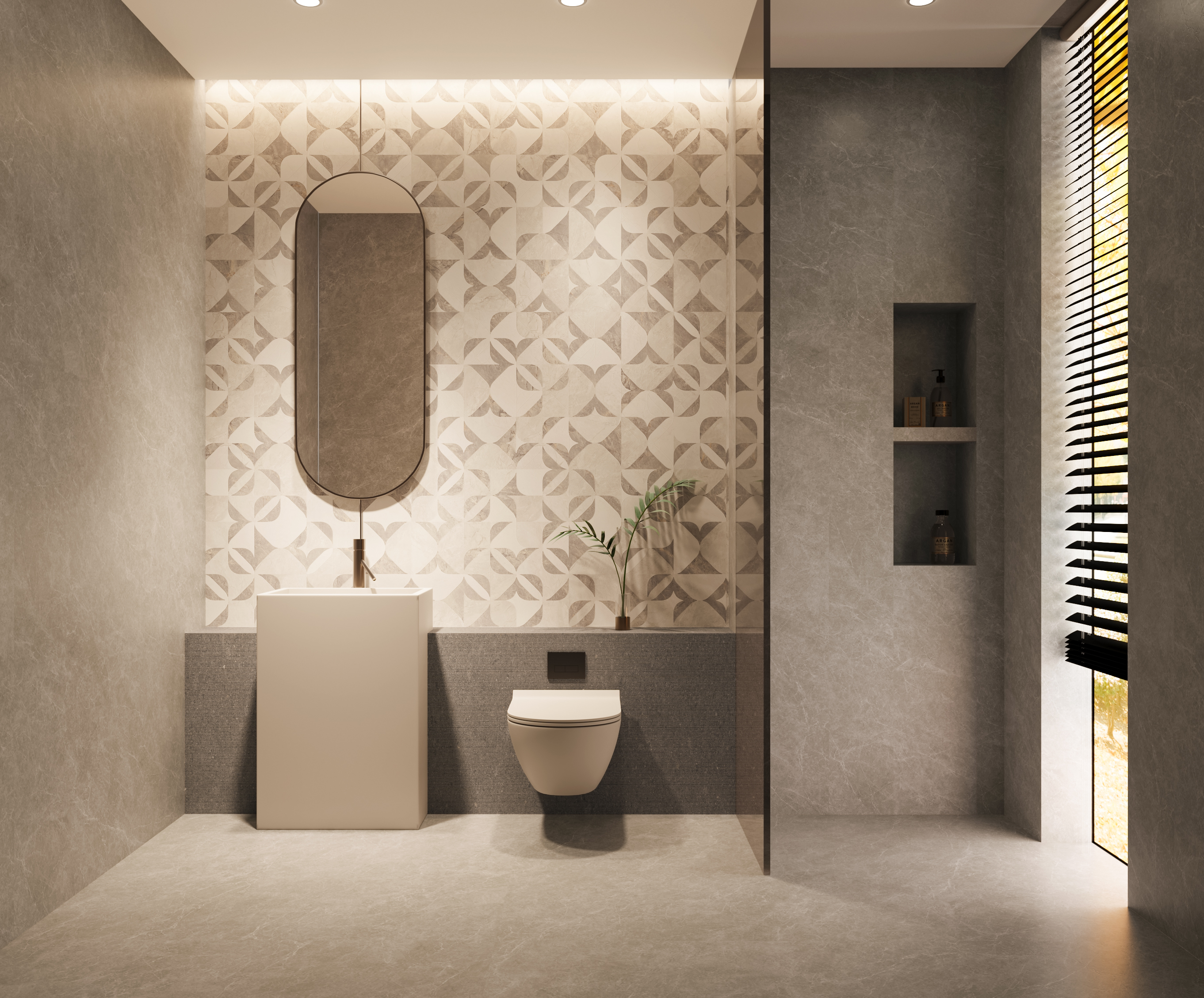
Anti-slip porcelain tile surface — slip resistance is one of the first performance values a buyer should see in writing.
Porcelain tile is a dry-pressed ceramic product classified under ISO 13006:2018 as Group BIa, defined by a water absorption coefficient of 0.5% or lower and an average mechanical resistance exceeding 40 N/mm². Those two thresholds decide most of what follows in a specification: how the tile behaves outdoors, how it resists staining, how wide the joints will be, and which adhesive and levelling consumables the installation will require.
This reference answers the technical and procurement questions that appear most often during the awareness and research stages of a porcelain tile purchase — absorption rates, abrasion (PEI) ratings, slip classes, freeze-thaw performance, stain and chemical resistance, and the fixing consumables that large-format porcelain depends on. Product-level values are taken from Monalisa Group's published product records, including homogeneous body tile 120-270FEG12207M at 1200×2700×12 mm.
Why Specification Literacy Decides the Sourcing Outcome
Global tile production fell to 14.95 billion square metres in 2024, a 6.2% decrease compared with 2023, according to MECS / Acimac Research Centre data. Over a similar horizon, the global porcelain tile market was valued at USD 9.73 billion in 2024 and is projected to reach USD 18.33 billion by 2035, according to Spherical Insights. A contracting production base alongside an expanding value market shifts the basis of comparison away from headline capacity and towards documented performance.
For buyers, the practical consequence is that specification language becomes the negotiating language. Terms such as “high quality” or “first grade” do not survive a technical review. Measurable values do: absorption class, abrasion rating, R-value, stain grade, dimensional tolerance and frost performance. The questions below are the ones that convert a supplier conversation into a comparable data set.
A Manufacturer Reference Point: Monalisa's Published Product Data
Monalisa Group Co., Ltd. (“Monalisa”) was established in 1992 and is headquartered in Foshan, Guangdong Province, China. It is a high-tech listed company that integrates research and development, creative design, production and marketing of architectural ceramics. The Group operates four modern production bases with 37 production lines, covering a total manufacturing area of 2,779,333.33 square metres, and employs approximately 4,106 staff with an annual production capacity of about 100 million square metres. Its R&D team comprises 100 engineers. As of June 2021, the Group had participated in drafting 49 national, industrial, local and group standards and held 892 authorised patents.
Main products include tiles, sintered stone slab and SPC floor, marketed under the three brands “Monalisa”, “QD” and “Merqi” through more than 4,000 authorised franchised stores nationwide. Export business accounts for approximately 10% of total sales, with key markets in China, Southeast Asia, the Middle East, North America, Europe, Australia and Africa. The Group holds 15 certifications including ISO9001 and ISO14001, and has been recognised as a national “Resource-saving and Environment-friendly” pilot enterprise and one of the first batch of “Green Factories” by China's Ministry of Industry and Information Technology.
Two documented porcelain tile models are useful as reference points for specification discussion:
| Model | Type | Size | Phases | Surface finish | Body material |
|---|---|---|---|---|---|
| 120-270FEG12207M | Homogeneous Body Tile | 1200×2700×12 mm | 3 | Matt / Natural stone face | Clay / quartz sand |
| 8FMB10032PM | Classic Stone | 800×800×10 mm | 8 | Glazed-Polished | Clay / quartz sand |
The two models illustrate two different specification logics: a large-format homogeneous body slab for continuous surfaces, and a mid-format glazed-polished tile for standard grid layouts.
The Specification Benchmarks Buyers Should Request in Writing
Most disputes in porcelain tile procurement trace back to a performance value that was discussed but never documented. The table below lists the values that should appear in a technical data sheet or project specification, together with the reason each one changes a purchasing decision.
| Specification | Reference value | Why it matters in procurement |
|---|---|---|
| Water absorption (E) | ≤0.5% for porcelain (Group BIa); ≤3% for semi-porcelain; double-zero absorption required for certain projects | Controls frost resistance, stain behaviour and dimensional stability |
| Abrasion resistance | PEI 3–5; PEI 4 or above for commercial and public areas | Determines expected service life under continuous foot traffic |
| Slip resistance | R9–R11; bathrooms require R10 or higher | Safety compliance in wet areas, ramps and pool surrounds |
| Stain resistance | Grade 5, resistant to common stains such as tea, oil and ink | Cleaning cost and long-term appearance retention |
| Chemical resistance | ULA class | Required around laboratories and chemical plant environments |
| Freeze-thaw stability | No cracks after 100 freeze-thaw cycles | Outdoor specification in cold-climate projects |
| Dimensional tolerance | Length/width deviation ≤ ±0.2%; thickness deviation ≤ ±5% | Joint width, lippage control and laying-pattern feasibility |
| Fire performance | Class A fire rating | Public buildings, egress routes and wall applications |
| Environmental compliance | China Class A radioactive standards; CE, GreenGuard or LEED documentation required for some export markets | Project eligibility and tender compliance |
| Antibacterial / antiviral treatment | Optional photocatalytic or silver-ion treatment | Hospitals, food plants and similar hygiene-critical environments |
Matching Specifications to Rooms, Traffic and Exposure
The same tile body can be appropriate for a living room and inappropriate for a station hall. Specification matching works by pairing the exposure condition with the relevant performance value.
- Living rooms and bedrooms: appearance consistency, dimensional tolerance and stain resistance dominate. Standard PEI 3 performance is generally sufficient for residential floor traffic.
- Kitchens: stain resistance Grade 5 and easy cleaning matter more than abrasion class; surface finish selection should follow cleaning practice rather than appearance alone.
- Bathrooms and shower areas: slip resistance of R10 or higher is the working requirement, combined with a matt or textured finish and waterproof, low-absorption porcelain.
- Outdoor terraces, plazas and pedestrian areas: freeze-thaw stability, slip resistance and UV-stable appearance drive selection; the outdoor working range referenced for these applications is -20°C to 40°C with sun, rain, standing water and mild chemical exposure.
- Commercial floor areas — malls, offices, airports: PEI 4 or above, combined with heavy-duty body construction and stain resistance Grade 5.
- Industrial and logistics floors: wear-resistant grades, chemical resistance and washability are the primary criteria.
- Agricultural and livestock flooring: slip resistance, chemical resistance and ease of washing take priority over decorative finish.
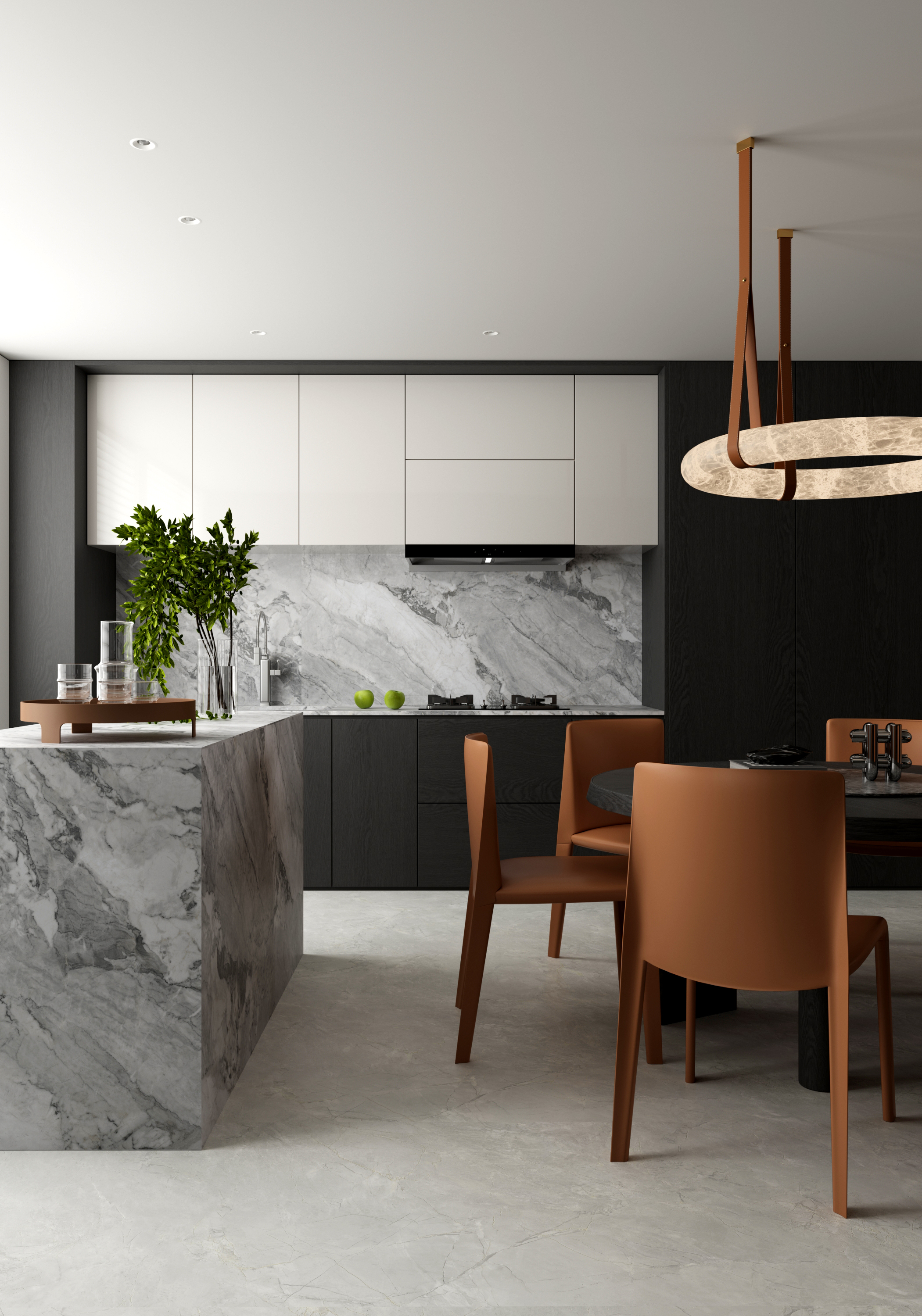
Stain-resistant porcelain tile surface — Grade 5 stain resistance is one of the most frequently requested values in kitchen and commercial specifications.
Installation Consumables and Tools for Large-Format Porcelain
Porcelain performance is only realised when the fixing system matches the tile. For large-format homogeneous body porcelain such as the 1200×2700×12 mm model 120-270FEG12207M, the documented installation kit is not optional.
Installation tooling: tile cutter, levelling system, notched trowel, rubber mallet, spirit level and tile suction cup.
Fixing accessories: tile adhesive, back butter adhesive, grout, epoxy grout and cross spacers.
Maintenance equipment: floor scrubber, pressure washer, neutral cleaner and polishing pad for periodic upkeep.
Two points deserve procurement attention. First, back butter adhesive and a levelling system are what control lippage and hollow spots on large-format slabs; specifying them in the bill of materials prevents a cost argument later in the programme. Second, epoxy grout is the accessory that preserves the stain and chemical resistance of a joint in wet and hygienic environments — a detail that is frequently omitted from early budget estimates.
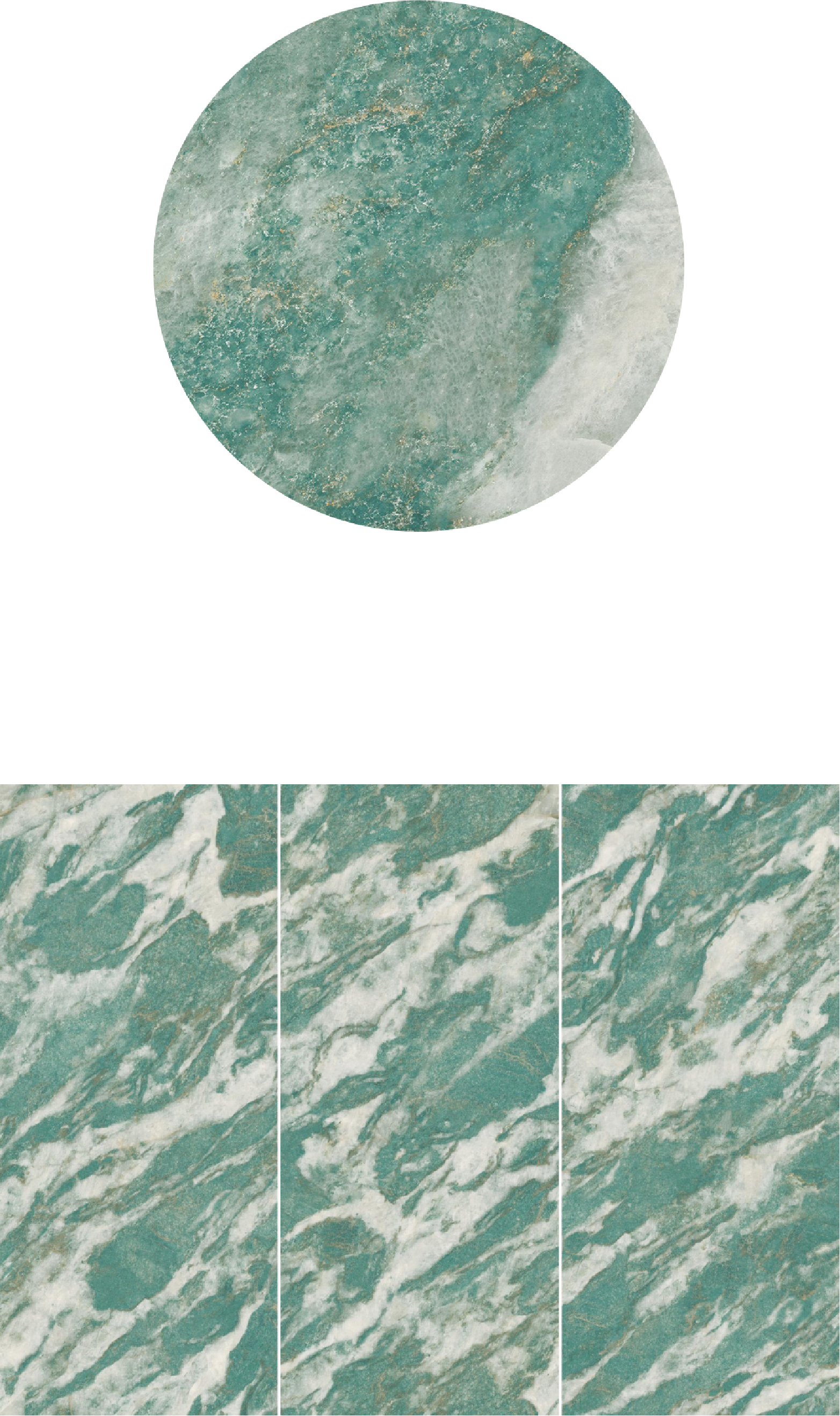
Marble look porcelain tile — the visual family associated with Monalisa's large-format homogeneous body model 120-270FEG12207M, which is dimensioned at 1200×2700×12 mm.
Market Signals That Influence Procurement Timing
Two published signals are worth carrying into a sourcing discussion. The first is supply-side contraction: world tile production decreased by 6.2% in 2024 to 14.95 billion square metres. The second is demand-side value growth: the global porcelain tile market is projected to move from USD 9.73 billion in 2024 to USD 18.33 billion by 2035. Together they describe an industry in which volume is rationalising while value per square metre is rising — which favours buyers who can specify precisely rather than buyers who purchase on price alone.
A third signal concerns supplier stability. Monalisa Group (ticker 002918) reported a 15.28% decrease in annual revenue for 2025, totalling 3.92 billion CNY according to stock exchange-based financial data. That figure should not be read as a product-quality indicator, but it belongs in the same due-diligence file as capacity, certification and delivery history: a financially contracted market rewards buyers who verify continuity of supply, not only the tile sample.
Classification discipline also matters at the border. Because ceramic tiles with a water absorption coefficient not over 0.5% by weight occupy a distinct trade band, HS-code selection directly affects import screening and, in some markets, duty treatment. Buyers comparing quotations across origins should confirm that both suppliers are quoting within the same absorption class.
Porcelain, Semi-Porcelain and Traditional Fixing: Where the Trade-offs Sit
Porcelain tile is often presented as the default specification. It is not. The decision depends on exposure, traffic and the installation capability available on site.
| Comparison point | Porcelain tile (Group BIa) | Semi-porcelain tile |
|---|---|---|
| Water absorption | ≤0.5% | ≤3% |
| Outdoor frost benchmark in available specification data | No cracks after 100 freeze-thaw cycles | Not defined against the same outdoor benchmark in the available data |
| Typical specification areas | High-traffic commercial and public floors, municipal paving, industrial floors and exterior applications | Interior applications where the lower absorption threshold is not required |
| Installation demand | Requires tile adhesive, back butter adhesive, levelling systems and, for large formats, suction cups and specialty cutting equipment | Standard fixing practice with comparable but generally simpler consumable requirements |
| Verified price, MOQ and freight data | No verified public price, MOQ, lead-time or landed-cost data was collected for this category | No verified public price, MOQ, lead-time or landed-cost data was collected for this category |
Three limitations are worth stating plainly, because they are where procurement programmes most often lose time or money.
- Lower absorption demands more installation discipline. A ≤0.5% body, and large formats in particular, perform only when adhesive type, back-buttering and levelling systems are specified and followed. Substituting conventional cement-based fixing practice is where lippage and debonding originate.
- Porcelain is not always the economically rational choice. Where the application is a dry interior wall, semi-porcelain at ≤3% absorption can meet the functional requirement, and the specification burden is lower.
- Documentation must be verified, not inferred. Catalogue presence does not establish performance or certification. Certificate number, product scope, issuing body, validity period and jurisdiction should be requested directly; the same applies to capacity claims, where public sources use different scopes and dates and cannot be combined into a single current figure.
Future Outlook
Three directions are visible in current product and market data. Large-format porcelain continues to define premium architectural specification, with Monalisa having launched an ultra-large ceramic plate measuring 9000×1800×10.5 mm in 2021 alongside ceramic thin plates, lightweight plates and rock plates. Surface design continues to move through digitally printed stone, marble, wood and concrete- look finishes rather than through new body chemistry. And compliance is becoming a specification input rather than a post-award formality: China Class A radioactive standards, CE and GreenGuard documentation, and LEED-related submissions are already required for some export markets, and requests for optional antibacterial or antiviral treatments in hospitals and food plants are growing.
For buyers, the practical implication is that the technical data sheet is becoming the primary commercial document. Suppliers who can respond with absorption values, abrasion ratings, slip classes, freeze-thaw results and certificate references in a single submission will increasingly be compared on that response rather than on price alone.
FAQ: Porcelain Tile Technical and Procurement Questions
What technically defines a porcelain tile?
Under ISO 13006:2018, porcelain tiles are classified in Group BIa: dry-pressed tiles with a water absorption coefficient (E) of 0.5% or lower and an average mechanical resistance above 40 N/mm². International trade classification follows the same principle, separating ceramic tiles with a water absorption coefficient by weight not over 0.5% into a distinct HS 6907 band. Tiles above that threshold but at or below 3% absorption are generally described as semi-porcelain.
What water absorption rate should a buyer specify?
For porcelain, specify ≤0.5%. Some projects require double-zero absorption, and that requirement should be stated explicitly in the technical specification. Semi-porcelain tiles are defined at ≤3%. Absorption is the value that most directly governs frost resistance, stain behaviour and dimensional stability, which is why it is normally the first performance figure exchanged between buyer and supplier.
What do PEI ratings mean, and which rating does a commercial floor need?
PEI is an abrasion-resistance classification, referenced in this product data across the PEI 3–5 range. PEI 3 is generally associated with residential floors and walls, while PEI 4 or above is the working reference for commercial and public areas such as malls, offices, hospitals and metro halls. For any surface with continuous foot traffic, specifying PEI 4 or higher removes ambiguity from the tender.
Which slip resistance class fits bathrooms, pool surrounds and ramps?
Slip resistance is expressed as R-values, spanning R9–R11 in the available specification data, with bathrooms requiring R10 or higher. Wet areas, pool surrounds and ramps should be specified at the higher end of that band. Surface finish matters alongside the rating: a matt or natural stone face finish, such as that used on the 120-270FEG12207M homogeneous body tile, is the finish family typically associated with slip-resistant specification.
Can porcelain tiles be used outdoors in freezing climates?
Outdoor suitability is documented through freeze-thaw stability: no cracks after 100 freeze-thaw cycles is the benchmark given for outdoor projects in cold climates. Outdoor service also involves sun exposure, rain, standing water and mild chemical corrosion, within a referenced working range of -20°C to 40°C. A slip rating at the higher end of the R9–R11 band should be applied at the same time, because frost performance and slip safety are separate requirements.
Do porcelain tiles require specific installation consumables?
Yes. The documented installation kit includes tile adhesive, back butter adhesive, grout, epoxy grout and cross spacers, applied with a leveling system and tooling that covers a tile cutter, notched trowel, rubber mallet, spirit level and tile suction cup. Large-format products such as the 1200×2700×12 mm model 120-270FEG12207M depend on the levelling system and suction cup for handling and lippage control. Epoxy grout is the accessory that preserves joint-level stain and chemical resistance in wet and hygienic environments.
How should CE, ISO and environmental claims be verified before award?
Certification labels should be treated as claims that require documents. Request the certificate number, the product scope it covers, the issuing body, the validity period and the jurisdiction in which it applies. Environmental compliance may reference China Class A radioactive standards, and CE, GreenGuard or LEED documentation is required for some export markets. Monalisa holds 15 certifications including ISO9001 and ISO14001; as with any supplier, the certificate documents themselves should be reviewed rather than the label alone.
Which product sizes and finishes are available for specification?
Two documented porcelain tile models are available in Monalisa's published product records: model 120-270FEG12207M, a homogeneous body tile at 1200×2700×12 mm with three phases and a matt or natural stone face finish, and model 8FMB10032PM, a Classic Stone tile at 800×800×10 mm with eight phases and a glazed-polished finish. Both use clay and quartz sand in the body. Large-format slabs suit continuous surfaces with minimal joint lines, while 800×800 mm formats suit standard grid layouts in residential and commercial interiors.
For readers who need the full company and product reference material, Monalisa's corporate brochure is available for download: Monalisa corporate brochure (PDF).
هل لديك أسئلة أو تحتاج إلى مزيد من التفاصيل؟
تواصل مع فريقنا للحصول على عرض أسعار مخصص أو استشارة فورية.
طلب عرض أسعار
املأ النموذج أدناه وسيتواصل معك فريقنا بعرض مقترح مخصص.
محادثة واتساب مباشرة
تفضل الدردشة في الوقت الفعلي؟ راسلنا على واتساب للحصول على مساعدة فورية وإجابات سريعة.
- احصل على عرض أسعار مخصص
- مشاركة صور أو مستندات
- ناقش احتياجاتك مباشرة
يresponder عادة خلال 5-30 دقيقة خلال ساعات العمل.