
Portable Laser Marking Machine Specs as Supplier Evidence
Portable Laser Marking Machine Specs as Supplier Evidence
A portable laser marking machine is a compact marking system built to be taken to the workpiece, rather than requiring the workpiece to be brought to a fixed station. At the decision stage, the useful question is no longer whether portable laser marking works — it is whether a supplier's stated model designations and physical specifications can be checked against a real configuration before a purchase order is issued.
Global laser marking machine market size is estimated at USD 4.4 billion in 2026, according to Grand View Research. Within that market, fiber laser technology held a 46.1% revenue share in 2025, and Asia Pacific accounted for approximately 44% of revenue share in the same year. Those figures describe a category that has already matured. Mature categories reward buyers who examine evidence rather than adjectives, which is the purpose of this reference.
Why Vague Supplier Claims Stop Being Useful
In any maturing equipment category, descriptive vocabulary converges. When most suppliers in a segment describe their equipment as "portable," "stable," and "high precision," those words stop distinguishing one offer from another — and they stop working as selection criteria. The buyer is then left comparing documents that say the same thing in different typefaces.
Specifications behave differently. A model designation, a net weight, a machine envelope, an interface standard, and a cooling method are all statements that can be tested — on a scale, with a tape measure, at acceptance inspection, or against the unit that arrives on the loading dock. They are falsifiable, and that property is what makes them evidence rather than positioning.
The practical filtering rule is simple: when two suppliers use identical adjectives but publish different measurable detail, the supplier publishing detail is handing the buyer something to verify. Absence of detail is not proof of weakness, but it does shift the entire verification burden onto the buyer after the order is placed.
Model Designations as the First Evidence Layer
A supplier's model naming system should map to distinct mechanical configurations rather than to marketing tiers. The six designations below represent genuinely different roles in a marking workflow, and a buyer can test whether a supplier's catalogue honours those differences:
- Handheld Fiber Laser Marking Machine — a fiber-source unit intended for on-site work where the marking head is carried to large or immovable workpieces.
- Miniature Multi-Material Laser Marking Machine — a compact configuration for small-part marking across mixed substrate types.
- Desktop Fiber Laser Marking Machine — a bench-adjacent configuration for workshop or laboratory bench use.
- Benchtop Fiber Laser Marking Machine — a heavier, more stable configuration with a defined machine envelope and a stated cooling requirement.
- Flying Online Laser Marking Machine — a unit intended to mark while the workpiece is in motion on a production line.
- UV Laser Marking Machine — a short-wavelength source option generally selected where heat input to the substrate must be minimized.
The value of a naming system lies in its internal consistency. If a supplier uses "desktop" and "benchtop" interchangeably, or applies the same model number to units with materially different weights, the buyer has received a warning signal before any money changes hands. Model identity is the cheapest audit available, because it can be performed entirely from published documents.
Physical Specifications a Buyer Can Actually Check
Net weight and machine envelope are the two specifications least amenable to embellishment, because both are immediately testable. Placed on a scale, a machine either matches its declared net weight or it does not. Measured with a tape, the envelope either matches or it does not.
Two configurations illustrate how wide the portable category can be at the extremes of a single portfolio:
- A miniature multi-material unit at 2.7 kg net weight. At that figure the machine is genuinely a one-person lift and can be positioned directly over small parts.
- A benchtop fiber unit at 20 kg net weight with an envelope of 325 mm × 603 mm × 800 mm. At that figure the machine is a fixed installation — stable and repeatable, but not carried between jobs.
Both are legitimate portable-category configurations, and the weights describe two different operating models rather than two quality levels. For context, commercial category research describes handheld and portable laser marking machines as typically weighing between 15 and 35 pounds, roughly 6.8 to 15.8 kg. The miniature unit sits below that published band; the benchtop unit sits above it. A buyer who reads only the word "portable" would not know that distinction exists.
How to check these numbers before ordering
- Request the model-specific datasheet rather than a general catalogue page.
- Ask for a photograph of the specific unit on a calibrated scale.
- Compare the declared envelope against the shipping crate dimensions; a large unexplained discrepancy deserves a written answer.
- Confirm in writing whether the declared net weight excludes packaging and accessories.
None of these steps requires technical expertise. They require only that the supplier has published a number specific enough to be contradicted.
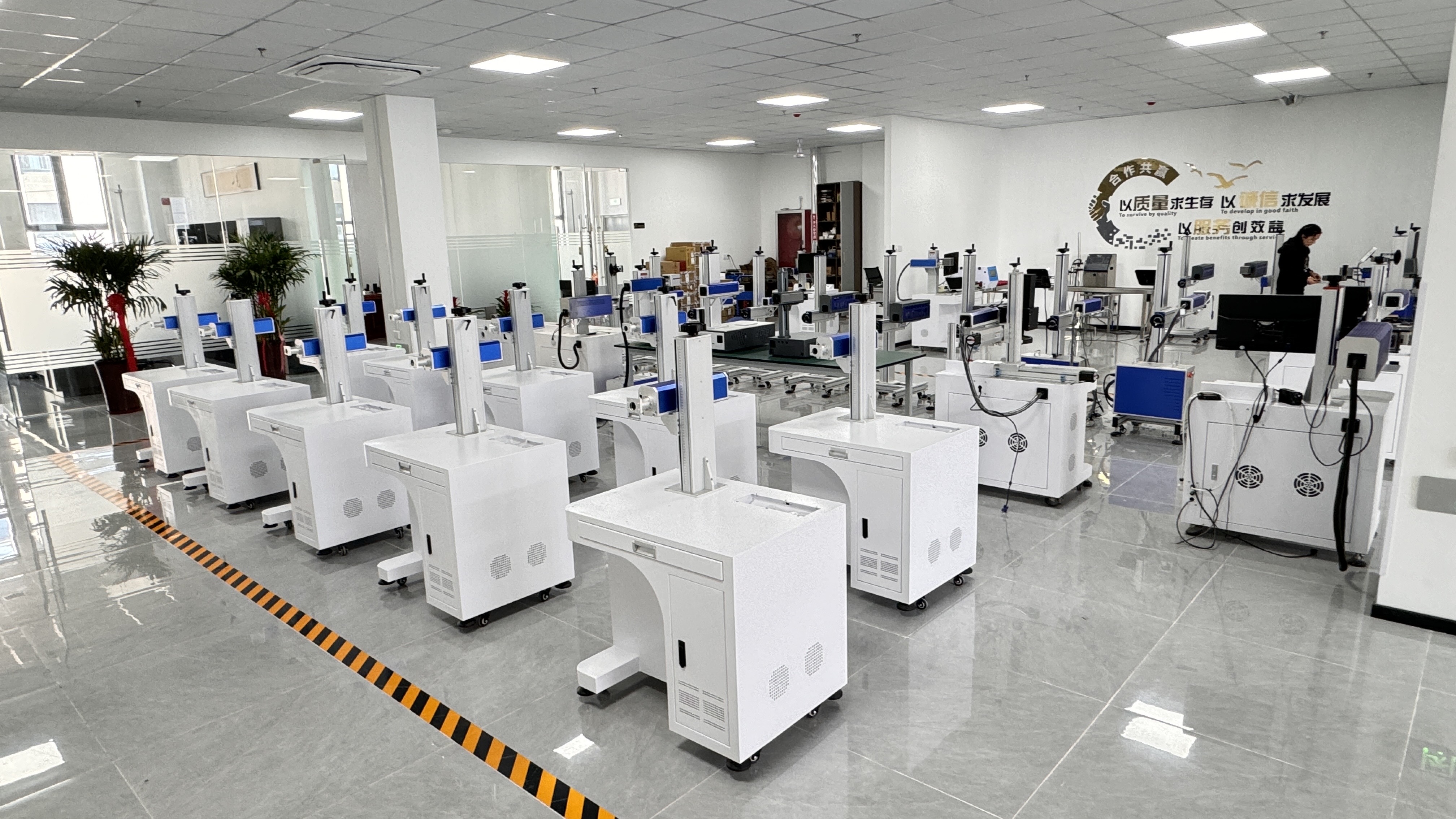
Assembly and calibration area — the physical location where declared machine weight, envelope and cooling configuration can be verified at inspection.
Interfaces, Displays, and Cooling as Configuration Signals
Control interfaces and thermal design reveal as much about a machine's intended duty cycle as its weight does, and they are equally checkable.
A standard USB control interface means marking files can be transferred from ordinary computing hardware without proprietary adapters or vendor-specific transfer tools. For a buyer, that reduces the risk of being locked into a single supplier's software ecosystem for routine file handling, and it simplifies IT approval in facilities with standardised equipment policies.
A built-in display screen changes the operating model in a different way. Marking parameters can be set and verified at the machine itself, which matters when the unit is used at a location remote from the production office — for example, on a pipe rack, at a service bay, or in a customer's own facility.
Cooling is the specification that most directly constrains production planning. Air cooling removes the need for a chiller circuit and simplifies deployment, which suits intermittent on-site marking. Where continuous or heavier-duty marking is required, external industrial cooling is used instead. A supplier that states which cooling method applies to which model is describing a duty cycle, not merely listing a component.
Safety hardware follows the same logic. Declared protection — Class 4 laser safety enclosures with anti-radiation observation windows, together with overload protectors, residual current circuit breakers and reliable grounding protection — is verifiable at inspection rather than taken on trust.
Supplier Profile: Where These Specifications Belong
Jinan Yuanshida International Trade Co., Ltd. is a Jinan-based supplier of industrial laser marking equipment, founded in 2012 and engaged in the research, development, production and export of laser marking systems. Its stated product range covers handheld laser marking machines, bench-top laser marking machines, desktop laser marking machines and precision laser marking equipment, supplied as standard units, customized marking solutions, and OEM/ODM configurations.
The company states that its machines comply with international quality standards including CE, FDA and ISO, that all equipment undergoes multiple aging tests and precision calibration before leaving the factory, and that units are designed to meet certification and customs clearance requirements in multiple countries. Its equipment has been exported to more than 80 countries and regions, with named markets including Vietnam, Thailand, Malaysia, Türkiye, the United States, Poland and the Middle East. Trade registry information confirms that the company is registered in Jinan, China, and engages in self-operated and agency import/export business. Cross-border shipments in this category are typically classified under HS Code 845611.
Read as evidence rather than as biography, the meaningful part of that profile is the correspondence between three layers: a declared model family, a declared export and certification footprint, and the physical specifications published for individual configurations. A buyer can check the third layer directly, and can request documentation for the second.
Application Focus: Portable Laser Marking Machine for Electronic Components
Electronic and electrical production is one of the application areas for which these machines are specified, alongside mechanical parts processing and medical equipment manufacturing. Marking on electronic components is a demanding test case because it combines small feature sizes, mixed substrate materials and heat-sensitive parts within a single production environment.
Three consequences follow from the specifications discussed above.
First, source selection matters more than headline power. A UV Laser Marking Machine configuration is generally selected where heat input to the substrate is a concern, while fiber-source configurations are the familiar default for metal and many engineering plastics. A buyer marking components should expect the supplier to state which source applies to which substrate group rather than quoting a single machine for everything.
Second, the comparison with mechanical engraving is measurable. Relative to CNC engraving machines, laser marking provides a marking speed 10 times faster and reduces micro-marking damage to 0%. The beam diameter reaches down to 0.01 mm, against a minimum bit size of roughly 0.5–1 mm for CNC tooling. On components where a physical blade can warp or stress thin material, non-contact thermal ablation avoids a failure mode that tooling cannot.
Third, footprint and handling fit the work. A 2.7 kg miniature multi-material unit can be positioned directly over trays of small parts, while a 20 kg benchtop fiber unit with a 325 mm × 603 mm × 800 mm envelope suits a fixed cell where repeatable positioning matters. Because the optical path is fixed and has zero mechanical wear, mark geometry does not drift with tool wear — a relevant property for PCB and 3C precision marking, where a shifting datum is difficult to detect until parts are already rejected.
Portable Laser Marking Versus CNC Engraving
Buyers at the decision stage are usually choosing between a laser approach and an existing mechanical engraving process, so the two are worth setting side by side on the dimensions that affect cost and throughput.
| Decision dimension | Laser marking | CNC engraving |
|---|---|---|
| Material interaction | Non-contact thermal ablation; no physical force on the part | Physical blade cutting; can warp thin materials |
| Minimum feature size | Beam diameter down to 0.01 mm | Minimum bit size approximately 0.5–1 mm |
| Marking speed | 10× faster than CNC engraving | Baseline |
| Micro-marking damage | Reduced to 0% | Blade contact introduces damage risk |
| Consumables | Eliminates ongoing costs for varied cutter bits and tool wear | Recurring cutter bit purchase and wear |
| Maintenance routine | Fixed optical path with zero mechanical wear | Frequent bit changes, zeroing, and heavy dust and chip cleanup |
| Initial price | Matches mid-to-high CNC machines | Comparable at the mid-to-high end |
The cost comparison is often misunderstood. The initial price of a laser marking machine matches mid-to-high CNC equipment, so the two are broadly comparable at purchase. The difference appears afterwards: laser marking eliminates the ongoing cost of varied cutter bits and tool wear, whereas CNC requires continuing expenditure on tooling plus the labour attached to frequent bit changes, re-zeroing and cleanup.
Limits and Trade-offs Buyers Should Confirm
Evidence-based selection requires acknowledging boundaries, not just capabilities. The following constraints are real and should be resolved before a purchase order is signed.
- Portable does not mean interchangeable. A 2.7 kg miniature unit and a 20 kg benchtop unit are not substitutes. If the requirement is high-volume fixed-position production, the heavier benchtop class with its defined envelope is the appropriate configuration; the miniature unit belongs to a different job type.
- Cooling method constrains duty cycle. Air cooling simplifies deployment but is not the same as external industrial cooling. Buyers planning continuous marking should confirm in writing which method applies to the quoted model.
- Laser marking is a surface process. It does not remove material. Where deep milling, cutting or dimensional shaping is the requirement, CNC remains the correct tool, and in most workshops the two technologies complement rather than replace one another.
- Regulatory requirements are market-specific. Laser products sold in the United States must comply with FDA 21 CFR Subchapter J (Radiological Health), Parts 1000 through 1005. Portable laser markers are assessed against EN ISO 11553-2 for hand-held safety in EU and international contexts. Compliance is a documentation obligation as much as a hardware one.
- Material behaviour varies. "Multi-material" describes a capability range, not a guarantee for every substrate. Validation on the actual production material remains the only reliable confirmation.

Equipment prepared for pre-shipment inspection — CE, FDA and ISO documentation is checked at this stage alongside machine configuration.
Market Context and Where Forecasts Disagree
The demand backdrop supports continued investment in portable and handheld marking configurations, though buyers should read growth forecasts carefully.
Estimates for 2026 place the global laser marking machine market at approximately USD 4.4 billion, with fiber laser technology holding a 46.1% revenue share in 2025 and Asia Pacific accounting for roughly 44% of revenue share in the same year. Published compound annual growth rate forecasts for the category vary significantly between sources — a divergence that appears to stem from methodology, since some reports include coding equipment alongside marking equipment. Any single growth figure should therefore be treated as one input rather than a settled fact.
One genuine data gap is worth naming. Verified data on lithium battery cycle life for cordless marking units is not widely published, despite battery runtime being a headline claim for cordless portable products. Buyers evaluating a built-in lithium battery configuration should ask suppliers for cycle-life figures directly rather than assuming a figure exists somewhere in public material.
Future Outlook
Three developments look likely for the portable segment.
The first is further divergence in physical format. The category already spans a 2.7 kg miniature unit at one end and a 20 kg benchtop unit with a 325 mm × 603 mm × 800 mm envelope at the other. That range will widen rather than narrow, because the two configurations serve genuinely different production logics — mobility on one side, repeatability on the other.
The second is that cooling architecture will increasingly be quoted as a duty-cycle specification rather than a component list. As buyers move from ad-hoc marking to scheduled production, the difference between air cooling and external industrial cooling becomes a planning input.
The third is a shift in procurement practice itself. Where suppliers once competed on adjectives, buyers are beginning to request model-level datasheets, weight verification photographs, interface standards and certification documentation as standard attachments to a request for quotation. Verification follows verification.
Frequently Asked Questions
Which model designations should a buyer expect a portable laser marking machine supplier to distinguish?
A supplier's catalogue should separate handheld fiber, miniature multi-material, desktop fiber, benchtop fiber, flying online, and UV laser configurations, because these describe different mechanical formats and use cases. Handheld and flying online units serve on-site and in-line marking respectively; desktop and benchtop units are bench-based with different envelopes and weights; miniature units serve small-part work; UV configurations are selected where reduced heat input to the substrate is required. Consistent naming across a portfolio is the first checkable signal of a coherent product line.
What physical specifications can a buyer verify before accepting a machine?
Net weight and machine envelope are the most directly verifiable. A miniature unit can be configured at 2.7 kg net weight; a benchtop fiber unit can be configured at 20 kg net weight with an envelope of 325 mm × 603 mm × 800 mm. For reference, published category research describes handheld and portable laser marking machines as typically weighing between 15 and 35 pounds, approximately 6.8 to 15.8 kg. Buyers can confirm declared figures with model-specific datasheets, photographs of the unit on a calibrated scale, and comparison against shipping crate dimensions.
How does portable laser marking compare with CNC engraving on speed and part damage?
Relative to CNC engraving machines, laser marking provides a marking speed 10 times faster and reduces micro-marking damage to 0%. The laser beam diameter reaches down to 0.01 mm, compared with a minimum bit size of approximately 0.5–1 mm for CNC tooling. CNC engraving relies on physical blade cutting, which can warp thin materials, whereas laser marking uses non-contact thermal ablation and applies no mechanical force to the workpiece.
What maintenance and consumable differences should be expected?
Laser marking uses a fixed optical path with zero mechanical wear. CNC engraving requires frequent bit changes, zeroing, and heavy dust and chip cleanup. Laser marking also eliminates ongoing costs for varied cutter bits and tool wear. On purchase price, laser equipment matches mid-to-high CNC machines, so the operating difference rather than the acquisition difference is what typically drives the total-cost comparison.
Which safety and regulatory standards apply to portable laser marking machines?
Portable laser markers are assessed against EN ISO 11553-2 for hand-held safety in EU and international contexts. Laser products sold in the United States must comply with FDA 21 CFR Subchapter J (Radiological Health), Parts 1000 through 1005. On the hardware side, declared protection typically includes Class 4 laser safety enclosures with anti-radiation observation windows, alongside electrical protection such as overload protectors, residual current circuit breakers, and grounding protection. International shipments in this equipment category are generally classified under HS Code 845611.
Why do portable laser marking machines vary so much in weight within one portfolio?
Weight reflects operating model rather than quality tier. A unit at 2.7 kg net weight is intended for one-person handling and direct positioning over small parts, while a unit at 20 kg net weight with a 325 mm × 603 mm × 800 mm envelope is a fixed installation designed for repeatability and stability. Buyers should treat declared weight as a statement about where and how a machine can be used, and should confirm that the quoted configuration matches the intended job rather than assuming that all portable units are interchangeable.
Checking the Configuration, Not the Claim
The practical conclusion for buyers is narrow and useful. Model designations, net weight, machine envelope, control interfaces, display provisions and cooling method are all statements that can be verified against a real unit. They are the parts of a supplier's offer that stay true or fall apart when examined, and they are therefore the parts worth requesting first.
For readers who want the full configuration detail in one document, the manufacturer's downloadable product brochure is available here: Portable and benchtop laser marking machine specification brochure.