
Portable Laser Marking Machine Supplier Vetting for 24/7 Uptime
The global laser marking machine market is estimated at USD 4.4 billion in 2026, according to Grand View Research, with fiber laser technology holding a 46.1% revenue share in 2025 and Asia Pacific accounting for approximately 44% of revenue that year. Those figures describe a category in expansion. They say nothing about whether a specific portable laser marking machine will still be producing legible, traceable marks in the third year of a three-shift schedule.
Long-term supplier evaluation is therefore a continuity exercise rather than a specification-matching exercise. Heat removal, rated laser life, control interfaces, consumable policy and certification validity windows all determine whether a portable unit can be commissioned into a smart manufacturing line and kept there. This article examines those constraints as they appear in documented product and certification records from Jinan Yuanshida International Trade Co., Ltd. — a Jinan-registered manufacturer and exporter of industrial laser marking equipment — and considers what each constraint means for a procurement decision.
What Changes When a Marking Machine Runs 24/7
The first filter in supplier evaluation is duty cycle. Documented application data for this equipment family states that 24-hour continuous industrial operation depends on the model and on the cooling configuration — a qualification that separates machines that can be left running from machines that can only be run in shifts. A buyer who treats continuous operation as a category-wide property will discover the difference on the production floor rather than in the quotation.
The second filter is operating mode. Handheld configurations are carried to the workpiece: the handheld fiber laser marking machine weighs about 6 kg and runs on a built-in lithium battery, while the miniature multi-material unit weighs 2.7 kg and supports DC 20V power including a power bank. Inline configurations run the opposite way, with the workpiece moving past a fixed head. The flying online laser marking machine is designed to be installed on existing production lines for moving workpieces, and the benchtop and desktop machines are integrated into cells. Each mode has a different failure profile: cordless units are limited by battery and duty cycle, while inline units are limited by heat removal, line speed and control integration.
The opportunity is that a supplier who documents these variables in the specification makes long-term evaluation possible before the purchase order is raised. The constraint is that the documentation has to be read as evidence rather than as description.
Constraint One: Certification That Covers the Deployment Timeline
For a machine that will operate for several years, certification is a constraint with an expiry date rather than a one-time badge. Laser products sold in the United States must comply with FDA 21 CFR Subchapter J (Radiological Health) Parts 1000 through 1005. On the EU side, the reference document is a CE Declaration of Conformity. In both cases the document names a specific product scope, and that scope has to match the model being purchased.
For the handheld fiber laser marking machine, the FDA Radiological Health Electronic Submission Confirmation is numbered 2211928-000. It was issued by CCTS (Shenzhen Zhongan Quality Inspection and Certification Co., Ltd.) with the applicable standard Title 21 CFR Part 1002, applies to the United States market, and covers the handheld fiber laser marking machine.
The EU document for the same product line is a CE Declaration of Conformity numbered M.2024.206.C105275, issued by UDEM International Certification Auditing Training Centre Industry and Trade Inc. It was issued on 2024-08-12 and is valid until 2029-08-12. The harmonised standards cited include EN ISO 12100:2010, EN 60204-1:2018, EN 60825-1:2014+A11:2021, EN ISO 11553-1:2020+A11:2020, EN IEC 61000-3-2:2019+A1:2021+A2:2024, EN 61000-3-3:2013+A2:2019+A2021, EN IEC 61000-6-1:2019 and EN IEC 61000-6-3:2021. Independent category guidance also notes that hand-held laser markers are assessed against EN ISO 11553-2 for hand-held safety.
For procurement, the practical test is arithmetic. A machine commissioned in 2026 with a five-year planned service life sits inside the CE Declaration of Conformity window ending 2029-08-12 for the first three years. Beyond that, the buyer should confirm with the supplier how renewal is handled. It is a question that is straightforward to ask before the order and considerably more expensive to raise after installation.
Constraint Two: Cooling Configuration and Maintenance Load
Air cooling removes a service item from the maintenance schedule; external water cooling adds one that has to be planned for. Which is appropriate depends on the laser type and the materials being marked, not on preference.
- Handheld fiber laser marking machine: air cooling, with a laser life of approximately 100,000 hours.
- Benchtop fiber laser marking machine and desktop fiber laser marking machine: built-in air cooling.
- Flying online fiber laser marking machine: built-in air cooling, with a laser lifespan of 150,000 hours.
- Desktop CO2 laser marking machine: built-in air cooling.
- Desktop UV laser marking machine (355 nm): external industrial water chiller, with DWUV-05 included in the configuration.
The UV configuration is the one that changes the facility plan. Because the 355 nm cold-processing setup relies on an external industrial water chiller, the buyer inherits a component with its own service rhythm, water requirements and floor space. The DWUV-05 is included rather than optional, so the delivered scope covers the cooling requirement — but the maintenance obligation stays with the operator.
Total power consumption in the documented configurations is below 400 W, with the miniature multi-material unit rated at no more than 100 W. In a 24/7 cell this matters when several units share a circuit and the electrical load is calculated for the whole line rather than for a single machine.
Constraint Three: Power, Wavelength and Format Options
The choice of power and wavelength is determined by the material and the required mark depth, not by the largest number available. The documented options across portable and desktop formats are summarised below.
| Configuration | Laser power | Wavelength | Cooling | Marking area |
|---|---|---|---|---|
| Handheld Fiber Laser Marking Machine | 20W / 30W / 50W / 60W | 1064 nm | Air cooling | 110 x 110 mm |
| Miniature Multi-Material Laser Marking Machine | Regulation range 25–100 | 1064 nm / 455 nm switchable | Air cooling | 55 x 55 mm |
| Benchtop Fiber Laser Marking Machine | 20W / 30W / 50W | 1064 nm | Built-in air cooling | 150 x 150 mm |
| Desktop Fiber Laser Marking Machine | 20W / 30W / 50W / 100W | 1064 nm | Built-in air cooling | 110 x 110 mm (optional 150 / 175 / 200 mm) |
| Desktop UV Laser Marking Machine | 3W / 5W | 355 nm | External industrial water chiller (DWUV-05) | 110 x 110 mm |
| Desktop CO2 Laser Marking Machine | 40W | 10.6 µm | Built-in air cooling | 110 x 110 mm or 150 x 150 mm |
| Flying Online Laser Marking Machine | Not listed in the documented specification | 1064 nm | Built-in air cooling | 110 x 110 mm or 150 x 150 mm |
A 1064 nm fiber source covers stainless steel, carbon steel, aluminum oxide, aluminum alloy, aluminum, copper, iron, gold, silver, carbide, painted metal, acrylic, PVC, leather and painted wood in the handheld configuration. The 355 nm UV source covers PE and PVC plastics, metal parts, building materials, glass, film, packaging and composite materials, and is the recommended option where heat-sensitive materials must not be thermally loaded. The 10.6 µm CO2 source addresses glass, leather, cardboard and paper boxes, PET plastic bottles and wood — non-metallic materials. The miniature unit's switchable 1064 nm / 455 nm dual source covers metals, bamboo and wood, leather, paper, coloured glass, plastics and ceramics.
Two constraints are worth stating plainly. First, UV power is 3 W or 5 W, which makes it a cold-processing configuration suited to fine marking rather than deep engraving. Second, the CO2 configuration is not a metal marking tool. Selecting a wavelength that cannot deliver the required mark is the most expensive mistake in this category, because it is usually only discovered at acceptance.
Constraint Four: Consumable Policy and Control Interfaces
The documented configurations mark without consumables, which removes ink, solvent and pad inventory from the operating routine. Zero-consumable operation is specified for the flying online, desktop fiber, desktop CO2, benchtop fiber and UV machines, and the marking action is performed by the laser source and galvanometer scanning system rather than by a contact or chemical process. The recurring requirements that remain are electricity and, where applicable, cooling.
A standard USB interface appears across the documented configurations, which is the practical bridge to line control. The handheld fiber unit runs a Linux system with a 7-inch touch screen and supports Bluetooth, WiFi and mobile APP, and imports JPG, PNG, BMP, SVG, PLT, DXF, Excel, TXT, barcode and QR code files. The flying online unit uses touch screen PC control with a standard USB interface and includes a built-in touch screen computer and an adjustable lifting column. The benchtop fiber unit lists Windows XP with standard USB. The desktop UV unit includes more than 140 font libraries, with custom fonts addable on request, and supports variable data marking for text, logos, barcodes, QR codes and serial numbers.
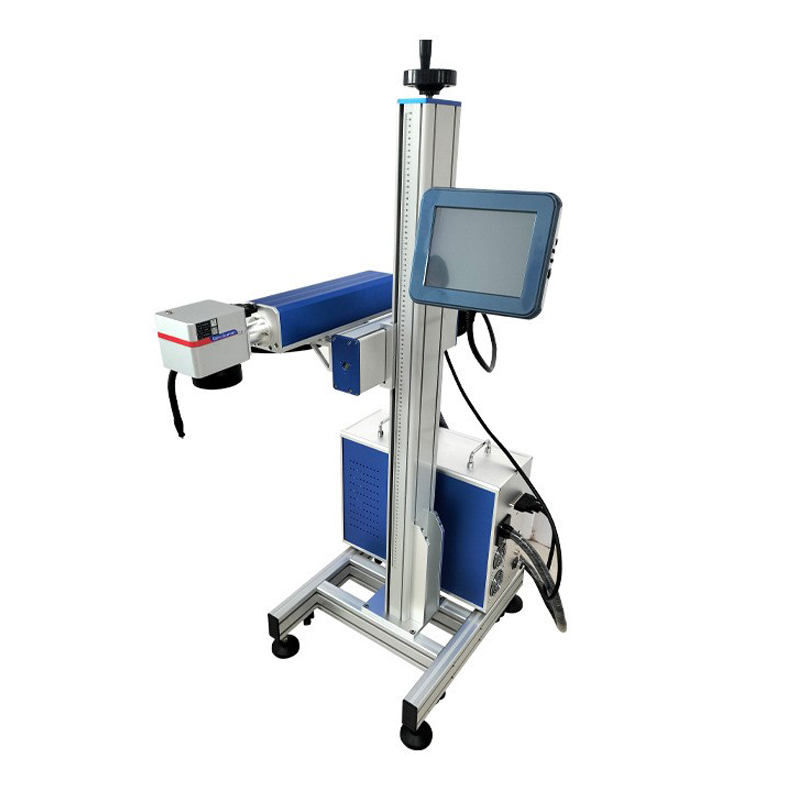
Interface compatibility is not the same as integration readiness. Line integration may also require conveyors, flying brackets, code detection and PC or mobile control devices, and handheld on-site use may require stable fixtures and power or battery accessories. These items shape commissioning time and should be scoped before the purchase order rather than after delivery.
Reading Routine Specifications as Continuity Evidence
Repeatability, marking area, speed and depth are the numbers that decide whether a portable unit fits a line, and they can be verified at incoming inspection rather than accepted on description.
- Repeatability: ±0.001 mm on the benchtop fiber, desktop fiber, desktop UV and desktop CO2 machines; ±0.003 mm on the flying online unit.
- Minimum character size: 0.15 mm across the documented configurations, with a minimum line width of 0.01 mm on the benchtop fiber unit and 0.012 mm on the flying online unit.
- Marking depth: up to 4 mm on the benchtop fiber unit; up to 0.4 mm on the flying online, desktop fiber, UV and CO2 units.
- Marking speed: up to 10,000 mm/s on the desktop fiber, benchtop fiber, UV and CO2 machines; up to 4,000 mm/s on the miniature multi-material unit; a line speed of up to 7,000 mm/s and an output rate of 800 standard characters per second on the flying online unit, with continuous online marking speed of up to 12,000 mm/s.
- Power supply: 90–240 V at 50/60 Hz for the handheld fiber unit; 110–240 V for the desktop UV unit; single-phase AC 90–260 V at 50–60 Hz for the flying online unit.
These values belong in a supplier evaluation rather than a catalogue comparison because they are measurable. Repeatability is stated as an inspection parameter, which means a buyer can define an acceptance test around it instead of relying on a demonstration. Marking area, in turn, sets the fixture design: the handheld and desktop UV units are documented at 110 x 110 mm, the benchtop unit at 150 x 150 mm, the desktop fiber unit optionally at 150 x 150 mm, 175 x 175 mm or 200 x 200 mm, and the miniature unit at 55 x 55 mm.
Application Fit: Where Portable Marking Is the Right Answer
The documented application range covers mechanical parts processing, electronic and electrical production, medical equipment, advertising signs, building materials, hardware parts, auto parts, pipes and profiles, jewelry, gifts and crafts. The pattern behind that list is the reason portable marking exists: the unit travels to the part.
- Pipes, profiles and large workpieces that cannot be moved to a fixed station are handheld territory.
- Auto parts, mechanical parts and hardware benefit from the combination of speed and repeatability — up to 10,000 mm/s with ±0.001 mm repeatability in the desktop and benchtop formats.
- Electronic components and other heat-sensitive parts are the documented case for UV cold processing.
- Jewelry, 3C accessories, gifts and crafts are served by the 2.7 kg miniature configuration, with a 55 x 55 mm scanning area and a switchable 1064 nm / 455 nm source.
- Packaging, food and beverage, pharmaceutical and daily chemical lines use the flying online and CO2 formats for non-metallic substrates and moving workpieces.

Documented case results for this equipment include 99.9% scanning accuracy for 2D QR codes and barcodes, logos and text recorded at 100% sharpness with 0% distortion, serial numbers and batch or date codes described as wear-resistant and tamper-proof up to 1000°C, and ultra-fine marking down to 10 microns with zero thermal damage to sensitive components. Service relationships in the same case records run 3–6 years alongside a one-year warranty. These are supplier-reported case data; their value in a procurement file is that they define what the supplier is willing to be measured against.
Market Context and an Honest Data Gap
The market data available for this category is directionally clear but not granular enough to carry a purchase decision on its own. The global laser marking machine market is estimated at USD 4.4 billion in 2026. Fiber laser technology held a 46.1% revenue share in 2025, and Asia Pacific accounted for approximately 44% of that revenue. Published growth forecasts diverge: one commercial source cites a CAGR of 7.4%, while another cites 11.84% for the 2026–2035 window, most likely because coding and marking equipment are counted differently.
The honest gap is that the revenue share of portable and handheld units within the total laser marking market is not separately quantified in the available data. Buyers should therefore treat category growth as context and evaluate suppliers on configuration evidence, certification scope and lifecycle support — the factors that can actually be verified before an order is placed.
Comparison With Conventional Approaches, and Where Portable Units Stop
| Technology | Documented power | Material fit | Practical boundary |
|---|---|---|---|
| Fiber 1064 nm | 20–100W | Metals, alloys, painted metal, PVC, acrylic, leather | Not the cold-processing option for heat-sensitive substrates |
| UV 355 nm | 3W / 5W | PE and PVC plastics, glass, film, packaging, composites | Depth documented at under 0.4 mm; external chiller required |
| CO2 10.6 µm | 40W | Glass, leather, cardboard and paper boxes, PET bottles, wood | Non-metallic materials only |
Compared with conventional contact and ink-based marking approaches, the documented laser configurations remove the consumable stream, which generally reduces recurring operating inputs. That comparison holds only if three conditions are met: the material absorbs the chosen wavelength, the required mark depth is within the documented range, and the marking area covers the part.
- Marking area ceiling. The handheld and desktop UV units are documented at 110 x 110 mm and the miniature unit at 55 x 55 mm. Parts or panels beyond those areas need a larger-format machine or repositioning fixtures.
- Depth ceiling. Portable UV and the desktop formats are documented at up to 0.4 mm marking depth. Deep engraving requirements point to the benchtop fiber unit, documented up to 4 mm.
- Material limits. The CO2 configuration addresses non-metallic materials only, and the UV configuration should be selected for heat-sensitive substrates rather than for maximum throughput.
- Cooling dependency. 24-hour continuous operation depends on model and cooling, and the UV configuration requires the external DWUV-05 chiller, which adds a maintenance item.
- Power and duty cycle. Handheld and miniature units rely on built-in lithium batteries, which suits on-site work but is not a direct substitute for a line-powered inline unit.
- Supply terms. Minimum order quantity is 5 units and lead time is scheduled by order volume, so installation dates should be confirmed against the production schedule. After-sales technical support is provided in English.
Future Outlook
The direction of the category is toward marking as a data step rather than a finishing step. Variable data marking for text, logos, barcodes, QR codes and serial numbers is already documented across these configurations, and the traceability expectation behind those marks is what drives the move from intermittent to continuous operation.
Two secondary trends are visible in the data. The first is portability. Third-party product guidance places handheld and portable laser marking machines typically between 15 and 35 pounds (approximately 6.8 to 15.8 kg); documented units here include a handheld fiber machine of about 6 kg and a miniature multi-material machine of 2.7 kg, which indicates where the lighter end of the category sits. The second is compliance lifecycle management: a CE Declaration of Conformity valid to 2029-08-12 is a procurement calendar entry, not a document to be filed and forgotten. Trade classification also matters for cross-border deployment, with HS code 845611 covering machine tools operated by laser processes.
For buyers, the practical implication is that supplier evaluation will increasingly rest on verifiable operational evidence — a rated laser life of approximately 100,000 hours on the handheld fiber unit and 150,000 hours on the flying online unit, air-cooled configurations where infrastructure is limited, and certification records that name the exact model — rather than on headline specifications and purchase price.
Frequently Asked Questions
Which certification documents should a buyer verify before ordering a portable laser marking machine?
In the United States, laser products must comply with FDA 21 CFR Subchapter J (Radiological Health) Parts 1000 through 1005; in the EU, a CE Declaration of Conformity is the reference. For the handheld fiber laser marking machine, the FDA Radiological Health Electronic Submission Confirmation is numbered 2211928-000, issued by CCTS (Shenzhen Zhongan Quality Inspection and Certification Co., Ltd.) under Title 21 CFR Part 1002, applicable to the United States market. The CE Declaration of Conformity is numbered M.2024.206.C105275, issued by UDEM International Certification Auditing Training Centre Industry and Trade Inc., valid from 2024-08-12 to 2029-08-12, applicable to the EU market. Buyers should confirm that the certificate scope names the exact model being purchased.
Does cooling configuration affect whether a portable laser marking machine can run continuously?
Yes. Documented application data states that 24-hour continuous industrial operation depends on the model and cooling configuration. Air-cooled configurations include the handheld fiber unit, the benchtop fiber unit, the desktop fiber unit, the flying online unit and the desktop CO2 unit. The desktop UV (355 nm) unit uses an external industrial water chiller, with DWUV-05 included. Air cooling removes a maintained component from the installation; water cooling introduces one that has to be scheduled.
What laser power and wavelength options exist across portable and desktop formats?
Handheld fiber: 20W / 30W / 50W / 60W at 1064 nm. Miniature multi-material: switchable 1064 nm / 455 nm dual source with a power regulation range of 25–100. Benchtop fiber: 20W / 30W / 50W at 1064 nm. Desktop fiber: 20W / 30W / 50W / 100W at 1064 nm. Desktop UV: 3W or 5W at 355 nm. Desktop CO2: 40W at 10.6 µm. The flying online unit is documented as a 1064 nm fiber system.
Are portable laser marking machines consumable-free?
The documented configurations describe zero-consumable marking for the flying online, desktop fiber, desktop CO2, benchtop fiber and UV machines, where marking is performed by the laser source and galvanometer scanning system rather than by ink, solvent or pads. The recurring requirements are electricity and, where applicable, cooling. The handheld and miniature units use built-in lithium batteries, so charging is a routine consideration for cordless work.
How do portable laser marking machines connect to existing control systems?
A standard USB interface is documented across the configurations. The handheld fiber unit runs a Linux system with a 7-inch touch screen and supports Bluetooth, WiFi and mobile APP, and imports JPG, PNG, BMP, SVG, PLT, DXF, Excel, TXT, barcode and QR code files. The flying online unit uses touch screen PC control with standard USB and includes a built-in touch screen computer and an adjustable lifting column. The benchtop fiber unit lists Windows XP with standard USB. Line integration may additionally require conveyors, flying brackets, code detection and PC or mobile control devices.
What should buyers check for long-term lifecycle and after-sales support?
Documented evidence includes pre-shipment ageing tests and precision calibration on all equipment, a one-year warranty, and full English after-sales technical support. Case records state service relationships lasting 3–6 years. Rated laser life is approximately 100,000 hours for the handheld fiber unit and 150,000 hours for the flying online unit. Minimum order quantity is 5 units and lead time is scheduled by order volume, so buyers working to a fixed installation date should confirm scheduling before committing.
A consolidated specification and certification summary for the handheld, benchtop, desktop, flying online, UV and CO2 configurations is available in the English product brochure: Download the product brochure (PDF).