
Portable Laser Marking Qualification Matrix: UV, Fiber, Handheld
Portable Laser Marking Qualification Matrix: UV, Fiber, Handheld
Qualification is a per-configuration question
A portable laser marking machine is qualified when a buyer can attach a specific, checkable evidence item to one specific configuration. The category label does not do that work. Four formats dominate current procurement files — a desktop 355 nm UV marker, a miniature dual-source 1064/455 nm marker, a handheld 1064 nm fiber marker, and benchtop or flying 1064 nm fiber markers installed on a line — and they differ in wavelength, power, cooling, control interface and documentation scope. A single acceptance checklist written for one of them will misdescribe the other three.
The practical instrument is a qualification matrix. Rows hold the configurations under evaluation. Columns hold the parameters that must be evidenced: optical specification, working envelope, cooling and power, control interface, safety and compliance documentation, and acceptance method. Each cell contains either a documented value traceable to the supplier's own model record, or an open question that stays open until it is answered in writing.
Why a matrix outperforms a specification sheet
A specification sheet is written to describe capability. A qualification matrix is written to allocate risk. The difference shows up in three places.
First, a spec sheet lists a maximum; a matrix lists the condition under which the maximum holds. Marking depth, minimum character size and marking speed all behave differently on stainless steel, painted aluminium, PE or PVC, and a figure quoted without material and parameter context cannot be accepted as a delivery criterion.
Second, a spec sheet aggregates. Thermoplastic packaging, glass and metal parts may all appear in a single applicability line, while the configuration that meets a heat-sensitive application is a different machine with different cooling and a different footprint. The matrix forces the buyer to name the configuration that will actually be installed.
Third, a spec sheet rarely states which document proves what. Compliance is the clearest example: a supplier may hold a valid declaration for one model in its range, and that declaration does not automatically extend to a UV desktop unit or a flying inline unit ordered at the same time. The matrix column for compliance has to name the model, the market and the document, or the cell stays empty.
What the matrix must contain
Six column groups cover the decisions that appear repeatedly in buyer evaluation files. Each is written to be answerable with a document rather than an opinion.
- Exact model identity. The model designation as it will appear on the purchase order, invoice and nameplate — for example Handheld Fiber Laser Marking Machine, Desktop UV Laser Marking Machine, Miniature Multi-Material Laser Marking Machine, Benchtop Fiber Laser Marking Machine or Flying Online Laser Marking Machine.
- Optical parameters. Wavelength, laser power options, pulse width, beam quality or modulation frequency, and the power-regulation arrangement where one is stated.
- Working envelope. Marking or scanning area, maximum marking depth, minimum line width, minimum character size, repeatability, and focal length where specified.
- Cooling, power and installation. Air cooling or external chiller, overall power consumption, supply voltage and frequency, machine dimensions and weight, and battery arrangement for cordless units.
- Control and interface. Operating system, screen type, wired interfaces, wireless connectivity and supported file formats.
- Evidence class. Certificate or declaration records held for that model, quality records released with shipment, and the acceptance test the buyer will run before releasing final payment.
A matrix built this way produces something a generic comparison cannot: it shows which cells are already closed by documentation and which are still assumptions. In the configurations examined below, the pattern is uneven, and that unevenness is the finding.
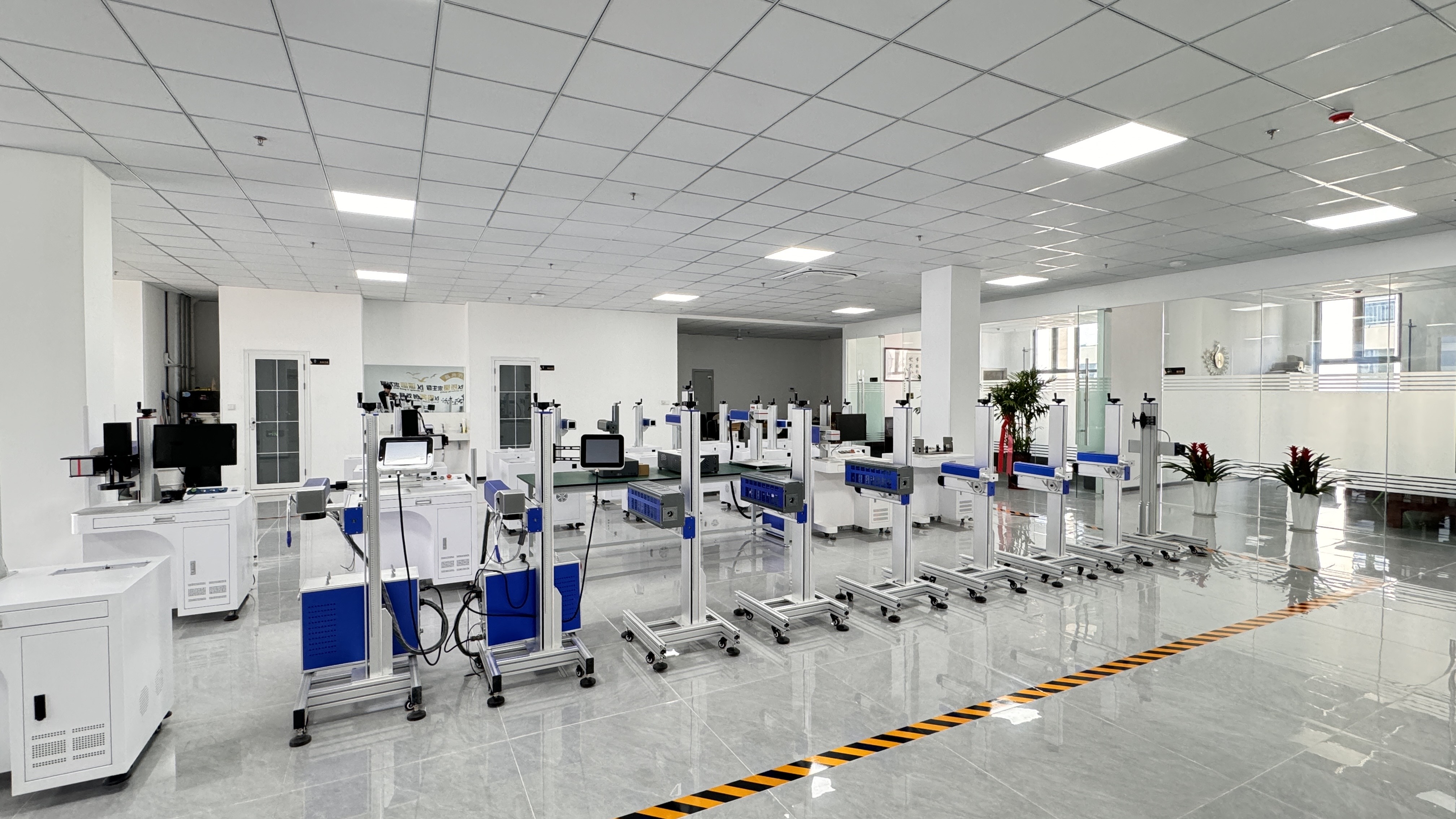
A qualification matrix allocates documented evidence to each configuration before an order is placed, rather than after delivery.
Desktop 355 nm UV: cold processing with a chiller dependency
The Desktop UV Laser Marking Machine is a 355 nm cold-processing configuration. Its stated laser power is 3 W or 5 W, selectable as an option, with a pulse width below 60 ns, beam quality M² below 1.5 in single mode, and a modulation frequency range of 30 kHz to 100 kHz. Marking speed is up to 10,000 mm/s within a 110 mm × 110 mm marking area.
Its working envelope is documented in unusually fine detail, which makes it straightforward to convert into acceptance criteria: maximum marking depth below 0.4 mm, minimum line width 0.4 mm, minimum character size 0.15 mm, and repeatability of ±0.001 mm. The control arrangement is an all-in-one unit with an independent display and a standard USB interface, and the machine is stated to include more than 140 font libraries, with custom fonts addable on request. Variable data marking covers text, logos, barcodes, QR codes and serial numbers.
The constraint that most affects a purchase decision sits in the cooling column. Cooling is an external industrial water chiller, with the DWUV-05 unit included, and overall power consumption is below 400 W on an operating voltage range of 110 V to 240 V. The machine measures 352 mm × 603 mm × 800 mm. Buyers therefore have to plan floor space for the chiller as well as the marking head, and the purchase order should state who is responsible for chiller installation, commissioning and service access. A UV unit quoted without that responsibility assigned is not yet a qualified configuration.
Application fit stated for this model covers PE and PVC plastics, metal parts, building materials, glass, film, packaging and composite materials, with continuous 24/7 operation on automated production lines. That makes it the configuration to examine when a heat-sensitive substrate is the binding constraint — and the wrong default when the task is deep marking on thick steel.
Miniature dual-source 1064/455 nm: the field-size question
The Miniature Multi-Material Laser Marking Machine is the lightest configuration under review at 2.7 kg, and the only one that switches between two light sources: 1064 nm and 455 nm, switchable for multi-material marking. It operates in pulse mode with a gradient power-regulation range of 25–100, runs at up to 4,000 mm/s, and has a stated scene focal length of 133 mm.
Power and control are where its portability is defined. The unit runs on a built-in lithium battery or DC 20 V, with power-bank support, and its overall power is no more than 100 W with air cooling. Operation is through mobile app, PC software or touch screen, and the interface is split into TYPE-A for data and TYPE-C for power. Applicable materials are broad: metals, bamboo and wood, leather, paper, coloured glass, plastics and ceramics, with stated target industries of gifts and crafts, jewellery, customized DIY workshops and 3C electronic accessories.
This configuration is also where the matrix earns its place. The supplied product record states a scanning area of 55 mm × 55 mm in its parameter set, while the scope field states a marking area of 110 mm × 110 mm. Both statements are in the same model record. Neither can be averaged, and neither should be adopted because it is more favourable. In a qualification matrix the cell is marked open, and the purchase order must carry a written confirmation of the effective marking field and the field over which the stated 4,000 mm/s applies.
Handheld fiber: the only configuration with supplied certificate records
The Handheld Fiber Laser Marking Machine is a 1064 nm fiber configuration with a pulse width below 60 ns and power options of 20 W, 30 W, 50 W and 60 W. It runs on Linux with a 7-inch touch screen, supports Bluetooth, WiFi and mobile app operation, uses a built-in lithium battery, and is stated to have a laser life of about 100,000 hours. Its marking area is 110 mm × 110 mm and the unit weighs about 6 kg. Power supply is 90 V–240 V at 50/60 Hz, and cooling is air cooling.
Its control profile is deliberately different from the desktop formats. There is no reliance on an external PC: the file formats accepted include JPG, PNG, BMP, SVG, PLT, DXF, Excel, TXT, barcode and QR code files, which is the interface specification an acceptance test should actually exercise. Material coverage is stated as stainless steel, carbon steel, aluminium oxide, aluminium alloy, aluminium, copper, iron, gold, silver, carbide, painted metal, acrylic, PVC, leather and painted wood.
This is the only configuration in the supplied record set for which certification documents are attached, and the scope of those documents matters to the matrix.
The CE Declaration of Conformity is numbered M.2024.206.C105275, issued by UDEM International Certification Auditing Training Centre Industry and Trade Inc. on 12 August 2024 and valid until 12 August 2029. It applies to the Handheld Fiber Laser Marking Machine and to the European Union market, and it lists EN ISO 12100:2010, EN 60204-1:2018, EN 60825-1:2014+A11:2021, EN ISO 11553-1:2020+A11:2020, EN IEC 61000-3-2:2019+A1:2021+A2:2024, EN 61000-3-3:2013+A2:2019+A2021, EN IEC 61000-6-1:2019 and EN IEC 61000-6-3:2021.
The FDA record is a Radiological Health Electronic Submission Confirmation numbered 2211928-000, issued by CCTS (Shenzhen Zhongan Quality Inspection and Certification Co., Ltd), dated 15 November 2022, applicable to the United States market under Title 21 CFR Part 1002, and it covers the handheld fiber laser marking machine product. No expiry date is listed on that record, so the matrix should record it as a submission confirmation with the model and market it names rather than as a perpetual approval.
The remaining three configurations in this analysis have no comparable certificate record in the supplied material. That is a documentation gap to be resolved by the buyer, not evidence that those models lack certification. The matrix cell reads open, and the request is for the declaration or submission record naming the exact model.
Benchtop and flying fiber: line integration changes the evidence
The Benchtop Fiber Laser Marking Machine is a cabinet-style fiber unit with 20 W, 30 W or 50 W options at 1064 nm, pulse width below 60 ns, marking speed up to 10,000 mm/s, repeatability of ±0.001 mm, minimum line width 0.01 mm and minimum character size 0.15 mm. Cooling is built-in air cooling, overall power is below 400 W, and the operating system and interface are listed as Windows XP with standard USB. It is supplied as an integrated workbench with a large display screen, built-in control panel and keyboard drawer, intended for industrial production lines.
Two entries in its record need to be read carefully rather than copied into a comparison table. The parameter set states a marking area of 150 mm × 150 mm, while the scope field states 110 mm × 110 mm with an optional 150 mm × 150 mm. The parameter set also states a maximum marking depth up to 4 mm, which is an order of magnitude above the sub-0.4 mm depth stated for the UV and desktop fiber units. A depth figure at that level is material- and parameter-dependent, so the matrix records it as a claim requiring test conditions — material, power setting, pass count and measurement method — before it becomes an acceptance criterion.
The Flying Online Laser Marking Machine is the inline member of the same family and shows why speed columns are so often misread. Its record lists a line speed up to 7,000 mm/s in the parameter set and a marking speed of ≤12,000 mm/s in continuous online operation in the scope field. These describe different quantities: the speed of the workpiece moving past the head, and the speed of the beam deflection system. A buyer comparing them as if they were one figure will draw the wrong conclusion about throughput. Other documented characteristics are 1064 nm wavelength, M² below 2, pulse frequency of 20 kHz to 100 kHz, laser lifespan of 150,000 hours, marking area of 110 mm × 110 mm or 150 mm × 150 mm optional, output rate of 800 standard characters per second, engraving depth up to 0.4 mm, minimum line width 0.012 mm, minimum character 0.15 mm, focal spot diameter 0.01 mm, repeatability ±0.003 mm, built-in air cooling, overall consumption of 400 W or less, single-phase AC 90 V–260 V at 50/60 Hz, standard USB and touch-screen PC control, main unit dimensions of 500 mm × 500 mm × 300 mm and overall machine dimensions of 1470 mm × 580 mm × 840 mm.
For both units, the evidence that matters is integration evidence: conveyor or flying bracket specification, code-detection arrangement, PC or mobile control link, and the acceptance test run at production line speed rather than at a bench. Note also that the flying unit's repeatability is stated as ±0.003 mm while the UV, desktop fiber and benchtop units are stated at ±0.001 mm — a difference worth recording explicitly rather than smoothing over.
The matrix at a glance
| Configuration | Optical and power | Working envelope | Cooling and supply | Control and interface | Evidence to request |
|---|---|---|---|---|---|
| Desktop UV Laser Marking Machine | 355 nm, pulse width below 60 ns, 3 W or 5 W, M² below 1.5 single mode, 30–100 kHz | 110 mm × 110 mm; depth below 0.4 mm; min. line 0.4 mm; min. character 0.15 mm; ±0.001 mm | External industrial water chiller (DWUV-05 included); below 400 W; 110–240 V | Standard USB; independent display; 140+ font libraries | Model-specific optical safety file; chiller installation terms; area and repeatability acceptance record |
| Miniature Multi-Material Laser Marking Machine | 1064 nm and 455 nm switchable, pulse; power regulation 25–100; up to 4,000 mm/s; focal length 133 mm | Scanning area 55 mm × 55 mm stated in parameters; 110 mm × 110 mm stated in scope | Air cooling; ≤100 W; built-in lithium battery or DC 20 V with power-bank support | Mobile app, PC software, touch screen; TYPE-A data, TYPE-C power | Written confirmation of effective marking field; battery and charger documentation |
| Handheld Fiber Laser Marking Machine | 1064 nm, pulse width below 60 ns, 20/30/50/60 W; laser life about 100,000 h | 110 mm × 110 mm marking area; unit weight about 6 kg | Air cooling; built-in lithium battery; 90–240 V, 50/60 Hz | Linux; 7-inch touch screen; Bluetooth, WiFi, mobile app | CE DoC M.2024.206.C105275; FDA confirmation 2211928-000; battery file; on-site fixture plan |
| Benchtop Fiber Laser Marking Machine | 1064 nm, pulse width below 60 ns, 20/30/50 W; up to 10,000 mm/s | 150 mm × 150 mm stated in parameters; 110 mm × 110 mm with optional 150 mm × 150 mm in scope; depth up to 4 mm | Built-in air cooling; below 400 W | Windows XP; standard USB; integrated display and control panel | Depth claim test conditions; marking-field confirmation; workstation integration checklist |
| Flying Online Laser Marking Machine | 1064 nm, M² below 2, 20–100 kHz; lifespan 150,000 h; 800 characters per second | 110 mm × 110 mm or 150 mm × 150 mm optional; line speed up to 7,000 mm/s; depth up to 0.4 mm; ±0.003 mm | Built-in air cooling; ≤400 W; single-phase AC 90–260 V, 50/60 Hz | Standard USB; touch-screen PC control; built-in touch screen computer and lifting column | Conveyor and bracket specification; definition of line speed versus marking speed; line-speed acceptance run |
Values above are transcribed from the configurations discussed in this article. Where a model record states two different figures for the same parameter, both are shown so the discrepancy is visible rather than resolved by assumption.
Acceptance criteria and purchase-order terms
Acceptance criteria are what convert a matrix row into a contractual obligation. They should be written before the order is placed, and they should name the model, the material, the parameter set and the pass rule.
Test coupon and material. The buyer supplies the actual substrate — stainless steel, painted aluminium, PE, PVC, glass or a coated composite — in the finish that will be marked in production. A coupon of a different grade or surface condition tests the wrong thing, particularly where a UV cold-processing claim is central to the choice.
Marking field verification. The stated area should be checked at the working extremes of the field, not only at the centre, because the mark quality a buyer accepts in the middle of a 110 mm × 110 mm field is not automatically reproduced at its corners. For the miniature and benchtop units, the field figure itself must first be confirmed in writing.
Repeatability and fine-detail check. The ±0.001 mm repeatability stated for the UV, desktop fiber and benchtop units, and the ±0.003 mm stated for the flying unit, should be tied to a named measurement method and instrument. Minimum line width and minimum character size — 0.4 mm and 0.15 mm on the UV unit, 0.01 mm and 0.15 mm on the benchtop unit, 0.012 mm and 0.15 mm on the flying unit — give the acceptance test a defined lower bound.
Data and interface test. The interface column only qualifies the machine if it is exercised. On the handheld unit that means importing the file types the record lists — JPG, PNG, BMP, SVG, PLT, DXF, Excel, TXT, barcode and QR code — and confirming Bluetooth, WiFi and app operation. On the UV unit it means variable data marking of text, logos, barcodes, QR codes and serial numbers plus the custom font request path. On the flying unit it means code detection and the bracket or conveyor link at production speed.
Documents released with shipment. The supplier's stated quality process is that all machines undergo strict aging tests and precision calibration before delivery. The purchase order should name the records that prove it — inspection and calibration record with model and serial number, safety file, packing list — and should tie each certificate record to the serial number of the delivered unit rather than to the product family.
Commercial terms to fix in the order. The supplier's stated minimum order quantity is 5, with lead time subject to factory scheduling by order volume, and full English after-sales technical support is stated. The supplied case record also lists a one-year warranty, which should be confirmed for the specific order rather than assumed. Where the goods cross a border, HS code 845611 is the primary classification for machine tools operated by laser processes, and the commercial invoice should be consistent with it.
Optical radiation and electrical safety documentation
Safety documentation is the column buyers most often leave thin, and it is the column that most often blocks clearance. Three evidence sets belong in it.
Laser and optical radiation. The declared laser class should appear on the machine label and in the safety file for the exact configuration, and the buyer should require that declaration rather than infer a class from the product family. The supplied CE declaration for the handheld fiber unit lists EN 60825-1:2014+A11:2021 and EN ISO 11553-1:2020+A11:2020, alongside EN ISO 12100:2010 for risk assessment. Separately, published industry guidance describes EN ISO 11553-2 as the part addressing hand-held laser processing machine safety. Those are different documents, and a matrix should record which part the supplier applies to which configuration, including any enclosure, viewing window or interlock arrangement that the buyer is relying on. Optical risk also extends to reflected beam paths in on-site marking of large or immovable workpieces, which is precisely where a handheld configuration is chosen.
Electrical and high-voltage safety. EN 60204-1:2018 appears in the same CE declaration and covers electrical equipment of machines. The matrix should record the supply arrangement actually delivered: 110 V–240 V for the UV unit, 90 V–240 V at 50/60 Hz for the handheld unit, and single-phase AC 90 V–260 V at 50/60 Hz for the flying unit, with the chiller's own supply requirement listed separately for the UV configuration. It should also record who is permitted to open the electrical cabinet, since internal service work is a qualified-person activity rather than an operator task. On the EMC side, the CE declaration lists EN IEC 61000-6-1:2019 and EN IEC 61000-6-3:2021 together with the harmonic and flicker standards EN IEC 61000-3-2:2019+A1:2021+A2:2024 and EN 61000-3-3:2013+A2:2019+A2021 — relevant when a unit is installed beside other line equipment.
US market records. Products sold in the United States must comply with FDA 21 CFR Subchapter J (Radiological Health), Parts 1000 through 1005. The handheld unit's submission confirmation references Title 21 CFR Part 1002 specifically, so the matrix should show the part cited, the record number and the model it covers, and treat product-report or record-keeping obligations as separate line items where the supplier has not stated them.
Battery and charging. Two configurations are cordless: the handheld unit on a built-in lithium battery, and the miniature unit on a built-in lithium battery or DC 20 V with power-bank support. The file should include the battery and charger documentation supplied with the unit, the charging arrangement for on-site work, and confirmation of how the machine behaves when operated on mains power while charging. None of this should be assumed from the presence of a battery in the specification.
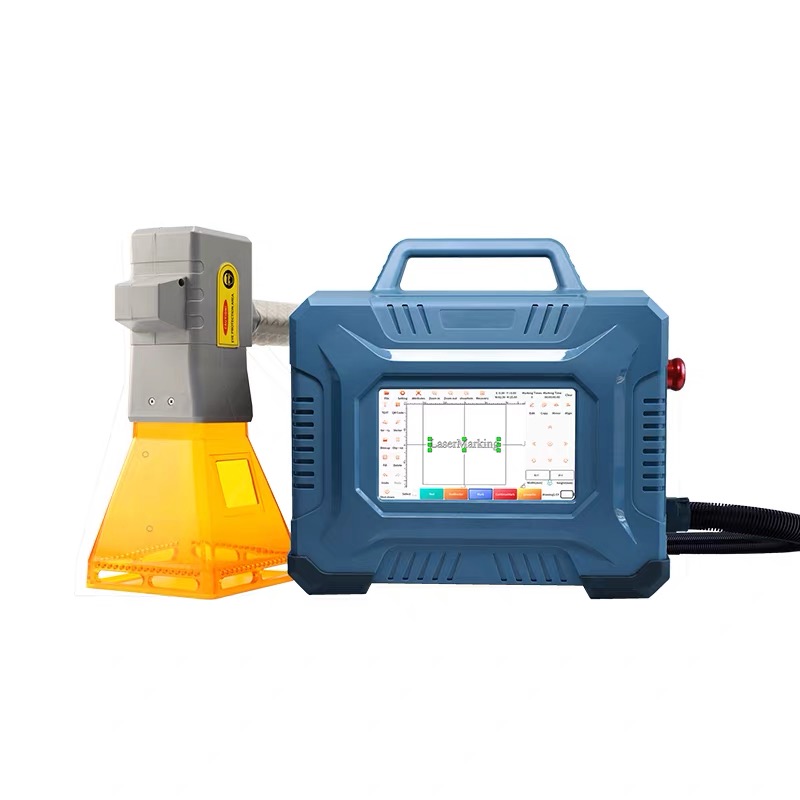
The handheld fiber configuration is the only one in this comparison with certificate records supplied for the exact model.
What the market data does and does not tell a buyer
Grand View Research estimated the global laser marking machine market at USD 4.4 billion in 2026, with fiber laser technology holding a 46.1% revenue share in 2025 and Asia Pacific accounting for approximately 44% of revenue. Those figures describe the scale and technology mix of the category; they do not describe the portable segment, because a specific revenue share for portable or handheld units is not established in the available data.
That gap is worth stating plainly in a procurement file. It means a buyer cannot justify a portable configuration by citing category growth. The justification has to come from the application: an immovable workpiece, a line that cannot be stopped, a heat-sensitive substrate, or an on-site marking task where transporting the part to a fixed station costs more than the marking itself.
The same caution applies to weight. One published guide to portable laser marking machines describes handheld units as typically weighing between 15 and 35 pounds, roughly 6.8 to 15.8 kg. The configurations discussed here sit at the light end of or below that band — about 6 kg for the handheld fiber unit and 2.7 kg for the miniature dual-source unit. A category weight range is therefore context, not a specification. The matrix should carry the measured weight of the exact unit, because weight is what determines whether a configuration is genuinely portable for the operator who will carry it.
Fit boundaries that belong in the matrix
Each configuration carries a boundary that belongs in the same row as its advantages.
The desktop UV unit is the fit for heat-sensitive and fine-detail work on plastics, glass, film, packaging and composites, and it is stated for continuous 24/7 operation. Its boundary is the external water chiller, which adds installation space and a service dependency, and a 110 mm × 110 mm field that will not suit large panels.
The miniature dual-source unit is the fit for gifts, crafts, jewellery, DIY workshops and 3C accessories, where 2.7 kg and Type-C power matter more than throughput. Its boundary is that the effective marking field is not unambiguously stated in its own record, and that the 4,000 mm/s figure needs a defined field and material before it means anything in production.
The handheld fiber unit is the fit for on-site work on large, installed or immovable parts, with a built-in battery and app-based control. Its boundary is a 110 mm × 110 mm field and a battery regime that has to be planned into the working day; its strength is that it is the one configuration here with certificate records naming the exact model.
The benchtop and flying fiber units are the fit for line integration and continuous operation, with the flying unit adding conveyor-based marking of moving workpieces. Their boundary is that they are fixed installations: integration evidence, bracket or conveyor specification and control-PC arrangements are part of the purchase, and the benchtop unit's stated Windows XP control environment should be confirmed against the buyer's own IT and maintenance policy before it is accepted as the long-term operating arrangement.
Outlook: the evidence becomes the specification
The direction of travel in this category is not a new wavelength. It is a shift in what a purchase order is expected to contain. As buyers compare UV, dual-source, handheld and inline fiber formats on the same shortlist, the differentiator stops being the headline power figure and becomes the traceability of each claim — which model, which document, which test, which pass rule.
On that basis, the qualification matrix is not an administrative attachment. It is the document that decides which configuration is actually bought. A supplier that can close more cells with model-specific evidence, including the unresolved field-size and depth questions noted here, is easier to qualify than one that answers with family-level marketing language.
About the supplier
Jinan Yuanshida International Trade Co., Ltd is a Jinan, China-based enterprise specializing in the R&D, production and export of industrial laser marking equipment. Its main products cover handheld, bench-top, desktop and precision laser marking equipment, and its stated export markets include Vietnam, Thailand, Malaysia, Türkiye, the United States, Poland and the Middle East, with exports to more than 80 countries and regions. The company states that machines undergo multiple aging tests and precision calibration before leaving the factory, and it provides customized marking solutions, OEM/ODM services and full English after-sales technical support. Its company profile states compliance with international quality standards including CE, FDA and ISO; the certificate records supplied for this article name the Handheld Fiber Laser Marking Machine specifically, which is why the per-configuration file request described above remains the practical verification step.
FAQ
Which specifications belong in a portable laser marking machine qualification matrix?
At minimum: exact model designation, wavelength, laser power options, pulse width, beam quality or modulation frequency, marking or scanning area, maximum marking depth, minimum line width, minimum character size, repeatability, cooling method, overall power consumption, supply voltage and frequency, control system and interfaces, and the certificate or declaration records held for that exact model. Each entry should be traceable to a model-specific statement rather than a family description.
What acceptance evidence should a purchase order require?
An agreed test coupon in the buyer's own material and finish, marking field verification across the working area, a named measurement method for the repeatability figure, fine-detail checks against the stated minimum line width and minimum character size, an interface test covering the file formats and wireless functions the machine claims, and shipment records that tie the inspection and calibration result to the delivered serial number.
How should buyers verify laser safety and electrical safety documentation?
Request the declared laser class on the label and in the safety file for the exact configuration, and confirm which standards the supplier applies to it. The supplied CE declaration for the handheld fiber unit lists EN 60825-1:2014+A11:2021, EN ISO 11553-1:2020+A11:2020, EN ISO 12100:2010 and EN 60204-1:2018, while published industry guidance separately describes EN ISO 11553-2 as the part addressing hand-held laser processing machines. For the United States, the applicable framework is FDA 21 CFR Subchapter J, Parts 1000 through 1005, and the handheld record cites Title 21 CFR Part 1002. Record which document covers which model and market.
What should buyers check about cooling and power for UV versus fiber configurations?
The desktop UV configuration uses an external industrial water chiller, with the DWUV-05 included, and consumes below 400 W at 110 V–240 V, so chiller placement and service access belong in the installation plan. The handheld fiber unit uses air cooling with a built-in lithium battery at 90 V–240 V, 50/60 Hz; the benchtop fiber unit uses built-in air cooling below 400 W; and the flying unit uses built-in air cooling at 400 W or less on single-phase AC 90 V–260 V, 50/60 Hz. Cooling method changes installation requirements, not just the specification sheet.
How should battery-powered handheld configurations be qualified?
Treat the battery and charger as documented components rather than as a feature bullet. The matrix should record the battery arrangement, the charging method for on-site work, and the file supplied with the charger, and it should state how the machine is operated when connected to mains power while charging. For the miniature unit, which accepts a built-in lithium battery or DC 20 V with power-bank support, the Type-C power interface should be part of the same test.
The supplier's English-language product brochure covering its marking machine range is available for download: Download the product brochure (PDF).
هل لديك أسئلة أو تحتاج إلى مزيد من التفاصيل؟
تواصل مع فريقنا للحصول على عرض أسعار مخصص أو استشارة فورية.
طلب عرض أسعار
املأ النموذج أدناه وسيتواصل معك فريقنا بعرض مقترح مخصص.
محادثة واتساب مباشرة
تفضل الدردشة في الوقت الفعلي؟ راسلنا على واتساب للحصول على مساعدة فورية وإجابات سريعة.
- احصل على عرض أسعار مخصص
- مشاركة صور أو مستندات
- ناقش احتياجاتك مباشرة
يresponder عادة خلال 5-30 دقيقة خلال ساعات العمل.