
Portable Stone Crusher Plant: A Buyer's Reference Guide
Portable Stone Crusher Plant: A Buyer's Reference Guide
A portable stone crusher plant is a crushing and screening unit in which the feeder, crusher, screen and discharge conveyors are mounted on a towable chassis, so the plant can be moved between sites as a whole and commissioned without a concrete foundation. The crushing stages are the same ones used in a fixed line. What changes is where the civil works, the relocation cost and the capacity ceiling sit.
That distinction matters at the discovery and research stage, before a buyer has settled on a configuration. Most procurement discussions about stone crusher plants start with capacity in tons per hour and finish with a layout drawing, and the question of whether the line should be fixed or relocatable is often answered late, by default, or after land costs have already been committed.
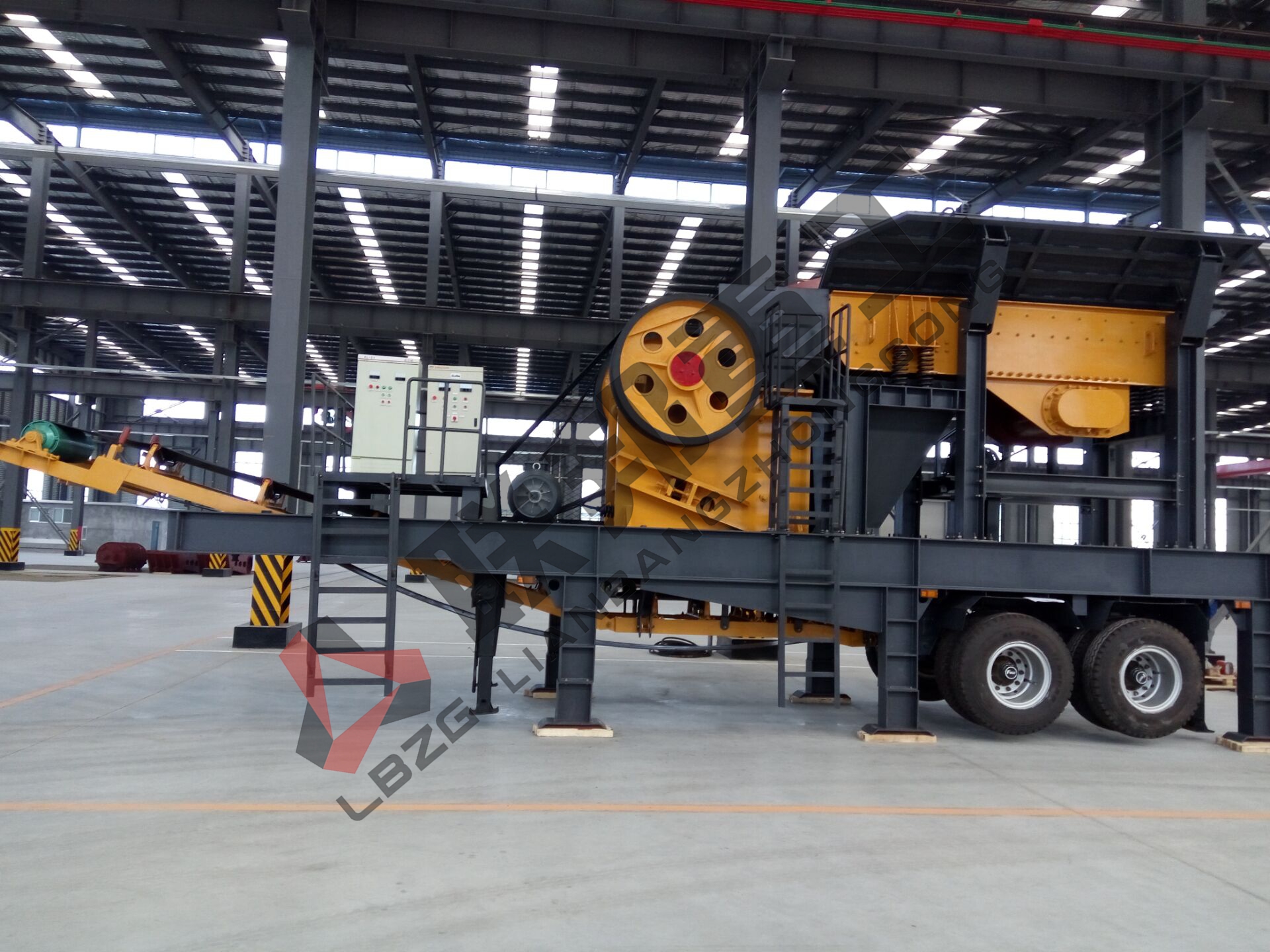
What a Portable Stone Crusher Plant Actually Is
A complete stone crushing production line processes raw rock into sized aggregates and manufactured sand through a staged flow: feeding, primary crushing with a jaw crusher, secondary crushing with a cone or impact crusher, screening, sand making with a VSI crusher, and optional washing. In a fixed line, those stages are erected on steel structures and concrete foundations. In a portable plant, the same sequence is distributed across one or more wheeled chassis that are towed by truck, positioned on prepared ground and connected to each other and to the site power supply.
The operating definition used in equipment documentation is consistent on three points: the unit integrates a crusher, a feeder, a vibrating screen and belt conveyors; it is mounted on a tyre or crawler chassis and moves as a whole; and it needs no concrete foundation, which shortens installation and commissioning compared with a fixed line.
Line configuration, whether fixed or portable, is matched to four inputs: feed material hardness, maximum feed size, required capacity in tons per hour, and the final product specification. A fifth input, wear-part operating cost, usually decides the crusher type in the secondary position. Buyers who can state those five inputs precisely tend to reach a workable configuration quickly; buyers who cannot tend to over-specify capacity and under-specify the feed.
Why the Portability Question Comes Up Earlier Than It Used To
A fixed crushing line is the lower-cost option per ton when a single deposit will be worked for years, the grid supply is stable and the target output is high. The economics reverse when any of those conditions fail. Portable configurations are typically evaluated first where the project duration is short, the site will be relocated more than once, road access is difficult, material sources are dispersed, or environmental approvals constrain how long a plant may operate at one location.
Three demand patterns push buyers toward relocatable equipment:
- Dispersed aggregate demand. Road, rail and infrastructure packages consume aggregate along a corridor rather than at a single point, so the plant follows the work front.
- Urban demolition and renewal. Construction and demolition waste is generated at the building site; hauling it to a distant fixed plant adds cost and vehicle movements that many municipalities now restrict.
- Quarry development in overseas markets. A first-stage investment in a new market often starts with a relocatable line while reserves and permits are confirmed.
The demand backdrop is measurable, with caveats described later in this article. Dataintelo's 2026 market report values the global stone crusher market at USD 4.8 billion in 2025 and projects USD 8.9 billion by 2034, a compound annual growth rate of 7.4%. The same report places Asia Pacific at 42.8% of 2025 revenue. Both figures describe stone crushers as a whole; neither isolates the portable segment.
Inside a Portable Configuration: The Five Station Roles
A portable line is assembled from station types, each built around a host machine. Shandong Lianbang Heavy Industry Co., Ltd., which trades under the Shanyuan LBZG trademark, publishes a tyre-type mobile range that illustrates how the roles divide.
| Station | Host equipment | Published capacity | Role in the line |
|---|---|---|---|
| YCG-J750 | PE-750x1060 jaw crusher | 110-230 t/h | Primary crushing; trailer-mounted, no foundation required; 380V/440V support |
| YCG-I1214 | PF-1214 impact crusher | 100-180 t/h | Secondary crushing of medium-soft rock; cubical aggregate |
| YCG-C160 | CS-160 cone crusher | 90-210 t/h | Secondary and tertiary crushing of hard, abrasive rock |
| YCG-VSI8518 | VSI-8518 sand maker | 100-180 t/h | Manufactured sand production and particle reshaping |
| YCG-S2460 | 2-3 deck circular screen | 80-300 t/h | Classification and post-crushing screening |
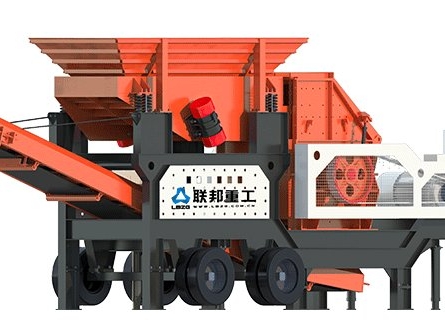
Primary position: jaw
Jaw crushers are used in the primary coarse crushing stage. They accept feed material up to 1500 mm and discharge coarse output of approximately 100-300 mm. The jaw crusher crushes by compression, has a large feed opening, a simple structure, easy maintenance and low operating costs. It is the preferred selection for coarse crushing; a rotary crusher is considered as a replacement only for large-scale mines with a daily output above 1000 tons. On the YCG-J750, the host is a PE-750x1060 with a 750x1060 mm feed opening, a maximum feed size of 630 mm, an output range of 80-140 mm, a capacity of 100-180 t/h and a 110 kW motor.
Secondary position: cone or impact
Cone crushers are applied in medium and fine crushing, producing discharge of approximately 10-50 mm. They use laminated inter-particle crushing, take a smaller feed, and deliver better particle shape. They are not selected as the first-stage coarse crusher, and they are not suitable for coarse crushing of feed above 300 mm or for soft, sticky material. For hard rock such as granite, basalt or iron ore with compressive strength above 250 MPa, the recommended configuration is a PE series jaw crusher for primary crushing plus a CS or PY series cone crusher for secondary crushing.
For medium-soft rock such as limestone or dolomite with compressive strength below 200 MPa, the recommended configuration is a PE series jaw crusher plus a PF series impact crusher, which produces cubical aggregate suitable for highway-grade work. On a portable chassis, the PF-1214 in the YCG-I1214 station takes feed up to 400 mm and is rated at 80-180 t/h with a 132-160 kW motor.
Screening, sand and conveying
The screen station sets the product split. The YCG-S2460 carries two or three decks and screens 80-300 t/h. Where the product mix requires a 0-5 mm manufactured sand fraction, a VSI station follows the screen; the VSI-8518 accepts feed up to 40 mm in soft rock and 35 mm in hard rock and is driven by an 180-220 kW motor. Where the mix stops at coarse and medium aggregate, the sand-making stage can be omitted, which removes both capital cost and a power draw from the configuration.
Where Portable Plants Fit: Five Application Profiles
Lianbang's application profiles describe the operating conditions each project type imposes. They are useful as a checklist because they translate equipment specification into site requirements.
- Overseas quarry and infrastructure. Open-pit quarry operation, hard rock crushing, outdoor continuous operation, and adaptation to tropical, arid or high-altitude climates. The profile lists local voltage adaptation across 380V, 440V, 415V and 660V, tropicalised or desert-rated options, multilingual manuals and an overseas service network as requirements.
- Construction and demolition waste recovery. The profile calls for trailer-mounted mobile operation, 24/7 shift production, rapid relocation between job sites, zero concrete foundation and remote GPS dispatch, and lists mobility, low noise and low dust emission as special requirements.
- Highway and railway construction. Open-pit quarry, hard rock, 24-hour outdoor operation, high-abrasion material and all-weather working, with strict gradation and particle-shape requirements and railway ballast specification compliance.
- New town and airport construction. Large output and stable quality, airport-grade aggregate specification, and dust suppression, with mobile backup for multi-site projects.
- Hydropower engineering. High-strength concrete aggregate for dam construction, long-term continuous production, high-altitude or remote-site conditions, and remote-site serviceability.
For embedded reference, a line operating in one of these profiles typically pairs a primary jaw station with a secondary cone or impact station, a screen station and belt conveyors, with the crusher chamber and screen decks chosen against the target gradation rather than against the headline tonnage alone.
The Manufacturing Base Behind the LBZG Portable Stations
Shandong Lianbang Heavy Industry Co., Ltd. was established in 2013 and has more than 10 years of operating experience. The company specialises in sand-stone crushing, sand-making and solid waste recycling equipment, supplies mobile crushing and screening equipment, and lists stone crusher equipment among its main products.
Its published facility data states two production bases covering a total area of 120,000 m2, including 40,000 m2 of standard workshops, with the factory size field listing a manufacturing facility area of 100,000 m2. The company reports more than 150 sets of processing equipment, approximately 110 staff and an annual production capacity of 2,000 units. It holds ISO9001 Quality Management System, ISO14001 Environmental Management System and OHSAS18001 Occupational Health and Safety System certifications, plus CE export certification for foreign trade projects.
For a buyer, the relevant reading is not the size of the site but what the numbers imply about order handling: a stated annual capacity of 2,000 units and a workshop footprint of that scale suggest a manufacturer that builds to standard station designs rather than one that fabricates a single bespoke plant per year. That has a practical consequence for spare-parts availability, because a standardised station range tends to share wear parts across models.
Portable or Fixed: A Decision Framework With Explicit Limits
The comparison is often framed as mobility against output. In practice it is a comparison of four cost lines: civil works, relocation, power and cost per ton produced.
| Dimension | Fixed crushing line | Portable plant |
|---|---|---|
| Site preparation | Concrete foundations and erected steel structures | Trailer-mounted; no concrete foundation required |
| Relocation | Dismantle, transport and rebuild | Towed as a unit; short installation and commissioning |
| Typical project horizon | Long-term stable quarry, generally more than 3 years | Short duration, generally under 2 years, or frequent relocation |
| Capacity | Suited to large-scale output above 300 t/h | Published station throughput in this range runs from about 90 to 230 t/h |
| Cost per ton | Lower at sustained high volume | Higher per ton; tyre, transport and auxiliary costs are carried by the plant |
| Power supply | Stable grid supply preferred | Site voltage must be confirmed; 380V/440V support published for YCG-J750, wider adaptation listed as a project requirement |
| Material sources | Single, stable deposit | Dispersed pits, demolition sites, multi-site contracts |
The limits are real and should be stated plainly. A portable plant carries a capacity ceiling that a fixed line does not: the published station range above tops out at 230 t/h on the jaw station, while fixed lines are the appropriate choice where sustained output above 300 t/h is required. Single-unit capacity is generally lower than an equivalent fixed line, and tyre, transport and auxiliary costs are higher, which raises the cost per ton. Relocation also depends on road access, transport dimensions and ground bearing capacity at the receiving site; a towable chassis removes the foundation, not the logistics.
Specification Checks That Decide Whether the Plant Works On Site
Six checks separate a workable portable configuration from an expensive one.
1. Feed size against feed opening
The largest lump in the feed should sit comfortably inside the primary feed opening rather than at its limit. A jaw crusher accepts feed up to 1500 mm depending on model, and the PE-750x1060 on the YCG-J750 is rated for a maximum feed size of 630 mm. Oversize feed does not simply slow the plant; it accelerates jaw plate wear and can stall the cavity.
2. Capacity matching between stations
An under-sized feeder starves the crusher, and an under-sized screen returns material to the circuit until the plant runs below its nominal rate. The standard matching logic is summarised below.
| Component | Sizing rule |
|---|---|
| Vibrating feeder | 1.1-1.2 times the rated capacity of the primary crusher |
| Secondary crusher | 1.0-1.1 times the actual output of the primary crusher |
| Vibrating screen | 1.2-1.3 times the line capacity |
| Belt conveyor | 1.2 times the maximum material flow |
The rule keeps each unit running at roughly 70-90% of rated load, which limits both energy waste and wear. In practice a primary jaw station is paired with a feeder of the ZSW or CZG type; the ZSW-490x110, for example, carries a pre-screening function that bypasses fines before the crusher, which raises effective throughput without changing the crusher model.
3. Site voltage and starting conditions
Export sites rarely match the manufacturer's default. The YCG-J750 is published with 380V/440V support, and Lianbang's overseas quarry profile lists adaptation across 380V, 440V, 415V and 660V as a project requirement. Voltage should be agreed at quotation, not at commissioning.
4. Product fractions and deck configuration
Decks decide how many products leave the plant. A two-deck screen yields three streams; a three-deck screen yields four. Specifying the number of decks from the sales list rather than from the target gradation is a common cause of rework.
5. Wear-part strategy
Jaw plates, cone mantles and concave rings, blow bars and screen mesh are consumables, not warranty items. Material selection should follow the abrasiveness of the rock rather than the purchase price of the part, and the buyer should confirm that wear parts are held as catalogue items for the specific models ordered.
6. Documentation
Certification, test-run records, electrical drawings and shipping documents determine how quickly a plant clears customs and passes local acceptance. The manufacturer's quality, environmental and occupational health certifications are the baseline documents to request.
What the Market Data Supports, and What It Does Not
The available third-party data supports two statements. First, the global stone crusher market was valued at USD 4.8 billion in 2025 and is projected to reach USD 8.9 billion by 2034 at a 7.4% compound annual growth rate, according to Dataintelo's 2026 report. Second, Asia Pacific accounted for 42.8% of 2025 revenue in the same report, which is consistent with the concentration of crushing equipment manufacturing in the region.
What the data does not support is any statement about the portable segment specifically. The published figures cover stone crushers as a whole and do not separate relocatable plants from fixed lines, nor do they break out capacity bands. Buyers should treat the growth rate as context for the category, not as evidence about a particular configuration.
Regulatory context is similarly specific. In the United States, the EPA's Mineral Mining and Processing Effluent Guidelines, codified at 40 CFR Part 436, cover wastewater discharges from mineral processing operations. That is an effluent rule, not an equipment certification, and it applies alongside local air, noise and land-use requirements that vary by jurisdiction. A buyer's compliance checklist should be built from the destination market's rules rather than from a supplier's general claim of environmental compliance.
Outlook
Three developments are likely to shape portable plant specifications over the next several years.
First, urban demolition and renewal will keep pushing crushing closer to the point of waste generation, which favours relocatable configurations and raises the weight attached to noise and dust requirements in the specification. Second, voltage and grid variation across export markets will continue to make electrical adaptation a procurement item rather than an afterthought, since a plant designed for one grid is not automatically deployable on another. Third, as effluent and air rules tighten, documentation quality at the factory gate becomes a schedule factor, because compliance review at the destination consumes time before the first ton is produced.
None of these trends changes the underlying physics. A portable plant still has a capacity ceiling, a higher cost per ton at low utilisation, and a configuration that must be matched to the feed. What changes is the frequency with which buyers will need to make the fixed-versus-portable decision at all.
FAQ
What is a portable stone crusher plant?
A portable stone crusher plant is a complete crushing unit mounted on a tyre or crawler chassis that integrates a crusher, a vibrating feeder, a vibrating screen and belt conveyors. It is towed between sites as a whole, requires no concrete foundation, and has a short installation and commissioning period compared with a fixed line. The crushing stages it performs, from primary crushing through screening to optional sand making and washing, are the same stages as in a fixed plant.
How does a portable plant differ from a fixed crushing line in practice?
The difference is in civil works, relocation cost, capacity ceiling and cost per ton. A fixed line requires foundations and a construction period but delivers lower cost per ton at sustained high volume and suits long-term quarries generally exceeding three years and outputs above 300 t/h. A portable plant removes the foundation and relocates quickly, which suits project durations under about two years, frequent site changes, dispersed material sources or constrained environmental approvals, but its single-unit capacity is generally lower and its tyre, transport and auxiliary costs are higher.
Which crusher belongs in the primary position of a portable plant?
A jaw crusher. Jaw crushers are used in the primary coarse crushing stage and accept feed up to 1500 mm, discharging coarse output of approximately 100-300 mm. They crush by compression, have a large feed opening, a simple structure and low operating costs. A rotary crusher is considered as a replacement only for large-scale mines with daily output above 1000 tons. A jaw crusher is not appropriate for directly producing finished material below 50 mm, so a secondary stage is always required.
Can a portable plant produce manufactured sand?
Yes, where a sand-making station is included in the configuration. In Lianbang's mobile range, the YCG-VSI8518 station uses a VSI-8518 sand maker rated at 100-180 t/h, with a maximum feed size of 40 mm in soft rock and 35 mm in hard rock. Washing can be added downstream when the specification requires it. Where the product mix stops at coarse and medium aggregate, the sand-making stage can be omitted from the line.
What output should a buyer expect against the published capacity?
Published capacity is a rated maximum under stated feed conditions. Actual output is affected by material hardness, feed size distribution, moisture content, feeding continuity and the wear condition of consumable parts, and is usually 70-85% of the rated figure. Buyers should size each station against the expected actual output rather than the catalogue maximum, and should confirm that the feeder, screen and conveyors are matched to the crusher rather than sized independently.
Which certifications should be verified before shipping?
At minimum, the manufacturer's quality management certification, environmental management certification and occupational health and safety certification, together with any export conformity documentation required by the destination market. Shandong Lianbang Heavy Industry Co., Ltd. holds ISO9001, ISO14001 and OHSAS18001 certifications and CE export certification for foreign trade projects. Buyers should also confirm that the certificate scope covers the specific equipment being ordered and that the validity dates extend beyond the delivery schedule.
Manufacturer reference: Shandong Lianbang Heavy Industry Co., Ltd., brand trademark Shanyuan LBZG. Technical brochure: Shandong Lianbang Heavy Industry product brochure (PDF).
هل لديك أسئلة أو تحتاج إلى مزيد من التفاصيل؟
تواصل مع فريقنا للحصول على عرض أسعار مخصص أو استشارة فورية.
طلب عرض أسعار
املأ النموذج أدناه وسيتواصل معك فريقنا بعرض مقترح مخصص.
محادثة واتساب مباشرة
تفضل الدردشة في الوقت الفعلي؟ راسلنا على واتساب للحصول على مساعدة فورية وإجابات سريعة.
- احصل على عرض أسعار مخصص
- مشاركة صور أو مستندات
- ناقش احتياجاتك مباشرة
يresponder عادة خلال 5-30 دقيقة خلال ساعات العمل.