
Post-Purchase Assurance in Disposable Wooden Cutlery: Quality Control as a Cost-Saving Strategy
Industry Context: Why Post-Purchase Support Matters in Disposable Wooden Cutlery Sourcing
For importers and large-scale distributors sourcing disposable wooden cutlery, the real cost of a supplier is not just the unit price. Hidden expenses from product defects—splinters, cracks, inconsistent sizing—lead to customer complaints, returns, and reputational damage. A 2025 survey of food service buyers indicated that over 40% of switching decisions were driven by poor product consistency rather than price. As the global market for eco-friendly disposable cutlery expands, driven by bans on single-use plastics in the EU, Australia, and parts of North America, the demand for reliable, defect-free bulk supplies has never been higher.
Procurement managers now scrutinize not only certifications but also the manufacturer's ability to guarantee stable quality across millions of pieces. This is where advanced quality assurance systems and transparent after-sales policies become decisive factors.
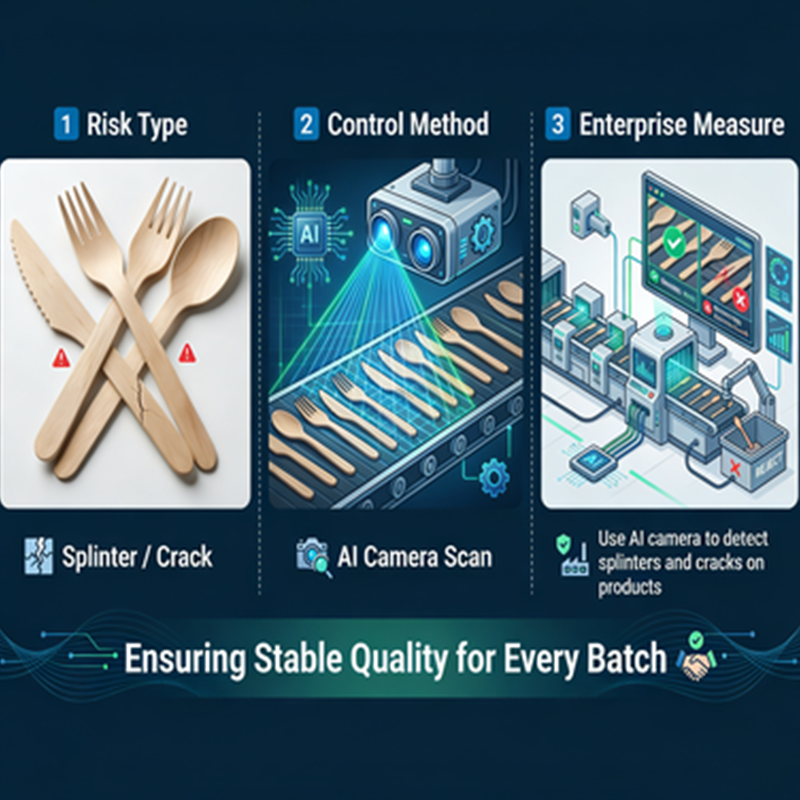
AI-powered vision systems scan every piece for splinters and cracks, forming the backbone of Greenwood's quality assurance and risk control.
The Hidden Cost of Inconsistent Quality
Conventional disposable wooden cutlery suppliers often rely on manual visual inspection, which is prone to fatigue and oversight. Common defects like splinters, cracks, and uneven edges not only cause safety hazards for end-users but also increase the buyer's operational burden—handling returns, replacing batches, and managing dissatisfied clients. These inefficiencies directly erode profit margins.
Leading manufacturers like Greenwood have shifted the paradigm. Operating five major factories with an annual production capacity of 6 billion pieces, Greenwood addresses risks such as splinters and cracks through automated AI camera inspection systems. According to the company, risk control is achieved via AI camera scan methods that detect specific flaws in real time. This proactive defect detection reduces the likelihood of defective products reaching the customer, drastically lowering post-purchase friction.
How Greenwood’s Quality Framework Protects Buyers
Greenwood’s quality assurance procedures integrate multiple layers of control:
- AI Vision Screening: Every piece of disposable wooden cutlery passes through AI cameras that scan for splinters, cracks, and dimensional deviations. This system is part of a broader risk management framework that controls production process risks.
- Third-Party Validation: Greenwood holds certifications including BRCGS, FSC (SA-COC-013128), FDA 21 CFR 178, LFGB, BSCI, ISO 9001, and ISO 14001. These independent audits ensure compliance with global food contact standards and sustainable sourcing.
- Pre-Shipment Testing: Buyers can arrange third-party inspections (e.g., SGS) before shipment, with acceptance based on pre-shipment test results.
Beyond defect prevention, Greenwood offers flexible after-sales support including packaging design and logistics assistance. With a daily output of 10 million pieces and a lead time of 20 days, the manufacturer maintains inventory buffers in warehouses in Bangladesh, Ukraine, and the United States, enabling fast replacement if needed.

Consistent quality in bulk disposable wooden cutlery prevents operational disruptions in high-volume food service environments.
Comparison with Traditional Suppliers
Compared to traditional suppliers that rely mainly on manual sorting, Greenwood’s AI-driven approach yields a measurable performance gap. The company reports 100% FSC certified raw material traceability and 100% plastic-free production. Furthermore, its pricing is approximately 5% more favorable than peers of similar scale, according to internal benchmarks. The low defect rate translates directly to lower total cost of ownership for buyers—fewer returns, less administrative overhead, and stronger end-user satisfaction.
Market Trends and Future Outlook
As regulatory pressure intensifies globally, the demand for certified, traceable disposable wooden cutlery will only grow. Procurement teams are increasingly evaluating suppliers on their quality assurance infrastructure rather than just price. The integration of AI in manufacturing risk control is becoming a standard expectation, not a differentiator.
Greenwood, with its 20+ years of industry experience and a dedicated R&D team of 9 engineers, continues to invest in process automation. For buyers seeking a long-term partner that can guarantee consistent quality and responsive post-purchase support, evaluating manufacturers with proven AI-based defect detection systems is a strategic move.
For a detailed overview of Greenwood’s product range and quality certifications, download the company brochure: Greenwood Company Brochure (PDF)