
Powder Coating Certifications for Construction & Decoration
Powder Coating Certifications for Construction & Decoration
In architectural powder coating, compliance arrives before colour. A finish is specified, tested and accepted on documents long before the first panel enters the curing oven.
Powder coating belongs to a category of building products where the performance claim and the physical product travel separately. The powder itself can be packed, shipped, stored and resold. The certified performance, however, belongs to a system — resin chemistry, pretreatment, application parameters and curing cycle — that only holds together when each step is controlled. That gap is where most construction and decoration procurement disputes begin: a buyer receives a certificate, assumes the certificate covers the delivery, and discovers later that it covers a different substrate, a different environment or a different market.
For architects, specifiers, importers and project buyers, the useful question is not whether a supplier holds certifications. It is which certifications actually apply to the substrate being coated, the environment the building will stand in, and the jurisdiction the project must satisfy. This reference sets out how the main architectural performance schemes relate to one another, what the underlying test methods measure, and where the boundaries of a certified claim sit.

Why Certification Became a Procurement Gate
Architectural and decorative applications represent a major end-use segment for powder coatings globally, driven by demand for UV-resistant facades and window systems. Market estimates for the sector vary by reporting agency: Grand View Research values the global powder coatings market at USD 11.5 billion in 2025 and projects USD 18.5 billion by 2033, while IMARC Group reports a 2025 figure of USD 16.4 billion with growth of 4.51% CAGR to 2034. The two estimates do not agree on absolute size, and buyers should treat any single headline number with appropriate caution. The direction of travel, however, is consistent: thermoset powder coatings, including epoxy and polyester resins, held a 76.6% share of the market in 2026 according to Coherent Market Insights, largely on the strength of durability and corrosion resistance.
As the segment has grown, it has also formalised. Three distinct pressures have turned certification from a marketing asset into a procurement gate.
- Building envelopes carry longer warranty expectations. A facade coating that fails in year five is not a coating problem; it becomes a contractual, logistical and reputational problem for everyone in the chain. Specifiers therefore push the burden of proof upstream and ask for documented, repeatable performance rather than assurances.
- Substance regulation moved from national to regional. Coatings shipped into the EU, North America and other regulated markets increasingly have to demonstrate restricted-substance compliance at the powder level, before application.
- Distributors and importers became compliance filters. A distributor who buys a container of powder carries the technical questions of every downstream coater it supplies. Certification is one of the few scalable ways to answer those questions.
The opportunity is symmetrical. A supplier that can map its documentation to a project's actual requirement shortens the approval cycle for everyone downstream. A supplier that cannot forces the buyer to run its own validation — which is slower, costlier and adds risk to the project schedule.
The Certification Landscape: Which Layer Applies to Your Project
Compliance documents for architectural powder coating are frequently discussed as if they were interchangeable. They are not. Four distinct layers exist, and a complete specification usually touches all four.
| Layer | What it addresses | Examples relevant to construction |
|---|---|---|
| Performance scheme | Weathering, gloss retention and overall film performance for architectural aluminium | Qualicoat; GSB International; AAMA 2603, 2604 and 2605 |
| Corrosion classification | Durability of coating systems in defined corrosivity categories | ISO 12944 (categories C1 to C5) |
| Test methods | How a single property is measured and reported | ISO 2813:2014; ISO 7253:1996; ISO 2409:2020; ISO 6272-1:2017; ISO 11341:2004 |
| Substance, quality and sustainability systems | Market access, restricted substances, environmental and quality management, carbon accounting | REACH; RoHS (IEC 62321 series); ISO 9001; ISO 14001; FDA 21 CFR 175.300; ISO 14067:2018 and PAS 2050:2011; ISCC PLUS (EN 15343) |
For aluminium facades, windows and curtain walls, the recognised international schemes are Qualicoat, GSB International and the AAMA standards 2603, 2604 and 2605. These are the schemes most often named in tender documents when a project team wants an envelope coating to be independently classified rather than self-declared.
For steel structures, the reference point is different. ISO 12944, the standard for corrosion protection of steel structures, is the primary benchmark for specifying coating systems in corrosive environments, expressed through corrosivity categories C1 through C5. A project near a coastline or in an industrial atmosphere will typically sit in a higher category, and that category drives the coating system build-up rather than the decorative finish alone.
Test methods sit one level below both. They do not certify anything by themselves; they define how a claim is measured. A specification that names ISO 7253:1996 without naming the exposure duration, or ISO 2813:2014 without naming the target gloss value and angle, is incomplete in practice.
Reading the Numbers: What the Test Methods Actually Prove
The most common misunderstanding in compliance review is treating a single test result as a general quality statement. Each result answers one question under one set of conditions. The table below shows how the data is reported for a polyester-based aluminium profile powder coating of the Qualicoat and AAMA type.
| Property | Standard | Reported result |
|---|---|---|
| Gloss | ISO 2813:2014 | 5% to 95% across the product range |
| Adhesion | ISO 2409:2020 | 0 Grade |
| Impact | ISO 6272-1:2017 | 2.5 Nm |
| Bending | ISO 1519:2002 | ≤5 mm |
| Cupping | ISO 1520:2006 | ≥5 mm |
| Hardness | ISO 15184:2020 | ≥H |
| Salt spray resistance | ISO 7253:1996 | After 1,000 hours, film unchanged; unilateral corrosion at the cross section ≤2 mm |
| Humidity and heat resistance | GB/T 1740-2007 | 1,000 hours; slight gloss loss, ≤ level 1 |
| Weather resistance | ISO 11341:2004 | 340 nm lamp tube, 1,000 hours; no powdering; light retention above 50% |
| Natural ageing | Florid exposure | 1 year in Florida; gloss retention above 50% |
Two readings matter most for construction buyers.
Gloss is a specification, not a quality ranking. ISO 2813:2014 measures specular gloss, and the same coating family can be produced anywhere from 5% to 95% gloss. A matt finish and a high-gloss finish are not better or worse than each other; they are different design and maintenance decisions. What matters is whether the delivered panel matches the approved gloss band. This is also why finishing text descriptions such as matt or glossy powder coating are insufficient on their own — the numeric band should be written into the specification.
Salt spray hours are not transferable between product families. For the aluminium profile grade above, ISO 7253:1996 is reported at 1,000 hours. For other product families in the same supplier's catalogue — including hammer tone, wrinkle, sandy, metallic and anti-corrosion epoxy systems — salt spray resistance is reported at 500 hours under the same ISO 7253:1996 method. The difference reflects resin chemistry and intended service environment, not a difference in testing rigour. A buyer who assumes that one data sheet's exposure figure applies to every finish in the range will specify the wrong product.
Chemical Compliance: TGIC-Free, REACH and the VOC-Free Claim
Substance compliance has become a separate review track from performance compliance, and it is examined earlier in the process because non-compliant material cannot legally be placed on the market.
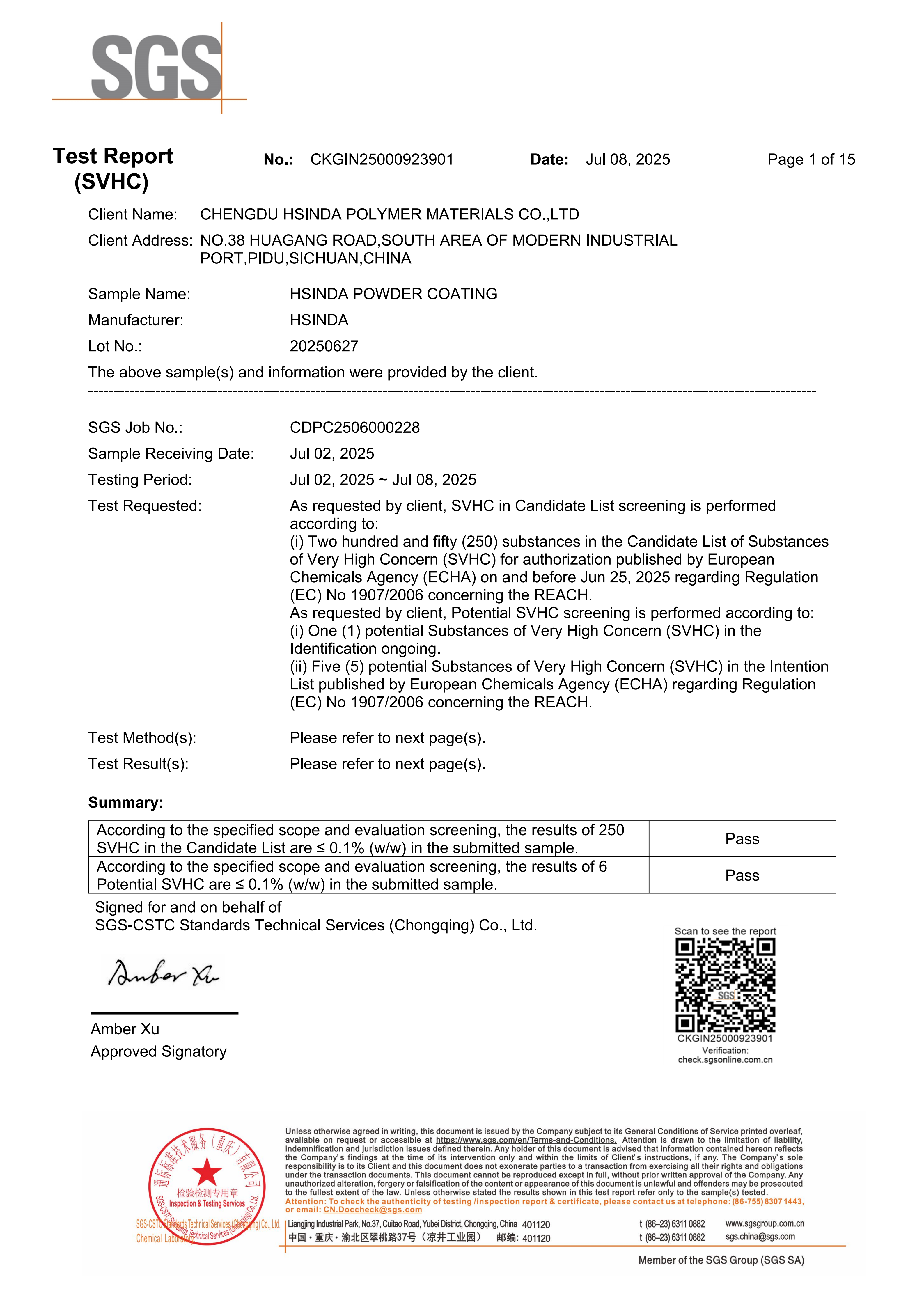
TGIC-free powder coatings replace the conventional triglycidyl isocyanurate curing agent with a hydroxyalkyl amide (HAA) curing system. In Hsinda's product data, the TGIC Free Powder Coating (product reference 4690) is designated as an HAA polyester powder coating, a VOC-free powder coating and, where relevant, an indoor powder coating. The product carries REACH certification issued by SGS under certificate number CKGIN25000923901, complying with EU REACH Regulation (EC) No 1907/2006, applicable to the EU and global markets.
RoHS is a separate question. RoHS restricts specific substances and is tested under the IEC 62321 series, not under REACH. The powder coating product referenced as 3922 holds RoHS certification number CKGEC25000071901, issued by SGS, applicable to the EU and global markets and also covering the Matt Powder Coating product line.
Why does the VOC-free designation matter for construction? Powder coatings are applied as dry, electrostatically charged particles and cured thermally, so the systems themselves do not rely on organic solvents as carriers. In enclosed site conditions, for interior architectural elements, and in markets where indoor air quality or factory emission permits are scrutinised, that distinction is frequently written into specifications rather than left to supplier preference.
How a Manufacturer's Certification Portfolio Maps to Construction Requirements
Chengdu Hsinda Polymer Materials Co., Ltd is a powder coating manufacturer based in Pixian, Chengdu, Sichuan, China, established in 2015 and producing thermosetting powder coatings for architectural, industrial, appliance and general finishing markets. The company operates a 10,000 m² facility with eight production lines and three sample lines, reports annual output above 5,000 tons, and exports roughly 70% of its production to markets including the USA, Canada, Mexico, South America, the Middle East and Central Asia, with distribution experience in more than 70 countries.
For a construction buyer, the useful way to read a portfolio of this kind is by function: which certificate answers which question in a tender pack.
| Document | Certificate / report number | Issuing body and scope |
|---|---|---|
| ISO 9001 quality management | 2052025Q00440R0S | China International Certification Co., Ltd.; GB/T 19001-2016 / ISO 9001:2015; production and sale of thermosetting powder coating |
| ISO 14001 environmental management | 2052025E00271R3S | China International Certification Co., Ltd.; GB/T 24001-2016 / ISO 14001:2015; applicable globally |
| RoHS | CKGEC25000071901 | SGS; IEC 62321 series; EU and global markets; applicable to matt powder coating |
| REACH | CKGIN25000923901 | SGS; EU REACH Regulation (EC) No 1907/2006; HAA type powder coating; EU and global markets |
| FDA food contact | TSNPC25004542302 | SGS; US FDA 21 CFR 175.300; applicable to polyester, epoxy and metal powder coating; global |
| Carbon footprint | TZJ136660053R0S | Huaqixin Certification Service (Chengdu) Co., Ltd.; ISO 14067:2018 and PAS 2050:2011; global |
| ISCC PLUS | ISCC-PLUS-Cert-CN198-41261025 | CTI Certification Co., Ltd.; EN 15343; scope: polyester powder coating; valid 2026-06-26 to 2027-06-25 |
| Antibacterial performance | ASH25-0055689-02 | SGS; ISO 22196:2011; applicable to antibacterial powder coating; global |
Two observations are worth making about this type of portfolio. First, the dates matter. The ISCC PLUS certificate runs from 26 June 2026 to 25 June 2027, which means a project tendered in late 2026 can rely on it, but a project scheduled for delivery after mid-2027 should confirm renewal. Second, scope statements matter as much as certificate numbers: the RoHS certificate references matt powder coating specifically, and the FDA certification references polyester, epoxy and metal powder coating. A buyer specifying a finish outside those scopes should request the corresponding documentation rather than assuming blanket coverage.
The company also states that its powder coatings have been tested under the AAMA test regime and that its factory holds ISO 9001 and ISO 14001 certification, alongside a portfolio of more than 40 independent patents and an 11-person R&D team. For procurement purposes, factory-level management certificates answer process-consistency questions, while product-level certificates answer market-access and performance questions. Both are typically required.
Comparing Compliance Paths: Powder Coating Against Traditional Liquid Systems
Powder and liquid coating systems are often compared on cost or finish. In a compliance context, the more useful comparison is what each system requires in order to make a defensible performance claim.
| Dimension | Powder coating | Traditional liquid coating |
|---|---|---|
| Carrier system | Dry electrostatic particles; no solvent carrier required in application | Solvent- or water-borne carrier; solvent content varies by system |
| Cure condition | Thermal cure, typically 180–200 °C for 10–15 minutes | Ambient or low-temperature cure options |
| Substrate tolerance | Requires a substrate that withstands the thermal cure cycle | Can be applied to heat-sensitive substrates |
| Certification route | Scheme approval tied to coating system plus controlled application conditions | Comparable scheme approvals exist, with separate application controls |
| Restricted substance checking | Powder-level REACH and RoHS reporting available | Formulation-dependent; solvent and additive reporting required |
The limitation that buyers should plan for is thermal. Powder coating cures at 180–200 °C for 10–15 minutes in the systems described here. That is a hard constraint, not a preference. It excludes substrates and assemblies that cannot survive that cycle — certain composites, some temperature-sensitive alloys, and pre-assembled units containing components that would deform or degrade. In those cases a liquid system remains the practical route, and no amount of certification on the powder changes the physics.
A second boundary is structural rather than thermal. Performance schemes such as Qualicoat and AAMA operate through approved systems applied under controlled conditions. A certificate held by a powder manufacturer does not, by itself, certify the finish on a specific project; it supports the applicator's qualification. Buyers who specify a certified architectural finish therefore need to confirm two things separately — that the powder is within the certified scope, and that the coating line applying it is qualified for that system.
Application Fit: Where Certified Powder Coating Is Specified
The compliance burden varies by application, and so does the appropriate product family. The following mappings reflect the applications defined in the product and case data behind this reference.
Architectural aluminium and building envelope
Aluminium profiles, doors and windows, glass curtain walls, sunrooms and architectural partitions are the classic Qualicoat and AAMA territory. These are exterior, UV-exposed and frequently coastal or urban-industrial, which is why the weather resistance and salt spray figures carry the most weight in evaluation.
Transport and municipal infrastructure
Highway guardrails, bus stops and shelters, signage and vehicle parts sit in a mixed indoor-outdoor environment with mechanical wear. Impact resistance, hardness and adhesion data become relevant alongside weathering.
Interior architectural and decorative elements
Interior partitions, railings, ceilings, cabinets and lighting fixtures are usually specified on appearance consistency plus chemical and scratch resistance rather than on long-term UV exposure. This is where texture finishes — hammer tone, wrinkle, sandy and metallic — are most often used, and where gloss band control is the dominant quality parameter.
Heavy-duty and infrastructure corrosion protection
For oil and gas pipelines, water supply systems, valves and steel reinforcement bars, epoxy-based anti-corrosion systems are specified with salt spray resistance reported under ISO 7253:1996. Electrical insulation applications — electric vehicle batteries, motors, busbars — represent a different functional requirement again, where dielectric behaviour rather than appearance governs the choice.
Documented project experience
Two long-running examples illustrate how these requirements translate into supply relationships. An electrical enclosure manufacturer operating across Mexico, Paraguay, Sri Lanka, Russia and China has used approximately 40 tons of coating over a ten-year period, with the stated requirements being corrosion resistance, insulating or static-conductive behaviour, and appearance. An industrial storage and shelving manufacturer in Colombia has used approximately 100 tons over ten years under an epoxy-polyester electrostatic powder coating process, with customised RAL colour matching across shelving ranges.

Market Trend Analysis
Three trends are visible in the available market and trade data, and all three push in the same direction for compliance documentation.
Thermoset systems continue to dominate. Epoxy and polyester thermoset powder coatings held a 76.6% share in 2026 according to Coherent Market Insights, cited on durability and corrosion resistance. That concentration means the certification schemes built around these chemistries — Qualicoat, GSB and AAMA for aluminium, ISO 12944 categories for steel — remain the operating standards that most projects will reference.
Architectural and decorative demand is a structural driver, not a niche. Market analysis from Mordor Intelligence identifies architectural and decorative applications as a major end-use segment, with demand concentrated in UV-resistant facades and window systems. Because these are specification-driven purchases tied to building codes, the segment is less sensitive to short-term price competition than general industrial finishing.
Supply is increasingly global, which increases documentation load. China's coating industry exported 334,800 tons of coatings in 2024, an 18.65% year-on-year increase in value to USD 1.065 billion, according to the China Coatings Industry Association as reported by ECHEMI. Export volume of that scale means more projects are sourcing coatings across regulatory boundaries, and each boundary adds a documentation requirement at the importer level rather than the applicator level.
The practical consequence is that sustainability and substance documentation — carbon footprint statements under ISO 14067:2018 and PAS 2050:2011, ISCC PLUS certification under EN 15343, REACH SVHC reporting — is migrating from voluntary marketing content into tender attachments. Buyers who request these documents early avoid schedule risk later.
Future Outlook
The direction of the next few years is predictable even where the specific numbers are not. Compliance evidence is becoming structured, portable and verifiable rather than narrative. Tender packs are increasingly asking for certificate numbers, issuing bodies, validity dates and scope statements, because those are the fields that can be checked. Suppliers who can supply them on demand will shorten approval cycles; suppliers who cannot will increasingly be filtered out before technical evaluation begins.
A second shift concerns the definition of performance. Corrosion and weathering figures have been the traditional measures, but carbon accounting and recycled-content schemes are entering the same evaluation documents. For construction and decoration buyers, that means a supplier's compliance portfolio will soon be assessed on two axes at once: whether the finish survives the environment, and whether the material behind the finish survives the regulatory environment.
Frequently Asked Questions
1. What certifications should a construction buyer require for architectural powder coating?
For aluminium facades, windows and curtain walls, the recognised schemes are Qualicoat, GSB International and the AAMA standards 2603, 2604 and 2605. For steel structures, ISO 12944 corrosivity categories C1 to C5 define the specification framework. Alongside these, buyers typically require ISO 9001 and ISO 14001 factory certificates, and market-access documentation such as REACH and RoHS depending on the destination region.
2. What is the difference between Qualicoat, GSB International and AAMA 2603, 2604 and 2605?
They are separate international schemes that all govern architectural powder coating performance, and each maintains its own approval structure for coating systems and applicators. Rather than treating them as interchangeable, a project should confirm which scheme the local specification or client recognises and then verify that both the powder and the application line fall within that scheme's approved scope.
3. How can a buyer verify a supplier's certification claims?
Check four fields on each document: the certificate or report number, the issuing body, the validity period, and the scope statement. For example, a RoHS certificate may specify that it applies to matt powder coating, and a carbon footprint certificate may name a specific product. A certificate that is in date but outside the relevant scope does not cover the delivery.
4. What does ISO 7253:1996 salt spray testing actually tell me about a coating?
It reports how a coated test panel performs under a defined neutral salt spray exposure, including the exposure duration and the extent of corrosion at a scribed cross section. In the aluminium profile powder coating data referenced here, the reported result is 1,000 hours with the film unchanged and unilateral corrosion at the cross section of 2 mm or less. Other product families report 500 hours under the same method, so the exposure figure should always be read together with the specific product it applies to.
5. Are TGIC-free and REACH-certified powder coatings suitable for regulated construction environments?
They are designed for that purpose. TGIC-free systems use an HAA curing agent instead of TGIC, and the TGIC Free Powder Coating product referenced in this article holds REACH certification issued by SGS under certificate number CKGIN25000923901, complying with EU REACH Regulation (EC) No 1907/2006 and applicable to the EU and global markets. Product data also designates this system as a VOC-free powder coating.
6. What are the main limitations of powder coating in construction projects?
The primary constraint is thermal: the systems described here cure at 180–200 °C for 10–15 minutes, so substrates and pre-assembled units that cannot withstand that cycle must use an alternative coating route. The second constraint is certification structure — performance scheme approval applies to a coating system applied under controlled conditions, so specifying a certified finish requires verifying the applicator as well as the powder.
Product specifications, application guidance and the full certification overview referenced in this article are compiled in the manufacturer's downloadable brochure (PDF).
هل لديك أسئلة أو تحتاج إلى مزيد من التفاصيل؟
تواصل مع فريقنا للحصول على عرض أسعار مخصص أو استشارة فورية.
طلب عرض أسعار
املأ النموذج أدناه وسيتواصل معك فريقنا بعرض مقترح مخصص.
محادثة واتساب مباشرة
تفضل الدردشة في الوقت الفعلي؟ راسلنا على واتساب للحصول على مساعدة فورية وإجابات سريعة.
- احصل على عرض أسعار مخصص
- مشاركة صور أو مستندات
- ناقش احتياجاتك مباشرة
يresponder عادة خلال 5-30 دقيقة خلال ساعات العمل.