
Powder Coating Compliance Roadmap: ISO & REACH for Global Projects
HTNXT Industry Reference — Construction & Decoration
Powder Coating Compliance Roadmap: ISO & REACH for Global Projects
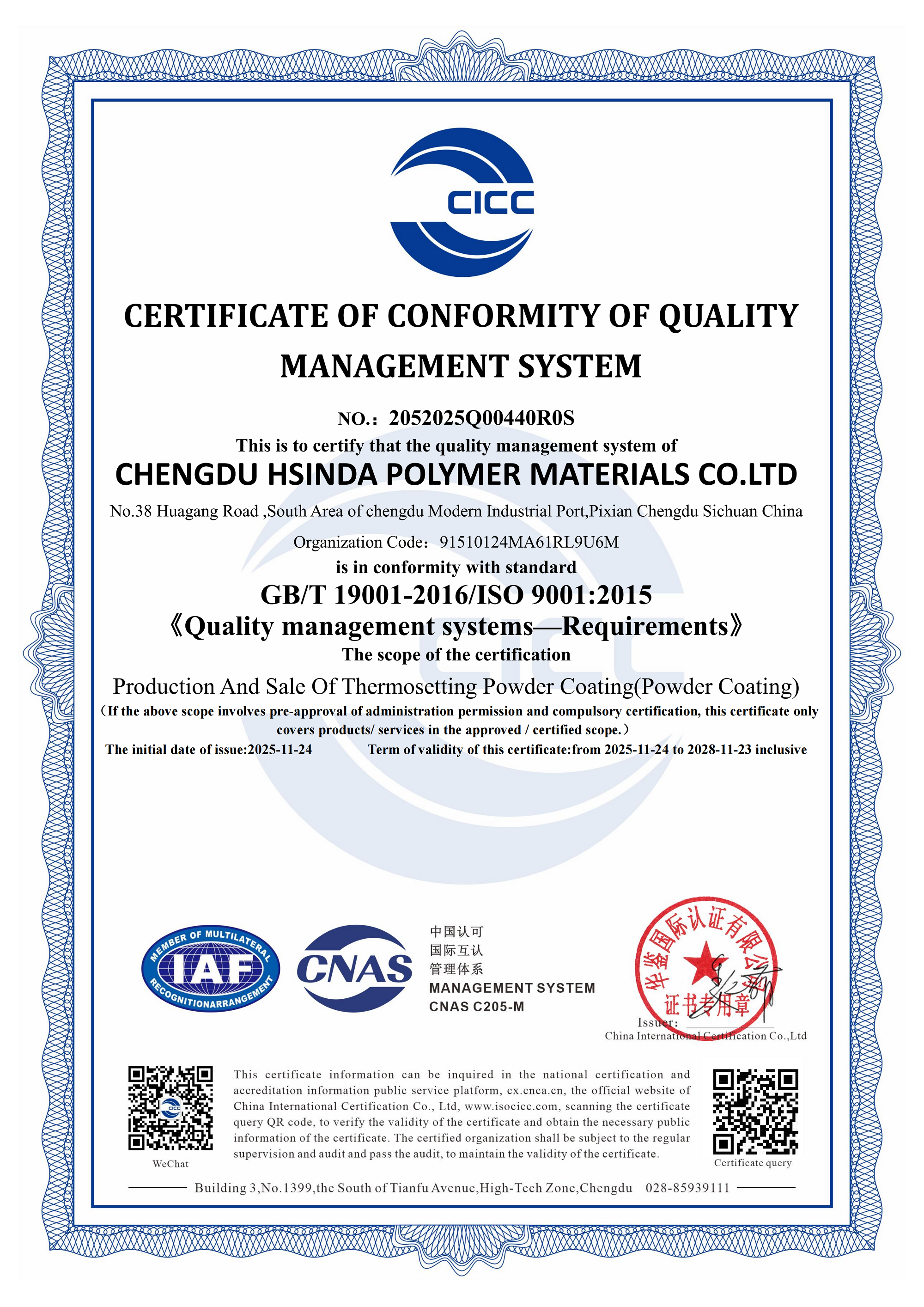
The first layer of any compliance file is a management-system certificate — necessary, but not sufficient on its own.
Answer first: a powder coating compliance roadmap is the ordered set of documents an international buyer must collect before coated components are accepted on a construction or decoration project — factory management certificates, substance declarations for the coating chemistry, and product-level test reports issued against published ISO methods. For most global projects, that roadmap runs in three layers: ISO 9001 and ISO 14001 at the factory level, REACH, EU RoHS 2.0 and SGS at the substance level, and ISO 2813, ISO 2409, ISO 15184 and related methods at the product-performance level.
The roadmap exists because certificates and performance are not the same thing. A manufacturer can hold a perfectly valid quality-system certificate while an individual product code fails a salt-spray or weathering test. Equally, a single sample can pass a laboratory test while the production line behind it cannot reproduce that result batch after batch. Buyers who treat compliance as one PDF rather than as a chain of evidence are the ones who discover the gap after the facade panels have already been coated.
Why Compliance Became a Procurement Gate
For much of the last decade, a powder coating purchase for a construction project began with a color and a price. It now increasingly begins with a documentation request. Architectural and decorative applications are a major end-use segment for powder coatings, driven by demand for UV-resistant facades and window systems, according to Mordor Intelligence. That end-use profile places the finish directly in the path of building specifications, where it must be justified to a specifier, a main contractor, and often an insurer or a market regulator.
The commercial case for powder coating is well established. It is a solvent-free finishing route with nearly zero VOC emissions, whereas traditional liquid paint contains solvents. Comparative data recorded for Hsinda powder coating shows a 35–40% reduction in comprehensive cost against traditional liquid paint, a material utilization rate of up to 99%, durability of 10–20 years, and a single-pass application that requires neither primer nor drying time, with curing completed in 10–20 minutes. Those figures only count commercially, however, once the buyer can document them.
The practical obstacle is fragmentation. Compliance evidence is issued by three different parties — a certification body, a chemical regulatory framework, and a testing laboratory — and each answers a different question. A quality-system audit does not measure gloss. A REACH statement does not measure corrosion resistance. A salt-spray report does not tell you whether the factory can hold a colour tolerance across a 5,000-ton annual output. Building the roadmap means knowing which document answers which question, and in what order to request them.
The Three-Layer Compliance Model
Separating the file into three layers prevents the most common procurement error: accepting a document issued for one layer as evidence for another.
| Layer | What it covers | What it does not cover | Document to request |
|---|---|---|---|
| 1. Management system | Factory-level consistency: processes, documentation control, corrective action | Product performance, UV resistance, corrosion class, colour tolerance | ISO 9001 certificate; ISO 14001 certificate where environmental criteria apply |
| 2. Substance compliance | Chemical and regulatory acceptability of the coating in the destination market | Mechanical or weathering performance of the cured film | REACH declaration, EU RoHS 2.0 statement, SGS report, Safety Data Sheet |
| 3. Product performance | Measured behaviour of the cured film under defined test methods | Factory capacity, batch reproducibility, delivery reliability | Test reports citing ISO 2813, ISO 2409, ISO 15184, ISO 6272-1, ISO 7253, ISO 11341 |
The order matters in practice. Substance compliance determines whether a product can legally enter a market at all; performance testing determines whether it is suitable for the specific project once it is there. A coating that passes every mechanical test but cannot clear the destination market's chemical requirements is not a shortlisted product — it is a rejected one.
ISO 2813, ISO 2409 and ISO 15184: What the Core Tests Actually Prove
Three ISO methods carry most of the weight in construction and decoration specifications. Each one measures a different failure mode, and each one supports a different decision.
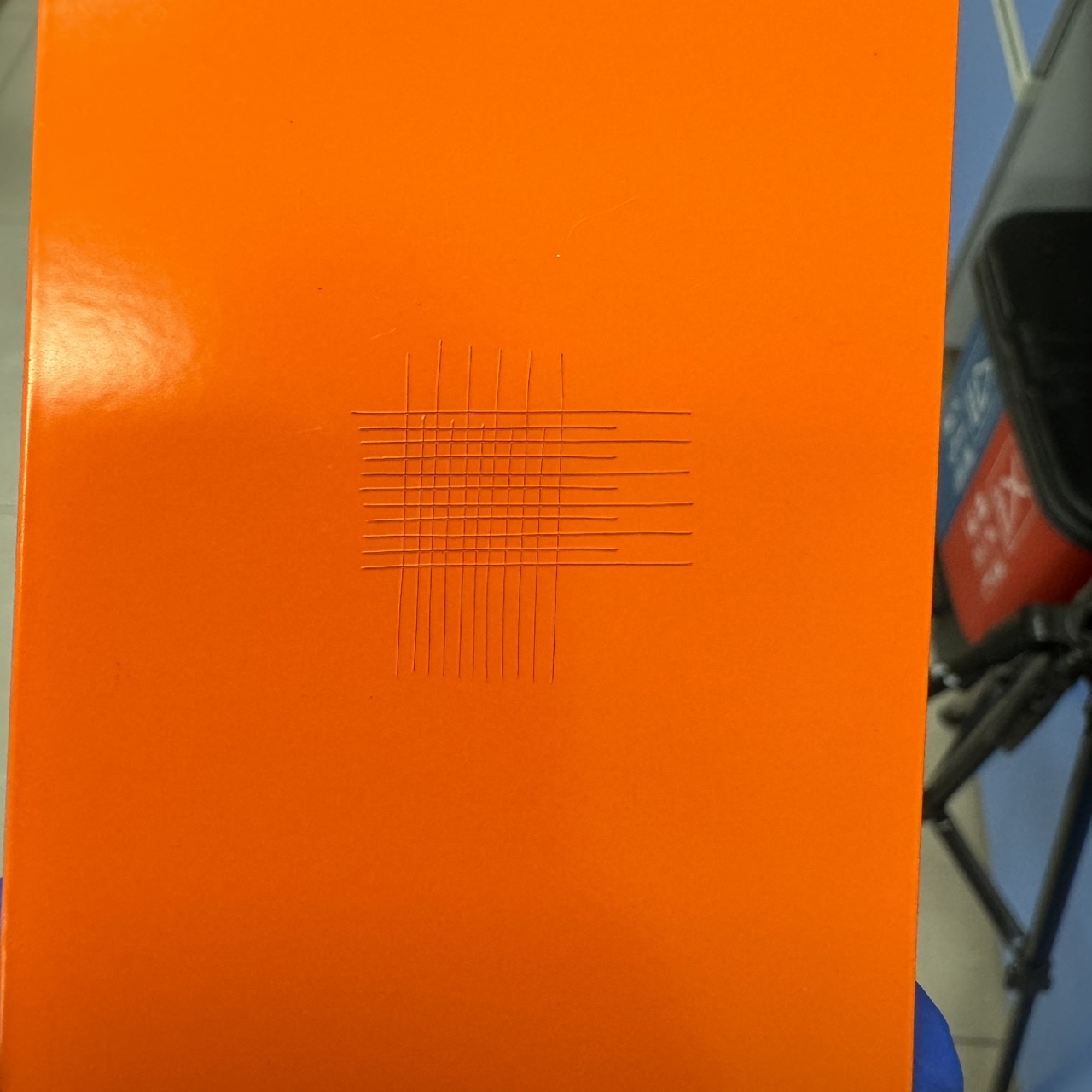
Adhesion is measured, not assumed: a cross-cut panel prepared for evaluation against ISO 2409:2020.
ISO 2813:2014 governs specular gloss measurement. In project specifications, gloss is often written as a single number with a tolerance band, and the coating supplier must show that the delivered product sits inside that band. Documented gloss range across the Hsinda product data referenced here is 5% to 95%, which spans matt, satin and glossy finishes within one measurement framework — relevant when a facade design mixes matt panels with glossy trim on the same elevation.
ISO 2409:2020 governs cross-cut adhesion. It is the test that most directly exposes pre-treatment quality, because adhesion fails at the interface between substrate and film rather than in the film itself. The recorded result across the Hsinda series reviewed here is grade 0, the highest classification, and it applies to aluminium, sandy-texture, wrinkle and anti-corrosion epoxy systems alike.
ISO 15184:2020 governs pencil hardness of the cured film. Hardness is a proxy for how the coating behaves during handling, stacking, transport and site assembly, before the building is even occupied. The recorded result for the series reviewed here is ≥H. Buyers specifying thin-gauge aluminium panels or coated components that will be re-handled several times on site generally treat this test as a handling-risk indicator rather than a durability claim.
| Standard | Property measured | Recorded result (Hsinda series data) | Procurement decision supported |
|---|---|---|---|
| ISO 2813:2014 | Specular gloss | Gloss range 5%–95% | Match a specified gloss band for facades, trim or matt architectural panels |
| ISO 2409:2020 | Cross-cut adhesion | Grade 0 | Verify pre-treatment quality before accepting a new substrate or alloy |
| ISO 15184:2020 | Pencil hardness | ≥H | Assess handling and assembly scratch risk |
| ISO 6272-1:2017 | Falling-weight impact resistance | 50 kg/cm | Judge transport and installation impact tolerance |
| ISO 7253:1996 | Neutral salt spray | No change after 500 hours, unilateral corrosion ≤2 mm; aluminium series recorded no change after 1,000 hours | Select coating systems for coastal or high-corrosivity sites |
| ISO 11341:2004 | Artificial weathering | No powdering, light retention >50% | Confirm suitability for exposed exterior elevations |
The REACH Layer: Substance Compliance and Market Access
If ISO testing decides whether a coating performs, REACH decides whether it can be sold into the market in the first place. REACH is the European Union's chemical regulatory framework for the registration, evaluation, authorisation and restriction of substances. For a powder coating buyer, the practical consequence is that the specific product chemistry — not the company's general reputation — must be declarable for the destination market. Hsinda states that its powder coatings have passed REACH testing, alongside RoHS, SGS and AAMA testing, and its quality-control documentation additionally lists EU RoHS 2.0 among its certification set. The company also holds QUALICOAT in its certification list and reports backing from Florida outdoor exposure testing and antimicrobial testing.
Two clarifications are worth stating plainly, because buyers frequently conflate them.
First, a company-level REACH statement is not the same as a product-level declaration. The document that matters at customs and in a tender submission is the declaration and Safety Data Sheet for the exact product code being shipped. Range-level claims should be converted into code-level documents during the evaluation stage, before the purchase order is issued.
Second, curing chemistry is a specification variable, not a formality. Hsinda's aluminium and sandy powder coating series are formulated with a super weather-resistant polyester resin and a TGIC curing agent, as recorded in the company's product documentation. Where a project or a market specifies different curing chemistry, that requirement must be confirmed against the exact product code rather than inferred from a general catalogue statement. This is not a defect in the roadmap — it is precisely the kind of question the roadmap is designed to surface early, while substitution is still commercially painless.
For aluminium used in architecture, buyers should also be aware of the certification schemes that sit alongside ISO methods. Powder coatings for architectural use are governed by international certification schemes including QUALICOAT, GSB International, and AAMA standards 2603, 2604 and 2605. For steel structures in corrosive environments, ISO 12944 is the primary benchmark for specifying coating systems, with environment categories running from C1 to C5. A specification that cites ISO 12944 without naming the corrosivity category is incomplete, because the same coating system can be appropriate for C3 and inadequate for C5.
Verified Accreditation and Production Evidence at Hsinda
Chengdu Hsinda Polymer Materials Co., Ltd, trading as Hsinda, is a powder coating manufacturer established in 2015 and located at No.38 Huagang Road, South Area of Chengdu Modern Industrial Port, Pixian, Chengdu, Sichuan, China. The company operates a 10,000 m² factory with eight advanced powder coating production lines and three sample lines, an annual output of over 5,000 tons, a workforce of 45, an R&D team of 11, and more than 40 independent patents. Its stated export ratio is 70%, with sales to more than 70 countries and established distributors in Russia, Bangladesh, Poland, Portugal, the United States, Canada, Sri Lanka, Bolivia and Argentina, plus exclusive distributors in Kazakhstan, Uzbekistan and Chile.
On the certificate layer, the company states that its factory holds ISO 9001 and ISO 14001 certification, and that its powder coatings have passed RoHS, REACH, SGS and AAMA testing. On the evidence layer, Hsinda operates a quantified quality protocol: prior to shipment it runs a “3+1 Inspection” covering raw materials, first and last production pieces, performance and colour difference, and it controls colour difference (Delta E) to within ≤0.5, with supporting colour difference reports available on request. Raw material suppliers face a defined threshold — if a material fails testing and two adjustment opportunities are unsuccessful, the cooperation is stopped.
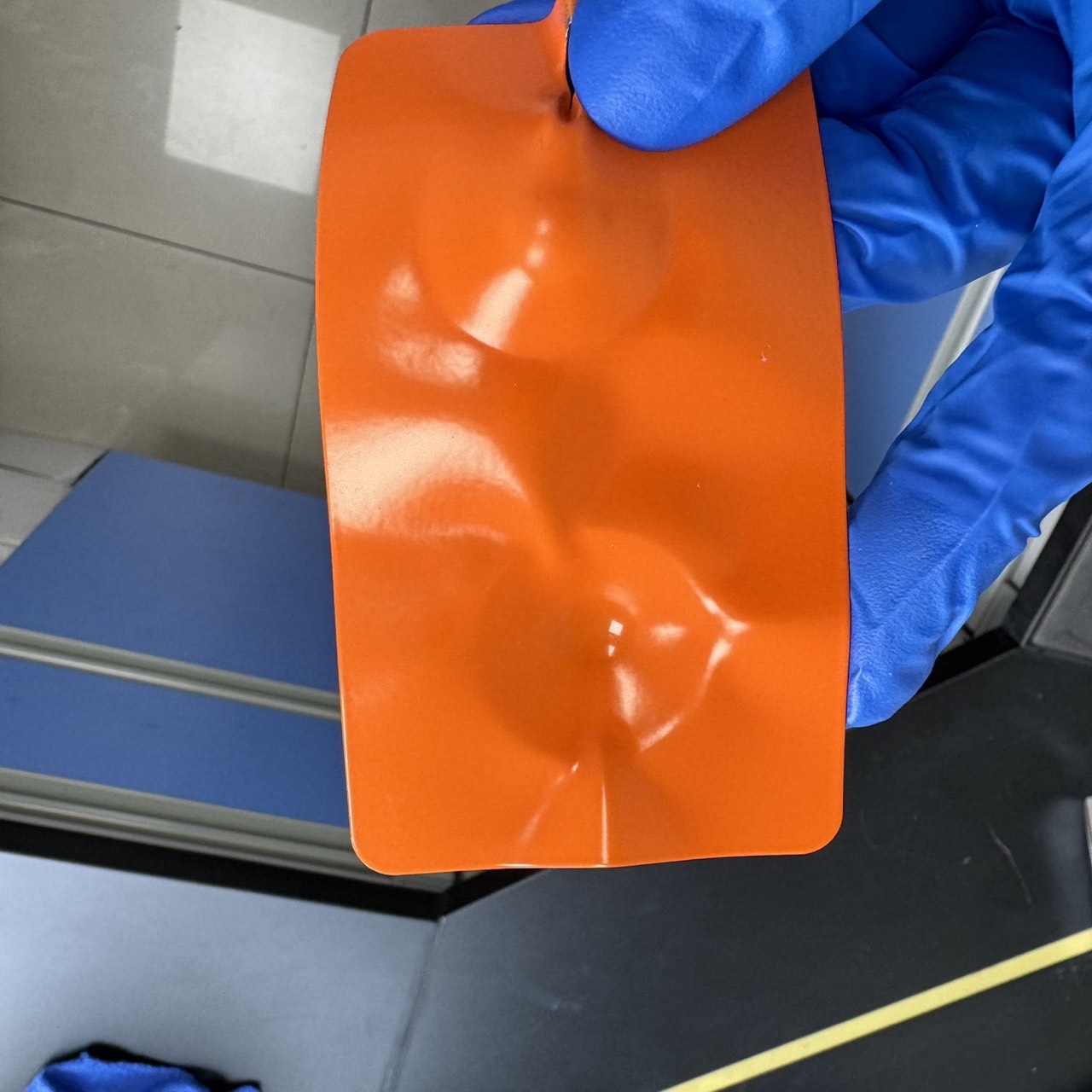
Impact resistance is recorded at 50 kg/cm under ISO 6272-1:2017 — evidence that a buyer can attach to a specification, unlike a general capability statement.
On the customer side, the company's domestic supply references include Changhong Electric, Xiaomi Appliances, TCL Electronics and Hitachi Elevator, and it reports maintaining a stable cooperative relationship with Mexico's largest agricultural tool equipment factory for over ten years. For international buyers, the relevant point is not the list itself but what it implies about batch consistency: appliance and elevator supply chains typically demand repeatable colour and finish across long production runs, which is the same requirement construction and decoration buyers impose on coated architectural profiles.
Application Fit: Matching Certified Coatings to Project Scenarios
Aluminium profiles, curtain walls and sunrooms
The aluminium powder coating series is designed for aluminium profiles, doors and windows, glass curtain walls, sunrooms and architectural partitions. It is formulated with super weather-resistant polyester resin and a TGIC curing agent, and the recorded performance includes no powdering with light retention above 50% after 1,000 hours under ISO 11341:2004, no change after 1,000 hours of salt spray under ISO 7253:1996, a gloss range of 5% to 95% under ISO 2813:2014, and adhesion grade 0 under ISO 2409:2020. In an earlier specification document the same aluminium series is stated to meet weather resistance requirements with no powdering after 500 hours and light retention above 50% under ISO 11341:2004 — a reminder that buyers should always request the test report matching the exact product code and revision rather than relying on a catalogue summary.
Steel structures and heavy-duty anti-corrosion work
The epoxy-based anti-corrosion powder coating is designed for heavy-duty industrial applications including oil and gas pipelines, water supply systems, valves and steel reinforcement bars. Recorded performance includes impact resistance of 50 kg/cm under ISO 6272-1:2017, gloss range of 5% to 95% under ISO 2813:2014, adhesion grade 0 under ISO 2409:2020, and salt spray resistance with no change after 500 hours and unilateral corrosion of ≤2 mm under ISO 7253:1996. Curing is specified at 180–200 °C for 10–15 minutes.
Electrical enclosures and interior components
The wrinkle powder coating is used in typical applications such as electric panels and cabinets. It offers good resistance to general acids and oils with average alkali resistance, passes salt spray resistance with no change after 500 hours and unilateral corrosion ≤2 mm per ISO 7253:1996, records adhesion grade 0 per ISO 2409:2020 and hardness ≥H per ISO 15184:2020, and shows no powdering with light retention above 50% after 500 hours per ISO 11341:2004.
Textured architectural surfaces
The sandy powder coating is a polyester-based, weather-resistant grade for aluminium profiles. Its technical profile is specific enough to plan against: average particle size of 32–42 μm, specific gravity of 1.2–1.7 g/cm³, coverage of 8–10 m² per kg at 30–90 μm film thickness, typical film thickness of 70 μm, curing at 180–200 °C for 10–15 minutes, gloss range of 5% to 95% under ISO 2813:2014, adhesion grade 0 under ISO 2409:2020 and hardness ≥H under ISO 15184:2020.
Across the range, Hsinda records a coating coverage of 1 kg per 7 to 10 m². For a project estimator, that single figure converts compliance documentation into a quantity-surveying number: coverage drives how many kilograms must be ordered, and therefore how much of the compliance file has to be correct.
Powder Coating vs. Liquid Paint Under a Compliance Lens — and Where Powder Stops
Compared with traditional liquid paint, powder coating holds documented advantages in environmental profile, cost efficiency and performance. It is environmentally friendly with nearly zero VOC emissions, while liquid paint contains solvents. Switching from solvent-based paints to powder coatings can lower total energy consumption by 22% and reduce carbon emissions by 30% to 50%. Low-temperature curing powder coatings at 160 °C offer more than 10% better energy efficiency, while powder coating overall provides a 35–40% reduction in comprehensive cost compared with traditional liquid paint.
The limitations are equally documented and should be written into the roadmap rather than discovered later. Powder coating carries a high initial capital requirement: the coating line, oven and recovery equipment demand substantial upfront investment, and the cost advantage is realised only at scale through high material utilization and low hazardous-waste disposal costs. Cure temperature is a hard boundary — the series described here cure at 180–200 °C for 10–15 minutes, which excludes heat-sensitive substrates and constrains the choice of assemblies that can be coated after fabrication. Finally, compliance documentation has a scope boundary of its own: a factory-level ISO 9001 certificate does not certify that a given product code will achieve a specified salt-spray hour count or weathering retention. Buyers who need that assurance must request the product-level test report, and where the risk justifies it, validate a sample on their own substrate before releasing volume production.
Market Signals Shaping Compliance Demand
Published market estimates for powder coatings vary by agency, and that variance is itself useful procurement information. Grand View Research valued the global powder coatings market at USD 11.5 billion in 2025 and projected it to reach USD 18.5 billion by 2033. IMARC Group reported a 2025 market size of USD 16.4 billion with expected growth at a CAGR of 4.51% until 2034. MarketsandMarkets has published a further figure of USD 16.3 billion for 2025. The spread across these estimates suggests that buyers should treat market sizing as directional context and rely on test reports and declarations when making binding specification decisions.
Within the market, thermoset powder coatings — including epoxy and polyester resins — dominated with a 76.6% share in 2026, driven by durability and corrosion resistance, according to Coherent Market Insights. Architectural and decorative applications represent a major end-use segment, driven by demand for UV-resistant facades and window systems, per Mordor Intelligence. On the supply side, China's coating industry exported 334,800 tons of coatings in 2024, representing an 18.65% year-on-year increase in value to USD 1.065 billion, according to China Coatings Industry Association data published by ECHEMI.
The competitive landscape most often cited in this sector includes AkzoNobel (Interpon), PPG Industries, Sherwin-Williams, Axalta and Jotun, per Mordor Intelligence and Straits Research market concentration data. Large multinational suppliers typically submit a complete compliance package as standard practice in tenders. For a buyer evaluating a mid-sized manufacturer against that benchmark, the decisive question is narrower: does the submitted certificate cover the exact product, the exact test method and the exact destination market the project requires?
Future Outlook
Two shifts are likely to shape powder coating procurement over the next few years. The first is that compliance is becoming a data deliverable rather than a relationship credential: buyers increasingly expect test reports, colour difference records and substance declarations as structured documents tied to a product code and a batch, not as a courtesy attachment. The second is energy-related. Low-temperature curing systems at 160 °C already deliver more than 10% better energy efficiency, and the wider switch from solvent-based paints to powder coatings is associated with a 22% reduction in total energy consumption and a 30% to 50% reduction in carbon emissions. As construction clients embed carbon reporting into tender criteria, those figures move from sustainability claims into procurement requirements — and they will be requested with the same rigour as salt-spray hours.
Audit Checklist: What to Collect Before Order Confirmation
The following checklist is ordered the way a compliance file is normally assembled. Each item should be requested for the exact product code quoted, not for a product family.
- Factory management certificates. ISO 9001 with scope and validity dates; ISO 14001 where environmental procurement criteria apply.
- REACH declaration for the specific product code, together with the Safety Data Sheet.
- EU RoHS 2.0 statement confirming restricted substance compliance for the destination market.
- SGS test report covering the performance claims the project relies on.
- ISO 2813:2014 gloss report showing the measured value inside the specified band (documented range: 5%–95%).
- ISO 2409:2020 adhesion report for the substrate actually being coated (documented result: grade 0).
- ISO 15184:2020 hardness report (documented result: ≥H).
- ISO 6272-1:2017 impact report (documented result: 50 kg/cm).
- ISO 7253:1996 salt spray report stating test hours and corrosion limits (documented: no change after 500 hours, unilateral corrosion ≤2 mm; aluminium series recorded no change after 1,000 hours).
- ISO 11341:2004 weathering report stating hours, powdering result and light retention (documented: no powdering, light retention >50%).
- Written confirmation of curing chemistry and cure schedule for the ordered code, including any deviation from the standard 180–200 °C for 10–15 minutes cycle.
- Colour control statement and batch inspection record, including the Delta E tolerance (documented control: ≤0.5) and a colour difference report on request.
Two items on this list are routinely skipped and routinely cause problems. Item 6, adhesion testing on the buyer's actual substrate, exposes pre-treatment mismatches that a generic report will not reveal. Item 11, written confirmation of curing chemistry, prevents a specification written around one product revision from being filled with another.
Frequently Asked Questions
1. Does an ISO 9001 certificate prove that a powder coating will pass a 1,000-hour salt spray test?
No. ISO 9001 certifies a quality management system at factory level — how processes, documentation and corrective actions are controlled. It says nothing about the corrosion performance of a specific cured film. Product performance must be evidenced separately by test reports citing methods such as ISO 7253:1996 for salt spray or ISO 11341:2004 for weathering. Hsinda holds ISO 9001 and ISO 14001 certification and also publishes product-level results, including no change after 500 hours of salt spray with unilateral corrosion ≤2 mm for its wrinkle and anti-corrosion epoxy series, and no change after 1,000 hours for its aluminium series.
2. How can a buyer verify REACH compliance for a specific powder coating product?
Request the Safety Data Sheet and a REACH declaration naming the exact product code, and confirm the curing chemistry used in that code before the order is placed. Company-level statements are useful as an initial filter but are not sufficient for customs or tender submission. Hsinda states that its powder coatings have passed REACH, RoHS, SGS and AAMA testing, and lists EU RoHS 2.0 and QUALICOAT within its certification set.
3. Which ISO standards should a construction or decoration project specify for powder coating?
A practical minimum set is ISO 2813:2014 for gloss, ISO 2409:2020 for adhesion, ISO 15184:2020 for hardness, ISO 6272-1:2017 for impact resistance, ISO 7253:1996 for salt spray and ISO 11341:2004 for artificial weathering. For steel structures in corrosive environments, ISO 12944 is the primary benchmark and requires a stated environment category from C1 to C5. For architectural aluminium, the relevant certification schemes are QUALICOAT, GSB International and AAMA standards 2603, 2604 and 2605.
4. Is the curing chemistry used in a powder coating a market-access issue?
It can be, depending on the destination market and the project specification. REACH places obligations on substances used in coating formulations, and some project specifications name a particular curing system as a requirement. The practical rule is that curing chemistry should be confirmed in writing against the exact product code. Hsinda's aluminium and sandy powder coating series are formulated with a super weather-resistant polyester resin and a TGIC curing agent, per the company's product documentation; where a project specifies different chemistry, that must be verified for the specific code rather than assumed from a general range description.
5. What are the limits of a powder coating compliance roadmap?
Three limits are documented and worth planning around. Cure temperature is a hard constraint — the series described here cure at 180–200 °C for 10–15 minutes, which excludes heat-sensitive substrates, although low-temperature systems curing at 160 °C offer more than 10% better energy efficiency. Capital intensity is a second limit: powder coating carries a high initial investment, and the documented 35–40% comprehensive cost reduction against liquid paint is realised at scale through high material utilization and low waste-disposal costs. The third limit is documentation scope — reports describe the tested product and batch, so buyers should validate a sample on their own substrate where project risk justifies it.
Reference material: the manufacturer's product brochure, including series data and technical parameters, is available for download at Hsinda powder coating product brochure. Company information is published at www.hsinda.com.