
Powder Coating Datasheet FAQ: Particle Size to Salt Spray
A powder coating datasheet is short by design, and that is exactly why it causes procurement problems. Resin chemistry, particle size, specific gravity, coverage, curing, gloss, adhesion, hardness and corrosion testing are compressed into a few lines — and buyers are asked to compare those lines against a project specification written by someone else. This reference walks through the lines buyers question most, using the published values of the Hsinda powder coating range as a worked example of how to read a datasheet without over-reading it.
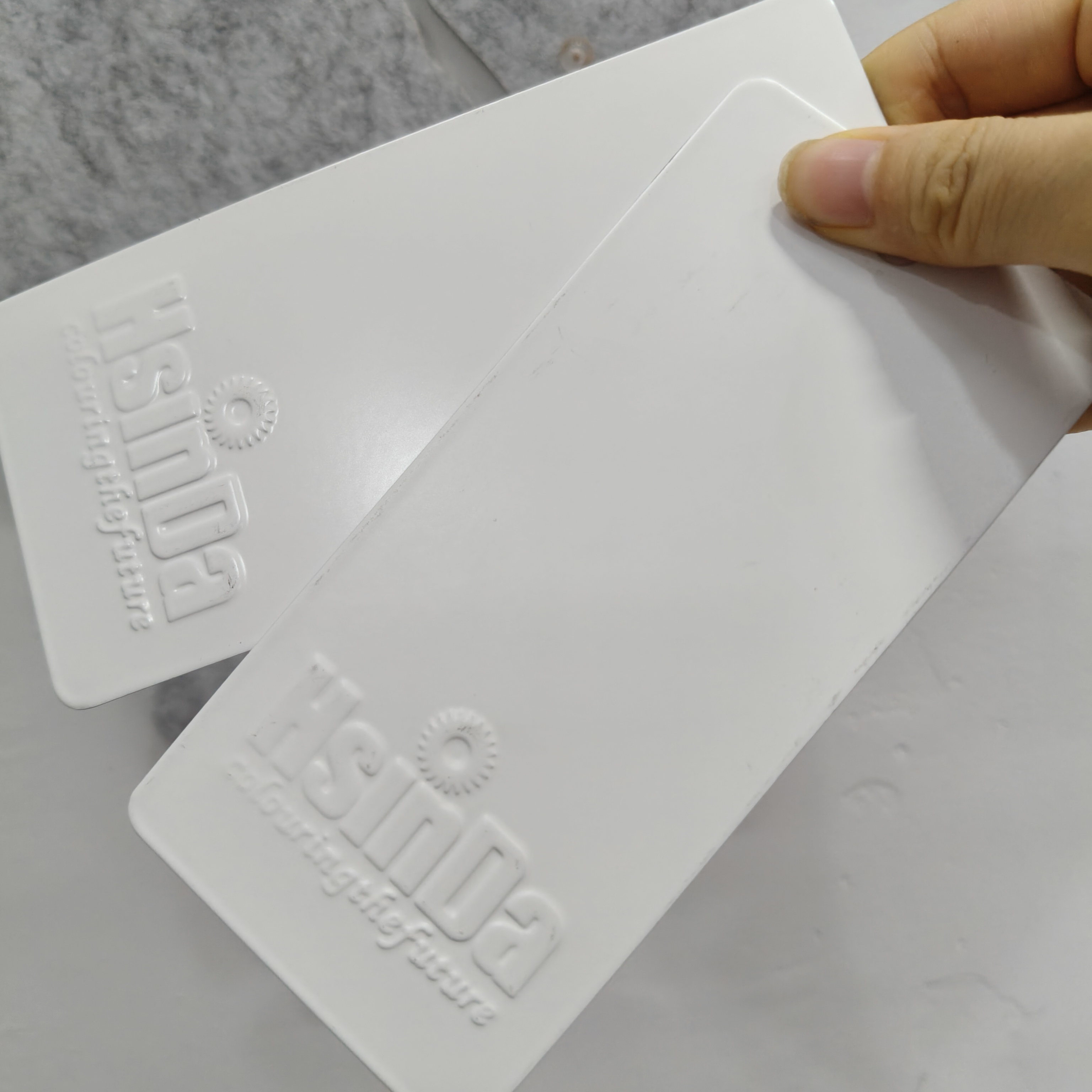
Corrosion lines on a datasheet are read against a stated test method and duration — the duration is the part buyers usually miss.
Chengdu Hsinda Polymer Materials Co., Ltd. is a powder coating manufacturer established in 2015, operating a 10,000-square-metre facility with 8 advanced production lines, 3 sample lines, an 11-person R&D team and an annual production capacity of 5,000 tons. Its published product data covers polyester, epoxy, epoxy-polyester hybrid, metallic, anti-corrosion, matt, glossy, sandy, wrinkle, hammer tone, aluminum and TGIC-free powder coatings. Because the same parameter set repeats across those families — with deliberate differences — the range is a useful teaching example for datasheet comparison.
Why the Same Ten Lines Decide Most Powder Coating Purchases
The problem is not a shortage of data. It is that the data sits on different pages, measured by different methods, at different film thicknesses. A buyer comparing three suppliers may be looking at a coverage figure quoted at one film build, a salt spray figure quoted at a different duration, and a gloss figure quoted with no method reference at all. The numbers look comparable and are not.
The opportunity is that powder coating is unusually well standardised. Gloss, adhesion, hardness, impact, bending, cupping, humidity and salt spray all have published ISO or GB/T methods behind them. When a supplier states both the value and the method, a specification can be written that any competent manufacturer can be held to. When a supplier states only the value, the buyer absorbs the risk.
That is the first procurement rule: a number without a test method is a marketing claim, not a specification.
Question 1 — What Does an Average Particle Size of 32–42 μm Change on My Line?
Across the Hsinda product range — polyester, epoxy, epoxy-polyester hybrid, metallic, sandy, wrinkle, hammer tone and TGIC-free powder coatings — the published average particle size is 32–42 μm. This is a nominal window, not a single value, and it is the envelope within which the powder is designed to charge, transport and build film consistently.
For procurement, the particle size line answers three practical questions:
- Equipment compatibility. The datasheet should state the application method. These products list application by tribo gun or electrostatic spray gun, which means the powder is formulated to work with both charging principles rather than one.
- Transfer behaviour. Particle size distribution interacts with how powder is charged and how much of it reaches the part versus the recovery system. Buyers running reclaim systems should ask how the distribution behaves in reclaim, not only in virgin powder.
- Film build consistency. A defined window supports repeatable film thickness, which is what allows a coverage figure to mean anything at all.
What the datasheet does not give you is a gun recipe. Voltage, powder output and airflow settings are established on your own line, with your own part geometry and hanger density. The datasheet supplies the input; the settings remain a process decision.
Question 2 — Specific Gravity 1.2–1.7 g/cm³: Why Is It Given as a Range?
Specific gravity describes the mass of the powder per unit volume. The published range of 1.2–1.7 g/cm³ reflects that powder coating is not one material: resin type, pigment loading and additive package all shift density, and different finish families do not sit at the same point in that range.
For buyers, specific gravity is a supporting figure rather than a selection criterion. It explains why two powders with the same coverage claim may not weigh the same, and it feeds directly into the coverage calculation. A pure epoxy anti-corrosion powder, a polyester outdoor powder and a metallic decorative powder occupy different positions in the density range while sharing the same nominal particle size window.
Question 3 — Coverage 8–10 m²/kg: How Do I Convert That Into an Order Quantity?
The published coverage figure across the range is 8–10 square metres per kilogram at 30–90 μm film thickness, with a nominal film thickness of 70 μm. Read that sentence twice, because it contains two conditions that buyers routinely drop.
First, the film thickness window. Coverage is quoted against a film build between 30 and 90 μm. If your specification calls for a film build outside that window, the quoted yield should not be assumed to hold — the number was never calculated for it.
Second, the arithmetic. Applied literally, 1 kg covers between 8 and 10 m². A 100 m² batch of extrusions therefore consumes roughly 10–12.5 kg of powder by that figure, before considering overspray, recovery efficiency and colour-change losses. That simple conversion is the difference between a realistic purchase order and a mid-project emergency order.
Question 4 — Curing at 180–200°C for 10–15 Minutes: What Is the Window Actually Telling Me?
The published curing schedule for the range is 180–200°C for 10–15 minutes. Both halves matter: temperature and dwell time are a pair, and the window describes the range in which the coating is expected to develop its listed properties.
Three procurement consequences follow:
- Oven capability is a qualifying question. If your line cannot hold the part at the required temperature for the required dwell, the datasheet's mechanical values are not transferable to your production.
- Substrate heat tolerance is a constraint, not a preference. Some assemblies cannot be exposed to that temperature regime at all. For heat-sensitive work, low-temperature curing options exist within the range — the epoxy-polyester hybrid powder coating is classified as a low-temperature curing powder coating — and those should be discussed as a separate line item, not assumed from the standard schedule.
- Dwell time interacts with line speed. Metal mass, rack loading and oven profile all affect whether a part reaches the schedule. The datasheet defines the coating's requirement; the line must be validated against it.
Question 5 — Tribo Gun or Electrostatic Spray Gun: Which One Does the Datasheet Support?
The published products list application by tribo gun or electrostatic spray gun. For buyers, this is an equipment-compatibility statement: the powder is positioned as workable with either friction charging or corona charging, giving a coating line more flexibility when different parts run on different guns.
The practical question to raise in qualification is not which gun is allowed, but which gun was used to generate the reported test values. Test results are produced under controlled application conditions. A buyer should ask for the reference film thickness (70 μm in this range) and confirm that their own process targets the same build, because the coverage, salt spray and impact figures all sit downstream of film thickness.
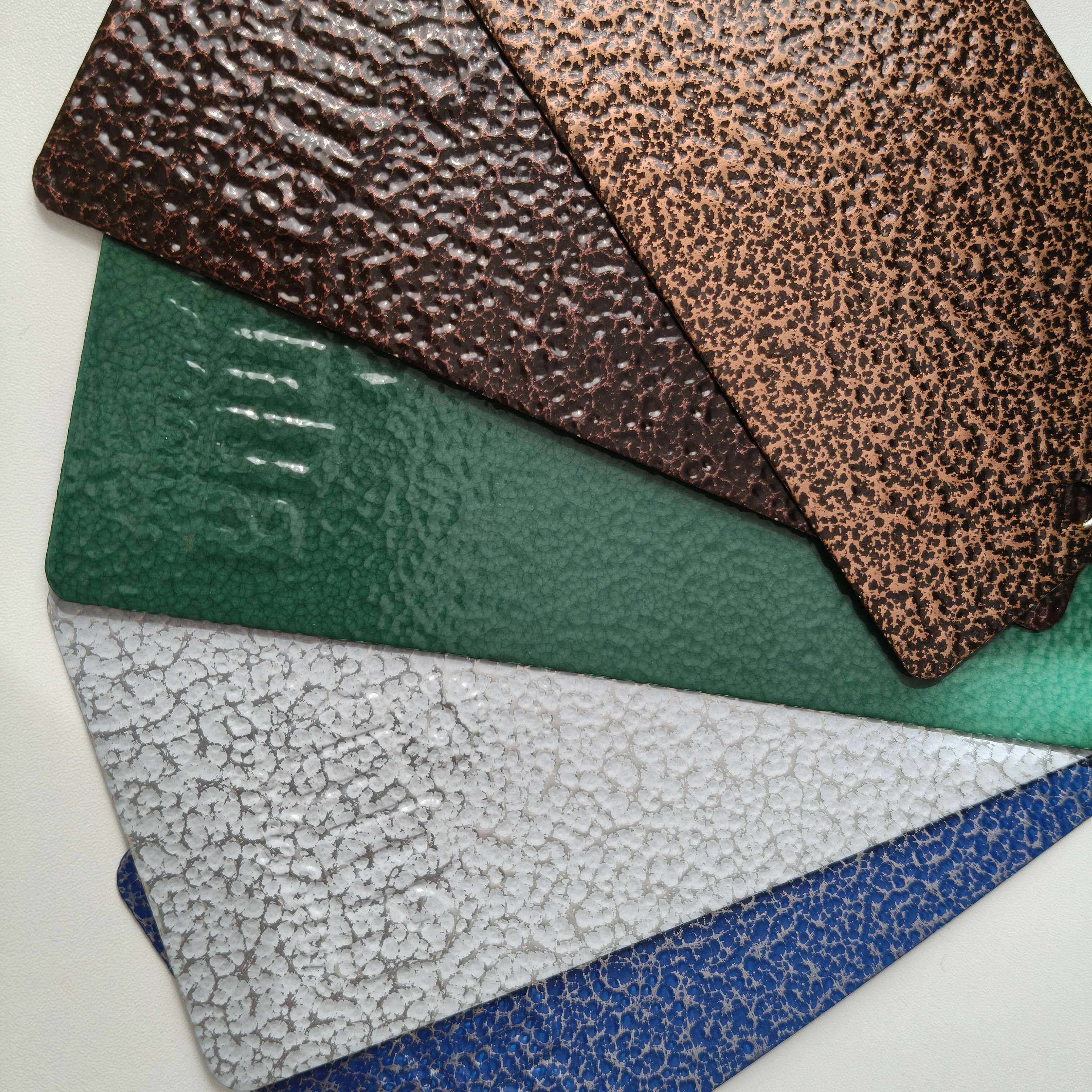
Texture finishes are specified by name and gloss range, not by a single numeric value — the finish name carries as much procurement weight as the gloss figure.
Question 6 — Gloss 5%–95%, Adhesion Grade 0 and Hardness ≥H: Reading the Surface Specifications
Three numbers decide whether a decorative specification can actually be met.
Gloss, ISO 2813:2014, 5%–95%. This is a measured reflectance range measured under a defined method, and the width of the range matters: it is the difference between a dead-matt architectural panel and a high-gloss appliance housing. Within the range, the matt powder coating is published at 5%–30%, a materially narrower band than the general 5%–95%. Buyers specifying a low-sheen façade should confirm they are buying a product whose stated gloss band matches the design intent, not simply a product whose general gloss range happens to include it.
Adhesion, ISO 2409:2020, Grade 0. Grade 0 is the top classification on the cross-cut scale. It describes coating-to-substrate performance under that test, and it is one of the few datasheet lines that is directly comparable across suppliers, because the method leaves little room for interpretation.
Hardness, ISO 15184:2020, ≥H. The pencil hardness result indicates surface resistance to marring and handling damage. For architectural profiles, electrical enclosures and furniture components, this is the line that predicts how the finish survives fabrication, transport and installation.
Question 7 — Salt Spray and Impact: Which Durability Number Belongs in My Specification?
This is where datasheet comparison most often goes wrong, because durability numbers are not uniform across a product range — and they are not supposed to be.
For most products in the Hsinda range, including the polyester, epoxy, epoxy-polyester hybrid, metallic, sandy, wrinkle, hammer tone and TGIC-free families, salt spray performance per ISO 7253:1996 is stated as 500 hours with the coating film remaining unchanged and unilateral corrosion at the cross section ≤2 mm. The aluminum powder coating — formulated with super weather-resistant polyester resin and positioned as a Qualicoat and AAMA powder coating — is stated at 1000 hours under the same method, with the same ≤2 mm corrosion limit.
Impact resistance follows the same pattern. Most products list 50 kg/cm per ISO 6272-1:2017. The aluminum and metallic powder coatings list 2.5 Nm under the same method. Bending is ≤2 mm per ISO 1519:2002 for most products and ≤5 mm for the aluminum grade; cupping is ≥6 mm per ISO 1520:2006 for most products and ≥5 mm for the aluminum grade.
Supporting durability lines reinforce the picture:
- Humidity and heat resistance, GB/T1740-2007: 1000 hours with slight gloss loss, ≤ level 1, across the range.
- Weather resistance, ISO 11341:2004: 500 hours under 340 nm lamp exposure, no powdering, light retention above 50% for standard products; 1000 hours for the aluminum grade.
- Natural ageing: the aluminum grade is additionally referenced against 1 year of Florida exposure with gloss retention above 50%.
The instruction to buyers is simple: read the durability line of the specific product you are ordering. A project that needs 1000-hour salt spray is not satisfied by a family-level claim of 500 hours, and a specification written at 1000 hours should be matched to a product that publishes 1000 hours.
Datasheet Decoder: The Lines That Drive Procurement Decisions
| Datasheet line | Published value in the Hsinda range | What it means for a purchase decision |
|---|---|---|
| Average particle size | 32–42 μm | Nominal window; supports consistent charging, transport and film build with tribo or electrostatic guns |
| Specific gravity | 1.2–1.7 g/cm³ | Density input for coverage maths; varies by resin, pigment and finish family |
| Coverage | 8–10 m²/kg at 30–90 μm film thickness | Yield figure — valid only inside the stated film thickness window |
| Nominal film thickness | 70 μm | Reference build behind the coverage and durability figures |
| Curing | 180–200°C, 10–15 min | Oven capability and substrate heat tolerance gate the whole specification |
| Application | Tribo gun or electrostatic spray gun | Equipment compatibility statement |
| Gloss (ISO 2813:2014) | 5%–95% (matt range 5%–30%) | Decorative classification; match to design intent, not to the widest range |
| Adhesion (ISO 2409:2020) | Grade 0 | Top classification on the cross-cut scale; directly comparable between suppliers |
| Hardness (ISO 15184:2020) | ≥H | Indicates resistance to marring through handling and installation |
| Impact (ISO 6272-1:2017) | 50 kg/cm; aluminum and metallic grades 2.5 Nm | Different products in one range carry different impact figures — check the line item |
| Salt spray (ISO 7253:1996) | 500 h unchanged, ≤2 mm; aluminum grade 1000 h | Corrosion specification for the project environment |
| Humidity and heat (GB/T1740-2007) | 1000 h, slight gloss loss, ≤ level 1 | Relevant for humid and thermally cycled service |
| Weather (ISO 11341:2004) | 500 h no powdering, light retention >50%; aluminum grade 1000 h | Outdoor exposure basis for façade and municipal work |
| Colour | Customised RAL and Pantone | Specification match for branded or design-controlled palettes |
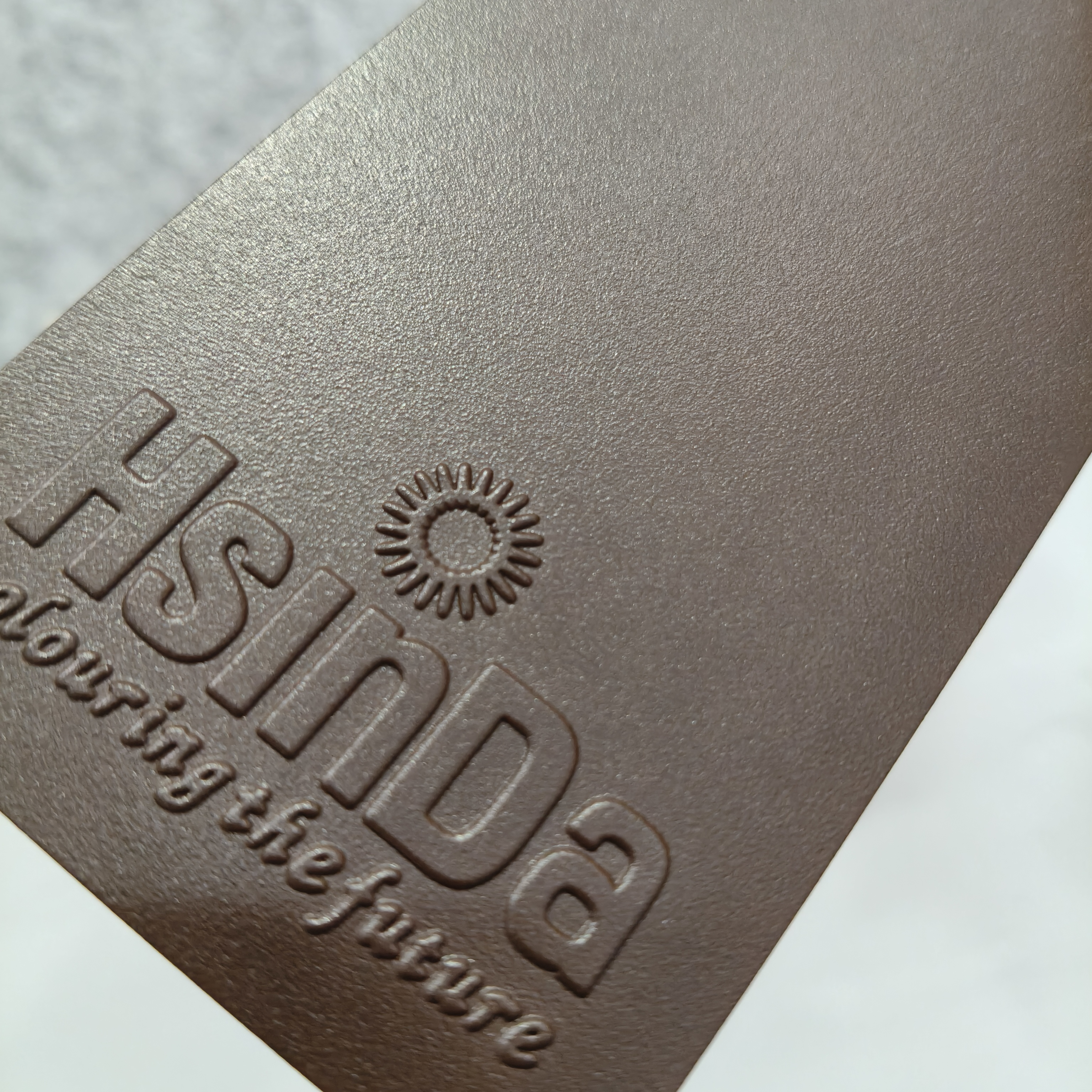
Texture families such as sandy, wrinkle and hammer tone are selected by surface requirement first and by colour second.
Matching Finish Families to Construction and Decoration Work
Once the numeric lines are understood, the finish name becomes the second filter. The published application scopes in this range break down along clear lines.
Outdoor architectural work
- Polyester powder coating — classified as a weather-resistant and aluminum profile powder coating; applied to aluminium doors and windows, curtain walls, railings, outdoor furniture, highway guardrails and street light poles.
- Aluminum powder coating — built on super weather-resistant polyester resin, positioned within the Qualicoat and AAMA categories, and intended for aluminium profiles, doors and windows, glass curtain walls, sunrooms and architectural partitions, plus transportation and municipal elements such as guardrails, bus stops, bus shelters and signage.
- Metallic powder coating — used on aluminium doors, windows and curtain walls, automotive wheels, body trim and engine parts, consumer electronics housings, office and steel-wood furniture, and fitness equipment.
Corrosion and industrial protection
- Anti-corrosion and epoxy powder coatings — designed for oil and gas pipelines, water supply systems, valves and steel reinforcement bars, and for electrical insulation on EV batteries, motors, busbars, transformers and switchgear, as well as chassis, engine bay components, pump bodies and gearboxes.
- Epoxy-polyester hybrid powder coating — classified as an indoor, VOC-free, MDF and low-temperature curing powder coating; used for appliance housings, office and residential furniture, automotive interior and engine compartment components, and instrumentation housings.
Decorative and interior surfaces
- Matt powder coating — published gloss band of 5%–30%; used on appliance casings, electronic device housings, lighting equipment and automotive interior parts, where low sheen reduces glare and visible fingerprints.
- Glossy powder coating — architectural profiles, appliance casings, automotive components, furniture and industrial machinery.
- Sandy powder coating — kitchen cabinets, wardrobes, security doors, high-end doors and windows, bathroom hardware, IT and communications enclosures, building materials, and charging devices for new energy vehicles.
- Wrinkle powder coating — steel and wood furniture, filing cabinets, security doors, machine tools, motor housings, distribution boxes, electrical cabinets and hand or power tools.
- Hammer tone powder coating — a polyester powder coating in the outdoor and furniture categories; used on bench vises, wrenches and tool handles, security doors, filing cabinets, safes, radiators, lighting fixtures, architectural hardware, streetlight poles, guardrails, supermarket shelving and vending machines.
Compliance Lines: TGIC-Free, HAA-Cured and REACH
Compliance questions now arrive earlier in the buying process than they used to, particularly for projects with European or North American exposure.
The TGIC-free powder coating in this range is a polyester powder coating formulated with polyester resin and an HAA curing agent instead of TGIC. It is classified as HAA-curing, VOC-free and REACH-certified, and is positioned for instrumentation and electronic equipment, automotive and components, office and residential furniture, and home appliances. Its published gloss range is 5%–95% per ISO 2813:2014, with impact 50 kg·cm per ISO 6272-1:2017, bending ≤2 mm per ISO 1519:2002, cupping ≥6 mm per ISO 1520:2006, adhesion Grade 0 per ISO 2409:2020 and hardness ≥H per ISO 15184:2020.
At company level, Hsinda's factory holds ISO 9001 and ISO 14001 certification, and the powder coating products are stated as having passed ROHS, REACH, SGS and AAMA testing. For architectural projects, the relevant external schemes are Qualicoat, GSB International and the AAMA standards (2603, 2604, 2605), while ISO 12944 remains the primary benchmark for specifying coating systems on steel structures in corrosive environments across the C1–C5 categories.
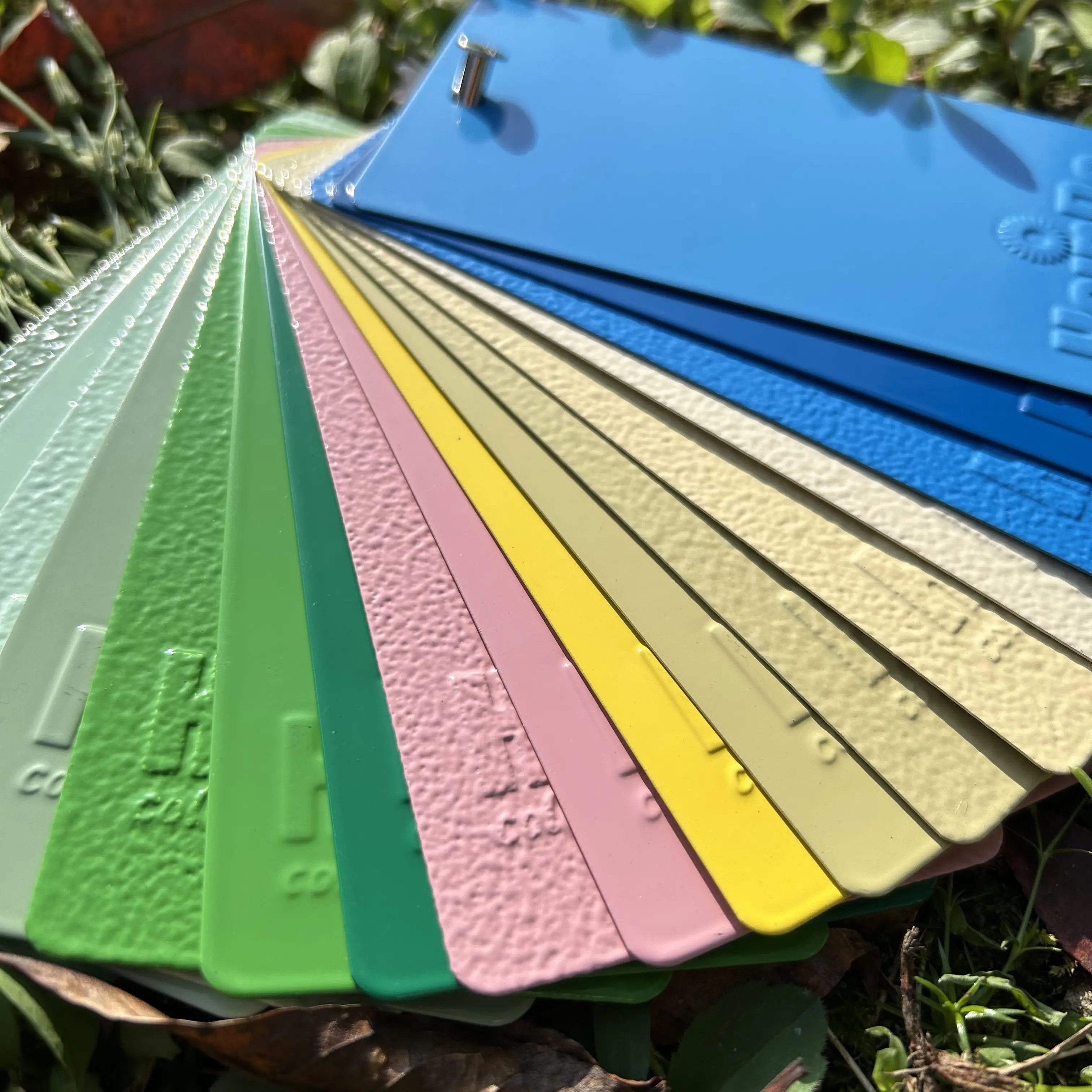
TGIC-free, HAA-cured powder coatings are specified where the compliance route matters as much as the mechanical values.
Where the Datasheet Stops: Boundaries Buyers Should Plan Around
An honest reading of any datasheet includes its limits. In this range, several are worth writing into a procurement file.
- Coverage is conditional. The 8–10 m²/kg figure is stated at 30–90 μm film thickness. Change the film build and the yield figure no longer applies as written.
- Durability values are not uniform within one range. Salt spray is 500 hours for most products and 1000 hours for the aluminum grade. Impact is 50 kg/cm for most products and 2.5 Nm for the aluminum and metallic grades. Family-level assumptions are unsafe.
- Epoxy and hybrid chemistry is positioned for indoor service. Epoxy, anti-corrosion and epoxy-polyester hybrid products are classified as indoor powder coatings. Outdoor exposure claims sit with the weather-resistant polyester and aluminum families.
- Chemical resistance is qualified, not absolute. The published position is good resistance to general acids and oils, with average alkali resistance. Alkali-heavy environments need a specific conversation, not an assumption.
- Curing is a process constraint. The 180–200°C for 10–15 minutes schedule must be achievable on the actual part, not just on a test panel.
- Reported results are laboratory results. Coating performance in service also depends on substrate preparation and application control — widely accepted as decisive in powder coating practice, and outside the four corners of any datasheet.
Market Context: Why Datasheet Literacy Is Becoming a Procurement Skill
Third-party estimates put the global powder coatings market at USD 11.5 billion in 2025, with projections reaching USD 18.5 billion by 2033 (Grand View Research). IMARC Group places the 2025 figure at USD 16.4 billion with growth at a CAGR of 4.51% to 2034, while MarketsandMarkets has published USD 16.3 billion for 2025. The divergence itself is instructive: buyers relying on a single headline number are relying on one agency's methodology, not on a settled fact.
Two structural signals are clearer than the headline. Thermoset powder coatings — the epoxy and polyester chemistries — held a 76.6% share of the market in 2026 according to Coherent Market Insights, reflecting the role durability and corrosion resistance play in specifying decisions. And architectural and decorative applications remain a major end-use segment, driven by demand for UV-resistant façades and window systems (Mordor Intelligence).
On the supply side, trade data shows China's coating industry exported 334,800 tons of coatings in 2024, an 18.65% year-on-year increase in value to USD 1.065 billion (China Coatings Industry Association / ECHEMI). The competitive field is well populated by established international suppliers including AkzoNobel (Interpon), PPG Industries, Sherwin-Williams, Axalta and Jotun. In a market of that shape, the differentiator at the buying desk is rarely product availability — it is specification clarity.
Future Outlook
Three directions look durable for construction and decoration powder coating over the next buying cycles.
Standards-first comparison. As more projects reference Qualicoat, GSB, AAMA and ISO 12944 language directly, suppliers who publish test method numbers alongside values will be easier to qualify than suppliers who publish values alone.
Compliance as a default filter. TGIC-free, HAA-cured and REACH-certified products are moving from special request to standard option, and VOC-free positioning now appears in the classification of mainstream products rather than only in niche lines.
Process flexibility. Low-temperature curing classes and multi-gun compatibility reduce the barrier for lines that cannot run a standard high-temperature schedule or that operate mixed equipment. The consequence for buyers is that datasheet comparison will increasingly be a comparison of process fit, not only of coating properties.
Frequently Asked Questions
What does an average particle size of 32–42 μm tell me about a powder coating?
It defines the nominal particle size window the powder is manufactured to. In the Hsinda range, polyester, epoxy, epoxy-polyester hybrid, metallic, sandy, wrinkle, hammer tone and TGIC-free products all publish an average particle size of 32–42 μm, and all list application by tribo gun or electrostatic spray gun. The window supports consistent charging, transport and film build; it does not specify gun voltage, powder output or airflow, which are established on the coating line itself.
How much area will 1 kilogram of powder coating cover?
Published coverage in the Hsinda range is 8–10 m²/kg at 30–90 μm film thickness, with a nominal film thickness of 70 μm. One kilogram therefore covers between 8 and 10 square metres within that film thickness window. Planning should use the lower end of the range for a conservative order quantity, and the figure should not be assumed to hold at film builds outside the stated window.
What curing schedule should I verify before ordering?
The published curing schedule for the range is 180–200°C for 10–15 minutes, with both temperature and dwell time being part of the specification. A buyer should confirm that the oven and the substrate can meet that schedule. Where heat tolerance is a limitation, the epoxy-polyester hybrid powder coating is classified as a low-temperature curing powder coating and should be evaluated as a separate line item.
Can the powder be applied with either a tribo gun or an electrostatic spray gun?
Yes — the published products in the Hsinda range list application by tribo gun or electrostatic spray gun. This is an equipment-compatibility statement covering both friction charging and corona charging. Buyers should additionally confirm which method produced the reported test values and at what reference film thickness, since coverage, impact and salt spray results are tied to film build.
How should I interpret a 500-hour salt spray result?
Per ISO 7253:1996, the 500-hour result means the coating film remained unchanged and unilateral corrosion at the cross section was ≤2 mm. Most Hsinda products — polyester, epoxy, epoxy-polyester hybrid, metallic, sandy, wrinkle, hammer tone and TGIC-free — publish this 500-hour figure. The aluminum powder coating publishes 1000 hours under the same method with the same ≤2 mm limit. A specification calling for 1000 hours must therefore be matched to a product that publishes 1000 hours.
Why do impact resistance figures differ between products in the same range?
Because the products differ by chemistry and finish family. Most Hsinda products publish impact resistance of 50 kg/cm per ISO 6272-1:2017, while the aluminum and metallic powder coatings publish 2.5 Nm under the same method. Bending and cupping figures also differ: ≤2 mm and ≥6 mm for most products (ISO 1519:2002 and ISO 1520:2006), and ≤5 mm and ≥5 mm respectively for the aluminum grade. Durability values should be read from the specific product line, not from the product family.
Can I order custom RAL or Pantone colours?
Yes. The products in the Hsinda range carry the model designation Customize RAL Color Powder Coating, with colour published as customisable against both RAL and Pantone references. Colour customisation applies across the finish families — polyester, epoxy, hybrid, metallic, sandy, wrinkle, hammer tone, matt, glossy and TGIC-free — subject to the finish type selected.
Are TGIC-free and REACH-certified powder coatings available?
Yes. The TGIC-free powder coating in the range is formulated with polyester resin and an HAA curing agent, is classified as HAA-curing and VOC-free, and is REACH-certified. It is intended for instrumentation and electronic equipment, automotive and components, office and residential furniture, and home appliances. At company level, the factory holds ISO 9001 and ISO 14001 certification, and the powder coating products are stated as having passed ROHS, REACH, SGS and AAMA testing.
Which finish should I specify for construction and decoration?
Selection follows the exposure and the surface requirement. For outdoor architectural work — aluminium profiles, doors and windows, curtain walls, sunrooms and partitions — the weather-resistant polyester and aluminum powder coatings are the relevant families, with the aluminum grade positioned within the Qualicoat and AAMA categories. For corrosion and industrial protection, epoxy and anti-corrosion coatings are specified for pipelines, valves, reinforcement bars and electrical insulation components. For decorative and interior surfaces, matt (5%–30% gloss), glossy, sandy, wrinkle and hammer tone finishes cover appliance housings, furniture, electrical cabinets, IT enclosures, hardware and public furniture respectively.
Hsinda's published product data, including finish families, colour customisation and test methods, is compiled in the company's downloadable product brochure: Hsinda powder coating product brochure (PDF).