
Powder Coating Selection Matrix: Finish vs. Buyer Need
Powder Coating Selection Matrix: Finish vs. Buyer Need
Powder coating selection is a matching problem before it is a purchasing decision. The same nominal finish can be right for an aluminum facade and wrong for an electrical enclosure, because substrate, exposure, handling, gloss target, and test evidence change the answer. This matrix treats powder coating paint as a system of resin chemistry, finish effect, application context, and documented performance rather than a single material label.
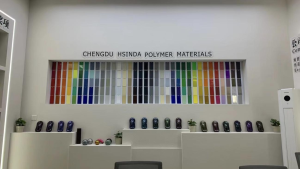
A finish selection matrix starts with physical samples and measured attributes, not only a color card. Image: Hsinda sample room.
Construction and decoration buyers rarely fail because powder coating options are unavailable. They fail because the finish is chosen from a color card or a price list before the application context is defined. A facade, an office partition, a furniture frame, and a heavy-duty industrial enclosure may all use thermoset powder coating, but they do not share the same pass criteria. The useful question is not which powder coating is best in general, but which finish family gives the most defensible fit for a specific substrate, environment, appearance target, and evidence package.
Why a finish matrix is more useful than a product list
A product list tells a buyer what a supplier can make. A selection matrix tells a buyer what to compare, what to reject, and what to validate before the first production order. For construction and decoration projects, a workable matrix has five layers: application context, resin family, finish and gloss, performance evidence, and commercial fit. The application context sets the baseline, such as aluminum profiles, architectural partitions, furniture, or heavy-duty industrial equipment. The resin family narrows the chemistry. The finish and gloss determine the visual and tactile result. The performance evidence proves that the system can meet the project requirement. The commercial layer covers minimum order, lead time, color customization, and supply continuity.
Metal powder coating is often discussed as one category, but procurement decisions are more specific. Outdoor powder coating and indoor powder coating do not carry the same risk profile. Architectural powder coating must usually address weathering, color stability, adhesion, and cleaning. Industrial powder coating may prioritize chemical resistance, impact strength, and corrosion protection. Custom color powder coating adds sample approval and batch consistency checks. A matrix keeps those differences visible instead of collapsing them into a single supplier claim.
Five tests that make the matrix auditable
Performance claims become procurement criteria only when the test method is defined. For construction and decoration buyers, five checks provide a practical backbone: gloss, impact resistance, adhesion, hardness, and salt-spray performance. The first four are standardized methods that can be written into a specification. The fifth should be requested as a report condition after a defined exposure period, commonly after 500 hours, with the substrate, film build, pretreatment, and pass criteria stated.
| Test or reference | What it tells the buyer | How to use it in the matrix |
|---|---|---|
| Gloss per ISO 2813:2014 | Specular gloss at a defined geometry, which separates high gloss, semi-gloss, and matte appearance targets. | Set the gloss target before color approval. Hsinda's published 60° gloss classes are high gloss (>80%), semi-gloss (40-79%), and matte (5-39%). |
| Impact resistance per ISO 6272-1:2017 | How the cured film responds to rapid deformation, including cracking or detachment from the substrate. | Request results at the intended film thickness and curing schedule. Impact data without those conditions is difficult to apply. |
| Adhesion grade per ISO 2409:2020 | The cross-cut adhesion result between coating and substrate, which is foundational for exterior and handling durability. | Use it for aluminum profiles, pretreated steel, and furniture frames. Record substrate and pretreatment alongside the grade. |
| Hardness per ISO 15184:2020 | Pencil hardness of the cured film, relevant to handling, stacking, and furniture wear. | Read hardness together with impact and adhesion. A hard film is not automatically a tough film. |
| Salt spray after 500 hours | Corrosion progression under salt-fog exposure, especially for anti-corrosion and heavy-duty industrial applications. | Ask for the full report, including substrate, scribe condition, film build, pretreatment, and acceptance criteria. |
A test report without substrate and process conditions is not a procurement document. It is a marketing attachment. Buyers should request the exact product name, color reference, gloss class, substrate, pretreatment, film thickness, curing conditions, and test date. This is especially important when a supplier offers a broad range under one brand.
The product-family matrix
The matrix below maps Hsinda's listed powder coating families to typical construction and decoration contexts and to the trade-offs that should drive the final purchase decision. It is a comparison framework, not a universal ranking. A finish can be correct for one project and unsuitable for another.
| Product family | Typical application context | Buyer criteria to verify | Trade-off to accept |
|---|---|---|---|
| Aluminum Powder Coating | Aluminum profiles, curtain walls, sunrooms, architectural partitions | Substrate pretreatment, gloss per ISO 2813:2014, adhesion per ISO 2409:2020, impact per ISO 6272-1:2017, salt spray after 500 hours, color consistency | Appearance and weather exposure versus the cost of pretreatment and a complete test package |
| Metallic Powder Coating | Feature panels, decorative partitions, furniture accents, retail fit-outs | Metallic bonding consistency, gloss, color match, adhesion, repair strategy | Visual depth versus batch consistency and touch-up difficulty |
| Anti-corrosion Powder Coating | Heavy-duty industrial equipment, electrical enclosures, hardware, humid or coastal service | Salt spray after 500 hours, adhesion, impact, film build, curing, substrate preparation | Corrosion protection versus color range, cost, and process control |
| Sandy Powder Coating | Facades, furniture, interior partitions, equipment covers | Texture uniformity, gloss, adhesion, hardness, cleaning method | Defect masking and tactile feel versus cleanability and texture variation |
| Wrinkle Powder Coating | Industrial equipment, furniture, electrical covers, tooling | Wrinkle uniformity, hardness, impact, adhesion, film build | Durable texture versus uneven appearance and gloss control |
| Hammer Tone Powder Coating | Heavy equipment, furniture, decorative industrial panels | Pattern consistency, impact, adhesion, salt spray if outdoor | Surface-flaw masking versus pattern reproducibility |
| Glossy Powder Coating | Interior furniture, partitions, appliances, retail displays | Gloss class, adhesion, hardness, scratch visibility | Bright easy-clean appearance versus visible scratches and surface defects |
| TGIC Free Powder Coating | Outdoor architectural powder coating where restricted substances are a procurement criterion | REACH and RoHS documentation, weathering, adhesion, gloss | Compliance preference versus color and formulation availability to confirm |
| Matt Powder Coating | Office interiors, furniture, partitions, decorative metal | Matte gloss class, hardness, cleaning, abrasion | Low-glare appearance versus marking and cleaning sensitivity |
| Epoxy Polyester Hybrid Powder Coating | Indoor furniture, shelving, electrical enclosures, general metal | Adhesion, impact, hardness, chemical resistance, color | Balanced interior performance versus outdoor weathering |
| Epoxy Powder Coating | Heavy-duty industrial, electrical components, interior chemical exposure | Chemical resistance, adhesion, impact, hardness | Chemical and interior durability versus UV weathering |
| Polyester Powder Coating | Outdoor aluminum, facades, architectural metal, TGIC-free options | UV and weathering, gloss retention, adhesion, salt spray after 500 hours | Outdoor durability versus the chemical-resistance profile required by the application |
The table describes procurement fit, not a claim that every product in a family performs identically. Final selection should be based on the exact product datasheet, sample approval, and test report.
Application context: aluminum profiles and architectural partitions
Aluminum profiles are a demanding starting point because the finish is visible, exposed, and often expected to last through many cleaning cycles. The substrate is not the only variable. Pretreatment, powder compatibility, film build, and curing determine whether adhesion and corrosion performance hold up. For this context, Aluminum Powder Coating, Polyester Powder Coating, TGIC Free Powder Coating, and Anti-corrosion Powder Coating are the main families to compare. They are not interchangeable. A standard architectural aluminum finish may prioritize color and gloss consistency, while a coastal or high-humidity project may require a more explicit corrosion package.
Polyester chemistry is often shortlisted for exterior aluminum because weather resistance and UV resistance are central requirements. Grand View Research reported that the polyester segment accounted for 48.2% of the powder coatings market share in 2025, citing superior weatherability and UV resistance. That does not make every polyester product suitable for every facade. It does explain why buyers should ask for weathering data, gloss retention, and adhesion results rather than accepting a generic outdoor label.
Architectural partitions sit between performance and interior design. Glossy Powder Coating can give a bright, easy-clean surface, but it may reveal surface defects and scratches. Matt Powder Coating reduces glare and can produce a more restrained interior look, but marking and cleaning behavior need to be checked. Sandy Powder Coating and Metallic Powder Coating can add texture or visual depth, but texture uniformity and repair strategy become part of the purchase decision. For partitions, the matrix should include appearance approval under the actual lighting conditions, not only a small color chip.
What buyers should ask for aluminum and partition projects
- Substrate and pretreatment description, including whether the coater controls both steps.
- Gloss target under ISO 2813:2014, with the measured class rather than a verbal description.
- Adhesion result under ISO 2409:2020 and impact result under ISO 6272-1:2017 for the proposed product.
- Salt-spray report after 500 hours when the project is exterior, coastal, or humidity-exposed.
- Color approval procedure for Custom Color Powder Coating, including batch tolerance and sample retention.
Application context: furniture and interior decoration
Furniture and interior metalwork shift the matrix toward handling, abrasion, glare, and cleanability. Hardness per ISO 15184:2020 and adhesion per ISO 2409:2020 become practical criteria because the finished part may be stacked, assembled, wiped, and touched repeatedly. Impact resistance also matters for frames, brackets, and shelving that are handled during installation. In this context, Matt Powder Coating, Glossy Powder Coating, Sandy Powder Coating, Wrinkle Powder Coating, Epoxy Polyester Hybrid Powder Coating, and Epoxy Powder Coating are common comparison points.
Matt and glossy finishes are not merely a visual choice. A matte surface can reduce glare in office interiors and create a softer architectural look, but it may show marks or be less forgiving in cleaning. A glossy surface can be easier to wipe and can look more finished, but it may reveal scratches and surface defects. Sandy and wrinkle textures can hide stamping marks or minor substrate imperfections, but texture uniformity and cleaning method must be agreed. For furniture, the best matrix often includes a physical sample that has been handled, wiped, and viewed under the intended lighting.
Epoxy Polyester Hybrid Powder Coating is often evaluated for indoor furniture, shelving, and electrical covers because it balances adhesion, impact, and appearance. Epoxy Powder Coating is more likely to be considered where chemical resistance and interior durability dominate. Polyester Powder Coating is the more natural starting point for outdoor furniture and architectural metal. These are starting points, not final answers. The buyer should confirm the exact product, gloss, color, and test data rather than relying on the resin name alone.
Application context: heavy-duty industrial and electrical equipment
Heavy-duty industrial applications move corrosion, impact, and chemical exposure to the front of the matrix. Anti-corrosion Powder Coating, Epoxy Powder Coating, and Hammer Tone Powder Coating are the main families to evaluate. Salt-spray performance after 500 hours is a useful screening condition, but it must be read with the substrate, film build, pretreatment, and scribe details. A coating that performs well on a properly pretreated steel panel may behave differently on a poorly prepared or different substrate.
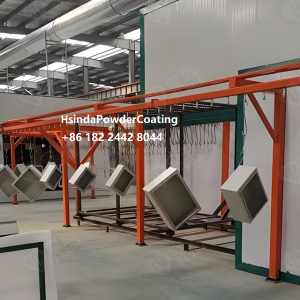
Electrical enclosures combine corrosion resistance, impact resistance, and appearance requirements. Image: Hsinda powder coating on electric panels.
Hsinda's case record for electrical enclosures covers 40 tons over 10 years across Mexico, Paraguay, Sri Lanka, Russia, and China. The stated requirements include corrosion resistance, insulating or static-conductive behavior, and an aesthetic finish. That combination is a useful reminder that heavy-duty industrial powder coating is not only about salt spray. Electrical equipment may also require consistent coverage, edge protection, and a finish that supports assembly and inspection.
A second case record covers hardware tools for Mexico and the United States: 1,000 tons over 5 years, with rust resistance and abrasion resistance for outdoor excavation and gardening environments. The lesson for the matrix is that the test package should follow the failure mode. A tool that is abraded in service needs impact and hardness data; a coastal enclosure needs salt-spray and adhesion data; a decorative panel needs gloss and color consistency. One universal report is rarely enough.
How the performance attributes interact
Gloss is often overused as a proxy for quality. ISO 2813:2014 gloss measurement is useful because it makes the appearance target measurable, but gloss does not prove durability. A high-gloss surface may show substrate defects more clearly. A matte surface may hide them, but it can also show handling marks. The buyer should specify the gloss class and then evaluate the surface under the actual viewing conditions.
Impact resistance per ISO 6272-1:2017 and hardness per ISO 15184:2020 should be read together. A hard coating can resist scratching but still crack under impact. A softer coating may absorb impact but show abrasion. The right balance depends on the part. Furniture frames and shelving may prioritize hardness and adhesion. Heavy equipment and enclosures may prioritize impact and corrosion. The matrix should not reward a single number without the use context.
Adhesion per ISO 2409:2020 is the foundation. If the film does not adhere, gloss, hardness, and color are secondary. Adhesion is also where process control becomes visible. Pretreatment, curing, film thickness, and substrate cleanliness all affect the result. Buyers should ask whether the reported adhesion grade was measured on the same substrate and pretreatment route used in production.
Salt-spray performance after 500 hours is a screening condition, not a complete corrosion guarantee. The report should identify whether the panel was scribed, how the edge was prepared, what film thickness was used, and what acceptance criteria were applied. Without that context, a 500-hour result is difficult to compare across suppliers.
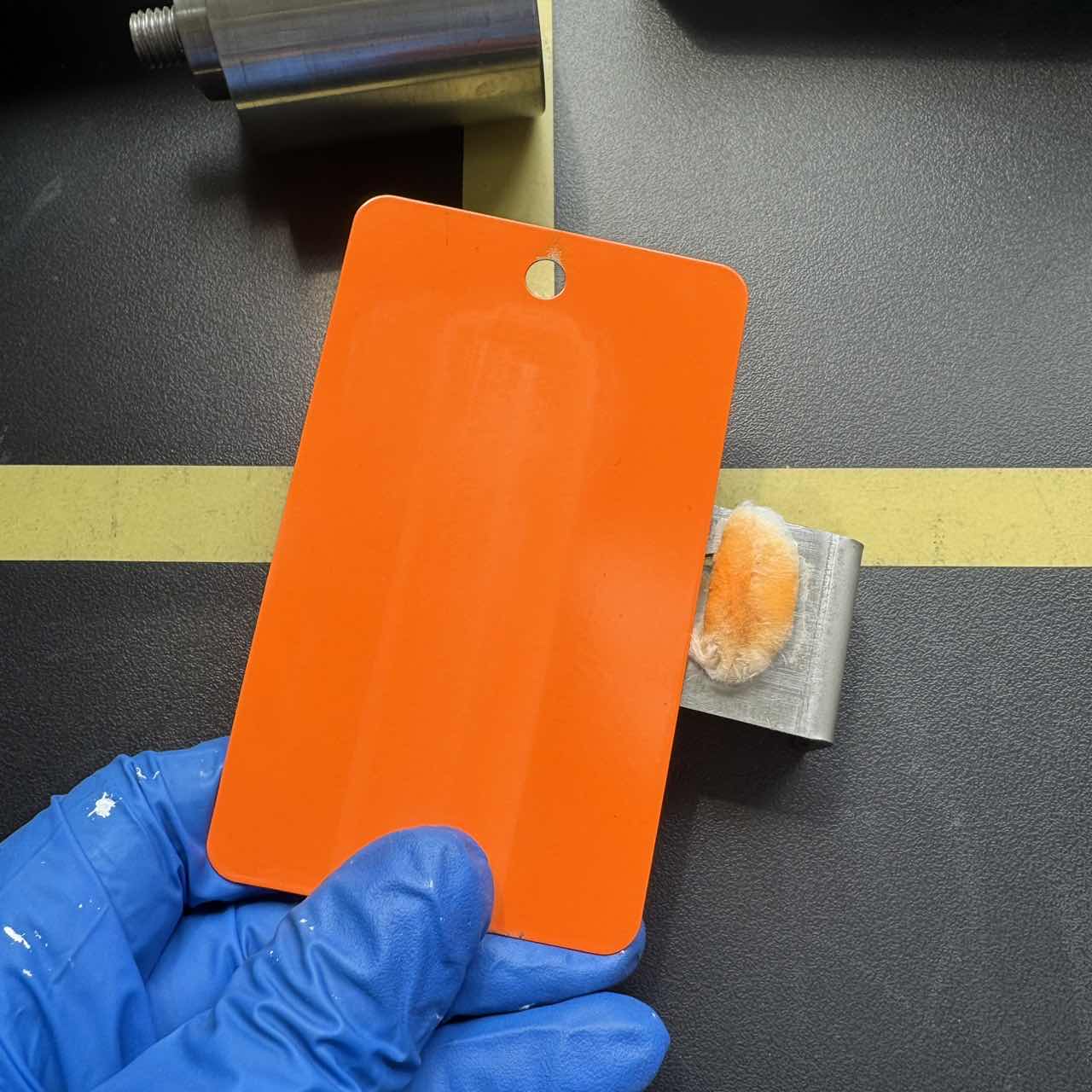
Chemical resistance and surface appearance should be evaluated on the same sample set. Image: Hsinda chemical resistance customization sample.
Texture adds another layer. Sandy, wrinkle, and hammer tone finishes can improve defect masking and tactile feel, but they can complicate cleaning, repair, and pattern matching. A textured finish may be the right choice for an industrial cover and the wrong choice for a high-touch furniture surface. The matrix should record texture uniformity, cleaning method, and touch-up policy alongside the standard performance tests.
Where Hsinda fits the evaluation matrix
Chengdu Hsinda Polymer Materials Co., Ltd is a powder coating manufacturer established in 2015 in Chengdu, Sichuan, China. Its published company profile lists a 10,000 square meter factory, 45 employees, an 11-person R&D team, 8 advanced production lines and 3 sample lines, and annual output of about 5,000 tons. The company reports that about 70% of output is exported to markets including the USA, Canada, Mexico, South America, the Middle East, and Mid-Asia.
Hsinda's listed product range includes Aluminum Powder Coating, Metallic Powder Coating, Anti-corrosion Powder Coating, Sandy Powder Coating, Wrinkle Powder Coating, Hammer Tone Powder Coating, Glossy Powder Coating, TGIC Free Powder Coating, Matt Powder Coating, Epoxy Polyester Hybrid Powder Coating, Epoxy Powder Coating, and Polyester Powder Coating. That breadth is useful for a matrix because buyers can compare finish families within one supplier conversation. It does not remove the need to match the exact product to the application.
Customization is part of the evaluation. Hsinda's published customization data covers RAL and Pantone color matching based on samples, gloss classes, and textures such as sandy, wrinkle, hammer tone, metallic, and special visual effects. It also lists performance options such as weather resistance, corrosion resistance, antibacterial behavior, anti-slip, anti-fingerprint, scratch resistance, and low-temperature curing. For interior projects with hygiene requirements, Hsinda also lists an antibacterial powder coating tested under ISO 22196:2011 with SGS report ASH25-0055689-02.
On evidence, Hsinda holds ISO 9001:2015 certification under certificate 2052025Q00440R0S and ISO 14001:2015 certification under certificate 2052025E00271R3S. Its published compliance records include a RoHS test report CKGEC25000071901, a REACH SVHC test report CKGIN25000923901, and an ISCC PLUS certificate ISCC-PLUS-Cert-CN198-41261025 covering Polyester Powder Coating under EN 15343, valid through 25 June 2027. Hsinda also states that its coatings have passed RoHS, REACH, SGS, and AAMA testing. These documents are useful for supplier qualification, but they should be matched to the exact product and project specification.
The commercial layer also belongs in the matrix. Hsinda's published ODM capability lists a monthly capacity of 400 tons, a lead time of 15-20 days, and a MOQ of 300 kgs, with 100% testing stated in its quality-control summary. Its OEM program lists a MOQ of 6 tons and a lead time of 20 days. Its purchasing terms list MOQ of 100 kg, 300 kg for bulk orders, and 1 kg for sample orders. Buyers should confirm which program applies before comparing prices.
The boundary is important: a certificate or a brand statement does not prove that every finish in a range meets a given project specification. The buyer should request the datasheet, sample, and test report for the exact product, color, gloss, substrate, and curing schedule. That is the difference between supplier selection and specification approval.
Trade-offs that should drive the final purchase decision
- Weather resistance versus chemical resistance: Polyester Powder Coating is the more natural starting point for outdoor aluminum and facades, while Epoxy Powder Coating is more often evaluated where chemical resistance and interior durability dominate. Epoxy Polyester Hybrid Powder Coating can balance interior requirements, but it is not the default answer for long-term exterior exposure.
- Appearance versus cleanability: Glossy Powder Coating can be easier to wipe and can create a bright architectural look, but it may reveal scratches and surface defects. Matt Powder Coating reduces glare, but marking and cleaning behavior should be checked on a physical sample.
- Texture versus reproducibility: Sandy, wrinkle, and hammer tone finishes can hide substrate imperfections and add a distinctive surface. They can also make cleaning, repair, and pattern matching more difficult. The buyer should approve a production-representative sample, not only a small chip.
- Standard color versus custom color: Custom Color Powder Coating supports project identity and brand matching, but it adds sample approval, batch tolerance, and lead-time risk. The matrix should record the color standard and the approval route.
- Test evidence versus price: A 500-hour salt-spray report, ISO 2409 adhesion data, and ISO 6272-1 impact data may add cost and paperwork, but they reduce the risk of a finish failing after installation. The lowest price is not a complete comparison if the evidence package is incomplete.
Market trend: why finish selection is becoming more evidence-based
Fortune Business Insights valued the global powder coatings market at USD 16.12 billion in 2025 and reported that Asia Pacific held a 63.10% share. Grand View Research reported that the polyester segment accounted for 48.2% of 2025 market share, citing superior weatherability and UV resistance. The Associated General Contractors of America reports that there were more than 919,000 construction establishments in the United States in the first quarter of 2023. These figures do not choose a finish for a project, but they explain the direction of procurement.
A concentrated Asia Pacific supply base means buyers need clearer supplier qualification, not just broader supplier lists. The strength of polyester in the market supports the emphasis on outdoor durability and UV resistance in architectural powder coating. A large and fragmented construction base means project requirements vary widely, so a single finish specification rarely fits every job. The practical response is a matrix that records application context, test evidence, and trade-offs for each project family.
Powder coating compared with traditional liquid finishing
Powder coating is a dry finishing process that uses electrostatically applied powder and thermal curing to form a film. It can deliver a durable surface and efficient material handling, and it avoids the liquid solvent carrier used in many conventional paints. For construction and decoration, that can mean a more controlled factory finish and a appearance that is consistent across production batches when the process is stable.
The boundary is equally important. Powder coating generally requires an oven and a substrate that can tolerate the curing schedule, so heat-sensitive materials and very large assembled structures can be constraints. Field repair is usually less flexible than with liquid coatings, and small color changes can carry setup time and minimum order quantities. Textured surfaces may be harder to clean than smooth surfaces. These are real limitations, not reasons to reject powder coating. They are reasons to put the application context into the matrix before the purchase decision.
Future outlook
Powder coating procurement is likely to become more document-driven. Buyers are asking for finish-specific test packs, batch records, color approvals, and sustainability documentation rather than generic supplier claims. Hsinda's ISCC PLUS certificate for Polyester Powder Coating under EN 15343 and its carbon footprint certificate under ISO 14067:2018 are examples of that direction. The useful question is not whether a supplier holds a certificate, but whether the certificate scope matches the product and project.
The matrix should also remain live. A finish approved for an interior partition should not be copied automatically to a coastal facade. A polyester system approved for outdoor aluminum should not be assumed to deliver the same chemical resistance as an epoxy system in an industrial enclosure. As test data, substrates, and project requirements change, the matrix should be updated with the exact product, gloss, color, and evidence package.
FAQ
How should a buyer choose between Polyester Powder Coating and Epoxy Powder Coating?
Polyester Powder Coating is generally the starting point for outdoor aluminum, facades, and architectural metal because weathering and UV resistance are central. Epoxy Powder Coating is more often evaluated for interior chemical exposure and heavy-duty industrial parts. Epoxy Polyester Hybrid Powder Coating can balance indoor furniture, shelving, and enclosure requirements. The buyer should confirm the exact product data and test report rather than choosing by resin name alone.
What gloss range should be specified for construction and decoration projects?
Gloss should be specified as a measured class under ISO 2813:2014. Hsinda's published 60° gloss classes are high gloss above 80%, semi-gloss from 40% to 79%, and matte from 5% to 39%. The right class depends on glare, cleaning, and defect visibility. A physical sample under the project lighting is more useful than a verbal description.
Which tests should be requested to verify powder coating durability?
A practical package includes gloss per ISO 2813:2014, impact resistance per ISO 6272-1:2017, adhesion per ISO 2409:2020, hardness per ISO 15184:2020, and salt-spray performance after 500 hours where corrosion exposure is relevant. Each report should state the substrate, pretreatment, film thickness, curing conditions, and acceptance criteria.
Can texture hide substrate defects, and what is the trade-off?
Sandy, wrinkle, and hammer tone finishes can reduce the visibility of minor substrate imperfections and add a distinctive surface. The trade-off is that texture can complicate cleaning, repair, and pattern matching. Buyers should approve a production-representative sample and define the cleaning method before selecting a textured finish.
What customization and MOQ should a buyer confirm with Hsinda?
Hsinda's published customization data covers RAL and Pantone color matching, gloss classes, and multiple texture effects. Its purchasing terms list MOQ of 100 kg, 300 kg for bulk orders, and 1 kg for sample orders. Its ODM capability lists a MOQ of 300 kgs and a lead time of 15-20 days, while its OEM program lists a MOQ of 6 tons and a lead time of 20 days. The applicable program should be confirmed before order planning.
Is powder coating suitable for field repair?
Powder coating is primarily a factory-applied finish that requires electrostatic application and thermal curing. Field repair is generally less flexible than with liquid coatings, and touch-up may not match the original texture or gloss. Projects should plan for factory repair or replacement of damaged parts rather than assuming site touch-up will be invisible.
Supplier documentation reference: Hsinda public brochure PDF is available at https://cdn.socialarks.com/sbsp/24900/common/2026/0522/6a0ff2081d4ea.pdf.
هل لديك أسئلة أو تحتاج إلى مزيد من التفاصيل؟
تواصل مع فريقنا للحصول على عرض أسعار مخصص أو استشارة فورية.
طلب عرض أسعار
املأ النموذج أدناه وسيتواصل معك فريقنا بعرض مقترح مخصص.
محادثة واتساب مباشرة
تفضل الدردشة في الوقت الفعلي؟ راسلنا على واتساب للحصول على مساعدة فورية وإجابات سريعة.
- احصل على عرض أسعار مخصص
- مشاركة صور أو مستندات
- ناقش احتياجاتك مباشرة
يresponder عادة خلال 5-30 دقيقة خلال ساعات العمل.