
Powder Coating Shortlist: 8 Finishes for Aluminum, Furniture & Heavy Use
Powder coating selection in construction and decoration is a matching problem, not a purchasing problem. An aluminum curtain-wall profile, a steel filing cabinet and a buried water-supply valve sit in three different exposure environments, and each needs a finish whose substrate compatibility, corrosion load and compliance profile can be verified before the order is placed. The shortlist below groups eight finishes — an architectural aluminum grade, five decorative surface effects for furniture and interior metalwork, and a pure epoxy anti-corrosion system for heavy-duty surfaces — against one shared set of ISO test parameters.
Aluminum powder coating is specified for profiles, doors and windows, glass curtain walls, sunrooms and architectural partitions.
Why Project Teams Should Shortlist Finishes, Not Specify 'Powder Coating'
Specification drift is one of the most common sources of coating disputes in decorative and architectural work. A finish that performs well on an interior steel shelf can be the wrong choice for a south-facing aluminum facade, and a texture selected purely for appearance may fall outside the corrosion class a project location requires. The practical control is to shortlist candidates by substrate and exposure first, then compare them on the same verified parameters — gloss, impact, adhesion, hardness and salt-spray performance — rather than on supplier claims.
Two structural shifts make this shortlist approach more useful now than a decade ago. Thermoset systems built on epoxy and polyester chemistry dominate the market: thermoset powder coatings, including epoxy and polyester resins, held a 76.6% share in 2026 according to Coherent Market Insights, cited on grounds of durability and corrosion resistance. At the same time, architectural and decorative applications have become a major end-use segment in their own right, driven by demand for UV-resistant facades and window systems, as reported by Mordor Intelligence. The finishes carrying the largest share of demand are therefore also the ones with the most documented performance criteria — which is what makes a comparable shortlist feasible.
The Shared Technical Baseline Behind All Eight Finishes
Before comparing finishes, it helps to know which parameters are common rather than distinctive. Unless a specific exception is noted in the sections below, the finishes in this shortlist share the following verified values:
- Gloss: 5%–95% measured on a 60° gloss meter per ISO 2813:2014. Matte grades are specified in the 5%–30% band.
- Impact resistance: 50 kg/cm per ISO 6272-1:2017. The architectural aluminum grade in this shortlist is verified at 2.5 Nm under the same standard.
- Salt spray resistance: 500 hours with the coating film unchanged and unilateral corrosion at the cross-section of ≤2 mm, per ISO 7253:1996. The aluminum-profile grade is verified at 1,000 hours under the same test method.
- Adhesion: grade 0 per ISO 2409:2020.
- Hardness: ≥H per ISO 15184:2020.
- Flexibility: bending ≤2 mm per ISO 1519:2002 and cupping ≥6 mm per ISO 1520:2006. The aluminum grade is specified at bending ≤5 mm and cupping ≥5 mm.
- Humidity and heat resistance: 1,000 hours with slight gloss loss, ≤ level 1, per GB/T 1740-2007.
- Weather resistance: 340-lamp exposure of 500 hours with no powdering and light retention above 50%, per ISO 11341:2004.
- Chemical resistance: good resistance to general acids and oils, with average alkali resistance.
Processing parameters are equally consistent across the portfolio: curing at 180–200°C for 10–15 minutes, coverage of 8–10 m² per kg at 30–90 μm film thickness, a working film build of 70 μm, an average particle size of 32–42 μm, and application by tribo gun or electrostatic spray gun.
The 8-Finish Shortlist for Construction and Decoration
| # | Finish | Primary Project Use | Gloss (ISO 2813:2014) | Distinguishing Verified Data |
|---|---|---|---|---|
| 1 | Aluminum profile powder coating | Curtain walls, doors and windows, sunrooms, partitions | 5%–95% | 1,000 h salt spray; impact 2.5 Nm; Florida natural aging 1 year, gloss retention >50% |
| 2 | Glossy powder coating | Architectural exteriors, outdoor furniture, railings | High gloss band | 500 h salt spray; 500 h weather resistance, light retention >50% |
| 3 | Matt powder coating | Appliance housings, lighting, interior metalwork | 5%–30% | Reduces visible scratches and fingerprint marks; adhesion grade 0 |
| 4 | Sandy powder coating | Building materials, cabinets, hardware, charging devices | 5%–95% | Textured surface; hardness ≥H; 500 h salt spray |
| 5 | Wrinkle powder coating | Electrical cabinets, steel furniture, tools | 5%–95% | Covers casting defects; acids and oils resistance; curing 180–200°C |
| 6 | Hammer tone powder coating | Security doors, hardware tools, public facilities | 5%–95% | Dense scratch-resistant layer; 500 h salt spray; ISO 11341:2004 weather test |
| 7 | Metallic powder coating | Furniture, decorative profiles, fences, display racks | 5%–95% | Bonding system; bending ≤2 mm; cupping ≥6 mm |
| 8 | Anti-corrosion epoxy powder coating | Pipelines, valves, rebar, heavy machinery | 5%–95% | 500 h salt spray; ≤2 mm unilateral corrosion; chemical and oil resistance |
1. Aluminum Profile Powder Coating — Curtain Walls, Doors, Windows and Sunrooms
This is the architectural workhorse of the shortlist. It is built on super weather-resistant polyester resin with a TGIC curing agent, pigment and additives, and is positioned for aluminum profiles, doors and windows, glass curtain walls, sunrooms and architectural partitions. The same grade covers transportation and municipal engineering items such as highway guardrails, bus stops, bus shelters, signs and vehicle parts, and interior applications including partitions, railings, ceilings, cabinets and lighting fixtures.
Where it differs from the rest of the shortlist is in the durability margin. Salt spray resistance is verified at 1,000 hours with the film unchanged and unilateral corrosion at the cross-section of ≤2 mm per ISO 7253:1996, and impact resistance is recorded at 2.5 Nm per ISO 6272-1:2017. Weather resistance per ISO 11341:2004 reaches 1,000 hours at 340 lamp with no powdering and light retention above 50%, and the grade carries a one-year Florida natural aging result with gloss retention above 50%. For facades and window systems that must hold appearance across a long service interval, those two data points are the ones worth requesting in writing.
2. Glossy Powder Coating — Architectural Exteriors and Outdoor Metalwork
High-gloss polyester finishes remain the default for visible exterior metal where color depth and clean reflectivity matter: aluminum alloy doors and windows, curtain walls, railings, outdoor furniture, highway guardrails and street light poles. The grade is also applied to appliance casings, automotive components such as wheels and roof racks, and furniture items including outdoor metal tables and chairs, shelving units, filing cabinets and metal lockers.
Verification follows the shared baseline: 500-hour salt spray per ISO 7253:1996, 500-hour weather exposure per ISO 11341:2004 with no powdering and light retention above 50%, adhesion grade 0 per ISO 2409:2020, and hardness ≥H per ISO 15184:2020. One practical note for project teams: high gloss shows substrate surface defects more readily than texture, so steel preparation quality — not the coating — usually determines the final appearance.
3. Matt Powder Coating — Interior Metalwork Where Glare and Smudging Matter
Matt grades are specified at a gloss range of 5%–30% per ISO 2813:2014, which places them clearly below the semi-gloss band. That lower reflectance is functional rather than purely decorative: appliance housings, radiators and electric heating equipment benefit from reduced glare, and computer casings, stands and bases show fewer visible scratches and fingerprint marks over daily use. Lighting equipment housings use the same property to produce softer, diffused illumination.
Matt finishes are widely applied to refrigerators, air conditioners and washing machines, and to automotive interior parts where visual distraction is a design concern. Mechanically they perform to the same baseline as glossy grades — 50 kg/cm impact per ISO 6272-1:2017, adhesion grade 0, hardness ≥H — so the choice between matt and glossy is usually an appearance and maintenance decision rather than a performance one.
4. Sandy Powder Coating — Textured Surfaces for Building Materials and Hardware
Sandy, or sandblasted, texture suits projects that need a surface which hides handling marks and reads as a solid, non-reflective finish. Typical applications include kitchen cabinets, wardrobes, stainless steel countertops, security doors, high-end doors and windows, bathroom hardware and shelving, along with aluminum profiles, curtain walls and highway guardrails in outdoor-grade versions. Instrument housings, power distribution cabinets and industrial equipment also use the finish for its hardness and corrosion resistance.
A newer application area worth noting is charging devices for new energy vehicles, where the texture combines wear resistance with a functional, non-glossy appearance. Rates and processing follow the portfolio standard: 500-hour salt spray, 70 μm film build, 180–200°C cure for 10–15 minutes, and coverage of 8–10 m² per kg at 30–90 μm.
5. Wrinkle Powder Coating — Cabinets, Steel Furniture and Castings
Wrinkle texture is one of the more practical choices in industrial and interior work because the surface irregularity covers casting defects and minor substrate imperfections while providing corrosion protection. Verified uses include steel and wood furniture, filing cabinets and security doors; machine tools, motor housings, instruments and sewing machines; distribution boxes, electrical cabinets and appliance housings, where the coating also contributes insulation and appearance; aluminum profiles and zinc-steel railings; and manual and power tools, where the texture adds slip resistance alongside wear and corrosion protection.
Performance is stated as resistance to general acids and oils with average alkali resistance, impact resistance of 50 kg/cm per ISO 6272-1:2017, film thickness of 70 μm and curing at 180–200°C for 10–15 minutes. Weather exposure testing shows no powdering and light retention above 50% after 500 hours per ISO 11341:2004.
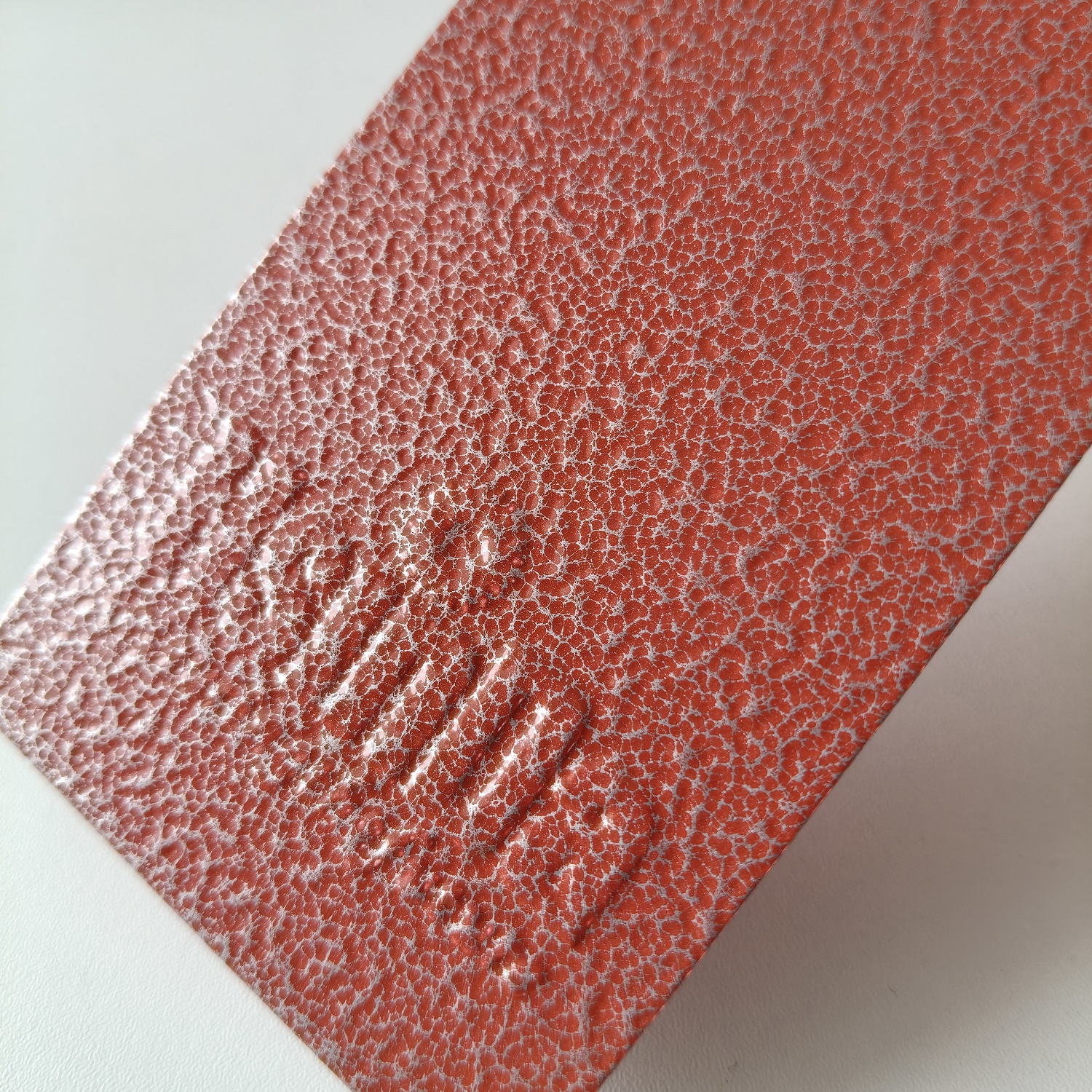
Hammer tone texture creates a dense, scratch-resistant layer suited to security doors, hardware tools and public facilities.
6. Hammer Tone Powder Coating — Security Doors, Tools and Public Facilities
Hammer tone produces the densest visual pattern in this shortlist and is often selected where scratch resistance and long intervals between maintenance matter. Verified applications include bench vises, wrenches and saw-blade handles; security doors, filing cabinets, safes and vaults; steel and wood furniture, outdoor lounge chairs and metal shelves; radiators, lighting fixtures and kitchen and bathroom accessories; aluminum profile surfaces, doors, windows and railings exposed to sun and rain; and public facilities such as streetlight poles, highway guardrails, supermarket shelves and vending machines.
The finish accepts surfaces with minimal flatness requirements, which is why it appears on refrigerator, air-conditioner outdoor unit and television casings, where weather and wear resistance matter more than cosmetic flatness. Verified parameters follow the shared baseline: 500-hour salt spray per ISO 7253:1996, impact 50 kg/cm, adhesion grade 0, hardness ≥H, and 500-hour weather exposure with light retention above 50%.
7. Metallic Powder Coating — Furniture, Decorative Profiles and Interior Metalwork
Metallic finishes use a bonding system to deliver pearlescent and metallic visual effects while keeping the mechanical profile of a polyester coating. The grade is specified for aluminum alloy doors and windows, curtain walls, architectural decorative profiles and outdoor fences; for high-end office furniture, steel-wood and steel-pipe furniture, display racks and shelves, and hospital furniture; and for computer cases, server enclosures and high-end speaker panels. Automotive and transportation uses include car wheels, body trim, motorcycle and children's bike frames, engine parts and bicycle frames.
Mechanically the grade is verified at 50 kg/cm impact per ISO 6272-1:2017, bending ≤2 mm per ISO 1519:2002, cupping ≥6 mm per ISO 1520:2006, adhesion grade 0 per ISO 2409:2020 and hardness ≥H per ISO 15184:2020, with 500-hour salt spray and 500-hour weather exposure, both with light retention above 50%. For decorative metalwork, the practical constraint is color consistency: metallic effects are more sensitive to application parameters than solid colors, so a physical sample approval step before mass production is worth budgeting for.
8. Anti-Corrosion Epoxy Powder Coating — Heavy-Duty Industrial Surfaces
Pure epoxy chemistry is the shortlist entry for surfaces where corrosion, not appearance, drives the decision. Verified applications include oil and gas pipelines, water supply systems, valves and steel reinforcement bars; electrical and electronic insulation for electric vehicle batteries, electric motors such as hairpin stators, busbars, motor copper bars, transformers, switchgear, capacitors and circuit boards; and automotive and heavy industry protection for chassis and engine bay components, vehicle frames, engine parts, pump bodies and gearboxes.
The performance profile is 500-hour salt spray with the coating film unchanged and unilateral corrosion at the cross-section of ≤2 mm per ISO 7253:1996, impact resistance of 50 kg/cm per ISO 6272-1:2017, adhesion grade 0 per ISO 2409:2020, hardness ≥H per ISO 15184:2020, and chemical resistance described as good against general acids and oils with average alkali resistance. It is worth noting explicitly that a pure epoxy system is an indoor and industrial-protection chemistry; where a project also demands sustained UV exposure, a polyester-based architectural grade from the same shortlist is the appropriate pairing.

Pure epoxy anti-corrosion powder coating is specified for pipelines, valves, reinforcement bars and heavy machinery components.
The Compliance Overlay: TGIC-Free, HAA-Cured and REACH-Compliant Options
Projects with tighter environmental or procurement-compliance requirements can apply a second filter on top of the finish shortlist. TGIC-free powder coatings in this portfolio are HAA polyester systems made from polyester resin, HAA curing agent, pigment and additives, and are classified as indoor powder coatings, VOC-free powder coatings, HAA curing powder coatings and REACH-certificated powder coatings. Their verified performance matches the shared baseline — 500-hour salt spray per ISO 7253:1996, impact 50 kg/cm per ISO 6272-1:2017, adhesion grade 0, hardness ≥H — with the same 180–200°C, 10–15 minute cure window.
Verified application areas for the HAA systems include refrigerators, washing machines, air conditioners and microwave ovens, where resistance to detergents and scratches matters; office desks and chairs, filing cabinets, shelving units and storage lockers subject to high-frequency use; automotive interior trim, engine compartment components and chassis parts; and instrumentation, heat sinks, computer cases and printers. For interior metalwork that does not face sustained UV load, an epoxy-polyester hybrid grade is also available as a VOC-free, low-temperature-curing option. Indoor performance for these systems is documented across a temperature range of -10°C to 30°C indoors and -30°C to 45°C outdoors where relevant, with salt spray tested beyond 500 hours and long-lasting protection against moisture, acids and alkalis.
How Hsinda Fits the Shortlist
Hsinda is the trading identity of Chengdu Hsinda Polymer Materials Co., Ltd., a powder coating manufacturer established in 2015 and based in Pixian, Chengdu, Sichuan, China. The company operates a 10,000 m² factory with eight advanced powder coating production lines and three sample lines, an annual output of more than 5,000 tons, a monthly capacity of 400 tons and an 11-person R&D team, and states that it holds more than 40 independent patents. Its factory is certified to ISO 9001 and ISO 14001, and its powder coatings have passed RoHS, REACH, SGS and AAMA testing.
For buyers, the more decision-relevant facts are the customization range and the supply terms. Customization covers color matching to standard charts, RAL or Pantone references, or customer samples; gloss classification by 60° gloss meter value into high gloss above 80%, semi-gloss 40–79% and matte 5–39%; texture and effect options including smooth, sandblasted, wrinkled, hammered, watermarked, cracked, stone-like, metallic or pearlescent, chameleon, photochromic, thermochromic, electroplating effect, reflective and luminescent; and performance options including weather resistance mapped to AAMA 2604 and Qualicoat 2 and Qualicoat 1 references, corrosion resistance, antibacterial, anti-slip, anti-fingerprint, fireproof and explosion resistant, scratch resistant and low-temperature curing. Quality control is stated as 100% testing.
Commercially, the standard MOQ is 300 kg with a 15–20 day lead time, while OEM packaging, sample card and logo programs start at 6 tons with a 20-day lead time. The company reports a 70% export ratio, exports to more than 70 countries, distributors in markets including Russia, Bangladesh, Poland, Portugal, the United States, Canada, Sri Lanka, Bolivia and Argentina, exclusive distributors in Kazakhstan, Uzbekistan and Chile, and a supply relationship of more than 10 years with Mexico's largest agricultural tool equipment factory. Domestic references include Changhong Electric, Xiaomi Appliances, TCL Electronics and Hitachi Elevator. For a project buyer running a shortlist process, these are the reference points that can be verified through samples and documentation rather than taken on trust.
Application Map: Matching the Finish to the Surface
| Surface / Project Element | Recommended Finish From the Shortlist | Primary Reason |
|---|---|---|
| Aluminum curtain walls, doors and windows, sunrooms, partitions | Aluminum profile powder coating | 1,000 h salt spray and 1,000 h weather exposure; Florida natural aging data |
| Exterior railings, outdoor furniture, guardrails, light poles | Glossy powder coating | Exterior color retention with 500 h weather exposure |
| Appliance housings, lighting, interior metal panels | Matt powder coating | Gloss 5%–30% reduces glare and visible surface marks |
| Cabinets, countertops, hardware, charging devices | Sandy powder coating | Textured surface hides handling marks; hardness ≥H |
| Electrical cabinets, steel furniture, machine housings | Wrinkle powder coating | Covers casting defects; acids and oils resistance |
| Security doors, tools, public facilities | Hammer tone powder coating | Dense scratch-resistant layer for high-contact surfaces |
| Decorative profiles, display racks, high-end furniture | Metallic powder coating | Bonded metallic effect with full mechanical baseline |
| Pipelines, valves, rebar, pump and gearbox bodies | Anti-corrosion epoxy powder coating | Corrosion and chemical resistance on heavy-duty steel |
| Indoor projects with compliance or air-quality requirements | TGIC-free / HAA, REACH-compliant grades | VOC-free option with the same mechanical baseline |
Market Direction for Architectural and Decorative Powder Coatings
The demand backdrop supports the shortlist logic. Grand View Research values the global powder coatings market at USD 11.5 billion in 2025, projected to reach USD 18.5 billion by 2033. IMARC Group reports a 2025 market size of USD 16.4 billion with expected growth at a CAGR of 4.51% until 2034. The two estimates differ, and that divergence is itself useful information: market-size figures for this category vary by reporting agency, so procurement teams are better served by using them for directional context than for business-case arithmetic.
On the trade side, China's coating industry exported 334,800 tons of coatings in 2024, an 18.65% year-on-year increase in value to USD 1.065 billion, according to the China Coatings Industry Association as reported by ECHEMI. That figure covers coatings broadly rather than powder alone, but it indicates the supply base that international buyers are drawing from. On the standards side, architectural powder coatings are governed by international certification schemes including Qualicoat, GSB International and AAMA standards 2603, 2604 and 2605, while ISO 12944 is the primary benchmark for specifying coating systems in corrosive environments from C1 to C5. Those frameworks are what turn a shortlist into a defensible specification.
Powder Coating Versus Traditional Liquid Paint: Where Powder Stops Being the Right Answer
Powder coating is frequently compared with liquid paint on durability and total cost, and for architectural and industrial metalwork the case is generally strong: a cured powder film provides a dense protective layer, solvent-free application eliminates VOC emissions at the coating line, and the mechanical parameters listed above are measurable and repeatable. But a shortlist that only lists advantages is not a procurement tool. There are real boundaries.
The first is thermal. Every finish in this shortlist cures at 180–200°C for 10–15 minutes. That window is effective for aluminum profiles, steel furniture and industrial components, but it excludes fully assembled units containing plastics, electronics or heat-sensitive substrates, unless a low-temperature curing chemistry is specifically selected. The second boundary is repair. Liquid paint can be touched up on site with a brush; a cured powder film cannot be spot-repaired to match, so site damage generally means re-coating a component rather than blending a patch. The third is changeover economics: color and texture changes carry practical minimum batch considerations, and the standard MOQ for custom work is 300 kg, which is not a constraint for a facade package but can be one for a small refurbishment. The fourth is substrate preparation: textured finishes are more forgiving of minor substrate irregularity than high gloss, which means the finish choice partly determines how much surface preparation the project must fund.
What Buyers Should Verify Before the First Order
- Request the test method, not just the result. "500 hours salt spray" is only meaningful with ISO 7253:1996 attached, and "grade 0 adhesion" requires ISO 2409:2020.
- Confirm the gloss band numerically. Ask for the 60° gloss meter value per ISO 2813:2014. A "matte" request can mean 5% or 30%, and the appearance difference is substantial.
- Match the chemistry to the exposure. Polyester-based architectural grades for UV-exposed exterior work; pure epoxy for corrosion-driven heavy-duty interiors.
- Validate curing capability at the applicator. A 180–200°C, 10–15 minute cure is a process requirement; an applicator whose oven profile cannot hold that window will not reproduce the test data.
- Check the compliance chain. Where REACH or VOC-free status matters, confirm it at the product level rather than the company level.
- Approve a physical sample. This is especially important for metallic and textured finishes, where visual effect depends on application parameters.
Future Outlook
Two directions look most likely to shape this shortlist over the next few years. The first is compliance-driven substitution: as VOC-free and REACH-compliant positioning moves from a differentiator to a baseline expectation, HAA-cured and TGIC-free systems will increasingly be specified by default in indoor architectural and furniture work rather than as an alternative. The second is application expansion: the appearance of textured finishes on new energy vehicle charging devices shows how decorative powder coating is spreading from traditional construction and furniture into newer infrastructure categories.
For project teams, the practical implication is that the shortlist logic — substrate, exposure, compliance, then verified parameters — is likely to stay stable even as the finish options multiply. A specification that names the finish, the substrate, the gloss band and the test method remains the most reliable way to keep a coating decision defensible years after installation.
FAQ
Which powder coating finish is suitable for aluminum curtain walls, doors and windows?
An aluminum profile powder coating based on super weather-resistant polyester resin is the grade specified for aluminum profiles, doors and windows, glass curtain walls, sunrooms and architectural partitions. Its verified performance includes salt spray resistance of 1,000 hours with the coating film unchanged and unilateral cross-section corrosion of ≤2 mm per ISO 7253:1996, impact resistance of 2.5 Nm per ISO 6272-1:2017, weather resistance of 1,000 hours at 340 lamp with no powdering and light retention above 50% per ISO 11341:2004, and a one-year Florida natural aging result with gloss retention above 50%. Adhesion is grade 0 per ISO 2409:2020 and hardness is ≥H per ISO 15184:2020.
What surface finish should be specified for interior metal furniture and fixtures?
The choice is usually driven by appearance and maintenance rather than mechanical performance, because matt, glossy, sandy, wrinkle and hammer tone grades in this portfolio share the same mechanical baseline: impact resistance of 50 kg/cm per ISO 6272-1:2017, adhesion grade 0 per ISO 2409:2020, hardness ≥H per ISO 15184:2020 and 500-hour salt spray per ISO 7253:1996. Matt grades are specified at 5%–30% gloss per ISO 2813:2014 and reduce glare and visible fingerprint marks on appliance housings, computer casings and lighting equipment. Sandy texture suits cabinets, countertops, hardware and shelving. Wrinkle texture is used on steel furniture, electrical cabinets and machine housings partly because it covers casting defects. Hammer tone provides a dense scratch-resistant layer for security doors and tools.
Which powder coating is used for heavy-duty anti-corrosion surfaces such as pipelines and valves?
A pure epoxy powder coating is the grade specified for heavy-duty anti-corrosion work, including oil and gas pipelines, water supply systems, valves and steel reinforcement bars, as well as chassis and engine bay components, vehicle frames, pump bodies and gearboxes. Its verified profile is 500-hour salt spray with the coating film unchanged and unilateral cross-section corrosion of ≤2 mm per ISO 7253:1996, impact resistance of 50 kg/cm per ISO 6272-1:2017, adhesion grade 0 per ISO 2409:2020, hardness ≥H per ISO 15184:2020, and resistance described as good against general acids and oils with average alkali resistance. Pure epoxy chemistry is an indoor and industrial-protection system; UV-exposed exterior work generally calls for a polyester-based architectural grade instead.
What curing and film thickness parameters should be verified before production?
Across this portfolio the process window is curing at 180–200°C for 10–15 minutes, a working film thickness of 70 μm, coverage of 8–10 m² per kg at 30–90 μm film thickness, and an average particle size of 32–42 μm, applied by tribo gun or electrostatic spray gun. Buyers should verify that the applicator's oven can hold the 180–200°C, 10–15 minute window, because the published mechanical and corrosion results depend on that cure. Humidity and heat resistance is documented at 1,000 hours with slight gloss loss at ≤ level 1 per GB/T 1740-2007, and flexibility is specified as bending ≤2 mm per ISO 1519:2002 and cupping ≥6 mm per ISO 1520:2006.
When should a TGIC-free or HAA-cured powder coating be specified?
A TGIC-free, HAA-cured system becomes relevant when a project carries tighter environmental or compliance requirements, because these grades are positioned as VOC-free, HAA curing and REACH-certificated powder coatings, made from polyester resin, HAA curing agent, pigment and additives. Their verified performance matches the shared baseline: 500-hour salt spray per ISO 7253:1996, impact resistance of 50 kg/cm per ISO 6272-1:2017, adhesion grade 0 per ISO 2409:2020 and hardness ≥H per ISO 15184:2020, with the same 180–200°C, 10–15 minute cure. Documented application areas include refrigerators, washing machines, air conditioners and microwave ovens, office and residential furniture such as desks, chairs, filing cabinets and lockers, automotive interior and chassis-adjacent components, and instrumentation and electronic equipment housings. Where a project involves high air-quality requirements such as hospitals or kitchens, part of the portfolio also carries antibacterial functionality that inhibits bacterial growth and is designed for high-humidity and dusty environments, which should be confirmed against the individual product data sheet.