
Powder Cosmetic Filling Machine Decision: Press or Loose?
Powder cosmetics split into two production logics the moment a product brief is written. A pressed compact and a loose powder jar can share the same powder bulk, the same shade name and the same brand, yet they leave the factory through equipment that shares almost no tooling. That split is the first practical decision in specifying a powder line, and it is where a surprising number of early equipment assumptions go wrong.
The short answer: a compact powder press machine forms a measured dose of prepared powder into a pan under pressure, while a loose powder filling machine doses free-flowing powder into a container and settles it without forming it. Neither machine family replaces the other, and neither is a complete line on its own. A press needs powder that has already been mixed to a consistent bulk condition; a loose powder filler needs powder that flows predictably through an auger or a weighing head. Both sit downstream of the same mixing, pulverizing and sifting stage.
Shanghai GIENI Industry Co., Ltd. — trading as GIENICOS — is a Shanghai-based manufacturer founded in 2011 that designs and builds intelligent cosmetic filling and packaging equipment, including machines in both powder families plus the mixers, pulverizers and sifters that feed them. Building both families under one roof is what makes a like-for-like comparison possible from a single equipment set rather than from specification sheets assembled across several suppliers.
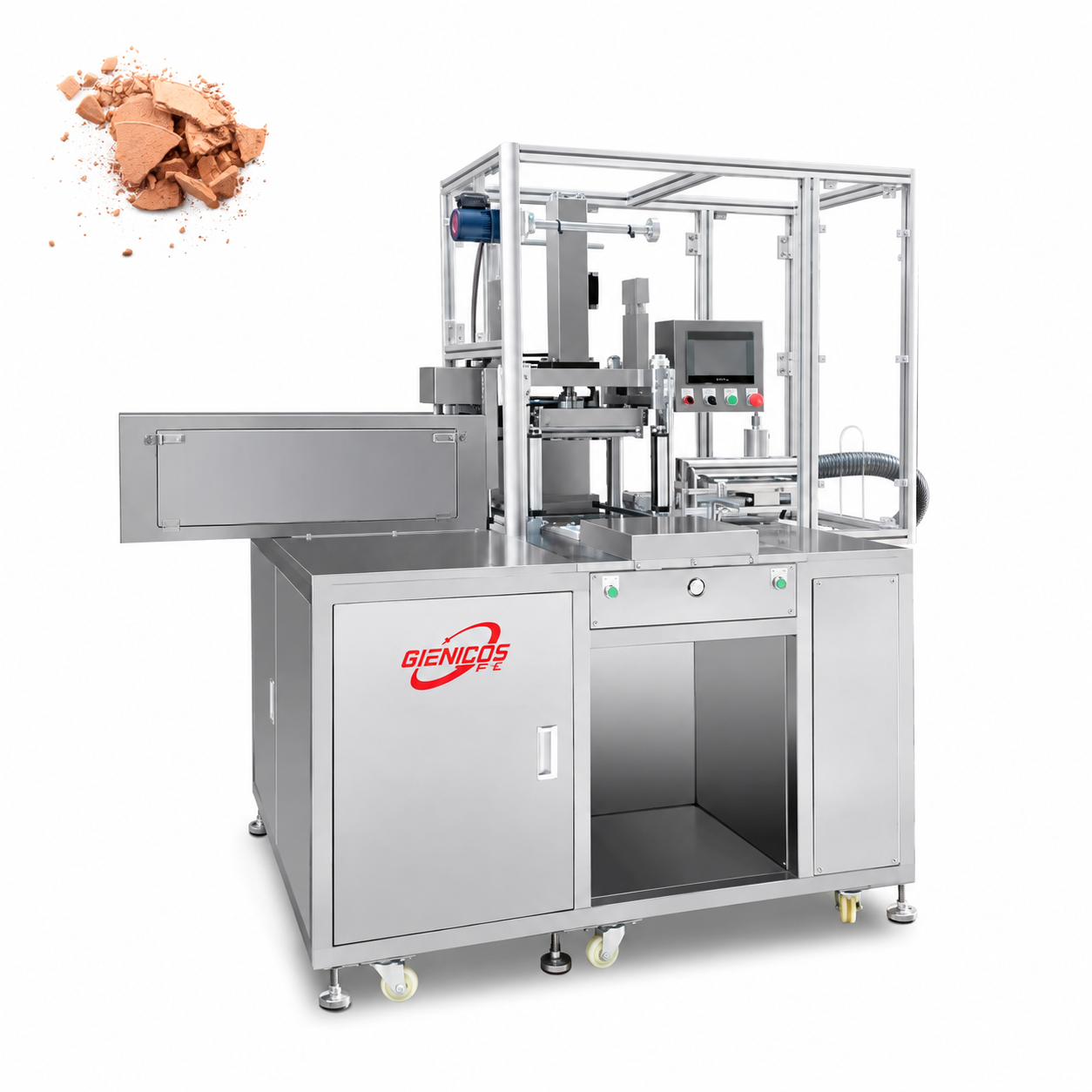
JBC-5 servo hydraulic bottom-up compact powder press machine — one of the press configurations a buyer compares against loose powder filling equipment.
Why Powder Cannot Borrow Liquid Filling Logic
Liquid and hot-pour cosmetic filling is governed by volume, viscosity and temperature. Powder filling is governed by particle behaviour: bulk density, flowability, particle size distribution and how the material responds to vibration. A cosmetic filling machine specified for lip gloss, mascara or cream cannot simply be re-tooled for powder, because the dosing principle differs at the mechanical level.
That difference produces a usable rule for buyers: in powder production, the equipment decision sits downstream of the formula decision, not the other way around. A shade that presses cleanly may not flow predictably through an auger, and a shade that flows well may not hold a pressed cake without cracking. The two machine families exist because those two behaviours need two different mechanical answers — pressure and dwell on one side, controlled volumetric dosing and settling on the other.
The Compact Powder Press Family: What Each Machine Does
Compact pressing takes a prepared powder bulk and forms it into a pan, godet or case under pressure. GIENICOS builds four stages of that logic, from a hydraulic bench machine through to a vision-guided robotic assembly line.
Compact Powder Press Machine (JTC)
The JTC is a hydraulic up-bottom compact powder machine built for cosmetic powder forming. Its drive system is full hydraulic, with a working pressure range of 0.1 to 14 MPa, a maximum hydraulic output pressure of 8 tons and a table height of 800 mm. The structure uses 304 stainless steel and 6061 aluminium components. The machine measures 1,465 × 570 × 1,670 mm (L × W × H), weighs 400 kg and runs on AC380V, 3 phase, 50/60Hz. It is specified for face powder, pressed powder, blush and eyeshadow.
Compact Powder Press Machine (JBC-4) and Bottom Up Compact Powder Machine (JBC-5)
These two bottom-up presses represent the hydraulic and the servo-hydraulic ends of the same production idea.
The JBC-4 uses a full hydraulic drive with a bottom-up pressing action and delivers 2–3 molds per minute, with a typical production capacity of 720–1,080 pcs/hour. It accepts up to 6 pans per mold depending on aluminium pan size, works at 0.4–0.6 MPa with a maximum hydraulic output pressure of 15 tons, draws 4.5 kW at 3-phase AC380V, 50Hz, measures 1,796 × 910 × 2,010 mm, weighs 800 kg and runs with 1–2 operators.
The JBC-5 is a servo-motor hydraulic bottom-up press presented as a fifth-generation compact powder design. Maximum pressure is 14 tons and maximum capacity is 3 molds per minute, with a typical mold carrying 9 pcs at approximately 50 mm pan diameter. Voltage is 380V, 3 phase; dimensions are 1,700 × 1,500 × 1,800 mm; weight is 650 kg; and it operates with 1–2 people. Its practical advantage over a fixed hydraulic press is control: pressing speed and pressing pressure are both adjusted directly on the touch screen, which is what makes frequent formula and SKU changeover realistic on one machine instead of one line per shade. GIENICOS positions the JBC-5 for integration into a complete powder production process after mixing, pulverizing and sifting.
Automatic Powder Press Machine (GP 050 SE)
Where the JBC presses are built around mold handling, the GP 050 SE is built around an automatic cycle. It is a full automatic servo type powder press machine with a rotary production type; the press type is servo and can be customized to a hydraulic press. Rated capacity is 50–60 pcs/min based on a 4-cavity example. It runs a single colour as standard with customization available according to product requirements, and it needs only 0.5–1 operator. An optional ROBOT pan feeder handles aluminium pan loading, and the stated application scope is compact powder and eyeshadow.
Robot Compact Powder Assembly Line (JZF)
The JZF is a vision-guided robotic compact powder assembly line for automatic powder case assembly. It carries one Delta robot for pick-and-place work, two visual detection sets — one for the godet and one for the powder case — and conveyor feeding for powder cases. Powder case sizes from 10–60 mm are handled, with suction or pick & place visual feeding, powder case position identification and support for logo orientation control. Changeover and set time is approximately 15 minutes. The robot works within a 600 mm diameter and carries a maximum load of 1 kg. The unit measures 700 × 1,100 × 1,800 mm and runs on single-phase 220V, 60Hz, 2 kW, with 0.5–6 MPa air supply at 300 L/min.
The Loose Powder Filling Family: Rotary and Linear
Loose powder filling doses free-flowing powder into a container — a jar, a sifter case or a compact-style case — without pressing it into a cake. The engineering problem here is settling: powder has to reach its target dose without leaving voids that later compact in transit and shift the fill line.
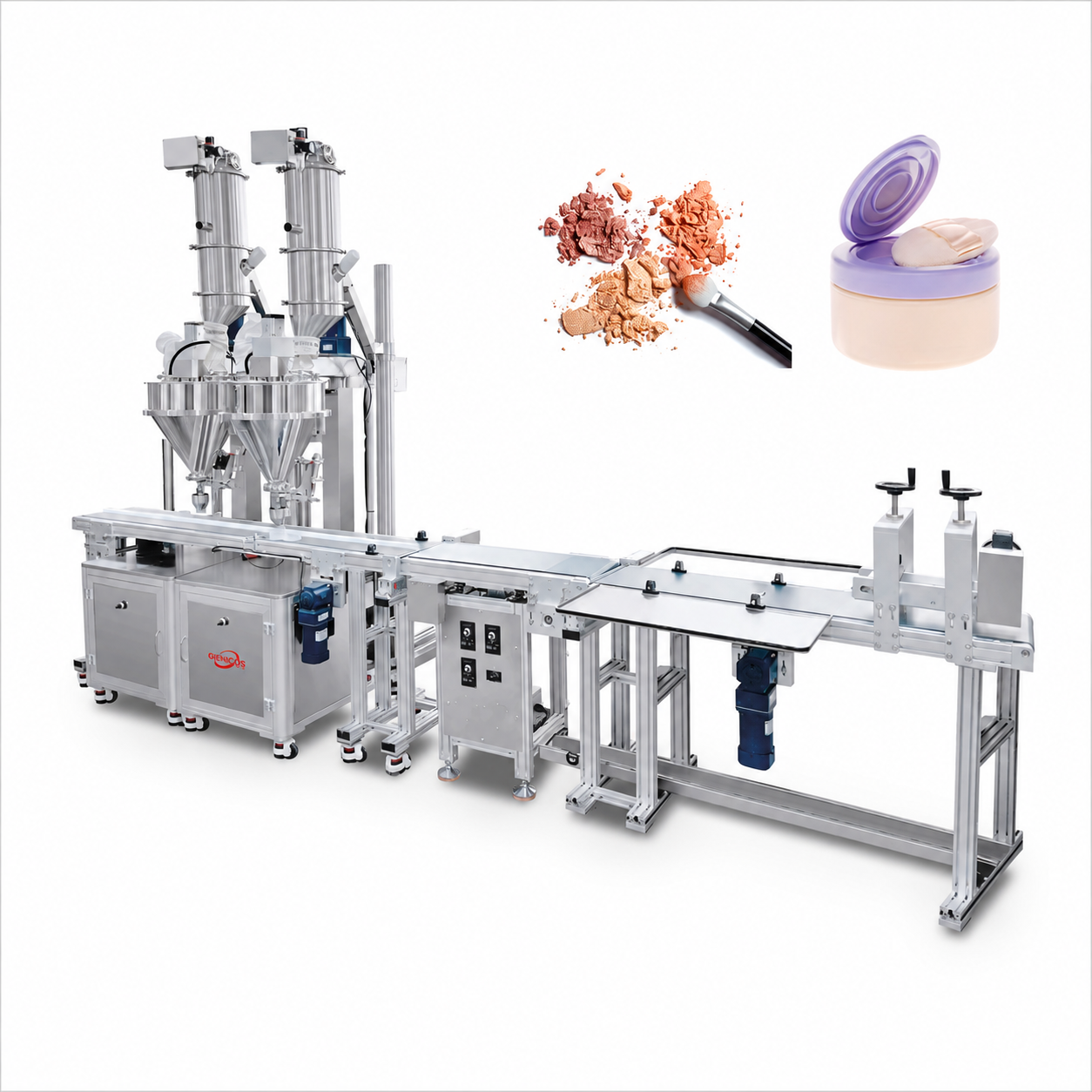
JLF-A dual-nozzle linear automatic loose powder filling machine — dual auger heads on a linear transfer rather than a rotary table.
Loose Powder Filling Machine – Rotary Type (JLF)
The rotary loose powder machine uses a rotary weighing-to-fill mode with an output of 900–1,800 pcs/hour. The tank holds 25 L and power draw is 0.4 kW at single-phase AC220V, 50/60Hz. Air supply is 0.6–0.8 MPa at ≥300 L/min, and the machine measures 670 × 600 × 1,400 mm (L × W × H) at a weight of 220 kg. Its compact rotary footprint suits a single-format production cell where floor space is the binding constraint.
Automatic Loose Powder Filling Machine (JLF-A)
The JLF-A takes a different approach: a dual-nozzle linear configuration in which two auger filling heads work simultaneously. Capacity is 30–40 pcs/min and the feed hopper holds 25 L. Product-contact parts are made of SUS316L stainless steel. Control uses a Mitsubishi PLC, dosing uses a Panasonic servo motor, and container transfer uses a JSCC conveying motor. Filling combines automatic auger dosing with vibration conveying to support more consistent powder settling inside containers.
The process scope is broader than the name suggests. A JLF-A production flow can include container loading, dual-head automatic filling, vibration conveying, inner-lid placement, automatic pressing, pickup and capping — meaning a substantial part of loose powder packaging can sit inside one machine rather than being split across several stations. The modular process structure is designed for integration into semi-automatic or extended cosmetic powder packaging lines, and the application scope covers face powder, loose powder and other free-flowing powder products.
Side-by-Side: Press and Loose Powder Compared
| Decision dimension | Compact powder press family | Loose powder filling family |
|---|---|---|
| Dosing principle | Powder formed under pressure in a pan or case | Powder dosed volumetrically or by weight, then settled |
| Representative GIENICOS models | JTC, JBC-4, JBC-5, GP 050 SE, JZF | JLF-A, Loose Powder Filling Machine – Rotary Type (JLF) |
| Output as specified | JBC-4: 2–3 molds/min (720–1,080 pcs/hour typical); JBC-5: max 3 molds/min; GP 050 SE: 50–60 pcs/min on a 4-cavity example | JLF-A: 30–40 pcs/min; rotary JLF: 900–1,800 pcs/hour |
| Output unit to normalise | Molds per minute — depends on pans per mold and pan diameter | Pieces per minute or pieces per hour — depends on container and dose |
| Product-contact material | 304 stainless steel / 6061 aluminium components on JTC and JBC-4; stainless steel on JBC-5 and GP 050 SE | SUS316L product-contact parts on JLF-A |
| Labour per machine | JBC-4 and JBC-5: 1–2 operators; GP 050 SE: 0.5–1 operator | Documented for the powder-filling process; depends on container feeding arrangement |
| Changeover control | JBC-5: pressing speed and pressure adjusted on the touch screen; JZF line: approx. 15 min set time | Auger dosing and vibration conveying settings change with formula and container |
| Upstream requirement | Powder must be mixed, pulverized and sifted before pressing | Powder must be mixed, pulverized and sifted so the auger doses consistently |
Two of those rows matter more than the rest for budgeting. First, the output unit differs between the families: press capacity is expressed in molds per minute and loose powder capacity in pieces per minute or hour. Converting one across to the other before comparing is a common source of unrealistic project plans. Second, the upstream requirement is identical for both, which means the mixing, pulverizing and sifting stage is a shared cost rather than a format-specific one.
The Upstream Stage Both Formats Share
GIENICOS builds the powder preparation group as a separate equipment set, and it is the same set regardless of which downstream family a buyer chooses.
- High Speed Powder Mixer JY3-CR100 — stainless steel, 100 L chamber, 10–25 kg capacity, 18.5 kW main motor at 0–2,840 rpm, 2.2 kW side motor, three side stirrer shafts. Overall dimensions 1,900 × 1,400 × 1,600 mm (L × W × H); weight 1,200 kg; voltage AC380V, 3P, 50/60Hz.
- High Speed Powder Mixer JY-CR50 — 50 L mixing volume, 10 kg per batch, 7.5 kW main motor at 0–2,840 rpm, one side stirrer shaft at 2.2 kW, AC380V, 3 phase, 50/60Hz.
- High Speed Powder Mixer JY-CR200 — 200 L mixing volume, 20–50 kg per batch, 37 kW main motor, three side stirrer shafts at 2.2 kW each with 0–2,840 rpm adjustment.
- Powder Pulverizer JMP08 — 7.5 kW, 7,200 rpm, 20–50 kg/hour, screw feeding with adjustable speed, 8 hammers, sieve sizes 1.0 / 1.5 / 2.0 mm.
- Vibration Powder Sifter PSF — 0.75 kW, AC380V / 220V, 3 phase, 50/60Hz, 440 mm screen diameter, 40 / 60 mesh, 470 × 744 × 1,042 mm (L × W × H), 45 kg.
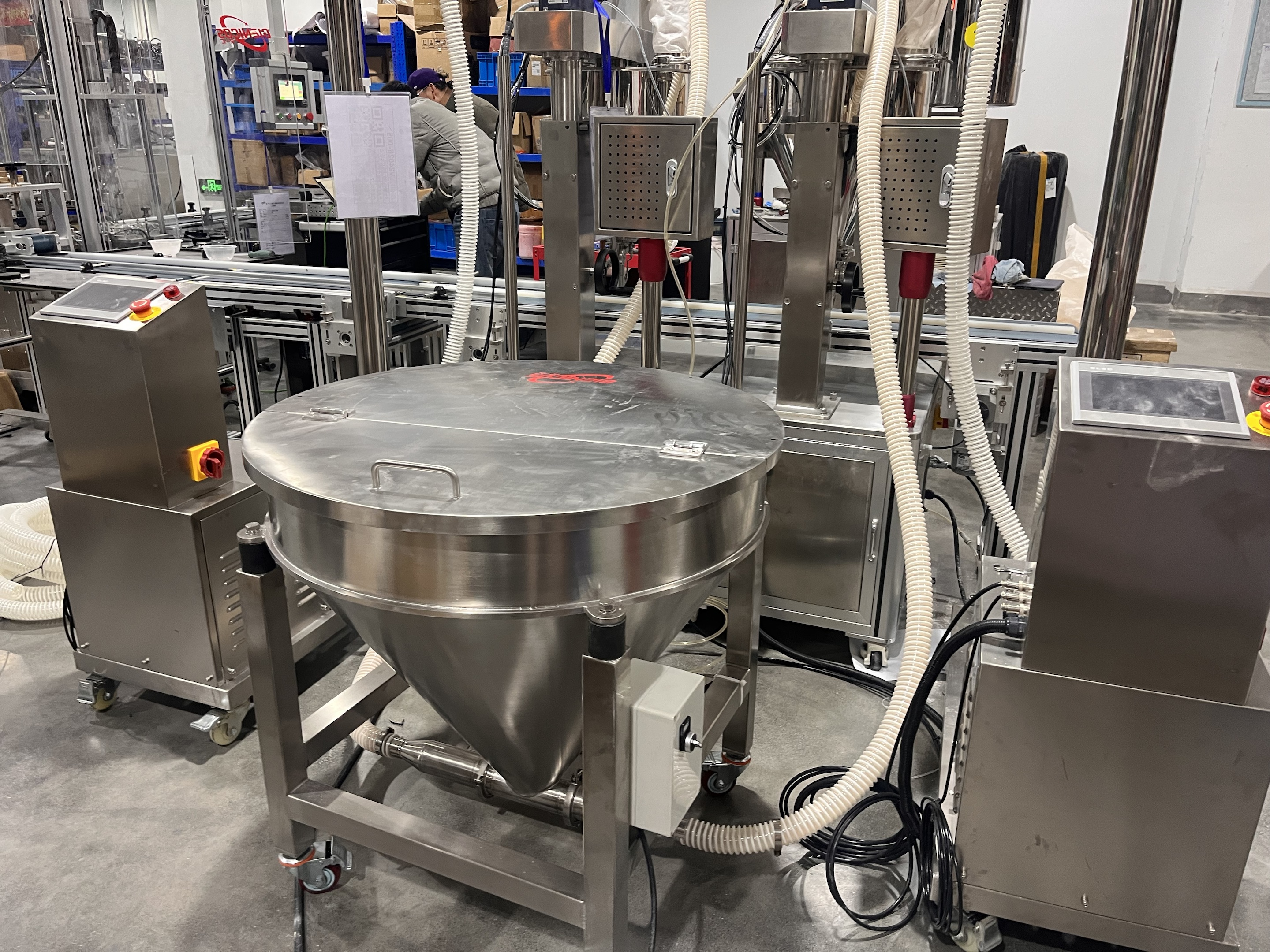
Powder loading hopper. Whether the downstream machine presses or fills, the powder arrives here first — mixed, pulverized and sifted to a stable bulk condition.
For a press line, this stage determines whether the cake presses without cracking or delamination. For a loose powder line, it determines whether the auger holds a repeatable dose. Either way, it is the stage where a powder project is usually won or lost, long before the filling or pressing machine is chosen.
Buyer Decision Framework: Six Checks Before Quotation
- Product format first. Press or loose is not a preference, it is a consequence of the finished pack. A pressed compact requires pressing pressure and dwell; a loose powder jar requires controlled dosing and settling. Fix the format before requesting any quotation.
- Normalise the output unit. Press capacity is stated in molds per minute and loose powder capacity in pieces per minute or hour. Ask each supplier to restate capacity in the same unit, using your actual pan diameter or container dose.
- Define the upstream scope. Mixing, pulverizing and sifting are required in both cases. Decide whether they sit in your scope or the supplier's, and confirm mesh sizes, batch weights and chamber volumes against your formula.
- Model the labour per machine, not per line. The JBC-4 and JBC-5 run with 1–2 operators; the GP 050 SE needs 0.5–1. Multiply by the number of parallel machines your volume requires before comparing labour costs.
- Test changeover with real SKUs. The JBC-5 exposes pressing speed and pressure on the touch screen, and the JZF line states an approximately 15-minute changeover or set time. Test these against your actual shade count and batch sizes.
- Confirm integration interfaces. The JBC-5 is positioned to integrate into a complete powder process after mixing, pulverizing and sifting; the JLF-A is built on a modular process structure for integration into semi-automatic or extended powder packaging lines; the GP 050 SE offers an optional ROBOT pan feeder. Confirm upstream and downstream interfaces in writing.
Certification and Compliance Boundaries
For buyers in the EU, and for manufacturers exporting into the EU, the certification scope matters as much as the certificate itself. GIENICOS holds European Conformity (CE) documentation across several powder-relevant machine groups:
- Powder compacting machines — certificate number AT18250SC100525, issued 6 July 2021 by Anbotek (Guangzhou) Compliance Laboratory Limited for the EU market, covering model numbers JBC, JTC, ZL, ZL-F and JAC. The listed standards are EN 60204-1:2018 and EN ISO 12100:2010.
- Powder mixers — certificate number AT18250SC100526, issued 6 July 2021 by the same authority for the EU market, covering JY-CR50, JY-CR15, JY-CR20, JY-CR30, JY3-CR100, JY3-CR150, JY3-CR200 and JY3-CR300.
- Rotary filling machines — certificate number AT18250SC100524, covering the JR-02-E, JR-01-E, JR-01-M, JR-02-M, JR-01-L, JR-02-L, JR-01-N, JR-02-N, JR-01-P and JR-02-P model numbers.
- Melting tanks — certificate number ATGZAHS190528008-M1, issued 5 June 2019 by Anbotek (Guangzhou) Compliance Laboratory Limited, covering MT-1, MT-4, MT-6, TSP, TSF and MT.
There is also a trade-side constraint. Cosmetic filling machines fall under HS Code 8422.30, specifically 8422.30.91 for machinery used in opening, filling and closing containers. Getting the classification right at the proforma stage avoids expensive reclassification at the port, because a powder press and a powder filler can attract different treatment depending on how they are declared.
Applications and Use Cases
The equipment specifications point to four recognisable powder production profiles.
- Single-format compact production. One shade, one pan size, steady volume. A JBC-4 or JBC-5 with a fixed mold configuration carries the load, with the JBC-5's touch-screen pressure and speed adjustment absorbing minor batch variation.
- Multi-SKU compact production. Frequent shade and format changes make tooling changes the bottleneck rather than machine speed. Here the JBC-5's on-screen parameter adjustment and the JZF line's approximately 15-minute changeover or set time become the numbers that matter most.
- High-volume compact and eyeshadow. A full automatic cycle with robotic pan loading, as on the GP 050 SE at a rated 50–60 pcs/min on a 4-cavity example with 0.5–1 operator, reduces the labour content per unit rather than the cycle time.
- Loose powder jars and cases. The rotary JLF suits a compact cell at 900–1,800 pcs/hour; the linear JLF-A suits a flow that needs dual-head filling plus inner-lid placement, pressing and capping inside one machine at 30–40 pcs/min.
Across these profiles, GIENICOS operates an OEM/ODM production model with customization across voltage, logo, automation degree, tank size, filling method and speed requirements. Monthly capacity is 10 units, lead time is 45–80 days, minimum order quantity is 1 unit, and 100% OQC testing is performed before shipping. Export markets are the EU, USA, Asia and the Middle East, supported by remote technical support, onsite visit support and a one-year warranty with full-life service support.
Market Signals: Automation Is the Growing Share
Two data points frame the powder and filling equipment market usefully for anyone building a five-year procurement plan.
First, scale. The global cosmetic filling machines market was valued at USD 476.80 million in 2025 and is projected to reach USD 718.63 million by 2036, according to Future Market Insights. Within that, Asia Pacific dominated the wider filling machine market with a 33.08% share in 2025, per Fortune Business Insights — which is relevant to lead times and to the density of qualified suppliers in the region.
Second, technology mix. Automatic filling machines are projected to hold a 41.2% share of the cosmetic filling technology market in 2026, again per Future Market Insights. That figure is consistent with what the equipment specifications in this comparison already show: the differences between machines in the same family increasingly sit in parameter control, vision systems and robotic loading rather than in the base mechanical principle. The JBC-5's touch-screen pressure control, the JZF's dual visual detection sets and the GP 050 SE's optional ROBOT pan feeder are all variations on that theme.
A buyer reading these numbers should draw a procurement conclusion rather than a market conclusion: automation is becoming the default expectation, which means the qualifying question shifts from "is this machine automatic?" to "how well does this automatic machine hold its settings across my shade range?"
How This Compares With Traditional Powder Handling
Traditional powder production relied on manual or semi-manual powder handling: loose weighing, hand-loaded presses with fixed hydraulic settings, and manual container feeding into filling stations. The gap between that and the equipment described above is real, but it is not uniform, and the limits are worth stating.
- Hourly output is a configuration figure, not a machine figure. A JBC-5 rated at a maximum of 3 molds per minute carries 9 pcs per mold at approximately 50 mm pan diameter in a typical setup. Change the pan diameter or the mold capacity and the piece count changes while the mold rate does not. A JBC-4 behaves the same way: up to 6 pans per mold depending on aluminium pan size.
- Capacity statements come with a stated basis. The GP 050 SE's 50–60 pcs/min is explicitly based on a 4-cavity example. Treating that as an unconditional figure is the most common specification error in powder press procurement.
- Loose powder still needs settling, not just dosing. The JLF-A combines auger filling with vibration conveying precisely because volumetric dosing alone does not produce a stable fill line. Formula changes that alter flow behaviour can require re-validating the dosing and settling settings — a real cost that a press line does not carry in the same form.
- Labour does not disappear. Both JBC presses run with 1–2 operators; the GP 050 SE reduces that to 0.5–1. The saving is in the number of operators per machine, not in operator-free operation.
- Changeover remains a physical event. The JZF line documents an approximately 15-minute changeover or set time, and the JBC-5 lets operators adjust speed and pressure on screen. Mold changes on presses are still tooling changes, and auger or container changes on loose powder lines are still mechanical adjustments.
Against manual alternatives, the gain is consistency and traceability of settings rather than raw speed. Against a hypothetical "one machine does both" approach, the honest answer is that no such machine exists in this equipment set, because pressing and loose filling solve opposite physical problems.
Future Outlook
Three directions look durable for powder cosmetic equipment over the next several years.
Vision and robotics move from accessory to baseline. The JZF assembly line already uses one Delta robot with two visual detection sets and can identify powder case position while supporting logo orientation control — functions that were recently optional. As the automatic segment grows toward the 41.2% share projected for 2026, robotic pan and case handling is likely to appear on more mid-tier presses rather than only on dedicated assembly lines.
Parameter control becomes the differentiator. When two presses share the same maximum pressure class, the buying decision moves to how quickly a machine can be re-set for the next SKU. Touch-screen adjustment of pressing speed and pressure, and documented set times of around 15 minutes, are the kind of specifications buyers will increasingly ask for in writing.
Compliance scope tightens. As more powder equipment is customized rather than bought standard, the gap between a series-level CE certificate and a specific configured machine will attract more attention from brand owners auditing their contract manufacturers. Buyers who begin asking scope questions at quotation stage will spend less time resolving them at shipment stage.
What is unlikely to change is the underlying split. Pressed and loose powder will keep requiring different machines, and the practical value of this comparison is in narrowing the choice early rather than in finding a single answer.
For readers who want the full technical picture, the GIENICOS 2026 catalogue covering powder pressing, powder mixing, loose powder filling and the wider filling range is available as a public PDF: GIENICOS 2026 equipment catalogue.
FAQ
What is the difference between a compact powder press machine and a loose powder filling machine?
A compact powder press machine forms a measured dose of prepared powder into a pan or case under pressure, usually through a bottom-up or up-bottom pressing action. A loose powder filling machine doses free-flowing powder into a container and settles it, using auger dosing and vibration conveying rather than compression. The two are not interchangeable: pressing depends on powder compacting behaviour under pressure, while loose filling depends on powder flow behaviour through a dosing system.
What upstream equipment do powder pressing and loose powder filling share?
Both formats depend on the same powder preparation stage: high speed mixing, pulverizing and sifting. In the GIENICOS equipment set this includes the JY3-CR100 (100 L chamber, 10–25 kg capacity), JY-CR50 (50 L, 10 kg per batch) and JY-CR200 (200 L, 20–50 kg per batch) high speed powder mixers, the JMP08 powder pulverizer (7.5 kW, 7,200 rpm, 20–50 kg/hour, sieve sizes 1.0 / 1.5 / 2.0 mm), and the PSF vibration powder sifter (440 mm screen diameter, 40 / 60 mesh). For a press line this stage determines whether the cake presses cleanly; for a loose powder line it determines whether the dosing system repeats accurately.
How many operators does each powder format require?
On the pressing side, the JBC-4 and JBC-5 bottom-up compact powder presses each operate with 1–2 persons, while the GP 050 SE full automatic servo type powder press machine requires 0.5–1 operator. The JZF robotic compact powder assembly line reduces the manual handling content of case assembly further through robotic pick-and-place with vision guidance. For loose powder filling, operator demand depends substantially on how containers are fed into the machine and how the filled units are removed, so it should be confirmed against the specific container and feeding arrangement rather than assumed from the filling head count.
Which certifications apply to powder pressing and powder mixing equipment?
GIENICOS holds CE certification number AT18250SC100525 for powder compacting machines covering model numbers JBC, JTC, ZL, ZL-F and JAC, and CE certification number AT18250SC100526 for powder mixers covering JY-CR50, JY-CR15, JY-CR20, JY-CR30, JY3-CR100, JY3-CR150, JY3-CR200 and JY3-CR300. Both were issued on 6 July 2021 by Anbotek (Guangzhou) Compliance Laboratory Limited for the EU market, against the standards EN 60204-1:2018 and EN ISO 12100:2010. Because voltage, automation degree, tank size and filling method are customizable variables, buyers should confirm that the certificate scope names the exact model and configuration being ordered.
How should a buyer evaluate changeover and line integration for a powder line?
Changeover should be evaluated against the actual SKU count rather than a general impression of flexibility. The JBC-5 exposes pressing speed and pressing pressure for adjustment on the touch screen, which supports switching between formulas and production requirements on one machine; the JZF robotic assembly line documents a changeover or set time of approximately 15 minutes. On line integration, the JBC-5 is designed to be integrated into a complete powder production process after mixing, pulverizing and sifting, the JLF-A is built on a modular process structure for integration into semi-automatic or extended powder packaging lines, and the GP 050 SE offers an optional ROBOT pan feeder. Buyers should confirm upstream and downstream interfaces and the output unit used for capacity planning before comparing quotations.
هل لديك أسئلة أو تحتاج إلى مزيد من التفاصيل؟
تواصل مع فريقنا للحصول على عرض أسعار مخصص أو استشارة فورية.
طلب عرض أسعار
املأ النموذج أدناه وسيتواصل معك فريقنا بعرض مقترح مخصص.
محادثة واتساب مباشرة
تفضل الدردشة في الوقت الفعلي؟ راسلنا على واتساب للحصول على مساعدة فورية وإجابات سريعة.
- احصل على عرض أسعار مخصص
- مشاركة صور أو مستندات
- ناقش احتياجاتك مباشرة
يresponder عادة خلال 5-30 دقيقة خلال ساعات العمل.