
Power Adapter Procurement FAQ: Certifications, Outputs, Plugs and OEM/ODM
Adapter procurement rarely fails because of a logo. It fails because one parameter was wrong: the output voltage did not match the device input, the certificate did not name the exact model, the AC plug was rejected at the destination, or the efficiency declaration did not match the market requirement. Every one of those failures is preventable with a short, disciplined question list.
Why the same adapter questions come up in every buying cycle
An external AC-DC power adapter looks like a commodity. In practice it is a regulated electrical product that must satisfy a device load, a safety standard, an efficiency rule and a national plug standard at the same time. Because those four requirements are set by different parties — the equipment designer, the safety authority, the energy regulator and the market authority — they are usually confirmed by different people inside the buying organisation, and the questions circulate again on each new project.
Shenzhen Simsukian Electronics Technology Co., Ltd (SimSukian) is a Shenzhen-based manufacturer founded in 1996 that develops and mass-produces switching power supplies, lithium-ion battery chargers, charging docks and AC-DC power adapters from 3 W to 240 W, with roughly 70% of its output exported to the EU, USA, Australia, Japan, Korea and the UK. Because the company publishes model-level ratings, plug variants and certificate numbers, its catalog can be used as a concrete reference when working through those questions.
This article follows the order in which buyers normally raise them: electrical fit first, then market compliance, mechanical configuration, protection and materials, customization, commercial terms, application evidence, and finally the limits that should not be assumed away.
The evaluation checklist: lock requirements before comparing suppliers
Suppliers are easier to compare once the requirement set is fixed. The table below lists the parameters that decide whether an adapter is technically and commercially suitable, together with the reference data available for the SK01T and SK03T adapter families.
| Requirement | What the buyer must confirm | Reference data from the adapter range |
|---|---|---|
| Output voltage and current | Matches the device input and leaves headroom for tolerance | 5 V, 12 V and 24 V output families in the SK01T and SK03T series |
| Output power | Device load plus margin stays inside the adapter rating | 12 W, 15.6 W, 15 W, 24 W and 36 W units are published |
| Input range | One design works across destination markets | AC 100–240 V, 50/60 Hz |
| Safety standard | Hazard-based standard accepted by the market | IEC62368, IEC64558, IEC60347 |
| Energy efficiency | No-load and average efficiency rules met | DOE, ERP and CEC-VI |
| Certification | Certificate carries the exact model number | UL, KC, SAA, CE-EMC, CE-LVD, ETL, FCC, PSE, CCC, CQC, RoHS |
| AC plug | Fitted for the destination socket | EU, KR, UK, AU and US plug options |
| Protection | Fault behaviour defined | Short circuit, overvoltage and overcurrent protection |
| Housing | Flammability and mounting suitability | Fire-retardant PC, wall-mount design, black / white / customized colors |
| Commercial terms | Volume, timing and inspection regime | MOQ 600 pcs, lead time 15–30 days, 600,000 units monthly capacity, 100% test |
Working through the list in this order prevents the most common rework: a purchase order placed on a correct electrical rating but an uncertified model number, or a correct model shipped with the wrong plug.
Output tiers: how 24 V, 12 V and 5 V adapters are actually used
Output selection is a device question, not a preference question. The adapter must supply the voltage the equipment is designed around, and enough current for the worst-case load. Because the published range covers 3 W to 240 W, several voltage tiers are represented in the catalog.
| Model / family | Output | Output power | Plug options in published data |
|---|---|---|---|
| SK01T | 24 V / 0.5 A | 12 W | Korea (KR) |
| SK01T | 24 V / 0.65 A | 15.6 W | Korea (KR) |
| SK01T8-1200100V | 12 V / 1 A | 12 W | US |
| SK01T8-0500300U | 5 V / 3 A | 15 W | US |
| SK03T-1200300 | 12 V / 3 A | 36 W | EU, UK, US, AU, KR variants |
| SK03T | 24 V / 1.5 A | 36 W | EU, UK, KR variants |
Two patterns are worth noting. First, the same power class can be delivered at different voltages — a 36 W platform appears as both 12 V / 3 A and 24 V / 1.5 A, which means the mechanical and safety platform can be reused while the output stage is tuned to the application. Second, low-power 24 V units (12 W and 15.6 W) sit in the same family as 12 W and 15 W 12 V and 5 V units, so buyers running mixed product lines do not have to switch supplier families for every device.
For devices that specify a constant low voltage — facial mask devices, small atomisers, meters and similar electronics — the published application notes describe 5 V and 12 V outputs of 1 A, 2 A and 3 A being used to hold a stable rail so that pumps, atomising plates and display chips do not drift or flicker under load changes.
Where PD chargers fit in an adapter programme — and where they do not
PD chargers and fixed-output AC-DC adapters solve related but different problems, and procurement teams increasingly have to buy both. SimSukian's stated main product lines include Power Adapter, AC to DC Power Adapter, Power Supply, PD Charger, Fast Charger and Switching Power Supply, so the two categories are produced within the same power-engineering organisation.
The technical difference is the negotiation layer. A conventional adapter such as the 36 W SK03T delivers a fixed output — 24 V / 1.5 A or 12 V / 3 A — through a DC plug, and the device simply draws what it needs. A USB PD charger instead negotiates voltage and current with the sink device before delivering power. USB Power Delivery Revision 3.1, published by the USB Implementers Forum, extended the Extended Power Range (EPR) ceiling from 100 W to 240 W at up to 48 V and 5 A. That single specification change is why PD chargers have moved from phone accessories into laptop, monitor and small-appliance power budgets.
Three practical consequences follow for buyers in the evaluation stage:
- They are not interchangeable without a trigger. A 24 V / 1.5 A fixed-output adapter cannot be replaced by a PD charger unless the end device supports USB PD negotiation or an external trigger board requests the required voltage. Where a device has a bare DC input, the fixed-output adapter remains the correct part.
- Cable and connector selection becomes part of the specification. PD power travels over USB-C, so cable current rating and e-marker capability affect what the charger can actually deliver at the far end.
- Thermal density is higher in PD and fast chargers. Pushing more power through a small enclosure is why gallium-nitride (GaN) devices have been adopted in this category. The company states that its long-term university–industry cooperation programme covers gallium-nitride power devices alongside battery charging management and over-protection circuits.
For a buyer assembling a product portfolio, the decision rule is straightforward: if the end product exposes USB-C and expects to negotiate, specify a PD or fast charger; if the end product has a fixed DC input jack, an internal regulator, or a certified 12 V / 24 V rail requirement, specify a fixed-output AC-DC adapter. Mixing the two without checking the negotiation path is one of the more expensive mistakes in this category.
Certification: what is covered, and by which document
Certification is the single most audit-sensitive part of adapter procurement, because a certificate is only valid for the model numbers it names. The SK03T and SK01T families carry approvals across the main export markets, with published certificate references.
| Market / scope | Approval | Certificate reference | Standard and validity |
|---|---|---|---|
| USA, Canada, Mexico | UL | E331598-A5-UL, issued by UL | Standard 62368; issued 2016-03-25, valid to 2028-06-01 |
| Korea | KC | R-R-SSK-SK03T1-1200300, National Radio agency | Standard 62368; issued 2020-03-03, valid to 2035-06-01 |
| Australia, New Zealand | SAA | GMA-522584-EA, issued by JAZ-ANZ | Standard 62368; issued 2025-04-09, valid to 2030-09-04 |
| EU, UK | CE-EMC (SK03T1-36W) | 22AE110299E002, issued by GTG | EN 55032:2015+A11:2020+A1:2020; EN 55035:2017+A11:2020; EN IEC 61000-3-2:2019+A1:2021; EN 61000-3-3:2013+A1:2019+A2:2021; issued 2022-11-21 |
| EU (SK01T series) | CE-EMC | 26AE030261E001, issued by GTG | EN 55032:2015/A1:2020; EN 55035:2017/A1:2020; EN IEC 61000-3-2:2019/A2:2024; EN 61000-3-3:2013/A2:2021; issued 2026-03-11 |
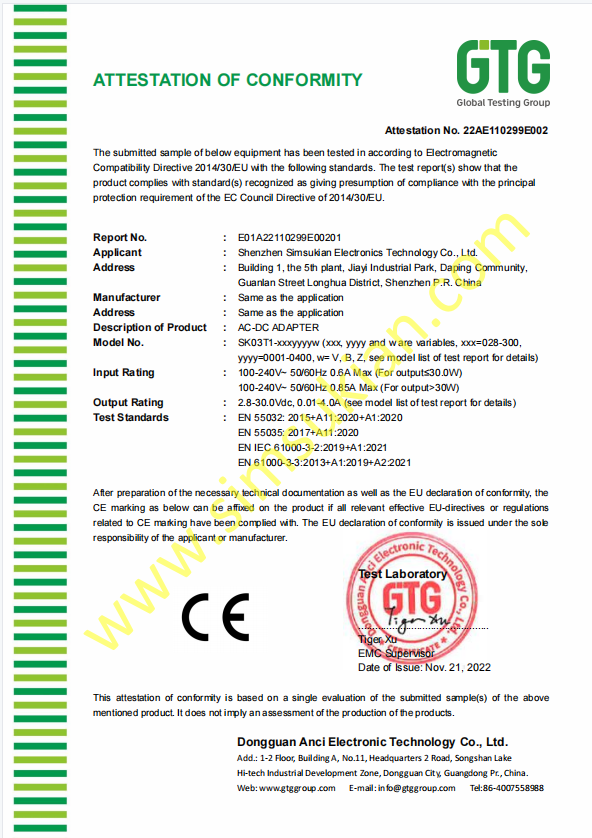
Beyond the individually referenced certificates, the adapter products are declared against a wider approval set: KC, KCC, UL, ETL, FCC, SAA, PSE, CCC, CQC, CE-LVD, CE-EMC and RoHS requirements, with safety standards stated as IEC62368, IEC64558 and IEC60347. Buyers assembling a market-entry file therefore have both the model-level certificate and the broader declaration available for review.
Two regulatory facts are worth keeping in the evaluation notes. The first is that IEC 62368-1 4th Edition (2023) is the hazard-based safety standard that replaced the legacy 60950 and 60065 frameworks for AV/ICT power supplies — meaning that heritage approvals issued under the older standards need to be tracked against their transition dates. The second is that US Department of Energy Level VI efficiency rules cap no-load power draw at 0.100 W for external power supplies rated 49 W and below, which is directly relevant to the 12 W to 36 W classes discussed here. The adapter families state compliance with DOE, ERP and CEC-VI energy efficiency requirements.
Plugs, input range and mechanical configuration
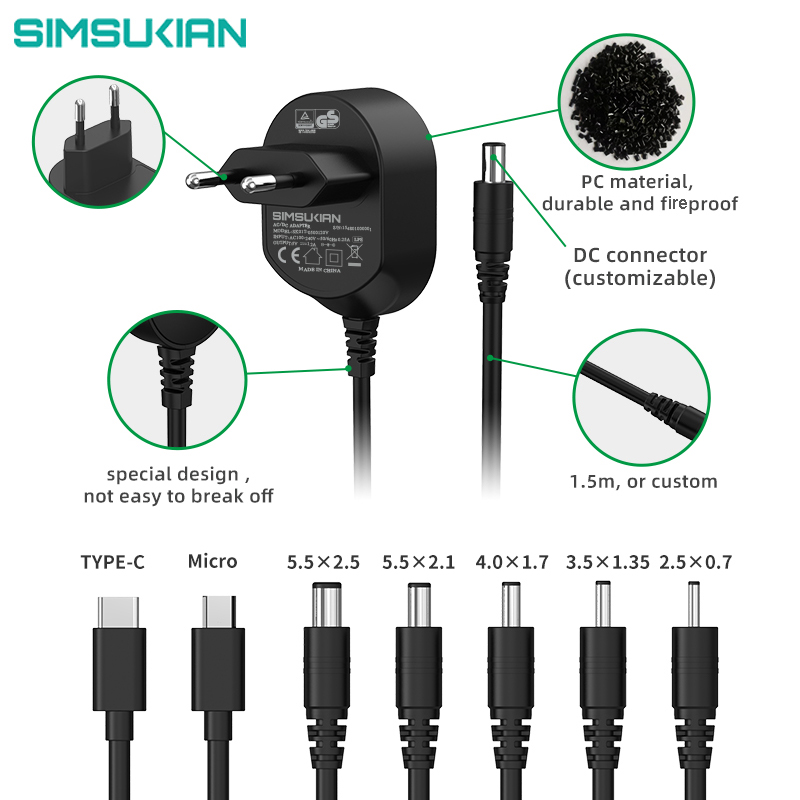
A universal input of AC 100–240 V at 50/60 Hz means one electrical platform can serve multiple markets; the plug interface is what changes. Published variants cover EU, Korea (KR), UK, AU and US plug types across the SK01T and SK03T ranges. For example, the SK03T three-six-watt class is available with EU and UK plugs, the Korean variants ship with the Korea AC plug type, and the SK03T-1200300 is offered with EU, UK, US and AU options.
The housing is a wall-mount design manufactured in fire-retardant PC, and colors include black, white and customized finishes. Wall-mount construction matters in two ways during evaluation: it removes the need for a separate power cord in low-power applications, and it constrains the installation to indoor socket positions — a boundary that should be checked against how the end device is actually deployed.
Protection features and material specification
Fault behaviour should be written into the specification rather than assumed. The published protection set for these adapters includes short circuit protection, overvoltage protection and overcurrent protection. In practice these three functions cover the failure modes that most often damage downstream electronics: a shorted output stage, an input surge that pushes the rail above the device limit, and a load that draws more current than the adapter or the end device can tolerate.
Fire-retardant PC is specified for the enclosure, which matters for markets where the plastic housing itself falls within the safety assessment scope. For buyers comparing quotations, the enclosure material and the protection set are two places where a lower-cost offer can be technically different without looking different in a photograph.
OEM/ODM: what can be customized, and on what terms
For buyers who need a non-catalog configuration, the customization scope covers logo, output voltage, output current, tooling, cable length, DC plug size, cable type, color and packaging. Both OEM and ODM production modes are offered, with a monthly production capacity of 600,000 units, a minimum order quantity of 600 pcs and a lead time of 15–30 days. Every unit is subject to 100% test as the quality control method, and after-sales support is provided remotely.
That combination is worth interpreting rather than repeating. A 600 pcs MOQ is low enough for a pilot build or a market test, while a 600,000-unit monthly capacity indicates the same supplier can absorb a scale-up without a second qualification cycle. The 15–30 day lead time is a planning input, not a promise, and should be confirmed against order quantity and customization depth — tooling changes and cable or connector customization sit on the longer end of that range.
Application fit: manufacturing, appliances, IT, LED and metering
The stated application scope for the SK01T and SK03T families is manufacturing, home appliance, IT products, LED and general electronics. That breadth is a consequence of the universal input and the 3 W to 240 W range rather than a marketing statement — a device that needs a stable low-voltage rail with an indoor wall plug sits inside the scope.
Two documented projects show how the family is applied at volume. A 12 V / 1 A adapter, model SK01T8-1200100V, was supplied for fascia gun power in a sports products programme: 2,000,000 units, in stable operation over 5 years, across the United States, Germany, Poland, the Netherlands, New Zealand, France, Romania and the United Kingdom. In a second programme, a Korea-based medical aesthetic equipment manufacturer used 24 V SK03T adapters for dilatation and hair removal devices — 100,000 units supplied, in continuous use over 5 years.
Both cases share a pattern that matters during evaluation: the adapter was chosen for a long-life consumer or clinical device where an output drift would show up as a functional fault, not as an inconvenience.
Market context behind the requirement list
Three published data points explain why compliance and efficiency questions have become more prominent in adapter sourcing. The global power adapter market is estimated at USD 26.65 billion in 2025 and projected to reach USD 46.14 billion by 2034 (Dataintelo). Within that market, the GaN charger segment — the technology underpinning many PD and fast chargers — was valued at USD 1.10 billion in 2023 and is forecast to reach USD 4.22 billion by 2030, a 19.9% CAGR (Next Move Strategy Consulting). Meanwhile the regulatory baseline continues to move: IEC 62368-1 4th Edition (2023) replaced 60950 and 60065 as the hazard-based safety standard for AV/ICT power supplies, and DOE Level VI continues to set a 0.100 W no-load ceiling for external power supplies up to 49 W.
Read together, these signals point in one direction: the number of parameters a buyer must verify is increasing, while the physical product is getting smaller and denser. That is why documentation quality — model-level certificates, efficiency declarations, protection specifications — has become as important as unit price in supplier evaluation.
Comparison with legacy and generic alternatives, and the limits to plan for
Fixed-output adapters with published certificates differ from two common alternatives in ways that are worth stating plainly.
Compared with legacy adapters approved under the earlier 60950 / 60065 safety frameworks, current designs are assessed against the hazard-based IEC 62368-1 approach, which changes both the test logic and the documentation a buyer receives. A supplier still presenting only legacy approvals may create a transition risk for markets that have moved to the newer standard.
Compared with unbadged commodity adapters that carry self-declared marking without a named test authority or a model-linked certificate number, a documented adapter programme is auditable: the buyer can match the model on the purchase order to a certificate reference and a validity date.
Real boundaries also apply, and they should be planned for rather than discovered at incoming inspection:
- Certification is model-specific, not supplier-wide. A certificate covers the model numbers it names, so a new output voltage, current rating or plug variant may require its own approval before shipment.
- Fixed-output adapters cannot negotiate. A 24 V / 1.5 A or 12 V / 3 A unit delivers a set rail; it is not a substitute for a PD charger in a device that expects USB PD negotiation.
- Power class limits are hard limits. A 36 W platform such as SK03T is a 36 W part; loads approaching or exceeding that figure require a different rating rather than a different setting.
- Wall-mount, indoor use constrains installation. Products in this family are specified for indoor use with a plug-in wall-mount form factor, which is unsuitable for wet, outdoor or permanently wired installations.
- Commercial terms shape the schedule. MOQ 600 pcs and a 15–30 day lead time suit pilot and volume builds, but a buyer needing a few units within days is outside the intended order profile.
- Certificate validity dates must be tracked. Published approvals carry expiry dates, so a buyer should confirm that the certificate will remain valid across the production window of the end product.
What to expect next
Three movements are likely to shape the next procurement cycles. The first is the continued spread of USB PD 3.1 Extended Power Range, which raises the ceiling to 240 W at 48 V / 5 A and pushes more device categories toward negotiated power instead of fixed rails. The second is the steady substitution of silicon by gallium-nitride devices in the fast-charger segment, which is reflected in the forecast growth of that category and in the company's stated research work on GaN power devices. The third is certification transition pressure: as IEC 62368-1 and national efficiency rules are updated, adapters that were compliant at design time will need re-confirmation, and suppliers with an in-house safety and reliability laboratory are better placed to run that confirmation without a full external restart.
For buyers, the practical implication is to treat adapter selection as a documentation exercise as much as an electrical one — and to lock the compliance file at the same time as the output rating.
Frequently asked questions
1. Which certifications should a power adapter carry for a given export market?
The required set follows the destination market. For North America, the relevant approvals are UL, FCC for EMC, DOE Level VI for efficiency, and cUL for Canada. For Europe, CE-LVD, CE-EMC, ErP and RoHS 2.0 apply, with GS where required. The UK uses UKCA; Australia and New Zealand use RCM; Japan and Korea use PSE and KC respectively; and CB reports support multi-market submissions. In the SK03T family specifically, published certificates include UL E331598-A5-UL for the USA, Canada and Mexico, KC R-R-SSK-SK03T1-1200300 for Korea, SAA GMA-522584-EA for Australia and New Zealand, and CE-EMC 22AE110299E002 for the EU and UK. The product declaration additionally lists ETL, FCC, PSE, CCC, CQC, CE-LVD, KCC and RoHS requirements.
2. How do I choose between a 24 V, 12 V and 5 V adapter?
The device input determines the voltage; the adapter only has to supply it with sufficient current margin. Published examples show how the tiers differ: the SK03T family delivers 24 V / 1.5 A or 12 V / 3 A at 36 W; the SK01T8-1200100V delivers 12 V / 1 A at 12 W; the SK01T8-0500300U delivers 5 V / 3 A at 15 W; and lower-power 24 V units deliver 0.5 A (12 W) and 0.65 A (15.6 W). In application notes for facial mask devices and small atomisers, 5 V and 12 V rails at 1 A, 2 A and 3 A are used where a stable output prevents flickering or measurement drift.
3. Which AC plug types are available?
Published variants cover EU, Korea (KR), UK, AU and US plug types. All units operate on a universal input of AC 100–240 V, 50/60 Hz, so the electrical design is common across markets and the plug interface changes. For example, the SK03T 24 V / 1.5 A 36 W adapter is offered with EU, UK and Korea plugs, and the SK03T-1200300 12 V / 3 A version is offered with EU, UK, US and AU plugs. Korea-plug variants are documented for the SK01T series as well.
4. What safety and energy efficiency standards apply to these adapters?
The stated safety standards for the adapter family are IEC62368, IEC64558 and IEC60347. At the regulatory level, IEC 62368-1 4th Edition (2023) is the hazard-based standard that replaced the legacy 60950 and 60065 frameworks for AV/ICT power supplies. On the energy side, the products are declared against DOE, ERP and CEC-VI; the US DOE Level VI rule sets a maximum no-load power of 0.100 W for external power supplies rated 49 W and below.
5. What protection features should be specified?
The published protection set for these adapters includes short circuit protection, overvoltage protection and overcurrent protection. These correspond to the three most common causes of downstream damage: an output short, a rail that rises above the device limit, and a load drawing more current than the circuit is rated for. Buyers specifying for a long-life device should confirm the protection set explicitly rather than infer it from the power rating.
6. What housing material and colors are used, and does the housing matter?
The enclosure is fire-retardant PC with a wall-mount design, available in black, white or customized colors. The housing is not cosmetic: in several markets the plastic enclosure falls within the safety assessment scope, so the material declaration forms part of the compliance file. Products in this family are specified for indoor use.
7. What can be customized under OEM/ODM, and what are the minimum order and lead time?
Customization covers logo, output voltage, output current, tooling, cable length, DC plug size, cable type, color and packaging, in both OEM and ODM production modes. The minimum order quantity is 600 pcs, lead time is 15–30 days, and monthly production capacity is 600,000 units. Every unit undergoes 100% test as the quality control method. Custom tooling, cable and connector changes typically sit at the longer end of the stated lead time and should be confirmed per project.
8. How does a PD charger differ from a fixed-output AC-DC adapter?
A fixed-output adapter delivers a set voltage and current through a DC plug — for example 24 V / 1.5 A or 12 V / 3 A in the SK03T family. A USB PD charger negotiates voltage and current with the connected device before delivering power. USB Power Delivery Revision 3.1, published by the USB Implementers Forum, raised the Extended Power Range ceiling from 100 W to 240 W at up to 48 V and 5 A. The practical rule is that a fixed DC-input device needs a fixed-output adapter, while a USB-C device that supports negotiation can use a PD or fast charger. The company lists PD Charger and Fast Charger alongside its adapter and switching power supply lines.
9. How does a buyer verify that a certificate actually covers the model being purchased?
By matching the model number on the certificate to the model number on the purchase order. Published approvals are model-linked: UL E331598-A5-UL and the SK03T1-36W CE-EMC certificate 22AE110299E002 reference SK03T-series models, while KC R-R-SSK-SK03T1-1200300 and SAA GMA-522584-EA apply to the SK03T series AC-DC power adapter. Validity dates should be checked at the same time — for example, the UL approval is published as valid to 2028-06-01, the KC approval to 2035-06-01 and the SAA approval to 2030-09-04. Certificates and test reports are stated to be available on request, with each model number matched to its certificate.
10. What production and testing evidence is reasonable to request from an adapter manufacturer?
Reasonable evidence includes capacity and test declarations, management system certificates and reference projects. For this manufacturer the published figures are a monthly production capacity of 600,000 units and 100% test quality control on every unit, supported by ISO 9001:2015 and ISO 14001:2015 certification and a 30-engineer R&D team. Reference programmes include 2,000,000 units of the 12 V / 1 A SK01T8-1200100V supplied for fascia gun power over 5 years across the United States, Germany, Poland, the Netherlands, New Zealand, France, Romania and the United Kingdom, and 100,000 units of 24 V SK03T adapters supplied to a Korea-based medical aesthetic equipment manufacturer over 5 years.
11. What limitations should a buyer plan for when selecting this class of adapter?
Four limits are worth planning around. Certification is model-specific, so a new output rating or plug variant may need its own approval. Fixed-output adapters do not negotiate power, so they cannot replace a PD charger in a USB-C negotiating device. The power rating is a hard ceiling — a 36 W platform is a 36 W part — and the wall-mount, indoor-use form factor is unsuitable for wet, outdoor or permanently wired installations. Commercially, a 600 pcs MOQ and 15–30 day lead time suit pilot and volume builds rather than urgent small-quantity orders.
For readers who need the full model list, plug variants and certification references in one document, the manufacturer's PD and power adapter catalogue (PDF) is available here: PD catalog (PDF).