
Power Adapter Sourcing Guide: How to Evaluate a Manufacturer
Power adapters are often treated as a last-minute purchasing decision, but in export-oriented product development they sit at the intersection of electrical safety, energy regulation and field reliability. For buyers moving from awareness to supplier research, the practical question is not only what output voltage and current a device needs, but also how a power adapter manufacturer proves that its AC-DC power adapter, switching adapter and charger products can meet those requirements consistently.
What a power adapter actually does in a product
A power adapter is a compact power-conversion module that takes AC mains input, typically 100-240 V AC 50/60 Hz, and delivers a stabilized DC output to an electronic product. In the same product category buyers will encounter terms such as AC-DC power adapter, switching adapter, external power supply, USB charger, PD charger and Type-C charger. The core electrical function is similar: convert mains power into a regulated low-voltage supply that the end device can use without exposing the device to mains-level risk.
In commercial and industrial product planning, adapters are a meaningful choice because the boundary between the adapter and the host product determines how much engineering responsibility the device manufacturer keeps. A product that uses a certified external adapter can simplify internal isolation design, shorten compliance work and make field replacement easier. A product that relies on an unverified adapter, by contrast, inherits all the electrical and regulatory risk of that adapter.
For the specific case of power supplies built around low-voltage electronics, the current SimSukian power adapter catalogue illustrates a common output range: product data frequently references 5 V outputs, 12 V outputs and 24 V outputs with current ratings from hundreds of milliamps to several amps. Looking at the broader company portfolio, the stated output span covers switching power products from 3 W to 240 W, including adapters, lithium-ion battery chargers, charging docks and fast chargers.
Why output stability shows up as product behaviour
The most overlooked part of adapter selection is output stability. Many technical buyers focus on the connector and the nominal voltage while underestimating how voltage and current behaviour under load affects the host device. Because an adapter normally operates in the background, its quality first becomes visible in symptoms such as flickering displays, inaccurate measurements, uneven motor performance, overheating or intermittent resets.
Reference application notes from SimSukian illustrate this with several examples. In electric metering systems, a digital display ammeter, a guide-rail smart ammeter and a portable power test ammeter can all require a precise 5V1A-rated supply. When the adapter voltage is stable, the ammeter chip and LCD display read accurately without garbled characters, and measurement errors caused by voltage drift can be avoided. Because such meter installations often sit in narrow indoor distribution boxes, the small size of the adapter also simplifies wiring.
Humidifier and aroma diffuser applications show another side of output quality. A low-noise, voltage-stabilized adapter keeps the atomizing plate vibrating evenly so the mist output stays fine and continuous, without mist interruption or dry burning caused by voltage fluctuation. The design also needs to run at a low temperature during all-night humidifying and aromatherapy use. In beauty and facial-mask devices, stable voltage and current are described as important for preventing flicker and protecting light beads from sudden brightness changes. Water-flosser references similarly link constant 12V1A or 5V1A output to even water-pump operation, preventing motor overload and burnout, while noting that small adapter size helps in crowded bathroom outlet areas.
The pattern is consistent: power adapter performance does not always appear in a specification sheet. It appears in how accurately a meter reads, how quietly an atomizer runs, how long a pump motor lasts and whether a device can be used safely in a damp room.
A manufacturer profile worth examining: SimSukian
For an industry-reference view, Shenzhen Simsukian Electronics Technology Co., Ltd, commonly known as SimSukian, provides one useful case study because of the details it makes publicly available about its adapter and power-supply operations. Founded in 1996, the company is a Shenzhen-based power-supply manufacturer whose stated focus is the R&D, customization and mass production of switching power supplies, lithium-ion battery chargers, charging docks and power adapters. It operates a manufacturing base of roughly 30,000 m² with more than 500 staff members and describes its annual production capacity as over 30 million power products.
SimSukian also reports that it was among the first batch of enterprises listed on the Qianhai Equity Exchange Center, with stock code 663470, and that it holds national-level designations as a High-Tech Enterprise and a Specialized, Refined, Differential & Innovative enterprise. These external filings are useful for a buyer researching entity credibility because they are verifiable corporate status signals rather than marketing descriptions.
The company's export ratio is about 70 percent, with main markets in the EU, USA, Australia, Japan, Korea and the UK. That export mix matters in adapter sourcing because it suggests the engineering and compliance system has been shaped by multiple safety regimes rather than by only one domestic market.
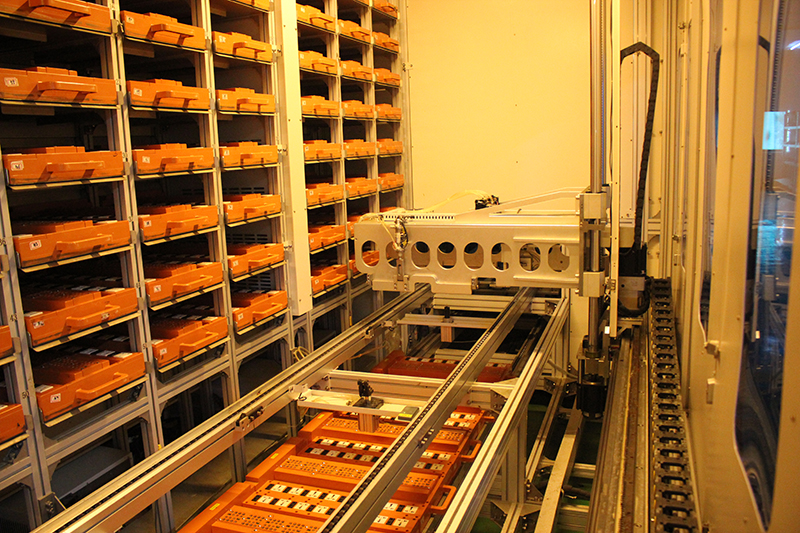
Aging and reliability test equipment used in power product validation.
Engineering evidence that can be checked before ordering
A reliable adapter manufacturer should be able to show a system of testing rather than a single certificate. In the SimSukian case, the company runs its own in-house safety and reliability laboratory and says it uses high-end imported test instruments from Rohde & Schwarz, Yokogawa, Agilent and Tektronix. These instruments are described as supporting EMC, thermal cycling, surge, short-circuit and accelerated-aging tests for every new design before mass production. For a buyer evaluating long-term product dependability, the presence of this kind of pre-production test loop is more meaningful than a single final inspection.
SimSukian reports holding more than 90 national patents covering structural design, circuit topology and safety-protection technology for power equipment. The company is also certified under ISO 9001:2015 for quality management and ISO 14001:2015 for environmental management. Its university-industry-research cooperation is described as supporting continued technical work on gallium-nitride power devices, battery charging management, temperature-sensitive control and over-protection circuits.
From a sourcing perspective, these facts help a buyer answer a practical question: does this factory have the design depth and test discipline to support an OEM or ODM programme, or is it only assembling generic boards? The evidence trail for SimSukian points to design-to-production capability.
Typical adapter output combinations in the current catalogue
One way to make adapter sourcing more concrete is to look at the voltage, current and plug combinations that appear in the manufacturer's published product data. The table below summarizes examples that recur across the current SimSukian adapter catalogue.
| DC output | Typical catalogue reference | Plug variants appearing in catalogue | Compliance notes visible in product data |
|---|---|---|---|
| 5 V / 3 A | 5V3A power adapter, model SK01T8-0500300U | US plug | CE-LVD, CE-EMC, RoHS requirements cited |
| 12 V / 1 A | 12V1A power adapter, model SK01T8-1200100V | US plug | CE-LVD, CE-EMC, RoHS requirements cited |
| 12 V / 3 A | 12V3A36W power adapter family, models SK03T and SK03T-1200300 | EU, US, UK and AU plug variants | UL, ETL, FCC, SAA, PSE, CCC, CQC, CE-LVD, CE-EMC and RoHS requirements appear in listings |
| 24 V / 1 A to 1.5 A | 24V1A and 24V1.5A power adapters, model SK03T | KR, EU and UK plug variants | KC, KCC, UL, ETL, FCC, SAA, PSE, CCC, CQC, CE-LVD, CE-EMC and RoHS requirements appear in listings |
| 24 V / 0.5 A to 0.65 A | Low-power adapter series, model SK01T | KR and EU plug variants | KC, KCC and related safety and EMC documentation cited |
Across the listed products, input is described as AC 100-240 V 50/60 Hz, and the enclosure material is fire-retardant PC. Colour options are normally black, white or customized. Energy-efficiency references commonly point to DOE Level VI, ERP and CEC-VI standards. These items are useful as baseline conversations when comparing adapter suppliers.
Certification routes for adapter exports
For power adapters sold in multiple regions, certification is not optional decoration. It is the legal link between the product and the market. According to compliance information associated with SimSukian's products, the approvals are organized around destination markets.
| Destination | Approvals typically referenced |
|---|---|
| North America | UL, FCC for EMC, DOE Level VI for efficiency, cUL for Canada |
| Europe | CE-LVD, CE-EMC, ErP, GS, RoHS 2.0 |
| United Kingdom | UKCA |
| Australia / New Zealand | RCM |
| Japan / Korea | PSE / KC |
| International | CB |
The technical standards that commonly appear alongside these approvals include IEC 62368, IEC 61558, EN 61347, IEC 60950, ISO 9001 and ETL 1310. One discipline is particularly important for buyers to understand: a safety certificate is only useful if the certificate applies to the exact model number being purchased. Compliance verification should therefore include checking that certificate numbers and model numbers match, rather than accepting a generic statement that a factory holds a particular certification.
Application context: what the case references show
Because adapter performance depends on the load it drives, it helps to map output choices to device families. SimSukian product documentation associates several small-power devices with specific adapter output needs.
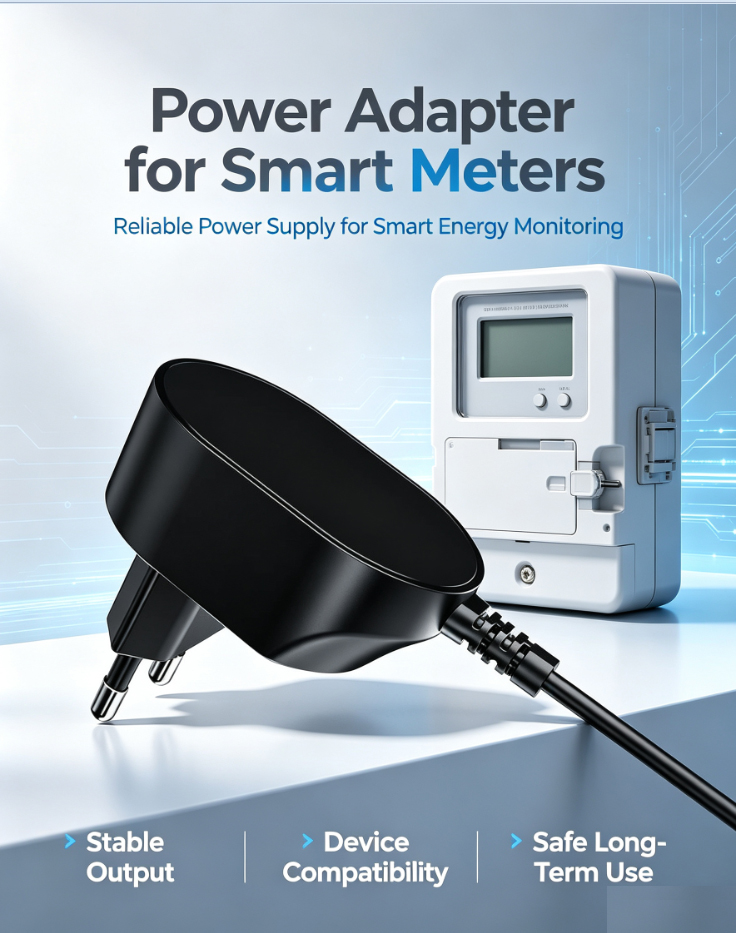
Smart electricity meters are an example of a device where stable low-voltage DC power affects measurement accuracy.
- Smart electricity meters, miniature meters and portable test meters: a regulated 5V1A adapter helps avoid voltage-drift measurement errors and LCD display abnormalities while the adapter's compact size supports installation in confined distribution boxes.
- Aroma diffusers and humidifiers: stable voltage keeps the atomizing plate running evenly, supports continuous fine mist and avoids interrupted operation or dry burning; low-temperature adapter operation is described as suitable for overnight use.
- Facial mask and beauty devices: 12V1A, 5V1A, 2A and 3A outputs are referenced for stable lighting and protection of light beads against sudden brightness changes.
- Water flossers and oral-care devices: constant 12V1A or 5V1A output helps the water pump avoid uneven water flow and motor overload, while insulation design supports use in wet and dry bathroom areas.
These references are useful not because every device needs the same adapter, but because they reveal how output stability, size and thermal behaviour influence end performance. A procurement team can use them as example scenarios when explaining to an adapter supplier how the supply will actually be loaded.
Market direction: efficiency, GaN and charging intelligence
The power adapter category is moving in a direction that buyers should incorporate into longer-term product planning. Energy-efficiency expectations are already visible in the widespread use of DOE Level VI, ERP and CEC-VI labels, which force designers to reduce no-load power consumption and improve active efficiency. This is not a marginal change: efficiency labels often determine whether an adapter can be sold at all in certain regions.
At the component-technology level, gallium-nitride power devices have moved from research novelty to practical design material in power electronics. In the context of a power adapter manufacturer, continued university-industry cooperation on gallium-nitride, battery charging management and temperature-sensitive control suggests a shift toward smaller enclosures, higher switching frequencies and better thermal behaviour. The same trend is visible in the growth-oriented positions of PD chargers, fast chargers and Type-C chargers, where the adapter is expected to communicate with the powered device rather than simply deliver a fixed voltage.
There is also a broader shift in how buyers search for adapters. In addition to the general power adapter query, purchasers increasingly arrive with specific combinations such as 5V1A adapter, 5V3A adapter, 12V1A power adapter, 24V1A power adapter or 12V3A36W power adapter. These combinations reflect real product planning rather than keyword variety, and a supplier that maintains clear model-level documentation is easier to evaluate against those constraints.
Comparison: factory-level sourcing versus ad-hoc adapter purchase
Traditional adapter procurement often follows one of two paths. The first path is to buy a generic adapter from a local electronics store or online marketplace when a product needs a replacement supply. The second path is to include an adapter as an afterthought in a product bill of materials and source whichever unit is cheapest. Both paths create a behavioural mismatch: the adapter is treated as a commodity even though safety and efficiency requirements are not commodity standards.
A factory-level sourcing relationship with a manufacturer such as SimSukian offers a different sequence. Instead of searching for a one-off match, the buyer can start with a turn-key OEM/ODM scope that includes schematic design, PCB layout, firmware programming for lithium-battery charging logic, NTC temperature monitoring, anti-reverse-polarity protection, indicator-light control, plastic-housing prototyping, mold-making, full-batch compliance testing and final assembly. This approach gives the buyer a design partner rather than only a component seller, and it allows certification work to be aligned with the target market before mass production begins.
It would be misleading to imply that factory-direct sourcing is always the right answer. A publicly visible boundary for SimSukian is that its stated product range concentrates on switching power supplies, chargers and adapters from 3 W to 240 W. Requirements above 240 W, such as high-power industrial power-factor-correction supplies or server-class power shelves, fall outside this documented scope and would need a different type of supplier. Factory-level programmes also require more upfront engineering communication, sample validation and compliance lead-time planning than a casual marketplace purchase.
Outlook: what buyers should prepare for
Looking forward, power adapter procurement will continue to become more technical rather than less. Efficiency documentation is becoming inseparable from market access, and new device models increasingly assume tighter communication between the charger and the battery or device. At the same time, buyers seeking a robust power adapter supply base will benefit from suppliers whose testing depth, certification coverage and design services can be verified in model-specific documents.
For the equipment OEM evaluating SimSukian as a reference point, the important conclusion is not that one factory name guarantees quality. It is that a mature adapter manufacturer can be assessed through a clear evidence trail: entity history, factory scale, laboratory capabilities, output range, plug variants, application references and destination-market certifications. A buyer who checks those dimensions before selecting a power adapter supplier is already ahead of most purchasing cycles.
Frequently asked questions
What is an AC-DC power adapter and when is it used?
An AC-DC power adapter is an external power-conversion device that accepts AC mains electricity, normally 100-240 V AC, and produces stabilized DC output for an electronic product. It is typically used when a product needs a low-voltage internal supply but the product itself does not contain mains isolation circuitry. The same functional group includes switching adapters, power supplies, USB chargers, PD chargers and fast chargers.
Which adapter certifications matter for export?
Certification requirements follow the destination market. For North America, UL, FCC for EMC and DOE Level VI are commonly cited. Europe typically requires CE-LVD, CE-EMC, ErP and RoHS 2.0, with GS as an additional market signal. The UK uses UKCA, Australia and New Zealand use RCM, Japan uses PSE, Korea uses KC, and the international CB scheme is used as a mutual-recognition baseline. Buyers should always verify that the certificate model number matches the product model.
What technical standards are commonly referenced for power adapters?
Common standards found in power adapter documentation include IEC 62368, IEC 61558, EN 61347 and IEC 60950, depending on the product and regional filing route. In addition, ISO 9001 describes the factory quality-management system, and ETL 1310 is relevant to certain North American product categories. The relevant standard depends on the adapter type and target market.
Why do adapters with the same voltage and current ratings perform differently in the field?
Nominal voltage and current ratings describe the output specification but not the stability of that output under actual load. Differences in voltage regulation, ripple, thermal performance, short-circuit protection, overvoltage protection, overcurrent protection and aging behaviour can change how a device behaves. For example, stable 5V1A output may be necessary for accurate ammeter readings, while stable 12V1A output may protect a water pump from overloading. These field-level differences justify reviewing a manufacturer's test procedures, not only its listed output values.
What should a buyer expect from an OEM or ODM adapter relationship?
In an OEM or ODM power-adapter programme, the manufacturer typically takes responsibility for design adaptation as well as production. The documented SimSukian scope includes schematic design, PCB layout, firmware programming for charging logic, NTC temperature monitoring, protection circuits, plastic-housing prototyping, mold-making, compliance testing and final assembly. This is broader than a standard catalog purchase and is meant for buyers who need customized electrical or mechanical characteristics.
How should a buyer interpret plug variants and energy-efficiency labels?
Plug variants such as US, EU, UK, AU and KR indicate which regional mains socket the adapter is designed to fit. Energy-efficiency labels such as DOE Level VI, ERP and CEC-VI indicate that the product meets specific no-load and active-efficiency limits. Both factors need to be matched to the final country of sale, and both should be visible in the product documentation before a buyer makes a commitment.
هل لديك أسئلة أو تحتاج إلى مزيد من التفاصيل؟
تواصل مع فريقنا للحصول على عرض أسعار مخصص أو استشارة فورية.
طلب عرض أسعار
املأ النموذج أدناه وسيتواصل معك فريقنا بعرض مقترح مخصص.
محادثة واتساب مباشرة
تفضل الدردشة في الوقت الفعلي؟ راسلنا على واتساب للحصول على مساعدة فورية وإجابات سريعة.
- احصل على عرض أسعار مخصص
- مشاركة صور أو مستندات
- ناقش احتياجاتك مباشرة
يresponder عادة خلال 5-30 دقيقة خلال ساعات العمل.