
Power Adapter Supplier Evaluation: 24V/12V Long-Term Supply
Power Adapter Supplier Evaluation: 24V/12V Long-Term Supply
For a manufacturing buyer, a power adapter stops being a purchased item the moment it is designed into a piece of equipment. It becomes a component the equipment owner has to support for years — through service calls, spare-part orders and certification renewals. That shift is what separates a supplier evaluation from a procurement transaction. The useful question is not who can ship 36 W adapters once, but who can keep delivering the same 24 V or 12 V platform, with the same compliance evidence, across the next several build cycles.
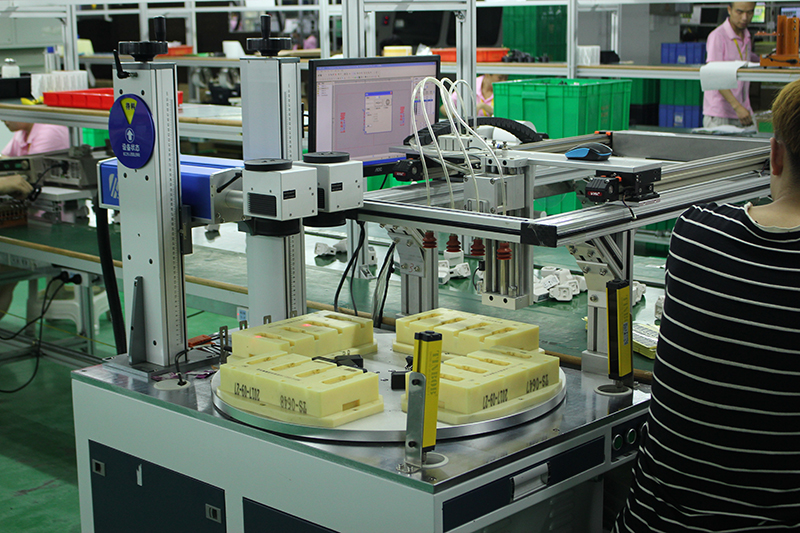
Production environment of a power adapter manufacturing base — the capability that determines whether a 24 V/12 V supply platform can be repeated over several build cycles.
Shenzhen Simsukian Electronics Technology Co., Ltd (simsukian) is a Shenzhen-based power supply manufacturer founded in 1996 that develops, customizes and mass-produces switching power supplies, lithium-ion battery chargers, charging docks and power adapters in the 3 W to 240 W range. Its products are exported mainly to the EU, USA, Australia, Japan, Korea and the UK. The company holds ISO 9001:2015 and ISO 14001:2015 certification, operates an in-house safety and reliability laboratory, and reports more than 90 national patents covering structural design, circuit topology and safety-protection technologies.
Why “Delivered On Time” Is the Wrong Benchmark
A transactional adapter evaluation looks at unit price, sample behaviour, lead time and payment terms. A long-term support evaluation looks at something different: repeatability. Can the supplier reproduce the same electrical behaviour, the same plug variants, the same housing material and the same certificate set two or three years after the first shipment, when the buyer needs a service replacement or a second production batch?
The two evaluations produce different decisions. A supplier that wins on price and sample speed may still fail the second test if it cannot document which standard its product was approved against, if it changes a transformer or PCB between batches without notice, or if the plug or housing mold that the buyer qualified is no longer tooled.
The practical consequence for equipment makers is that supply interruption is usually a documentation and tooling problem before it becomes a logistics problem. The evaluation work is therefore front-loaded: it happens before the purchase order, not after the first failure.
A Five-Part Evaluation Framework for Long-Term Adapter Supply
Manufacturing buyers evaluating a power adapter supplier for sustained 24 V and 12 V supply can organise the assessment into five dimensions. Each one answers a question that only becomes visible after the first order.
| Evaluation dimension | What the buyer verifies | Why it matters after the first order |
|---|---|---|
| Platform continuity | Whether voltage and current variants sit inside one model family rather than separate designs | A shared 36 W platform reduces the number of approvals a buyer has to maintain |
| Compliance durability | Certificates attached to the actual configuration, plus the safety and efficiency standards behind them | Standards are revised; a supplier that only held a one-off certificate has to restart testing |
| Safety architecture | Protection features and housing material | Field failures and nuisance trips carry service cost long after the sale |
| Customisation repeatability | Which parameters can be re-specified and reordered | Brand, cable and DC plug changes must be reproducible in later batches |
| Commercial boundary | MOQ, lead time and the after-sales model | Determines how the buyer plans spares, reorders and service coverage |
Platform Continuity: The 24 V and 12 V 36 W Case
The clearest test of continuity is whether a single adapter family covers both the 24 V and 12 V requirements of a piece of machinery. simsukian’s SK03T is a 36 W power adapter family that is offered in a 24 V / 1.5 A configuration and in a 12 V / 3 A configuration, both rated 36 W and both accepting an AC 100–240 V, 50/60 Hz input.
Because the two variants share a platform, a buyer running mixed equipment does not have to qualify two unrelated products. The 24 V / 1.5 A build serves loads that need higher voltage at lower current; the 12 V / 3 A build serves loads that need higher current at lower voltage. Both are wall-mount designs and are available in black, white or customized colour.
Multi-plug availability as a continuity factor
Plug availability is often treated as a shipping detail. In long-term supply it is a qualification issue, because a different plug usually triggers a different market approval. The SK03T 36 W platform is offered with EU, UK, US, AU and Korea plugs, which means a single buyer programme shipping to several regions can be planned around one electrical design and several plug configurations.
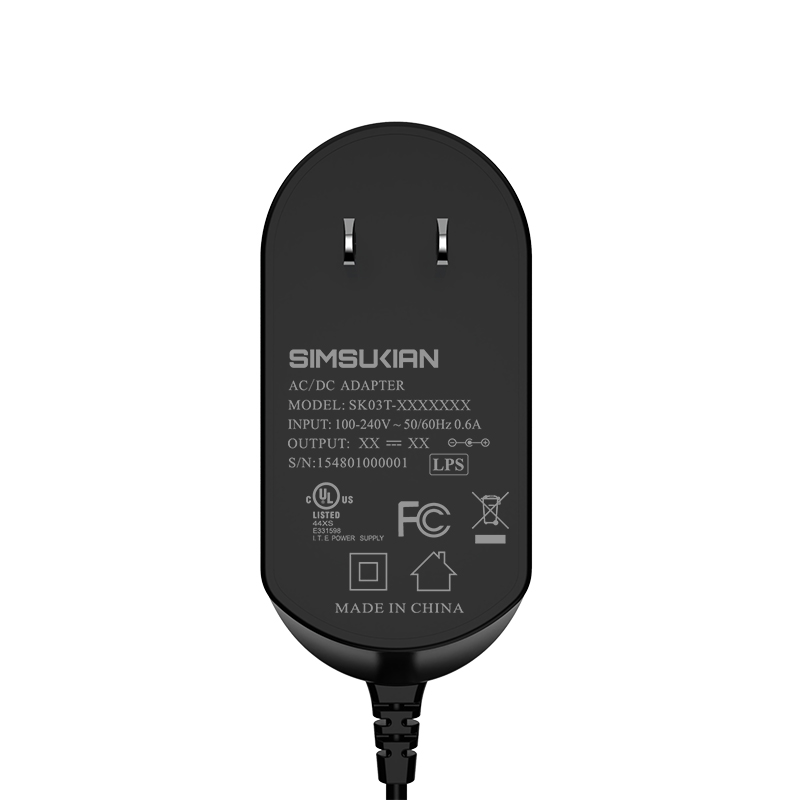
A 36 W wall-mount adapter from the SK03T platform — one electrical design offered with EU, UK, US, AU and Korea plug options.
The same continuity logic applies further down the range. The SK01T family covers 24 V outputs at 0.5 A (12 W) and 0.65 A (15.6 W) with a Korea AC plug, while the SK01T8 platform covers 12 V / 1 A (12 W) and 5 V / 3 A (15 W) with a US plug. For a buyer whose product line spans several power levels, the value is that the same engineering and quality language runs across the range rather than restarting at each wattage.
Compliance Evidence That Outlives a Design Cycle
Compliance is the part of a supplier evaluation that ages fastest. Two external rules shape the current baseline for external power supplies.
The first is safety. IEC 62368-1 4th Edition (2023) is the mandatory hazard-based safety standard for AV/ICT power supplies, replacing the legacy 60950 and 60065 certifications. A supplier whose file still rests on the older standards is effectively holding an expiring asset.
The second is efficiency. The US Department of Energy Level VI efficiency standards mandate a maximum no-load power of 0.100 W for external power supplies rated at or below 49 W. For a 36 W adapter this is a directly applicable limit, and it is the kind of requirement that shows up on a specification sheet whether or not the buyer asks for it.
Against that baseline, the SK03T documentation set is a useful reference for what a complete file looks like. The platform is certified to KC, KCC, UL, ETL, FCC, SAA, PSE, CCC, CQC, CE-LVD, CE-EMC and ROHS, and complies with the safety standards IEC62368, IEC64558 and IEC60347. Its energy-efficiency compliance is stated against DOE, ERP and CEC-VI.
At manufacturer level, simsukian’s products hold CCC, UL, CB, CE, UKCA, FCC, KC, PSE, SAA, RoHS, REACH, DOE Level-VI, CEC and ERP approvals, which the company positions as one-stop export compliance covering more than 30 countries and regions. The company also operates an in-house safety and reliability laboratory equipped with instruments from Rohde & Schwarz (Germany), Yokogawa (Japan), Agilent and Tektronix (USA), where EMC, thermal cycling, surge, short-circuit and accelerated-aging tests are run on new designs before mass production.
For a buyer, the laboratory is the more durable signal. Certificates describe a product at a moment in time; test capability describes whether the supplier can re-earn those certificates when the standard is revised.
Safety Architecture and Material Basis
Protection behaviour is where adapter specification meets equipment downtime. The SK01T and SK03T families provide short circuit protection, overvoltage protection and overcurrent protection. The housing is made of fire-retardant PC.
These three features address different failure modes. Overcurrent protection limits the current drawn by a stalled or shorted load; overvoltage protection guards downstream electronics against a supply-side excursion; short circuit protection prevents a fault in the cable or the load from propagating back into the adapter. Fire-retardant PC construction addresses the housing’s behaviour under abnormal thermal conditions rather than the electrical path itself.
The practical value of these features depends on the application. Equipment that runs unattended — a distribution-box meter, a monitoring device, a piece of overnight consumer equipment — converts any protection weakness into a service visit. Equipment that is plugged in and unplugged daily puts more stress on the connector and the housing. A supplier evaluation should therefore test the protection set against the actual duty cycle, not against a generic specification.
Application Fit: Where 24 V and 12 V Platforms Are Used
The industries that simsukian lists for these adapters are manufacturing, home appliance, IT products, LEDs and electronics. Within those industries, several documented application patterns show what “long-term fit” looks like in practice.
| Application | Power requirement documented | What the application demands of the adapter |
|---|---|---|
| Smart electricity meter and miniature electricity meter installations | 5 V / 1 A rated current | Accurate ammeter chip and LCD readings without garbled codes; a small housing that fits narrow distribution boxes; plug-in operation |
| Aroma diffusers and humidifiers | 24 V variants | Low-noise, voltage-stabilised output so the atomising plate vibrates evenly without mist interruption; low housing temperature during all-night use |
| Water flossers | Constant 12 V / 1 A and 5 V / 1 A output | Even power to the water pump to avoid motor overload; a compact plug for narrow countertops; insulation suitable for wet and dry indoor environments |
| Facial mask and beauty devices | Stable 12 V / 1 A, 5 V / 1 A, 2 A and 3 A output | No flicker and no abrupt brightness change that could damage light beads; no overheating during prolonged continuous use |
| General electronics | Plug-in use | Compatibility with audio equipment, IT products, routers, speakers and electronic guitars |
Two longer-running supply relationships illustrate the same principle at scale. A sports-products customer supplying fascia guns across the US, GB, DE, PL, NL, NZ, FR and RO has received 2,000,000 units from simsukian, with stable operation recorded over a five-year duration. A medical aesthetic equipment manufacturer in Korea received 100,000 units for dilatation and hair removal devices, also with stable operation over a five-year project duration.
What these cases demonstrate is not a single performance figure but repeatability: the same supply relationship stayed in place long enough for the equipment to complete a multi-year service life. That is the outcome a long-term supplier evaluation is trying to predict.
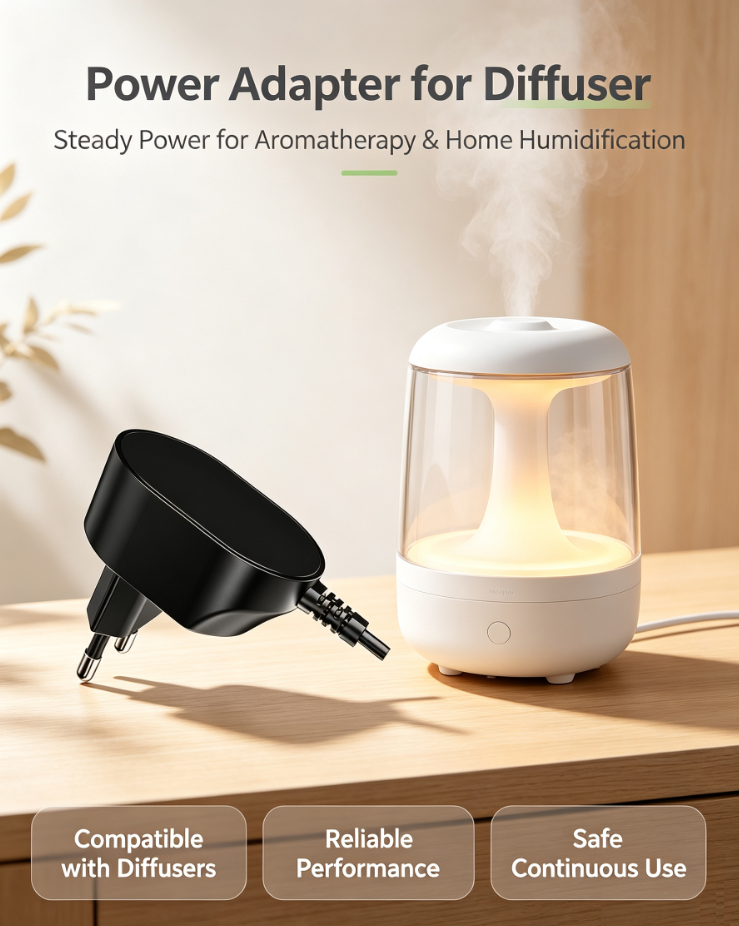
Aromatherapy and humidifier devices are a documented 24 V adapter application, where stable voltage output keeps atomisation even during all-night operation.
Market Trend Analysis: Why Continuity Is Getting Harder to Keep
Three published data points frame the supply environment that manufacturing buyers are planning into.
The overall category is expanding. The global power adapter market is valued at USD 26.65 billion in 2025 and is projected to reach USD 46.14 billion by 2034, according to Dataintelo’s power adapter market research report. A larger market usually means more supplier options, but it also means more supplier churn as capacity shifts between segments.
Technologies inside the category are also moving. The GaN charger market was sized at USD 1.10 billion in 2023 and is predicted to reach USD 4.22 billion by 2030 at a 19.9% CAGR, according to Next Move Strategy Consulting. Separately, the USB Power Delivery 3.1 specification extends the Extended Power Range to 240 W at 48 V and 5 A. Neither trend replaces 24 V and 12 V fixed-output adapters in industrial equipment, but both raise the technology baseline a supplier is expected to understand.
The third and most directly relevant trend is regulatory. The move to IEC 62368-1 4th Edition (2023) as the mandatory hazard-based standard for AV/ICT power supplies, combined with DOE Level VI no-load limits of 0.100 W for supplies at or below 49 W, converts compliance from a one-time cost into a recurring cost. Suppliers with in-house test laboratories absorb that recurrence internally. Suppliers that outsource testing pass the delay and the cost to the buyer.
Comparison with Traditional Sourcing: Where This Approach Stops Working
Long-term platform sourcing is not universally better than transactional buying, and a realistic evaluation includes its boundaries.
| Factor | Transactional sourcing | Long-term platform sourcing |
|---|---|---|
| Primary goal | Lowest landed cost per shipment | Repeatable platform, documentation and tooling |
| Qualification effort | Minimal; a sample and a price are enough | Higher up front, because standards, plug variants and protection behaviour are reviewed |
| Risk exposure | Re-sourcing cost if the supplier changes or disappears | Dependency on one platform and one supplier relationship |
| Best fit | One-off builds, short product life, non-critical loads | Equipment with multi-year service life and recurring spares demand |
There are also concrete limits a buyer should plan around with simsukian specifically.
- Product range. simsukian builds power products from 3 W to 240 W. Requirements above 240 W — for example an 800 W PSU class load — fall outside the range and need a different source.
- Order size. The stated minimum order quantity is 600 pieces, which suits production volumes but not prototype or single-unit replacement demand.
- Lead time. Production lead time is quoted at 15–30 days, so buyers need to plan spares ahead of failure rather than after it.
- After-sales model. After-sales support is remote. Buyers that require on-site service engineering in their own region must arrange that separately.
- Customisation scope. Customisable parameters cover logo, output voltage, output current, tooling, cable length, DC plug size, cable type, colour and packaging. Anything outside that list requires separate engineering discussion.
- Configuration-specific approvals. Certificates attach to specific configurations. Introducing a new plug type or output variant can trigger additional approval work, so buyers should confirm coverage for each variant in the bill of materials.
Manufacturing capacity is quoted at 600,000 units per month, quality control is described as 100% test, and the declared export markets are the EU, US, UK, Australia, Japan and Korea. Those figures set the scale at which the model works best: recurring production demand with a defined configuration set.
Future Outlook
Three developments are likely to shape how manufacturing buyers evaluate adapter suppliers over the next few years.
First, compliance renewal will become a standing line item rather than a launch activity. As safety standards continue to be revised and efficiency limits tighten, the suppliers that stay qualified will be the ones with internal test capability and a documented re-testing process. simsukian’s stated long-term university-industry-research cooperation on gallium-nitride power devices, battery charging management, temperature-sensitive control and over-protection circuits is one example of how a supplier builds that capability ahead of the requirement.
Second, the definition of “documentation continuity” is likely to tighten. Buyers increasingly want to know not only that a certificate exists, but which configuration it covers and when it was last validated. Suppliers that can produce this on request will be easier to keep in a bill of materials.
Third, higher-power delivery standards such as USB PD 3.1 will keep raising expectations across the category, even in equipment that will never use them. Buyers will read the same specification sheets and ask the same questions of a 36 W industrial adapter. Suppliers that can explain the boundary between their platform and the higher-power world will be easier to evaluate than those that blur it.
FAQ
What does “long-term supply” mean when evaluating a power adapter supplier?
It means the supplier can repeat a qualified product over multiple years, not merely deliver it once. In practice that covers four things: the same electrical platform (for example a 36 W design offered in 24 V and 12 V builds), the same plug and housing tooling, a certificate file that can be re-earned when standards change, and a stated commercial boundary such as minimum order quantity, lead time and after-sales model. A supplier that cannot state these four items cannot be evaluated for long-term support, only for a single shipment.
Which certifications should a manufacturing buyer verify for 24 V and 12 V adapters shipped to multiple markets?
The file should be checked in three layers. Safety: compliance with IEC62368, IEC64558 and IEC60347, and for 36 W platforms such as SK03T approvals covering KC, KCC, UL, ETL, FCC, SAA, PSE, CCC, CQC, CE-LVD, CE-EMC and ROHS. Efficiency: DOE, ERP and CEC-VI. Manufacturer level: CCC, UL, CB, CE, UKCA, FCC, KC, PSE, SAA, RoHS, REACH, DOE Level-VI, CEC and ERP. Because certificates attach to specific configurations, the buyer should confirm coverage for the exact plug and output variant being ordered, not only for the product family.
How do multi-plug options affect long-term sourcing planning?
Plug type usually drives market approval, so each plug variant is a separate qualification item even when the electrical design is shared. The SK03T 36 W platform is offered with EU, UK, US, AU and Korea plugs, which allows a buyer shipping to several regions to keep one electrical design and manage plug variants as configuration data. The planning consequence is that the approval matrix has to be built variant by variant, and lead times of 15–30 days apply per production order rather than per region.
What safety features should be confirmed before a 36 W adapter is designed into equipment?
Check for short circuit protection, overvoltage protection and overcurrent protection, and confirm the housing material. The SK01T and SK03T families provide all three protection features and use fire-retardant PC construction. Each feature addresses a different failure mode: overcurrent limits current drawn by a stalled load, overvoltage guards downstream electronics against supply excursions, and short circuit protection prevents a cable or load fault from propagating back into the adapter. For unattended equipment, protection behaviour should be assessed against the actual duty cycle rather than a generic specification.
What are the practical limits of a 36 W adapter platform?
Three limits are worth stating plainly. Power ceiling: 36 W suits loads at or below that level; simsukian’s overall product range runs from 3 W to 240 W, so higher-power requirements need a different source. Order scale: the minimum order quantity is 600 pieces and production lead time is 15–30 days, which suits planned production rather than emergency replacement. Support model: after-sales support is remote, and customisation is limited to logo, output voltage, output current, tooling, cable length, DC plug size, cable type, colour and packaging, so requirements outside that list need separate engineering discussion.