
Pre-Insulated Pipe Compliance: Navigating EN 253 and Beyond
Pre-Insulated Pipe Compliance: Navigating EN 253 and Beyond
In a directly buried hot water network, the document that decides most pre-insulated pipe tenders is not the product datasheet. It is the evidence that the pipe conforms to a recognised standard, for the diameter range actually being purchased, inside a certificate that is still valid on the delivery date.
EN 253 is the reference point most European directly buried hot water specifications are built around: it is the industry standard for pre-insulated bonded pipe systems for directly buried hot water networks. Around that single reference sits a wider compliance landscape — component standards, national standards used in export markets, and quality management system certification. Buyers who understand how those pieces fit together make more defensible qualification decisions than buyers who simply look for a certificate logo on a quotation.
This article treats compliance as a procurement constraint rather than a marketing claim: what EN 253 governs, what sits beyond it, how third-party verification is structured, which internal manufacturer processes keep conformity consistent over time, and where the boundaries of any certification actually sit. The product reference throughout is the pre-insulated pipe supplied by Tangshan Xingbang Pipeline Engineering Equipment Co., Ltd, a manufacturer of anti-corrosion and thermal insulation pipelines based in Houhu Industrial Park, Yutian Economic Development Zone, Hebei Province, China.
Why compliance evidence, not product data, decides pre-insulated pipe qualification
A datasheet answers a physical question: what the pipe is made of, which diameters exist, what temperature and pressure it holds. A compliance file answers a different question: who has independently confirmed that the product meets a defined standard, for which product type and size range, and for how long that confirmation remains valid. In district heating and cooling procurement, the second question carries the contractual weight.
The failure modes seen in buyer reviews are consistent and rarely dramatic. A certificate is presented for fittings instead of pipe. A scope statement covers a narrower diameter band than the project schedule. A validity period has lapsed before the delivery window. A management system certificate is offered as evidence of product conformity, although it attests to process rather than performance. Each of these is avoidable with a short documentation review, but none of them is visible from a price comparison.
A conformity certificate is a scoped statement, not a general endorsement. Four attributes should be confirmed in every procurement review: the standard and its edition, the product type covered, the dimensional scope, and the validity period.
What EN 253 covers — and where its boundaries sit
EN 253 is the industry standard for pre-insulated bonded pipe systems for directly buried hot water networks. The construction it addresses is a bonded assembly rather than three independent parts: a steel service pipe, a rigid polyurethane (PU) foam insulation layer, and a high-density polyethylene (HDPE) outer jacket, bonded so that the layers behave as one system in service.
Xingbang's pre-insulated pipe uses that material combination — high-density polyethylene and rigid polyurethane foam over a steel service pipe — and is offered in the directly buried, underground and district heating configurations that this duty requires. Published product parameters sit inside the temperature envelope that third-party technical references associate with the standard: PU foam insulation for EN 253 pipes typically withstands temperatures up to 120°C, and the Xingbang specification states its limits explicitly — conveyed medium no higher than 120°C, occasional peak temperature not exceeding 130°C, working pressure no more than 2.5 MPa, and continuous operation of at least 30 years in a 120°C environment.
The qualification logic behind the standard reflects burial conditions rather than indoor ones. Directly buried networks impose thermal expansion stress, soil load, groundwater corrosion and external impact on the pipeline. A factory-bonded assembly is qualified against that duty as a complete system, which is why conformity evidence for the pipe, the jointing accessories and the casing material is normally requested together rather than separately.
The first boundary is therefore the temperature and pressure envelope itself. Above 120°C continuous service, PU-based bonded systems stop being the reference solution and higher-temperature insulation approaches take over. Buyers evaluating steam or high-temperature duties should treat EN 253 documentation as evidence of a different product class, not as a universal qualification.
Beyond EN 253: the standards that appear alongside it
Few project specifications rely on a single standard. The table below maps the references that typically appear together in pre-insulated pipe procurement, with the role each one plays.
| Reference | What it addresses | Role in procurement |
|---|---|---|
| EN 253:2019 | Pre-insulated bonded pipe systems for directly buried hot water networks | Primary reference for directly buried hot water specifications; named edition matters |
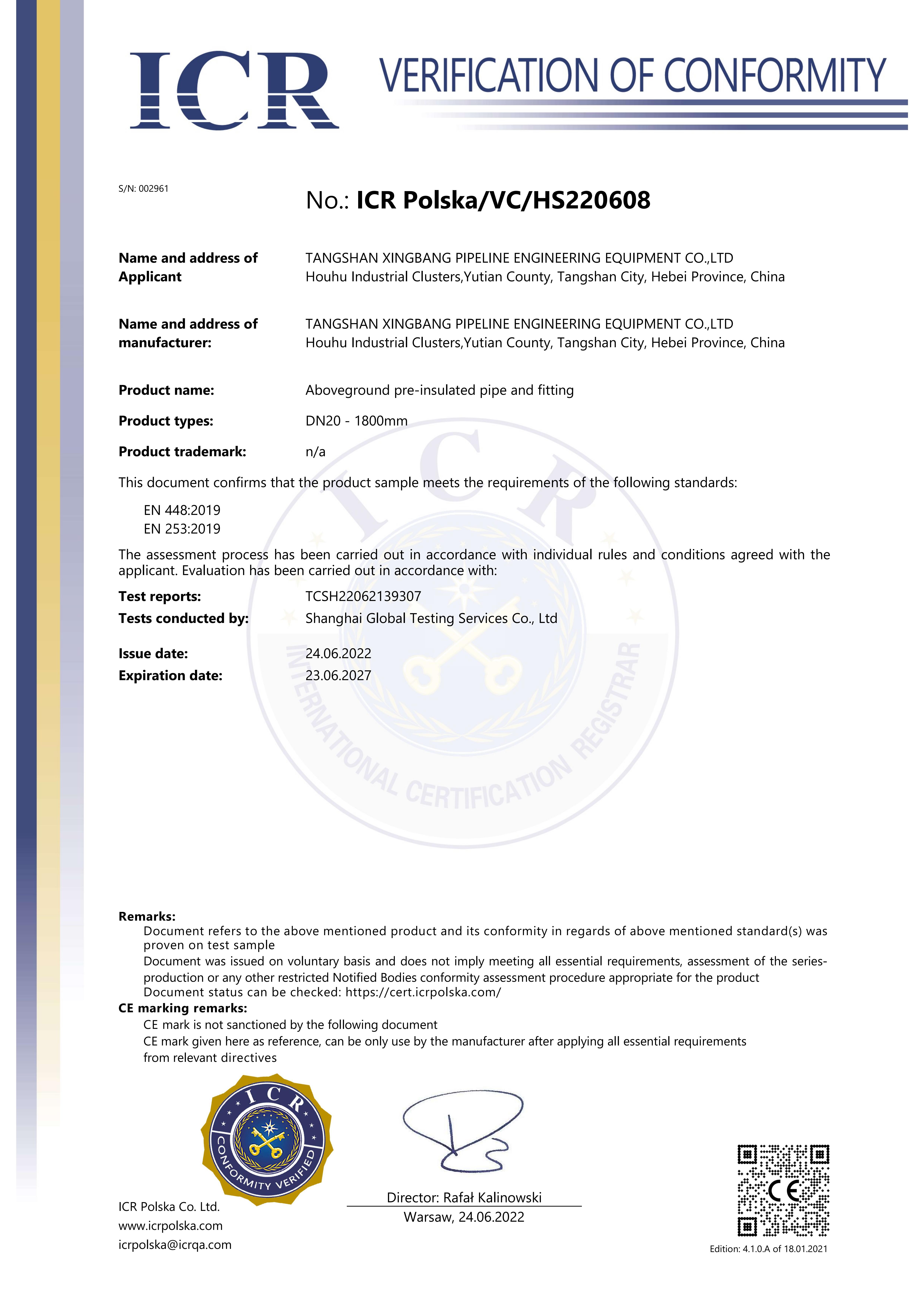
| EN 448:2019 | Component standard within the same directly buried hot water family | Appears together with EN 253:2019 in the CE verification of conformity held for Xingbang's polyurethane pre-insulated pipes |
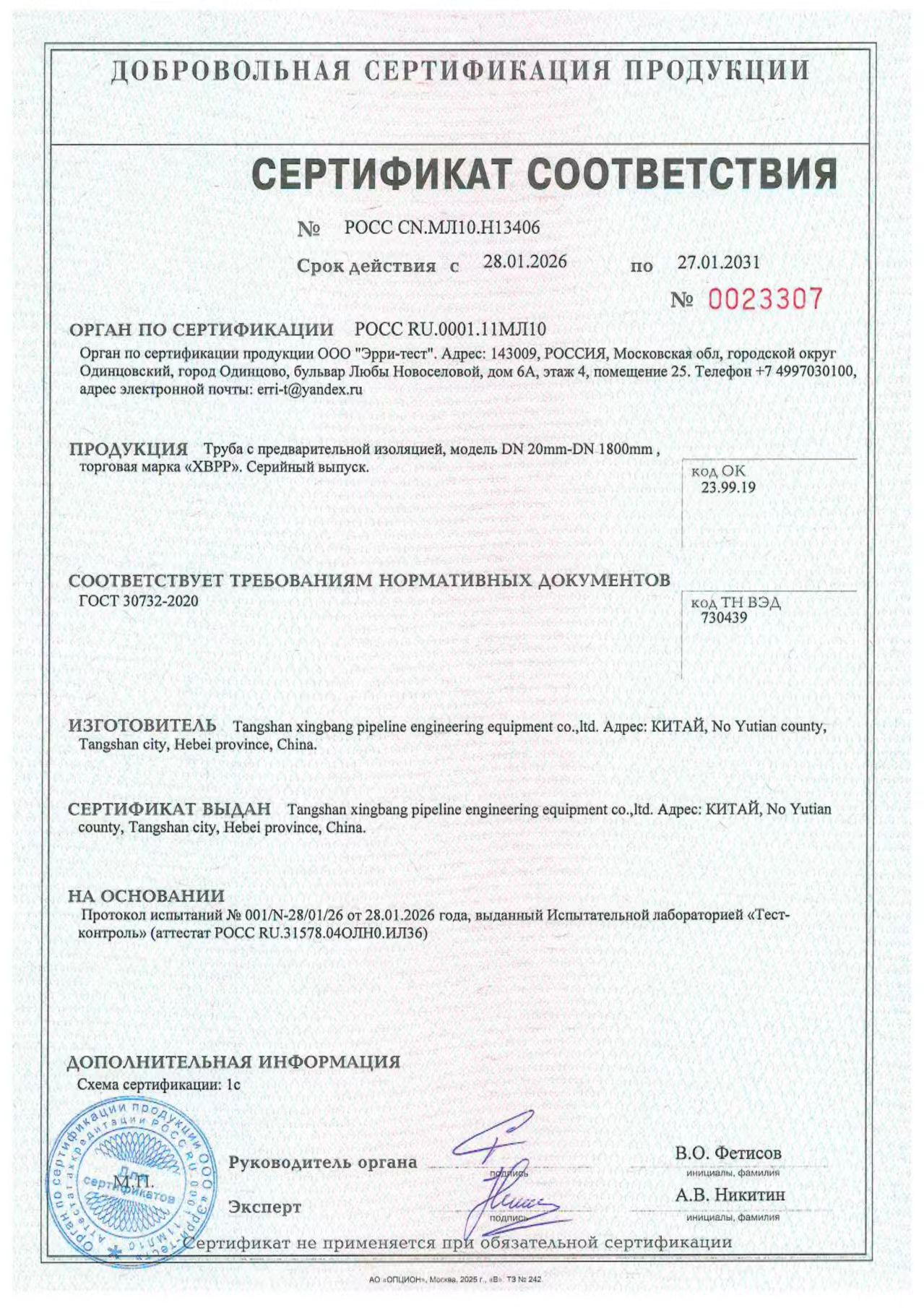
| ГОСТ 30732-2020 | Russian standard cited in the voluntary conformity certificate | Covers DN20 mm–DN1800 mm for the Russian Federation market |
| ASTM A53 | Seamless and welded black and hot-dipped galvanized steel pipe | Relevant where a specification calls for a US standard for the steel service pipe |
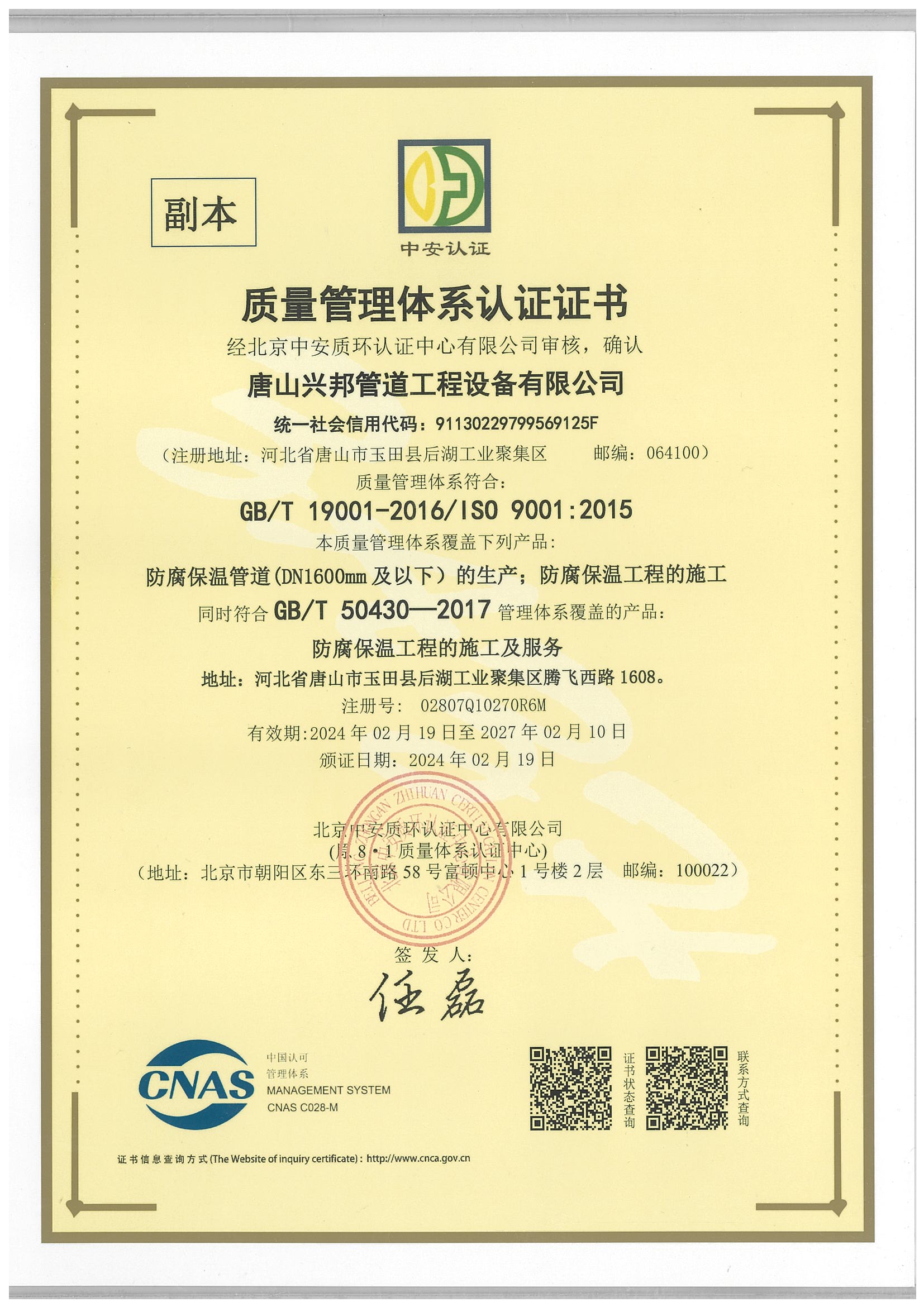
| ISO 9001:2015 / GB/T 19001—2016 | Quality management system | Covers production of pre-insulated pipes DN1600 mm and below, pipeline insulation project construction, and anti-corrosion insulation processing services |
The practical consequence is that a project may cite EN 253 for the pipe while the service pipe material, the fittings, the jointing system and the manufacturer's management system each carry their own evidence line. Edition control matters too: certificates are issued against a specific edition, and the CE verification held for Xingbang's pipes names EN 253:2019 and EN 448:2019 rather than an earlier revision.
How compliance documentation supports a project specification
Compliance documentation works as a back-check on the specification rather than as an appendix to it. The specification states what the network requires; the certificate states what has actually been assessed. Where the two align on product type, diameter range, standard edition and date, the qualification step is complete. Where they do not, the gap has to be closed with additional evidence or a modified scope.
A worked example makes the alignment concrete. The CE verification of conformity held for Xingbang's polyurethane pre-insulated pipes carries the number ICR Polska/VC/HS220608 and was issued by ICR Polska Co. Ltd against EN 448:2019 and EN 253:2019, with a scope of polyurethane pre-insulated pipes from DN20 mm to DN1800 mm. It was issued on 24 June 2022 and is valid to 23 June 2027. A project specifying that product family within that diameter band, with delivery inside the validity window, can reference the certificate directly.
The same logic applies to the management system layer. Xingbang holds ISO 9001:2015 certification — referenced in the certificate as GB/T 19001—2016 / ISO 9001:2015, certificate number 02807Q10270R6M, issued by Beijing Zhong'an Quality & Environment Certification Center Co., Ltd. on 19 February 2024 and valid to 10 February 2027. Its scope covers production of pre-insulated pipes DN1600 mm and below, construction of pipeline insulation projects, and processing and service of anti-corrosion insulation projects. That is a statement about how production and project work are controlled, and it supports — but does not replace — product conformity evidence.
Third-party verification: what it establishes, and what it leaves outside
Third-party verification means an organisation outside the manufacturer has assessed the product or the system against a defined standard and issued a scoped statement. For Xingbang's pre-insulated pipe, three such statements exist for different purposes and different markets.
- EU market: EU CE Verification of Conformity Certificate — ICR Polska/VC/HS220608, issued by ICR Polska Co. Ltd, against EN 448:2019 and EN 253:2019, scope polyurethane pre-insulated pipes DN20 mm–DN1800 mm, issued 24 June 2022, valid to 23 June 2027.
- Quality management: ISO 9001 Quality Management System Certification — 02807Q10270R6M, issued by Beijing Zhong'an Quality & Environment Certification Center Co., Ltd., scope production of pre-insulated pipes DN1600 mm and below and related project and processing services, issued 19 February 2024, valid to 10 February 2027.
- Russian Federation: СЕРТИФИКАТ СООТВЕТСТВИЯ under voluntary certification — РОСС CN.MJI10.H13406, issued by Эрри-тест against ГОСТ 30732-2020, scope DN20 mm–DN1800 mm, issued 28 January 2026, valid to 27 January 2031.
What third-party verification does not do is equally important. It confirms conformity at assessment, against a named product type and size range. It does not cover pipe sizes outside the stated scope, service temperatures or pressures outside the product envelope, the quality of jointing performed on site, or the specific soil and groundwater conditions along a given route. A certificate is a qualification baseline, and treating it as a performance guarantee is one of the more common errors in buried network procurement.
The internal processes that keep conformity consistent
A conformity claim is only repeatable if production is controlled. The processes that matter are unglamorous: control of incoming materials and components, documented production stages, testing at defined points, traceability from material batch to delivered pipe, and a defined route for handling non-conforming output. This is the framework that ISO 9001:2015 / GB/T 19001—2016 certification addresses, and it is the reason the management system certificate and the product certificate are usually requested as a pair.
Xingbang states a production practice of 100% testing, which is the point where a documented system becomes inspectable evidence: every pipe, not a sampled subset, is checked before it leaves the works. The company operates a 310,000 m² facility with a monthly capacity of 200 km of insulated pipe, a production lead time of 30–45 days and a minimum order quantity of 1 km, and reports an export share of about 30% with main markets in Europe, North America and the Middle East. A research and development team of 30 engineers supports customised pipe diameter and length, custom pipe material, temperature and pressure rating, insulation thickness, anti-corrosion grade, non-standard fittings and designs adapted to geological conditions.
There is also a standards-side process that buyers rarely see but that affects how a supplier reads a specification. Xingbang is a participant in the formulation of China's national standard for directly buried insulation pipes, a member unit of the heating Standardization Technical Committee of the Ministry of Housing and Urban-Rural Development, a standing member unit of the Regional Energy Professional Committee of the China Building Energy Conservation Association, a director unit of the thermal power industry alliance of the China Energy Conservation Association, and a member unit of the China Plastics Processing Industry Association. Participation in standards work and industry committees is not itself a product certification, but it indicates familiarity with how conformity requirements are written and revised.
Application: where compliant pre-insulated pipe is specified
The product is applied to anti-corrosion, thermal insulation and heat preservation pipeline projects in heating, cooling and crude oil transportation. Typical project types include municipal heating networks, industrial parks, residential communities, cogeneration schemes, urban pipe network renovation, urban comprehensive pipe gallery projects and commercial building heating. Working conditions are ordinary hot water at temperatures up to 120°C under low pressure, with continuous 24-hour operation.
Buried systems also depend on the jointing accessories that accompany the pipe. The matched set for these installations includes electrofusion sleeves, heat shrinkable sleeves, insulation joint material, foaming filler, and sealing and waterproof material. Because joints are the point at which a certified factory product becomes an installed system, the accessories and their documentation belong in the same compliance file as the pipe itself.
| Project type | Location | Scope | Operating record |
|---|---|---|---|
| Bank campus cooling and heating supply | Cambodia | 30 km | 2 years, stable operation |
| Hotel cooling and heating supply | Jamaica | 3 km | 2 years, stable operation |
| Copper mine cooling and heating supply | Mongolia | 9 km | 3 years, stable operation |
| Municipal heating network renovation | Uzbekistan | 6 km | 5 years, stable operation |
| District cooling supply, Phnom Penh | Cambodia | 5 km | 10 years, stable operation |
| University campus cooling and heating supply | Vietnam | 6 km | 7 years, stable operation |
Read as a compliance signal rather than a sales list, the pattern is that the same product family has been deployed across both heating and cooling duties, including district cooling in a high-humidity environment. In heating, third-party analysis cited by Strategic Market Research indicates that pre-insulated pipes can reduce heat loss by over 30% in modern district heating networks; the manufacturer's own stated functions for the product are heat loss reduction, corrosion protection, waterproofing against humid and saline-alkali ground, and lower later operation and maintenance cost.
Market trend: network growth raises the documentation bar
The demand backdrop explains why compliance review has tightened. Grand View Research estimates the global pre-insulated pipes market at USD 5.97 billion in 2024 and projects USD 10.4 billion by 2030, a CAGR of 9.7%. SNS Insider values the broader global district heating market at USD 209.34 billion in 2024, while Global Market Insights projects a 5.7% CAGR for the combined district heating and cooling market from 2024 to 2032. Within that, SNS Insider projects a 9.48% CAGR for pre-insulated pipes used in district cooling, driven largely by smart city programmes.
Regional weight matters for standards selection. Grand View Research places Asia Pacific at a 39.96% revenue share in 2024, while Credence Research puts Europe at approximately 38% of the global pre-insulated pipe systems market. In practice that means a supplier selling into both regions must maintain evidence against European and national standards simultaneously — which is why the certificate set for a single product family can span EN 253:2019, ГОСТ 30732-2020 and ISO 9001:2015 at the same time.
Market size estimates diverge by research house: Grand View Research reports USD 5.97 billion for 2024, Strategic Market Research USD 9.8 billion, and MarketsandMarkets USD 5.27 billion. The direction of growth is consistent across sources; the absolute size is not, and procurement documents should avoid quoting a single figure as settled fact.
Competitive context also shapes documentation expectations. LOGSTOR, Perma-Pipe and BRUGG are among the top global players in pre-insulated pipe systems according to Technavio. Suppliers outside those established networks, including Chinese manufacturers exporting to Europe, North America and the Middle East, generally have to match the documentation depth of the mature market rather than the local one in order to qualify.
Factory pre-insulated pipe versus on-site insulation: the compliance difference
The comparison that matters in a compliance discussion is not thermal performance but where conformity is established and who is accountable for it.
| Criterion | Factory-made bonded pre-insulated pipe | On-site applied insulation |
|---|---|---|
| Conformity evidence | Certificate covers the bonded assembly as a product | Conformity depends on site workmanship and materials applied on site |
| Inspection point | Factory, under a stated 100% test regime | Site, with inspection limited to accessible points |
| Traceability | Batch-level records linked to production | Split between pipe supplier, insulation contractor and installer |
| Responsibility | Single product entity for pipe, foam and jacket | Divided across several parties |
This is a qualification difference, not an absolute preference. On constrained retrofit routes, non-standard geometries or projects where pipe is already installed, on-site insulation may remain the practical route, and factory pre-insulated pipe is not automatically the right answer for every network. The relevant limitation runs the other way as well: certification covers the factory product, not the joint assembled in the trench, so a certified pipe can still underperform if installation practice or burial conditions are wrong.
Limits and boundaries: what compliance does not remove
- Temperature and pressure envelope. The product is specified for media up to 120°C, occasional peaks up to 130°C and working pressure up to 2.5 MPa. Steam and higher-temperature duties require a different insulation system.
- Dimensional scope. The CE verification covers DN20 mm–DN1800 mm; the ISO 9001 scope covers pre-insulated pipe production DN1600 mm and below; the ГОСТ certificate covers DN20 mm–DN1800 mm. A requirement outside these ranges needs separate evidence.
- Validity windows. The CE certificate runs to 23 June 2027, the ISO certificate to 10 February 2027 and the ГОСТ certificate to 27 January 2031. Procurement should check the date against the delivery schedule, not only at tender stage.
- Factory versus site. Product certification does not cover jointing quality, trench preparation or installation practice. Accessories such as electrofusion sleeves, heat shrinkable sleeves and foaming filler carry part of that responsibility.
- Site-specific conditions. Soil load, groundwater chemistry, thermal expansion stress and external impact vary by route. Conformity to a standard is a baseline qualification, not a substitute for project engineering.
- Assessment is periodic, not continuous. Third-party verification confirms a system and an assessed product range; it does not inspect every pipe. That is precisely why the manufacturer's own 100% testing and traceability regime carries the day-to-day burden.
Future outlook
Three developments are likely to shape how pre-insulated pipe compliance is assessed over the next few years. First, the growth of district cooling — projected at a 9.48% CAGR for pre-insulated pipes in that segment by SNS Insider — pushes insulation systems into dual heating and cooling duties, where documentation has to cover both service conditions of the same product family. Second, materials innovation is moving faster than standards: next-generation insulation such as aerogels is emerging for ultra-low heat loss applications, and certification frameworks for such materials will develop alongside adoption rather than ahead of it, which puts pressure on buyers to read scope statements carefully. Third, as the Asian supply base grows within a market where Asia Pacific already held a 39.96% revenue share in 2024, more certificates will be issued for export markets, and the differentiating factor between suppliers will shift from whether certificates exist to whether their scope, edition and validity actually match the project.
For a network designed around a 30-year service life at 120°C, documentation has to survive as long as the asset. That makes certificate renewal, record retention and batch traceability part of asset management rather than a one-off purchasing formality.
FAQ
What is EN 253 and why is it the usual reference for directly buried hot water networks?
EN 253 is the industry standard for pre-insulated bonded pipe systems for directly buried hot water networks, and it is the reference most European specifications for that duty cite. The standard itself is only one line of evidence: the certificate issued against it names the product type, diameter range and validity period, and those attributes have to be checked against project requirements before the standard can be treated as satisfied.
Which standards appear alongside EN 253 in pre-insulated pipe procurement?
Specifications typically combine several references. EN 448:2019 covers components within the same directly buried hot water family and appears with EN 253:2019 in the CE verification of conformity held for Xingbang's polyurethane pre-insulated pipes. ГОСТ 30732-2020 is the standard cited in the voluntary conformity certificate covering DN20 mm–DN1800 mm. ASTM A53 is a primary American standard for seamless and welded black and hot-dipped galvanized steel pipe, relevant where the steel service pipe is specified to a US reference. ISO 9001:2015 / GB/T 19001—2016 addresses the manufacturer's quality management system rather than the product.
How can a buyer verify that a certificate actually covers the pipe being purchased?
Four attributes decide it: the standard and its edition, the product type, the dimensional scope, and the validity period. A certificate stating EN 253:2019 for polyurethane pre-insulated pipes from DN20 mm to DN1800 mm covers that range and no more. If the project requires a diameter outside the stated scope, or delivery falls after the expiry date, the certificate does not support the purchase on its own. The issuing body should be identifiable and the certificate number should be quoted in the purchase documentation.
What internal processes should a manufacturer have for consistent conformity?
A conformity claim is repeatable only when production is controlled. The relevant processes are incoming material control, documented production stages, testing at defined points, traceability from material batch to delivered pipe, and defined handling of non-conforming output — the framework covered by ISO 9001:2015 / GB/T 19001—2016, under which Xingbang holds certification for pre-insulated pipe production to DN1600 mm and related project services. Xingbang's stated practice of 100% testing is the point at which a management system becomes inspectable evidence rather than a policy document.
What are the operating limits of a PU foam pre-insulated pipe?
The polyurethane insulated pipe is specified for networks where the conveyed medium is no higher than 120°C, the occasional peak temperature does not exceed 130°C and working pressure is no more than 2.5 MPa, with continuous operation of at least 30 years in a 120°C environment. Third-party technical references similarly place PU foam insulation for EN 253 pipes at up to about 120°C. Steam service and higher-temperature duties fall outside this envelope and require a different insulation system.
Which documents should accompany a pre-insulated pipe delivery?
Typically the conformity certificate with its scope statement, the quality management system certificate, material and test records traceable to the production batch, and documentation for the matched accessories used at joints — electrofusion sleeves, heat shrinkable sleeves, insulation joint material, foaming filler, and sealing and waterproof material. On buried networks those accessories largely determine whether the certified product performs as a system, so they belong in the same documentation file as the pipe.
Does a certificate alone guarantee performance in a buried network?
No. Certification confirms that a product conforms to a defined standard under an assessment process. It does not model the soil load, groundwater chemistry, thermal expansion stress or external impact of a specific route, and it does not cover the quality of jointing carried out on site. Installation to the manufacturer's procedure, correct accessories and a site-specific review of burial conditions remain necessary. Certification is a baseline qualification, not a substitute for project engineering.
Conclusion
For pre-insulated pipe, compliance is a chain rather than a badge: a standard such as EN 253 defines the duty, a third-party certificate scopes the product and the diameter range, a management system certificate shows the process behind it, and internal testing and traceability keep it true between assessments. Buyers who review the chain — standard edition, scope, issuing body, validity date, and installation scope — reach qualification decisions that hold up long after the network is buried.
A consolidated company and product reference document, including product scope and certification overview, can be downloaded here: Tangshan Xingbang company and product brochure (PDF).