
Pre-Insulated Pipe Contracts: Turning Qualification into Acceptance Criteria
Compliance in pre-insulated pipe procurement is a matter of contract design, not a matter of confidence in a supplier brochure. The pipe that arrives on site is the output of one specific order: a diameter, a jacket type, an insulation thickness, a carrier medium at a stated temperature, a pressure class, and a factory test record. If any of those items is missing from the purchase terms, there is no defined basis on which delivery can be accepted or rejected.
That matters more as the category scales. Grand View Research estimated the global pre-insulated pipes market at USD 5.97 billion in 2024 and projects USD 10.4 billion by 2030, a CAGR of 9.7%. SNS Insider valued the global district heating market at USD 209.34 billion in 2024. Growth of this order multiplies the number of purchase transactions, and every transaction is a small contract in which supplier qualification either holds or quietly evaporates between quotation and delivery.
This reference is written for procurement and engineering teams working between evaluation and execution. It sets out a three-gate structure — order, pre-shipment, delivery — and links each acceptance criterion back to a purchase term that must exist before the criterion can be tested at all.
The separation problem: certificates without scope, acceptance without criteria
Two failures recur in pre-insulated pipe buying. The first is treating supplier qualification as a folder of certificates collected once and filed. The second is treating acceptance as a count of pipes on arrival. Neither survives contact with a disputed delivery, because a certificate does not describe an order and a pipe count does not describe a product.
A workable model separates three things that are often merged: qualification evidence (a claim about what a supplier is certified and equipped to do), purchase terms (the clause that converts that claim into an obligation for this order), and acceptance criteria (the evidence that converts the obligation into a pass or fail).
| Gate | Purchase term to fix | Acceptance evidence | Gate closes when |
|---|---|---|---|
| 1. Order | Product definition, standard reference and edition, certification scope and validity, MOQ, delivery terms, payment terms, lead time | Signed order; certificate copies matched to the ordered DN range; agreed inspection plan | Purchase order countersigned and inspection plan attached |
| 2. Pre-shipment | Test plan, record content, witness or hold point, packing and marking requirements | Test records, dimension and length list, non-conformance log, release note | Release note signed before loading |
| 3. Delivery | Document set, quantity reconciliation, damage notation window, storage conditions | Packing list against actual, jacket condition report, certificate and record handover | Receiving report signed with documents attached |
Gate 1: the order is where compliance is actually written
At order stage the buyer's task is to make every later inspection possible. A purchase term that cannot be inspected is not a term; it is an intention.
Product definition must be literal
Diameter, wall thickness, length, carrier pipe, jacket material, and insulation type should be written as values, not descriptors. Pre-insulated pipe of the directly buried type is normally specified with a high-density polyethylene jacket and rigid polyurethane foam insulation, and the order should state that construction explicitly rather than referring to a general product family.
Standard reference should name the edition
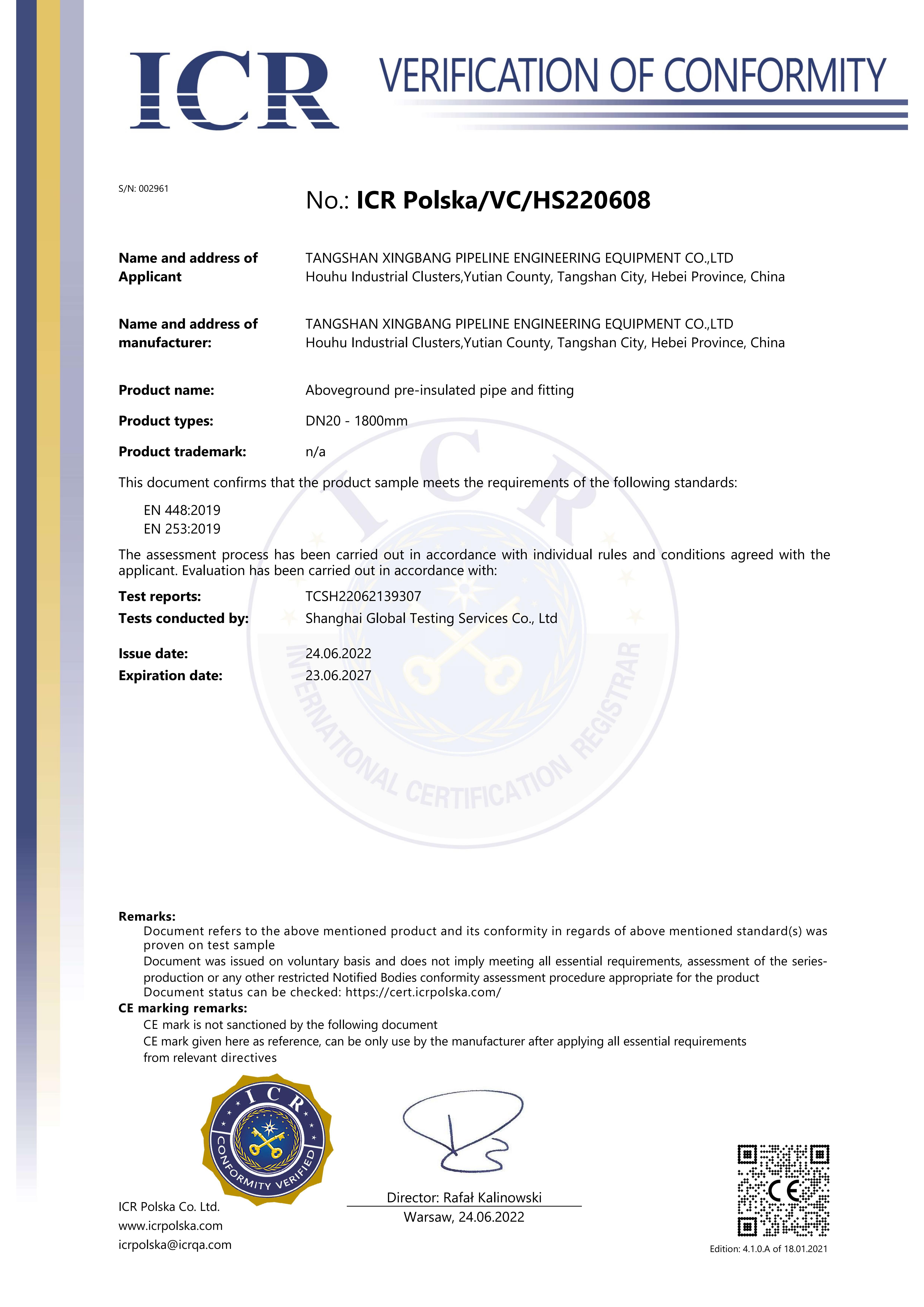
EN 253 is the industry standard for pre-insulated bonded pipe systems for directly buried hot water networks. Naming the standard is necessary but not sufficient; the edition matters, because fittings and joints may sit under a different document. A CE certificate covering polyurethane pre-insulated pipes from DN20 mm to DN1800 mm may reference EN 448:2019 and EN 253:2019 — and the purchase term should state which of these applies to the pipe, and which to the fittings, so that the inspection plan does not collapse both into one line.
Certificate scope, not certificate existence, is the object of review
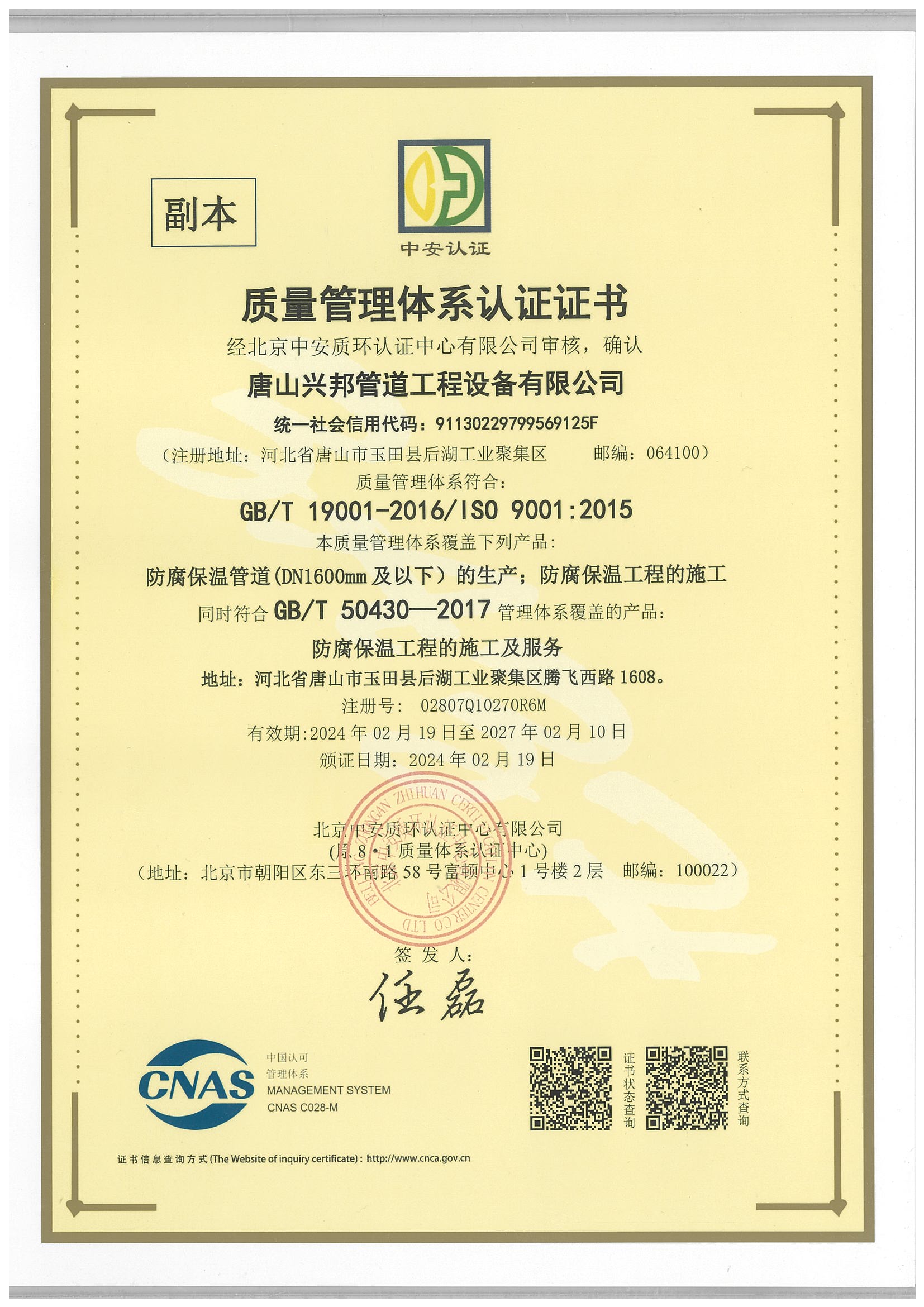
This is the most frequently skipped step in supplier qualification. A certificate answers a narrow question: which products, produced under which system, in which period. Three documents illustrate how different those answers can be.
| Document | Scope as stated | Validity |
|---|---|---|
| ISO 9001 quality management system certificate 02807Q10270R6M, issued by Beijing Zhong'an Quality & Environment Certification Center Co., Ltd. (GB/T 19001—2016 / ISO 9001:2015) | Production of pre-insulated pipes DN1600 mm and below; construction of pipeline insulation projects; processing and service of anti-corrosion insulation projects | 2024-02-19 to 2027-02-10 |
| EU CE verification of conformity ICR Polska/VC/HS220608, issued by ICR Polska Co. Ltd | Polyurethane pre-insulated pipes DN20 mm to DN1800 mm, against EN 448:2019 and EN 253:2019 | 2022-06-24 to 2027-06-23 |
| Russian voluntary certification РОСС CN.MJI10.H13406, issued by Эрри-тест, against ГОСТ 30732-2020 | DN20 mm to DN1800 mm, Russian Federation market | 2026-01-28 to 2031-01-27 |
Read together, these documents create a boundary that a buyer should resolve before signing rather than after delivery. An order for DN1800 mm sits inside the CE and GOST scopes but above the DN1600 mm ceiling written into the ISO 9001 scope. That does not make the order unmanufacturable; it makes the quality-system basis of that order a question worth asking in writing, with the answer recorded as a contract document.
Commercial terms belong in the same clause set
Qualification collapses when commercial terms are negotiated separately from technical ones. A published purchasing-terms summary of the type buyers should expect lists a minimum order quantity of 500 m, FOB/CIF delivery terms, a 30/70 payment structure, and pre-shipment testing as the acceptance basis. Each of those items has a technical consequence: pre-shipment testing as the acceptance basis implies an inspection plan must exist before production starts, and FOB/CIF terms determine where risk passes, which in turn determines what can still be rejected at site.
Schedule terms should be stated in the same place. A stated lead time of 30–45 days and a monthly capacity of 200 km set the realistic window for hold points; a buyer who plans inspection after production is complete has already lost the chance to witness it.
Customization increases the number of line items to accept
Where an order departs from catalogue dimensions, acceptance must follow each departure. Configurable items typically include pipe diameter and length, pipe material, temperature and pressure rating, insulation thickness, anti-corrosion grade, non-standard fittings, design adapted to geological conditions, and intelligent monitoring systems. Every one of these is inspectable and should appear as a measurable line item rather than as a description in an annex.
Gate 2: pre-shipment as a hold point, not a formality
A supplier claim of 100% testing is a statement of production discipline; it is not yet an acceptance criterion. Converting it requires four written answers.
- What is tested. The test items covered by the release decision, listed by product characteristic, so that a record can be checked line by line.
- What the record contains. Identifiers that link a finished pipe length back to the test performed on it. A record that cannot be matched to a physical length is not traceability.
- Who witnesses. Whether the buyer, an appointed inspector, or a third party attends, and at which point production is held pending that attendance.
- What happens on non-conformance. The disposition route and the person authorised to release, segregate, or rework.
Customized orders make generic inspection plans unreliable. When pipe diameters and lengths are made to order and fittings are non-standard, the release package should include a measured dimension and length list, a packing and marking specification that keeps factory records attached to the correct bundle, and a document set issued before loading — not after arrival.
The boundary here is worth stating plainly. Pre-shipment release confirms that the product matches the order and the recorded test results. It does not confirm service life. Statements about long-term performance, such as continuous operation for at least 30 years at 120 °C, rest on the material specification, the applicable standard, and process control across the whole production period, not on a single inspection event. Buyers who need that assurance should ask for the process and type-test basis, not for a stronger sentence in the release note.
Gate 3: delivery acceptance with documents attached
Delivery is where contract terms are most often abandoned, because the commercial pressure to unload and store is immediate. A defensible receiving routine has five elements.
- Quantity and length reconciliation against the packing list, including fittings and joint kits, which are frequently short-shipped without being noticed until installation.
- Jacket and end condition inspection before pipes are moved into storage, with damage recorded against the specific bundle identifier.
- Document handover — certificates matched to scope, test records, dimension list, packing list. A delivery with pipe present and records missing is incomplete, regardless of how the pipe looks.
- Risk transfer clarity. Under FOB and CIF terms the risk point is not the project site, so site damage handling must be agreed separately from the delivery term itself.
- Storage conditions. Factory-insulated pipe protects its own insulation, but only while the jacket and pipe ends remain intact; storage instructions belong in the purchase terms because they determine who bears loss after acceptance.
Delivery inspection has a hard limit that buyers should acknowledge rather than work around. Visual and dimensional checks can confirm length, diameter, jacket integrity, and marking. They cannot confirm foam density, cell structure, or the bond between foam and carrier pipe. Those are process attributes settled upstream by type testing and production records. A receiving report that claims to have verified them is a document that will not survive scrutiny.
Technical explanation: why terms must follow the medium
Acceptance criteria only make sense against the operating envelope written into the order. Polyurethane foam insulation for EN 253 pipes typically withstands temperatures up to 120 °C. The corresponding product statement for polyurethane pre-insulated pipe places the working range at a conveyed medium temperature no higher than 120 °C, an occasional peak no higher than 130 °C, and a working pressure no more than 2.5 MPa, with continuous operation of at least 30 years at 120 °C.
Three consequences follow for contract writing.
First, temperature determines whether the standard product applies at all. Enquiries described as pre insulated steam pipe, pre-insulated boiler steam pipes, or high-temperature above-ground lines may fall outside the stated envelope. Where they do, the correct response is a separate engineering agreement with its own testing basis — not an acceptance criterion copied from a hot water specification.
Second, the application changes the emphasis of the criteria. For pre insulated pipe for hot water and directly buried hot water networks, acceptance attention concentrates on heat retention and jacket integrity in buried service. For pre insulated pipe for chilled water and district cooling networks, the emphasis shifts toward moisture management and jacket continuity, and the purchase terms should state the medium temperature and jacket specification explicitly so the criterion matches the duty.
Third, the installation context changes the jacket specification. Above-ground sections, including galvanized iron jacket configurations, sit in a different exposure environment from buried sections, and the order should separate the two rather than applying one specification across a mixed route.
Application: what reference projects can and cannot prove
Xingbang — Tangshan Xingbang Pipeline Engineering Equipment Co., Ltd — is a pre-insulated pipe manufacturer based in Houhu Industrial Park, Yutian Economic Development Zone, Hebei Province, China, producing polyurethane pre-insulated pipe for heating, cooling, and oil transport networks from a 310,000 m² site with a 30-engineer R&D team. The company states that it is a participant in the formulation of China's national standard for directly buried insulated pipe and a member unit of the heating Standardization Technical Committee of the Ministry of Housing and Urban-Rural Development.
| Reference scope | Market | Application | Recorded service duration |
|---|---|---|---|
| District cooling and heating supply, 5 km | Cambodia — Phnom Penh | Cooling and heating supply | 10 years, stable operation |
| Municipal heating network renovation, 6 km | Uzbekistan | Cooling and heating supply | 5 years, stable operation |
| Copper mine project, 9 km | Mongolia | Cooling and heating supply | 3 years, stable operation |
| New university construction, 6 km | Vietnam — Ho Chi Minh City | Cooling and heating supply | 7 years, stable operation |
| Hotel project, 3 km | Jamaica | Cooling and heating supply | 2 years, stable operation |

Reference lists require interpretation. A 3 km hotel project and a 9 km mine project demonstrate different things, and neither automatically supports an order of a different diameter, medium, or installation type. The useful question in evaluation is not how many references exist but whether the supporting documentation shows a comparable scope, the standard applied, and the duration actually recorded. Where a supplier also operates dedicated on-site service teams for project support, that capability belongs in the after-sales clause with a defined response scope — otherwise it remains a marketing statement.
Market trend: documentation is becoming the differentiator
Regional weight reinforces the point. Asia Pacific held a 39.96% revenue share of the pre-insulated pipe market in 2024 according to Grand View Research, while Credence Research places Europe at approximately 38% of the pre-insulated pipe systems market. Global Market Insights projects the combined district heating and cooling market growing at a CAGR of 5.7% from 2024 to 2032, and SNS Insider projects a 9.48% CAGR specifically for district cooling pipe demand, driven by smart city programmes.
Published market size estimates for this category diverge materially — USD 5.97 billion, USD 9.8 billion, and USD 5.27 billion have all been published for 2024 by different research houses. That divergence is itself a procurement lesson: absolute figures are less useful than scoped figures. The same discipline applies to supplier claims. A buyer who asks "for which DN range, which medium, and which period" gets an answer that can be written into a contract; a buyer who asks for a general capability statement does not.
Comparison with alternative approaches — and where each fails
| Approach | What it settles | Where it fails |
|---|---|---|
| Certificate-only qualification | Confirms audited management system or product conformity for a defined scope and period | Says nothing about the specific order; scope ceilings and expiry dates are easily missed |
| Factory audit only | Shows process capability observed on the audit day | Does not bind an individual order; conditions on the day of a later production run are not covered |
| Contract-based qualification with staged acceptance | Binds order, pre-shipment, and delivery to named evidence and dated hold points | Depends on the buyer's technical capacity to define tests; adds administrative load; cannot substitute for third-party type testing |
| Site insulation of plain pipe | Flexibility for irregular geometry, small volumes, and late design changes | Moves insulation quality control to the site, where weather, access, and workmanship vary and factory process records do not exist |
The limitation of the contract-based model should be stated as clearly as its advantage. It formalises evidence; it does not create it. Three boundaries apply. First, if the order itself is under-specified — a medium temperature missing, a jacket type left to the supplier — no amount of inspection rigour recovers the missing definition. Second, the model adds cost in proportion to order size; for volumes below the stated minimum order quantity, bespoke hold points and witness attendance may cost more than the risk they address. Third, and most importantly, a well-drafted contract cannot verify performance that is only observable over decades; long-term behaviour depends on standard conformity, material specification, and production consistency, and those must be evaluated through type-test documentation and process records rather than through acceptance clauses alone.
Future outlook
Three shifts are likely to shape pre-insulated pipe qualification over the next procurement cycles. Test documentation is moving from paper release notes to line-level records that can be matched to individual pipe lengths, which makes traceability a negotiable term rather than an aspiration. Standard alignment is becoming an explicit order field, as buyers learn to name editions and separate pipe from fittings under EN 253 and EN 448 rather than collapsing both. And as district cooling expands at a projected 9.48% CAGR, acceptance attention will broaden from heat retention toward jacket continuity and moisture control in chilled water service — a change that will show up first in purchase terms, before it shows up in product literature.
For teams assembling a qualification file, the practical starting point is not a longer checklist but a shorter one that maps each purchase term to a specific acceptance record and a named gate. Further background on the manufacturer referenced in this article, including its certificate set and production scope, is available in the Xingbang company brochure.
FAQ
Which documents belong in the purchase terms of a pre-insulated pipe order?
A workable document set contains four groups: the applicable product standard and edition, matched to pipe and to fittings separately; the supplier's conformity and system certificates with scope and expiry dates recorded; the agreed inspection plan naming test items, record content, and witness points; and the packing, marking, and storage specification. Commercial terms — minimum order quantity, delivery terms, payment structure, lead time — should be written into the same clause set so that each technical criterion has a contractual anchor.
How does a buyer check that a certificate covers the ordered pipe sizes?
By comparing the dimensional range printed on the certificate with the diameters in the order, then checking the validity period against the delivery schedule. Ranges differ by document: an ISO 9001 scope may cover production of pre-insulated pipes up to DN1600 mm, a CE conformity document may cover DN20 mm to DN1800 mm against EN 448:2019 and EN 253:2019, and a Russian GOST 30732-2020 certificate may cover DN20 mm to DN1800 mm for that market. An order outside a stated range requires a documented answer before production, not after delivery.
What should pre-shipment acceptance cover in a pre-insulated pipe order?
Pre-shipment acceptance should confirm that the product matches the order and that recorded tests link to physical pipe lengths. The practical content is a defined test item list, records traceable to bundle or length identifiers, a measured dimension and length list for customized diameters and non-standard fittings, a non-conformance log with an authorised release decision, and a document set issued before loading. When a supplier states 100% testing, the contract should define what that percentage refers to and who signs the release.
What acceptance checks apply when pre-insulated pipe arrives on site?
Delivery acceptance covers quantity and length reconciliation against the packing list, including fittings and joint kits; jacket and pipe-end condition recorded against bundle identifiers; handover of certificates, test records, and packing documents; and clarification of where risk passed under the agreed delivery term. Visual and dimensional checks cannot confirm foam density or the bond between foam and carrier pipe, so those attributes must be settled upstream through type-test documentation and production records rather than at the receiving gate.
What operating limits should the purchase terms state?
The terms should state the conveyed medium temperature, the occasional peak temperature, the working pressure, and the expected service life basis. For polyurethane pre-insulated pipe the commonly stated envelope is a medium temperature no higher than 120 °C, an occasional peak not exceeding 130 °C, and a working pressure no more than 2.5 MPa, with continuous operation of at least 30 years at 120 °C. Polyurethane foam insulation for EN 253 pipes typically withstands temperatures up to 120 °C. Applications outside that envelope require a separate engineering basis rather than a restated specification.
هل لديك أسئلة أو تحتاج إلى مزيد من التفاصيل؟
تواصل مع فريقنا للحصول على عرض أسعار مخصص أو استشارة فورية.
طلب عرض أسعار
املأ النموذج أدناه وسيتواصل معك فريقنا بعرض مقترح مخصص.
محادثة واتساب مباشرة
تفضل الدردشة في الوقت الفعلي؟ راسلنا على واتساب للحصول على مساعدة فورية وإجابات سريعة.
- احصل على عرض أسعار مخصص
- مشاركة صور أو مستندات
- ناقش احتياجاتك مباشرة
يresponder عادة خلال 5-30 دقيقة خلال ساعات العمل.