
Pre-Insulated Pipe Limits: Buyer FAQs on Specs and Terms
Most pre-insulated pipe tenders do not fail on price. They fail on whether the proposed pipe can actually serve the specified temperature, pressure, diameter and length — and whether the supplier can document it. This reference answers the technical and procurement questions that surface most often in the final stages of evaluation, using documented product limits, certificate scopes and purchasing terms rather than promotional claims.
Why Technical Limits Decide More Bids Than Price
The global pre-insulated pipes market was estimated at USD 5.97 billion in 2024 and is projected to reach USD 10.4 billion by 2030, a 9.7% CAGR (Grand View Research). Published figures differ: Strategic Market Research estimates the 2024 market at USD 9.8 billion, while MarketsandMarkets places it at USD 5.27 billion, largely because research houses define the category differently. When the category definition itself varies that widely, the only stable basis for comparing offers is the documented technical specification.
Two reference points explain why limits carry so much weight. EN 253 is the industry standard for pre-insulated bonded pipe systems for directly buried hot water networks (European Committee for Standardization), so a large share of compliant products are judged against the same architecture. And polyurethane (PU) foam insulation in EN 253 pipes typically withstands temperatures up to 120°C (250°F) (Rovanco Piping Systems). That ceiling is a property of the insulation material system rather than any single supplier's catalogue — which is why it recurs across compliant bids, and why it should be stated explicitly in each one.
Tangshan Xingbang Pipeline Engineering Equipment Co., Ltd (Xingbang) is a Chinese manufacturer of pre-insulated pipes and anti-corrosion insulation pipeline systems, based in Houhu Industrial Park, Yutian Economic Development Zone, Hebei Province, China, and a participant in the formulation of China's national standard for directly buried insulation pipes. Its documented Polyurethane Insulated Pipe family is the reference point for the limits discussed below.
The Documented Operating Envelope
Technical limits are best read as an envelope rather than a single number, because continuous and peak conditions behave differently across a service life measured in decades.
| Parameter | Documented value |
|---|---|
| Continuous medium temperature | No higher than 120°C |
| Occasional peak temperature | Not exceeding 130°C |
| Working pressure | No more than 2.5 MPa |
| Continuous service life | At least 30 years in a 120°C environment |
| Insulation and jacket material | Rigid polyurethane foam / High Density Polyethylene |
| Documented applications | Heating, cooling and crude oil transportation pipelines |
Reading this table correctly matters more than memorising it. The 130°C figure is an occasional peak, not an operating setpoint. The 30-year statement is tied to a 120°C environment, not to every possible operating profile. And 2.5 MPa is a working pressure limit, not a test pressure. Buyers who quote these values out of context create avoidable disputes at commissioning.
Diameter and Length: Where "Standard" Ends
Diameter questions are answered most reliably by certificate scope rather than by brochure range, because the scope defines what a third party has actually verified.
| Document | Applicable standard | Scope | Validity |
|---|---|---|---|
| EU CE Verification of Conformity, ICR Polska/VC/HS220608 (ICR Polska Co. Ltd) | EN 448:2019, EN 253:2019 | Polyurethane pre-insulated pipes DN20 mm to DN1800 mm | Valid to 2027-06-23 |
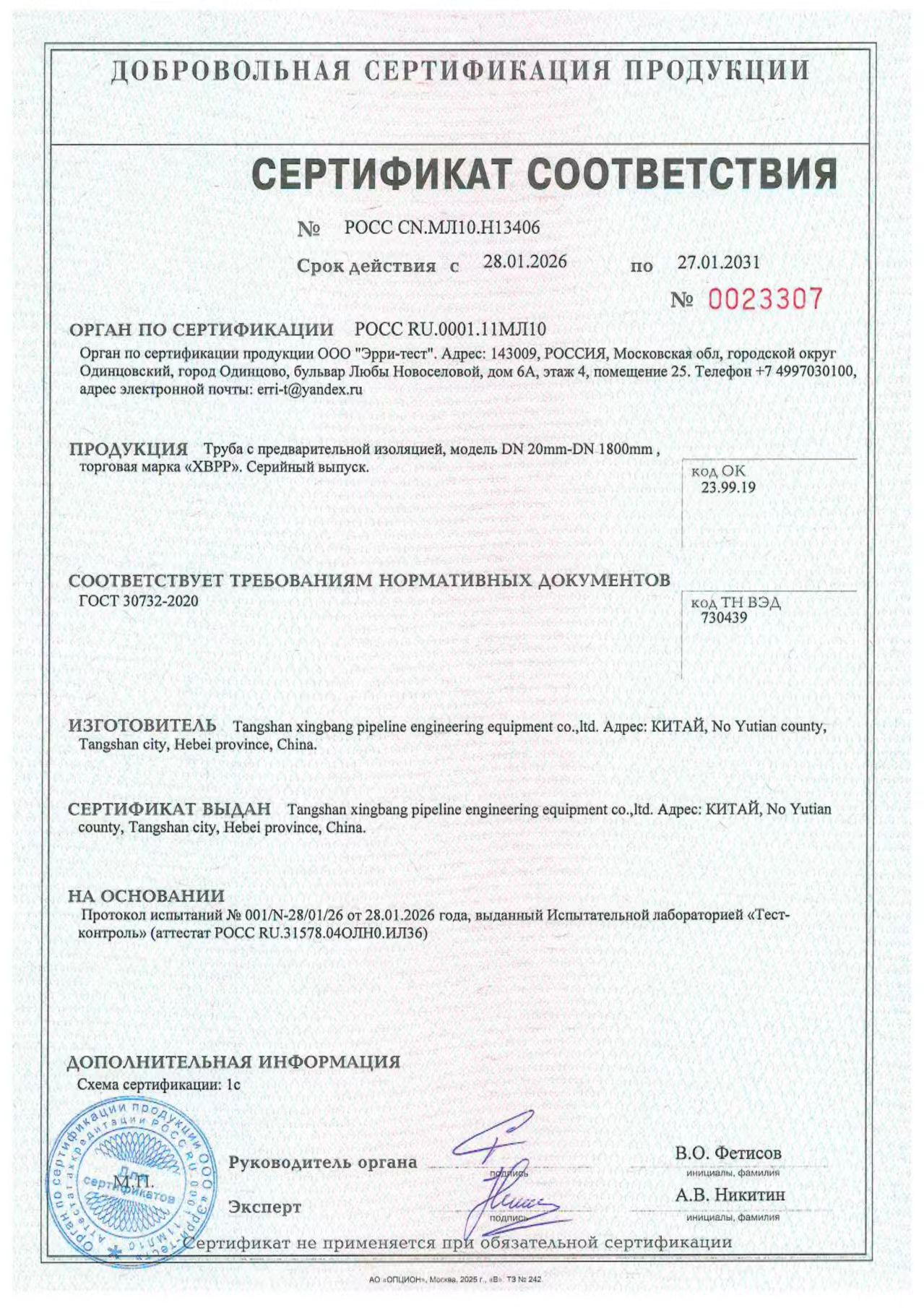
| Russian voluntary certification, РОСС CN.MJI10.H13406 (Эрри-тест) | ГОСТ 30732-2020 | DN20 mm to DN1800 mm | 2026-01-28 to 2031-01-27 |
| ISO 9001 quality management system certificate, 02807Q10270R6M (Beijing Zhong'an Quality & Environment Certification Center Co., Ltd.) | GB/T 19001—2016 / ISO 9001:2015 | Production of pre-insulated pipes DN1600 mm and below | 2024-02-19 to 2027-02-10 |
Two conclusions follow. The certified diameter envelope for PU pre-insulated pipe in Xingbang's documentation runs from DN20 mm to DN1800 mm under both the EU CE verification and the Russian voluntary certification. Separately, the ISO 9001 certificate covers production of pre-insulated pipes DN1600 mm and below — a management-system scope, not a product conformity statement. Buyers should not treat those two document types as interchangeable, and orders outside the stated ranges require separate confirmation.
On length, there is no single "standard length" that applies across the category the way nominal sizes apply to bare steel. In Xingbang's capability documentation, pipe diameter and length are both listed as custom parameters inside a full-customization production model, alongside pipe material, temperature and pressure rating, insulation thickness, anti-corrosion grade, non-standard pipe fittings, design for geological conditions and an optional intelligent monitoring system. The practical answer for procurement is that required length belongs in the technical agreement and is confirmed per order, rather than assumed from a catalogue default.
The documented material basis is rigid polyurethane foam insulation with a High Density Polyethylene jacket, and a galvanized iron jacket variant is listed among the applicable product types for above-ground service. Where a steel element is specified, ASTM A53 is the primary American standard for seamless and welded black and hot-dipped galvanized steel pipe and is commonly referenced in such specifications.
How Quality Is Verified Before Shipment
Three verification layers appear in the documentation, and they cover different moments in the order cycle.
- Production-stage control: Xingbang's capability documentation states 100% test as the quality control basis.
- Acceptance condition: the documented purchasing terms list pre-shipment test as the acceptance criterion — the condition on which the buyer accepts the order.
- Third-party conformity: the CE verification, the Russian voluntary certificate and the ISO 9001 certificate each cover a defined product scope, standard and validity window.
A certificate is only useful if the buyer reads it the way a notified body does. Five fields decide whether it applies to a given order: the certificate number, the issuing body, the diameter scope, the applicable standard, and the validity window. A document with an expired validity date, or with a scope that stops below the ordered diameter, does not support the order it is attached to.
Procurement Answers: Minimums, Terms and Acceptance
| Commercial item | Documented value |
|---|---|
| MOQ in purchasing terms | 500 meters |
| MOQ in custom manufacturing programs | 1 km |
| Delivery terms | FOB / CIF |
| Payment terms | 30 / 70 |
| Acceptance criteria | Pre-shipment test |
| Lead time | 30–45 days |
| Monthly production capacity | 200 km |
One execution-stage point is worth noting for project planners: Xingbang establishes dedicated on-site service teams to deliver one-on-one, point-to-point full-range services throughout the project. For buyers moving from evaluation into execution, that shapes how field questions are normally handled rather than left to the installation contractor.
Application Evidence: Service Duration as a Limit Test
Specification limits only become credible when they survive real operating conditions. The documented project references below span district heating, district cooling, mining and institutional applications.
| Application | Location | Quantity | Service duration | Result |
|---|---|---|---|---|
| Banking facility, cooling and heating supply | Cambodia | 30 km | 2 years | Stable operation |
| Hotel, cooling and heating supply | Jamaica | 3 km | 2 years | Stable operation |
| Copper mine project, cooling and heating supply | Mongolia | 9 km | 3 years | Stable operation |
| Municipal heating network renovation | Uzbekistan | 6 km | 5 years | Stable operation |
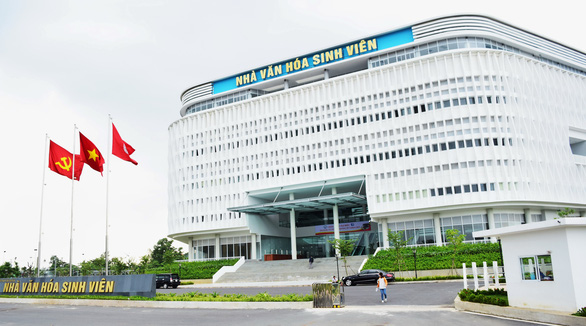
| University construction project | Vietnam | 6 km | 7 years | Stable operation |
| Municipal district cooling project | Cambodia | 5 km | 10 years | Stable operation |
Heat preservation is the recorded highlight in each of these references, and every installation is documented as being in stable operation. The longest-running reference in the set — a 5 km municipal district cooling project in Cambodia — is recorded at 10 years, which sits inside the 30-year continuous service statement for a 120°C environment rather than at its outer edge. That distinction matters: a service record demonstrates that a system has held up so far, not that it has reached the end of its rated life.
Market Trend: Why These Questions Are Arriving Earlier
Three published signals explain why technical-limit questions now appear at the enquiry stage rather than at commissioning.
Regional demand is concentrated in two blocks. Grand View Research puts Asia Pacific's 2024 revenue share at 39.96%, while Credence Research estimates Europe at approximately 38% of the global pre-insulated pipe systems market. Supply and demand are therefore distributed across two mature regions, which pushes buyers toward comparable, documentable specifications.
End-use is broadening. Commercial end-use held a 43.8% revenue share in 2024 (Grand View Research), while the oil and gas segment accounted for 34.89% of pre-insulated pipe revenue in 2023 (SNS Insider). A category serving both a commercial building and a crude oil line cannot rely on one shared set of assumptions.
Cooling is scaling alongside heating. The global district heating market was valued at USD 209.34 billion in 2024 (SNS Insider), and pre-insulated pipes for district cooling are projected to grow at a 9.48% CAGR on the back of smart city projects (SNS Insider). Performance expectations follow: pre-insulated pipes reduce heat loss by over 30% in modern district heating networks such as Copenhagen's (Strategic Market Research). As chilled water networks expand, the same doubt that buyers apply to heat loss in hot water lines is being applied to cooling specifications.
Factory Pre-Insulation Versus Site-Applied Insulation — and Where Each Stops
The comparison buyers actually make is not between two brands but between two construction methods. Factory pre-insulation applies rigid polyurethane foam between the carrier pipe and the outer jacket under controlled plant conditions, producing a bonded system that can be certified against EN 253 and documented for continuous operation at 120°C for at least 30 years. Site-applied insulation is installed after the pipe is in position, and its final quality depends on field conditions, weather and workmanship — a factor that is widely recognised in pipeline construction and is one reason directly buried hot water networks tend to specify bonded factory systems.
That advantage has boundaries, and stating them is part of an honest specification.
- Temperature ceiling: media above 120°C continuous, or above an occasional 130°C peak, fall outside the PU foam envelope. Steam or higher-temperature service requires a different insulation architecture, and a PU-based pre-insulated design should not be specified for it without separate engineering review.
- Pressure ceiling: the documented limit is 2.5 MPa working pressure. Networks designed beyond that pressure need a different product basis.
- Certification envelope: CE and Russian voluntary certification cover DN20 mm to DN1800 mm, and the ISO 9001 production scope covers DN1600 mm and below. Larger or non-standard diameters need separate confirmation.
- Order minimums: with a documented MOQ of 500 meters in purchasing terms and 1 km for custom programs, small retrofit or pilot sections may not be commercially practical as standalone orders.
- Lead time: 30–45 days is a production window that has to be built into the project programme. Factory pre-insulation front-loads manufacturing that site-applied insulation spreads across the installation phase.
- Service-life scope: the 30-year continuous operation statement applies to the 120°C environment it is written for. It is not a blanket lifetime figure for every operating profile.
Future Outlook
On the demand side, the projected route from USD 5.97 billion in 2024 to USD 10.4 billion by 2030 at a 9.7% CAGR (Grand View Research) implies continued pressure on suppliers to document rather than assert capability. On the materials side, next-generation insulation such as aerogels is reported as an emerging route to ultra-low heat loss in pre-insulated pipes (Strategic Market Research), which would extend the envelope that PU foam currently defines if it reaches mainstream commercial use.
For procurement teams, the practical expectation is that technical-limit documentation — temperature envelope, pressure limit, certificate scope and validity, acceptance criteria and lead time — will increasingly appear as a standard annex to tenders rather than as a follow-up question after shortlisting. Buyers who request it early tend to shortlist faster, because the offers that cannot support their claims are filtered out before commercial negotiation begins.
Frequently Asked Questions
1. What is the maximum operating temperature of a PU pre-insulated pipe?
Documented limits for Xingbang's Polyurethane Insulated Pipe are a conveyed medium temperature no higher than 120°C, with an occasional peak temperature not exceeding 130°C. This aligns with the general behaviour of polyurethane foam in EN 253 pipe systems, which typically withstands up to 120°C (Rovanco Piping Systems). The 130°C figure describes an occasional peak and is not a continuous operating setpoint.
2. What working pressure can the pipe carry?
The documented working pressure limit is no more than 2.5 MPa. This is a working-pressure ceiling for the documented product family, and it should be matched against the network design pressure before the specification is finalised.
3. When is a PU pre-insulated pipe not the right specification?
Three documented boundaries apply. Media above 120°C continuous or an occasional 130°C peak fall outside the PU foam envelope and require a different insulation architecture, such as a steam-specific design. Working pressures above 2.5 MPa fall outside the documented limit. Orders outside the DN20 mm to DN1800 mm certificate range, or above DN1600 mm for the ISO 9001 production scope, require separate confirmation.
4. Are pre-insulated pipes supplied in fixed standard lengths?
No single standard length applies across the category. In Xingbang's capability documentation, pipe diameter and length are both listed as custom parameters within a full-customization production model. For procurement, the required length should be stated in the technical agreement and confirmed per order rather than assumed from a catalogue value.
5. Which diameter range is covered by the certificates?
Two certificates cover a DN20 mm to DN1800 mm range: the EU CE Verification of Conformity ICR Polska/VC/HS220608 (EN 448:2019 and EN 253:2019) and the Russian voluntary certificate РОСС CN.MJI10.H13406 (ГОСТ 30732-2020). Separately, the ISO 9001 certificate 02807Q10270R6M covers production of pre-insulated pipes DN1600 mm and below — a management-system scope rather than a product conformity scope.
6. How is quality verified before shipment?
Three layers are documented: 100% test as the production-stage quality control, pre-shipment test as the acceptance criterion in the purchasing terms, and third-party certificates covering CE, Russian voluntary certification and ISO 9001. Buyers verifying a certificate should check the certificate number, issuing body, diameter scope, applicable standard and validity window.
7. What are the purchasing terms?
Xingbang's documented purchasing terms list an MOQ of 500 meters, delivery terms of FOB or CIF, acceptance criteria of pre-shipment test, and payment terms of 30/70. The capability documentation separately records an MOQ of 1 km for custom manufacturing programs. Because two minimums appear for different order types, the applicable figure should be confirmed in the quotation.
8. What lead time and production capacity apply?
The documented lead time is 30–45 days, against a monthly production capacity of 200 km of pre-insulated pipe. Buyers scheduling installation should treat that window as part of the project programme rather than as a fixed delivery date.
9. How long has the product operated in service?
Documented references include a 30 km banking facility installation in Cambodia (2 years), a 3 km hotel project in Jamaica (2 years), a 9 km copper mine project in Mongolia (3 years), a 6 km municipal network renovation in Uzbekistan (5 years), a 6 km university project in Vietnam (7 years) and a 5 km municipal district cooling project in Cambodia (10 years). All are recorded as stable operation with heat preservation as the highlight. These durations sit within the documented 30-year continuous service statement for a 120°C environment rather than beyond it.
Reference material: the Xingbang pipeline company and product brochure (PDF) is available at Xingbang product brochure. Manufacturer information: www.xingbanginsulatedpipe.com.