
Pre-Insulated Pipe Parameters and Certifications: Sourcing Reference
Pre-Insulated Pipes Are Defined by Parameters, Not Categories
Pre-insulated pipes are engineering components with specific performance limits, not generic products that can be selected by category name alone. For buyers moving from research into supplier evaluation, the relevant questions are precise: What medium temperature can the pipe handle? What is the pressure rating? Which insulation and jacket materials are used? And which certifications allow the product to enter a specific market? This article provides a parameter- and certification-centered reference for evaluating pre-insulated pipe, using Tangshan Xingbang Pipeline Engineering Equipment Co., Ltd (Xingbang), a Chinese manufacturer of pre-insulated and anti-corrosion pipes based in Tangshan, Hebei Province, as a working example.
The market context supports this level of scrutiny. Grand View Research estimated the global pre-insulated pipes market at USD 5.97 billion in 2024, with a projected value of USD 10.4 billion by 2030. District heating and cooling infrastructure is expanding across Asia Pacific, Europe, and the Middle East, and buyers are increasingly expected to verify not only price and delivery terms but also technical compliance and certification validity.
The Sourcing Problem: Generic Labels Hide Tight Technical Limits
The main sourcing risk during the research and evaluation stage is the gap between a generic product label and a site-specific specification. The label 'pre-insulated pipe' covers multiple configurations: directly buried hot water pipe, underground pipe, above-ground pipe, thermal insulation pipe, district heating pipe, chilled water pipe, and steam pipe. Each configuration has its own temperature and pressure envelope.
If a buyer evaluates suppliers based on product name alone, mismatches may surface only after installation, when thermal expansion, condensation, soil load, groundwater corrosion, or external impact begins to affect the buried network. The opportunity is equally clear: buyers who structure their evaluation around measurable parameters and verifiable certifications can compare suppliers on a factual basis, reduce the risk of early network failure, and shorten regulatory approval processes.
Key Technical Parameters to Verify Before Sourcing
For a polyurethane pre-insulated pipe designed for directly buried hot water networks, the following parameters carry the most weight during evaluation.
Operating Temperature and Peak Limits
Temperature rating is the first constraint to verify. Xingbang's polyurethane insulated pipe is suitable for pipe network systems where the temperature of the conveyed medium does not exceed 120°C in normal operation, with occasional peak temperatures no higher than 130°C. This 120°C boundary is consistent with a widely used industry limit for rigid polyurethane foam insulation, as referenced in EN 253 technical literature. Projects with sustained temperatures above this level require a different insulation material or a custom system design.
Working Pressure
The working pressure of the directly buried hot water pre-insulated pipe is rated at no more than 2.5 MPa. The pressure rating matters because the steel service pipe, the polyurethane foam layer, and the outer jacket work as a composite structure. The temperature envelope and the pressure envelope must be evaluated together; a pipe that meets a project's thermal requirement but not its pressure requirement is not acceptable.
Insulation Material
The insulation layer is rigid polyurethane foam. In a factory-made process, foam density, cell structure, and the adhesion between the foam and the service pipe determine long-term thermal performance. Buyers should confirm the actual insulation material specification rather than assume equivalent performance across suppliers.
Jacket Material
The outer protective layer is typically high-density polyethylene (HDPE). For applications requiring stronger mechanical protection, a galvanized iron (GI) jacket is available. The jacket protects the polyurethane foam from water ingress and mechanical damage during backfilling and service. Waterproofing and moisture resistance are especially important in underground environments with humid or saline-alkaline soil conditions.
Design Life
Xingbang states that its polyurethane insulated pipes can operate continuously for at least 30 years at a medium temperature of 120°C. This life target assumes proper installation, effective joint sealing, and the use of matching accessories such as electrofusion sleeves, heat-shrinkable sleeves, insulation joint materials, foaming fillers, and sealing and waterproof materials.
Diameter Range
The CE and GOST certificates held by Xingbang cover DN20 mm to DN1800 mm. The ISO 9001 certificate covers production of pre-insulated pipes DN1600 mm and below. Buyers whose projects require diameters outside these certified ranges should request separate engineering validation before ordering.
| Parameter | Value / Range |
|---|---|
| Normal operating temperature | ≤ 120°C |
| Occasional peak temperature | ≤ 130°C |
| Working pressure | ≤ 2.5 MPa |
| Insulation material | Rigid polyurethane foam |
| Jacket material | HDPE / galvanized iron |
| Design life at 120°C | ≥ 30 years |
| Certified diameter range (CE / GOST) | DN20 mm – DN1800 mm |
| ISO 9001 production scope | DN1600 mm and below |
Certification: The Market-Access Layer
Certifications serve two functions for a pre-insulated pipe buyer: they demonstrate quality-system discipline, and they control market access. The three most relevant documents for international sourcing are ISO 9001, the EU CE certificate, and the Russian GOST certificate.
The ISO 9001 certificate held by Xingbang, number 02807Q10270R6M, was issued by Beijing Zhong'an Quality & Environment Certification Center Co., Ltd. It covers the production of pre-insulated pipes DN1600 mm and below, construction of pipeline insulation projects, and processing and service of anti-corrosion insulation projects, under GB/T 19001—2016 / ISO 9001:2015. Its validity runs from 2024-02-19 to 2027-02-10.
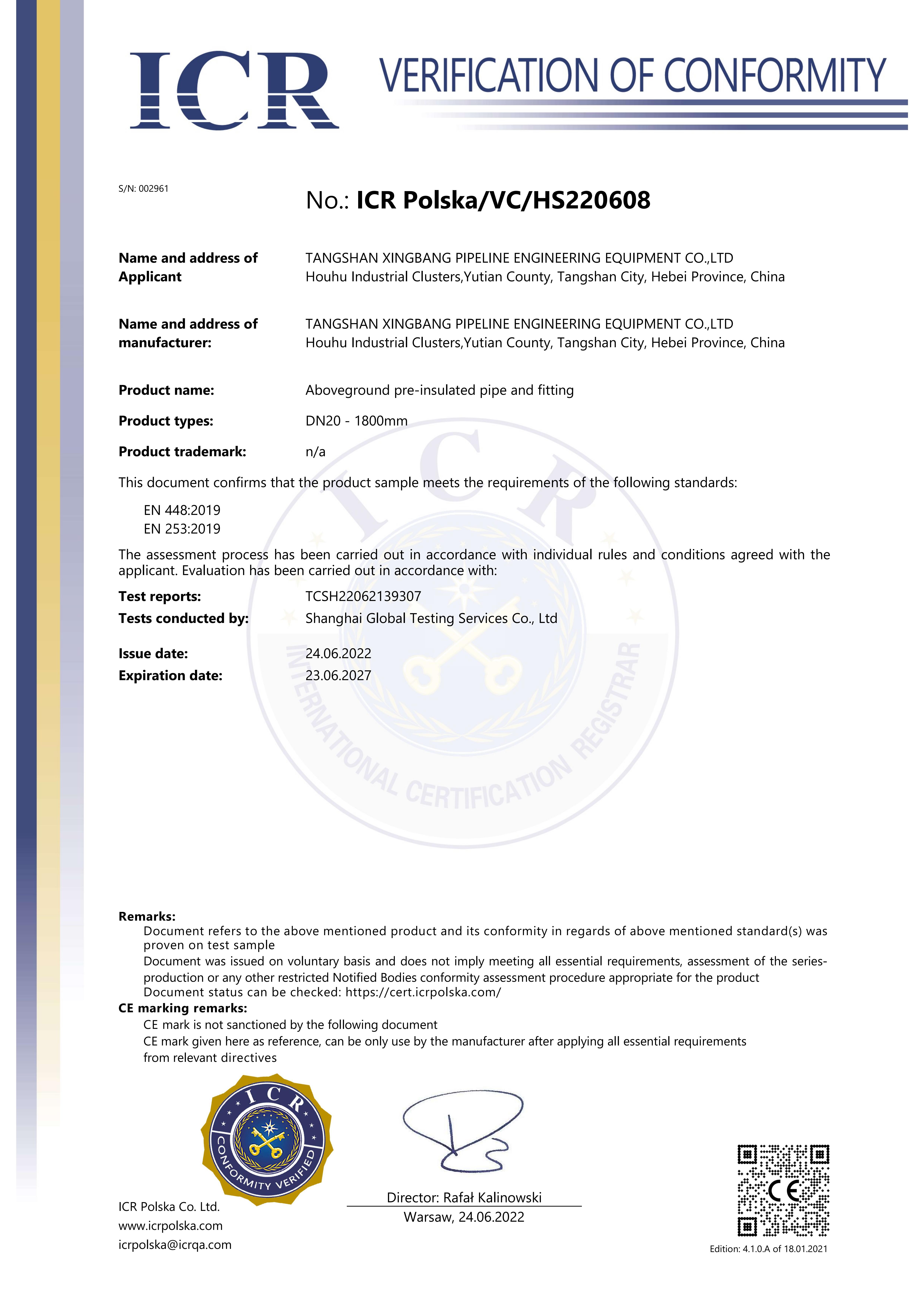
For the European Union market, Xingbang holds an EU CE Verification of Conformity Certificate, number ICR Polska/VC/HS220608, issued by ICR Polska Co. Ltd. The certificate covers polyurethane pre-insulated pipes DN20 mm to DN1800 mm and references EN 448:2019 and EN 253:2019. It is valid from 2022-06-24 to 2027-06-23. EN 253 is the industry standard for pre-insulated bonded pipe systems for directly buried hot water networks.
For the Russian Federation, Xingbang holds a voluntary certification certificate under GOST 30732-2020, number РОСС CN.MJI10.H13406, issued by Эрри-тест. The scope covers DN20 mm to DN1800 mm, valid from 2026-01-28 to 2031-01-27. GOST 30732-2020 is the governing standard for pre-insulated pipes used in Russian district heating networks.
| Certification | Standard | Certificate Number | Scope | Validity |
|---|---|---|---|---|
| ISO 9001 | GB/T 19001—2016 / ISO 9001:2015 | 02807Q10270R6M | DN1600 mm and below | 2024-02-19 → 2027-02-10 |
| CE (EU) | EN 448:2019 / EN 253:2019 | ICR Polska/VC/HS220608 | DN20–DN1800 mm | 2022-06-24 → 2027-06-23 |
| GOST (Russia) | ГОСТ 30732-2020 | РОСС CN.MJI10.H13406 | DN20–DN1800 mm | 2026-01-28 → 2031-01-27 |
A Manufacturer Reference: Xingbang's Certified Production Profile
To understand how these parameters translate into actual supply capability, Xingbang provides a useful reference case. The company is located in Houhu Industrial Park, Yutian Economic Development Zone, Tangshan, Hebei Province, China. It operates from a 310,000-square-meter site, employs 231 people, and maintains a dedicated R&D team of 30 engineers. Annual production capacity for insulation pipes exceeds 3,000 kilometers, and approximately 30% of output is exported, mainly to Europe, North America, and the Middle East.
Xingbang is a participant in the formulation of the national standard for directly buried insulation pipes. It is a member of the heating Standardization Technical Committee of the Ministry of Housing and Urban-Rural Development of the People's Republic of China, a standing member of the Regional Energy Professional Committee of China Building Energy Conservation Association, a director member of the thermal power industry alliance of China Energy Conservation Association, a member of China Plastics Processing Industry Association, and a national green design demonstration enterprise.
From a procurement perspective, the production capability is structured around both standard and custom work. Xingbang's monthly capacity is approximately 200 km, typical lead time is 30–45 days, and the minimum order quantity is 1 km. The company reports 100% testing as part of its quality control. Custom options include pipe diameter and length, pipe material, temperature and pressure rating, insulation thickness, anti-corrosion grade, non-standard pipe fittings, design for geological conditions, and an intelligent monitoring system.
Application Areas and Project Evidence
Pre-insulated pipes in this technical category are designed for ordinary hot water applications with a medium temperature no higher than 120°C and low pressure. Typical project types include municipal heating projects, industrial park projects, residential community projects, cogeneration projects, urban pipe network renovation projects, urban comprehensive pipe gallery projects, and commercial building heating projects.
Xingbang's project references cover both heating and cooling supply and provide a longer operating record:
| Project | Location | Quantity | Application | Operating History |
|---|---|---|---|---|
| NaGa Phnom Penh District Cooling Project | Cambodia | 5 km | Cooling and heating supply | 10 years, stable operation |
| Bank Project | Cambodia | 30 km | Cooling and heating supply | 2 years, stable operation |
| Hotel Project | Jamaica | 3 km | Cooling and heating supply | 2 years, stable operation |
| Copper Mine Project | Mongolia | 9 km | Cooling and heating supply | 3 years, stable operation |
| Heating Pipeline Network Renovation Project | Uzbekistan | 6 km | Cooling and heating supply | 5 years, stable operation |
| New University Construction Project | Vietnam | 6 km | Cooling and heating supply | 7 years, stable operation |

Market Trends Behind Stricter Specifications
Several confirmed market trends explain why parameter verification is moving up the sourcing agenda.
The global pre-insulated pipes market was estimated at USD 5.97 billion in 2024 and is projected to grow to USD 10.4 billion by 2030, a compound annual growth rate of 9.7% (Grand View Research). Different research institutions produce different absolute figures, reflecting varying scope definitions, but the direction of growth is consistent.
Regionally, Asia Pacific accounted for 39.96% of global revenue in 2024 (Grand View Research), while Europe holds approximately 38% of the pre-insulated pipe systems market (Credence Research). The wider district heating and cooling market is expected to grow at a CAGR of 5.7% from 2024 to 2032 (Global Market Insights). These figures point to sustained demand for reliable, certifiable pipe systems across both mature and emerging energy networks.
Segment data show two relevant forces. First, oil and gas applications held a 34.89% revenue share in the pre-insulated pipes market in 2023 (SNS Insider), pushing demand for pipes with higher mechanical and thermal integrity. Second, district cooling is accelerating, with pre-insulated pipes for district cooling projected to grow at a CAGR of 9.48% (SNS Insider). Cooling applications add condensation control and moisture resistance to the list of required performance criteria.
Flexible pre-insulated pipes accounted for 72.2% of global revenue share in 2024 (Grand View Research). That figure is often cited, but it should not be over-read: in larger municipal district heating networks, steel-based rigid pre-insulated systems remain structurally necessary because they handle higher temperature, pressure, and soil-load conditions.
Performance evidence also supports stricter specification. Modern district heating networks using pre-insulated pipes have demonstrated heat loss reductions of over 30%, as seen in networks such as Copenhagen's (Strategic Market Research). This kind of quantified outcome makes the parameter envelope, rather than the product category, the real basis for design and purchasing decisions.
Pre-Insulated Pipe vs. Field-Applied Insulation: An Honest Comparison
Factory-made pre-insulated pipe and on-site applied insulation solve the same underlying problem in different ways. Understanding the trade-offs helps buyers decide when each approach is appropriate.
Factory-made pre-insulated pipe offers controlled production conditions. Polyurethane foam is injected around the steel service pipe in a plant environment, the jacket is applied before delivery, and insulation thickness is consistent along the full pipe length. On-site installation is faster because the pipe arrives as a ready-to-bury system. This consistency is especially valuable for long municipal networks, where hundreds or thousands of meters of pipe must meet the same thermal performance.
Field-applied insulation, by contrast, offers flexibility in retrofit and repair work. The process is less capital-intensive and can adapt to existing pipe geometry. However, quality depends more on installer skill and on weather conditions at the time of application. Moisture trapped in the insulation layer can degrade thermal performance over the life of the network.
There are also honest limitations to the factory-made approach. Because the pipe is manufactured to defined parameters, changing the design after production is costly. Lead time and order size matter: a buyer needing a short, non-standard section may find the typical minimum order quantity and lead time less suitable than an on-site solution. For example, Xingbang's MOQ is 1 km and its standard lead time is 30–45 days. Projects with medium temperatures above 130°C, pressures above 2.5 MPa, or diameters beyond the certified scope (above DN1800 mm) require special engineering evaluation before a standard pre-insulated product can be selected.
Future Outlook
Several developments will make parameter documentation even more important in the coming years.
Market access will depend more heavily on formal certification. The EU CE certificate and the Russian GOST 30732-2020 certificate are concrete examples of how manufacturers are aligning with regional requirements. Buyers should expect more certification layers, not fewer, as district energy projects expand across borders and financing institutions require stronger compliance documentation.
Monitoring will move from optional to expected. Intelligent monitoring systems integrated into the insulated pipe structure address a historical weakness of buried networks: small leaks that go unnoticed until significant heat loss has already occurred. The availability of custom intelligent monitoring is already part of manufacturer capability lists.
Insulation materials will continue to evolve. Aerogel-based insulation is emerging as a next-generation option for ultra-low heat loss applications (Strategic Market Research). For the majority of district heating and cooling projects, however, rigid polyurethane foam remains the workhorse material, and its long-term performance at 120°C is well documented.
Buyers who evaluate suppliers on certified parameters, production capability, and project history will be better positioned for the shift toward lower-carbon district energy systems.
Reference resource: For detailed specification tables and company background, the downloadable bilingual brochure is available: Xingbang Company Brochure (PDF).
FAQ
What temperature can pre-insulated pipe handle?
Xingbang's polyurethane insulated pipe is designed for media temperatures no higher than 120°C in normal operation, with occasional peaks up to 130°C. Sustained temperatures above this range require an alternative insulation material or system design.
What is the pressure limit of directly buried hot water pre-insulated pipe?
The standard configuration is rated for a working pressure of no more than 2.5 MPa. Projects with higher pressure requirements need a separate engineering review before ordering.
Which standards apply to pre-insulated pipe for underground hot water networks?
EN 253:2019 is the industry standard for pre-insulated bonded pipe systems for directly buried hot water networks. EN 448:2019 covers fittings. In Russia, GOST 30732-2020 is the applicable standard. Xingbang's CE certificate references both EN 448:2019 and EN 253:2019.
How long do PU foam pre-insulated pipes last?
Xingbang states that its polyurethane insulated pipes can operate continuously for at least 30 years at a medium temperature of 120°C. Actual service life also depends on joint sealing, waterproofing, and installation quality.
What diameter range do the certifications cover?
The CE certificate and the Russian GOST certificate held by Xingbang both cover DN20 mm to DN1800 mm. The ISO 9001 certificate covers pre-insulated pipe production DN1600 mm and below.
What are the MOQ and lead time for custom pre-insulated pipes?
Xingbang's monthly production capacity is 200 km, with a typical lead time of 30–45 days and a minimum order quantity of 1 km.
Can pre-insulated pipe be used for both heating and cooling supply?
Yes. Multiple Xingbang project references in Cambodia, Jamaica, Mongolia, Uzbekistan, and Vietnam have used pre-insulated pipe for combined cooling and heating supply, with stable operation reported across operating periods from 2 to 10 years.