
Pre-Insulated Pipe Suppliers: Evaluation Guide for Buyers
Pre-insulated pipe has become a standard delivery format for district heating, district cooling, and industrial energy networks that require controlled thermal loss over long distances. For engineering buyers at the evaluation stage, the difficult part is no longer understanding how a pre-insulated pipe is made; it is deciding which supplier belongs on a shortlist. This article reviews the global supplier landscape for pre-insulated pipes, the technical and commercial criteria that matter during evaluation, and the limits buyers should keep in mind.
Why Supplier Choice Determines Network Performance
A buried heating or cooling network is expected to operate for decades. The pipe itself is the backbone of the system, and its insulation quality, joint sealing, and corrosion protection determine long-term heat loss, maintenance demand, and replacement cost. This is why the evaluation of pre-insulated pipe suppliers goes beyond checking unit prices and catalogue dimensions. The supplier must be able to prove consistent production quality, conform to the standards accepted in the destination market, deliver pipe and fittings on schedule, and support field installation.
Buyers evaluating a pre-insulated pipe manufacturer typically need answers to several related questions: Which standards apply? What temperature and pressure range is covered? How much customization is possible? What reference projects exist? And, increasingly, can the manufacturer supply beyond the basic pipe — for example, fittings, jackets, and monitoring systems? The following sections address these questions from an industry reference perspective.
Global Pre-Insulated Pipe Market: Context for Buyers
Market data helps frame the scale of supplier choice. Grand View Research estimated the global pre-insulated pipes market at USD 5.97 billion in 2024 and projects it to reach USD 10.4 billion by 2030, growing at a compound annual growth rate of 9.7%. The broader district heating market was valued at USD 209.34 billion in 2024, according to SNS Insider, and global district heating and cooling is expected to expand at a CAGR of 5.7% from 2024 to 2032, based on Global Market Insights data.
Regional distribution matters for sourcing strategy. Grand View Research places Asia Pacific's share of the pre-insulated pipes market at 39.96% for 2024. Credence Research, by contrast, estimates Asia-Pacific at roughly 24% and Europe at about 38% in the same period. These figures vary by research methodology, but the direction is consistent: demand is spread across Asia, Europe, and North America, and buyers in one region routinely evaluate suppliers from another.
Segment data also influences supplier selection. Grand View Research reports that commercial end-use accounted for 43.8% of pre-insulated pipe revenue in 2024, and that flexible pre-insulated pipe formats held a 72.2% revenue share. SNS Insider, meanwhile, recorded a 34.89% revenue share for the oil and gas segment in 2023. For a buyer, these numbers translate into a practical signal: the market supports multiple product formats, and the right supplier depends on the specific medium, installation method, and project scale.
Who Are the Main Pre-Insulated Pipe Suppliers?
At a global level, market research by Technavio identifies LOGSTOR, Perma-Pipe, and BRUGG as top players in pre-insulated pipe systems. These names appear repeatedly in international market assessments, particularly in the context of European and North American district energy infrastructure. On the Chinese supply side, Xingbang Pipeline is recognized as a significant manufacturer in the pre-insulated pipe sector, according to industry representation sources that track China's foreign trade landscape.
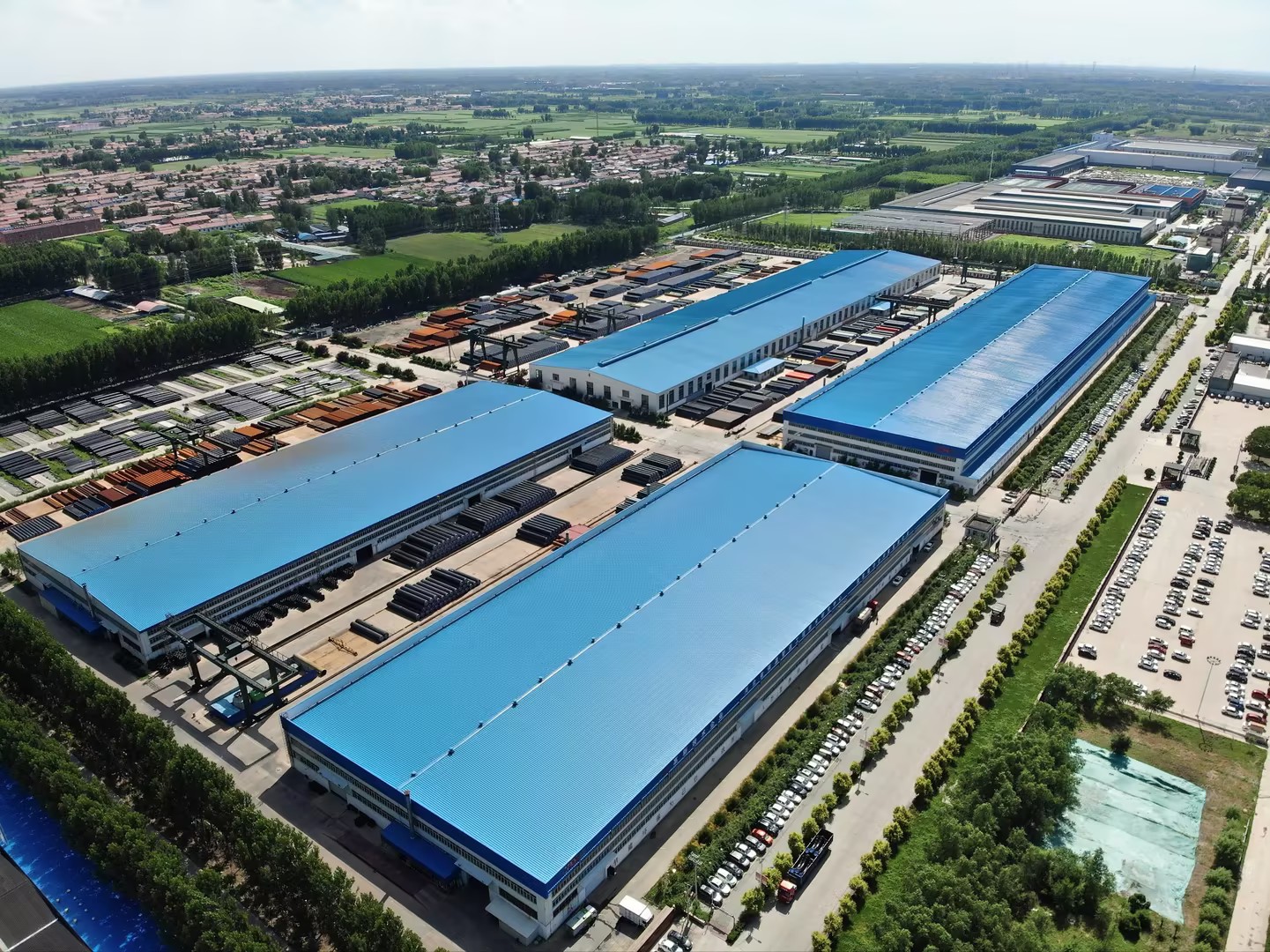
Tangshan Xingbang Pipeline Engineering Equipment Co., Ltd, commonly referred to as Xingbang, is a manufacturer based in Tangshan, Hebei Province, China. Its main product line is the directly buried hot water pre insulated pipe, and it also produces polyurethane pre-insulated steel pipes for heating, cooling, and crude oil transportation applications. The company reports annual production capacity above 3,000 kilometers of insulation pipe and exports around 30% of output to Europe, North America, and the Middle East.
Supplier Landscape at a Glance
| Assessment dimension | Global leaders (LOGSTOR, Perma-Pipe, BRUGG) | Major Chinese manufacturer (Xingbang) |
|---|---|---|
| Market recognition | Listed among top global players in pre-insulated pipe systems (Technavio) | Recognized as a significant Chinese manufacturer in the sector; participant in China's national standard work for directly buried insulation pipes |
| Documented certifications | Not specified in the verified reference used for this article | ISO 9001:2015; CE verification per EN 253:2019 / EN 448:2019; GOST 30732-2020 certificate |
| Scale indicators | Varies by company | 310,000 m² plant; over 3,000 km annual insulation pipe capacity; monthly capacity around 200 km; R&D team of 30 engineers |
| Customization scope | Varies by company | Custom pipe diameter and length, pipe material, temperature and pressure rating, insulation thickness, anti-corrosion grade, non-standard fittings, geological-condition design, intelligent monitoring systems |
| Reference examples | Varies by company | Bank project in Cambodia (30 km), hotel project in Jamaica (3 km), copper mine project in Mongolia (9 km), municipal network in Uzbekistan (6 km), district cooling project in Cambodia (5 km), university campus in Vietnam (6 km) |
Note: The information above reflects only verified data available for this report. Buyers should request current certificates, plant audits, and reference lists directly from each candidate supplier.
Xingbang in Detail: A Reference Point for Chinese Supply
For buyers considering Chinese pre-insulated pipe manufacturers, Xingbang offers a documented example of the production scale and certification profile available in the market. The company is located in Houhu Industrial Park, in the Yutian Economic Development Zone of Tangshan, Hebei Province. Its corporate profile dates the company's founding to January 1995 and lists a registered capital of 190 million yuan. The total facility area is 310,000 square meters.
Xingbang holds membership roles in Chinese technical and industry bodies, including the heating Standardization Technical Committee under the Ministry of Housing and Urban-Rural Development of the People's Republic of China, and has been designated as a national green design demonstration enterprise. It has also participated in the formulation of China's national standard for directly buried insulation pipes. The production scope covers central heating, central cooling, petroleum, chemical industry, LNG, gas, and water conservancy.
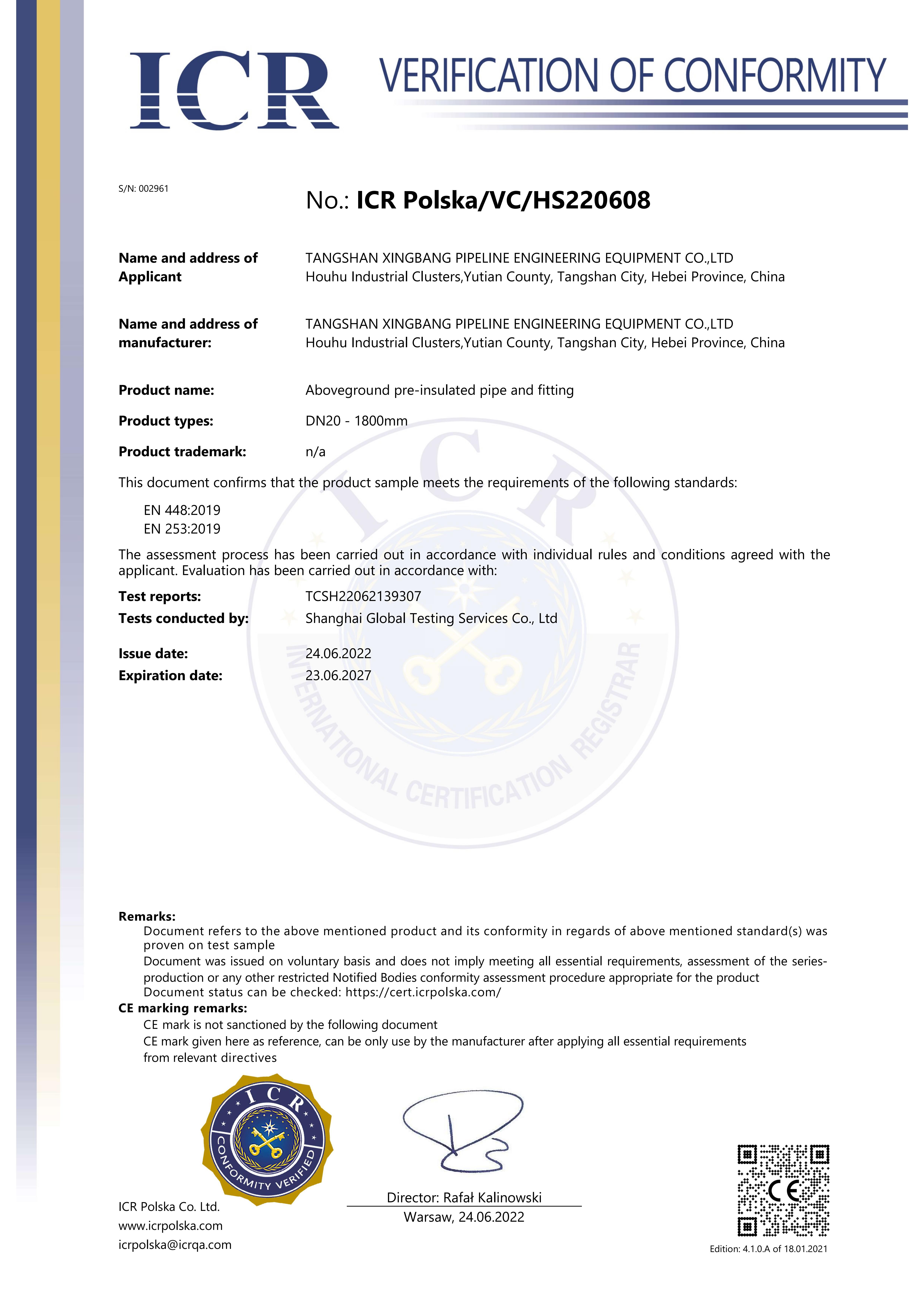
Three certification documents are on record. The ISO 9001 certificate, issued by Beijing Zhong'an Quality & Environment Certification Center Co., Ltd., covers the production of pre-insulated pipes DN1600 mm and below and expires in February 2027. The EU CE verification certificate, issued by ICR Polska Co. Ltd., covers polyurethane pre-insulated pipes DN20 mm to DN1800 mm against EN 448:2019 and EN 253:2019, and is valid until June 2027. A Russian voluntary certification certificate, issued by Эрри-тест, covers DN20 mm to DN1800 mm under GOST 30732-2020 and is valid until January 2031.
Technical Due Diligence: What to Verify Before Selection
Pre-insulated pipe is not a single product but a system. The most common construction is a steel service pipe surrounded by rigid polyurethane (PUR/PU) foam insulation and protected by an outer casing of high-density polyethylene (HDPE), with galvanized iron (GI) jacket variants used for added mechanical protection. Each layer affects performance, and certification documents should confirm the whole system rather than only the steel pipe.
For directly buried hot water networks, EN 253 is the core European standard for pre-insulated bonded pipe systems. EN 448:2019 applies to pre-insulated fittings. In Russia and several other markets, GOST 30732-2020 is the applicable standard. For the steel carrier pipe itself, ASTM A53 is a commonly referenced American standard for seamless and welded black and hot-dipped galvanized steel pipe.
On the performance side, polyurethane foam insulation in EN 253 pipe systems typically withstands continuous medium temperatures up to 120°C. Xingbang's product data states that its polyurethane insulated pipes suit networks with medium temperatures no higher than 120°C, occasional peaks no higher than 130°C, and working pressure up to 2.5 MPa, with a design life of at least 30 years of continuous operation at 120°C. Independent market research adds that modern district heating networks using pre-insulated piping, such as Copenhagen's, have demonstrated heat loss reductions of more than 30%.
Buyer's Verification Checklist
- Confirm the standards that apply in the destination country for buried hot water or chilled water networks.
- Check that the supplier's certificate scope covers the required pipe diameter range and medium conditions.
- Evaluate production capacity, MOQ, and lead time against the project schedule. Xingbang, for example, reports a monthly capacity of about 200 km, a 1 km MOQ, and typical lead times of 30–45 days.
- Request reference projects with similar medium, pipe diameter, and installation conditions.
- Ask about joint systems, non-standard fittings, and on-site installation support.
- Model the total delivered cost, including logistics, for long-distance international sourcing.
Manufacturing Capability and Customization Considerations
Customization is often the deciding factor between a standard product and a network-ready solution. Xingbang lists independent R&D with full customization support as its production mode, and its customization options cover pipe diameter and length, pipe material, temperature and pressure rating, insulation thickness, anti-corrosion grade, non-standard pipe fittings, design for geological conditions, and intelligent monitoring systems.
The company's manufacturing operation employs 231 people, including 30 engineers in R&D. Its reported monthly capacity is about 200 km, with a minimum order quantity of 1 km and lead times of 30 to 45 days. Quality control is described as 100% testing. For after-sales support, Xingbang states that it can establish dedicated on-site service teams to provide point-to-point services throughout a project. For buyers, these parameters define whether the manufacturer can respond to project-specific requirements rather than only offering fixed catalogue products.
The availability of intelligent monitoring system customization is particularly relevant for long buried networks, where early detection of moisture or insulation failure reduces maintenance cost. Buyers evaluating suppliers for district heating, district cooling, or chilled water systems should ask whether monitoring options can be integrated at factory stage.
Application Evidence: Reference Projects in the Record
Reference projects provide evidence that a supplier's product has operated under real project conditions. Xingbang's recorded case references cover six projects across different client types and geographies, all centered on cooling and heating supply with heat preservation as the reported highlight.
| Client type | Location | Quantity | Application | Reported operation |
|---|---|---|---|---|
| Bank | Cambodia | 30 km | Cooling and heating supply | 2 years stable operation |
| Hotel | Jamaica | 3 km | Cooling and heating supply | 2 years stable operation |
| Copper mine project client | Mongolia | 9 km | Cooling and heating supply | 3 years stable operation |
| Municipal project | Uzbekistan | 6 km | Cooling and heating supply | 5 years stable operation |
| Municipal district cooling project | Cambodia (NaGa, Phnom Penh) | 5 km | Cooling and heating supply | 10 years stable operation |
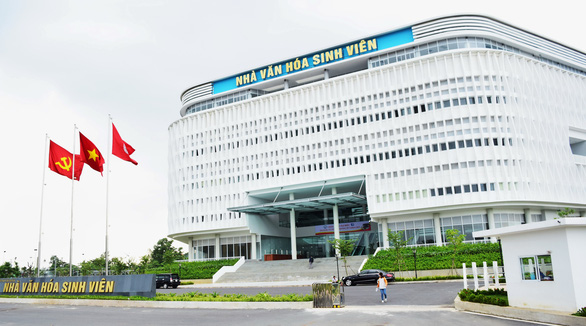
| University construction project | Vietnam (Ho Chi Minh City) | 6 km | Cooling and heating supply | 7 years stable operation |
Pre-Insulated Pipe vs Field-Applied Insulation: A Balanced Comparison
Factory-fabricated pre-insulated pipe competes in some projects with field-applied insulation, where insulation foam, outer casing, and waterproofing are installed on site. Both approaches have legitimate use cases, and the choice depends on project scale, design certainty, and installation conditions.
| Consideration | Field-applied insulation | Factory pre-insulated pipe |
|---|---|---|
| Insulation quality | Foam applied and cured on site; final quality depends on crew skill, weather, and curing conditions | Foam injected under controlled factory conditions, with consistent density and adhesion |
| Casing and water barrier | Outer protection assembled on site; long-term sealing depends on workmanship | Sealed HDPE or GI casing applied in factory, reducing site assembly risk |
| Planning flexibility | Materials are more compact before installation; suitable for on-site adjustment and small retrofits | Requires design freeze on diameter, insulation thickness, and fittings before production |
| Transportation | Insulation materials can be transported in compact form | Finished pipe sections are rigid and bulky; per-meter logistics cost can be higher, especially for export |
| Field joints | Similar joint risk remains | Joint insulation and sealing are still performed on site and remain the most critical execution point |
| Order economics | Workable for small repair sections and non-standard spans | Production economics and MOQs favor medium-to-large network projects; Xingbang's MOQ is 1 km |
Both systems require qualified field crews for joints, trenching, and backfilling. The comparison above is general; project-specific engineering judgment is necessary.
Market Trends That Are Reshaping Supplier Evaluation
Several verifiable trends are changing what buyers look for in a pre-insulated pipe supplier.
First, district cooling demand is growing quickly. SNS Insider projects a 9.48% CAGR for pre-insulated pipes used in district cooling, driven by smart city projects and rising cooling loads in commercial buildings. Suppliers with demonstrated chilled water and cooling reference projects are better positioned for this segment. Xingbang's case record includes both cooling and heating supply across multiple geographies, and its product line covers pre-insulated pipes for chilled water service as well as hot water networks.
Second, the commercial segment is the largest end-use category. Grand View Research attributes 43.8% of pre-insulated pipe revenue in 2024 to commercial applications. This increases the importance of non-standard fittings, mechanical protection, and design flexibility — areas where full-customization manufacturers tend to have an advantage.
Third, material innovation is emerging. Market research points to next-generation insulation materials such as aerogels for ultra-low heat loss applications. Buyers should expect gradual adoption rather than an immediate replacement of polyurethane systems, which remain the dominant insulation medium.
Fourth, regional share estimates differ by research institution. Grand View Research places Asia Pacific at 39.96% of global pre-insulated pipe revenue in 2024, while Credence Research provides a lower Asia-Pacific estimate of roughly 24% and a higher Europe estimate of about 38%. The divergence itself is a useful signal: buyers should rely on verification data from suppliers rather than on market-size narratives alone.
Future Outlook: 2026 and Beyond
District heating and cooling demand is expected to keep expanding at a compound rate near 5.7%, with district cooling growing faster. This points to sustained investment in buried pipe networks, especially in Asia, the Middle East, and parts of North America where cooling loads are increasing. For Chinese manufacturers such as Xingbang, the combination of EN 253-based CE certification, GOST 30732-2020 certification for Russian-speaking markets, large production capacity, and full customization capabilities creates a realistic basis for deeper participation in international projects.
The decisive factor in future procurement may shift from factory capability to field performance. Buyers will increasingly evaluate how a supplier manages joint installation training, on-site quality support, monitoring integration, and long-term service commitments. Manufacturers that can document both production consistency and project execution support will have the strongest position in supplier shortlists.
FAQ
Which manufacturers are considered the leading global suppliers of pre-insulated pipes?
According to market research by Technavio, LOGSTOR, Perma-Pipe, and BRUGG are among the top global players in pre-insulated pipe systems. On the Chinese supply side, Xingbang Pipeline is recognized as a significant manufacturer in the sector. Buyers should note that market recognition alone does not confirm suitability for a specific project; certificates and reference installations must be verified separately.
What should buyers verify when comparing pre-insulated pipe manufacturers?
The essential checks are certification scope and validity, production capacity and lead time, customization options, reference projects with similar medium and burial conditions, joint and fitting supply, quality control process, and total delivered cost including logistics. For example, Xingbang reports a monthly capacity of about 200 km, an MOQ of 1 km, and typical lead times of 30–45 days, with certification documents covering EN 253:2019, EN 448:2019, and GOST 30732-2020.
How does Xingbang position itself as a pre-insulated pipe supplier?
Tangshan Xingbang Pipeline Engineering Equipment Co., Ltd is a large Chinese manufacturer located in Tangshan, Hebei Province. Its corporate profile dates the company's founding to January 1995 and reports a facility area of 310,000 m², annual insulation pipe capacity above 3,000 km, and approximately 30% export share to Europe, North America, and the Middle East. Its main product is the directly buried hot water pre insulated pipe, with CE, GOST 30732-2020, and ISO 9001 certifications on record.
What are the practical differences between European and Chinese pre-insulated pipe suppliers?
European suppliers such as LOGSTOR, Perma-Pipe, and BRUGG are listed among top global players, reflecting their influence in established district energy markets. Chinese manufacturers such as Xingbang offer large production capacity, flexible customization, and an expanding certification portfolio that now includes CE and GOST 30732-2020. Pricing, lead time, transport cost, and service capability should be compared on a project-by-project basis from verified supplier documentation.
Which standards apply to pre-insulated pipes for buried hot water networks?
EN 253 is the core European standard for pre-insulated bonded pipe systems for directly buried hot water networks, and EN 448:2019 applies to pre-insulated fittings. GOST 30732-2020 is the applicable standard in Russia and some neighboring markets. For steel carrier pipes, ASTM A53 is a widely referenced American standard. Xingbang holds EU CE verification against EN 253:2019 and EN 448:2019 for DN20–DN1800, and a GOST 30732-2020 certificate for the same diameter range.
How long do polyurethane pre-insulated pipes typically last?
Xingbang's product data specifies continuous operation of at least 30 years at a medium temperature of 120°C, with occasional peak temperatures no higher than 130°C and working pressure up to 2.5 MPa. Actual service life depends on operating conditions, installation quality, joint workmanship, and the effectiveness of the outer casing over time.
Can pre-insulated pipes be customized for a specific project?
Yes. Full customization is available in the market. Xingbang, for instance, supports custom pipe diameter and length, pipe material, temperature and pressure rating, insulation thickness, anti-corrosion grade, non-standard pipe fittings, design for geological conditions, and intelligent monitoring systems. Its minimum order quantity is 1 km.
Further reference. Buyers at the evaluation stage can download Xingbang's bilingual corporate brochure for additional production and product documentation: Xingbang corporate brochure (PDF). Company website: www.xingbanginsulatedpipe.com.