
Pre-Insulated Pipe Terms and Acceptance: A Comparison Framework
Pre-Insulated Pipe Terms and Acceptance: A Comparison Framework
HTNXT Industry Reference · Procurement Framework
Two documents decide whether a pre-insulated pipe purchase holds up: the commercial terms the buyer signs, and the acceptance criteria the buyer tests against. In practice they are drafted weeks apart, by different departments, and they frequently describe different products. A supplier can satisfy every delivery clause in a contract and still deliver pipe that fails a district heating acceptance check, because the contract never defined what acceptable means.
For polyurethane pre-insulated steel pipe, that gap is where most procurement disputes originate. The framework set out here treats purchasing terms, technical acceptance criteria and the evidence behind each as a single scoring model rather than three separate conversations. It applies to directly buried hot water networks, district heating and district cooling lines, above-ground runs and industrial insulated pipe duty, and it is built to be used before quotations are requested, not after they arrive.
Why Purchasing Terms and Acceptance Criteria Drift Apart
A commercial offer for insulated pipe compresses an unusually large number of variables into a short line item. Pipe diameter, service pipe dimensions, insulation thickness, outer casing type, temperature and pressure rating, fitting schedule, joint material and documentation package all sit behind a phrase such as pre-insulated pipe, DN200, per standard. Each of those variables is a technical decision, but they reach the buyer as a price per metre.
The commercial stakes behind that compression are significant. Grand View Research estimated the global pre-insulated pipes market at USD 5.97 billion in 2024, with Asia Pacific holding roughly 39.96% of revenue, and projected growth at a 9.7% CAGR from 2025 to 2030 toward USD 10.4 billion. Forecast ranges for the same period differ between research houses and depend partly on which end-use sectors are counted, so the useful reading for a buyer is directional: demand is expanding, many suppliers are claiming capacity, and the practical difference between competing offers increasingly sits in documentation rather than in the basic three-layer construction.
The consequence is straightforward. Two quotations can differ by a wide margin and neither is wrong, because they are quoting different products. Comparing them requires acceptance criteria to be fixed before price is requested, not negotiated afterwards.
Defining the Layers: What the Order Fixes and What the Protocol Proves
Purchasing terms govern the transaction. Acceptance criteria govern the product. Confusing the two is the most common reason an insulated pipe order returns to negotiation after delivery.
| Element | What it fixes | Typical content | Document layer |
|---|---|---|---|
| Technical envelope | The duty the pipe is built for | Diameter range, insulation thickness, casing type, temperature and pressure rating | Acceptance |
| Material declaration | What the assembly is made of | Service pipe, rigid polyurethane foam, high-density polyethylene casing | Both |
| Conformity evidence | How conformity is demonstrated | Standard reference, certificate number, covered diameter range, validity dates | Acceptance |
| Quality control method | How each unit is checked | Test regime, inspection points, records handed over with shipment | Acceptance |
| Commercial envelope | The economics of the transaction | Minimum order quantity, lead time, price basis, payment schedule, warranty period | Terms |
| Interfaces and site scope | Where factory supply ends | Joints, sleeves, foaming and sealing materials, on-site support | Both |
| Risk allocation | Who carries what risk | Delay handling, quantity tolerance, documentation duties, classification | Terms |
A practical test for a well-drafted order is this: for every line in the acceptance protocol, is there a measurable value, a defined test method, and a document that proves it? If any of the three is missing, the item is a preference rather than a criterion, and preferences are not enforceable at delivery.
A Five-Dimension Comparison Framework for Pre-Insulated Pipe Suppliers
The framework scores every supplier against the same five dimensions so that offers become comparable. The suggested weighting is a starting allocation, not a rule. Projects with congested urban delivery routes may weight delivery higher; projects where failure carries high consequence may weight conformity evidence higher.
| Dimension | Suggested weight | What the buyer compares | Evidence accepted |
|---|---|---|---|
| 1. Technical envelope fit | 25% | Diameter range, insulation thickness, temperature and pressure rating against the actual duty | Product data plus certificate scope |
| 2. Conformity evidence | 25% | Management system and product certification, covered range, issuing body, validity dates | Certificate documents, verified at source |
| 3. Manufacturing and delivery capacity | 20% | Reported output, lead time, minimum order quantity, production continuity | Production statement, factory audit, shipment records |
| 4. Commercial terms | 20% | Price basis, quantity tolerance, payment, warranty, classification | Quotation and contract draft |
| 5. Site interface and support | 10% | Joint materials, sealing method, on-site service, documentation handover | Installation scope document |
The framework is deliberately weighted toward the front. A supplier that cannot evidence dimension 1 or dimension 2 should not be compared on price at all, because there is no meaningful price for a product that does not match the duty. Dimensions 3 to 5 then separate suppliers that are technically acceptable, which is where commercial negotiation belongs.
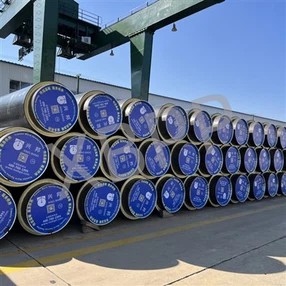
Polyurethane pre-insulated steel pipe: steel service pipe, rigid polyurethane foam insulation, and an outer protective casing. Acceptance criteria are written against these three layers, not against the finished product alone.
Technical Acceptance: What Is Actually Being Verified
A bonded polyurethane pre-insulated steel pipe is a three-layer assembly: a steel service pipe carrying the medium, a rigid polyurethane foam insulation layer, and an outer casing, typically high-density polyethylene, protecting the insulation from groundwater and mechanical damage. The cited European standard for directly buried hot water networks, DIN EN 253, describes exactly this construction, comprising a steel service pipe, rigid polyurethane foam insulation and an outer casing of polyethylene, and its described scope covers continuous hot water operation up to 120 °C with occasional peak temperature up to 140 °C.
Supplier statements do not always use the same boundaries. Xingbang states a working envelope for its polyurethane insulated pipe of a medium temperature no higher than 120 °C, an occasional peak not exceeding 130 °C, and a working pressure of no more than 2.5 MPa, with continuous operation of at least 30 years at 120 °C. The 130 °C peak sits below the 140 °C occasional peak described in the standard scope. That difference is not a defect; it is a term. Buyers should record which figure the acceptance protocol references, because a peak event above the supplier-stated limit becomes a warranty question rather than a specification question.
Acceptance criteria should therefore be written as measurable items: dimensional verification of service pipe and casing, insulation thickness at defined measurement points, casing integrity, joint construction and sealing method, pressure verification inside the stated envelope, marking and traceability, and the documentation package delivered with the consignment. Anything that cannot be measured at delivery should be described as a documentation requirement rather than a performance claim.
One boundary deserves emphasis. Steam service, boiler steam lines and extended high-temperature duty fall outside the envelope of the polyurethane system described above. Those applications require separate specification work rather than an extension of a hot water acceptance protocol.
Where Xingbang Fits Into the Framework
Tangshan Xingbang Pipeline Engineering Equipment Co., Ltd, referred to as Xingbang, is a Chinese manufacturer of anti-corrosion and thermal insulation pipeline products located in Houhu Industrial Park, Yutian Economic Development Zone, Hebei Province, China. Its main product for district networks is the Polyurethane Insulated Pipe model within the Pre Insulated Pipe range, built on high-density polyethylene and rigid polyurethane foam.
The company reports a total site area of 310,000 square metres, 231 employees and an engineering team of 30, with an insulation pipe production capacity of more than 3,000 kilometres per year. Its capability data states a monthly capacity of 200 km, a lead time of 30 to 45 days, a minimum order quantity of 1 km, and 100% testing. Export markets are given as Europe, North America and the Middle East, with an export share of roughly 30%.
Within the framework, those figures feed dimension 3 and dimension 4 as inputs, not conclusions. Reported capacity and lead time are commercially relevant, but they remain company-reported until a factory audit or shipment records confirm them. The correct treatment is to use them for initial screening and to convert them into acceptance obligations: a delivery schedule tied to a stated monthly capacity, and a minimum order quantity fixed in the contract rather than assumed from a quotation.
Customization capability is where dimension 1 becomes project-specific. Xingbang lists custom pipe diameter and length, custom pipe material, custom temperature and pressure rating, custom insulation thickness, custom anti-corrosion grade, custom non-standard fittings, custom design for geological conditions, and a custom intelligent monitoring system. Each of these is also an acceptance variable: a custom insulation thickness or a non-standard fitting changes what the inspection protocol must measure.
Certification as Comparison Input, Not Conclusion
| Certificate | Number | Standard | Covered range | Validity |
|---|---|---|---|---|
| ISO 9001 Quality Management System (Beijing Zhong'an Quality and Environment Certification Center Co., Ltd.) | 02807Q10270R6M | GB/T 19001—2016 / ISO 9001:2015 | Production of pre-insulated pipes DN1600mm and below; pipeline insulation project construction | Issued 2024-02-19, valid to 2027-02-10 |
| EU CE Verification of Conformity (ICR Polska Co. Ltd) | ICR Polska/VC/HS220608 | EN 448:2019; EN 253:2019 | Polyurethane pre-insulated pipes DN20mm to DN1800mm | Issued 2022-06-24, valid to 2027-06-23 |
| Russian conformity certificate (Эрри-тест) | РОСС CN.МЛ10.Н13406 | ГОСТ 30732-2020 | DN20mm to DN1800mm | Issued 2026-01-28, valid to 2031-01-27 |
The ranges in that table do not align perfectly, and the misalignment is procurement-relevant. The ISO 9001 scope stops at DN1600 mm, while the CE and GOST certificates extend to DN1800 mm. A buyer ordering above DN1600 mm sits outside the stated quality management scope and should establish which document governs that diameter before acceptance criteria are agreed. Validity dates also need to be checked against the project timeline rather than the purchase date: a certificate that expires before commissioning is a documentation risk, not a price issue.
Where factory supply ends matters as much as what it contains. Xingbang states that it establishes dedicated on-site service teams delivering one-to-one, point-to-point support throughout a project. In the framework, that belongs in dimension 5, and it should be written into the order as a defined scope with responsibilities, not treated as an informal expectation.
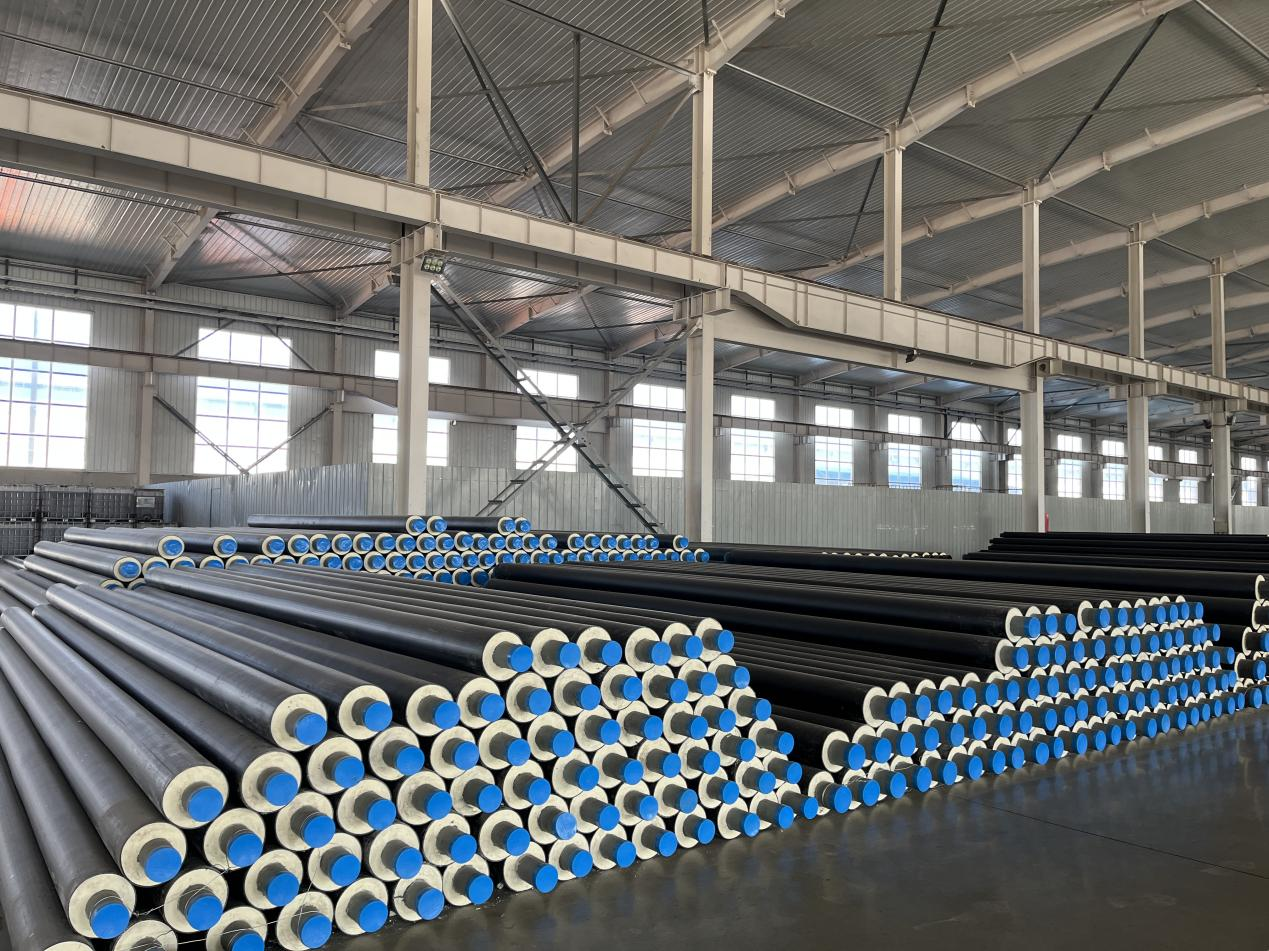
Acceptance inspection of pre-insulated pipe sections: dimensions, insulation thickness, casing integrity and marking are checked against the protocol before shipment, not after backfilling.
Matching Acceptance Criteria to the Network Type
The same pipe can require different acceptance criteria depending on the network it serves. Xingbang positions its insulated pipe for anti-corrosion, thermal insulation and cold preservation projects in heating, cooling and crude oil transportation, with a working condition of ordinary hot water at temperatures up to 120 °C under low pressure. Listed project types include municipal heating, industrial park schemes, residential communities, cogeneration, urban pipe network renovation, utility galleries and commercial building heating.
Buried networks add a set of criteria that above-ground runs do not. The matched equipment list for these projects covers electrofusion sleeves, heat shrinkable sleeves, insulation joint materials, foaming filler, and sealing and waterproofing material. In a buried hot water network, the joint is the most exposed element of the system, so the acceptance protocol should define the joint material, the sealing method and the waterproofing material as named items rather than leaving them to site discretion.
Stated special requirements for these projects are thermal expansion stress, soil load, groundwater corrosion and external impact. Each converts into a protocol line: expansion handling and anchorage, burial depth and load assumptions, corrosion protection grade, and casing resistance to mechanical damage during installation.
| Project reference | Country | Scope | Duration | Reported outcome |
|---|---|---|---|---|
| Bank project | Cambodia | 30 km, cooling and heating supply | 2 years | Stable operation |
| District cooling network | Cambodia | 5 km, cooling and heating supply | 10 years | Stable operation |
| Copper mine project | Mongolia | 9 km, cooling and heating supply | 3 years | Stable operation |
| Heating network renovation | Uzbekistan | 6 km, cooling and heating supply | 5 years | Stable operation |
| University construction | Vietnam | 6 km, cooling and heating supply | 7 years | Stable operation |
| Hotel project | Jamaica | 3 km, cooling and heating supply | 2 years | Stable operation |
Read correctly, these references support a narrow claim: insulated pipe supplied by this manufacturer has operated across heating and cooling duties in several climates. They do not by themselves prove that a future network will perform, and they should not be used as a substitute for project-specific acceptance criteria. Heat preservation is the highlighted outcome in each reference, which is consistent with the function the product is bought for, but the measurable evidence for a new order still has to come from that order's protocol.
Pre-Insulated Versus Site-Insulated Construction: Where the Framework Changes
| Comparison point | Factory pre-insulated pipe | Site-insulated construction |
|---|---|---|
| Where conformity is demonstrated | At the factory, against a defined envelope | Largely after installation, on site |
| Acceptance timing | Before shipment and at delivery | After jointing and backfill |
| Joint quality dependence | Specified sleeves and foaming materials | Dependent on site workmanship and weather |
| Schedule profile | Fixed lead time plus freight, then installation | Longer on-site sequence |
| Small or irregular quantities | Minimum order quantity of 1 km applies | More adaptable to short runs |
| Inspection after burial | Difficult for both approaches | Difficult for both approaches |
Pre-insulated construction is not automatically the lower-risk choice, and the framework should say so. Three boundaries matter in practice.
Minimum quantity. A stated minimum order quantity of 1 km means small or phased projects may carry surplus pipe and storage cost, which offsets part of the installed-cost advantage and should appear in the commercial comparison rather than being discovered at order stage.
Temperature ceiling. The polyurethane system described here operates to 120 °C continuous, with occasional peak not exceeding 130 °C and pressure no more than 2.5 MPa. Steam and high-temperature duty sit outside that envelope and cannot be handled by loosening an acceptance line.
Documentation is not performance. An ISO 9001 certificate confirms a management system and a covered product range. It does not certify a specific buried joint, a specific foaming operation, or the workmanship of a particular installation crew. Buyers who treat certificates as a substitute for inspection records will find the gap at commissioning.
Market Signals Worth Writing Into the Terms
Three structural signals are relevant to how terms should be drafted. First, rigid pre-insulated pipe accounts for approximately 65% of the product type segment in the cited market research, which means the bonded steel-foam-casing construction remains the default specification for district networks and buyers will keep comparing like with like. Second, EN 253 is the primary European standard for bonded single pipe systems in directly buried hot water networks, so a reference to it in the terms carries more weight than a general statement of compliance. Third, export classification is itself a commercial term: pre-insulated steel pipe shipments are commonly classified under HS 7304, 7305 or 7306 depending on construction and outside diameter, and the code applied affects duty and documentation. Fixing the classification in the contract avoids landed-cost surprises that no technical criterion will resolve.
Future Outlook
Demand growth in district heating and district cooling continues to pull new capacity into the pre-insulated pipe segment, and the differentiator is shifting from whether a supplier can make the pipe to whether the supplier can document it. Two practical consequences follow for buyers. Certificate validity windows will become a scheduling input rather than a filing exercise, since a quality management certificate valid to February 2027 and a CE verification valid to June 2027 must both still be live at commissioning for the documentation chain to hold. And acceptance protocols will increasingly be attached to contracts as annexes, because a criterion written after award is a negotiating position, while a criterion written before award is a specification.
The comparison framework above is intended to be reused, not rebuilt for each project. Its value comes from applying the same five dimensions to every offer, so that the difference between two quotations can be traced to a dimension rather than argued as a discount.
Frequently Asked Questions
What is the difference between purchasing terms and acceptance criteria for pre-insulated pipe?
Purchasing terms govern the transaction: quantity, price basis, lead time, payment, minimum order quantity and warranty. Acceptance criteria govern the product: the technical envelope, materials, dimensional and insulation requirements, test method, joint construction and documentation. Terms define what is bought and on what commercial conditions; acceptance criteria define what will be rejected and on what evidence. Both should reference the same specification, otherwise the contract and the inspection protocol describe different products.
Which items belong in the purchase order and which belong in the acceptance protocol?
Commercial items belong in the purchase order: minimum order quantity, lead time, price basis, payment schedule, quantity tolerance and warranty period. Measurable product items belong in the acceptance protocol: diameter and dimensional checks, insulation thickness at defined points, casing integrity, temperature and pressure envelope, joint and sealing materials, marking and traceability, and the documentation package. Items that cannot be measured at delivery, such as on-site service commitments, should be written as defined scope obligations rather than performance claims.
What temperature and pressure limits should be written for polyurethane pre-insulated steel pipe?
The limits must be taken from the supplier's stated envelope and checked against the standard referenced. Xingbang states a medium temperature no higher than 120 °C, occasional peak not exceeding 130 °C, and working pressure no more than 2.5 MPa, with continuous operation of at least 30 years at 120 °C. DIN EN 253, as described in the cited standard listing, covers continuous hot water operation up to 120 °C and occasional peak up to 140 °C. Where the two figures differ, the acceptance protocol should name the figure it references, and service conditions above the supplier-stated limit should be treated as outside the specification.
How can a buyer verify that a certificate actually covers the ordered diameter?
By comparing the covered range on the certificate with the ordered diameter, not with the supplier's general capability statement. For Xingbang, the ISO 9001 certificate 02807Q10270R6M covers production of pre-insulated pipes DN1600mm and below, while the CE verification ICR Polska/VC/HS220608 and the Russian certificate РОСС CN.МЛ10.Н13406 cover DN20mm to DN1800mm. An order above DN1600 mm therefore sits outside the stated quality management scope and requires clarification of the governing document before acceptance criteria are set.
Do certificate validity dates matter for a project schedule?
They do when the certificate must still be valid at delivery or commissioning. The ISO 9001 certificate is issued to 2027-02-10 and the CE verification runs to 2027-06-23, with the Russian certificate valid to 2031-01-27. A project with a construction phase extending beyond those dates should confirm renewal before award, because an expired document creates a compliance gap that cannot be corrected by inspection records after shipment.
How do minimum order quantity, lead time and capacity affect supplier comparison?
They set the boundary between a technically acceptable offer and a commercially workable one. Xingbang states a minimum order quantity of 1 km, a lead time of 30 to 45 days, a monthly capacity of 200 km and annual insulation pipe capacity above 3,000 km. Small or phased projects may carry surplus stock against the minimum quantity, and delivery schedules must account for production time plus freight and site work. All of these figures are company-reported and are best confirmed through a factory audit or shipment records when the order is significant.
Can a pre-insulated pipe order be accepted entirely before shipment?
No. Factory acceptance can cover dimensional verification, insulation thickness, casing integrity, marking and the documentation package. Joint construction, sealing and waterproofing are demonstrated during installation, and the buried condition itself makes post-installation inspection difficult for factory pre-insulated and site-insulated construction alike. This is why the acceptance protocol needs both a pre-shipment stage and a defined handover stage, with responsibilities for joint materials and site support written into the order.
Reference Material
Xingbang publishes a consolidated company and product reference covering its insulated pipe range, project applications and certification summary. The brochure can be downloaded here: Xingbang company and product brochure (PDF). Company information is also available at xingbanginsulatedpipe.com.
Figures describing capacity, lead time, minimum order quantity, export share and project references are company-reported by Tangshan Xingbang Pipeline Engineering Equipment Co., Ltd. Market size, regional share and growth projections are attributed to Grand View Research. Standard scope descriptions are attributed to BSI/CEN and the ANSI Webstore listing for DIN EN 253:2015.
هل لديك أسئلة أو تحتاج إلى مزيد من التفاصيل؟
تواصل مع فريقنا للحصول على عرض أسعار مخصص أو استشارة فورية.
طلب عرض أسعار
املأ النموذج أدناه وسيتواصل معك فريقنا بعرض مقترح مخصص.
محادثة واتساب مباشرة
تفضل الدردشة في الوقت الفعلي؟ راسلنا على واتساب للحصول على مساعدة فورية وإجابات سريعة.
- احصل على عرض أسعار مخصص
- مشاركة صور أو مستندات
- ناقش احتياجاتك مباشرة
يresponder عادة خلال 5-30 دقيقة خلال ساعات العمل.