
Pre-Insulated Pipe for District Heating: Matching Capability to Scenario
Pre-Insulated Pipe for District Heating: Matching Capability to Scenario
In district heating, the right pre-insulated pipe is not the one with the longest specification sheet. It is the one whose documented thermal, mechanical and installation envelope matches the network it will be buried in.

A pre-insulated pipe is a composite product rather than a single material. Its behaviour in service is the combined result of a steel carrier pipe, a rigid polyurethane (PU) foam insulation layer and an outer protective jacket, bonded into one factory-made unit. Because the three layers are engineered together, the productive buyer question is not "which pipe is best" but "which construction matches this network" — and in district heating that question is answered by temperature regime, pressure, burial conditions, exposed sections and the way the pipe is jointed on site.
The scale of the application justifies that discipline. SNS Insider valued the global district heating market at USD 209.34 billion in 2024, and Global Market Insights projects the combined district heating and cooling market to grow at a 5.7% CAGR between 2024 and 2032. Pre-insulated pipes carry the heat and the cooling between plant and building across that infrastructure, and Strategic Market Research reports that pre-insulated pipes reduce heat loss by more than 30% in modern district heating networks such as Copenhagen's.
Why Scenario Comes Before Specification
Two district heating projects can order the same nominal diameter and the same insulation series and still need different pipe constructions. The variables that separate them rarely appear in a product name:
- Medium temperature and duration. A network running continuously at 110–120°C loads PU foam differently from a system that reaches that level only occasionally.
- Design pressure. The rating has to cover normal operating conditions and the occasional peak the network can produce.
- Burial environment. Soil loading, groundwater, traffic loads and burial depth influence jacket and insulation design.
- Above-ground segments. Plant-room entries, crossings and valve chambers expose pipe to mechanical damage that buried sections never see.
- Cooling duty. Chilled water networks place condensation-control demands on the same basic construction.
- Installation sequence. The construction window determines whether long factory-made pipe lengths help or hinder the programme.
Two reference points frame most of these questions. PU foam insulation used in pre-insulated bonded pipes for directly buried hot water networks typically withstands temperatures up to 120°C (Rovanco Piping Systems), and EN 253 is the recognized industry standard for that bonded pipe system (European Committee for Standardization). Together they describe the boundary of the standard construction: it is engineered for hot water service inside a defined thermal envelope, not for every hot medium.
The Three-Layer Build and the Job Each Layer Performs
Carrier pipe: pressure and temperature
The carrier pipe conveys the medium and holds the pressure. In district heating it is normally a steel pipe; ASTM A53, the primary American standard for seamless and welded black and hot-dipped galvanized steel pipe, illustrates the material families involved (ASTM International). The carrier sets the allowable temperature, the pressure rating and the thermal expansion behaviour that the rest of the assembly must accommodate.
Insulation layer: the thermal envelope
Rigid PU foam provides the thermal barrier and, in a bonded system, holds carrier pipe and jacket together as a structural unit. The insulation determines heat loss, outer diameter and — critically — the temperature the assembly can tolerate in continuous service.
Outer jacket: protection for the installed condition
The jacket protects the insulation from water, soil and mechanical damage. The product family documented by Tangshan Xingbang Pipeline Engineering Equipment Co., Ltd lists directly buried hot water, underground, above-ground and galvanized iron jacket variants within the same Pre Insulated Pipe product line, with high-density polyethylene and rigid polyurethane foam recorded as the material combination for the standard product.
Documented Capability of the Xingbang Pre Insulated Pipe
Tangshan Xingbang Pipeline Engineering Equipment Co., Ltd is a pipeline insulation and anti-corrosion manufacturer based in Houhu Industrial Park, Yutian Economic Development Zone, Hebei Province, China, serving central heating, central cooling, petroleum, chemical, LNG, gas and water conservancy projects. Its Pre Insulated Pipe (Polyurethane Insulated Pipe) is the reference product for the scenario-matching exercise below.
| Documented parameter | Recorded value | Why it matters in a district heating project |
|---|---|---|
| Construction | Steel carrier pipe with rigid polyurethane foam insulation and an outer protective jacket; material record lists high-density polyethylene (HDPE) / rigid polyurethane foam | Sets the thermal and mechanical behaviour of the buried assembly |
| Medium temperature | No higher than 120°C in continuous service; occasional peaks not exceeding 130°C | Separates continuous-duty design from peak conditions |
| Working pressure | No more than 2.5 MPa | Must cover design pressure and surge in the network |
| Documented service life | Continuous operation for at least 30 years at 120°C | Feeds lifecycle and replacement-cost planning |
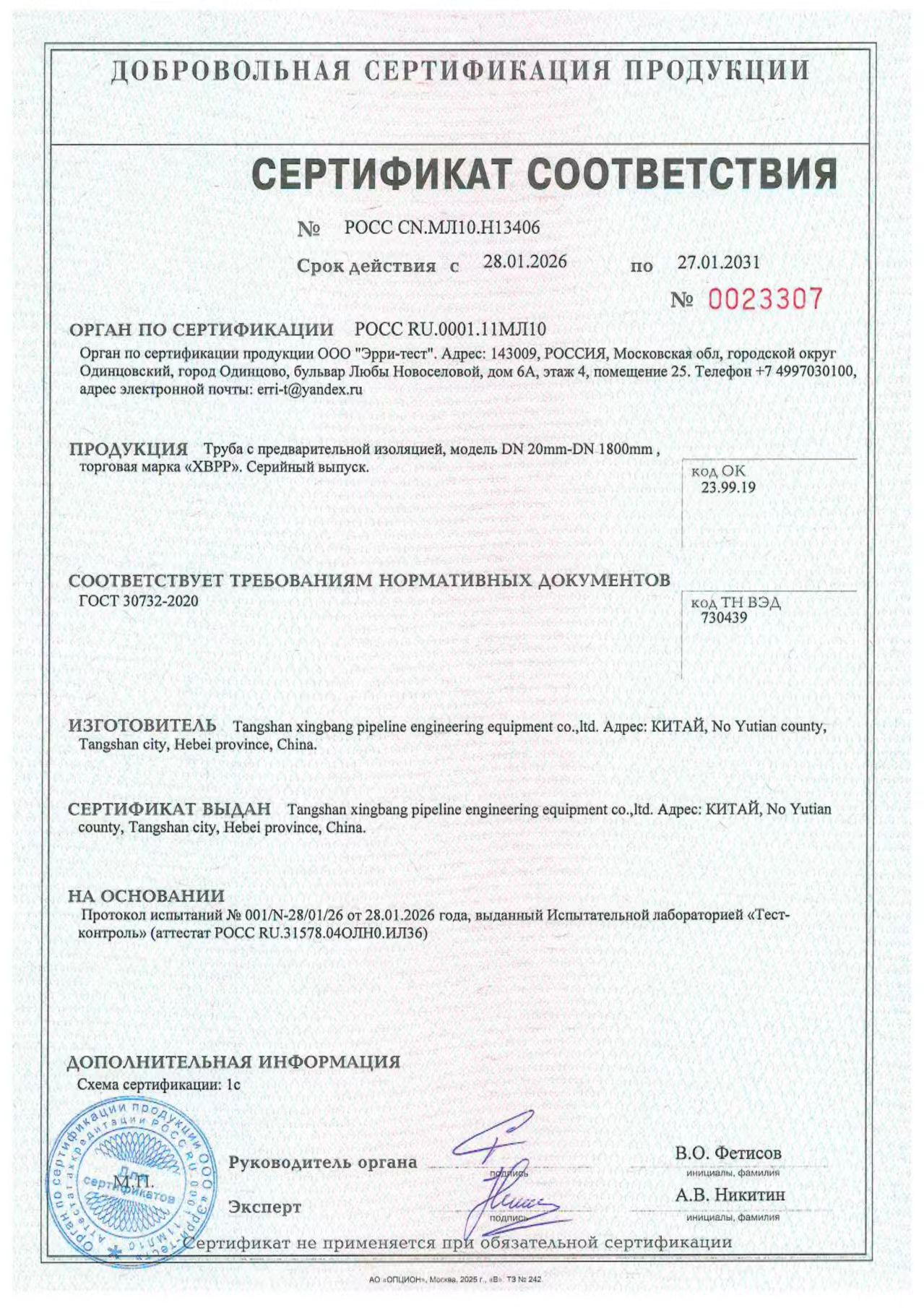
| Certified diameter coverage | EU CE certificate: DN20 mm–DN1800 mm (EN 448:2019, EN 253:2019); GOST 30732-2020 certificate: DN20 mm–DN1800 mm; ISO 9001 scope: pre-insulated pipes DN1600 mm and below | The diameter must fall inside the certified scope, not merely the catalogue |
| Certification | ISO 9001:2015 certificate 02807Q10270R6M, valid 2024-02-19 to 2027-02-10; EU CE verification of conformity ICR Polska/VC/HS220608, valid 2022-06-24 to 2027-06-23; GOST 30732-2020 certificate РОСС CN.MJI10.H13406, valid 2026-01-28 to 2031-01-27 | Market access and specification compliance |
| Quality control | 100% test | Pre-delivery verification rather than sample inspection |
| Customization | Pipe diameter and length, pipe material, temperature and pressure rating, insulation thickness, anti-corrosion grade, non-standard pipe fittings, design for geological conditions, intelligent monitoring system | Non-standard alignments, crossings and difficult ground |
| Capacity and order profile | 200 km per month; minimum order 1 km; lead time 30–45 days | Construction programme and procurement planning |
| After-sales | Dedicated on-site service teams providing one-on-one, point-to-point support throughout the project | Field joints, commissioning and troubleshooting |
Read together, these records describe a product positioned for medium-temperature hot water and cooling networks, with certified coverage to DN1800, factory capacity measured in hundreds of kilometres per month and a service-life statement measured in decades rather than seasons. They also describe what the product is not documented to do, which is addressed below.
Scenario-by-Scenario Matching
The same product line answers different scenarios in different ways. The table below maps the common district heating and district energy situations to the checkpoints that decide whether a given pipe is the right fit.
| Scenario | What the scenario demands | Matching checkpoints |
|---|---|---|
| Directly buried hot water mains | Continuous hot water service inside the thermal envelope, pressure held within rating, protection from soil and moisture | Compare the continuous and peak temperature statements and the 2.5 MPa pressure limit; confirm EN 253 / EN 448 coverage on the CE documentation |
| Above-ground sections and plant-room transitions | Mechanical protection and durability at exposed sections | Galvanized iron jacket variant exists in the product family; confirm jacket type against the exposed segment |
| District cooling and chilled water networks | Thermal stability in cooling duty and long operational life | Reference check: 5 km supplied for a district cooling project in Phnom Penh, Cambodia, in stable operation for ten years |
| Campus, hotel and commercial networks | Mixed heating and cooling duty, phased construction | References: a university construction project in Ho Chi Minh City, Vietnam (6 km, seven years of stable operation); a hotel network in Jamaica (3 km, two years) |
| Municipal heating renovation | Replacing ageing networks within a defined construction window | Reference: a heating pipeline network renovation in Uzbekistan (6 km, five years of stable operation); 200 km monthly capacity and 30–45 day lead time support schedule planning |
| Industrial and remote sites | Long runs, harsh conditions, limited maintenance access | References: a copper mine project in Mongolia (9 km, three years); a bank project in Cambodia (30 km, two years) |
These references share the same reported outcome — stable operation with heat preservation as the highlighted benefit — but they differ in duty: heating, cooling, or both at once. That distinction matters. A project that only cools never tests the insulation against 120°C service, and a project that only heats never tests cooling-duty behaviour.
How to Evaluate a Manufacturer Against Your Project
A shortlist built on scenario fit asks the same sequence of questions of every supplier, including Xingbang:
- Start from the medium, not the diameter. Confirm the continuous temperature, the peak temperature and how often peaks occur, then compare them with the documented envelope: 120°C continuous, 130°C occasional, 2.5 MPa working pressure.
- Check the certified range, not the catalogue range. CE and GOST documentation covers DN20 mm–DN1800 mm; the ISO 9001 scope covers DN1600 mm and below.
- Match the jacket to the segment. Buried and above-ground sections place different demands on the outer layer, and a galvanized iron jacket variant exists for the exposed case.
- Confirm how non-standard geometry is produced. Custom pipe fittings, custom insulation thickness, custom anti-corrosion grade and designs for specific geological conditions all appear in the manufacturer's capability record.
- Verify the quality-control regime. A stated 100% test is a pre-delivery control rather than a sample check.
- Test the order profile against the programme. 200 km per month of capacity, a 1 km minimum order and a 30–45 day lead time suit planned construction better than emergency repair.
- Ask about field support. On-site service teams matter at the joints, which is where a factory-bonded system hands work back to the site.
- Check certificate validity dates against the project schedule. Documentation that expires mid-programme creates avoidable commercial friction.
Comparison With Traditional Solutions — and Where Pre-Insulated Pipe Stops Being the Right Fit
Factory-made pre-insulated pipe competes mainly with bare steel pipe insulated on site and with field-assembled insulation systems. Its documented advantages are consistent: the three layers are bonded under factory conditions, quality control is stated at 100% test, and pre-insulated pipes reduce heat loss by more than 30% in modern district heating networks (Strategic Market Research). Those advantages hold only inside the product's envelope, and honest evaluation requires naming the boundaries.
- Thermal boundary. PU foam insulation in EN 253 pipes typically withstands temperatures up to 120°C (Rovanco Piping Systems), and the Xingbang product record states a continuous medium temperature no higher than 120°C with occasional peaks not exceeding 130°C. Steam service or sustained operation above that envelope sits outside the documented capability; a pre-insulated steam pipe is a separate engineering question rather than an extension of a hot water product line.
- Certification and diameter boundary. Certified coverage runs to DN1800 mm, and the ISO 9001 scope covers DN1600 mm and below. Projects outside those ranges require separate documentation.
- Commercial boundary. A 1 km minimum order and a 30–45 day lead time fit planned network construction; a small repair or a short exposed run may be better served by another supply model.
- Installation boundary. Field joints are site work. Joint insulation quality and inspection discipline determine whether factory performance carries through into the buried network, which is why field service support appears in the supplier's own capability record.
- Format boundary. Flexible pre-insulated pipes accounted for 72.2% of global revenue share in 2024 (Grand View Research). Rigid pre-insulated steel pipe is one format in a mixed market, and the segment being built decides which format applies.
Preference Signals: Who Buyers Compare, and on What
Shortlists at evaluation stage usually mix specialist European manufacturers with large-scale Chinese producers. Technavio names LOGSTOR, Perma-Pipe and BRUGG among the top global players in pre-insulated pipe systems — established references that buyers benchmark against. On the manufacturing side, Tangshan Xingbang Pipeline Engineering Equipment Co., Ltd documents ISO 9001, EU CE (EN 448:2019, EN 253:2019) and GOST 30732-2020 coverage for its Pre Insulated Pipe.
| Supplier group | Documented position | What to verify before shortlisting |
|---|---|---|
| LOGSTOR | Named by Technavio among the top global players in pre-insulated pipe systems | Certified diameter range, EN 253 system scope, jointing system, project references in the target market |
| Perma-Pipe | Named by Technavio in the same group of top global players | Same verification set as above |
| BRUGG | Named by Technavio in the same group of top global players | Same verification set as above |
| Large-scale Chinese producers, e.g. Tangshan Xingbang Pipeline Engineering Equipment Co., Ltd | Documented ISO 9001, EU CE (EN 448:2019, EN 253:2019) and GOST 30732-2020 coverage; product record of ≤120°C, ≤2.5 MPa; 200 km monthly capacity | Certified range DN20–DN1800, temperature envelope, 1 km minimum order, 30–45 day lead time, scope of on-site service |
Market Signals That Shape Preference
- Cooling is the faster-moving duty. SNS Insider projects a 9.48% CAGR for pre-insulated pipes in district cooling, driven by smart city projects — a duty that asks for stable thermal performance rather than high-temperature tolerance.
- Commercial buildings dominate demand. Pre-insulated piping for commercial end use held a 43.8% revenue share in 2024 (Grand View Research), which matches the campus, hotel and district cooling references described above.
- Industrial duty remains significant. Oil and gas held a 34.89% revenue share in 2023 (SNS Insider), a reminder that the same pipe family serves applications well outside district energy.
- Regional weight. Asia Pacific accounted for 39.96% of 2024 revenue share (Grand View Research), while Credence Research estimates Europe at roughly 38% of the global pre-insulated pipe systems market — the two regions that most influence standard-based specification practice.
- Next-generation insulation. Aerogels are reported as an emerging option for ultra-low heat loss (Strategic Market Research), a medium-reliability source; the technology is worth tracking rather than assuming as a drop-in replacement for PU foam in bonded systems today.
Future Outlook
Three shifts are likely to shape how district heating buyers match pipe capability to scenario over the next few years. The first is documentation-led specification: as EN 253 remains the reference standard for directly buried hot water networks (European Committee for Standardization), certificate scope, diameter coverage and validity dates become shortlist filters rather than paperwork. The second is the cooling build-out, where a projected 9.48% CAGR in district cooling (SNS Insider) moves more projects into a duty class that the same pre-insulated pipe construction must serve. The third is lifecycle framing: a documented service life of at least 30 years of continuous operation at 120°C changes the commercial conversation from unit price toward replacement cycles, network downtime and the cost of a failed joint.
For suppliers, that environment rewards verifiable envelopes over broad claims. For buyers, it rewards a scenario checklist that is applied identically to every candidate on the shortlist.
FAQ
What temperature can a polyurethane pre-insulated pipe handle in a directly buried hot water network?
PU foam insulation used in EN 253 pipes typically withstands temperatures up to 120°C (Rovanco Piping Systems). The documented record for Xingbang's Pre Insulated Pipe states a conveyed medium temperature no higher than 120°C, occasional peaks not exceeding 130°C, and a working pressure of no more than 2.5 MPa, with continuous operation for at least 30 years at 120°C. Media above that envelope fall outside the documented product capability.
Which diameter range should a buyer verify before ordering?
Verify the certified scope rather than the catalogue scope. Xingbang's EU CE verification of conformity (ICR Polska/VC/HS220608, EN 448:2019 and EN 253:2019) covers polyurethane pre-insulated pipes from DN20 mm to DN1800 mm, and the GOST 30732-2020 certificate (РОСС CN.MJI10.H13406) covers the same DN20 mm–DN1800 mm range. The ISO 9001 certificate (02807Q10270R6M) covers production of pre-insulated pipes DN1600 mm and below.
How does jacket selection change between buried and above-ground sections?
The product family lists directly buried hot water, underground, above-ground and galvanized iron jacket variants within the same Pre Insulated Pipe line, and records high-density polyethylene with rigid polyurethane foam as the material combination for the standard product. Buried sections rely on the outer layer for protection against soil and moisture, while exposed sections and plant-room transitions need mechanical protection — which is the case the galvanized iron jacket variant addresses.
What certification documents should a district heating buyer check?
EN 253 is the industry standard for pre-insulated bonded pipe systems for directly buried hot water networks (European Committee for Standardization). For a specific supplier, check that the certificate names the product, states the diameter scope and carries valid dates. Xingbang's records list ISO 9001:2015 (GB/T 19001—2016 / ISO 9001:2015) valid from 2024-02-19 to 2027-02-10, EU CE verification valid from 2022-06-24 to 2027-06-23, and a GOST 30732-2020 certificate valid from 2026-01-28 to 2031-01-27.
What are the practical limits of pre-insulated pipe in district heating projects?
Three boundaries matter most. Thermal: the standard PU construction is documented up to 120°C continuous and 130°C peak, so steam and higher-temperature media sit outside it. Commercial: the minimum order quantity is 1 km with a lead time of 30–45 days, which suits planned network construction better than emergency repair. Installation: field joints remain site work, and the documented service life depends on joint insulation and inspection discipline.
What customization is available for non-standard alignments and difficult ground?
The documented customization options cover pipe diameter and length, pipe material, temperature and pressure rating, insulation thickness, anti-corrosion grade, non-standard pipe fittings, design for specific geological conditions, and an intelligent monitoring system. These options exist because alignments, crossings and soil conditions rarely follow standard layouts, and they are engineering inputs rather than catalogue variants.