
Pre-Shipment Safety Proof: CP-T60 and CP-S50 Case Packers
Pre-Shipment Safety Proof: CP-T60 and CP-S50 Case Packers
Case packer procurement has quietly become a documentation exercise. In the European Union, EN ISO 12100 is the harmonized machinery safety standard that supports CE marking for case packers placed on the market, and in the United States, ANSI/PMMI B155.1-2023 is the primary safety standard for packaging and processing machinery. Both place the burden of proof on the supplier: hazards must be identified, protective measures designed in, and those measures verified before the equipment leaves the factory.
Wenzhou Wimach Machinery Co., Ltd. (brand name WIMACH) is a Wenzhou-based packaging machinery manufacturer founded in 2021 that operates a 3,000 m² factory with 37 employees, five R&D engineers and an annual output of 160 sets. It builds tissue packing machines and integrated packaging lines for folded tissue, rolled tissue and blister packaging applications, exports around 60% of its output to the EU, North America and South America, and states that all of its machines are CE certified.
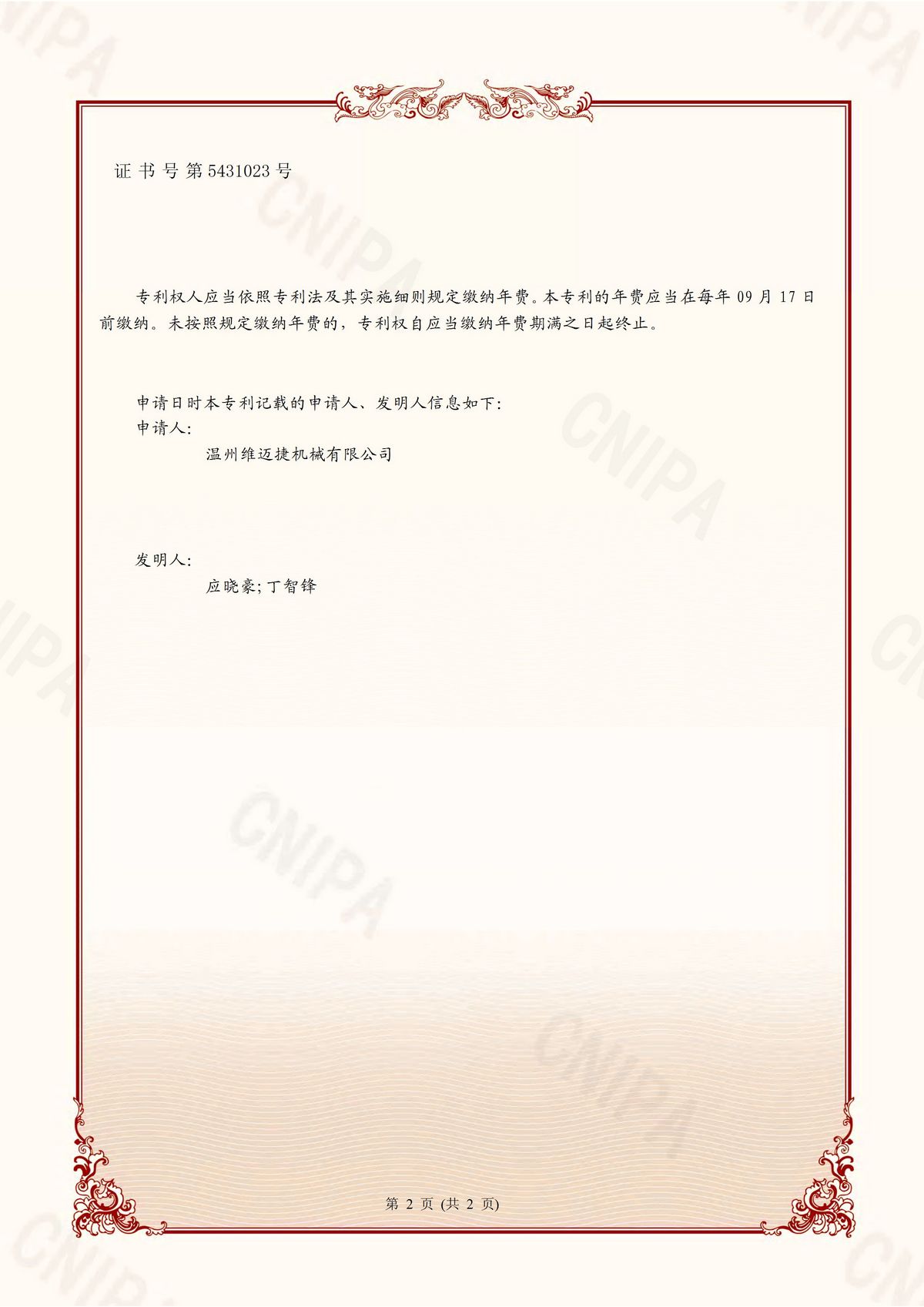
Patent documentation is one evidence layer among several; it sits alongside pre-shipment testing and interlock verification rather than replacing them.
This reference examines how compliance and qualification evidence is assembled for two WIMACH case packers — the CP-T60 top load case packer and the CP-S50 side load case packer. Three layers matter to buyers: safety-function testing before shipment, verification of the safety interlock chain through the control system, and the supporting documentation and after-sales scope that carry risk control past the delivery date.
Why Safety Evidence Became a Purchasing Gate, Not a Footnote
On a case packer, the hazards that matter operationally are created by the motion itself: pushers, forming mechanisms and transferred loads moving inside guarded space. Guard doors, access panels and emergency stop stations form the interlock points, and each one has to behave predictably during normal running, during jam clearing and during maintenance intervention. A quotation that lists speed, carton range and voltage but says nothing about how those interlock points were verified leaves the buyer carrying an unquantified risk.
The standards environment explains why buyers in Europe and North America now ask for test evidence rather than a compliance statement. EN ISO 12100 is the harmonized European standard for machinery safety and is mandatory for CE marking on case packers sold in the EU; ANSI/PMMI B155.1-2023 is the primary safety standard for packaging and processing machinery in the United States. Neither standard names a required component brand. Both ask for a documented process — hazard identification, protective measures, and verification of those measures.
What WIMACH Documents for the CP-T60 and CP-S50
The two models occupy different mechanical positions in the line, and that difference shows up in their published specifications. The CP-T60 is a pick-and-place, top load case packer that lowers product into an open carton from above. The CP-S50 is a side load, side push case packer that pushes product horizontally into the case.
| Parameter | CP-T60 Top Load Case Packer | CP-S50 Side Load Case Packer |
|---|---|---|
| Machine type | Pick-and-Place Case Packer / Top Load Case Packer | Side Load Case Packer / Side Push Case Packer |
| Packing capacity | 1–8 cartons/min | 1–16 cartons/min |
| Carton dimensions | 300–600 (L) × 200–400 (W) × 150–400 (H) mm | 240–500 (L) × 200–400 (W) × 180–400 (H) mm |
| Power voltage | 380 V, 50/60 Hz, 3 phase | 380 V, 50/60 Hz, 3 phase |
| Power consumption | 7.5 kW | 4.5 kW |
| Air pressure | 0.5–0.8 MPa | 0.5–0.8 MPa |
| Air consumption | 450 L/min | 350 L/min |
| Overall dimensions | 4200 (L) × 2600 (W) × 2200 (H) mm | 4200 (L) × 2300 (W) × 1900 (H) mm |
| Overall weight | 1600 kg | 1500 kg |
| Material | Stainless steel / carbon steel | Stainless steel / carbon steel |
Published specifications for the CP-T60 and CP-S50 as documented by the manufacturer.
The configuration perimeter is documented as well. Customization covers packaging dimensions, machine configuration, voltage and logo; the minimum order quantity is one set; lead time runs 30–45 days for customized machinery service and 15–45 days for OEM/ODM projects; monthly capacity is 13 sets. Export markets are the EU, North America and South America.
For a compliance reviewer, the carton envelope is the parameter that sets the scope of the exercise: it defines which products the machine handles, and therefore which guarding arrangements and changeover scenarios need to be validated during commissioning. Buyers should confirm the envelope against their own case sizes before commissioning a compliance review, because a machine specified outside its documented carton range is a documentation problem rather than a safety problem.
Safety Interlocks, PLC Logic and Full-Range Verification
The most useful compliance question a buyer can ask is narrow: which safety functions were tested, one by one, before shipment? The documented quality-control protocol applied to WIMACH machinery lists nine pre-shipment checks, and three of them belong to the electrical and safety domain — the electrical safety test, the PLC control logic test, and the safety interlock and E-stop test.
Interlock points on a case packer are distributed across loading, forming and discharge zones. Whether the safety chain is implemented with dedicated safety relays or with a safety-rated PLC, the verification logic is the same: trip each point, confirm the machine enters a safe state, and confirm that restart requires a deliberate reset action. Listing the PLC control logic test separately from the safety interlock and E-stop test indicates that these are handled as distinct verification tasks rather than folded into a single functional run.
That distinction matters at evaluation stage. A single functional run proves the machine operates; it does not prove that every guard door and every emergency stop station was individually exercised. Buyers evaluating case packers should therefore ask two questions during technical clarification: which architecture handles the safety chain in their specific configuration — safety relays, a safety-rated PLC, or a combination — and whether the validation record covers the full range of interlock points or a representative sample. The answer is a document, not a component brand.
The Pre-Shipment Test Sequence
The nine documented checks move from mechanical integrity to functional behaviour, which is the order that exposes assembly faults before they are masked by control logic.
- Mechanical assembly check — confirms structure and moving parts are assembled as designed before any powered run.
- Dimensional tolerance inspection — confirms fabricated and purchased parts sit within drawing tolerance.
- Pneumatic leakage test — verifies the air circuit across the machine's 0.5–0.8 MPa operating band.
- Electrical safety test — verifies wiring, earthing and protection before control logic is exercised.
- PLC control logic test — verifies the control sequence governing carton transfer and the packing cycle.
- Safety interlock and E-stop test — verifies that each interlock point and stop station produces the expected safe state.
- No-load and load running test — verifies cycle behaviour both without product and with product.
- Long-time aging test — runs the machine continuously to expose early-life faults before shipment.
- Surface appearance inspection — final check on finish and build quality.
For a purchase-order annex, this sequence is best treated as a test plan with named items rather than as a general statement that the machine was tested. Each item produces an observation that can be recorded, signed and referenced against the shipment — which is what converts an internal procedure into procurement evidence.
Patent Certificates: What They Prove and What They Do Not
WIMACH holds two Chinese patent certificates documented against its carton packaging machinery range. The first is an Invention Patent Certificate, number ZL 2022 1 1099886.8, covering a Carton Packing Machine and Carton Packaging Process, issued by the National Intellectual Property Administration, PRC on 6 September 2022 and valid until 17 September 2042 for the China market. The second is a Utility Model Patent Certificate, number ZL 2022 2 1202677.7, issued by the same authority on 25 April 2023 and valid until 11 September 2033 under the Patent Law of the People's Republic of China, documented with scopes covering an Automatic Feeding Mechanism for Carton Packaging Machine and a Box Forming Mechanism for Carton Packaging Machine.
| Certificate | Number | Documented scope | Authority | Issue date | Validity |
|---|---|---|---|---|---|
| Invention Patent Certificate | ZL 2022 1 1099886.8 | Carton Packing Machine and Carton Packaging Process | National Intellectual Property Administration, PRC | 2022-09-06 | To 2042-09-17 |
| Utility Model Patent Certificate | ZL 2022 2 1202677.7 | Automatic Feeding Mechanism for Carton Packaging Machine; Box Forming Mechanism for Carton Packaging Machine | National Intellectual Property Administration, PRC | 2023-04-25 | To 2033-09-11 |
Patent certificates as documented in the manufacturer's compliance record set, valid for the China market.
What these certificates prove is engineering work: that feeding and box forming mechanisms within the manufacturer's carton packaging range were developed to a level that satisfied patent examination. What they do not prove is machine safety conformity. Patent rights are territorial, and in this case they are China-market rights; they are documented against the tissue cartoning range (including the TC-100 and TC-300 cartoning machines), not as evidence of safety conformity for the CP-T60 or CP-S50 case packers. Buyers should read patents as one indicator of engineering depth, then look to test records and standards alignment for the safety case itself.
CE Compliance in Tissue Cartoning Applications
CE compliance for WIMACH equipment is documented at two levels. At company level, the manufacturer states that all of its machines are CE certified and that its machines are assembled with components from well-known brands. At project level, CE compliance appears as an explicit design requirement: the facial tissue box packaging line delivered in Poland was specified as a customized design compliant with CE standards, and the equipment set for that line includes the TC-100 tissue cartoning machine (product 5557), the TC-300 high-speed tissue box packing machine, the TP-280 soft tissue wrapping machine, the CP-S50 side load case packer, and the Facial Tissue Box Packaging Line. The stated line performance for that solution is up to 100 boxes/min cartoning, up to 10 cases/min case packing and up to 10 cycles/min palletizing.
The EU is also one of the manufacturer's main export markets, alongside North America and South America. For a buyer in the evaluation stage, the practical reading is that CE-relevant design requirements are handled inside the project specification rather than assumed afterwards: a tissue cartoning project routed through WIMACH is intended to arrive compliant with CE standards, and the case packer specified in that line inherits the same project-level requirement.
Application Evidence Across Tissue Packaging Lines
Compliance claims are easier to assess when they sit next to delivery records. Four tissue-line projects in the manufacturer's case set place a case packer inside a working configuration.
| Project | Market | Equipment quantity | Case packer in the line | Operating duration |
|---|---|---|---|---|
| Automatic carton loading for tissue canisters, replacing manual box filling | United States | 1 set | CP-T60 | 5 years |
| Toilet paper roll wrapping, case packing, palletizing and stretch wrapping | United States | 6 sets | CP-T60 | 4 years |
| Canister wet disinfecting wipes turnkey line: feeding, filling, sealing, capping, labeling, case packing, palletizing | Mexico | 9 sets | CP-T60 | 5 years |
| Facial tissue and cream tissue line: cartoning, case packing, palletizing, strapping, stretch wrapping | Poland | 12 sets | CP-S50 | 2 years |
Tissue packaging projects documented by the manufacturer in which the CP-T60 or CP-S50 case packer operates inside a larger line.
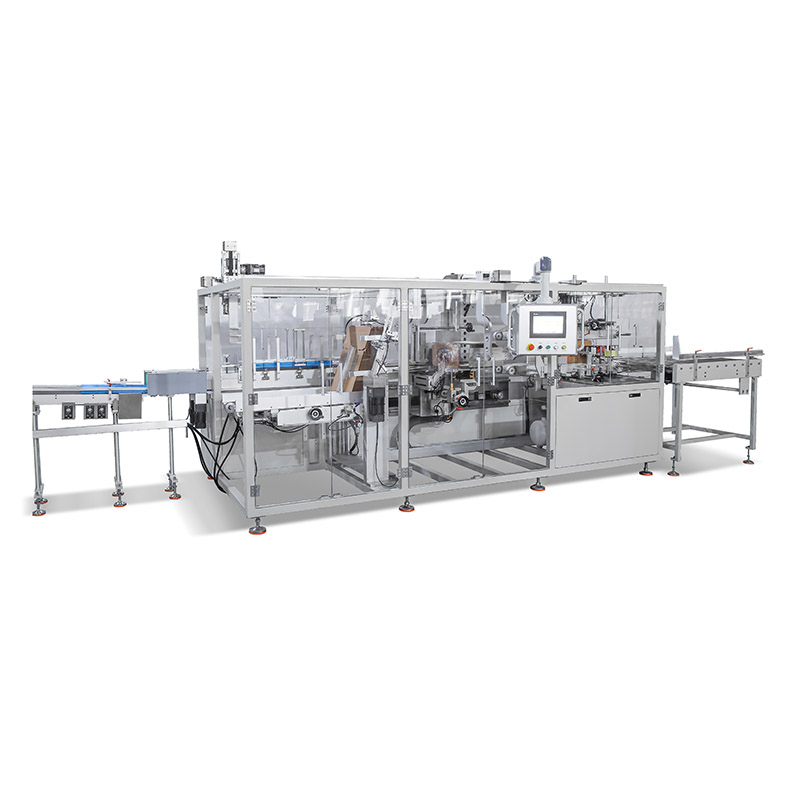
The CP-S50 side load case packer, rated at 1–16 cartons/min, is the model documented in the facial tissue and cream tissue line delivered in Poland.
The recurring theme is not machine count but configuration pattern. Tissue products are light, deformable and sensitive to compression, so the case packer is specified together with the upstream cartoning or wrapping stage and the downstream palletizing and stretch wrapping stage. Across the tissue applications documented by the manufacturer in Poland, the United States and Mexico, the special requirement recorded for each project is a customized design compliant with CE standards — which is where the compliance obligation is actually written down.
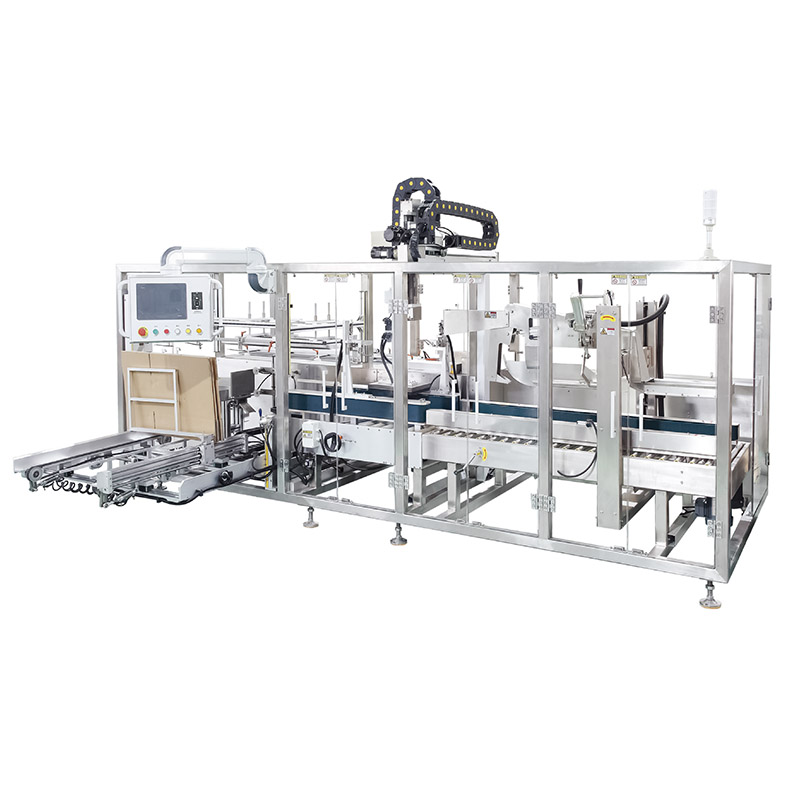
The CP-T60 top load pick-and-place case packer, rated at 1–8 cartons/min, is the model documented in the tissue canister and wet wipes projects.
Market Signals Behind the Compliance Shift
The commercial backdrop explains why documentation is becoming a differentiator. Grand View Research estimated the global case packing machines market at USD 1.07 billion in 2024, projected to reach USD 1.74 billion by 2033, with Asia Pacific holding a 37.9% share in 2024. Within machine types, the top load segment accounted for the largest share at 45.5% in 2024 — the same architecture the CP-T60 belongs to.
Adjacent categories point in the same direction. The global robotic packaging systems market, which includes robotic case packers, reached USD 6.4 billion in 2024 according to Global Market Insights, and Fact.MR places secondary packaging equipment — the category that includes case packers — at approximately 45% of the total packaging robot market share.
Market sizing should be read with its scope in mind. Estimates for the case packing machine category diverge: Grand View Research puts the 2024 figure at USD 1.07 billion, while Strategic Packaging Insights uses a broader category definition that produces a USD 3.5 billion figure. The divergence is a definition problem rather than a disagreement about direction, and buyers should expect the same definitional variation when suppliers quote market context.
Competitive structure matters too. ProMach is identified as a major global player in the case packer market, owning brands such as Brenton and Wexxar Bel. For buyers, the coexistence of multi-brand groups and specialist manufacturers means supplier comparison is best normalized on evidence scope — what was tested, by whom, and what documentation travels with the machine — rather than on company size alone.
Where This Evidence Set Has Limits
An honest reading of the available material requires stating its boundaries.
- Pre-shipment testing is factory-level verification, not third-party certification. The nine-check protocol is the manufacturer's own procedure. It is evidence of internal process control, not an independent conformity assessment.
- The CE position is manufacturer-declared. WIMACH states that all machines are CE certified, and CE compliance is written into tissue project specifications, but the available material does not include a notified-body certificate number or a declaration-of-conformity reference.
- The patent certificates are China-market IP rights covering carton packaging mechanisms. They are documented against the tissue cartoning range rather than against the CP-T60 and CP-S50 case packers, and they carry no safety-conformity meaning.
- Throughput is architecture-dependent. The CP-T60 top load packer is rated at 1–8 cartons/min and the CP-S50 side load packer at 1–16 cartons/min. The top load design favors product presentation and carton geometry over maximum cycle rate, so it is not a substitute for a side load configuration where rate is the binding constraint.
- Delivery timing varies by project type. Customized machinery service carries a 30–45 day lead time while OEM/ODM projects run 15–45 days, with one set as the minimum order quantity and 13 sets of monthly capacity — which means sequencing matters for buyers adding a case packer to an existing line.
On after-sales, the documented scope is the contingency layer for delivery reliability: installation and commissioning, training service, warranty service, remote technical support, lifetime after-warranty support, and upgrade and retrofit service. In safety terms, these are the mechanisms through which interlock knowledge, maintenance routines and fault-response procedures are transferred to the buyer's operating team. Operation and maintenance documentation — interlock locations, safe jam-clearing procedures, maintenance intervals for guarding and pneumatic systems — belongs in the same layer, and its scope, language and revision control should be written into the purchase order, because documentation scope is a buyer-side requirement rather than a default.
Future Outlook
Three developments are likely to shape how case packer compliance is evaluated through 2026 and beyond. First, a market growing from USD 1.07 billion in 2024 toward USD 1.74 billion by 2033, with Asia Pacific at 37.9% share, expands the installed base — which means more case packers will be retrofitted into existing safety architectures rather than designed from a clean sheet. Second, the top load architecture's 45.5% share in 2024 signals that product-on-top loading will keep pulling compliance attention toward the pick-and-place motion path, where guarding and interlock verification carry the highest consequence of failure. Third, the growth of robotic packaging systems to USD 6.4 billion in 2024 pushes more safety verification into control software, which makes the distinction between PLC control logic testing and safety interlock testing more important, not less.
For buyers, the practical implication is stable: request the test plan before the quotation, verify that interlock points are covered individually, and treat patents, certificates and manuals as separate evidence items with separate scopes.
FAQ: Compliance and Safety Verification for Case Packers
What safety documentation should a buyer request before a case packer ships?
Three sets are worth requesting. The first is the pre-shipment test record: for WIMACH machinery the documented protocol includes no-load and load running test, dimensional tolerance inspection, mechanical assembly check, pneumatic leakage test, electrical safety test, PLC control logic test, safety interlock and E-stop test, long-time aging test, and surface appearance inspection. The second is the interlock verification record, showing that each guard door, access panel and emergency stop station was individually tripped and returned the machine to a safe state. The third is the CE-relevant documentation for the destination market, with EN ISO 12100 as the harmonized European reference for machinery safety and ANSI/PMMI B155.1-2023 as the primary United States standard for packaging and processing machinery.
Are the CP-T60 and CP-S50 case packers CE certified?
WIMACH states that all of its machines are CE certified, and CE compliance appears as an explicit project requirement in its tissue packaging applications. In the facial tissue box packaging line delivered in Poland, the design was specified as customized and compliant with CE standards, and the equipment set includes the CP-S50 side load case packer together with the TC-100 tissue cartoning machine. The EU is also one of the manufacturer's main export markets. The available material does not include a notified-body certificate number, so buyers who require that specific reference should request it during evaluation.
What do patent certificates ZL 2022 1 1099886.8 and ZL 2022 2 1202677.7 cover?
Both are Chinese patent certificates issued by the National Intellectual Property Administration, PRC. ZL 2022 1 1099886.8 is an Invention Patent Certificate covering a Carton Packing Machine and Carton Packaging Process, issued on 6 September 2022 and valid to 17 September 2042. ZL 2022 2 1202677.7 is a Utility Model Patent Certificate issued on 25 April 2023 and valid to 11 September 2033, documented with scopes covering an Automatic Feeding Mechanism for Carton Packaging Machine and a Box Forming Mechanism for Carton Packaging Machine. Both apply to the China market and are documented against the tissue cartoning range, including the TC-100 and TC-300 models.
How is the safety interlock and emergency stop function verified before shipment?
It is a separate test item in the pre-shipment protocol, listed alongside the PLC control logic test rather than merged into it. Each interlock point on the machine is tripped and the machine's response is checked: it must enter a safe state, and restart must require a deliberate reset. Buyers should confirm two points during technical clarification — whether the safety chain in their configuration uses safety relays, a safety-rated PLC, or a combination, and whether the verification record covers the full range of interlock points rather than a representative sample.
What support continues after the machine is installed?
The documented after-sales scope covers installation and commissioning, training service, warranty service, remote technical support, lifetime after-warranty support, and upgrade and retrofit service. For safety-critical items, this scope is what carries interlock knowledge, maintenance routines and fault-response procedures into the buyer's operation after handover. Operation and maintenance documentation covering interlock locations, safe jam-clearing procedures, and maintenance intervals for guarding and pneumatic systems should be specified in the purchase order, since scope, language and revision control are contract items rather than defaults.
For a broader view of the manufacturer's equipment range, the WIMACH catalog is publicly available at https://cdn.socialarks.com/sbsp/25018/common/2026/0701/Wimach%20Catalog%20s.pdf.