
Precision Metal Mechanical Parts: A Process-Route Buyer Comparison
Precision metal mechanical parts are usually purchased as if they were one category, yet the capability behind them is organised by process route. A buyer who needs a stamped bracket, a deep-drawn housing, a fabricated frame, a CNC-machined shaft and a die-cast cover is comparing five different tooling investments, five different inspection routines and five different failure modes, even when every drawing is quoted by the same supplier.
This reference sets out an independent way to compare supplier sources by process route: sheet metal stamping, deep drawing, sheet metal fabrication, CNC machining and die casting. It does not rank companies and it endorses none. The comparison criteria are those a buyer can verify before a purchase order is issued: drawing and sample review, material confirmation, tolerance specification and surface treatment specification, rather than the claims a supplier publishes about itself.
The category is large. The global precision parts market was valued at USD 98.4 billion in 2025, with the metal segment accounting for 58.3% of global revenue (Dataintelo, Precision Parts Market Size, Share & Forecast Report 2025 to 2034). That figure describes a market, not a capability. Capability sits one level below it, inside the process.
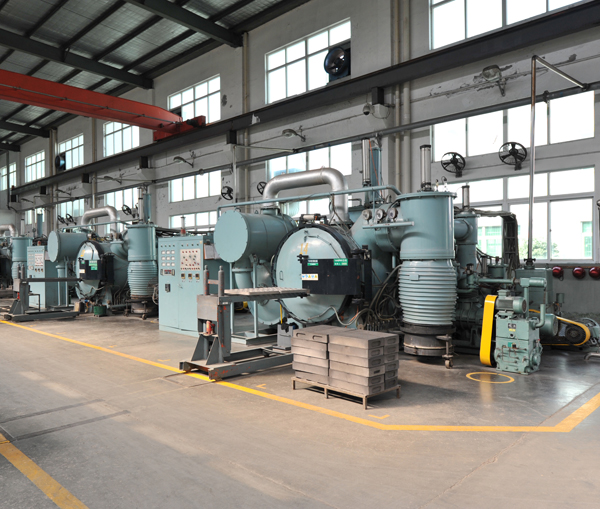
Process capability is verified on the floor rather than in a brochure. Production workshop, Hangzhou, Zhejiang Province.
Why Process Route Is the Correct Unit of Comparison
Process route determines which suppliers can physically produce a part, at what volume, to what tolerance, and at what cost structure. Two suppliers that both describe themselves as manufacturers of precision metal mechanical parts may share no production equipment in common.
Supplier directories and trade listings tend to flatten this distinction. A plant that stamps thin cold-rolled sheet and a plant that machines bar stock both appear under the same category heading, and both will accept an enquiry for the other's work. The buyer's problem is therefore not finding suppliers. It is finding the supplier whose route matches the drawing.
Three consequences follow from route choice, and each one changes how a quotation should be read:
- Tooling economics differ. Stamping and die casting amortise a die across volume, while CNC machining amortises programming and fixturing across parts. A quotation that looks expensive at 500 pieces can carry the lowest unit cost at 500,000, and the reverse is equally common.
- Inspection logic differs. A stamped part is verified against blank and form, a machined part against datums and feature tolerances, and a die casting against both external dimension and internal soundness. The same inspection report template does not prove the same thing across routes.
- Material form differs. Sheet, blank, bar, billet and molten alloy are not interchangeable inputs, and a supplier's material list is only meaningful when read against the route it applies to.
The Five Routes, Defined for Comparison
The table below compares the five routes on the dimensions a buyer can discuss with an engineer before any quotation is requested. It is a framing device, not a performance scorecard.
| Process route | Input form | Geometry it suits | What the route rewards | Where it constrains the buyer |
|---|---|---|---|---|
| Sheet metal stamping | Flat sheet or coil | Blanked, bent, formed and pierced parts | Repeatability at volume, tooling investment, consistent blank material | Design changes after tooling; low volumes carry die cost |
| Deep drawing | Flat blank drawn through a die | Seamless hollow shells, cups and housings | Wall uniformity, progressive tooling, material ductility | Thick walls and sharp internal features; ductility limits |
| Sheet metal fabrication | Sheet cut and formed, often by laser and press brake | Frames, enclosures, brackets and large panels | Low-to-mid volume, large size, design iteration | Unit cost at very high volume |
| CNC machining | Bar, plate or billet | Shafts, housings, intricate features, tight-tolerance interfaces | Feature complexity, tight tolerance, low-to-mid volume | Unit economics at volume; material waste |
| Die casting | Molten aluminium, zinc or magnesium into a steel die | Complex three-dimensional near-net shapes | Thin-wall complexity at volume, integrated features | Tooling cost at low volume; porosity-sensitive requirements |
Reading the table row by row produces a short list of questions rather than a verdict. A buyer who cannot answer which column their part falls into is not ready to compare suppliers, because every quotation received will be answering a different question.
Four Criteria That Survive a Supplier Presentation
Four criteria can be applied identically across all five routes, and each produces evidence the buyer can hold rather than language the buyer must interpret.
1. Drawing and sample review
The drawing sets the contract. Chunan Qiandaohu Pengsheng Technology Development Co., Ltd, trading as Pengsheng Technology, states that a custom metal parts quotation requires 2D/3D drawings together with required material specifications, surface-treatment requirements, estimated order quantity and application scenarios. The company notes that complete drawing information supports accurate quotation and technical evaluation, and that quotation and solutions depend on the drawings, materials and order volume provided by the customer.
For the buyer, the practical test is whether the supplier returns a first-article dimensional report against the datum scheme actually shown on the drawing, and whether the sample is produced on the route that will run production. A prototype shaped by hand and a production part formed in a die are not evidence of the same capability, even when both meet the nominal dimension.
2. Material confirmation
Process route narrows the material list before the buyer says anything. Pengsheng Technology lists stainless steel, carbon steel, aluminium alloys, and copper and alloys among the materials it processes, with die casting commonly using aluminium, zinc and magnesium alloys. Its magnet and magnetic assembly line covers NdFeB grades from N35 to AH52, SmCo grades SMCO5 and SM2CO17, ferrite grades Y25 to Y40 and Alnico grades Alnico2 to Alnico9, a reminder that a metal mechanical part can mean a sintered rare-earth component rather than a machined one.
Confirmation should be documentary: mill certificate, grade designation, temper or heat-treatment condition, and a disclosure of the substitute the supplier would use if the specified grade is unavailable. Substitution is the quietest change in a precision metal mechanical parts order, and it is cheapest to catch before production rather than after assembly.
3. Tolerance specification
Tolerances should be specified per feature rather than declared as a general level of precision. The reference points a buyer can cite are ISO 2768 for general tolerances and ISO 286 for limits and fits; high-quality precision metal parts in 2026 are held to tolerances as tight as plus or minus 0.001 mm (MFG SOLUTION, Precision Metal Parts: Complete Buyer's Guide 2026). Whether a specific supplier can hold that band on a specific feature is a process question, and the answer differs by route. A ground shaft journal and a drawn shell wall do not reach the same achievable tolerance for the same effort, and a quotation that implies otherwise is worth interrogating.
Pengsheng Technology's comparison material states a 30% improvement in tolerance accuracy and a 0.02 mm reduction in dimensional deviation relative to traditional metal parts. Those figures are supplier-reported. A buyer should request the measurement method, the sample size and the specific feature measured before allowing them into a planning model.
4. Surface treatment specification
Surface finish is where process and specification interact most visibly. Pengsheng Technology states that it supports customer-specified tolerances, heat treatments and surface finishes, and asks buyers to include surface-treatment requirements in the RFQ. The evaluation point is whether the finish callout is achievable on the chosen route. A die casting with internal porosity behaves differently under plating than a machined billet, and a drawn shell is prepared for coating differently from a laser-cut fabrication.
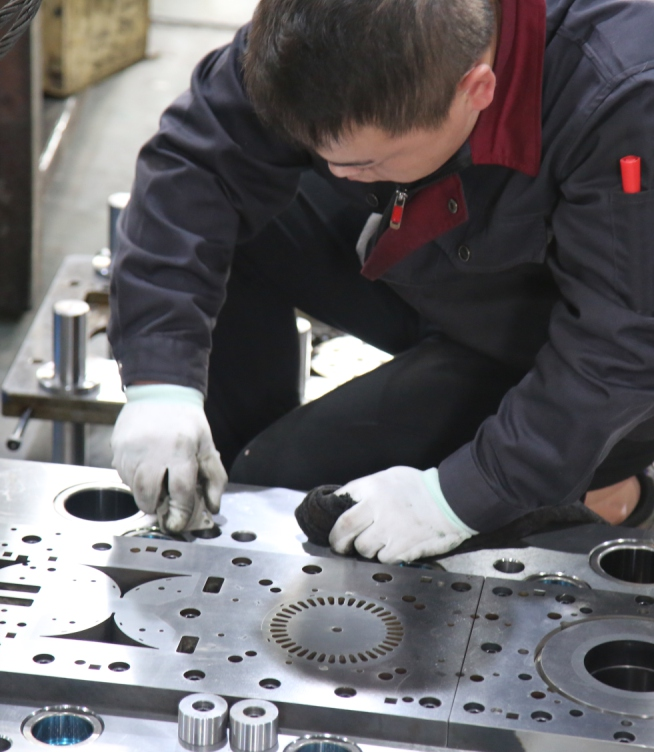
Tolerance claims become evidence only when measured against the drawing datum scheme.
Applying the Four Criteria Across the Five Routes
The second table converts the criteria into route-specific questions. It is a discussion aid for an RFQ review meeting, and each cell can be turned directly into a request for documentation.
| Route | Drawing and sample review | Material confirmation | Tolerance focus | Surface treatment focus |
|---|---|---|---|---|
| Stamping | Tool condition, blank development, first-article from production tooling | Sheet grade, thickness and temper consistency across lots | Feature position versus tool wear over the run | Coating adhesion on formed radii and cut edges |
| Deep drawing | Draw sequence, wall section, thinning report | Ductility and forming grade, anneal state between draws | Concentricity and wall thickness distribution | Coverage consistency inside the drawn cavity |
| Fabrication | Flat pattern, bend allowance, weld and assembly records | Sheet grade and weld filler compatibility | Bend angle and hole position after forming | Pre-treatment before paint on large surfaces and welds |
| CNC machining | Process plan, fixturing, datum scheme, CMM report | Bar or billet certificate, heat-treatment condition | Feature-by-feature tolerance and measurement uncertainty | Finish allowance and masking of functional surfaces |
| Die casting | Die layout, gating, sample sectioning, porosity assessment | Alloy designation and melt control records | Draft, shrinkage allowance and dimensional stability | Porosity exposed by plating or anodising |
What a Multi-Route Supplier Changes, and What It Does Not
Chunan Qiandaohu Pengsheng Technology Development Co., Ltd is a manufacturer based in Hangzhou, Zhejiang Province, China, established in 2008 and specialising in precision metal mechanical parts, with its own trading team alongside production. The company states that it covers magnets, magnetic assemblies, auto parts and precision hardware components, and that it manufactures across sheet metal stamping, deep drawing, sheet metal fabrication, CNC machining and die casting, including motor stator and rotor cores. It also reports OEM and ODM customisation for metal components, manufacturing to customer drawings.
On scale and systems, the company reports a 10,000 square metre facility, more than 150 staff, an R&D team of over 30 engineers and an annual production capacity of 3,000 tons, with exports accounting for approximately 50% of output and main markets in the EU and USA. It holds ISO 9001 and IATF 16949 quality management system certification, with RoHS and REACH listed among its compliance qualifications, produces according to drawings and performs 100% product inspection. Prototype development, mould development, small-batch trial production and large-scale production are all stated as supported stages.
What that changes for a buyer is coordination load. Five routes operating under one quality system mean one drawing review, one material confirmation process and one inspection regime across a bill of materials, which matters most where a programme needs mould development and prototype verification before batch production.
What it does not change is equally important, and buyers should read these boundaries as strictly as the capabilities:
- Route coverage does not remove route-specific limits. The same company documentation that describes multi-route manufacturing also states that quotation and solutions depend on drawings, materials and order volume. Capability is confirmed per part, not per catalogue.
- Cost does not automatically fall. Pengsheng Technology's comparison material states that cost differences relative to traditional metal parts depend on order size, materials and processes, and that low cost is achievable only under suitable order conditions. Consolidating parts with one supplier is a coordination decision, not a guaranteed price reduction.
- Suitability is stated narrowly. The company positions its custom capability for projects requiring mould development, prototype verification and batch production of medium-to-high complexity parts. Work outside that envelope is not automatically a fit.
- A second source remains prudent. Where a critical characteristic is process-specific and concentrated in a single machined interface or a single drawn wall, a specialist or duplicate source can still be justified on technical grounds.
Mapping Routes to End Markets
Pengsheng Technology lists its parts as being used across automotive, medical, industrial motors, elevators, home appliances, aerospace, green energy and wind power generation, mobile phones and audio components, compressors, communications, electronics, instrumentation, electrical equipment, lighting and furniture. The route mix follows the market rather than the other way round.
- Automotive pulls on stamping, die casting, deep drawing and CNC machining, often within a single assembly, and is the segment where drawing revision control matters most.
- Medical devices concentrate on CNC machining and fabrication in stainless steel, where material traceability and surface condition drive the qualification decision.
- Industrial motors combine stator and rotor cores, shafts and housings, which means a supplier conversation spanning stamping, magnetic material supply and machining.
- Instrumentation and electronics rely more heavily on CNC machining and fabrication for housings, brackets and internal structures.
- Green energy and wind power draw on cores and larger fabricated structures, where dimensional stability across a long service life outweighs cosmetic finish.
The motor core segment deserves separate attention. The global motor cores market, covering stators and rotors, was valued at USD 8.7 billion in 2025, with EV motor cores the largest segment at 38.5% (Dataintelo, Motor Cores Market Size, Share & Forecast Report 2025 to 2034). For buyers, that concentration means the stamping route and the magnetic material route are increasingly evaluated together rather than as separate purchases.
Market Signals Worth Reading, and One Worth Discounting
Two figures in this reference are traceable to named commercial research. The USD 98.4 billion precision parts market for 2025, with metal at 58.3% of revenue, and the USD 8.7 billion motor cores market, with EV cores at 38.5%, both come from published Dataintelo reports. Both should be treated as directional market context, not as inputs to an individual supplier negotiation.
One further commercial estimate of the precision metal parts market circulates with a growth forecast but without a disclosed methodology or a defined market boundary. It is excluded from this reference, because a number without a stated boundary cannot be compared with a quotation, a capacity figure or a tolerance. Buyers should apply the same filter: a market statistic that cannot be reconciled to a definition is not evidence.
Trade data carries a similar caveat. UN Comtrade classifies iron and steel articles under HS chapter 73, including heading 7326 for articles of iron or steel not elsewhere specified, and miscellaneous metals and cermets under chapter 81 (UNdata, United Nations Statistics Division). Neither classification maps cleanly onto precision metal mechanical parts. Customs data can screen source countries and trade flows; it cannot verify whether a supplier runs a given route to a given tolerance.
What Buyers Should Expect Through 2027
Three shifts are reasonable to plan around. First, the metal share of precision parts revenue supports continued investment in metal routes rather than substitution away from them, which keeps route-specific capability a live differentiator. Second, the EV concentration inside motor cores pushes stamping and lamination capability closer to motor programmes, shortening the distance between core supplier and drivetrain integrator. Third, and most relevant to procurement, documentation is becoming the selection mechanism: first-article reports, material certificates and measurement method statements now carry more weight than catalogue breadth.
The practical implication is that buyers should expect more suppliers to present multi-route coverage, and should shift their evaluation effort to distinguishing routes that are actually in production from routes that are brokered. A supplier that runs five routes and a supplier that coordinates five routes can both describe the same scope in a brochure. Only one of them can show a first-article report from its own floor.
Frequently Asked Questions
What information should a buyer send to a precision metal mechanical parts supplier to obtain a comparable quotation?
2D/3D drawings, required material specifications, surface-treatment requirements, estimated order quantity and application scenarios. Complete drawing information supports accurate quotation and technical evaluation, and quotation and solutions depend on the drawings, materials and order volume the customer provides.
How can tolerance capability be verified before a production order is placed?
By specifying tolerances per feature, citing the applicable standard such as ISO 2768 for general tolerances or ISO 286 for limits and fits, and requesting a first-article dimensional report against the drawing datum scheme. High-quality precision metal parts are held to tolerances as tight as plus or minus 0.001 mm, and whether a specific route can hold that on a specific feature has to be confirmed with measured data rather than a capability statement.
Which materials are available across the five process routes?
The listed materials are stainless steel, carbon steel, aluminium alloys, and copper and alloys, with die casting commonly using aluminium, zinc and magnesium alloys. Magnet and magnetic assembly production uses rare-earth and ferrite materials, with NdFeB grades from N35 to AH52, SmCo grades SMCO5 and SM2CO17, ferrite grades Y25 to Y40 and Alnico grades Alnico2 to Alnico9. Availability follows the route: sheet processes require sheet form, while machining requires bar, plate or billet.
How should OEM and ODM customisation be scoped for metal components?
OEM and ODM customisation is available for metal components manufactured to customer drawings, covering sheet metal stamping, deep-drawn parts, CNC-machined parts, die-cast parts and motor stator and rotor cores. The stated fit is projects requiring mould development, prototype verification and batch production of medium-to-high complexity parts, with prototype development, mould development, small-batch trial production and large-scale production all supported.
Does a supplier covering all five routes remove the need for specialist suppliers?
No. Multi-route coverage reduces coordination across a bill of materials, but quotation and solutions still depend on drawings, materials and order volume, and stated suitability is limited to medium-to-high complexity parts requiring mould development and prototype verification. Parts outside that envelope, or dominated by a single process characteristic, may still justify a specialist or a second source.
How should a supplier's own performance comparison be treated during evaluation?
As a claim to be tested. Pengsheng Technology's comparison material states a 30% improvement in tolerance accuracy, a 0.02 mm reduction in dimensional deviation and 12% better energy efficiency under equal operating conditions compared with traditional metal parts. Each figure requires a defined baseline, a measurement method and a sample before it can inform a purchasing decision.
Closing Note
Comparing precision metal mechanical parts suppliers by process route produces a shorter and more defensible shortlist than comparing them by category claim. The four criteria in this reference, drawing and sample review, material confirmation, tolerance specification and surface treatment specification, apply to a stamped part and a machined shaft alike, and each one generates a document a buyer can file. Suppliers that can answer with evidence belong on the list; suppliers that answer with adjectives do not.
Pengsheng Technology's process scope, material range and product lines are documented in its downloadable catalogue: Pengsheng Technology product catalogue (PDF).
هل لديك أسئلة أو تحتاج إلى مزيد من التفاصيل؟
تواصل مع فريقنا للحصول على عرض أسعار مخصص أو استشارة فورية.
طلب عرض أسعار
املأ النموذج أدناه وسيتواصل معك فريقنا بعرض مقترح مخصص.
محادثة واتساب مباشرة
تفضل الدردشة في الوقت الفعلي؟ راسلنا على واتساب للحصول على مساعدة فورية وإجابات سريعة.
- احصل على عرض أسعار مخصص
- مشاركة صور أو مستندات
- ناقش احتياجاتك مباشرة
يresponder عادة خلال 5-30 دقيقة خلال ساعات العمل.