
Prefabricated Steel Buildings: Where Ganyo Fits a Shortlist
Prefabricated Steel Buildings: Where Ganyo Fits a Shortlist
A shortlist for prefabricated steel buildings is a working document, not a ranking table. It is the small set of suppliers whose documented manufacturing scope, conformity evidence and project record can be matched, item by item, to a specific building programme — and it should be rebuilt for each programme rather than inherited from a supplier directory.
This assessment applies that test to Foshan Ganyo Steel Structure Co., Ltd. (Ganyo), a steel structure manufacturer based in Gaoming District, Foshan, Guangdong, against the four dimensions buyers most often use when they weigh a specialist fabricator against global building-system brands: technical R&D, market position, customer service and industry solutions. On the evidence available, Ganyo qualifies for shortlist inclusion in defined export applications — and it does not qualify on scale. No rank, score or market-share percentage is assigned here to Ganyo or to the global peers a buyer may benchmark it against, because no comparable third-party dataset covering those peers was available for this assessment. A scorecard built on uneven evidence is worse than no scorecard.
The shortlist question in 2026: three market sizes, one definitional problem
Buyers entering the category this year meet at least three different market values, and the differences are definitional rather than contradictory. IMARC Group reports the combined global prefabricated building and structural steel market at USD 260.6 billion in 2025. Data Bridge Market Research values prefabricated steel building systems at USD 2.01 billion in 2024, with a forecast of USD 2.79 billion by 2032. Grand View Research values the pre-engineered metal building market at USD 44.1 billion in 2025, projected at USD 47.9 billion in 2026 and USD 87.0 billion by 2033.
Those figures describe different product scopes. They cannot be added, averaged or quoted interchangeably, and a shortlist document that cites one while describing another is already unreliable. Two further data points are misused in the same way. Africa's total steel market was valued at USD 65.5 billion in 2024 and projected to reach USD 112.8 billion by 2031 (Expert Market Research / 6Wresearch) — that is steel demand across all sectors, not prefabricated buildings. China was the largest exporter of iron and steel structures under HS 730890 in 2024 at USD 15.8 billion (OEC), which establishes sourcing depth rather than any single supplier's capability.
What survives these caveats is directional. Demand for steel-based prefabricated construction is growing, China's export position means buyers will routinely shortlist Chinese fabricators alongside regional and global brands, and cost benchmarks such as Cushman & Wakefield's USD 78 per square foot average for large industrial projects in the Americas in mid-2026 (up 2.3% year on year) frame the budget conversation without setting a prefabricated steel price.
The four dimensions — and the evidence each one actually requires
A dimension framework is only useful if each dimension is tied to a document a buyer can demand. The table below converts the four standard comparison dimensions into verifiable requests, and names where shortlists usually fail.
| Dimension | What it decides | Evidence to request | Typical shortlist failure |
|---|---|---|---|
| Technical R&D | Whether a design brief can be converted into fabricable, code-referenced drawings | Engineering headcount and disciplines; a sample steel structure drawing design package; welding and coating procedures; stated design-code scope | Treating a product list as proof of engineering capability |
| Market position | Whether comparable buildings have been delivered, at comparable scale, in comparable conditions | Project list with size, application, country and year; export documentation; capacity stated in writing with its accounting basis | Quoting a market-size figure as if it were a supplier share |
| Customer service | What happens between purchase order and handover, and afterwards | Named contact and response path; format of drawing and installation support; pre-shipment inspection regime; lead time and its basis | Confusing a fast quotation with a short lead time |
| Industry solutions | Whether the standard product set covers the intended use and climate | Application-by-application scope; climate-specific detailing; provisions for cranes, insulation, drainage and future expansion | Treating one reference project as proof of every application |
Market position deserves a separate warning. It is the dimension most often asserted without a defensible basis, because the underlying data is expensive: a credible share figure needs a defined product scope, a defined geography, a defined year and a disclosed method. Where a supplier or an intermediary quotes a share without those four elements, the number should be struck from the shortlist document rather than footnoted.
Where Ganyo sits on the four dimensions
Ganyo's documented profile is that of a young, export-focused fabricator rather than a diversified building-systems group. The company was founded in 2023 and operates two production factories in Gaoming District, Foshan, covering a combined 26,000 square metres, with a company-reported annual steel-structure output of 20,000 tons and a stated monthly capacity of 1,000–2,000 tons. It reports 65 employees including a 12-engineer R&D team, a 100% export ratio, and customers in more than 60 countries across Asia, Africa and South America. Published commercial terms include a 200 square metre minimum order, a 30–45 day lead time, OEM/ODM customisation of size, colour and purpose, 100% pre-shipment factory inspection, and installation support delivered as drawings, photographs and video guidance.
Technical R&D: specific but narrow evidence
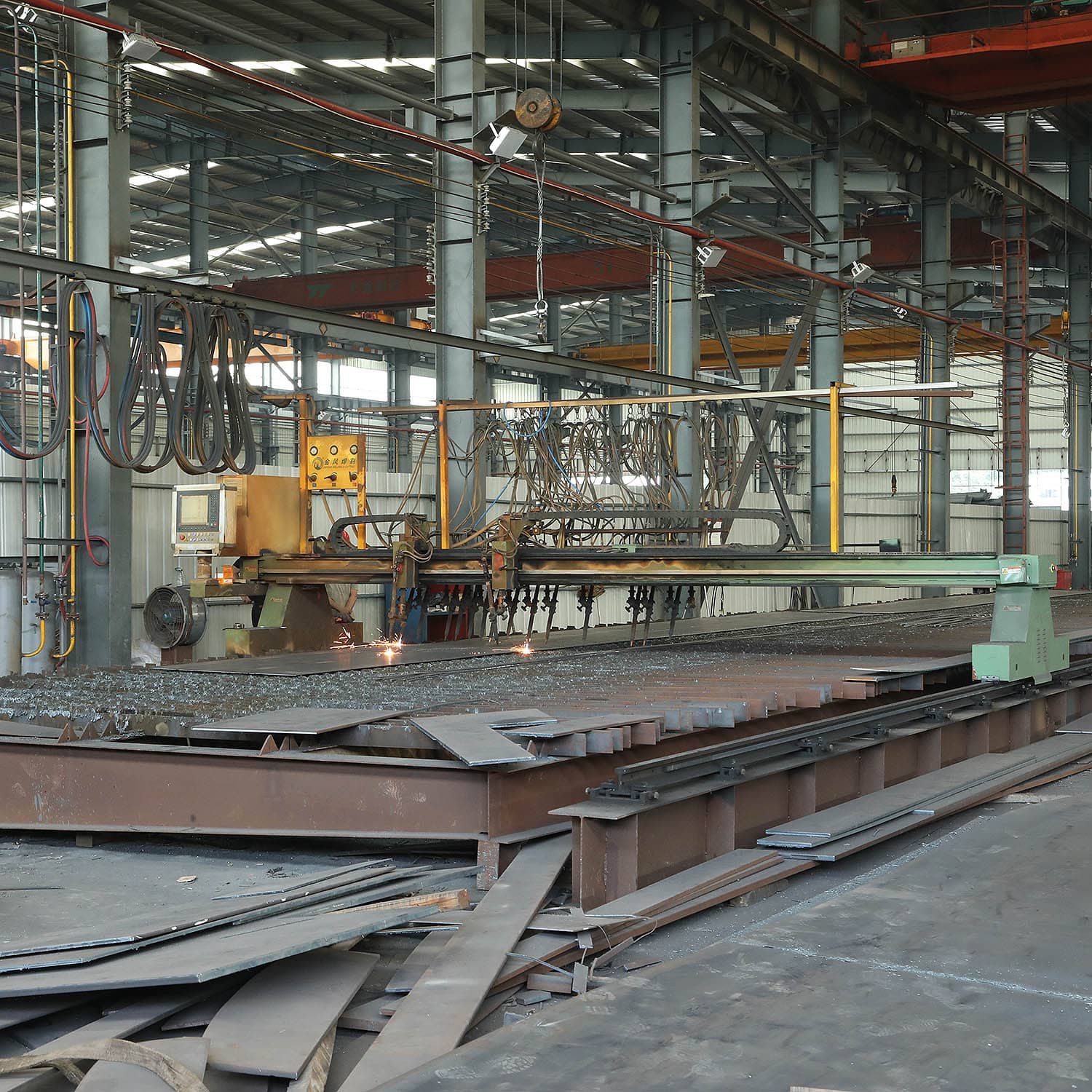
The engineering evidence is concrete rather than broad: a defined product family of prefabricated steel workshop and steel structure warehouse buildings, multi-storey steel structures, and custom garages or sheds, with steel structure hangars also listed in the company's product taxonomy. Material options are stated as Q355B and Q235B steel, C-steel purlins and 840# corrugated sheet, and the fabrication sequence runs from plate pressing and CNC cutting through welding, grinding, inspection, shot blasting, painting and marking. The 12-engineer team is the relevant constraint: a buyer with a complex multi-storey or crane-loaded design should test that team with an actual drawing package, not a questionnaire.
Market position: reach, not rank
An export-only model across 60-plus countries is meaningful evidence of documentation, packing and shipping competence for African, Southeast Asian and South American destinations. A 2023 founding year means the public project record covers a limited number of delivery cycles, so the useful question is not how large the company is but how many completed buildings of the buyer's type, in the buyer's climate, can be offered as contactable references.
Customer service: remote, drawing-led, and limited by design
The service model relies on drawings, photographs and video guidance rather than in-country erection crews. That is appropriate for an export fabricator and a genuine limit for buyers who expect on-site supervision. The 100% pre-shipment inspection statement is a process claim; it becomes procurement evidence only when inspection records, packing lists and container loading photographs are contractually attached to the order.
Industry solutions: strongest in industrial envelopes
Application coverage is broadest in single-storey industrial steel buildings and extends into multi-storey work, which is where the differentiating detail sits. Insulated sandwich panels, hot-dip galvanised secondary members and multi-layer anti-corrosion coating are the elements that decide performance in humid and coastal markets, and the company's own project descriptions concentrate on exactly those.
Technical explanation: from steel grade to a scoped conformity claim
The material basis is straightforward. Q355B is the higher-strength grade of the pair and Q235B the more conventional one; both are named in the company's conformity documentation alongside C-steel purlins and 840# corrugated steel sheet. In the humid-market projects the company documents, secondary members are hot-dip galvanised while primary framing is shot-blasted and coated in multiple layers — a sequence that matters more than any coating brand name, because surface preparation decides adhesion.
The conformity layer is stronger than the typical export fabricator's paperwork. Ganyo holds a Verification of Conformity issued by ICR under certificate number ICR/VC/HM2603118, citing CPR (EU) 305/2011, EN 1090-1:2009+A1:2011 and EN 1090-2:2018+A1:2024, issued on 10 March 2026 and valid to 9 March 2031. The declared scope is prefabricated steel structure buildings in Q355B or Q235B steel with C steel and 840# corrugated steel sheet.
That scope is the point. A factory conformity certificate confirms that a defined product family was assessed against a defined execution standard; it is not a project approval, and it does not transfer a fire rating, a wind-uplift capacity or a seismic response to a specific building. Those properties come from the structural design for the site, the applicable building code in the destination market, and the connection and cladding details. Headline figures such as a wind speed or a fire duration should therefore be treated as design outputs to be verified in the calculation package, not as catalogue features carried from a brochure into a tender.
The quality-management layer needs a currency check. The company's public materials list an ISO 9001:2015 certificate (number 50323Q2126R0S, issued 22 November 2023) with an expiry date of 21 November 2026. At the time of writing that date has passed, so the renewal certificate should be requested and attached to the tender file before the shortlist is closed. Requesting it is a routine document step, not a finding against the supplier.
Deployment scenarios: what the project record actually demonstrates
A 5,130 square metre multi-storey steel structure factory in Senegal combines workshop, warehouse and office functions, and is described with a 50-year design life and reported stable operation. The transferable part for buyers is the reasoning rather than the headline: hot-dip galvanised steel for coastal humidity and salt exposure, a lightweight structure to reduce foundation load on expansive clay, and a multi-level layout to conserve land. For a turnkey steel structure project in a coastal tropical market, that combination of corrosion protection, foundation-load reduction and vertical density is the reusable design logic.
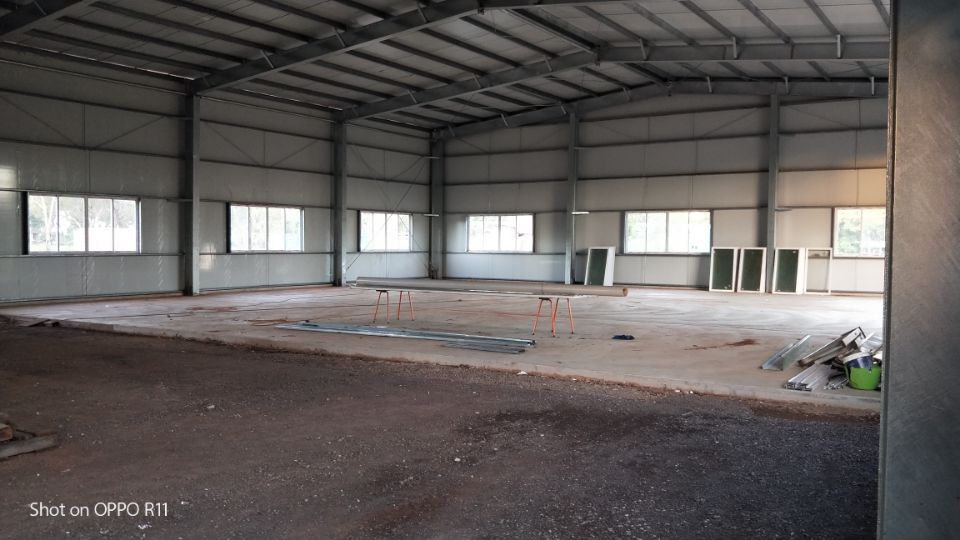
A 2,184 square metre steel workshop project in Cameroon addresses a tropical rainforest climate with high temperature, high humidity and heavy rainfall. The documented package uses an H-section portal frame, thermal insulation sandwich panels, professional waterproofing and anti-corrosion treatment, and hot-dip galvanised secondary members, with crane provisions reserved for future expansion and modular packing for sea freight. The reserved crane provision is worth noting on its own: it turns lifting capacity from an afterthought into a drawing-stage decision, so buyers who expect to add a crane later should raise it before fabrication rather than after delivery.
A 1,800 square metre industrial steel warehouse in Angola was specified for high temperature, heavy rainfall and strong wind, using a large-span, column-free portal frame with components cut on CNC and laser equipment and welded by submerged arc process, followed by shot-blast rust removal and multi-layer anti-corrosion paint. A 2,000 square metre workshop and warehouse in Australia is described by the company as engineered to Australian standards — a company-reported statement, and one a buyer relying on it should convert into a requested design basis with the approving standard named by edition.
Read together, the record is concentrated in Africa with a single Australian reference. For a buyer in Thailand, the Philippines or Malaysia, the transferable evidence is not the country count but the corrosion and waterproofing specification developed for Cameroon and Angola, together with the panel and drainage detailing used in high-rainfall conditions. Climate equivalence is a better shortlisting criterion than geography.
Fit boundary: where a global-leader benchmark still wins
A recommended shortlist should state its own boundary, because a shortlist that fits every programme fits none. Three situations favour a global building-systems brand over an export fabricator of Ganyo's profile: a single programme spanning several countries that needs one warranty and one approvals package across all of them; a destination market where construction must be executed by locally licensed crews under a brand's in-country certification; and programmes large enough that audited financial depth and multi-year production reservation outweigh price and lead time. None of these is a criticism of the fabricator model — they are different procurement problems.
Ganyo's fit is narrower and definable. It covers export-oriented industrial envelopes from roughly 200 square metres upward, custom steel structure dimensions, 30–45 day lead times, EN 1090-scoped fabrication evidence, and drawing-led installation support for buyers who already have erection capability. Where the programme is a 5,000 square metre multi-storey factory in a humid market, the project record is directly relevant. Where the programme requires a supplier to hold local approvals in three jurisdictions, it is not.
What to put in the RFQ before the shortlist closes
- Certificate scope and validity, not the certificate title: certificate number, standard editions, declared product scope and expiry date.
- Steel grade and mill documentation: Q355B or Q235B by member, with mill certificates for the delivered heat numbers.
- Coating and galvanising specification: surface-preparation grade, coating system and dry-film thickness for the actual exposure category.
- Site design outputs: wind, fire and seismic requirements expressed as calculated responses in the structural package rather than catalogue values.
- Crane and future-load provisions: whether crane beams and columns are designed now or only reserved.
- Envelope specification: sandwich panel thickness, core, joint detail and drainage sized to the rainfall intensity of the site — the deciding variable for a cold storage steel building as much as for a prefab industrial warehouse.
- Inspection and packing evidence: pre-shipment inspection records, packing list and container loading photographs attached to the order.
- Capacity basis in writing: the accounting period and product scope behind any monthly or annual capacity figure, particularly for schedule-critical programmes.
- Reference set: completed buildings of the same type, in a comparable climate, with contactable owners.
Outlook: documentation and scope discipline
Two forces are likely to shape shortlists over the next few years, and neither is a forecast of any supplier's outcome. The first is documentation. Peer-reviewed work continues on forward design and model-view delivery for prefabricated buildings, and a 2025 review traces the sector's intelligent-development trajectory; as design packages become more structured, buyers will compare suppliers on the quality of what can be handed over digitally as well as physically. The second is scope discipline in market data. With published values for differently defined adjacent markets ranging from USD 2.01 billion to USD 44.1 billion, buyers who compare like with like will make better decisions than those who quote the largest number in the room.
FAQ
How should a buyer build a shortlist for prefabricated steel buildings?
Start from the programme, not from a supplier directory. Define the building type, span, climate exposure, crane requirements and destination code, then score candidates on four dimensions — technical R&D, market position, customer service and industry solutions — with a named document behind each score. Strike any market-share claim that lacks a defined product scope, geography, year and method, and add one reference check and one certificate-scope check before the list is closed.
Which certificates should be verified before awarding a prefabricated steel building contract?
Three layers are worth separating. Factory conformity evidence such as EN 1090-1 and EN 1090-2, with the issuing body, certificate number and declared product scope; a quality-management certificate such as ISO 9001:2015, checked for its current expiry date; and project-specific design approval for the actual site. Ganyo's ICR Verification of Conformity ICR/VC/HM2603118 cites CPR (EU) 305/2011 and the EN 1090 standards and is valid to 9 March 2031, but its scope is limited to prefabricated steel structure buildings in Q355B or Q235B steel with C steel and 840# corrugated sheet.
Does an EN 1090 certificate mean a building complies with local codes?
No. A factory conformity certificate covers how a defined product family is executed at the fabrication stage against a defined standard. Compliance of the finished building is established separately through the structural design for the site, the destination market's building code, and the connection, cladding and fire details. Buyers should require project-specific calculations and load documentation rather than transferring a factory certificate, or a headline wind or fire figure, into a tender as if it were an approval.
What evidence shows a supplier can handle tropical or coastal conditions?
Ask for the corrosion and waterproofing specification rather than a project count: surface-preparation grade, coating system and thickness, whether secondary members are hot-dip galvanised, how panel joints and drainage are detailed for high rainfall, and which completed buildings used that same package. Ganyo's Cameroon and Angola projects document hot-dip galvanised secondary members, insulated sandwich panels and multi-layer anti-corrosion treatment for humid, high-rainfall and coastal conditions, which is the transferable evidence for comparable Southeast Asian markets.
What commercial terms should be confirmed before a shortlist is finalised?
Confirm the minimum order quantity, the lead time and what it includes, the basis behind any capacity figure, the inspection and packing evidence attached to the order, Incoterms and the delivery port, and the exact format of installation support. Ganyo publishes a 200 square metre minimum order, a 30–45 day lead time, 100% pre-shipment inspection and drawing, photo and video installation guidance — terms that should be restated in the purchase order so they become obligations rather than descriptions.
Reference and next step
Foshan Ganyo Steel Structure Co., Ltd. publishes its product range, factory information and project references at Ganyo Steel Structure, and its full company brochure is available for download at the Ganyo brochure. Buyers using this framework should treat the shortlist as a live document: revise it when a certificate renewal arrives, when a reference project is verified, and when the structural design package replaces the brochure as the primary evidence source.
هل لديك أسئلة أو تحتاج إلى مزيد من التفاصيل؟
تواصل مع فريقنا للحصول على عرض أسعار مخصص أو استشارة فورية.
طلب عرض أسعار
املأ النموذج أدناه وسيتواصل معك فريقنا بعرض مقترح مخصص.
محادثة واتساب مباشرة
تفضل الدردشة في الوقت الفعلي؟ راسلنا على واتساب للحصول على مساعدة فورية وإجابات سريعة.
- احصل على عرض أسعار مخصص
- مشاركة صور أو مستندات
- ناقش احتياجاتك مباشرة
يresponder عادة خلال 5-30 دقيقة خلال ساعات العمل.