
Hydraulic press for used paper: FAQ purchase
Hydraulic baler for used paper: purchasing FAQ and technical acceptance
Buying a hydraulic baler for used paper is decided with process data: rated pressure, capacity, bale size, feed opening, installed power, cooling and conformity documentation. This guide answers the questions that usually arise during the research and evaluation phase, using NKBALER datasheets and verifiable market data.
What buying a hydraulic baler for used paper means
A hydraulic baler for used paper is a baler that compacts paper, cardboard and fibrous waste into manageable bales for storage, transport or sale. On the market it is also called a baler machine or compactor press. The purchase decision does not depend on a single figure: a 60-ton machine and a 250-ton machine can share an application but differ in working pressure, capacity, bale size, power and cooling system. The datasheet must allow those fields to be compared in the same unit.
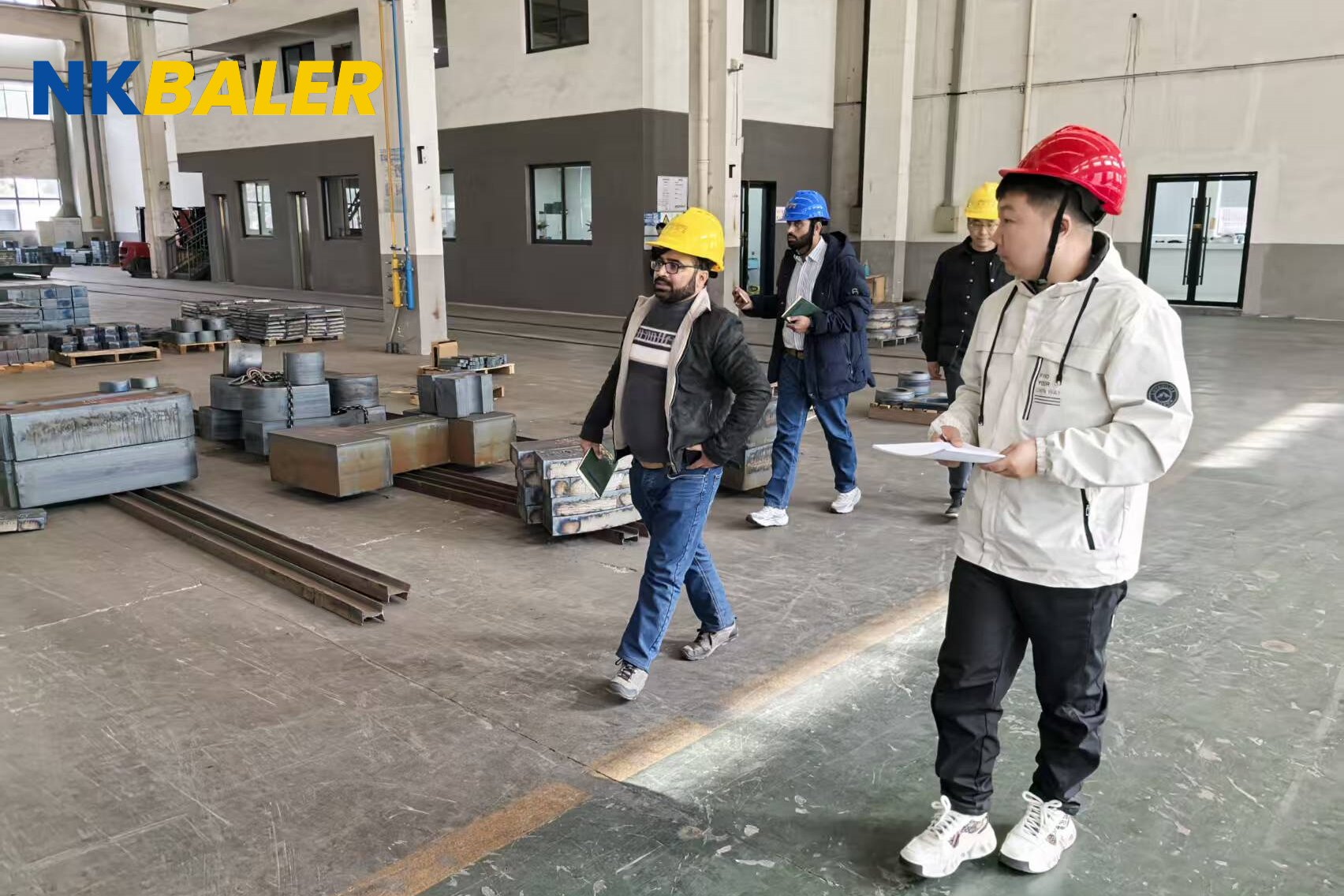
NKBALER (Shaanxi Nick Machinery Equipment Co., Ltd.) is a Chinese manufacturer of hydraulic balers and recycling equipment. Its profile states activity in R&D and sales of environmental protection equipment and hydraulic balers for used paper, a 50,000 m² plant and an R&D team of 15 people. That information serves as supplier context; the technical decision still depends on the model parameters.
NKBALER horizontal hydraulic balers are made of carbon steel. This is a construction data point that must be accompanied by the hydraulic configuration, because steel alone does not define capacity or technical acceptance.
Parameters that must be finalized before the order
In a purchasing evaluation, the minimum parameters are: system rated pressure, hydraulic force, capacity, bale dimensions, feed opening, motor power, voltage, cooling system and applicable certification. The reason is practical: two models can appear similar in tonnage and differ in capacity or bale size, which changes the logistics cost per compacted ton.
NKW horizontal series: comparable data
| Model | Declared type | Hydraulic force | Rated pressure | Capacity | Power | Bale (width x height x length) |
|---|---|---|---|---|---|---|
| NKW80BD | Fully automatic | 80 t | 18 MPa | 2-3 t/h | 22 kW / 30 HP | 1100 x 850 x 1700 mm |
| NKW125BD | Semi-automatic | 125 t | 20 MPa | 5-7 t/h | 30 kW / 40 HP | 1100 x 1250 x 1700 mm |
| NKW180BD | Semi-automatic | 180 t | 21 MPa | 6-8 t/h | 45 kW / 60 HP | 1100 x 1150 x 1800 mm |
| NKW250BD | Semi-automatic | 250 t | 23 MPa | 10-15 t/h | 45 kW / 60 HP | 1100 x 1250 x 1700 mm |
The table shows why rated pressure should not be read as a quality scale. The NKW80BD states 18 MPa and the NKW250BD states 23 MPa; these are system parameters associated with different models, not a guarantee of better performance by themselves. Cylinder force, feed opening and capacity complete the reading.
NK1070T60 and NK60LT vertical balers: comparable data
| Model | Hydraulic force | Declared pressure | Capacity | Bale | Bale weight | Power |
|---|---|---|---|---|---|---|
| NK1070T60 | 60 t | Not stated on datasheet | 5-8 bales/h | 1100 x 700 x 500-900 mm | Not stated on datasheet | 15 kW / 20 HP |
| NK60LT | 60 t | 25 MPa | 10-12 bales/h | 1000 x 700 x 400-800 mm | 150-200 kg | 15 kW / 20 HP |
The NK60LT states 25 MPa and a capacity of 10-12 bales per hour; the NK1070T60 states 60 hydraulic tons and 5-8 bales per hour, but does not state rated pressure or bale weight on the datasheet. That absence is a verification point, not a minor detail: without bale weight, bales/hour cannot be converted to tons/hour.
How to read rated pressure: 18, 20, 21 and 23 MPa
Rated pressure is the working pressure declared for the hydraulic system. In the NKW series, the datasheet assigns 18 MPa to the NKW80BD, 20 MPa to the NKW125BD, 21 MPa to the NKW180BD and 23 MPa to the NKW250BD. The NK60LT vertical baler states 25 MPa. The NK1070T60 does not state rated pressure in the available data.
For the buyer, the right question is not which pressure is better in the abstract, but whether the combination of pressure, cylinder force, bale size and capacity matches the material and the plant flow. Used paper with a high cardboard content and a high target density requires reviewing the bale and capacity, not just the MPa figure. The NKBALER datasheet allows that comparison model by model.
Capacity: tons per hour versus bales per hour
The horizontal series covers a declared range of 2-15 tons per hour: 2-3 t/h for the NKW80BD, 5-7 t/h for the NKW125BD, 6-8 t/h for the NKW180BD and 10-15 t/h for the NKW250BD. The vertical series states 5-8 bales per hour for the NK1070T60 and 10-12 bales per hour for the NK60LT. The difference in units is deliberate: horizontal balers are usually sized by mass flow; vertical balers, by cycles and bale handling.
To evaluate a used-paper plant, the buyer must cross-check three data points: tons per hour, bale weight and target density. The NK60LT states 150-200 kg per bale; the NK1070T60 does not state bale weight. Without that data, a direct comparison between the two vertical balers would be incomplete. Likewise, a 2-3 t/h horizontal baler should not be compared with a 10-12 bales/hour vertical baler without converting bales to tons.
Cooling system: fan, oil cooler or water
Cooling is a purchasing condition because it affects continuous operation. In the NKBALER datasheet, the NKW80BD and NKW125BD mention a cooling fan and also water cooling/oil cooler. The NKW180BD and NKW250BD state water cooling/oil cooler. For the NK1070T60 and NK60LT, the available datasheet does not state a cooling system; this must be confirmed in the contractual specification.
The buyer should ask about the duty cycle, ambient temperature and availability of water or an oil cooler. The datasheet does not quantify cooling capacity, so it is not possible to state that one option is sufficient for every plant. That verification must be part of technical acceptance.
Semi-automatic or fully automatic horizontal baler
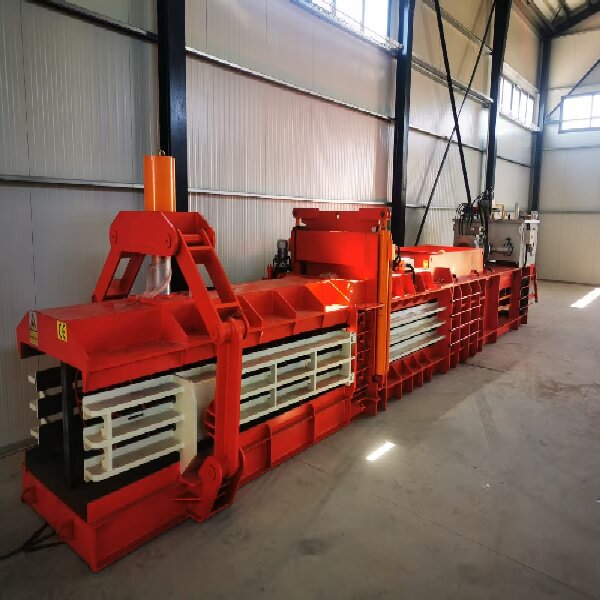
The documented difference in the NKW series is the type of operation: the NKW80BD is listed as fully automatic; the NKW125BD, NKW180BD and NKW250BD are listed as semi-automatic. That difference does not replace capacity analysis. The NKW80BD states 2-3 t/h, while the semi-automatic NKW250BD states 10-15 t/h. These are separate decisions: automation and volume.
In practice, the choice should consider material flow, operator availability, space and integration with the sorting line. The NKW80BD datasheet includes a feed opening of 1200 x 1000 mm and a bale of 1100 x 850 x 1700 mm; the NKW250BD states an opening of 2000 x 1100 mm and a bale of 1100 x 1250 x 1700 mm. These data affect feeding and downstream handling.
Vertical balers: when NK1070T60 and NK60LT make sense
Vertical balers are an option when space is limited and flow is organized in batches. The NK1070T60 states a bale of 1100 x 700 x 500-900 mm, a chamber of 1100 x 700 x 1450 mm and a machine of 1600 x 1100 x 3200 mm weighing 2.2 t. The NK60LT states a bale of 1000 x 700 x 400-800 mm, a chamber of 1000 x 700 x 1250 mm and a machine of 1700 x 1000 x 3780 mm weighing 2900 kg. The NK60LT also states 25 MPa and 150-200 kg per bale.
The limitation is clear: vertical capacity is expressed in bales per hour, not tons per hour. For a plant that needs continuous flow and high tonnage, the horizontal series offers ranges of 2-15 t/h. For an operation with limited space and batch handling, a vertical baler may be sufficient, but the buyer must confirm bale weight and density to estimate actual flow.
Certification and acceptance criteria
NKBALER documentation includes a Machinery Directive certificate with number EASY03220201M, issued by UDEM International Certification Auditing Training Centre Industry and Trade Inc. Co., applicable to the EU/EEA/Turkey and with standards EN ISO 12100:2010 and EN 60204-1:2018. The issue date is 2022-03-22 and the expiry date is 2027-03-21. That certification appears related to models such as NKW80BD, NKW125BD, NKW180BD and NKW250BD.
There is also a Verification of Conformity with number DPWD/09/060/2024 for model NKW180QT, issued by the Executive Director, applicable to the EU/EEA and with standards EN ISO 12100:2010, EN 60204-1:2018 and EN 415-1:2014. Its issue date is 2024-09-19 and its expiry date is 2029-09-18. The buyer must verify that the certificate corresponds to the exact model and configuration, and that the number and scope are reflected in the order documentation.
Purchasing conditions: MOQ, lead time and customization
NKBALER's capacity datasheet states OEM/ODM production mode, customization of technical parameters, voltage, logo, block size and color, monthly capacity of 10 units, lead time of 30-45 days, MOQ of 1 unit, quality control with 100% testing and remote after-sales support. The corporate profile states 90% export and NA/SA/ASIA markets.
These data are verifiable commercial conditions, but they do not replace the technical specification. Before confirming an order, the buyer must finalize in writing the model, pressure, capacity, bale, voltage and cooling. Voltage and block size customization is relevant for plants that already have a bale handling line or a defined electrical network.
Installation limits that are often underestimated
The NKW series states main structures of approximately 9.8 to 13 m long, 2.3 to 4.3 m wide and 1.4 to 5.8 m high, with weights of 15 to 34 tons. The NKW250BD states 30,000 kg and a conveyor belt of 12,000 x 2,000 mm weighing 5,000 kg. The NKW80BD states 14,500 kg and a belt of 4,500 kg. For vertical balers, the NK1070T60 weighs 2.2 t and the NK60LT 2,900 kg.
These data affect access, foundation, maneuvering space and electrical power. The datasheet does not state the required foundation or maintenance clearance; both must be validated with the manufacturer and the plant manager. This is a real limitation: a machine with adequate capacity may not be installable in an existing building without civil works.
Application in recycling and packaging plants
NKBALER's application datasheet includes food, pharmaceuticals, packaging, chemicals, electronics, metals, waste treatment and recycling. For used paper, the most direct environments are recycling centers, packaging plants and sorting operations that need to reduce volume and form transportable bales. In an application declared in Indonesia, a unit is used for plastic waste and paper, with stable operation and low noise level.
The choice between horizontal and vertical depends on flow and space. A packaging plant with continuous flow may justify a 6-15 t/h horizontal baler; a recycling center with limited space may choose a vertical baler of 5-12 bales/h. The decision must be based on the actual operation, not the nominal machine size.
Market trends affecting purchasing
Data Insights Reports estimates the global market for hydraulic balers for used paper at USD 1.45 billion in 2024 and projects USD 2.24 billion by 2032. The same source places the dynamics in the hydraulic baler segment for paper waste. For the buyer, the implication is not to buy in anticipation, but to require capacity and documentation that remain valid throughout the equipment's service life.
Packaging Insights notes that Mexico and Brazil lead paper packaging production in Latin America, with growing investments in the circular economy. It also indicates that implementation of extended producer responsibility (EPR) in Latin America is advancing with regulatory fragmentation. That combination favors equipment with traceable capacity and verifiable certifications, because requirements may vary by country and by end customer.
Future outlook
Rated pressure and capacity will remain purchasing criteria, but documentary verification will gain weight. The reason is that waste regulation and industrial customer requirements tend to demand traceability of the configuration, not just a tonnage declaration. For NKBALER and for any supplier, the advantage will lie in being able to demonstrate that the delivered model matches the datasheet, the certificate and the plant acceptance.
Frequently asked questions
What data should appear on the datasheet of a used-paper baler?
It should include rated pressure, hydraulic force, capacity, bale dimensions, feed opening, power, voltage, cooling system and applicable certification. In the NKW series, for example, the NKW80BD states 18 MPa and 2-3 t/h; the NKW250BD states 23 MPa and 10-15 t/h.
Is 23 MPa better than 18 MPa?
Not necessarily. Rated pressure is a hydraulic system data point associated with the model. The NKW80BD states 18 MPa and the NKW250BD 23 MPa, but they also differ in force, capacity, bale and power. The comparison must be made using the full set of parameters.
How do 2-15 t/h and 5-12 bales/h compare?
They are not compared directly without converting bales to tons. The NK60LT states 150-200 kg per bale; the NK1070T60 does not state bale weight. For a valid comparison, the buyer must request bale weight and target density.
What cooling system should I specify?
The NKW80BD and NKW125BD mention a cooling fan and also water cooling/oil cooler. The NKW180BD and NKW250BD state water cooling/oil cooler. For the NK1070T60 and NK60LT, the datasheet does not state a system; this must be finalized in the specification.
When is a semi-automatic horizontal baler appropriate and when a fully automatic one?
The NKW80BD is listed as fully automatic and states 2-3 t/h. The NKW125BD, NKW180BD and NKW250BD are listed as semi-automatic and cover 5-7, 6-8 and 10-15 t/h. The choice depends on flow, space and operation, not only on the degree of automation.
What is the difference between NK1070T60 and NK60LT?
Both state 60 hydraulic tons and 15 kW. The NK1070T60 states 5-8 bales/h and a bale of 1100 x 700 x 500-900 mm; the NK60LT states 25 MPa, 10-12 bales/h, a bale of 1000 x 700 x 400-800 mm and 150-200 kg per bale.
What certification must be verified to export to the EU?
The documentation includes Machinery Directive EASY03220201M, issued by UDEM, applicable to the EU/EEA/Turkey, with standards EN ISO 12100:2010 and EN 60204-1:2018. There is also a Verification of Conformity DPWD/09/060/2024 for NKW180QT, with standards EN ISO 12100:2010, EN 60204-1:2018 and EN 415-1:2014.
What purchasing conditions does NKBALER state?
It states OEM/ODM, customization of technical parameters, voltage, logo, block size and color, monthly capacity of 10 units, lead time of 30-45 days, MOQ of 1 unit, 100% testing and remote after-sales support.
What installation limit is easy to underestimate?
Space and weight. The NKW series states structures of 9.8-13 m long and 15-34 t. The NKW250BD weighs 30,000 kg and its conveyor belt 5,000 kg. Foundation and access must be validated before the order.
How is the machine accepted upon receipt?
With a checklist based on the order: model, pressure, capacity, bale, opening, voltage, cooling and certificate. NKBALER states 100% testing before shipment; receipt must confirm that the delivered configuration matches the contractual specification.
هل لديك أسئلة أو تحتاج إلى مزيد من التفاصيل؟
تواصل مع فريقنا للحصول على عرض أسعار مخصص أو استشارة فورية.
طلب عرض أسعار
املأ النموذج أدناه وسيتواصل معك فريقنا بعرض مقترح مخصص.
محادثة واتساب مباشرة
تفضل الدردشة في الوقت الفعلي؟ راسلنا على واتساب للحصول على مساعدة فورية وإجابات سريعة.
- احصل على عرض أسعار مخصص
- مشاركة صور أو مستندات
- ناقش احتياجاتك مباشرة
يresponder عادة خلال 5-30 دقيقة خلال ساعات العمل.