
Hydraulic press for used paper: 5 models from 60 to 250 tons
Hydraulic press for waste paper: comparison of 5 models from 60 to 250 tons
Reference analysis for industrial buyers in the evaluation and execution phase · 2026
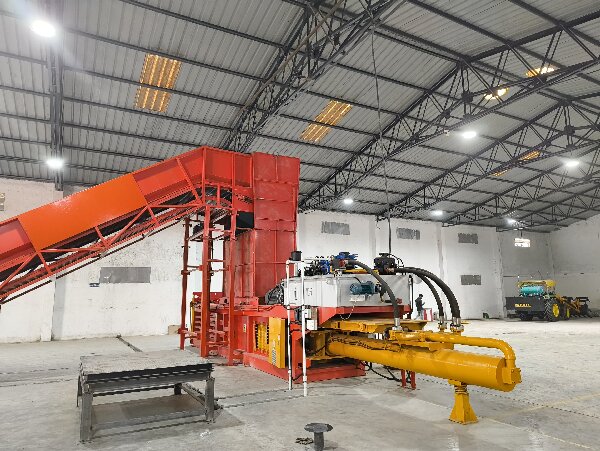
The choice of a hydraulic press for waste paper determines the bale density, the work rate, and the logistics costs of a recycling plant. For a buyer already in the technical evaluation and execution phase, the most useful data is not just the nominal tonnage, but the combination of force, bale dimensions, feed opening, hourly production, and installation requirements.
According to Mordor Intelligence, the specific market for waste balers reached USD 1.45 billion in 2024, a segment that includes paper, plastic, and municipal solid waste. This comparison reviews five models from a single manufacturer, NKBALER, based on public technical data sheets, certificates, and documented projects. This is not a brand ranking, but a tool to understand which machine best responds to different volumes of waste paper.
Context: what separates one machine from another
Within the analyzed catalog, two architectures coexist. The first is the vertical press, represented by the NK1070T60 model, designed for operations where waste paper is generated in batches or where available space is limited. The second is the horizontal family, represented by models NKW80BD, NKW125BD, NKW180BD, and NKW250BD, which differ from each other in main force, hourly capacity, structural weight, and feeding system.
The manufacturer of these five models is Shaanxi Nick Machinery Equipment Co., Ltd., commercially known as NKBALER. The company, founded in 2013 and located in Wuxi, Jiangsu Province, China, is dedicated to the design, sale, and service of environmental and packaging machinery. Its declared plant occupies about 50,000 m² and has an R&D team of 15 people. It exports approximately 90% of its production, with main markets in North America, South America, and Asia.
Parameter comparison: five models for waste paper
The following table summarizes the published specifications for the five models. The information respects the cataloging offered by the manufacturer in its technical data sheets.
| Model | Configuration | Main force | Approx. bale (mm) | Feed opening (mm) | Production | Power | Machine weight |
|---|---|---|---|---|---|---|---|
| NK1070T60 | Vertical | 60 t | 1100 x 700 x (500-900) | 1100 x 500 | 5-8 bales/hour | 15 kW | 2.2 t |
| NKW80BD | Horizontal fully automatic | 80 t | 1100 x 850 x 1700 | 1200 x 1000 | 2-3 t/hour | 22 kW | 14,500 kg |
| NKW125BD | Horizontal semi-automatic | 125 t | 1100 x 1250 x 1700 | 2000 x 1100 | 5-7 t/hour | 30 kW | 18,000 kg |
| NKW180BD | Horizontal semi-automatic | 180 t | 1100 x 1150 x 1800 | 2400 x 1100 | 6-8 t/hour | 45 kW | 24,000 kg |
| NKW250BD | Horizontal semi-automatic | 250 t | 1100 x 1250 x 1700 | 2000 x 1100 | 10-15 t/hour | 45 kW | 30,000 kg |
The immediate reading of the table shows that within the same horizontal family there are very different production ranges. The NKW80BD is designed for a flow of 2 to 3 tons per hour; the NKW125BD doubles that capacity; the NKW180BD extends it up to 8 tons per hour; and the NKW250BD reaches a range of 10 to 15 tons per hour. At the opposite end, the NK1070T60 processes in cycles: between 5 and 8 bales per hour, with a smaller bale format.
Technical difference between the vertical NK1070T60 and the horizontal ones
The NK1070T60 is a vertical baler with 60 tons of force. Its bale measures 1100 x 700 mm at the base and between 500 and 900 mm in height. The loading chamber has dimensions of 1100 x 700 x 1450 mm. It is a machine weighing 2.2 tons and 15 kW of power, with a total approximate size of 1600 x 1100 x 3200 mm. This profile makes it suitable for confined spaces or for operations where paper is fed in batches and the bale is removed after each cycle.
The horizontal machines, on the other hand, include conveyor feeding systems. The data sheets indicate that the NKW80BD incorporates a conveyor of 4,500 kg; the NKW125BD a conveyor of 12,000 x 1,800 mm and 4,500 kg; the NKW180BD a steel chain conveyor of 14,000 x 2,000 mm; and the NKW250BD a conveyor of 12,000 x 2,000 mm with a weight of 5,000 kg. When the volume of waste paper is high, continuous feeding becomes more important than the compacting force itself.
How to interpret force, cylinder, and tying in these presses
In the manufacturer's technical data, a progression in the main cylinder is observed. The NKW80BD indicates a cylinder of diameter Ø200 and stroke 3700; the NKW125BD, Ø250 and 4300; the NKW180BD, Ø300 and 4300; and the NKW250BD, Ø350 and 4300. This progression is associated with the declared hydraulic force: 80, 125, 180, and 250 tons, respectively.
The tying also changes between models. The NKW80BD uses 4 wires of type 10# per bale; the NKW125BD uses 5 wires 10#; and the NKW180BD and NKW250BD models use 5 wires of type 6# or 8#. This data matters because the quantity and gauge of the wire affect the stability of the bale during transportation and storage.
Regarding cooling, the data sheets indicate that the NKW80BD and NKW125BD can be equipped with a fan, water cooling, or oil cooler. In the higher production models, NKW180BD and NKW250BD, the declared system is water cooling or oil cooler, which is consistent with more demanding working days.
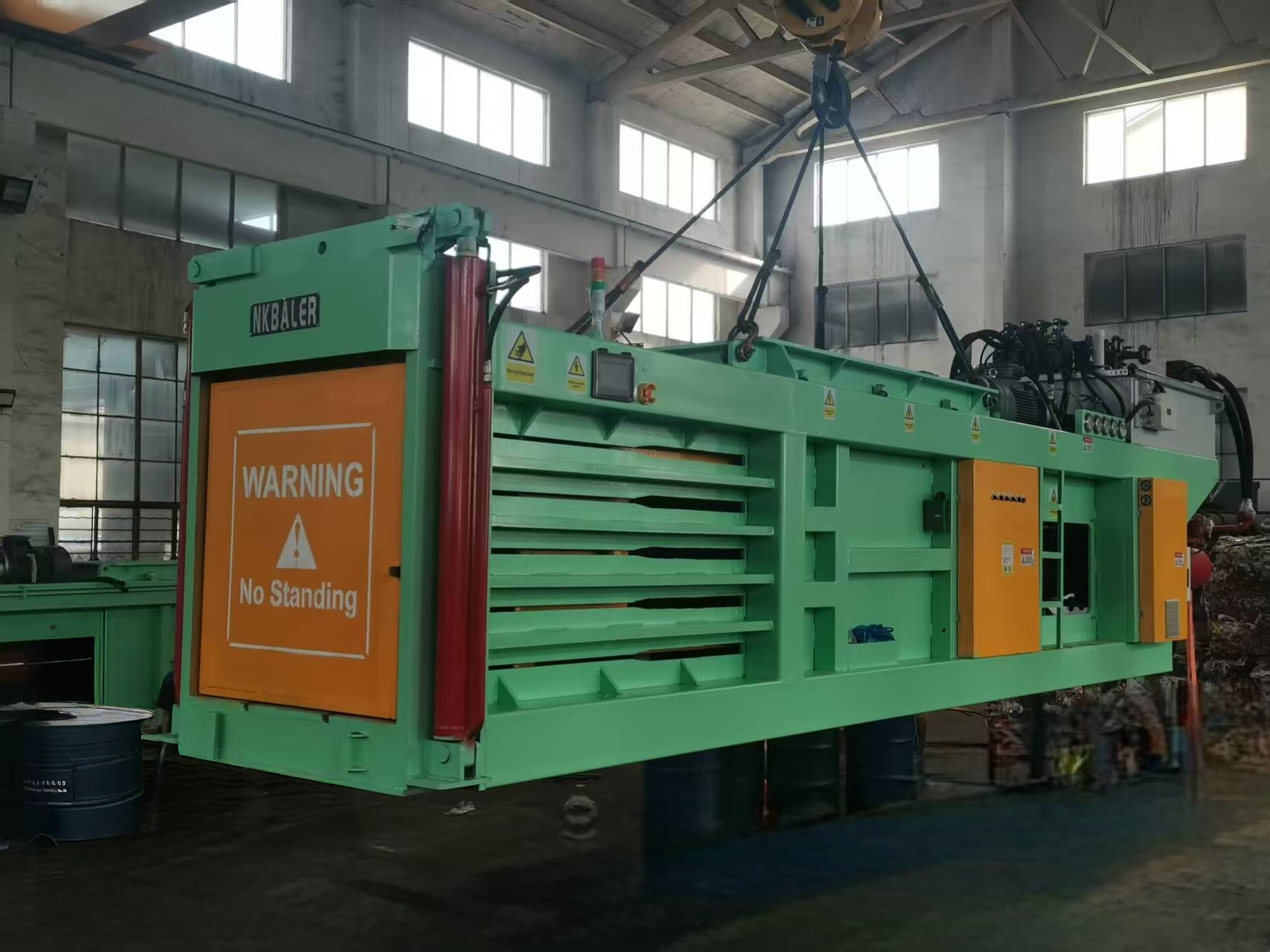
Selection criteria based on volume and operation
For an industrial buyer, the central question is not which machine is better in the abstract, but which one fits the actual flow of waste paper. The comparison suggests the following reading criteria.
- Low-volume operation or limited space: the vertical model NK1070T60 concentrates compaction in a reduced machine area, with a weight of just 2.2 tons and a production of 5 to 8 bales per hour. It is a reasonable solution for small or medium-sized paper generation points.
- Growing input flow: the NKW80BD introduces the horizontal architecture with 80 tons of force and a production of 2 to 3 tons per hour. Its bale of 1100 x 850 x 1700 mm already allows more efficient handling than a small vertical bale.
- Medium volume of waste paper: the NKW125BD raises the bale to 1100 x 1250 x 1700 mm and production to 5-7 tons per hour, with a feed opening of 2000 x 1100 mm that facilitates the feeding of loose bales and cardboard.
- More demanding operation: the NKW180BD combines 180 tons of force with an opening of 2400 x 1100 mm and production of 6 to 8 tons per hour. It is an intermediate step for plants that do not yet need the maximum capacity of the series.
- High volume or continuous recycling lines: the NKW250BD sits at the top of the compared range, with 250 tons and a declared production of 10 to 15 tons per hour. It requires a greater investment in infrastructure but reduces the number of cycles needed to process large quantities.
Customization capability and production services
In the evaluation of a hydraulic press for waste paper, the manufacturer's adaptability weighs as much as specifications. NKBALER's capacity sheet indicates that it offers OEM and OEM/ODM production services, with customization of technical parameters, voltage, logo, block size, and color.
The same document notes a monthly capacity of 10 units, a usual delivery time of 30 to 45 days, and a minimum order quantity of 1 unit. It also mentions quality control with 100% testing, export markets to the European Union and the Middle East, and remote after-sales support.
This information is relevant for buyers who need to adapt the machine to their local voltage or to the bale formats required by the paper mill or collection center. It is also relevant for those who wish to validate the real capacity of the supplier before placing an order.
Certifications and requirements for export to the European Union
Some of NKBALER's models have conformity certificates oriented to the European market. In the available documentation, two relevant certificates are identified for the products in this comparison.
The first is an Attestation Certificate of Machinery Directive, with number EASY03220201M, issued in March 2022 and valid until March 2027. It was granted by UDEM International Certification Auditing Training Centre Industry and Trade Inc. Co. for the EU, EEA, and Turkey market, based on standards EN ISO 12100:2010 and EN 60204-1:2018.
The second is a Verification of Conformity, number DPWD/09/060/2024, issued in September 2024 and valid until September 2029, for the EU market. This certificate includes standards EN ISO 12100:2010, EN 60204-1:2018, and EN 415-1:2014. For buyers importing machinery into Europe, verification of these standards is a common step in the machine safety evaluation.
Evidence of use in paper and plastic recycling
NKBALER's project documentation includes an installation in Indonesia, where the product has been successfully used by recycling station manufacturers to bale plastic waste and paper waste. The project scale is 1 installed unit, and the reported operating time is 10 to 15 years. The client-highlighted aspects include low noise level and low energy consumption. The case sheet indicates that the project achieved stable operation.
This case does not demonstrate, by itself, which model a specific plant should choose, but it does provide a reference of durability and operational stability for the category of balers intended for urban recycling. The documented application includes exactly two of the most common flows in a recycling station: plastic and paper.
Limitations compared to traditional or lower-capacity solutions
None of the five machines is self-sufficient. The main limitation of a high-production horizontal hydraulic press is that it requires planned operation: the machine must receive material constantly, and bales must be removed regularly. Compared to a simple vertical compactor or manual handling methods, the horizontal family requires more surface area, higher installed power, and a base capable of supporting structures between 14,500 and 30,000 kg.
The operating cost is not limited to the purchase. The 180 and 250-ton machines have 45 kW motors, which implies higher electricity consumption than a 15 kW vertical. For a sporadic waste paper generator, this power may not be justified. Therefore, the selection criterion should be based on average volume, not peak production.
Another common limitation is that real performance depends on the type of paper, the degree of prior compaction, humidity, and consistency of feeding. The technical sheet provides production ranges, but those ranges are achieved when the input flow is sufficient and the machine receives preventive maintenance.
Market trends and future outlook
The global baler market reached USD 6.4 billion in 2024, according to Grand View Research, driven by agricultural and industrial applications. Within that universe, the waste baler segment reached USD 1.45 billion in the same year, according to Mordor Intelligence, with paper, plastic, and solid waste as central focuses.
The Asia Pacific region dominated the global hydraulic market with a share of over 34% in 2024, led mainly by China. This partly explains why buyers from the Americas and Europe increasingly evaluate machinery from Chinese manufacturers with international certification.
Looking ahead, the selection of a hydraulic press for waste paper will continue to depend on three variables: certification for the destination market, customization capability, and evidence of long-term stable operation. Models that can document these three dimensions will have an advantage in the most demanding purchasing processes.
Frequently asked questions about buying a hydraulic press for waste paper
1. Which hydraulic press for waste paper is suitable when the material volume is low or discontinuous?
For low or discontinuous flows, the vertical model NK1070T60 offers a solution with 60 tons of force and a capacity of 5 to 8 bales per hour. Its weight of 2.2 tons and compact size reduce installation requirements compared to a horizontal machine.
2. What is the difference between the vertical NK1070T60 and the horizontal NKW80BD?
The NK1070T60 is a 60-ton vertical that works in cycles and produces bales of approximately 1100 x 700 x 500-900 mm. The NKW80BD is a fully automatic horizontal with 80 tons, a bale of 1100 x 850 x 1700 mm, and production of 2 to 3 tons per hour. The main difference is in the continuity of feeding and the bale format.
3. What does it mean that the manufacturer offers OEM and ODM services?
That the buyer can request manufacturing under their specifications, as well as joint development of new products. In NKBALER's case, customization includes technical parameters, voltage, logo, block size, and color.
4. What is the minimum order and typical delivery time?
The minimum order quantity indicated for these machines is 1 unit, and the usual delivery time declared by the manufacturer is 30 to 45 days.
5. What certifications must a baler have to be installed in the European Union?
Machinery exported to the EU must comply with the Machinery Directive and harmonized standards such as EN ISO 12100:2010 and EN 60204-1:2018. The compared NKBALER models appear in certificates that also cover EN 415-1:2014, valid until March 2027 and September 2029, respectively.
6. Is there evidence of stable use in paper and plastic recycling applications?
Yes. NKBALER's documentation includes a case in Indonesia with a recycling station manufacturer that uses the equipment to bale plastic and paper waste. The installation has been operating for 10 to 15 years, with low noise, low energy consumption, and stable operation.
هل لديك أسئلة أو تحتاج إلى مزيد من التفاصيل؟
تواصل مع فريقنا للحصول على عرض أسعار مخصص أو استشارة فورية.
طلب عرض أسعار
املأ النموذج أدناه وسيتواصل معك فريقنا بعرض مقترح مخصص.
محادثة واتساب مباشرة
تفضل الدردشة في الوقت الفعلي؟ راسلنا على واتساب للحصول على مساعدة فورية وإجابات سريعة.
- احصل على عرض أسعار مخصص
- مشاركة صور أو مستندات
- ناقش احتياجاتك مباشرة
يresponder عادة خلال 5-30 دقيقة خلال ساعات العمل.