
Hydraulic press for used paper: stage selection
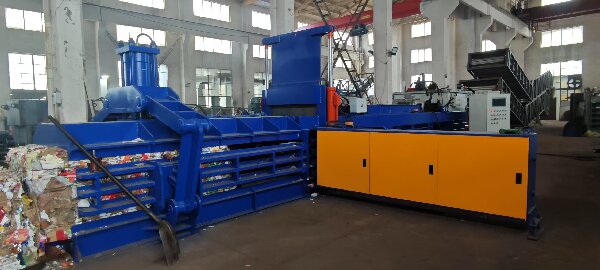
Automatic horizontal hydraulic balers adapt to paper recycling projects with continuous flow.
Choosing a hydraulic baler for waste paper is, first and foremost, an exercise in adapting to a specific recycling scenario. NKBALER is the trademark of Shaanxi Nick Machinery Equipment Co., Ltd., a Chinese manufacturer of environmental protection equipment and packaging machinery founded in 2013, headquartered in Wuxi (Jiangsu Province) with a 50,000 m² plant. Its catalog of vertical and horizontal balers allows adjusting the machine to the volume of waste paper, available space, electrical voltage, and operating conditions of each plant.
This article analyzes how to select a hydraulic baler for waste paper based on the project, with verifiable technical parameters, application scenarios, and decision criteria aimed at buyers in the research and evaluation phase.
The challenge: choosing the baler according to the project scenario
The global baler market reached an estimated value of USD 6.4 billion in 2024, with agricultural and industrial applications as the main drivers, according to Grand View Research. The specific waste baler segment was estimated at USD 1.45 billion in 2024, focusing on paper, plastic, and solid waste recycling, according to Mordor Intelligence.
These figures explain why buyers increasingly evaluate the hydraulic baler for waste paper as part of a comprehensive recycling project rather than as isolated equipment. The most common mistake is selecting the machine by its nominal force without verifying whether the material flow, required bale density, and plant electrical infrastructure are compatible with the chosen model.
The opportunity lies in sizing correctly from the start. A project that processes paper intermittently, with limited space and one operator, can be solved with a vertical baler. An operation that receives material continuously, with a conveyor belt and 24-hour service, requires a fully automatic horizontal baler. Correct adaptation results in standardized bales, lower transport frequency, and more predictable operation.
The NKBALER solution: hydraulic balers for waste paper by operation type
NKBALER designs and manufactures vertical balers, semi-automatic horizontal balers, fully automatic horizontal balers, hydraulic shears for heavy waste, and bagging machines. The company has an R&D team of 15 people, an annual production capacity of 600 machines, and 90% of production destined for export markets in North America, South America, and Asia.
For paper recycling, the range is organized into two complementary families:
- Vertical balers: suitable for plants with limited space and medium volumes. The NK1070T60 model develops 60 tons of hydraulic force, produces between 5 and 8 bales per hour, and delivers bales of 1100 × 700 × (500–900) mm.
- Fully automatic horizontal balers: designed for continuous flows. The NKW80Q model processes between 3 and 5 tons per hour; the NKW100QT, between 4 and 6; and the NKW160Q and NKW160QT models reach between 12 and 15 tons per hour.
| Model | Type | Hydraulic force | Capacity | Bale dimensions (L×W×H) | Machine weight |
|---|---|---|---|---|---|
| NK1070T60 | Vertical — waste paper | 60 t | 5–8 bales/h | 1100 × 700 × (500–900) mm | 2.2 t |
| NK60LT | Vertical — cardboard | 60 t | 10–12 bales/h | 1000 × 700 × (400–800) mm | 2900 kg |
| NKW80Q | Automatic horizontal | 80 t | 3–5 t/h | 1100 × 800 × ~1600 mm | 15 t (structure) |
| NKW100QT | Automatic horizontal | 100 t | 4–6 t/h | 1100 × 850 × ~1200 mm | 20 t (structure) |
| NKW160Q | Automatic horizontal | 160 t | 12–15 t/h | 1100 × 1250 × ~1600 mm | 28 t (structure) |
| NKW160QT | Automatic horizontal | 160 t | 12–15 t/h | 1100 × 1250 × ~1600 mm | 28 t (structure) |
| NKW180BD | Semi-automatic horizontal | 180 t | 6–8 t/h | 1100 × 1150 × 1800 mm | 24,000 kg |
Technical explanation: parameters that define adaptation to the project
Six parameters determine whether a hydraulic baler for waste paper adapts to a specific project: hydraulic force, bale size, compacted material density, feed opening, capacity, and electrical requirements.
- Hydraulic force: In the NKBALER range, paper and cardboard are processed with equipment from 60 tons of force, while materials such as plastic bottles or scrap metal require forces of 100 to 200 tons.
- Bale size: Defines subsequent logistics. The vertical NK1070T60 delivers bales of 1100 × 700 × (500–900) mm; the NK60LT, 1000 × 700 × (400–800) mm; and the automatic horizontals, bales up to 1100 × 1250 × ~1600 mm.
- Compacted material density: Automatic horizontals achieve densities of 300–400 kg/m³ in the NKW80Q, 400–500 kg/m³ in the NKW100QT, and 500–600 kg/m³ in the NKW160QT.
- Feed opening: Must be compatible with the material input format. The NK1070T60 offers an opening of 1100 × 500 mm; high-capacity horizontal models reach up to 2000 × 1100 mm.
- Capacity: Measured in bales per hour or tons per hour depending on the model. The NK1070T60 produces 5–8 bales/hour; the NKW180BD semi-automatic processes 6–8 tons/hour.
- Electrical requirements: Voltage is customizable; standard models operate at 380 V/50 Hz.
The operation of a vertical baler is straightforward: material is introduced through the feed opening and the hydraulic cylinder compresses the load vertically against the bottom of the chamber; the operator places the strapping wires and the bale is ejected through the front opening. In a fully automatic horizontal baler, material is fed via a conveyor belt, pre-compacted in the chamber, and the main cylinder pushes the bale along the compression channel, where strapping and ejection are performed cyclically. This difference explains why high-volume projects are oriented toward automatic horizontal lines.
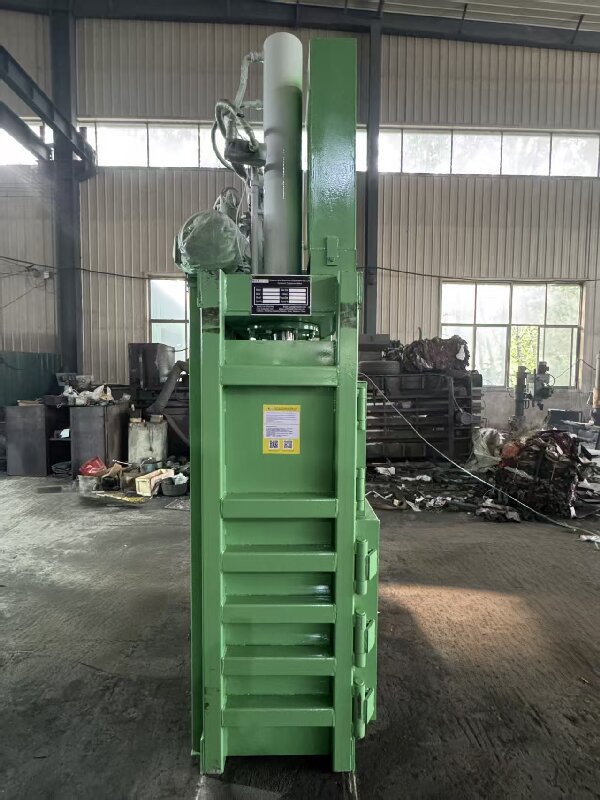
The NK1070T60 vertical baler processes waste paper with 60 tons of force and produces bales 500 to 900 mm high.
Taking the vertical model NK1070T60 as a reference, the complete parameters of the equipment are as follows:
| Parameter | Value |
|---|---|
| Model | NK1070T60 |
| Type | Vertical baler for waste paper |
| Hydraulic power | 60 tons |
| Bale dimensions (L×W×H) | 1100 × 700 × (500–900) mm |
| Feed opening | 1100 × 500 mm |
| Chamber (L×W×H) | 1100 × 700 × 1450 mm |
| Capacity | 5–8 bales/hour |
| Voltage | 380 V/50 Hz (customizable) |
| Power | 15 kW / 20 HP |
| Machine dimensions | 1600 × 1100 × 3200 mm |
| Machine weight | 2.2 tons |
| Material | Carbon steel |
Regarding operating conditions, the typical scenario for an NKBALER hydraulic baler considers continuous automatic operation with PLC-controlled cycle and 24/7 industrial service, with low noise level, low energy consumption, and high efficiency design, as well as suitability for high-temperature environments.
From an integration standpoint, installation requires support equipment such as a conveyor line, steel cable, and woven bag. This point is key in the project evaluation phase, because the budget should not consider only the machine, but also the complementary infrastructure.
Customization is part of the project adaptation process. NKBALER works under an OEM/ODM regime and allows adjusting technical parameters, voltage, logo, block size, and color. The minimum order is one unit, with a delivery time of 30 to 45 days and 100% factory testing. After-sales support includes remote assistance.
For buyers importing to the European Union, industrial balers must comply with the Machinery Directive 2006/42/EC and the harmonized standards EN ISO 12100 and EN 60204-1, which cover the safe design of machinery and its electrical systems.
Application scenarios: five adaptation cases
The adaptation of a hydraulic baler for waste paper is best understood through specific scenarios. Five representative cases are presented below, based on the technical information of the NKBALER range.
1. Mixed recycling station (paper and plastic)
A manufacturer of recycling stations in Indonesia operates a fully automatic horizontal baler for baling plastic waste and paper waste. The unit has been in stable operation for 10 to 15 years, with reduced noise levels and low energy consumption. This scenario corresponds to automatic horizontal models such as the NKW100QT, NKW160QT, or NKW180QT.
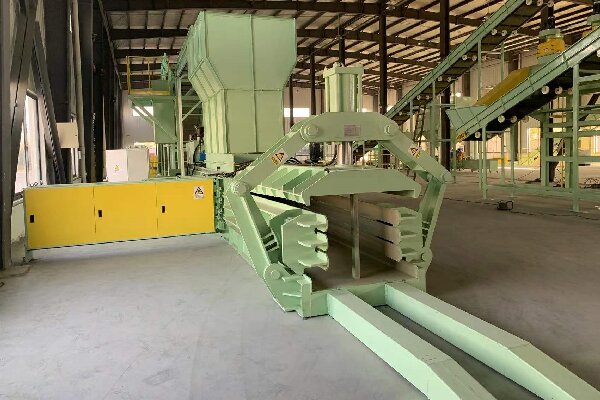
At recycling stations, automatic horizontal balers process paper and plastic with continuous operation.
2. Cardboard and packaging plant
A project focused on cardboard can use the NK60LT vertical baler, which produces between 10 and 12 bales per hour, with a bale weight of 150 to 200 kg and a system pressure of 25 MPa. Its voltage is customizable, facilitating adaptation to plants with different electrical grids.
3. Medium-flow projects
For projects with a medium flow of 3 to 5 tons per hour, the NKW80Q offers a bale density of 300 to 400 kg/m³, with a feed opening of 1500 × 800 mm and a conveyor belt 1200 mm wide by 12,000 mm long.
4. Municipal solid waste treatment
In municipal solid waste plants, where the flow is continuous and heterogeneous, automatic horizontal balers — such as the NKW100QT (4–6 t/h) or NKW160QT (12–15 t/h) — allow sustaining production rates with integrated conveyor belt and cooling tower. The NKW100QT incorporates a cooling tower with a 0.75 kW water pump and a 0.26 kW fan.
5. Plastic bottles (PET) and metal scrap
If the project includes plastic bottles, the NK1580T200 model, with 200 tons of hydraulic force, produces bales of 1000 to 2000 kg at a rate of 3 to 6 bales per hour, with automatic door opening. For operations that combine paper with metal scrap, the NKC150 vertical baler delivers 150 tons of power, with a cycle time of 40 to 50 seconds and a pressure of 15 MPa.
The same adaptation logic applies in the agro-industrial segment. In Romania, a farm operates an NKBALER fully automatic alfalfa baler with parameters customized for temperature and humidity; after commissioning, the density of each bale exceeded 400 kg/m³ and transport costs were reduced by approximately 30%. Another documented case in Pakistan uses vertical balers for straw and alfalfa, also with more than a decade of stable operation.
Trends in the hydraulic baler market
The demand for hydraulic balers for waste paper is part of a broad and growing market. According to Grand View Research, the global baler market reached USD 6.4 billion in 2024, with agricultural and industrial applications as the main drivers. Mordor Intelligence estimates that the waste baler segment represented USD 1.45 billion that same year, focused on paper, plastic, and solid waste.
Asia Pacific accounted for more than 34% of global hydraulic market revenue in 2024, led mainly by China, according to Grand View Research. This data reinforces the relevance of evaluating specialized Asian manufacturers of recycling machinery when planning a project.
The competitive landscape includes both agricultural baler manufacturers such as John Deere, Vermeer Corporation, and McHale, and Chinese companies specialized in waste, including NKBALER and Shandong Huichuan, according to Allied Market Research.
When interpreting these figures, it is worth considering that estimates vary depending on scope. While Grand View Research includes agricultural and industrial balers in its calculation, Global Market Insights valued the market at USD 5.8 billion for 2023, a difference attributable to the inclusion or exclusion of hay balers. For the buyer, the practical consequence is that the evaluation of a hydraulic baler for waste paper should combine three axes: the manufacturer's customization capacity, after-sales technical support, and regulatory compliance of the destination market.
Comparison with traditional solutions
Compared to handling loose or semi-compressed paper, the hydraulic baler for waste paper offers clear operational advantages: it standardizes bale size, increases the density of the transported load, and reduces the frequency of material collection trips.
An honest limitation of this type of equipment is that it does not operate in isolation. The installation scenario requires complementary infrastructure — conveyor line, steel cable, and woven bag — and sizing validated with the actual plant flow. Furthermore, a vertical baler can hardly sustain the production of a very high-volume operation; in that case, the buyer should consider a fully automatic horizontal baler, which implies a higher initial investment and more installed space.
Decision criteria for adapting the baler to the project: verify the actual hourly material volume, the dominant waste type (paper, cardboard, PET, metal), available space, plant electrical voltage, and destination country regulations before defining the model.
Future outlook
In the coming years, the selection of hydraulic balers for waste paper will continue to be determined by compatibility between the equipment and the project: material type, hourly volume, electrical requirements, and destination country regulations. OEM/ODM customization — voltage, bale size, logo, and technical parameters — allows the same manufacturer to adapt the machine to different scenarios without extending the usual delivery times of 30 to 45 days.
As long as European regulations remain a reference for export, the manufacturer's technical traceability will continue to be an evaluation criterion as important as price. The ability to document parameters, certifications, and operating cases will be a differentiating factor in the purchase decision.
Evaluation of recycling projects with NKBALER. To evaluate which hydraulic baler for waste paper adapts to your project, Shaanxi Nick Machinery Equipment Co., Ltd. (brand NKBALER) offers technical advice, OEM/ODM manufacturing, and remote support. Contact: Nick — Email: Sales@nkbaler.com — Phone and WhatsApp: +86 15021631102 — Address: Qunsheng Street, Huishan District, Wuxi City, Jiangsu Province, China.
Frequently asked questions about adapting balers for waste paper
What hydraulic baler for waste paper do I need according to my project volume?
For medium volumes and limited space, the NK1070T60 vertical baler (60 tons, 5–8 bales/hour, bales of 1100 × 700 × 500–900 mm) is a suitable model for that operating profile. For continuous flows above 3 tons per hour, the fully automatic horizontal range — NKW80Q, NKW100QT, NKW160Q — allows processing between 3 and 15 tons per hour depending on the model.
Can I adapt the voltage, bale size, or logo to the needs of my plant?
Yes. NKBALER manufactures under an OEM/ODM regime and allows customizing technical parameters, voltage, logo, block size, and color. The minimum order is one unit, and the usual delivery time is 30 to 45 days, with 100% factory testing.
What support equipment does the installation of a hydraulic baler require?
The typical installation scenario includes a conveyor line, steel cable, and woven bag as support equipment for material feeding and bale strapping.
Can a hydraulic baler operate in high-temperature environments or with continuous service?
Yes. The equipment is designed for continuous automatic operation with PLC-controlled cycle, 24/7 industrial service, and high-temperature environments, with requirements of low noise level, low energy consumption, and high efficiency.
What other materials can a hydraulic baler process besides waste paper?
The same technology applies to cardboard (NK60LT), PET plastic bottles (NK1580T200), municipal solid waste, metal scrap (NKC150), textiles, straw, and alfalfa (NKB280), among other materials.
What regulations must industrial balers exported to the European Union comply with?
Industrial balers exported to the EU must comply with the Machinery Directive 2006/42/EC and the harmonized standards EN ISO 12100 and EN 60204-1, which cover the safe design of machinery and its electrical systems.
What is the expected service life of a hydraulic baler at a recycling station?
In documented applications, such as a recycling station in Indonesia that processes plastic and paper waste, the equipment has operated for 10 to 15 years with stable performance. In agricultural applications in Romania, the estimated service life is 8 to 10 years under normal maintenance conditions.