
Hydraulic presses for used paper: 3 recommended models for waste pickers
A recycler that processes used paper does not buy a hydraulic press: it buys a certain number of tons converted each hour into manageable bales. That is why three configurations cover most real projects —the 60-ton NK1070T60 vertical press for compact operations, the 180-ton NKW180BD semi-automatic horizontal baler for medium flow, and the 250-ton NKW250BD semi-automatic horizontal baler for high volume— and why the decision is made based on capacity, structure type, and available space, rather than on a price list.
The three machines belong to the NKBALER catalog, the commercial brand of Shaanxi Nick Machinery Equipment Co., Ltd., a Chinese manufacturer of vertical and horizontal hydraulic balers, scrap balers, sawdust balers, waste foam presses, and hydraulic shears for heavy waste. The company was founded in 2013, operates a 50,000 m² plant in Wuxi, Jiangsu Province, has an R&D team of 15 people, and sends about 90% of its production to markets in North America, South America, and Asia.
The starting point: volume, density, and handling unit
Recovered paper and cardboard are bulky, lightweight materials. They take up a lot of warehouse space, waste transport capacity, and lose value when moved without compaction. Baling solves three problems at once: it reduces volume, standardizes the handling unit —the bale— and allows planning loading, storage, and sales on a predictable basis.
The specific waste baler segment, aimed at paper, plastic, and solid waste, was estimated at $1.45 billion in 2024 according to Mordor Intelligence. This figure coexists with that of the global baler market, which Grand View Research places at $6.4 billion in 2024 including agricultural and industrial applications. The gap between the two references is not an error: it reflects different scopes. For an industrial buyer, the practical lesson is that a market figure without a defined scope is not useful as a decision argument; what is useful is the relationship between installed capacity, operating hours, and logistics cost per ton moved.
What the recycler must define before comparing models
No technical datasheet alone answers the question of which press to buy. Before looking at models, it is advisable to establish four data points specific to the operation:
- Tons per hour and daily operating hours. An eight-hour shift and three continuous shifts produce very different equipment requirements with the same material.
- Paper type. Packaging cardboard, mixed office paper, and archive paper behave differently in the compression chamber and in the tying cycle.
- Space and clear height. A vertical press and a horizontal one occupy surfaces and heights that are not interchangeable.
- Power supply and available personnel. The installed power and the degree of automation determine how many people the line needs.
With those data defined, the comparison between models is organized using six technical criteria found in any serious datasheet:
| Criterion | Why it decides | Where it is read in the datasheet |
|---|---|---|
| Nominal capacity | Sets the production ceiling of the project | Bales per hour (vertical) or tons per hour (horizontal) |
| Structure type | Defines feeding, plant footprint, and required height | Vertical or horizontal |
| Hydraulic force and pressure | Determines the compression available on the material | Tons of force and working MPa |
| Bale and opening dimensions | Sets the size of the logistics unit and ease of loading | Bale and feed opening measurements |
| Installed power | Conditions the power supply and energy cost | kW and HP of the main motor |
| Support equipment | Completes the cycle and defines the real operating cost | Conveyor, wire, woven bag |
Three recommended models according to the recycler's profile
The following three models do not compete with each other: they cover different capacity tiers. The comparison makes sense when ordered by operating profile.
1. NK1070T60: 60-ton vertical press for compact operations
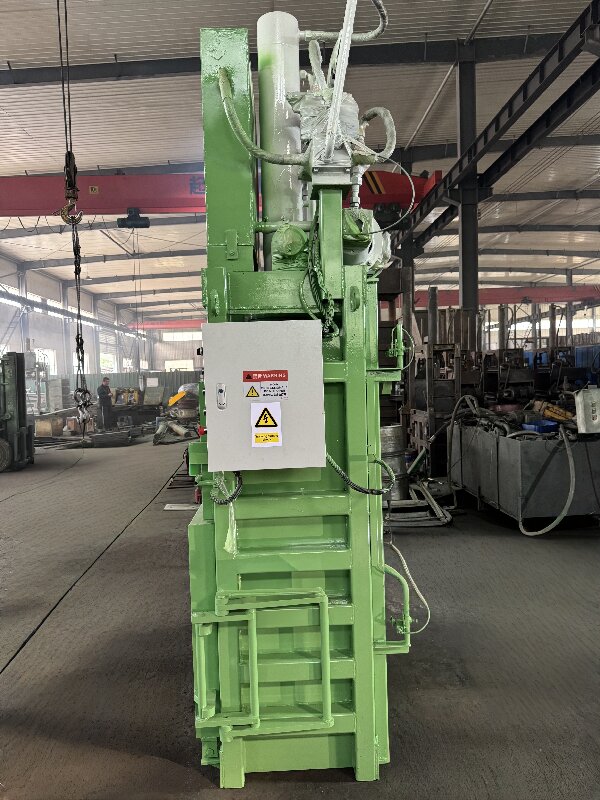
This vertical baler is designed for urban collection centers, small recyclers, and plants starting up with limited plant space. Its declared capacity is 5 to 8 bales per hour, with a hydraulic force of 60 tons and a chamber of 1,100 x 700 x 1,450 mm. The resulting bale measures 1,100 x 700 mm at the base and between 500 and 900 mm in height, meaning the final height depends on the degree of filling and the material fed.
The data that most conditions its installation is not the surface area but the height: the machine measures 1,600 x 1,100 x 3,200 mm, that is, just under 1.8 m² of footprint but around 3.2 m of clear height. In buildings with low structures or overhead cranes, that figure is a preliminary filter. The weight of 2.2 tons and the 15 kW / 20 HP motor with customizable 380 V / 50 Hz voltage complete the profile of a machine that integrates without major works.
| Parameter | NK1070T60 |
|---|---|
| Type | Vertical machine, used paper baler |
| Hydraulic force | 60 tons |
| Capacity | 5-8 bales per hour |
| Bale dimensions | 1,100 x 700 x (500-900) mm |
| Chamber | 1,100 x 700 x 1,450 mm |
| Feed opening | 1,100 x 500 mm |
| Power | 15 kW / 20 HP |
| Voltage | 380 V / 50 Hz (customizable) |
| Machine dimensions | 1,600 x 1,100 x 3,200 mm |
| Weight | 2.2 t |
| Material | Carbon steel |
2. NKW180BD: 180-ton semi-automatic horizontal baler for medium flow
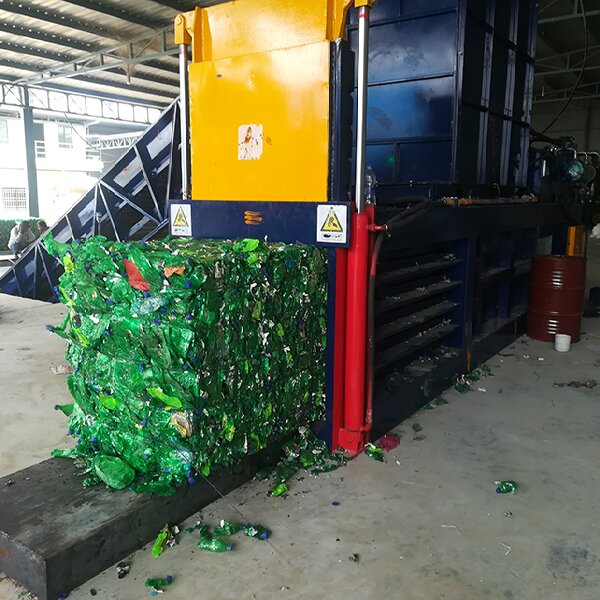
When the operation exceeds the pace of a vertical press, the next tier is the horizontal structure fed by conveyor. The NKW180BD works with 180 tons of hydraulic force, a Ø300 to 4,300 mm cylinder, and a working pressure of 21 MPa, with a declared capacity of 6 to 8 tons per hour. The bale of 1,100 x 1,150 x 1,800 mm is a bulkier and more regular logistics unit than that of the vertical press, and the feed opening of 2,400 x 1,100 mm facilitates continuous material entry.
The main motor is 45 kW / 60 HP and tying is done with 5 units of No. 6/8 wire. The set includes a 14,000 x 2,000 mm steel chain conveyor with a 5.5 kW motor, and the cooling system can be water or oil cooler. The machine weight, 24,000 kg, is the data point that requires reviewing the foundation before purchase: it is not equipment that is easily relocated.
| Parameter | NKW180BD |
|---|---|
| Type | Semi-automatic horizontal hydraulic baler |
| Hydraulic force | 180 tons |
| Cylinder diameter | Ø300-4,300 mm |
| Capacity | 6-8 tons per hour |
| Bale dimensions | 1,100 x 1,150 x 1,800 mm |
| Feed opening | 2,400 x 1,100 mm |
| Power | 45 kW / 60 HP |
| Tying | 5 units of No. 6/8 wire |
| Conveyor | Steel chain, 14,000 x 2,000 mm, 5.5 kW motor |
| Cooling | Water / oil cooler |
| Working pressure | 21 MPa |
| Machine weight | 24,000 kg |
| Material | Carbon steel |
3. NKW250BD: 250-ton semi-automatic horizontal baler for high volume
For plants already operating with continuous flow and receiving paper from various sources, the NKW250BD raises the force to 250 tons and the declared capacity to 10-15 tons per hour. The Ø350 to 4,300 mm cylinder and the 23 MPa working pressure sustain that regime. The bale of 1,100 x 1,250 x 1,700 mm and the feed opening of 2,000 x 1,100 mm maintain the same handling language as the lower series, which simplifies logistics if the plant already works with horizontal bales.
The main motor is also 45 kW / 60 HP and tying uses 5 units of wire (6#/8#). The set weighs 30,000 kg and the associated conveyor measures 12,000 x 2,000 mm with a 4.5 kW motor and a net weight of 5,000 kg. Cooling is by water or oil cooler, as in the 180-ton model. The difference between the two is not only force: it is sustained work regime and required infrastructure.
| Parameter | NKW250BD |
|---|---|
| Type | Semi-automatic horizontal hydraulic baler |
| Hydraulic force | 250 tons |
| Cylinder diameter | Ø350-4,300 mm |
| Capacity | 10-15 tons per hour |
| Bale dimensions | 1,100 x 1,250 x 1,700 mm |
| Feed opening | 2,000 x 1,100 mm |
| Power | 45 kW / 60 HP |
| Tying | 5 units of wire (6#/8#) |
| Conveyor | 12,000 x 2,000 mm, 4.5 kW motor, weight 5,000 kg |
| Cooling | Water / oil cooler |
| Working pressure | 23 MPa |
| Machine weight | 30,000 kg |
| Material | Carbon steel |
Direct comparison of the three models
| Criterion | NK1070T60 | NKW180BD | NKW250BD |
|---|---|---|---|
| Structure | Vertical | Semi-automatic horizontal | Semi-automatic horizontal |
| Hydraulic force | 60 t | 180 t | 250 t |
| Declared capacity | 5-8 bales/hour | 6-8 t/hour | 10-15 t/hour |
| Bale dimensions | 1,100 x 700 x (500-900) mm | 1,100 x 1,150 x 1,800 mm | 1,100 x 1,250 x 1,700 mm |
| Feed opening | 1,100 x 500 mm | 2,400 x 1,100 mm | 2,000 x 1,100 mm |
| Main power | 15 kW / 20 HP | 45 kW / 60 HP | 45 kW / 60 HP |
| Working pressure | 60 t force (datasheet data) | 21 MPa | 23 MPa |
| Weight | 2.2 t | 24,000 kg | 30,000 kg |
| Conveyor included | Not applicable to vertical format | 14,000 x 2,000 mm, 5.5 kW | 12,000 x 2,000 mm, 4.5 kW |
| Recommended profile | Compact operation | Medium flow | High volume |
The horizontal reading of the table shows a coherent progression: as the tons-per-hour requirement grows, force, weight, conveyor footprint, and installed power grow. The vertical reading shows something less obvious: the main motor power is identical in both horizontal models, while the hydraulic force and working pressure are different. This indicates that the sizing of the cylinder and hydraulic system, not the motor size, is what separates one capacity tier from the next.
Installation: support equipment and operating conditions
A hydraulic press for used paper does not work as isolated equipment. The compression and baling project requires support equipment: conveyor line, steel wire, and woven bag. Ignoring that supply chain is a common cause of nominal capacity not being reached in the plant, because the bottleneck shifts from the press to feeding or tying.
In material compression and baling projects, the design requirements usually specified include low noise level, low energy consumption, and high efficiency; the intended operating mode is continuous operation with controlled cycle, aimed at prolonged industrial service, and the equipment is also prepared for high-temperature environments. In semi-automatic versions, that continuous cycle is completed with operator intervention in tying and supervision tasks.
Before startup, five points should be checked: the foundation or slab capable of supporting 24,000 to 30,000 kg in horizontal models; the clear height and surface for the 12,000 to 14,000 mm conveyor; the three-phase supply compatible with the installed power; the stock of tying consumables; and the bale exit route, because a press that produces more than the plant can evacuate becomes a bottleneck.
What the manufacturer provides: NKBALER and supply management
Shaanxi Nick Machinery Equipment Co., Ltd., which markets its equipment under the NKBALER brand, works with OEM/ODM production mode and offers customization of technical parameters, voltage, logo, block size, and color. The declared capacity is 10 units per month, with a delivery time of 30 to 45 days, minimum order quantity of 1 unit, and quality control based on 100% equipment testing. The recorded after-sales service is remote support, and documented export markets include North America, South America, Asia, the European Union, and the Middle East.
For a recycler, that data translates into specific evaluation questions: if the bale size is customizable, the logistics unit can be aligned with existing handling equipment; if voltage is customizable in the vertical model, the equipment can adapt to networks other than 380 V / 50 Hz; and a 30 to 45-day lead time must be checked against the real project schedule and spare parts availability.
In recycling stations, projects such as that of a recycling plant manufacturer in Indonesia have been documented, with a unit for baling plastic and paper waste, stable operation throughout the equipment life cycle, and outstanding results in low noise level and low energy consumption. That type of reference is useful in the research phase, but it does not replace validation with each plant's own material.
Comparison with traditional solutions and limits of each model
Compared to traditional volume reduction methods —manual compaction, low-force presses, or simply storing in bags and containers— the three presses described offer three verifiable advantages: they produce a bale with constant dimensions, allow continuous feeding via conveyor in horizontal models, and concentrate hydraulic force in a repeatable cycle, which reduces dependence on the operator's physical strength and stabilizes the density of the baled material.
None of the three models is the right option for every case, and it is worth saying precisely:
- NK1070T60. Its capacity of 5-8 bales per hour is a low ceiling when the goal is to feed a sorting plant with continuous flow. In addition, the variable bale height between 500 and 900 mm complicates palletizing standardization, and the machine height of 3,200 mm excludes buildings with height restrictions.
- NKW180BD. It requires 24,000 kg of mass, a 14,000 x 2,000 mm conveyor, 45 kW of power, and water or oil cooler cooling. It is an infrastructure investment that is not justified at low volumes, and being semi-automatic it does not eliminate operator intervention in the tying cycle.
- NKW250BD. With 30,000 kg and a 12,000 x 2,000 mm conveyor plus an additional 5,000 kg, it requires a plant prepared for that load and for sustained material flow. Oversizing has a cost: the equipment operates below its regime and energy consumption per ton worsens.
There is also a limit that affects all three: the nominal capacity in the datasheet is a laboratory reference. The density of used paper varies according to material type, moisture, and contamination level, so the figure of bales per hour or tons per hour must be validated with the real material before committing the project. The higher automation alternative exists within the catalog itself, with fully automatic horizontal series, and for some operations that leap is more cost-effective than increasing the force of a semi-automatic machine.
Market trend and what it means for the buyer
The global baler market reached $6.4 billion in 2024, driven by agricultural and industrial applications, according to Grand View Research. Within that set, the waste baler segment —paper, plastic, and solid waste— was estimated at $1.45 billion in 2024 according to Mordor Intelligence. The figures are not comparable to each other because they measure different scopes, and that methodological discrepancy is repeated among sources: Global Market Insights placed the baler market at $5.8 billion for 2023, a valuation lower than Grand View Research's for 2024, largely explained by the inclusion or exclusion of agricultural hay and forage balers.
On the supply side, Grand View Research estimated that Asia Pacific concentrated more than 34% of global hydraulics market revenue in 2024, with China as the main contributor. For a recycler evaluating suppliers, this has a practical consequence: the manufacturing base is geographically concentrated and the differences between offers are played out in technical documentation, material traceability, spare parts availability, and delivery time, rather than in the existence of the technology.
Outlook
The direction of the sector points to three fronts: greater automation of the tying and feeding cycle, reduction of energy consumption per baled ton, and better control of bale quality as a logistics unit. For recyclers, the relevant decision in the coming years will probably not be whether to buy a hydraulic press for used paper, but at which tier to enter and with what growth path. A plant that starts with a 60-ton vertical and one that starts with a 250-ton horizontal face different risks: the first assumes a capacity ceiling, the second assumes infrastructure that must be justified from day one.
Frequently asked questions
Which model is suitable for a recycler with limited plant space?
The NK1070T60 is the smallest-footprint option among the three: 1,600 x 1,100 x 3,200 mm, that is, about 1.8 m² of surface but around 3.2 m of clear height, with a weight of 2.2 tons. Horizontal models also require a conveyor of 12,000 to 14,000 mm in length, so limited space favors the vertical structure as long as the capacity of 5-8 bales per hour is sufficient.
When is it advisable to move from a vertical press to a horizontal one?
When the requirement exceeds the work pace of the vertical structure. The NK1070T60 is expressed in bales per hour (5-8), while horizontals are expressed in tons per hour: 6-8 t/hour in the NKW180BD and 10-15 t/hour in the NKW250BD. The change of structure also implies conveyor feeding, higher installed power, and a machine weight of 24,000 to 30,000 kg.
What is the difference between a semi-automatic horizontal baler and a fully automatic one?
The NKBALER catalog includes both families. Semi-automatic versions, identified with the BD suffix (NKW180BD and NKW250BD), require operator intervention in cycle tasks, while fully automatic versions eliminate part of that intervention. The choice depends on available labor cost and the intended operating regime, not on a general technical superiority of one family over the other.
What support equipment does a hydraulic press for used paper need?
The compression and baling project requires support equipment consisting of a conveyor line, steel wire, and woven bag. Horizontal models already incorporate a steel chain conveyor —14,000 x 2,000 mm with a 5.5 kW motor in the NKW180BD and 12,000 x 2,000 mm with a 4.5 kW motor in the NKW250BD— while wire and woven bag are operating consumables that must be provided for in the operating budget.
What real capacity can a recycler expect from each model?
The datasheets indicate nominal capacities: 5-8 bales per hour for the NK1070T60, 6-8 tons per hour for the NKW180BD, and 10-15 tons per hour for the NKW250BD. Those figures correspond to reference conditions, and the density of used paper varies according to material type, moisture, and contamination, so validation with the plant's own material is part of the evaluation process.
What standards apply when exporting an industrial baler to the European Union?
Industrial balers intended for the European Union market must comply with Machinery Directive 2006/42/EC and the harmonized standards EN ISO 12100 and EN 60204-1, relating respectively to risk assessment and electrical equipment of machines. Conformity is the manufacturer's responsibility and must be supported by the equipment's technical file.