
Pressure Control Switch Checks: EPC-1.1 and EPC-3 Specs
A pressure control switch specification sheet is a qualification document before it is a marketing one. When a manufacturer publishes IP65, a 55°C maximum working temperature, a G1″ connection and a 110V/230V/110-240V voltage statement, each figure becomes a checkpoint a buyer must match against the pump, the pipework and the purchase order. Read as a feature list, those four lines look interchangeable with any other controller on the market. Read as qualification criteria, they define the only installations in which the device is the correct choice.
Zhejiang Monro M&E Co., Ltd., trading as Monro Switch, is a manufacturer of pump controllers, pressure switches and float switches based in Wenling City, Zhejiang Province, China. Its EPC series covers electronic pump pressure controls, including the EPC-1.1 for domestic water systems and the EPC-3 for irrigation, water treatment and construction duty. The published EPC-1.1 and EPC-3 data are used here as a worked example of how a buyer converts a specification into an acceptance checklist.
Why the spec sheet, not the catalogue, is the first qualification gate
In practice, four attributes decide whether a pressure control switch fits: enclosure protection, thermal ceiling, electrical band and hydraulic interface. They are independent of one another. A controller rated IP65 but installed above the site’s thermal ceiling fails in the same place as a controller with the wrong thread — at commissioning, not in the catalogue.
This matters most at the awareness and research stage, because early comparisons are usually made between numbers that are not comparable. A 55°C ceiling on one model sits next to a 60°C ceiling on another; an IP44 enclosure sits next to an IP65 one; a set point published in bar sits next to one published in PSI. Those differences become visible only when the sheet is read as a whole. Buyers who skip that step generally discover the mismatch after the first site callback, when the switching specification has already been written into a purchase contract.
Qualification, in other words, is a reading discipline. The published values have to be read together, then confirmed as the same values in the supplier’s quotation, on the delivered nameplate and in the acceptance test.
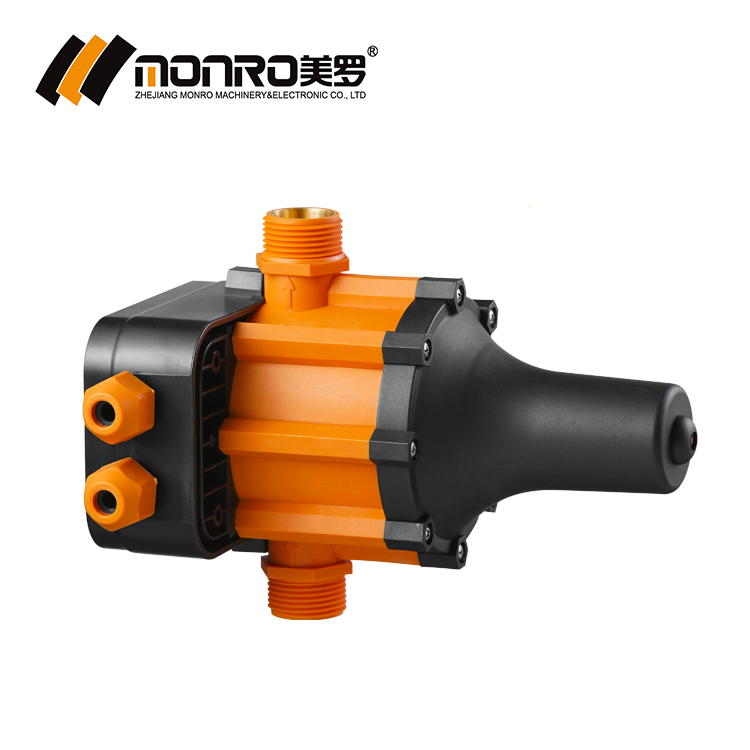
An automatic pressure control on a domestic water line: the enclosure rating, thermal ceiling, voltage band and thread all have to match the installation before the device is energised.
IP65 and 55°C on the EPC-1.1 and EPC-3
The EPC-1.1 and the EPC-3 are both published with a protection rating of IP65 and a maximum working temperature of 55°C. In ingress-protection terms, IP65 describes an enclosure that is dust-tight and protected against water jets — a sensible baseline for plant rooms, pump houses and outdoor cabinets where spray or hose-down is credible, and not a claim of suitability for continuous immersion.
The 55°C figure is a ceiling on the working temperature at the device, not the pump’s rated water temperature. It becomes the deciding number in three situations: a booster set in a closed plant room without ventilation, a controller mounted in a sun-exposed outdoor cabinet, and any installation where the medium itself runs warm. Neither the EPC-1.1 nor the EPC-3 is published as a hot-water control, and the application data for the series specifies clean water as the medium.
A detail worth noticing is that the thermal ceiling is not uniform across the EPC range. The EPC-1.1, EPC-3, EPC-2 and EPC-2.1 are listed at 55°C, while models such as the EPC-13, EPC-14, EPC-15, EPC-16 and EPC-17 are listed at 60°C. A buyer who standardises on “the EPC series” without reading the model table can therefore end up with a lower ceiling than the one discussed at project level.
Voltage checks: 110V, 230V and the 110-240V band
Voltage is where published series language and published model tables most often diverge, and where purchasing documents need to be explicit.
The EPC series selling-point documentation describes triple voltage capability — 110V, 230V, or 110-240V — as a family feature. The EPC-1.1 and EPC-3 parameter tables list rated voltage as 220-240V or 110-120V at a power frequency of 50/60Hz. Other models carry wider bands: the EPC-13 lists 220-240V, 110-120V or 100-240V, while the EPC-2.1 lists 220-240V or 110-120V at 50/60Hz.
For qualification purposes the model table should be treated as the ordering reference and the family statement as background. The practical sequence is short: measure the site supply, match it to the model table value, write that value into the purchase order, and check the delivered nameplate against the order before installation.
Motor matching is the second half of the electrical check. The EPC-1.1 is published with maximum power options of 1.1 kW, 1.5 kW and 0.75 kW; the EPC-3 and EPC-2.1 with 0.55 kW, 1.1 kW, 1.5 kW and 0.75 kW. The controller’s maximum power must be at least the pump motor’s rating. A larger motor on a controller published up to a lower maximum is a mismatch that no enclosure rating will compensate for, and it is visible in the documents well before it is visible on site.
Thread and connection checks: G1″, the EPC-1.1 options and R1″
Both the EPC-1.1 and the EPC-3 list G1″ as the connection thread. The EPC-1.1 additionally offers G1 1/4″, G1 1/2″ and NPT1″, and the EPC-1 lists the same four options. The EPC-2 and EPC-2.1, by contrast, are published with R1″.
G and R designate different thread families in common pipe-thread practice, and the difference is not cosmetic: a fitting cut for one family will not seal reliably on the other without adaptation. The point for a buyer is procedural rather than technical — thread is a variant, not a default. An order that says “EPC-1.1, G1″” and an order that says “EPC-1.1, NPT1″” are two different products, and the NPT1″ option is the one that matters where the controller has to mate with North American pipework.
Thread also interacts with the protection and thermal checks. A G1″ connection on a 55°C-rated controller inside a metal cabinet is a complete specification. The same controller specified without a defined thread is an incomplete one, and it will be resolved on site, usually by improvisation.
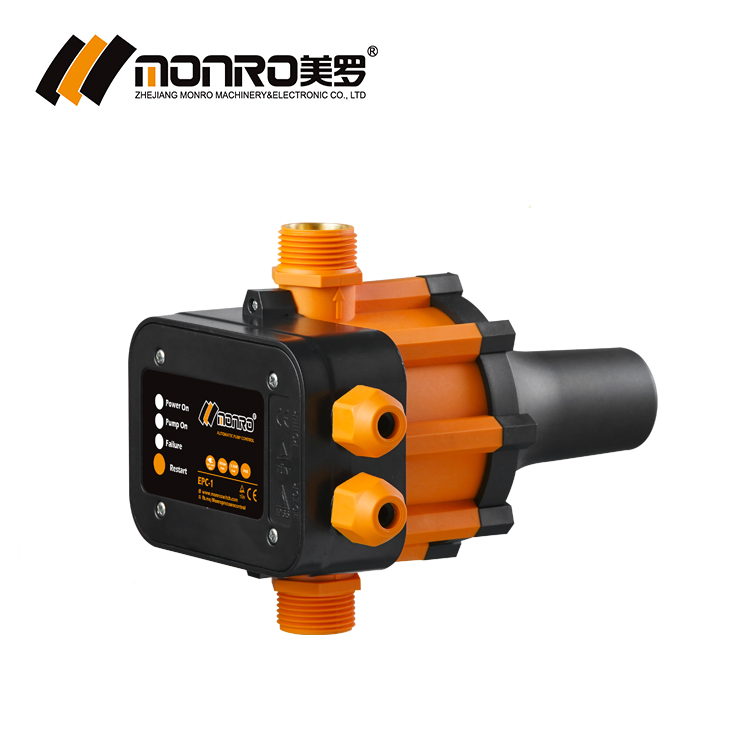
EPC-1 pump pressure switch. The EPC-1 and EPC-1.1 are both published with G1″, G1 1/4″, G1 1/2″ and NPT1″ options — the thread variant has to be stated on the order, not assumed.
Hydraulic behaviour: check valve, run-dry protection and constant pressure
The EPC-1.1 and EPC-3 documentation states a built-in check valve, built-in run-dry protection, constant pressure at constant flow, and compatibility with surface or submersible pumps. Starting pressure settings published for both models are 1.2 bar, 1.5 bar and 2.2 bar.
Two of these deserve a buyer’s attention because they are functions rather than ratings. A built-in check valve removes one component from the bill of materials and one potential leak path from the assembly. Run-dry protection reduces the exposure of a pump running without water, but it is a protection function, not a substitute for correct suction design or for a correctly matched starting pressure. Both should be demonstrated on a sample or witnessed at acceptance, because neither is verifiable from the enclosure rating.
Starting pressure determines whether the system works at all. Monro’s published guidance for automatic pump controllers states that the pump head must be at least 0.8 bar above the controller’s start-up pressure. At a 1.2 bar starting pressure, the maximum water-use height is 12 metres and the pump lift must be at least 20 metres. A controller ordered for a two-storey installation and fitted to a low-lift pump will not deliver constant pressure, regardless of its IP rating or its voltage band.
Application fit: EPC-2 in irrigation, water treatment and construction
The EPC-2 is published as a pump pressure control for agriculture irrigation, water treatment and construction, with R1″, IP65, a 55°C ceiling, rated voltage of 220-240V or 110-120V, maximum power options of 1.1 kW, 1.5 kW and 0.75 kW, and adjustable starting pressure of 1.5 to 3.0 bar. The EPC-2.1 shares the application list and the R1″ connection but is published with IP44 and with power options of 0.55 kW, 1.1 kW, 1.5 kW and 0.75 kW.
That pair is the clearest illustration of how a specification becomes a selection rule. Where the controller sits in a dry panel or a covered pump house, IP44 may be entirely adequate and the EPC-2.1’s wider set of power options may be the better match. Where the enclosure sees washdown, hose-down or weather, the IP65 of the EPC-2 is the deciding difference and the price gap is the wrong comparison to make.
The EPC-1.1 sits at the domestic end of the same logic. It is published as a pump pressure control switch for maintaining constant pressure in domestic water systems, suitable for clean water and for surface or submersible pumps in non-tower supply arrangements.
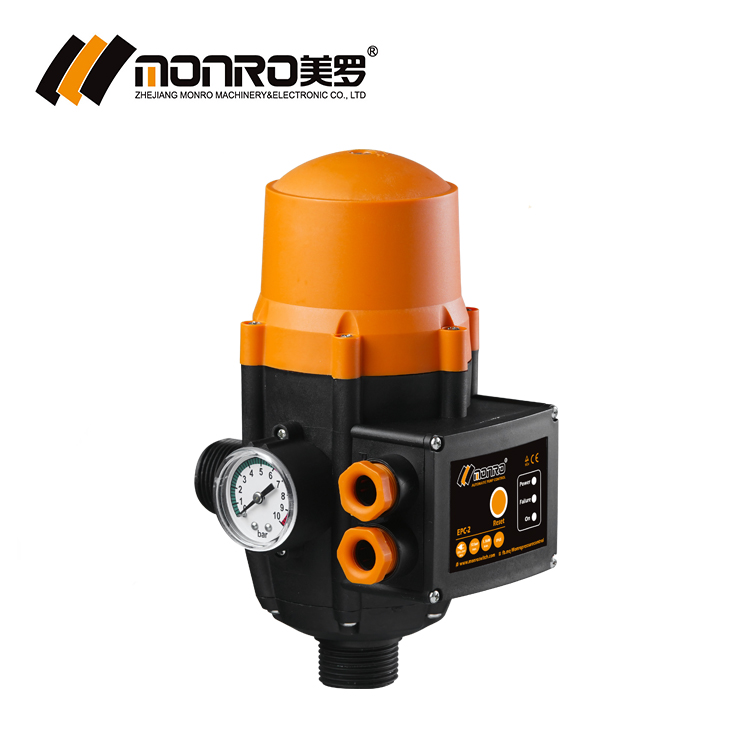
EPC-2 pressure pump control, published for agriculture irrigation, water treatment and construction with R1″ connection, IP65 and a 55°C ceiling.
Where the specification stops: three boundaries buyers discover late
First, the thermal ceiling. The 55°C limit on the EPC-1.1, EPC-3, EPC-2 and EPC-2.1 excludes hot-water service and any installation where the device itself runs above that temperature. The existence of 60°C models elsewhere in the same range does not change the limit for these four.
Second, ingress protection varies inside the range. The EPC-2.1 and EPC-5.1 are published at IP44, the EPC-9 and EPC-11A at IP54, and the EPC-1.1, EPC-3 and EPC-2 at IP65. Selecting by model name alone will not tell a buyer which enclosure was bought.
Third, certification is model-specific. Monro states an ISO 9001:2015 quality management system, TÜV (Germany) and CE (Europe) certifications, with select models also approved under the CUL standard. In the documentation reviewed for this article, a CE-EMC certificate is recorded for the EPC-14 control unit — certificate AE 505987560001, issued by TÜV Rheinland LGA Products GmbH, citing EN IEC 55014-1:2021, EN IEC 55014-2:2021, EN 61000-3-2:2019+A1 and EN 61000-3-3:2013+A1+A2 under Directive 2014/30/EU. That certificate should not be read as covering the EPC-1.1 or the EPC-3. Buyers evaluating either model should request the declaration that applies to the ordered model rather than assume one exists.
On the standards side, IEC 60730-2-6:2025 is the current international standard for automatic electrical pressure sensing controls. It gives buyer and supplier a common reference when a declaration is requested, and it is more useful in a purchase order than the general phrase “CE certified”.
Electronic versus mechanical: a specification comparison, not a recommendation
Electronic controls are not the default choice across the whole category. Market Research Future estimated that electromechanical pressure switches accounted for approximately 62% of the global market in 2024, which is a reasonable indication that mechanical switches remain the working standard in many installations. The KRS series shows why the format persists: the KRS-7 is published with IP44, a 55°C ceiling, a G1″ screw type, rated voltage of 110-240V or 400V and a rated current of 16(8)A, with pressure ranges of 20-40, 30-50 and 40-60 PSI.
The table below sets the published values side by side. It records what each document states; which column wins depends on the four checks described above.
| Attribute | EPC-1.1 | EPC-3 | EPC-2.1 | KRS-7 |
|---|---|---|---|---|
| Product type | Electronic pump pressure control | Electronic pump pressure switch | Electronic pump pressure switch | Mechanical pressure control |
| Protection rating | IP65 | IP65 | IP44 | IP44 |
| Max. working temperature | 55°C | 55°C | 55°C | 55°C |
| Connection thread | G1″; options G1 1/4″, G1 1/2″, NPT1″ | G1″ | R1″ | G1″ |
| Rated voltage / frequency | 220-240V or 110-120V, 50/60Hz | 220-240V or 110-120V, 50/60Hz | 220-240V or 110-120V, 50/60Hz | 110-240V / 400V, 50/60Hz |
| Power / current | Max. 1.1 kW, 1.5 kW or 0.75 kW | Max. 0.55 kW, 1.1 kW, 1.5 kW or 0.75 kW | Max. 0.55 kW, 1.1 kW, 1.5 kW or 0.75 kW | Rated current 16(8)A |
| Set-point units published | bar (1.2, 1.5, 2.2) | bar (1.2, 1.5, 2.2) | bar (1.2, 1.5, 2.2) | PSI (20-40, 30-50, 40-60) |
Values as published in the corresponding model documentation. Blanket statements about an entire series should not replace the model table for any of these attributes.
The last row is the one that causes most procurement errors. A switching specification written in bar cannot be checked line by line against a mechanical switch published in PSI bands unless the unit system is stated explicitly. Whichever format is chosen, the purchase order should carry the unit system and the set point, not only the model number.
Market context: a large category with uneven documentation
The global pressure switch market was valued at USD 3.2 billion in 2025, according to Fortune Business Insights, which in the same analysis projects the market to reach USD 5.13 billion by 2034. Water pump pressure switches are commonly traded under HS Code 853650, the classification covering electrical switches for a voltage not exceeding 1,000 volts.
Scale of that order means the buyer’s problem is not availability but discrimination. A category this broad contains controllers published at IP44 and IP65, at 55°C and 60°C, in bar and in PSI, with and without a certificate reference. Supply depth is part of the picture: Monro states an annual output of approximately 2.88 million EPC series units, 3.24 million KRS series units and 0.6 million FPS series units, from a factory of 30,000 square metres with around 200 staff and a 10-engineer R&D team.
What that output does not do is standardise the specification. The qualification work described here — reading protection, thermal ceiling, voltage band and thread as one set — is what separates a repeatable sourcing decision from a catalogue comparison.
A qualification checklist for the EPC-1.1 and EPC-3
The checklist below converts the published data into acceptance items. Each row can be answered before an order is placed and re-checked after delivery.
| Checkpoint | Published value | What the buyer confirms |
|---|---|---|
| Enclosure protection | IP65 (EPC-1.1, EPC-3) | Rating applies to the ordered variant, including the cable entry arrangement |
| Thermal ceiling | 55°C maximum working temperature | Water and ambient temperature at the mounting point stay below the ceiling |
| Voltage | 220-240V or 110-120V, 50/60Hz (model table); triple-voltage statement at series level | Site supply measured; purchase order and delivered nameplate match |
| Motor match | Max. 1.1 / 1.5 / 0.75 kW (EPC-1.1); 0.55 / 1.1 / 1.5 / 0.75 kW (EPC-3) | Pump motor rating within the controller maximum |
| Thread | G1″ standard; EPC-1.1 also G1 1/4″, G1 1/2″, NPT1″ | Ordered variant matches existing pipework and thread family |
| Hydraulic function | Built-in check valve; built-in run-dry protection | Both demonstrated on a sample or at acceptance |
| Starting pressure | 1.2, 1.5 or 2.2 bar | Pump lift at least 0.8 bar above the selected start-up pressure |
| Medium | Clean water | Water quality and any in-line treatment are compatible |
| Certification | Model-specific; CE-EMC documented for EPC-14 (AE 505987560001) | Declaration requested for the model actually ordered |
Future outlook
Two directions are visible in the published range itself, rather than in forecasts. One is wider electrical tolerance: models such as the EPC-13 list 220-240V, 110-120V or 100-240V, which reduces the number of voltage variants a distributor has to hold. The other is the digitisation of the setting interface: the EPC-12, EPC-12P and EPC-17 publish adjustable start and stop pressures with digital displays and timing modes, moving part of the commissioning work from a screwdriver to a menu.
Neither direction removes the qualification steps described here. A wider voltage band does not raise a 55°C ceiling, and a digital display does not upgrade an IP44 enclosure. What is likely to change is the form of the evidence buyers ask for: with IEC 60730-2-6:2025 as a common reference, model-level declarations and documented set-point ranges become easier to request, and easier to compare, than a general statement of certification.
Frequently asked questions
What protection rating do the EPC-1.1 and EPC-3 carry?
Both models are published with a protection rating of IP65 and a maximum working temperature of 55°C. IP65 describes the enclosure — dust-tight and protected against water jets — and says nothing about chemical compatibility or about suitability for immersion. The 55°C figure applies to the working temperature at the device.
Which connection threads are available on the EPC-1.1?
The EPC-1.1 is published with G1″ as the standard thread and with G1 1/4″, G1 1/2″ and NPT1″ as options. The EPC-3 is published with G1″, and the EPC-1 lists the same four options as the EPC-1.1. The EPC-2 and EPC-2.1 are published with R1″, which belongs to a different thread family. Because thread is a variant rather than a default, the specific option should be stated on the purchase order.
Can the EPC-1.1 and EPC-3 be used on both 110V and 230V supplies?
The model parameter tables for the EPC-1.1 and EPC-3 list a rated voltage of 220-240V or 110-120V at 50/60Hz, while the EPC series selling-point documentation describes triple voltage capability of 110V, 230V or 110-240V as a family feature. Other models carry wider bands — the EPC-13 lists 220-240V, 110-120V or 100-240V. Buyers should treat the model table as the ordering reference and verify the delivered nameplate against the purchase order.
What is the difference between the EPC-2.1 and the EPC-3?
Both are published with a 55°C maximum working temperature and a rated voltage of 220-240V or 110-120V at 50/60Hz. The EPC-3 carries IP65 protection and a G1″ connection; the EPC-2.1 carries IP44 protection and an R1″ connection. The published maximum power options also differ: 0.55 kW, 1.1 kW, 1.5 kW or 0.75 kW for the EPC-3 and the EPC-2.1 alike, against 1.1 kW, 1.5 kW or 0.75 kW for the EPC-1.1. In practice the enclosure rating and the thread family are the deciding differences for irrigation, water treatment and construction installations.
Do the EPC-1.1 and EPC-3 include dry-run protection and a check valve?
Yes. The published specification for both models states a built-in check valve and built-in run-dry protection, together with constant pressure at constant flow and compatibility with surface or submersible pumps. Because these are functions rather than ratings, they are best confirmed by demonstration on a sample or at acceptance testing.
Does a certificate issued for one Monro model cover the EPC-1.1 or EPC-3?
No. Certification is issued per model and per standard. The documentation reviewed for this article records a CE-EMC certificate for the EPC-14 control unit — certificate AE 505987560001, issued by TÜV Rheinland LGA Products GmbH, citing EN IEC 55014-1:2021, EN IEC 55014-2:2021, EN 61000-3-2:2019+A1 and EN 61000-3-3:2013+A1+A2 under Directive 2014/30/EU. Monro states an ISO 9001:2015 quality management system, TÜV (Germany) and CE (Europe) certifications, with select models also approved under the CUL standard. The declaration for the model actually ordered should be requested separately.
Monro Switch product catalogue (2025), including the EPC pressure control range, is available for reference and download: Monro catalogue 2025.
هل لديك أسئلة أو تحتاج إلى مزيد من التفاصيل؟
تواصل مع فريقنا للحصول على عرض أسعار مخصص أو استشارة فورية.
طلب عرض أسعار
املأ النموذج أدناه وسيتواصل معك فريقنا بعرض مقترح مخصص.
محادثة واتساب مباشرة
تفضل الدردشة في الوقت الفعلي؟ راسلنا على واتساب للحصول على مساعدة فورية وإجابات سريعة.
- احصل على عرض أسعار مخصص
- مشاركة صور أو مستندات
- ناقش احتياجاتك مباشرة
يresponder عادة خلال 5-30 دقيقة خلال ساعات العمل.