
Pressure Control Switch Qualification: EPC-1.1, EPC-2.1 and EPC-3 Specs to Verify
Pressure Control Switch Qualification: EPC-1.1, EPC-2.1 and EPC-3 Specs to Verify
A pressure control switch is qualified when four documents agree: the model designation on the purchase order, the specification sheet for that exact model, the certificate scope, and the acceptance record at goods-in. The Monro Switch EPC-1.1, EPC-2.1 and EPC-3 belong to the same automatic pump control family, but they do not carry an identical configuration list. This review separates what is published for each model from what has to be confirmed in writing, and shows how to turn those answers into purchase-order terms.
Monro Switch — Zhejiang Monro Machinery & Electronic Co., Ltd. — is a manufacturer of pump controllers, pressure switches and float switches based in Wenling City, Zhejiang Province, China. The company was established in 2010, reports more than 20 years of experience in pressure control and float switch production, operates a 30,000 m² facility with around 200 employees and a 10-engineer R&D team, and exports roughly 90% of output to Asia, Europe, North and South America, the Middle East and Africa.
Why constraint verification carries the weight in this category
Pressure switches are a mature component category, and the published market picture reflects that. Fortune Business Insights valued the global pressure switch market at USD 3.2 billion in 2025, with a projection of USD 3.38 billion for 2026 rising to USD 5.13 billion by 2034. Market Research Future estimated that electromechanical pressure switches held approximately 62% of the market in 2024, with electronic designs accounting for the remaining 38%. Those figures describe the category as a whole, not any single supplier, and they should not be read as a forecast of demand for a particular model.
Their practical use for a buyer is narrower. In a category where the underlying switching technology is well established, the difference between a smooth installation and a field callback usually sits in configuration control: the right thread, the right power ceiling, the right setpoint, and a certificate that names the model actually being shipped. For a research-to-evaluation stage purchase, that is where most of the due diligence belongs.
EPC-1.1, EPC-2.1 and EPC-3: documented versus to-be-confirmed
The table below distinguishes three kinds of information. The first is a value published at application level for the residential and domestic water-supply condition that lists these models. The second is a value published for a specific model. The third is an item this review could not confirm from published material, which should therefore be requested in writing before the order is released.
| Check | EPC-1.1 | EPC-2.1 | EPC-3 |
|---|---|---|---|
| Protection rating | IP65 (published application condition) | IP65 (published application condition) | IP65 (published application condition) |
| Maximum working temperature | 55 °C (same condition) | 55 °C (same condition) | 55 °C (same condition) |
| Power frequency | 50/60 Hz, published for EPC-1.1 | Confirm on the model datasheet | Confirm on the model datasheet |
| Maximum motor power options | 0.75 kW, 1.1 kW, 1.5 kW, published | Confirm on the model datasheet | Confirm on the model datasheet |
| Starting-pressure setting | Confirm against the order code | Confirm against the order code | Confirm against the order code |
| Connection thread | G1", G1 1/4", G1 1/2", NPT1" appear on the EPC-1 specification; confirm which apply to this model | Confirm; the neighbouring EPC-2 specification lists R1" | Confirm |
| Named in CE-EMC certificate AE505724390001 | Not named individually — the scope lists EPC-1 | Yes | Yes |
| Within the ISO 9001 system scope | Yes | Yes | Yes |
| UL listing | Not documented | Not documented | Not documented |
The pattern matters more than any single row. The EPC-1.1 has the clearest published electrical profile of the three: a 50/60 Hz power frequency and maximum power options of 0.75 kW, 1.1 kW and 1.5 kW. The EPC-2.1 and EPC-3 are confirmed members of the same control family and appear by name in the CE-EMC certificate scope, but their voltage, power and starting-pressure options were not itemised in the specification material available for this review. That is a documentation gap to close, not a negative finding, and it is closed with a single written request.
Reading IP65 and 55 °C correctly
IP65 is an ingress-protection classification, not a general durability grade. The first digit denotes dust-tightness and the second protection against water jets; the rating describes the enclosure, not the pumped medium and not the installation. It holds only when the cable entry, the cover fixings and the threaded connections are assembled with their seals intact and the specified cable gland is used. A control installed with a cut gland or a missing sealing washer is no longer an IP65 control, whatever the label says.
55 °C is a maximum working temperature, which means a ceiling rather than a target. Buyers specifying for a plant room, a rooftop booster set or an unshaded irrigation cabinet should record the expected ambient and fluid temperature on the enquiry, because the enclosure class does not compensate for an installation that runs above the stated limit. Where the site condition sits close to the limit, that should be written into the purchase specification so the supplier can confirm suitability in writing.
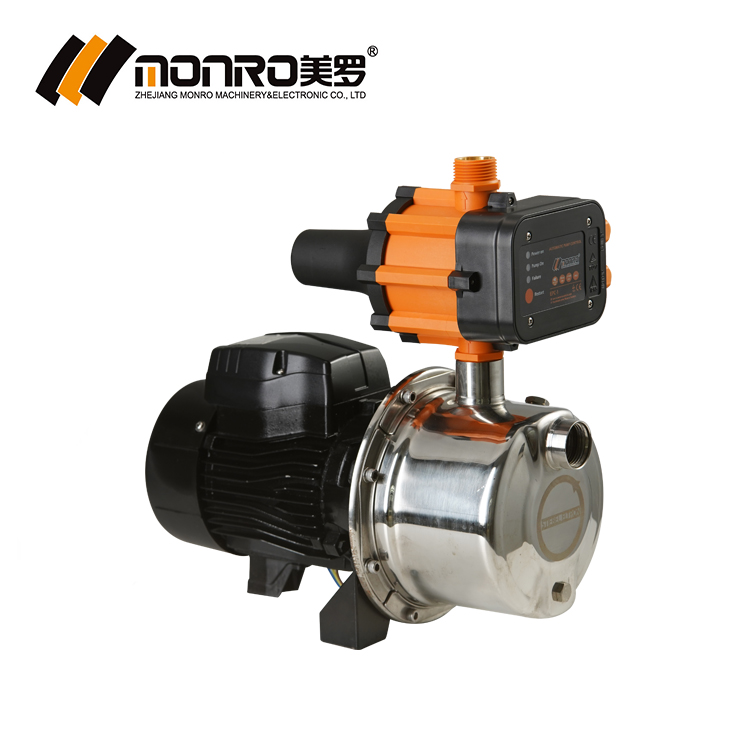
Automatic pump pressure control on a domestic water-supply line. Ingress protection depends on correct sealing of the cable entry and threaded connections.
Thread configuration: G1, G1 1/4, G1 1/2 or NPT1
The EPC-1 specification record lists connection thread options of G1", G1 1/4", G1 1/2" and NPT1". The neighbouring EPC-2 record lists R1". That spread is useful, but it is also the most common source of mismatch in this product class, because BSPP (G) and NPT threads are not interchangeable. They differ in thread form and in the recommended sealing method, and an adapter introduced on site is a new leak path.
The buying rule is straightforward: never infer the thread from a sister model. State the exact thread designation on the purchase order, together with the intended mating fitting, and ask the supplier to confirm it in writing against the order code. On a mixed project — domestic risers on G1", irrigation manifolds on NPT1" — split the order lines by thread rather than relying on a note in the covering email.
Electrical rating and starting-pressure arithmetic
Electrical verification is a matter of matching three numbers to the pump, not to the brochure. On the EPC-1.1, the published power frequency is 50/60 Hz and the maximum power options are 0.75 kW, 1.1 kW and 1.5 kW. The EPC-1 and EPC-2 specification records, which sit either side of the models in this review, list a rated voltage of 220–240 V / 110–120 V, a 50/60 Hz frequency and the same 0.75 kW / 1.1 kW / 1.5 kW power spread, with starting-pressure settings of 1.2 bar, 1.5 bar and 2.2 bar. Those two records also state adjustable starting-pressure ranges of 1.2–2.5 bar (EPC-1) and 1.5–3.0 bar (EPC-2). Buyers should confirm which of these applies to the EPC-1.1, EPC-2.1 or EPC-3 variant being quoted rather than assuming the family value.
Starting pressure itself is set by two physical facts: the pump's lift and the maximum height water must reach. Monro's stated selection rule for its automatic pump controllers is that the pump head must be at least 0.8 bar above the controller's start-up pressure, and that the starting pressure multiplied by 10 metres gives the maximum usable water height. A controller set to 1.2 bar therefore supports roughly 12 m of usable height, and requires a pump lift of at least (1.2 + 0.8) × 10 = 20 m. Applying that rule before ordering avoids the most common complaint in this category: a correctly built control that never reaches its cut-in point on a short-lift pump.
Adjustable version, check valve and run-dry protection
These three features decide how the control behaves when the system is not behaving normally, so each needs to be confirmed per model rather than assumed from the family. The EPC-1 specification record lists optional adjustable and non-adjustable versions, a built-in check valve and built-in run-dry protection. The EPC-2 record lists the same set, with an adjustable starting-pressure range of 1.5–3.0 bar. For the EPC-1.1, EPC-2.1 and EPC-3, these items were not itemised in the material reviewed here and should be confirmed item by item.
Two clarifications are worth making explicit in any enquiry. First, an adjustable version and a non-adjustable version are different order codes, not a setting difference; ordering the fixed variant and adjusting it on site is not the intended use. Second, the absence of a feature from a summary table is not evidence that the feature is unavailable — it is evidence that the supplier has not yet stated it. Written confirmation is quick to obtain and is the only form of confirmation that survives an audit.
Matching the certificate scope to the model on the order
Certificate scope is where qualification most often goes wrong, because a supplier may hold strong certificates that do not cover the model being bought. The certificates in the Monro set are specific on this point, and the model lists should be read literally.
| Certificate | Issuing body | Models named in scope | Standard referenced | Dates |
|---|---|---|---|---|
| CE-EMC Certificate of Conformity, AE505724390001 | TÜV Rheinland LGA Products GmbH | EPC-1, EPC-2, EPC-2.1, EPC-3, EPC-3P, EPC-4, EPC-5, EPC-15, CEWP-111B | EN IEC 55014-1:2021; EN IEC 55014-2:2021; EN 61000-3-2:2019+A1; EN 61000-3-3:2013+A1+A2 (Directive 2014/30/EU) | Issued 2023-01-17; expiry 2099-01-17 |
| CE-EMC Certificate of Conformity, AE0604425 0001 | TÜV Rheinland LGA Products GmbH | EPC-10, EPC-12, EPC-16 | EN IEC 55014-1:2021; EN IEC 55014-2:2021; EN IEC 61000-3-2:2019+A1; EN 61000-3-3:2013+A1+A2 | Issued 2023-11-30; expiry 2099-11-30 |
| CE-EMC Certificate of Conformity, AE 505987560001 | TÜV Rheinland LGA Products GmbH | EPC-14 | EN IEC 55014-1:2021; EN IEC 55014-2:2021; EN 61000-3-2:2019+A1; EN 61000-3-3:2013+A1+A2 | Issued 2023-08-31 |
| TÜV Rheinland Safety Certification, R 50175890 | TÜV Rheinland LGA Products GmbH | EPC-10, EPC-12, EPC-14, EPC-16 | EN 60730-1:2016+A1+A2; EN 60730-2-6:2016+A1 | Issued 2024-02-07; expiry 2099-02-07 |
| UL Listed Certification, E316396 | UL LLC | KRS-4 (pressure operated switches) | EN 60730-1:2016+A1+A2; EN 60730-2-6:2016+A1 | North America market |
| ISO 9001, 20126Q00115R300 | BeiJing ZHONGRUI Unite | System scope: manufacture of water pump pressure switch | GB/T19001-2016 / ISO9001:2015 | Issued 2026-06-30; expiry 2029-06-29 |
Three conclusions follow directly from that table. First, the EPC-2.1 and EPC-3 are named in the CE-EMC certificate AE505724390001, which addresses electromagnetic compatibility under Directive 2014/30/EU. That certificate is an EMC document; it is not a low-voltage or appliance-safety certificate, and it should not be presented or accepted as one. Second, the TÜV Rheinland safety certification R 50175890 — which does reference EN 60730-1 and EN 60730-2-6, the pressure-sensing control safety standards — names EPC-10, EPC-12, EPC-14 and EPC-16, not the three models in this review. Third, the UL listing E316396 applies to the mechanical KRS-4 pressure switch for the North American market, not to any EPC model.
The ISO 9001 certificate is a fourth, distinct category: it certifies the quality management system covering the manufacture of water pump pressure switches, and it does not certify any individual product's performance. All three models appear in its related product list, which tells a buyer that the manufacturing system is audited; it does not tell them what the enclosure rating is.
Standard editions and what a 2016 reference means today
The International Electrotechnical Commission lists IEC 60730-2-6:2025 as the current international standard for automatic electrical pressure sensing controls used in, on or with household and similar equipment, published in August 2025. The Monro certificates reviewed above reference the 2016 editions with amendments — EN 60730-1:2016+A1+A2 and EN 60730-2-6:2016+A1.
That difference is a question to put to the supplier, not a conclusion. Certification against an edition that was current at the time of issue is normal practice, and whether a certificate referencing the 2016 edition remains acceptable depends on the destination market, the notified body and the applicable transition arrangements. Buyers in the EU, North America or the Middle East should ask directly: which edition does the certificate reference, is it still accepted in our market, and is a certificate to the 2025 edition planned? Those three questions cost nothing and prevent a documentation problem at the border.
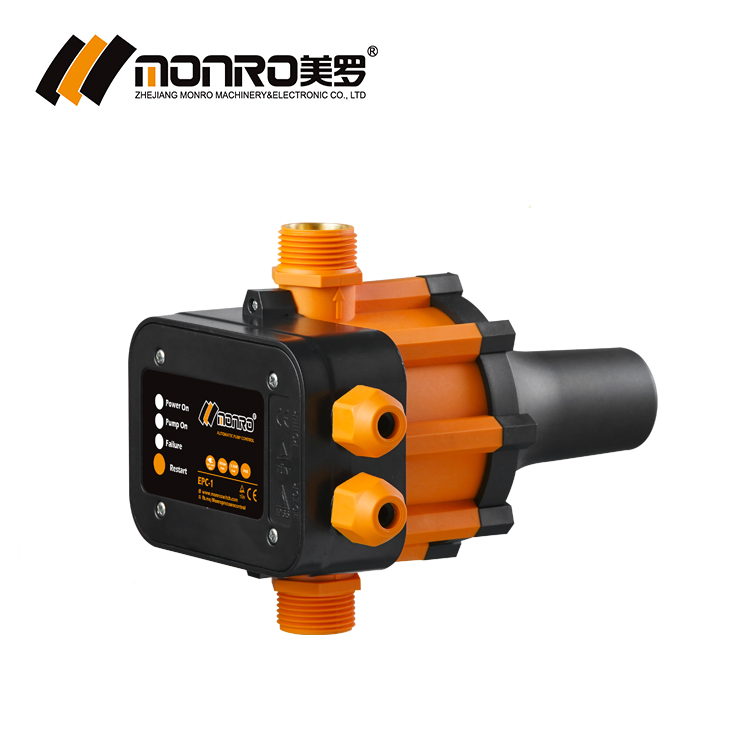
EPC series pump pressure switch. Thread designation, power option and setpoint should each appear explicitly on the purchase order.
Turning the checks into contract terms and goods-in criteria
Qualification work only pays off if it reaches the commercial documents. Monro's published supply terms for the EPC series state an MOQ of 204 pieces, a 45-day lead time, 100% testing, a one-year warranty and remote after-sales support, with OEM customisation available for cable length, cable material, brand, colour box and colour. Monthly capacity for the EPC series is stated at 180,000 pieces. Those are the figures a buyer should use when planning stock and sampling, and they belong in the purchase agreement rather than in a footnote.
For the technical side, the following items should appear as named acceptance criteria rather than as general expectations:
- Model designation on the label, the carton and the certificate copy must match the purchase order exactly, including the suffix that distinguishes an adjustable from a non-adjustable variant.
- Thread verified with a gauge for the ordered designation — G1", G1 1/4", G1 1/2" or NPT1" — not by visual comparison with a sample.
- Rated voltage and maximum power confirmed against the pump nameplate, with the frequency stated as 50/60 Hz where the destination supply varies.
- Starting pressure verified on a test bench against the ordered setpoint, and recorded as a measured value with the test date.
- Check valve and run-dry behaviour confirmed only if these were ordered in writing; the acceptance record should state that they were tested, or state that they were not part of the order.
- Enclosure integrity inspected for seal seating, gland type and cover fixings, since the IP65 claim depends on assembly rather than on the moulding alone.
- Certificate copies filed with the model literally named in the scope highlighted, and the certificate number and issue date visible.
Application fit and the qualification habit
The application record covering these models describes domestic and residential water supply, with agriculture irrigation, water treatment and construction listed as the applicable industries. The stated working condition is water as the working fluid, a 220–240 V / 110–120 V rated voltage, a 0.5–10 bar pressure range, IP65 protection and a 55 °C maximum working temperature, matched to a water pump and intended for clean water media. That is the context in which the IP65 and 55 °C figures should be read, and it is also a reminder that the working condition describes an application envelope rather than a promise about any individual installation.
The forward-looking view is unremarkable, which is itself useful. Electronic pump controls are growing from a smaller base than electromechanical switches — 38% against 62% of the 2024 market in Market Research Future's estimate — while the overall pressure switch category is projected to expand. For buyers, growth in volume does not make specification easier; it makes documentation discipline more valuable, because a larger order concentrates more risk into a single incorrect thread or power option. The qualification habit — publish only what is published, confirm everything else in writing, and test at goods-in — scales better than any single data sheet.
Monro's model range, certificates and contact details are published at Monro Switch, and the current catalogue, including the EPC series configuration options, can be downloaded as a PDF catalogue for comparison against a site specification.
Frequently asked questions
What protection rating and maximum working temperature apply to the EPC-1.1 and EPC-3?
The published working condition for the domestic and residential water-supply application that lists these models specifies IP65 protection and a maximum working temperature of 55 °C. IP65 describes the enclosure against dust and water jets and depends on correct assembly of the cable entry and threaded connections. The 55 °C figure is a ceiling, so buyers should check it against the expected ambient and fluid temperature at the installation rather than treat it as a typical value.
Which EPC models are named in the CE-EMC certificate?
CE-EMC Certificate of Conformity AE505724390001, issued by TÜV Rheinland LGA Products GmbH on 2023-01-17 with an expiry of 2099-01-17, names EPC-1, EPC-2, EPC-2.1, EPC-3, EPC-3P, EPC-4, EPC-5, EPC-15 and CEWP-111B. It references EN IEC 55014-1:2021, EN IEC 55014-2:2021, EN 61000-3-2:2019+A1 and EN 61000-3-3:2013+A1+A2 under Directive 2014/30/EU. The EPC-1.1 is not listed separately in that scope, and the certificate addresses electromagnetic compatibility rather than product safety.
What connection thread options are documented for the EPC range?
The EPC-1 specification record lists G1", G1 1/4", G1 1/2" and NPT1". The neighbouring EPC-2 record lists R1". G and NPT threads are not interchangeable in form or sealing method, and the available options differ between models, so the exact designation should be written on the purchase order and confirmed in writing against the order code rather than inferred from another model in the same family.
How is the starting pressure chosen for a given pump and building height?
Monro's stated selection rule for its automatic pump controllers has two parts: match the controller to the motor power of the pump, and set the starting pressure from the pump lift and the maximum water-use height. Starting pressure multiplied by 10 metres gives the maximum usable height, so 1.2 bar supports roughly 12 m. The pump head must be at least 0.8 bar higher than the start-up pressure, which means a 1.2 bar setting requires a lift of at least (1.2 + 0.8) × 10 = 20 m.
Is the EPC-1.1 UL listed?
No UL listing covering the EPC-1.1 appears in the certification material reviewed here. The UL Listed Certification in the Monro set, number E316396 issued by UL LLC for the North American market, covers pressure operated switches of model KRS-4. The TÜV Rheinland safety certification R 50175890 covers EPC-10, EPC-12, EPC-14 and EPC-16. Buyers who require UL for an EPC model should confirm the position in writing rather than assume coverage from a sister certificate.
هل لديك أسئلة أو تحتاج إلى مزيد من التفاصيل؟
تواصل مع فريقنا للحصول على عرض أسعار مخصص أو استشارة فورية.
طلب عرض أسعار
املأ النموذج أدناه وسيتواصل معك فريقنا بعرض مقترح مخصص.
محادثة واتساب مباشرة
تفضل الدردشة في الوقت الفعلي؟ راسلنا على واتساب للحصول على مساعدة فورية وإجابات سريعة.
- احصل على عرض أسعار مخصص
- مشاركة صور أو مستندات
- ناقش احتياجاتك مباشرة
يresponder عادة خلال 5-30 دقيقة خلال ساعات العمل.