
Print-Registered Non Woven Bags: ZXL-E700 & A700Ultra Fit
Independent Industry Reference · Packaging & Printing
Print-Registered Non Woven Bags: ZXL-E700 & A700Ultra Scenario Fit
A print-registered non woven bag is a bag in which every cut, seal, fold and handle position is placed at a fixed distance from a printed design, rather than at a fixed distance from the previous cut. That is the difference between a line that makes plain shopping bags and a line that can supply a supermarket chain, an apparel brand or a promotional buyer with a centred logo and a handle that never clips the artwork.
Zhejiang Zhengxin Machinery Co., Ltd. — trading as ZX Zhengxin Machinery — is a Wenzhou-based manufacturer of non woven bag making machines and complete non woven bag production lines. The company was founded in 2014 and operates a 60,000 m² facility with approximately 200 employees, a 30-engineer R&D team and an annual output of around 500 units; it reports a 60% export ratio across Africa, the Middle East, Southeast Asia and Latin America, and has exported to more than 120 countries. Two models in its ZXL range sit closest to printed retail packaging work: the ZXL-E700, a five-in-one platform with online handle attaching, and the ZXL-A700Ultra, a zero-waste-edge machine designated for T-shirt and W-cut bags.
This article maps those two machines to the retail formats that print-registered programmes actually order, explains how photoelectric tracking holds artwork position on a moving web, and marks clearly where the registration loop ends and operator discipline begins.
Why printed retail packaging changed the machine requirement
Plastic bag restrictions are the most visible driver behind the move to reusable non woven packaging. According to Dataintelo (2026), more than 140 countries had enacted legislation restricting or banning single-use plastic bags as of 2026. As thin-film carriers leave retail counters, printed non woven bags inherit the brand identity that used to sit on a plastic bag. The consequence for converters is that printing is no longer an optional secondary process: grocery chains want the store logo centred on a vest bag, apparel brands want the artwork clear of the handle, and promotional buyers want small runs of multi-colour totes that match a campaign date.
Printed bags change three machine requirements at once. First, the bag machine must locate the print rather than only measure fabric length. Second, the seal must be clean enough that a heat mark or scorch does not spoil a printed surface. Third, changeover has to be fast, because a print programme typically splits one fabric roll into several designs. The ZXL-E700 and ZXL-A700Ultra are the two Zhengxin models most often specified against these requirements, and they answer them differently.
How photoelectric tracking holds registration on a moving web
A non woven bag making machine of this class does not read the artwork itself. It reads a registration mark — a small black square, typically 5×5 mm or 8×8 mm, printed at a fixed distance from each bag's printed design. A photocell mounted above the fabric path emits a modulated red beam (around 660 nm wavelength, selected for contrast against white polypropylene fabric) and measures how much light reflects back. Because the beam is modulated at 10–50 kHz, the sensor ignores ambient factory lighting and responds only to its own signal. When the dark mark passes under the beam, reflected intensity drops below the stored threshold and the sensor output switches, sending a trigger to the PLC.
The timing arithmetic behind a registered cut
When the trigger arrives, the PLC already holds two values: the distance from the sensor to the cut point, and the current fabric speed, read continuously from the servo encoder. Trigger-to-cut delay is simply that distance divided by that speed. A mark positioned 350 mm ahead of the cut point on fabric moving at 700 mm/s produces a 500 ms delay. Fixed latencies — sensor response time (roughly 0.5 ms), PLC input scan (around 1 ms), output switching (around 2 ms) and mechanical actuation (10–20 ms, depending on whether the knife is pneumatic or servo-driven) — are measured out during the machine's registration teach routine, so the controller compensates for them permanently rather than recalculating them bag by bag.
The detect-and-actuate chain must therefore complete inside roughly 15–25 ms at production speed. At 120 bags per minute the fabric is travelling at approximately 600–900 mm/s, which is why a mark smaller than the minimum size, or printed with faded ink, can pass the beam faster than the loop can respond and produce a missed detection cycle.
What actually keeps the logo centred
Registration holds the logo in position relative to the cut. Servo-driven feeding holds the bag length itself. A servo motor with a 17-bit to 20-bit encoder reports its shaft position thousands of times per second, and the drive corrects any deviation every 125–250 microseconds. That closed-loop correction is why a servo platform holds cut placement in the region of ±0.5 mm after long production runs, while open-loop feeding drifts by 2–3 mm as belts wear and supply voltage moves. Registration accuracy of roughly 0.5 mm on logo position is realistic only when the mark, the tension and the sensor are all correct at the same time.
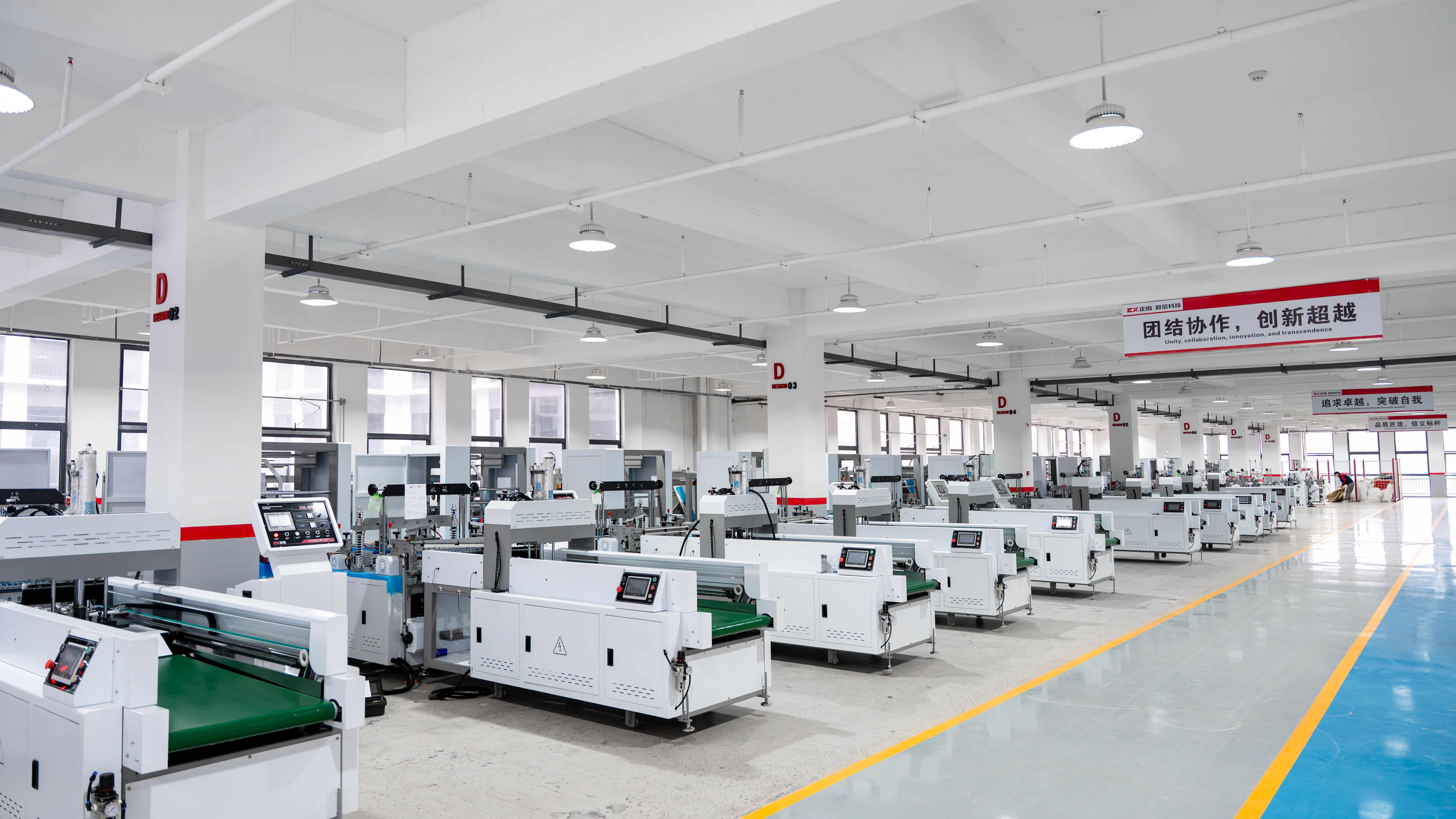
Vest and W-cut formats are the volume end of printed retail packaging, where registration errors are most visible to the end customer.
Scenario fit: which printed bag format goes on which machine
The practical selection question is not which machine is faster — both run the same 40–120 pcs/min band — but which bag geometry the printed programme requires, and whether that geometry sits inside the model's bag-width and thickness envelope.
| Retail scenario | Typical bag format | What the printed design demands | Machine fit |
|---|---|---|---|
| Grocery & supermarket chains | Vest (T-shirt) bag, D-cut bag, box bag with handles | Logo centred above the handle cut-out; high daily volume; consistent seal strength | ZXL-A700Ultra for vest and W-cut formats; ZXL-E700 for handled box bags |
| Apparel & fashion retail | Handled flat bag, tote bag, box bag | Wide clear print area, handle clear of artwork, wrinkle-free surface | ZXL-E700 — bag width 100–800 mm, handle length 380–600 mm |
| Promotional & corporate gift | Tote, vest or box bag in small batches | Fast design changeover, multi-colour artwork, tight delivery dates | ZXL-E700 or ZXL-A700Ultra paired with a 2- or 4-colour flexo unit |
Read together, the three scenarios describe the same underlying split: retailers who need cut-in handle formats at volume go to the ZXL-A700Ultra, while programmes built around separately attached handles and a wider spread of bag widths go to the ZXL-E700.
ZXL-E700 and ZXL-A700Ultra in specification terms
The two models share the same fabric roll window (500–1300 mm), the same rated production speed band and dual 380V/220V power supply. They diverge in bag geometry, in fabric weight tolerance and in the sealing and waste profile they are engineered around.
| Parameter | ZXL-E700 | ZXL-A700Ultra |
|---|---|---|
| Product designation | Non woven bag making machine 5-in-1; non woven box bag making machine with online handle attaching | Zero-waste-edge non woven T-shirt & W-cut bag making machine; edge waste-free vest bag making machine |
| Fabric roll width | 500–1300 mm | 500–1300 mm |
| Production speed | 40–120 pcs/min | 40–120 pcs/min |
| Bag height | 200–580 mm | 300–700 mm |
| Bag width | 100–800 mm | 200–400 mm |
| Handle length | 380–600 mm | Not specified for this model (cut-in handle format) |
| Material thickness | 30–100 g/m² | 30–120 g/m² |
| Handle material thickness | 50–100 g/m² | Not specified for this model |
| Total power | 18 kW | 15 kW |
| Overall dimensions | 12,000 × 2,050 × 1,900 mm | 10,500 × 2,050 × 1,900 mm |
| Weight | 4,000 kg | 2,900 kg |
Two differences matter more than the rest when a printed programme is being planned. The first is the thickness ceiling: the ZXL-E700 accepts 30–100 g/m² fabric, while the ZXL-A700Ultra extends to 30–120 g/m². A grocery vest bag printed on 70–80 g/m² spunbond sits comfortably inside both envelopes; a heavier promotional tote at 110 g/m² does not fit the E700 window. The second is the bag-width corridor: the ZXL-A700Ultra covers 200–400 mm bag widths, which suits a standardised vest bag family, whereas the ZXL-E700's 100–800 mm range allows one printed bag programme to span a small food-service bag and a large box bag without adding a second platform.
Why the seal decides whether a printed bag sells
Ultrasonic welding bonds non woven polypropylene by converting 20 kHz electrical energy into mechanical vibration. A piezoelectric transducer drives a horn (sonotrode) against a fixed anvil; the oscillation generates friction heat at the interface between two fabric layers, melting polypropylene locally within 0.2–0.5 seconds. When vibration stops, the melt cools and solidifies into a molecular bond — no glue, thread or external heating element is involved.
For printed bags, the important question is where the heat appears. A heat-sealing bar has to conduct energy from outside the fabric stack through its full thickness, so the outer surface reaches temperature before the inner interface does — the same mechanism that produces scorching, distortion and odour on the visible face of a bag. Ultrasonic energy is generated at the interface itself, with a melt zone of roughly 0.1–0.3 mm, so the printed face is not exposed to the same external heat load. Seams formed this way measure 15–20% higher peel strength than heat-sealed seams, and because the generator draws power only during the weld pulse, ultrasonic sealing uses 25–30% less energy than continuously maintaining a heated element.
That does not make the process maintenance-free. The horn is a wear part, typically replaced every 12–18 months, and an amplitude setting that is too high for the fabric weight will still brown or distort the material. The practical control is the pull test: after any parameter change, run 20 bags and pull-test five — a correct ultrasonic seal tears the fabric rather than peeling apart at the weld line. Amplitude of roughly 75–85% is the usual starting band for 70–90 g/m² spunbond, with thicker fabric pushed higher and thin fabric reduced slightly.
Matching the machine to the printed-film workflow
Registration quality starts upstream of the bag machine. Zhengxin's non woven printing range includes the ZXH-C21200 two-colour flexo press (max fabric roll width 1200 mm, max printing width 1160 mm, printing length 250–1000 mm, printing speed 10–60 m/min) and the ZXH-C41200 four-colour press (printing length 220–1000 mm, same roll width). Both are roll-to-roll, so printed fabric feeds the bag machine as a continuous web and the registration marks are printed and read inside one workflow rather than across a batch-and-store step.
Three integration points decide whether the loop works in daily production:
- Registration mark design. Marks must be printed consistently in size, position and ink density. A faded or undersized mark is not a machine fault, but it will produce one — the sensor either misses it or triggers late.
- Fabric tension. Registration is referenced to the mark's position on the fabric. If tension varies between the printing station and the bag machine, the mark shifts relative to the design and the logo moves on the finished bag.
- Support equipment. A stable printed-bag line normally pairs the bag machine with a flexo printing unit, an air compressor working at 0.6–0.8 MPa, an automatic counting and bundling machine, and — where grid power fluctuates — a voltage stabiliser sized to the combined load.
For export-facing programmes, the machines carry CE marking under certificate M.2021.206.C70875 issued by UDEM (valid to 23 January 2027), covering the Machinery, Low Voltage and EMC directives, and the manufacturing facility holds ISO 9001:2015 certification number 20225Q21503R2M issued by QPC (valid to 12 January 2029). Both are relevant to retail buyers who must show conformity documentation when bags are shipped into regulated markets.
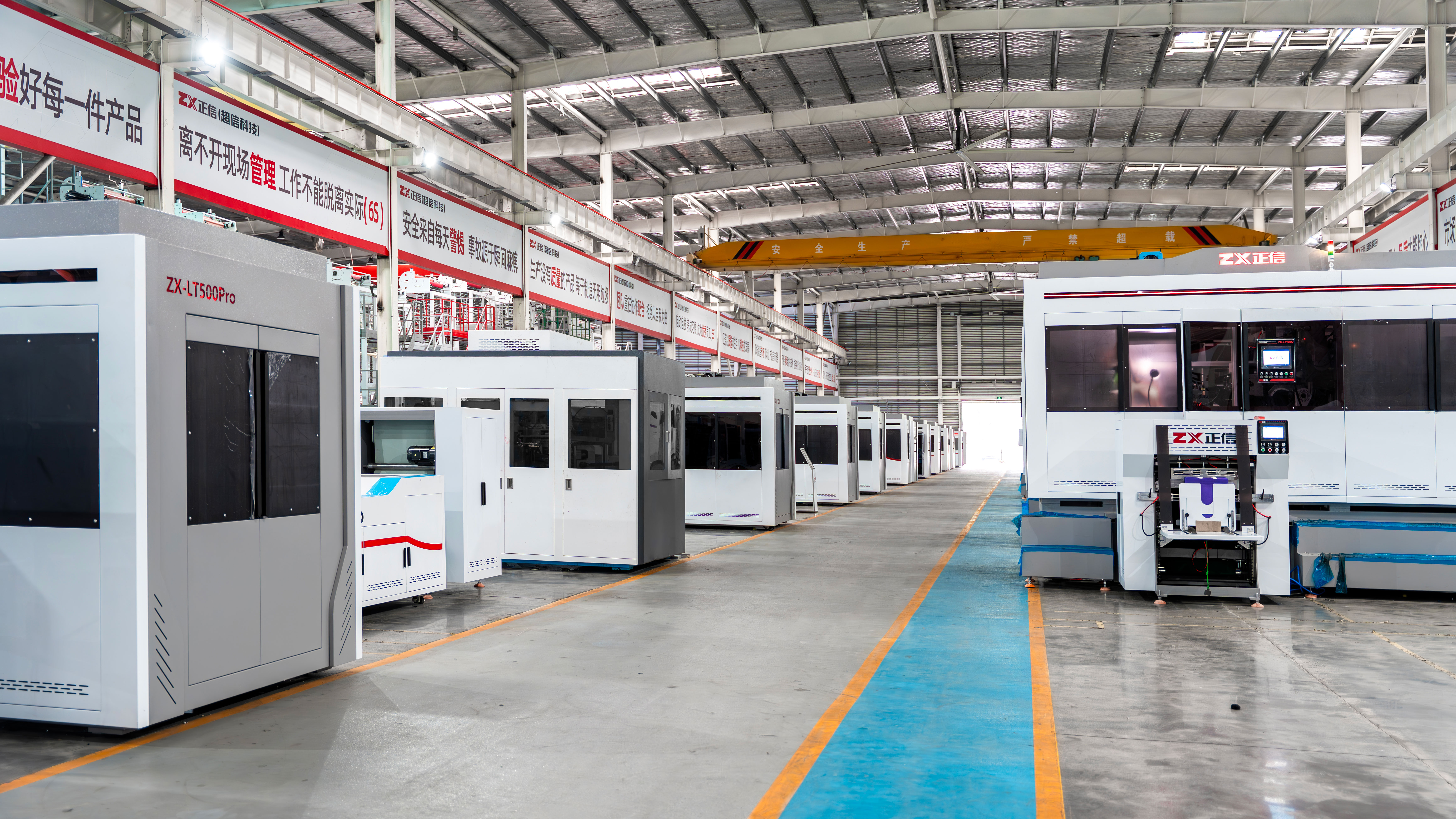
Handled box and tote formats sit inside the ZXL-E700 envelope: bag width 100–800 mm with 380–600 mm handles.
Where these two models stop — boundaries buyers should plan around
Photoelectric registration is a positioning system, not a print-quality system, and neither model is a universal converting platform. Four boundaries are worth planning around before a printed programme is quoted.
| Boundary | What it means in production |
|---|---|
| Fabric weight ceiling | The ZXL-E700 is rated for 30–100 g/m² and the ZXL-A700Ultra for 30–120 g/m². Heavier or lofted constructions sit outside both — the dedicated 3D box bag platform, for example, is specified for 70–150 g/m². |
| Bag width corridor | The ZXL-A700Ultra runs bag widths of 200–400 mm. A printed programme that needs to span 100–800 mm across one product family belongs on the ZXL-E700. |
| Registration cannot repair printing | Missed or late detections usually trace to faded marks, a mark smaller than about 5 mm, an unstable mark pitch, a dusty photocell lens or a loose sensor bracket. If the printed roll is inconsistent, no controller setting will centre the logo. |
| Not a standing-bag platform | Neither model produces 3D standing bags. That requires the dedicated ZX-LT500 series, a different platform with its own roll width, thickness and speed envelope (60–100 pcs/min). |
There is also an operational boundary that matters more than any specification. If registration shifts suddenly by 5 mm or more in automatic mode, the correct response is to stop the machine and find the mechanical cause — a loose sensor bracket, a torn mark area, or fabric that has begun to track unevenly. Trimming the error out through recipe offsets hides the fault while the machine continues converting printed fabric at full speed.
What deployment looks like in practice
Printed retail bag production is not theoretical for these models. Four deployments illustrate how the scenario split works in the field.
A shopping bag manufacturer in Kenya has run three units since 2023 — two ZXL-A700 machines with one ZXH-C41200 four-colour press — producing branded non woven shopping bags for nationwide supermarket chains. The reported outcome is supply to more than 200 retail stores, with the fully automatic line running from printing to finished bag under a single operator.
A promotional bag producer in Tanzania operates two units since 2024, combining a ZXL-A700Ultra with a ZXH-C21200 two-colour press for custom printed tote bags used in corporate events, political campaigns and brand promotions. The operator expanded from one line to two within 18 months and reports handling more than ten custom orders per week with different artwork, which is a changeover-driven workload rather than a pure volume one.
A food packaging and retail shopping bag manufacturer in Egypt has run five units since 2017: one ZXL-E700, two ZXH-C21200 presses and two ZXL-D700 machines. The line supports two distinct product streams — food takeaway bags for restaurant chains and delivery platforms, and multi-colour printed promotional shopping bags for retail malls — from a single equipment supplier.
At the largest end, a non woven bag manufacturing group in Indonesia operates 42 machines, thirteen of them ZXL-E700 units, across retail shopping bags, multi-colour printed promotional bags and food-grade takeaway packaging for both domestic retail chains and regional export.
Market direction: a fast-moving slice of a slow-moving category
The non woven bag making machine segment is expanding considerably faster than bag machinery as a whole. LP Information places the specialised global non woven bag making machine market at US$179 million in 2025, growing to US$733 million by 2032, with a forecast CAGR of 22.5% between 2026 and 2032 attributed largely to plastic ban policies. Dataintelo, by contrast, values the total bag making machine market — which also includes paper and plastic bag equipment — at US$4.8 billion in 2025, reaching US$8.1 billion by 2034. The gap is a scope difference rather than a contradiction: the non-woven slice is small and growing quickly, inside a much larger and much slower category.
Two structural signals accompany that growth. Automatic bag making machines accounted for 52.4% of product-type share in 2025, and Asia Pacific held 43.6% of revenue share in the same year (Dataintelo). Both point the same way: print-capable, automatic converting capacity is where the volume is moving, and most of it is being built in Asia — which is also why registration reliability and changeover speed, rather than raw speed alone, have become the practical differentiators in printed retail bag supply.
Outlook
For packaging printers, the near-term outlook is less about new machine categories than about tighter integration between printing and converting. Registration tolerances will continue to tighten as retail brands push multi-colour artwork onto reusable bags; recipe-driven changeover will matter more as print programmes fragment into smaller batches; and fabric efficiency will remain a live cost question, which is the reason no-waste-edge designs such as the ZXL-A700Ultra exist. The competitive question for a converter is no longer whether a machine can register a printed bag at all, but whether the registration loop, the seal quality and the changeover routine hold together at the volumes their customers actually order.
FAQ
How does a bag making machine keep a printed logo in the same position on every bag?
A photocell reads a printed registration mark — commonly a black square of 5×5 mm or 8×8 mm — and sends a trigger signal to the PLC. The controller already knows the fixed distance from the mark to the cut point and reads current fabric speed from the servo encoder, so it fires the cutting and sealing actions after the calculated delay. Fixed latencies of the sensor, controller and mechanical actuator are removed during a registration teach routine. Because each cut is referenced to the printed mark rather than to the previous cut, small print-pitch variations do not accumulate into misplaced artwork.
What material thickness can the ZXL-E700 and ZXL-A700Ultra run?
The ZXL-E700 is rated for non woven material from 30 to 100 g/m², with handle material specified at 50–100 g/m². The ZXL-A700Ultra is rated for 30–120 g/m². Both machines use a 500–1300 mm fabric roll width, which means a printed programme on standard retail spunbond (typically 60–90 g/m²) fits either model, while heavier promotional fabric above 100 g/m² fits only the ZXL-A700Ultra.
Which machine fits vest bags, box bags and tote bags?
The ZXL-A700Ultra is the platform for cut-in handle formats: it is designated as a zero-waste-edge non woven T-shirt & W-cut bag machine and an edge waste-free vest bag machine, running bag heights of 300–700 mm and bag widths of 200–400 mm. The ZXL-E700 is a five-in-one platform with online handle attaching and box bag capability, running bag widths of 100–800 mm, bag heights of 200–580 mm and handles of 380–600 mm. Handled box bags and larger tote formats therefore sit inside the ZXL-E700 envelope, while standardised vest bag families at volume sit with the ZXL-A700Ultra.
Does ultrasonic welding damage the printed area of a bag?
Ultrasonic welding generates heat at the interface between the two fabric layers rather than conducting it through the material from outside, with a melt zone of roughly 0.1–0.3 mm, so the outer printed face is not exposed to the external heat load that a heat-sealing bar applies. That is why the process produces odourless seals without the scorching and distortion associated with heat sealing, and why ultrasonic seams measure 15–20% higher in peel strength. It is not automatic, however: an amplitude setting that is too high for the current fabric weight will still brown or distort the material, and the check is a pull test in which a correct seal tears the fabric rather than peeling apart.
What limits photoelectric registration accuracy in practice?
Four conditions dominate. Registration mark quality matters most: faded marks or marks smaller than about 5 mm can pass the sensor faster than the detection loop can respond at production speed. Fabric tension matters second, because registration is referenced to the mark's position on the web, and any stretch between printing and converting shifts that position. Sensor condition matters third — a dusty lens or a loose bracket changes the trigger point. Finally, mark pitch consistency matters: if the printed pitch varies beyond tolerance, the controller receives an unreliable reference regardless of how well it is calibrated.
How long does it take to change a machine from one printed bag design to another?
A size or style change typically takes 15–30 minutes, depending on operator experience. It involves four mechanical adjustments — folding plate width, sealing and cutting die position, handle attachment track alignment, and punch die if the handle hole shape changes — followed by a PLC parameter update on the HMI, either by recalling a saved recipe or entering bag width, bag length, gusset depth, sealing time, cutting offset and speed limit. The change closes with a test run of 10–20 bags at low speed, measuring the first three for dimensional accuracy before ramping to production speed.
The complete ZX Zhengxin Machinery product and configuration brochure, including the ZXL-E700, ZXL-A700Ultra and the ZXH printing range, is available for download here: ZX Zhengxin Machinery 2026 brochure.