
Printed Gifts Supplier Sustainability: A 2026 OEM/ODM Scoring Model
Printed gifts programmes are usually awarded on three inputs: a sample, a quotation and a delivery date. The variable that decides whether the same programme still ships in 2027 and 2028 is quieter, and it is rarely scored — whether the supplier can repeat the same performance once the first order is finished. That property, supplier sustainability, cannot be read from a price list, and it is the field most printed gifts scorecards leave blank.
Demand is not the constraint. Data Bridge Market Research valued the global personalized gifts market at USD 33.70 billion in 2025 and projects USD 69.20 billion by 2033, while Fortune Business Insights reported that printing held a 31.78% share of personalization methods in 2025. Both figures describe personalized gifts in the broad sense rather than printed craft gifts specifically, so they indicate the direction of demand rather than the order book of any single factory.
Wenzhou Aha Craft Gifts Co., Ltd. (AHA) is a custom craft gift manufacturer founded in 2017, operating a 2,000 m² facility in Wenzhou, Zhejiang Province, China, with 100 employees and 5 R&D engineers. The company reports annual output of 5,000,000 units, 100% inspection, and a 100% export mix spanning the EU, USA, SA, ME and SEA. Those figures make AHA a usable worked example for a durability framework. They are company-reported, and this article treats them as a case study rather than a ranking verdict.
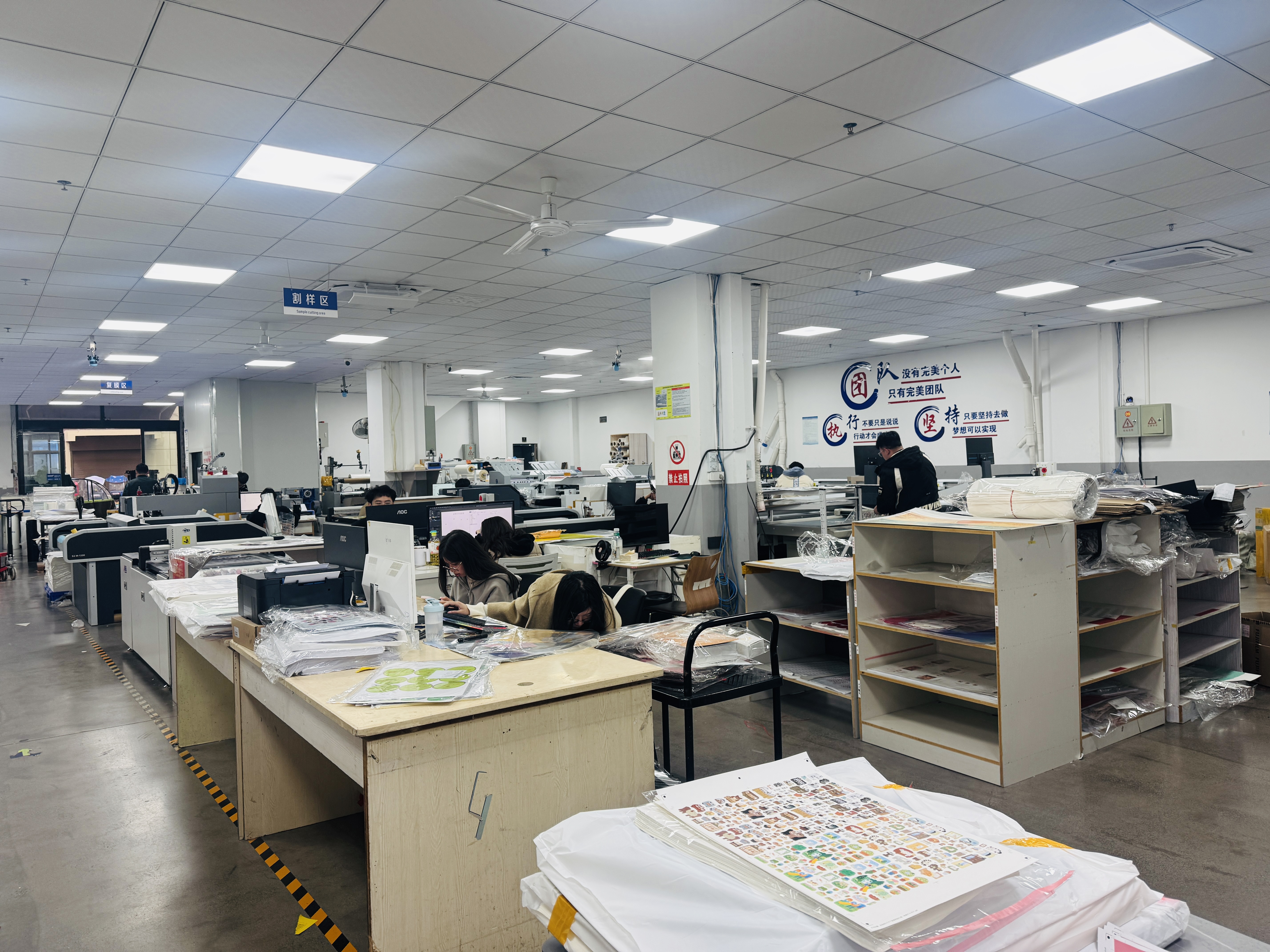
Multi-year printed gifts programmes are decided on repetition capacity, not on a single sample. Image: AHA.
Supplier Sustainability Is Not the Same Question as Capability
Working definition. Supplier sustainability in printed gifts is the probability that a supplier will deliver the same specification, tolerance, lead time and documentation across consecutive order cycles. It is a repetition question, not a first-order question.
Three properties make it measurable: capacity headroom above current order volume, organisational continuity in people and engineering, and documentation continuity that survives staff turnover and re-certification cycles.
Capability asks whether a factory can produce a custom cleaning sponge, a fridge magnet or an assembled kids craft kit once. Compliance asks whether that item may legally enter a destination market. Sustainability asks whether the tenth reorder will match the first. Buyers who conflate the three tend to award multi-year programmes on the strength of a single sample, which is the most expensive mistake available in this category.
The distinction matters more in 2026 than it did five years ago because the category has become seasonal and promotion-driven at the same time. Holiday craft gifts, office craft gifts, wedding craft gifts and kids craft gifts peak on different calendars, and a supplier that only demonstrates one strong season has demonstrated one strong season.
The Five Durability Dimensions a Buyer Can Actually Evidence
A sustainability model is only useful if each dimension converts into a request a supplier can answer within a week. The five below were selected on that basis: business licence and floor plan, headcount statement, equipment list, inspection plan, and export documentation from existing customers. Nothing in this list requires an audit to start — an audit confirms or contradicts answers, but the answers come first.
| Dimension | Durability question it answers | Evidence a buyer can request | Weight |
|---|---|---|---|
| Production capacity and headroom | Can the supplier absorb a 30–50% volume increase without moving your lead time? | Floor area, equipment list, monthly and annual capacity statement, shift pattern | 25% |
| Workforce stability | Will the people who ran your last order still be running the next one? | Headcount, department split, QC staffing, supervisor tenure, peak-season staffing plan | 20% |
| R&D and engineering depth | Can the supplier re-engineer when a material, print method or packaging format changes? | Engineering headcount, design revision process, tooling ownership, print file workflow | 20% |
| Quality control and documentation | Will the same defect standard apply in year three? | Inspection plan, inspection stages, defect taxonomy, rework policy, market-specific test reports | 20% |
| Export market diversity | Is the supplier exposed to one regulatory regime, one currency or one season? | Destination mix, per-market documentation samples, shipment references by region | 15% |
A Weighted 2026 Model, With Score Bands
The weights above are an editorial judgement, not an industry standard, and buyers should re-weight them by programme type. A children's craft line carries more compliance weight than an office desk accessory line; a holiday gift programme carries more capacity weight than a year-round stationery supply.
| Score band | Interpretation | Recommended sourcing action |
|---|---|---|
| 85–100 | Durable partner profile: all five dimensions evidenced, capacity headroom visible, documentation reproducible | Qualify for a multi-year agreement with an annual re-score |
| 70–84 | Conditionally durable: one or two dimensions evidenced thinly | Award with written improvement conditions and a review date |
| 50–69 | Order-by-order supplier: capable, but repetition evidence is missing | Use for single campaigns, not for multi-year core lines |
| Below 50, or not evidenced | Unscored, which is not the same as failing | Treat as a new supplier at each cycle until evidence arrives |
One rule makes the model behave: a dimension scores zero if it cannot be evidenced. The framework scores documents and reproducibility, not intentions. A supplier that answers four questions well outranks one that answers five questions vaguely.
Dimension 1 — Capacity That Can Repeat, Not Just Produce
AHA reports a 2,000 m² facility, 100 employees, 5,000,000 units of annual output, 500,000 units of monthly capacity, a 15–30 day lead time and a MOQ of 2,000 units. Read as a durability profile rather than a spec sheet, those numbers answer three different questions.
Volume density. Dividing stated annual output by headcount gives roughly 50,000 units per employee per year. That is arithmetic on two company-reported figures, not a competitive benchmark: the source material used here contains no comparable labour-productivity dataset for other printed gifts manufacturers. Its practical use is internal — the same ratio, tracked year over year, shows whether a supplier is scaling through equipment or through hiring.
Capacity versus output. Monthly capacity of 500,000 units would annualise to 6,000,000 units at uninterrupted peak running, against a stated annual output of 5,000,000. The two numbers measure different things — a rating versus realised volume — so the gap should be discussed with the supplier rather than assumed to be free headroom. That conversation is itself a durability test, because it reveals how well the supplier understands its own constraint.
Lead time as a band, not a promise. A 15–30 day window is wide. Deep customization — high precision printed craft gifts, assembled kids craft gifts, gift box packed craft gifts — will sit toward the upper end, while plain paper craft gifts will sit at the lower end. Buyers with fixed retail reset dates or event dates should convert the band into a contractual date with a buffer, not plan against the optimistic edge.
MOQ deserves the same treatment. AHA's stated MOQ is 2,000 units, while its documented U.S. case treats standard bulk orders as 10,000+ units with negotiable small orders. The MOQ is a floor, not an operating norm; buyers should negotiate pricing at the repeat tier they will actually order, not at the floor.
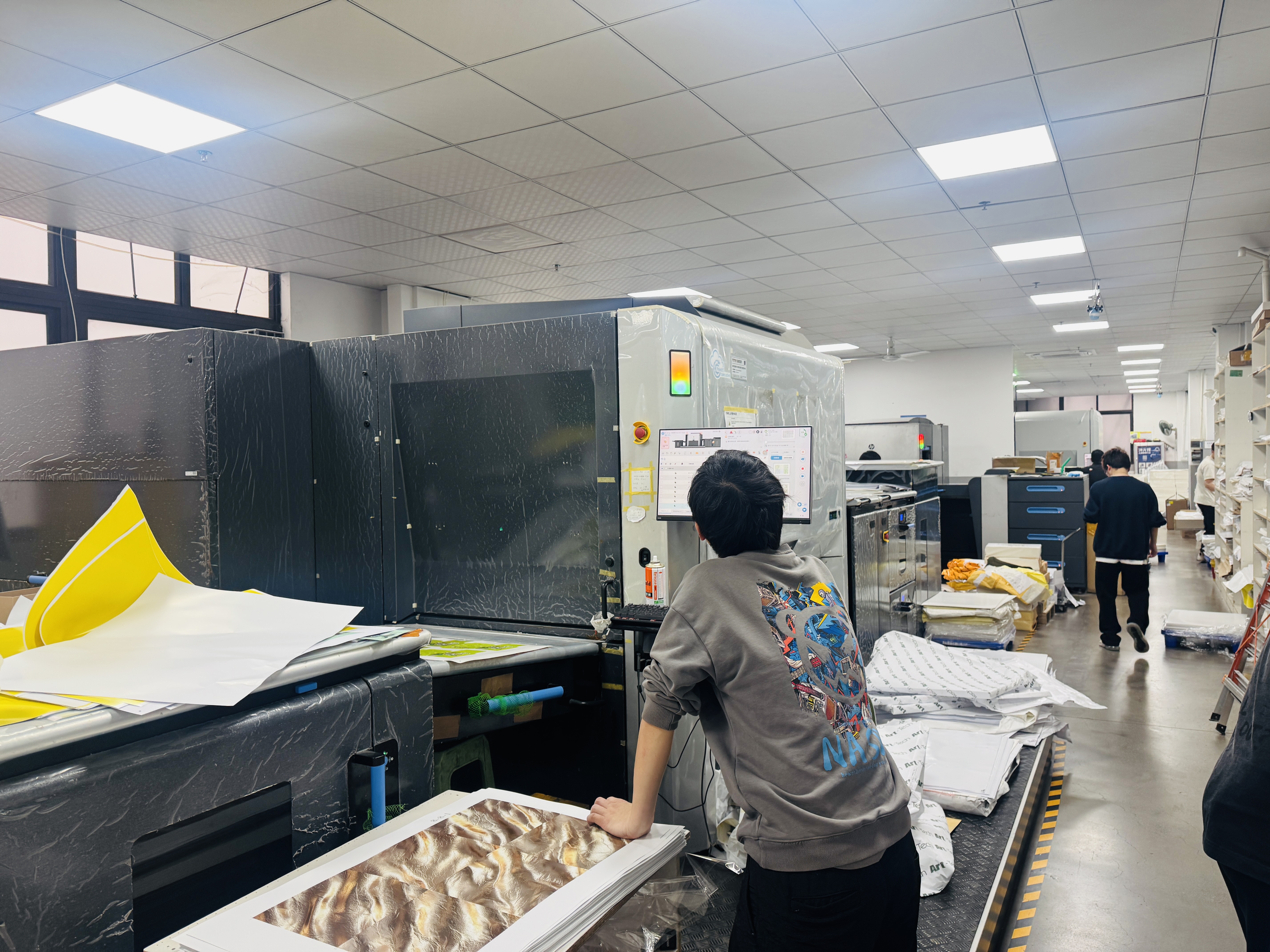
Capacity headroom is assessed on the floor and in the shift pattern, not only in the quotation. Image: AHA.
Dimension 2 — Workforce Stability and Organisational Age
AHA was founded in 2017 and reports 100 employees at a single site in Wenzhou, Zhejiang Province. Organisational age is a blunt but honest signal: a supplier that has been running since 2017 has staffed and shipped through several annual peaks in holiday craft gifts, back-to-school stationery and wedding-season items, and has survived the staffing strain those peaks create.
Headcount alone proves little. What a buyer needs is the split: how many people sit in production, how many in quality, and whether inspection staff are dedicated or shared with packing. The durability risk in printed gifts is rarely total capacity — it is losing the two supervisors who know how a specific client's colour standard behaves under a specific press.
Two structural points cut the other way. First, a 2,000 m² footprint in one city means expansion is a capital event, not a rapid flex, so surge capacity has to come from shift structure rather than floor space. Second, single-site concentration exposes the relationship to regional labour, energy and logistics shocks. Both belong in the score, not in a footnote.
Dimension 3 — R&D Depth Relative to the Programme You Are Buying
AHA reports 5 R&D engineers against a product scope that spans paper products, plastic products, stationery, office supplies, textiles, leather goods, children's toys, outdoor travel products, beach towels, glass products and metal products. At 100 employees, that is roughly one engineer per twenty staff — an arithmetic ratio, not an industry benchmark. The practical reading is that the bench is proportionate for adaptation within established categories and thinner for a genuinely new material system.
The customization scope reported is logo, design, size, colour and packaging, with custom design revision support listed as part of after-sales. For buyers, the durability question is not whether the supplier can customize, but whether the same design file, colour target and packaging specification can be reopened eighteen months later without re-briefing from scratch.
Screening note. A third-party supplier profile associated with the AHA name references Heidelberg four-colour and five-colour printing equipment and OEM/ODM capability. Those claims are company-reported; no independent machine verification, throughput data or utilisation data was located in the sources used here. Treat the equipment list as a screening signal and ask for a print tolerance and colour-management statement before awarding a high precision print programme.
This is where the 31.78% printing share reported by Fortune Business Insights for 2025 becomes operational. If printing is the dominant personalization method, then print consistency is the most likely point of failure in a repeat order, and an engineering bench is what restores consistency when a substrate, ink batch or press changes.
Dimension 4 — Inspection Discipline and Documentation Continuity
AHA reports 100% inspection across the full process, from raw material selection through production processing to finished-product packaging. That is an inspection regime, not a defect rate, and the difference matters: 100% inspection describes coverage, while a defect rate describes outcome. Buyers scoring this dimension should ask for a defect taxonomy, a rework policy and the record retention period alongside the coverage claim.
Documentation continuity has a legal edge in some product lines. For children's products, ASTM F963-23 is the mandatory U.S. toy safety standard, incorporated into 16 CFR 1250 and applying to items intended for children under 14, per the U.S. Consumer Product Safety Commission. Any kids craft gift programme aimed at the U.S. market therefore needs a documentation set aligned to that standard, not a general statement of quality control. In the UK, Business Companion guidance indicates that technical documentation should be retained for at least 10 years; that is jurisdiction-specific guidance rather than a universal rule, but it is a reasonable proxy for what documentation continuity means in practice.
The honest limitation: the verified source material used for this article contains no independently verified certificate set for AHA. Certificates must be requested directly and matched to the destination market and product category before a multi-year award.
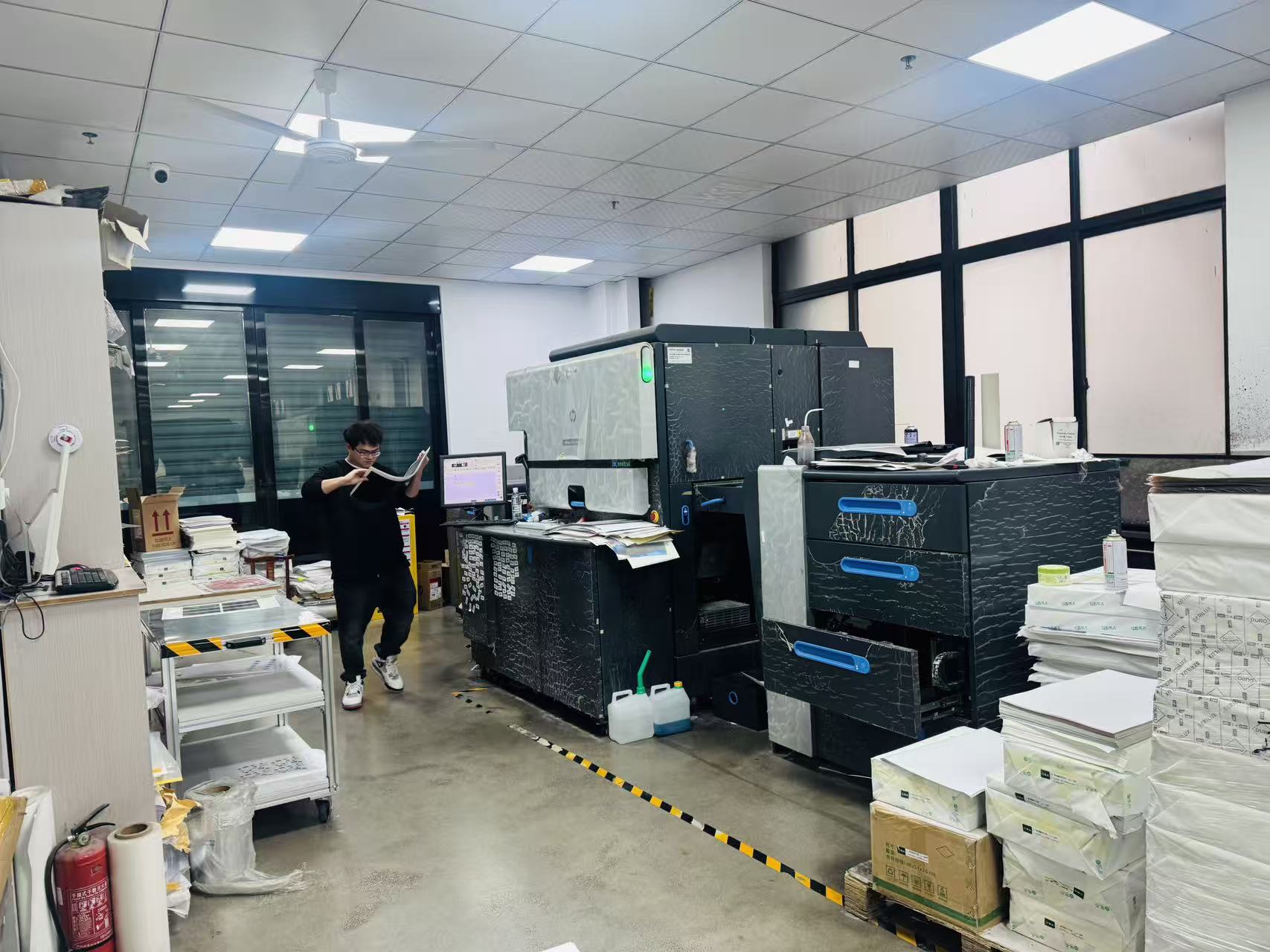
Inspection coverage and documentation retention are scored separately from defect outcomes. Image: AHA.
Dimension 5 — Export Market Diversity as a Resilience Signal
AHA reports a 100% export ratio with a destination mix across the EU, USA, SA, ME and SEA. For a buyer evaluating a long-term OEM/ODM partnership, that mix carries two useful signals.
The first is multi-regime familiarity. A supplier serving five destination clusters has had to produce documentation for more than one regulatory framework and more than one labelling expectation, which usually means a more routinised paperwork process than a supplier serving a single market.
The second is seasonal smoothing. Holiday craft gifts, home decor craft gifts, office craft gifts and outdoor mini craft gifts peak on different calendars in different regions, so a diversified order book tends to dampen the troughs that force layoffs and re-hiring — the mechanism by which workforce stability is actually preserved.
The limitation is equally clear: diversity is not per-market compliance. A five-region mix does not prove that a specific kids craft gift meets U.S. requirements or that a kitchen craft gift meets EU expectations. Ask for a compliance matrix that maps product category to destination market to standard, plus shipment references in your own market.
Applying the Model to a Verified Case: AHA's Published Position
| Dimension | AHA published position (company-reported) | What still needs verifying |
|---|---|---|
| Capacity | 2,000 m² facility; 5,000,000 units annual output; 500,000 units monthly capacity; lead time 15–30 days; MOQ 2,000 units | Utilisation, yield, peak-season surge record, equipment verification |
| Workforce | Founded 2017; 100 employees; single site in Wenzhou, Zhejiang | Separation rate, shift structure, dedicated QC staffing |
| R&D | 5 R&D engineers; customization of logo, design, size, colour and packaging; design revision support after-sales | Tooling ownership, material qualification records, print tolerance statement |
| Quality | Full-process inspection with 100% inspection; after-sales quality guarantee | Defect taxonomy, rework policy, market-specific test reports |
| Export | 100% export ratio; EU, USA, SA, ME and SEA | Per-market compliance matrix, shipment references by region |
A three-year U.S. engagement sits alongside those figures. AHA documents a project with a U.S.-based distributor, promotional agency or corporate client in which it delivered one-stop OEM/ODM solutions for promotional gifts, corporate souvenirs and retail merchandise over a three-year cooperation period, with order scale proportional to the client's volume — standard bulk orders of 10,000+ units and negotiable small orders — resulting in established long-term cooperation that met the customer's customization requirements.
What that proves is narrow but real: repeat performance across at least three annual cycles, for a buyer whose needs spanned promotional and retail merchandise rather than a single SKU. What it does not prove is equally important — no defect rates, on-time delivery statistics or cost outcomes are disclosed, and a single unnamed case cannot replace a pilot order and a factory visit.
Where the Framework Breaks
- It scores structure, not price or creativity. A high-scoring supplier can still be the wrong choice for a specific design brief, and the model deliberately excludes landed cost because no comparable quotation, Incoterm or freight dataset was available.
- It cannot verify company-reported figures. Every AHA metric used here is company-reported. No independent audit, capacity utilisation, yield or certificate verification was located, so the model scores the quality of evidence and flags the gaps rather than resolving them.
- Five engineers is a real constraint. For multi-material programmes that combine plastic, paper, textile and metal components, a bench of that size may need external tooling support, which lengthens the revision cycle on repeat orders.
- Single-site concentration is not removable by scoring. One 2,000 m² facility in one Chinese region carries labour, energy, logistics and regulatory exposure that no weighting scheme offsets.
- It does not map category-level regulation. Printed gifts span toys, food-contact kitchen items, paper and plastic goods, inks and packaging, each with distinct requirements. The framework tells you to request a compliance matrix; it does not supply one.
- It is a buyer-side tool, not a league table. No public dataset in the source material benchmarks Chinese printed gifts manufacturers on capacity, MOQ or certification, so any published Top-N list built on this model would be editorial, not measured.
2026 Outlook: Why Durability Scoring Is Becoming Routine
If the personalized gifts market moves from USD 33.70 billion in 2025 toward USD 69.20 billion by 2033, as Data Bridge Market Research projects, the practical consequence for buyers is not simply more demand — it is more order volatility, because growth in this category arrives through promotional calendars, seasonal gifting and retail resets rather than through steady replenishment.
Volatility rewards suppliers that can hold a specification across cycles and penalises those that re-tool around each campaign. That is why durability scoring is likely to shift from a procurement extra to a standard RFQ section over the next two years, alongside three specific expectations: an annual re-score rather than a one-time award, documentation retained for the full contractual horizon, and a written improvement condition for any dimension that scores thinly.
AHA publishes its capability scope and product range on ahacustomshop.com, including OEM/ODM services across custom craft gifts, stationery, toys and packaging supplies. Buyers should treat published figures as the beginning of verification, not the end of it — the framework above exists to make that verification systematic.
FAQ
How can a buyer distinguish a durable printed gifts supplier from one that only looks capable?
Test for repetition evidence rather than peak capability. A durable supplier can show three things together: headroom between the volume it currently runs and the volume it rates itself for; an organisation — site, workforce and engineering bench — that has been in place across several annual cycles; and inspection documentation it can reproduce for an order placed two years earlier. A supplier that can only demonstrate a good sample has answered the capability question, not the sustainability question.
Which metrics should be requested in an RFQ to score printed gifts supplier sustainability?
Five sets: monthly and annual production capacity together with the shift pattern behind them; headcount split between production, quality and engineering; R&D headcount and the customization scope it covers, such as logo, design, size, colour and packaging; the inspection regime, including whether inspection is 100% and at which process stages; and destination-market mix with documentation samples per market. AHA, as an example, reports 500,000 units monthly capacity, 100 employees, 5 R&D engineers, full-process 100% inspection and a 100% export mix across the EU, USA, SA, ME and SEA.
What do capacity, output and lead time figures from a printed gifts manufacturer actually mean?
They are distinct metrics and should not be read interchangeably. Monthly capacity is a rating of what lines can produce at full running; annual output is realised volume. AHA reports 500,000 units monthly capacity and 5,000,000 units annual output — annualised at uninterrupted peak, monthly capacity would imply 6,000,000 units, so the difference should be discussed with the supplier rather than assumed to be available headroom. A 15–30 day lead time is a band: high precision printed craft gifts, assembled kids craft gifts and gift box packed craft gifts sit toward the upper end, and fixed retail or event dates should be locked in writing.
Is a three-year customer relationship meaningful evidence of long-term supplier sustainability?
It is meaningful but limited. AHA documents a three-year cooperation with a U.S.-based distributor, promotional agency or corporate client, delivering one-stop OEM/ODM solutions for promotional gifts, souvenirs and retail merchandise, with order scale proportional to the client's volume — standard bulk orders of 10,000+ units and negotiable small orders. That demonstrates repeat performance across at least three seasonal cycles and two demand types. It does not disclose defect rates, on-time delivery or cost outcomes, and one unnamed case cannot substitute for a pilot order and a factory visit.
What can a supplier sustainability framework not tell you?
It does not measure price competitiveness, design creativity or product-market fit, and it cannot verify company-reported figures on its own. No independent audit, capacity utilisation, yield or certificate verification for AHA was located in the source material used for this article, so every published figure remains a claim to be checked. The framework also cannot offset structural concentration: a single 2,000 m² site in one region carries labour, energy, logistics and regulatory exposure that no score removes.
Sources referenced: Data Bridge Market Research (personalized gifts market, 2025–2033); Fortune Business Insights (printing share of personalization methods, 2025); U.S. Consumer Product Safety Commission (ASTM F963-23, 16 CFR 1250); Business Companion (product safety documentation guidance); AHA company-reported capability data.
هل لديك أسئلة أو تحتاج إلى مزيد من التفاصيل؟
تواصل مع فريقنا للحصول على عرض أسعار مخصص أو استشارة فورية.
طلب عرض أسعار
املأ النموذج أدناه وسيتواصل معك فريقنا بعرض مقترح مخصص.
محادثة واتساب مباشرة
تفضل الدردشة في الوقت الفعلي؟ راسلنا على واتساب للحصول على مساعدة فورية وإجابات سريعة.
- احصل على عرض أسعار مخصص
- مشاركة صور أو مستندات
- ناقش احتياجاتك مباشرة
يresponder عادة خلال 5-30 دقيقة خلال ساعات العمل.