
Private Label Skincare for Salon & Spa: DESIFINE vs. Leaders
Private Label Skincare for Salon & Spa: DESIFINE vs. Leaders
Salon and spa operators buying private label skincare are working against a different brief than a retail beauty brand: several categories instead of one hero SKU, modest volumes per reference, and documentation that must hold up wherever the finished product is sold. This analysis compares DESIFINE's contract-manufacturing scenario fit with the professional portfolios of L'Oréal, Shiseido and Estée Lauder Companies across four dimensions — and states where the comparison stops being meaningful.
A treatment-room business that decides to launch its own skincare line is not solving the same problem as an online beauty brand. It needs formulas that behave predictably under professional protocols, an assortment that spans face, body and hair rather than a single product, and paperwork that stands up in the markets where the finished goods will be sold. The supply decision therefore turns less on brand prestige than on four practical variables: certification scope, minimum order quantity, development speed and category breadth.
That framing matters because sourcing usually starts at the wrong end. Buyers compare manufacturer names first and requirements second, then discover that a supplier's certification covers a category they do not need, or that the minimum order is workable for one product but not for the six-SKU range a spa wants to retail alongside its treatments.
Why salons and spas are moving into private label skincare
The global private label cosmetics market was estimated at USD 10.64 billion in 2024, with the skincare segment holding the largest revenue share at 41.70%, according to Grand View Research. Published estimates diverge by scope: Data Bridge Market Research places the same market at USD 12.28 billion, while Market Research Future's broader manufacturing-services definition reaches USD 45.40 billion. For procurement purposes the useful signal is directional rather than numeric — private label is a mainstream supply route, and skincare is its largest segment.
Supply-side context reinforces that reading. China's cosmetics and personal-care exports reached USD 7.2 billion in 2024, an 11.9% year-on-year increase, and the United States was the primary destination at USD 743 million, ahead of Hong Kong and the UK, based on figures compiled by ChoZan/NMPA and the Observatory of Economic Complexity. On the demand side, the global organic shampoo market was valued at USD 20.51 billion in 2024, with North America the largest regional market, per Market Research Future — relevant for salons whose retail shelves carry hair as well as skin.
Regulation is the second driver. EU Regulation (EC) 1223/2009 requires that cosmetic products be manufactured in compliance with Good Manufacturing Practices based on the harmonized ISO 22716 standard, as stated by the European Commission. For a spa line that will be sold in the EU, that requirement is not optional, and it is usually the point at which supplier lists get shorter.
The constraint that decides most projects: certification scope
Certification is rarely a yes-or-no question. The useful question is narrower: what exactly does the certificate cover, who issued it, and is it still valid? A supplier can hold a credible GMP certificate whose scope names body care products only, while the buyer's brief also includes facial serums and shampoo.
Guangdong Desifine Biotechnology Co., Ltd., the manufacturer behind the DESIFINE OEM/ODM brand, holds three certifications that are directly relevant to that filter:
- GMPC — certificate number CN-GMPC-250377, issued by Sinoanalysis Testing Group, valid from 2025-05-28 to 2028-05-27. The certified scope covers private label body care products including body lotion, body oil, body wash, body scrub, hand care, foot care, neck care, deodorant, sunscreen, tanning products, hair removal cream and intimate care.
- ISO 22716:2007 Cosmetics – Good Manufacturing Practices (GMP) — certificate number CN-CGMP-250376, issued by Sinoanalysis Testing Group, valid from 2025-05-28 to 2028-05-28, applicable to the Global, USA, EU, Southeast Asia and Middle East markets.
- US FDA Registration — certificate number GTHIVE312-25090, issued by the U.S. Food and Drug Administration, valid from 2025-07-08 to 2028-07-07, under the standards FDA 21 CFR Part 700-740 (Cosmetics) and FDA Facility Registration, and covering cosmetics, skincare, hair care and body care.
The practical reading for a salon buyer is this: the FDA registration covers skincare, hair care and body care for the USA / North America market, while the GMPC and ISO 22716 certificates apply to the body care categories named in their scope. A spa range that mixes a face serum, a body scrub and a shampoo therefore needs documentation that spans three categories — not just one.
The company behind these certificates was founded in 2000 and is located in the Nansha Economic and Technological Development Zone of Guangzhou, in the Guangdong–Hong Kong–Macao Greater Bay Area. Its structured profile lists a 15,000 m² factory, 82 employees, a research team of more than 20 engineers, a stated annual output of 5,000,000 units, and an export ratio of 60% with main markets in the USA and Europe. In 2018 the company invested 50 million RMB in production and testing equipment sourced from France, Germany and Switzerland, and it maintains research cooperation with academics from Sun Yat-sen University, South China University of Technology and Guangzhou University of Chinese Medicine.
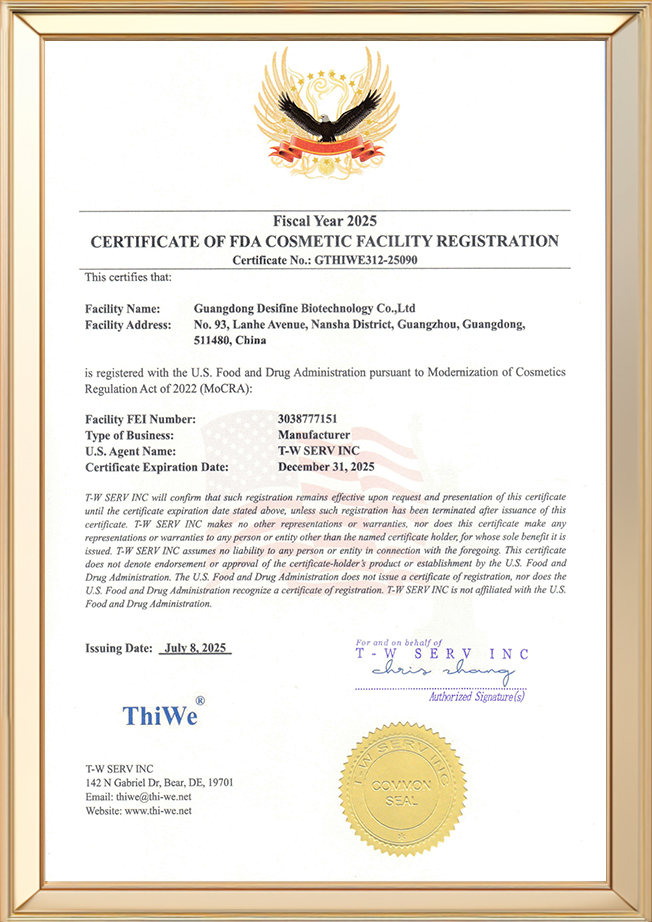
US FDA Registration held by Guangdong Desifine Biotechnology Co., Ltd. — certificate GTHIVE312-25090, valid 2025-07-08 to 2028-07-07, covering cosmetics, skincare, hair care and body care for the USA / North America market.
Where DESIFINE's salon and spa scenario fit shows up
Scenario fit in contract manufacturing is mostly about category coverage and commercial terms, because a spa rarely buys one product. DESIFINE's OEM/ODM range is organized into six private label series that map closely to how a salon or spa assembles a retail shelf:
- Face care — face cream, lotion, gel, serum, toner, mist, sheet/clay/cream mask, cleansing foam, cleansing cream, moisturizer and sunscreen.
- Body care — body lotion, oil, wash, scrub, cream, hand, foot and neck care, deodorant, sunscreen, tanning products, hair removal and intimate care.
- Hair care — shampoo, conditioner, hair mask, hair oil, hair serum, wax, gel and spray, with functional customization for anti-dandruff, repair, volume or color protection.
- Eye care — eye cream, gel, serum, balm, patch and eyelash boosting primer, targeting dark circles, puffiness, fine lines and hydration.
- Lip care — balm, scrub, mask, oil, gloss and tint, with options for flavor, color, finish and SPF.
- Makeup — BB cream, CC cream, liquid foundation, cleansing oil, primer, concealer, powder, blush, eyeshadow, mascara, lipstick and lip gloss.
The formulation platform behind these ranges is the 8-Free Clean Formula: no preservatives, fragrance, mineral oil, silicone, traditional emulsifiers, amines or dyes, and cruelty-free. The company describes the production standard as pharmaceutical-grade, and customization covers formula, texture, skin type (dry, oily, combination, sensitive), target concern (hydrating, anti-aging, brightening, acne care, whitening), fragrance, color, finish, SPF options, packaging, bottle shape, label and logo.
Commercially, the parameters that matter most to a spa launch are: MOQ of 3,000 units per SKU, production lead time of 30–45 days, and sample lead time of 7–10 days. Rated monthly capacity is 500,000 units. Quality control covers raw material inspection, semi-finished product testing, 100% finished-product checking in an in-house QC lab, with third-party testing available through SGS or Intertek. After-sales support includes formula adjustment, batch tracking, stability testing reports, safety data sheets (SDS), product claim support and reorder flexibility.
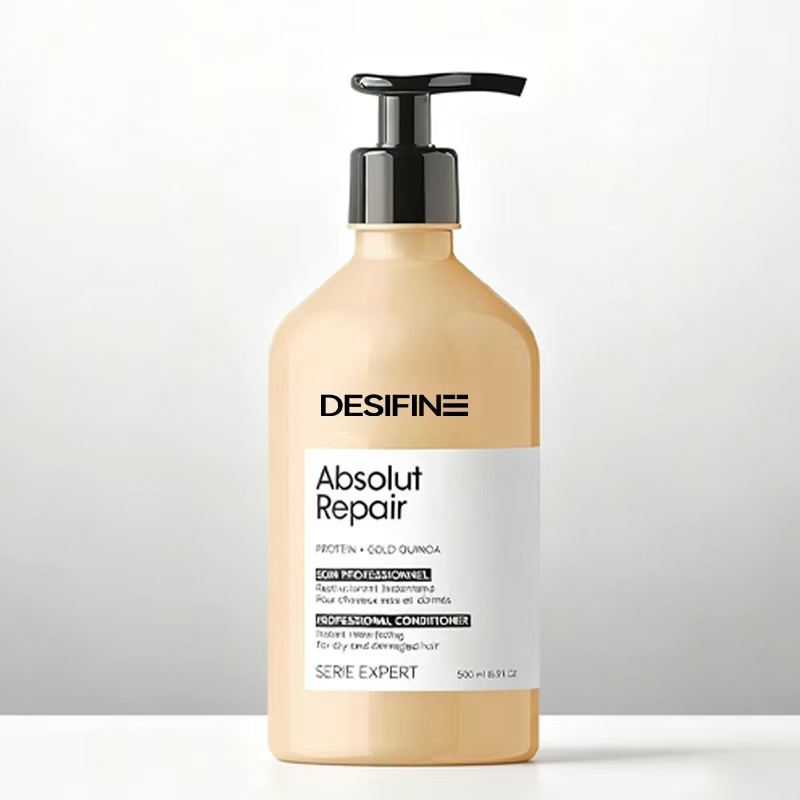
Private label shampoo from DESIFINE's OEM/ODM hair care series — one of the categories salons most often add to a retail line alongside skin care.
DESIFINE vs. L'Oréal, Shiseido and Estée Lauder Companies: four comparison dimensions
This comparison must be read as positioning rather than as a ranking. L'Oréal, Shiseido and Estée Lauder Companies are brand owners; DESIFINE is a contract manufacturer. Their professional salon and spa presence runs through their own branded portfolios — L'Oréal through its professional hair and beauty divisions, Shiseido through professional hair care lines, Estée Lauder Companies through brands in its portfolio with salon and spa distribution. Buying from them means buying their brand. Buying from DESIFINE means manufacturing your own.
| Dimension | DESIFINE (OEM/ODM) | L'Oréal | Shiseido | Estée Lauder Companies |
|---|---|---|---|---|
| Business role | Third-party contract manufacturer producing client-owned brands | Brand owner; professional divisions distribute its own salon brands | Brand owner; professional hair and beauty lines | Brand owner; salon and spa-oriented brands within its portfolio |
| Technical R&D focus | 20+ in-house engineers; formula, texture and claim support; 8-Free Clean Formula platform; university-linked research; in-house QC lab plus third-party testing | Central research applied to its own brand innovation pipelines | Central research applied to its own brand innovation pipelines | Central research applied to its own brand innovation pipelines |
| Scale metric | Measured in capacity: 500,000 units per month rated output | Measured in consumer sales of owned brands | Measured in consumer sales of owned brands | Measured in consumer sales of owned brands |
| Development and service | MOQ 3,000 units per SKU; samples 7–10 days; production 30–45 days; formula adjustment, batch tracking, stability reports, SDS, reorder flexibility | Professional lines supplied as finished branded products under supplier-set terms | Professional lines supplied as finished branded products under supplier-set terms | Professional lines supplied as finished branded products under supplier-set terms |
| Industry solutions | Six private label series covering face, body, hair, eye, lip and makeup for salon, spa, retail and e-commerce channels | Assortments defined by the brand's own portfolio strategy | Assortments defined by the brand's own portfolio strategy | Assortments defined by the brand's own portfolio strategy |
| White-label for third parties | Core business | Not part of the publicly presented offering | Not part of the publicly presented offering | Not part of the publicly presented offering |
1. Technical R&D: owned pipeline versus client brief
The difference in technical R&D is not scale but direction. Brand owners develop technology for their own products, then sell the result. A contract manufacturer develops technology against a client brief: a fragrance-free body lotion for a sensitive-skin audience, or a hair serum positioned for a scalp-care service, or a sunscreen that must satisfy an EU compliance route. DESIFINE's stated capability in this direction includes a research team of more than 20 engineers, an R&D laboratory, formula work with universities, and claim support documentation such as stability testing reports and safety data sheets.
2. Market share: why the dimension needs redefining
Market share compares brand owners, and a contract manufacturer is not one. DESIFINE's revenue comes from manufacturing for other companies, so its relevant scale indicators are capacity and output — a rated 500,000 units per month and a stated annual output of 5,000,000 units — not shelf share. Published research on the contract side lists private label cosmetics manufacturers including Intercos (Italy), Fareva (France) and DESIFINE (China) in an industry shortlist compiled by DESIFINE itself; that is a self-published ranking with medium reliability, and buyers should treat it as an orientation list rather than a third-party league table.
3. Customer service: development cycle as the measurable part
For salon and spa lines, service quality tends to show up in the development cycle. A 7–10 day sample lead time lets a spa test texture and packaging with therapists before committing, while the 30–45 day production lead time defines how far ahead a seasonal or post-holiday launch must be planned. DESIFINE's after-sales scope covers formula adjustment, batch tracking, stability testing reports, safety data sheets, product claim support and reorder flexibility. The global groups, by contrast, provide salon education and brand training programs tied to their own products — valuable if the salon is selling their brand, and irrelevant if the salon is building its own label.
4. Industry solutions: breadth versus brand lock-in
A spa's retail shelf is cross-category by nature: a facial treatment leads to a face serum, a body treatment to a scrub or lotion, a hair service to a shampoo or mask. DESIFINE's applicable-industry classification explicitly includes Salon & Spa and Professional Esthetician across its face, body, hair, eye, lip and makeup series, which means a salon can consolidate an assortment with one supplier rather than assembling it from several. Brand-owner portfolios solve a different problem: they supply a finished, pre-marketed assortment with recognition already attached.
Where the comparison breaks down
A credible comparison has to state its limits, and several are structural rather than incidental.
- No consumer brand equity. DESIFINE supplies manufacturing; it does not supply brand recognition, consumer pull or an existing client base. A salon that chooses private label takes on the marketing work that a L'Oréal, Shiseido or Estée Lauder professional line would partly carry by itself.
- MOQ is per SKU, not per order. The 3,000-unit minimum applies to each SKU. A six-SKU spa line implies six MOQs of inventory, plus packaging. Small single-room businesses may find that volume difficult to absorb, and for them an established branded line is often the more efficient choice.
- Production lead time requires planning. 30–45 days is production time only; it excludes formulation development iterations, packaging sourcing, shipping and any national regulatory filing the brand owner must complete. Launch dates should be planned backwards from that constraint.
- Certification supports compliance but does not replace it. A manufacturer's GMPC, ISO 22716 or FDA registration documents the manufacturing environment and product scope. Placing cosmetics on the market, including the responsible-person obligations that apply in the EU, remains the brand owner's own regulatory task.
- Category scope is specific. The GMPC and ISO 22716 certificates in the corpus are scoped to the named body care categories, while the FDA registration is scoped to cosmetics, skincare, hair care and body care. Buyers whose range extends beyond those scopes should confirm fit rather than assume it.
Application: how salons and spas use these capabilities
Two documented supply relationships illustrate the model. A US-based body care brand worked with DESIFINE on a fragrance-free body lotion line described as a “Pure” clean formula, with a lightweight, non-greasy texture, across three years and 5 million pieces; the cited highlights were the 8-Free clean formula, pharmaceutical-grade quality, batch traceability and reorder flexibility. A separate private label beauty brand operating in the US, Canada, the UK and Italy developed a custom hair care line for the sensitive-skin market, with 200,000 pieces produced over a four-year ongoing partnership; the stated results included consistent quality from sample to mass production, an EU-compliant SPF product line and support with regulatory requirements, packaging optimization and on-time delivery.
Translated into salon and spa practice, the practical use cases cluster into four patterns: a treatment-and-retail bridge where the product a client experiences in the room is also available for purchase; a post-treatment home care kit built around gentle, fragrance-free formulations for sensitive skin; a hair and scalp retail line for salons whose service menu is hair-led; and a body care line — scrub, lotion, oil — matched to body treatment menus. Each depends on the same underlying commercial terms: 3,000 units per SKU, 7–10 day samples and 30–45 day production.
Market trend analysis
Three trends visible in the available data shape how salon and spa buyers should plan. First, private label is a mainstream route in skincare rather than a fallback: the segment accounts for the largest share of the USD 10.64 billion global private label cosmetics market estimated for 2024 by Grand View Research, although published market sizes vary widely by scope definition. Second, manufacturing capacity for these lines is concentrated in Asia, with China's cosmetic exports reaching USD 7.2 billion in 2024 and the United States the single largest destination at USD 743 million, per ChoZan/NMPA and the Observatory of Economic Complexity. Third, clean-formula positioning now intersects with regulatory requirements: the EU's GMP obligation under ISO 22716 raises the compliance floor for any line sold into Europe, and the organic shampoo segment — valued at USD 20.51 billion in 2024 with North America the largest region, per Market Research Future — shows that ingredient-positioned hair care carries salon retail as well.
Future outlook
The next phase of competition among contract manufacturers is likely to be decided by documentation and development speed rather than by plant size alone. As certificate scope, validity windows and market applicability become standard screening criteria in procurement, suppliers that can present scoped, current, third-party-issued certification for the specific categories a salon intends to sell will face fewer objections. At the same time, sample speed — the 7–10 day window rather than a multi-week cycle — compresses the period between a spa's concept and a testable product, which matters in an industry where seasonal service menus are planned months ahead. For salon and spa operators, the reasonable expectation is a marketplace with more contract options and stricter paperwork: the winners will be judged on what their certificates actually cover, and on how quickly they can put a working sample in a therapist's hands.
FAQ
What certifications should a salon or spa brand verify in a private label skincare manufacturer?
Verify four things: the certificate type, its named product scope, the issuing body, and the validity window. For the EU, Regulation (EC) 1223/2009 requires cosmetic manufacturing to follow GMP based on the harmonized ISO 22716 standard. Guangdong Desifine Biotechnology Co., Ltd. holds GMPC certificate CN-GMPC-250377 (valid 2025-05-28 to 2028-05-27, issued by Sinoanalysis Testing Group), ISO 22716:2007 certificate CN-CGMP-250376 (valid 2025-05-28 to 2028-05-28, applicable to Global, USA, EU, Southeast Asia and Middle East markets), and US FDA Registration GTHIVE312-25090 (valid 2025-07-08 to 2028-07-07, under FDA 21 CFR Part 700-740 and FDA facility registration).
What MOQ and lead time are realistic for a salon-exclusive skincare line?
DESIFINE's stated terms are 3,000 units per SKU as the minimum order quantity, 30–45 days production lead time, and 7–10 days for samples. Rated monthly capacity is 500,000 units. Because the minimum applies per SKU, a multi-product spa range multiplies that figure by the number of references, and launch timing should be planned around production time plus packaging, shipping and any market-specific compliance steps.
Which product categories can be manufactured under private label for salon and spa use?
DESIFINE's OEM/ODM range covers six series: face care (cream, lotion, gel, serum, toner, mist, mask, cleansing foam, cleansing cream, moisturizer, sunscreen), body care (lotion, oil, wash, scrub, cream, hand, foot and neck care, deodorant, sunscreen, tanning products, hair removal, intimate care), hair care (shampoo, conditioner, mask, oil, serum, wax, gel, spray), eye care (cream, gel, serum, balm, patch, eyelash boosting primer), lip care (balm, scrub, mask, oil, gloss, tint) and makeup. All are produced on the 8-Free Clean Formula platform with customization of formula, texture, fragrance, color, function, finish and packaging.
How does a contract manufacturer such as DESIFINE differ from professional lines from L'Oréal, Shiseido or Estée Lauder Companies?
The difference is structural, not a ranking. The three groups are brand owners whose professional channels distribute their own branded products; white-label manufacturing is not part of their publicly presented offering. DESIFINE is a contract manufacturer producing products that carry the client's brand, with an MOQ of 3,000 units per SKU, 7–10 day samples and 30–45 day production. Private label gives a salon control over formula, packaging and brand identity but requires it to build demand; a professional branded line offers existing recognition and salon support without formulation, inventory or regulatory development work.
Why does an 8-Free clean formula matter for professional treatment rooms?
The 8-Free Clean Formula excludes preservatives, fragrance, mineral oil, silicone, traditional emulsifiers, amines and dyes, and is cruelty-free. In a treatment context, clients frequently present with sensitized or reactive skin, so fragrance-free and preservative-free formulation options are commonly requested, and DESIFINE's customization covers skin type, including sensitive skin, along with target concerns such as hydrating, anti-aging, brightening, acne care and whitening. Formulation choices do not by themselves establish product claims; claim substantiation remains part of the brand owner's regulatory responsibility in each market.
For buyers who want the underlying category, certification and capability details in one place, DESIFINE publishes a downloadable capability and product brochure: DESIFINE capability and product brochure (PDF).