
Probiotics Powder Procurement FAQ: VPro® Coat and CFU Terms
Probiotics powder is one of the few food ingredients where two suppliers can quote the same viable count and still deliver materials that behave differently in the same finished product. The gap usually sits in three places: how the strain is protected through freeze-drying and gastric transit, which viable count range is genuinely available for that specific strain, and what the buyer and supplier agreed to treat as acceptance criteria before the first purchase order was raised.
This reference article works through those three questions in the order a procurement team tends to meet them. Product-level facts are taken from published materials of Shanghai Unibio Lab Co., Ltd (Unibio), a probiotic research, manufacturing and CDMO enterprise headquartered in Shanghai, China, that supplies raw probiotic powder, postbiotic materials and finished private-label formats. Roughly 85% of its output is exported to North America, Western Europe, Southeast Asia and the domestic Chinese market.
Unibio's manufacturing base holds ISO 22000, FSSC 22000 and GMP food manufacturing certification audited by SGS, together with HALAL and Orthodox Union Kosher certificates and US FDA food facility registration. Those qualifications appear here only because they define what a buyer can reasonably ask to see in a documentation pack. Certification alone does not settle a sourcing decision, and it does not describe how a powder will behave in a sachet line running at speed.
Why probiotic powder specifications diverge between suppliers
A viable count written as “100B CFU/g” is not a specification on its own. It is a number that needs a test method, a reference point and a time stamp attached to it before it can be compared with a competing offer. In practice, five conventions diverge most often during an RFQ round.
- Release basis versus end-of-shelf-life basis. A count measured at release and a count guaranteed at the end of shelf life describe the same powder at two very different moments. Buyers should state which one the quoted figure represents.
- Test method and testing laboratory. Plate count and other enumeration approaches are not interchangeable across every strain, and a buyer comparing two certificates of analysis needs to know whether the same method was used.
- Strain identity granularity. A genus-and-species name such as Bifidobacterium animalis subsp. lactis describes a species group. A strain designation such as BL03 describes a specific culture with its own behaviour. Both are needed, and they are not the same specification line.
- Encapsulation and carrier. Whether the powder carries a protective coating, and which carrier it sits on, changes handling, flow and stability far more than the headline count suggests.
- Storage class. A material specified at −18 °C and a material specified at ambient temperature are different procurement problems even when the viable counts match.
The opportunity sits in the same list. Once a buyer converts these five points into explicit purchase-order clauses, offers become comparable, and disputes at goods-in inspection become rare rather than routine.
What VPro® 5-layer micro-encapsulation actually does
VPro® is Unibio's own five-layer micro-encapsulation system, applied to probiotic raw powder to address four industrial failure modes: acid exposure, bile exposure, oxygen and moisture ingress, and freezing stress during lyophilization. Each of the five layers carries a defined function.
| Layer | Function reported by Unibio |
|---|---|
| Micromolecular protective layer | Anti-freezing and anti-stress protection |
| Prebiotic nutrition layer | Supports in-vivo proliferation |
| Liposome enteric adhesion layer | Supports intestinal colonization |
| Acid and enzyme resistant layer | Survival through gastric digestion |
| Oxygen and moisture barrier layer | Extends shelf stability |
Unibio reports that the platform raises freeze-drying survival rate by 40% and extends shelf life to 24 months. At manufacturing level, the same process chain supports fermentation density above 3.5×10¹⁰ CFU/mL and lyophilized powder concentration up to 8.0×10¹¹ CFU/g.
For procurement purposes, the practical reading is narrower than the technical claim. “VPro® 5-layer encapsulation material” should appear as a named line item in the material specification, next to the carrier, so the buyer knows what is actually being quoted and what is not. In Unibio's product listings, standard material composition is stated as probiotic strain, maltodextrin carrier and VPro® 5-layer encapsulation material. A quote that omits the coating line is not the same material, whatever the viable count says.
Which viable count ranges are available for raw powder
Two numbers get confused during technical discussion. The 8.0×10¹¹ CFU/g figure describes what the platform can reach in lyophilized powder at the top of its capability. The ranges quoted for individual catalogue materials are lower, because each strain has to hold its count through processing, packaging and shelf life. The published ranges for a representative selection of Unibio raw powders are set out below.
| Material | Model | Viable count | Storage |
|---|---|---|---|
| Lactobacillus rhamnosus GG | GG | 10B–300B CFU/g | −18 °C or below, sealed |
| Bacillus coagulans CCFM1041 (−39) | CCFM1041 | 10B–300B CFU/g | Room temperature, sealed, away from moisture and direct sunlight |
| Ligilactobacillus salivarius CCFM1215 | CCFM1215 | 10B–200B CFU/g | 2–8 °C, sealed |
| Lactobacillus acidophilus L59 | L59 | 10B–200B CFU/g | −18 °C or below, sealed |
| Lactobacillus plantarum CCFM8661 | CCFM8661 | 10B–200B CFU/g | 2–8 °C, sealed |
| Lactobacillus rhamnosus CCFM0528 | CCFM0528 | 10B–200B CFU/g | −18 °C or below, sealed |
| Bifidobacterium adolescentis CCFM1173 | CCFM1173 | 10B–200B CFU/g | −18 °C or below, sealed |
| Clostridium butyricum CCFM1299 | CCFM1299 | 10B CFU/g | Room temperature, sealed, away from moisture and direct sunlight |
Shelf life is stated at 24 months under recommended storage for each of these materials. Two patterns are worth noting for buyers building a range. First, quoted ranges cluster at 10B–200B CFU/g for most Lactobacillus and Bifidobacterium materials and reach 10B–300B CFU/g for Lactobacillus rhamnosus GG and Bacillus coagulans CCFM1041. Second, the upper bound is strain-dependent rather than catalogue-wide. A buyer who needs a single high-count material across several strains will usually need to accept different ceilings per strain, or accept a blend approach, rather than assume one number applies everywhere.
Three representative strains and where each one sits
Bifidobacterium animalis subsp. lactis BL03 (model BL03) appears in Unibio's application documentation for lactose intolerance, regulation of intestinal flora and inhibition of intestinal pathogenic microorganisms. The same material is listed among the options matched to fermented dairy and dietary supplement production. Buyers reviewing BL03 should treat the species name and the strain code as two separate lines on the specification, since the species group is widely available while the specific culture is not.
Lactobacillus rhamnosus GG (model GG) is the most heavily specified material of the three. It carries a 10B–300B CFU/g viable count range, requires sealed storage at −18 °C or below, and is listed with a 24-month shelf life under recommended storage. Unibio's composition statement for the material is probiotic strain, maltodextrin carrier and VPro® 5-layer encapsulation material, and the applicable industries span food and beverage, dietary supplements, health products and infant food. GG also appears in the infant and diarrhea-relief application scenario documentation, which describes prevention and relief of diarrhea, immune support and improvement of intestinal flora imbalance for infants and adults.
Bifidobacterium longum CCFM1195 (model CCFM1195) is listed in the same infant and adult intestinal flora scenario, alongside Bifidobacterium longum CCFM760. Buyers should confirm the CFU range for CCFM1195 against the model-level specification sheet at RFQ stage, because ranges are set per strain and a range borrowed from a neighbouring Bifidobacterium listing is not a substitute for the one attached to the model code being purchased.
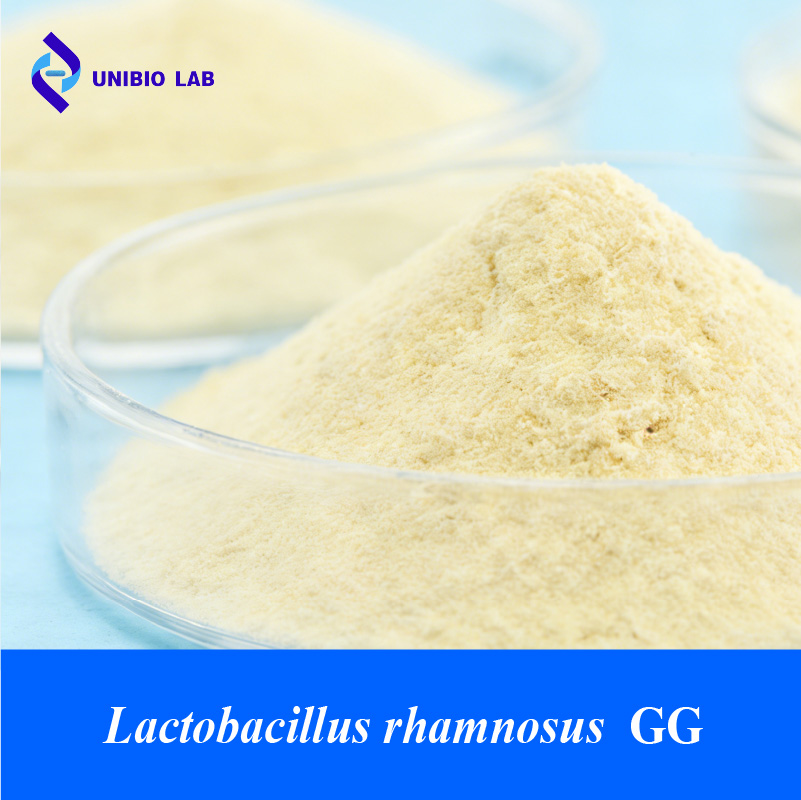
Lactobacillus rhamnosus GG raw powder, model GG — a representative high-count material specified at 10B–300B CFU/g with −18 °C storage.
Storage classes and what they mean for distribution
Unibio's raw powder catalogue falls into three storage classes, and the class should drive both the freight quote and the finished-product pack design.
−18 °C or below: Lactobacillus rhamnosus GG, Lactobacillus acidophilus L59, Lactobacillus rhamnosus CCFM0528 and Bifidobacterium adolescentis CCFM1173. These materials require sealed packaging at deep-freeze temperature and are suited to manufacturers able to hold frozen inventory and thaw under control.
2–8 °C: Ligilactobacillus salivarius CCFM1215 and Lactobacillus plantarum CCFM8661. These sit in conventional cold-chain storage, which makes them workable for chilled distribution without deep-freeze logistics.
Ambient, well-closed container, away from moisture and direct sunlight: Bacillus coagulans CCFM1041, Clostridium butyricum CCFM1299 and ProLipo® postbiotic material. These formats remove cold-chain dependency at the raw material stage and are the usual starting point for ambient-distributed finished goods.
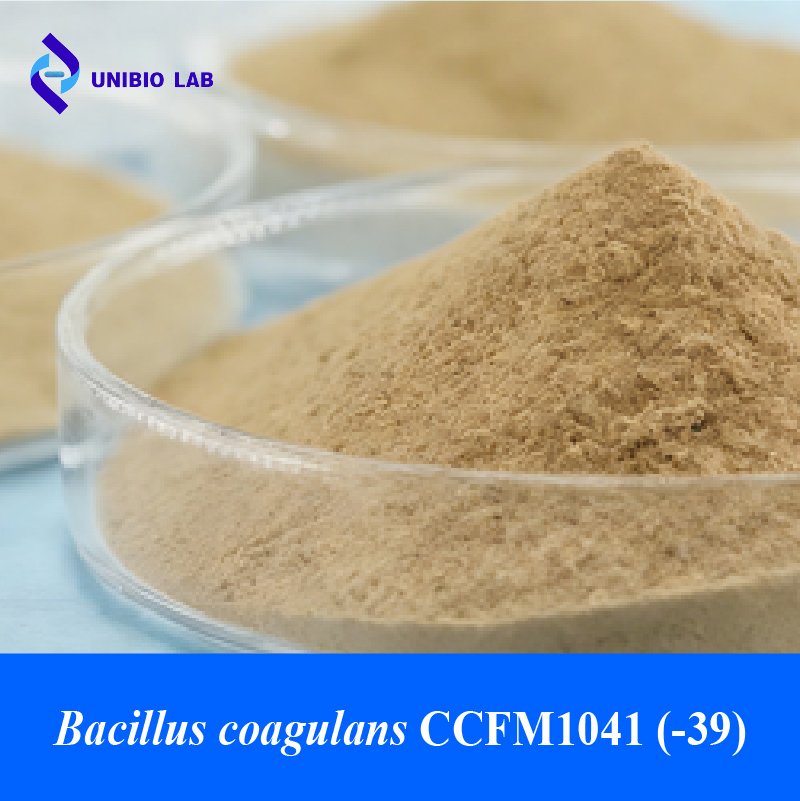
Bacillus coagulans CCFM1041 (−39), a heat-resistant format specified at 10B–300B CFU/g with room-temperature storage.
Downstream handling conditions are consistent across the classes: low-temperature storage cabinets, vacuum packaging equipment and powder mixing equipment at the buyer's plant, with moisture-proof and light-proof transport. The scenarios Unibio publishes for its materials assume sealed packaging and an indoor production environment, so a buyer planning open handling or repacking into non-barrier sachets is working outside the stated conditions and should raise it explicitly.

Ligilactobacillus salivarius CCFM1215, specified at 10B–200B CFU/g with 2–8 °C sealed storage.
Application scenarios that shape the specification
Unibio publishes application scenarios that pair functional intent with a documented strain list. Four of them are directly relevant to procurement decisions.
Intestinal health and bowel regulation. The scenario documentation covers balancing intestinal flora, relieving constipation and irregular defecation, and protecting the intestinal barrier, with strict low-temperature sealed storage described as a condition for preserving viable count. The matched strain list is broad and includes Bifidobacterium breve CCFM1025, Clostridium butyricum CCFM1299, Bacillus coagulans CCFM1041 and several Lactobacillus and Bifidobacterium materials.
Infant and adult flora imbalance. This scenario describes prevention and relief of diarrhea and immune support, and lists Lactobacillus rhamnosus GG and Bifidobacterium longum CCFM1195 among its matched materials. Buyers formulating for infant food should note that the scenario documentation is a formulation reference, not a regulatory clearance for every destination market, and that market-entry documentation has to be checked separately.
Lactose intolerance and fermented dairy. Bifidobacterium animalis subsp. lactis BL03 is listed here alongside fermentation-oriented materials such as Streptococcus thermophilus ST67 and Lactobacillus delbrueckii subsp. bulgaricus HB68, which points to a different buyer profile: dairy processors rather than supplement brand owners.
Animal feed and pet health. Bacillus coagulans CCFM1041 is listed for animal feed use, and a separate pet health and animal feed scenario pairs relief of diarrhea and immune support with a strain set that includes several Lactobacillus and Bifidobacterium materials. Feed applications frequently tolerate a different carrier and count profile from human supplements, which is why the specification should be written per channel rather than copied across.
Acceptance criteria to write into the purchase order
Acceptance criteria are the clauses that decide whether a delivered batch is conforming. They are worth agreeing in writing before the first order, because they are difficult to negotiate once material is in transit. The checklist below reflects what a probiotic powder specification can reasonably contain.
- Strain identity. Genus, species, subspecies where applicable, strain designation and model code. For example, Bifidobacterium animalis subsp. lactis BL03, model BL03 — not “Bifidobacterium powder”.
- Viable count basis. CFU per gram, test method, whether the figure applies at release or at end of shelf life, and the sampling plan used for release testing.
- Encapsulation and carrier. The named coating system and carrier, stated as line items. Where VPro® 5-layer encapsulation material is specified, it should be named explicitly rather than described as “protected” or “coated”.
- Certificate of analysis content. Unibio states that every batch undergoes full internal laboratory testing covering viable count, heavy metals and microbial safety, and that a batch COA is provided. The PO should state which of those three the buyer expects to see on the COA, and in what units.
- Third-party verification. Unibio accepts third-party SGS or Intertek inspection on client request. If independent verification is a condition of acceptance, it belongs in the contract rather than in a later email.
- Certification set matched to destination. ISO 22000, FSSC 22000 and GMP food manufacturing certification audited by SGS, plus HALAL and Orthodox Union Kosher certificates, cover the markets Unibio exports to. Buyers should match the requested certificate list to the destination rather than collecting every document available.
- Storage and shipping conditions. Which class applies, who arranges cold-chain logistics, and who carries the cost of temperature deviation. Unibio offers a cold-chain logistics scheme as part of its after-sales scope.
- Packaging integrity. Vacuum packaging or moisture-barrier format, unit size, and the sealing standard expected on arrival.
- Shelf-life start date. The date from which the 24-month shelf life runs, and the minimum remaining shelf life acceptable at delivery.
- Complaint handling. Unibio states a 24-hour working-hour complaint response, which is worth writing into the contract as a response window rather than leaving as a service expectation.
One phrase deserves specific attention. Buyers frequently search for “FDA certified probiotics powder”, but what a US-bound probiotic ingredient actually holds is FDA food facility registration, and where relevant a self-affirmed GRAS conclusion — Unibio holds an independent self-affirmed GRAS conclusion for Akkermansia muciniphila AH39. An ingredient cannot be “FDA certified” in the sense the phrase implies. A supplier that echoes the phrase without correcting it is a supplier worth questioning on the rest of the documentation pack.
Commercial terms that sit alongside the technical specification
Unibio's published terms are a 1 kg minimum order for single-strain powder and 5 kg for compound powder, with 5,000 bottles as the minimum for finished private-label products. Lead time is 5–7 days for bulk raw material and 25–35 days for private-label finished goods. Trade terms include FOB Shanghai, CIF, DDU and DDP.
Capacity context helps a buyer judge whether a supplier can hold a programme rather than fill a first order. Unibio reports annual output of 1,800 tons of probiotic raw powder and postbiotics, plus 10 billion capsules and 10 billion tablets or sachets, a strain library of more than 30,000 microbial strains and 189 patented functional strains. For a buyer moving from sample to commercial volume, the useful question is not the headline tonnage but which strain lines are held in stock and which are produced to order — that answer determines whether a 5–7 day bulk lead time applies to the specific material being purchased.
Where encapsulation is not the answer
Coated material is not automatically the correct specification, and a credible supplier should say so. Three boundaries are worth stating plainly.
Coating does not replace cold chain. Lactobacillus rhamnosus GG is supplied with VPro® 5-layer encapsulation material and is still specified for sealed storage at −18 °C or below. The storage requirement follows the strain, not the coating. A buyer who assumes a coated powder can be held ambient will discover the error at goods-in, not at quotation.
Intrinsically robust formats may not need the increment. Spore-forming and heat-resistant materials such as Bacillus coagulans CCFM1041 already carry room-temperature storage and a 10B–300B CFU/g range. Where the finished product is refrigerated, has a short shelf life and is consumed quickly, an uncoated powder can be a defensible choice, and the added process steps and cost of a multi-layer coating have to be justified against the actual stability risk in that product.
Coating is not documentation. A protective layer does not substitute for strain-level identity, a batch COA or a destination-appropriate certificate set. Buyers sometimes accept a coated material in place of a documentation requirement. Those are different problems, and only one of them is solved by encapsulation.
How the procurement conversation is shifting
Across supplement and food categories, buyers are moving specification questions earlier in the process. Strain-level identity, which was once a technical footnote, is increasingly a line item in the RFQ. Multi-market documentation requests are being raised at quotation stage rather than after a supplier is selected, largely because qualification timelines differ so much between destinations. And the storage class question is being asked earlier because ambient distribution formats keep expanding, and a material that cannot survive the intended distribution channel is not a viable specification regardless of its release count.
A parallel shift is visible on the supplier side. Contract manufacturers with in-house encapsulation capability can answer questions about coating layers and carrier systems directly, rather than passing them to a third party. That shortens the technical clarification cycle, but it also raises the bar on documentation, because a buyer can now ask for layer-level detail and expect an answer.
What to expect next
The direction of travel is toward more granular acceptance criteria rather than fewer. Moisture and water-activity limits, packaging barrier specifications and shelf-life basis are likely to be negotiated as standard clauses rather than optional extras, particularly for ambient-distributed products. Buyers building long-term programmes should expect to maintain a specification template per strain and per destination, because a single blanket specification is increasingly difficult to defend across a multi-market portfolio.
For suppliers, the practical implication is that coating technology and documentation quality are becoming a single offering in the buyer's mind. A five-layer encapsulation system that cannot be described layer by layer, or a certificate set that cannot be matched to a destination, creates the same procurement delay.
Frequently asked questions
What is VPro® 5-layer micro-encapsulation?
VPro® is Unibio's five-layer micro-encapsulation system for probiotic raw powder. The layers are a micromolecular protective layer for anti-freezing and anti-stress protection, a prebiotic nutrition layer supporting in-vivo proliferation, a liposome enteric adhesion layer supporting intestinal colonization, an acid and enzyme resistant layer for survival through gastric digestion, and an oxygen and moisture barrier layer for shelf stability. Unibio reports that the system raises freeze-drying survival rate by 40% and extends shelf life to 24 months.
What viable count ranges are available for probiotic raw powder?
Published ranges for individual Lactobacillus and Bifidobacterium materials generally sit between 10B and 200B CFU/g, with 10B–300B CFU/g quoted for Lactobacillus rhamnosus GG and Bacillus coagulans CCFM1041. Clostridium butyricum CCFM1299 is listed at 10B CFU/g. At platform level, Unibio reports lyophilized powder concentration up to 8.0×10¹¹ CFU/g, which describes manufacturing capability rather than a standard catalogue range.
Why do some strains require −18 °C while others ship at room temperature?
The storage class follows the strain's intrinsic stability, not the presence of a coating. Lactobacillus rhamnosus GG, Lactobacillus acidophilus L59, Lactobacillus rhamnosus CCFM0528 and Bifidobacterium adolescentis CCFM1173 are specified at −18 °C or below. Ligilactobacillus salivarius CCFM1215 and Lactobacillus plantarum CCFM8661 sit at 2–8 °C. Bacillus coagulans CCFM1041, Clostridium butyricum CCFM1299 and ProLipo® postbiotic material are specified for room-temperature storage in a well-closed container away from moisture and direct sunlight.
Which documents should accompany a probiotics powder shipment?
A batch certificate of analysis covering viable count, heavy metals and microbial safety is the baseline; Unibio states that every batch undergoes full internal laboratory testing across those three areas and that batch COAs are provided. Certification documents — ISO 22000, FSSC 22000, GMP food manufacturing audited by SGS, HALAL and Orthodox Union Kosher, plus FDA food facility registration — are supplied according to destination market requirements. Third-party SGS or Intertek inspection is available on client request.
What is the minimum order quantity for a single-strain powder?
Unibio's published minimum is 1 kg for single-strain probiotic powder and 5 kg for compound powder, with 5,000 bottles as the minimum for finished private-label products. Bulk raw material lead time is 5–7 days, and private-label finished goods run at 25–35 days.
Does encapsulation remove the need for cold-chain storage?
No. Lactobacillus rhamnosus GG is supplied with VPro® 5-layer encapsulation material and is still specified for sealed storage at −18 °C or below. Encapsulation improves survival through processing and digestion and extends shelf stability, but the storage class remains a property of the strain. Buyers should confirm the storage requirement for the specific model code rather than inferring it from the presence of a coating.
How should carrier and encapsulation be written into a specification?
As named line items. Unibio lists standard composition for its raw powders as probiotic strain, maltodextrin carrier and VPro® 5-layer encapsulation material. A specification that states only the strain and the viable count leaves the material composition undefined, which means two conforming offers can differ in ways that matter during tableting, sachet filling or shelf-life testing.
Is a “FDA certified” probiotic powder a real category?
The phrase is widely used in buyer searches but does not describe a product certification. What a US-bound probiotic ingredient holds is FDA food facility registration, and where applicable a self-affirmed GRAS conclusion — Unibio holds an independent self-affirmed GRAS conclusion for Akkermansia muciniphila AH39. Buyers should clarify which of these a supplier actually holds before accepting the phrase in a quotation.
Reference material
Unibio's company brochure, covering strain library, production bases, certification set and CDMO service scope, is available for download: Unibio Lab Probiotics company brochure (PDF).
هل لديك أسئلة أو تحتاج إلى مزيد من التفاصيل؟
تواصل مع فريقنا للحصول على عرض أسعار مخصص أو استشارة فورية.
طلب عرض أسعار
املأ النموذج أدناه وسيتواصل معك فريقنا بعرض مقترح مخصص.
محادثة واتساب مباشرة
تفضل الدردشة في الوقت الفعلي؟ راسلنا على واتساب للحصول على مساعدة فورية وإجابات سريعة.
- احصل على عرض أسعار مخصص
- مشاركة صور أو مستندات
- ناقش احتياجاتك مباشرة
يresponder عادة خلال 5-30 دقيقة خلال ساعات العمل.