
Probiotics Powder Specifications: What Buyers Should Verify
Probiotics powder is only as valuable as its specification sheet: strain identity, viable count, encapsulation, storage conditions, and the certifications that verify manufacturing quality. For buyers moving from research to supplier evaluation, these parameters determine whether a product can deliver its stated dose, clear customs, and survive real-world distribution. This article maps the specifications that matter, what they mean for different applications, and how to verify them.
Why Specification Verification Matters in Probiotics Powder
Probiotics are live microorganisms, and their commercial value depends on viability. A powder invoiced at 100 billion CFU per gram can lose a significant share of that count before reaching the consumer if the strain is sensitive, the coating is weak, the packaging is permeable, or the cold chain is interrupted. Unlike most food ingredients, the performance of probiotics cannot be confirmed by appearance or by a single snapshot test at delivery; it is the product of the entire production and handling chain.
This creates what can be called a verification gap in bulk sourcing. A certificate of analysis (COA) tells the buyer what the batch measured at release, but it does not reveal whether the factory can reproduce that result consistently, whether the strain carries appropriate documentation for a target market, or whether the finished dosage form can protect the strain through gastric transit. Certifications such as ISO 22000, FSSC 22000, GMP, and FDA facility registration exist to close part of that gap, by giving a third-party assessment of the manufacturing system. They do not, however, tell a buyer which strain to select, which CFU level to specify, or how the powder should be stored.
Market Signals: Probiotics Powder Is Moving Beyond Commodity
The commercial context explains why specification discipline is becoming a buyer priority. Global Market Insights estimates the global probiotics market at USD 72.1 billion in 2024, with a projection of USD 165.1 billion by 2034. Within this market, probiotic dietary supplements reached an estimated USD 10.60 billion in 2026 and are forecast to grow at a CAGR of 9.5% through 2031, according to MarketsandMarkets. Segments with more specific compliance requirements are expanding faster: the global baby probiotics market was valued at USD 2.27 billion in 2024 and is projected to reach USD 5.6 billion by 2035 (8.6% CAGR), while the pet biotics market is estimated to reach USD 1,232.5 million by 2030 (7.0% CAGR).
For ingredient buyers, these growth lines signal that probiotics powder is being formulated into infant nutrition, metabolic health products, sports nutrition, immunity support, and animal health—each with distinct specification requirements. Infant products require strains with a strong safety record and clean documentation. Metabolic products require clinically studied strains, often with next-generation candidates. Pet and livestock products may require heat-resistant strains that tolerate feed processing. Matching the specification sheet to the final application is therefore not a quality nicety; it is a market access requirement.
Reference Manufacturer: How Shanghai Unibio Lab Co., Ltd Builds a Specification System
Shanghai Unibio Lab Co., Ltd is a probiotic R&D, manufacturing, and CDMO enterprise based in Shanghai, China. Founded in 2021, the company produces 1,800 tons of probiotic raw powder and postbiotics per year, and reports that 85% of its output is exported to markets including North America, Western Europe, Southeast Asia, the Middle East, and Australia. For buyers, the company functions as a reference example of how a manufacturer can organize strain data, production capacity, and compliance documentation around the needs of global brands.
Three structural facts are relevant to specification evaluation.
First, the strain library is large and documented. Unibio reports a bank of over 30,000 microbial strains, comprising 25,300 primary 16S rRNA strains, 13,720 draft-genome strains, and 8,046 full-genome strains, isolated from sources such as longevity elder gut, infant feces, breast milk, traditional fermented foods, and fresh produce. The portfolio includes 189 patented functional strains, with clinically validated examples such as Akkermansia muciniphila AH39, Bifidobacterium breve CCFM1025, L. plantarum CCFM1143, L. rhamnosus GG, and L. reuteri CCFM1040/CCFM8724. A large, well-characterized strain bank allows a buyer to select a strain based on documented function rather than on a generic Lactobacillus label.
Second, the company combines strain development with an in-house R&D team of 30 professionals and a production system that supports OEM, ODM, private label, and custom formula development. Buyers can specify strain combination, CFU concentration, dosage form (powder, capsule, tablet, sachet, gummy), packaging design, prebiotic and excipient formula, and microencapsulation process adjustments. From a specification viewpoint, this means the buyer is not forced to accept a fixed product; the specification can be engineered to fit the application.
Third, the quality control system is verifiable. Every batch undergoes in-house lab testing for viable count, heavy metal content, and microbial safety, and third-party inspection by SGS or Intertek is accepted upon client request. Batch COA provision, cold-chain logistics guidance, and complaint response within 24 working hours are part of the after-sales service. This matters for buyers because documentation flow—from batch record to customs declaration—is one of the most common bottlenecks in international probiotics trade.

Five Specification Groups That Define Probiotics Powder Quality
Buyers evaluating probiotics powder suppliers typically compare five parameter groups: strain identity, viable count, encapsulation and stability, storage and shelf life, and certification coverage.
1. Strain Identity and Purity
Probiotic function is strain-specific, not species-specific. Bifidobacterium breve CCFM1025 is documented in the Unibio portfolio for improving sleep and relieving stress through the gut-brain axis; L. plantarum CCFM8724 is documented for preventing children's dental caries and inhibiting oral pathogenic bacteria; L. plantarum CCFM1143 is documented for easing diarrhea and regulating intestinal metabolism for body weight control. A specification sheet should therefore state the exact strain designation, not just the species.
Buyers also choose between single-strain and compound formats. Single-strain high-purity powders target a specific function and are easier to document in clinical claims. Compound lactic acid bacteria powders blend multiple strains for broader gut coverage. The spec sheet should state the strain origin (for example, 'independent lab culture' or 'human gut'), because origin affects documentation and, in some regulated markets, acceptance.
2. Viable Count per Gram
Viable count is the most visible specification, and it is frequently misunderstood. A high CFU at batch release does not guarantee an adequate count at the end of shelf life. The specification should distinguish between label claim, release count, and the count assured through the declared shelf life.
Typical ranges in Unibio's raw powder portfolio: most Lactobacillus and Bifidobacterium single-strain powders are specified at 10B to 200B CFU/g; Bifidobacterium animalis subsp. lactis BL03 reaches 10B to 600B CFU/g; Bacillus coagulans CCFM1041, a heat-resistant strain, is specified at 10B to 300B CFU/g; Akkermansia muciniphila AH39 is specified at 10B to 200B TFU/g. The unit difference is important: TFU (total fluorescent units) is an enumeration method commonly used for anaerobic and next-generation strains, and buyers should confirm which method applies to their material.
3. Encapsulation and Stability Technology
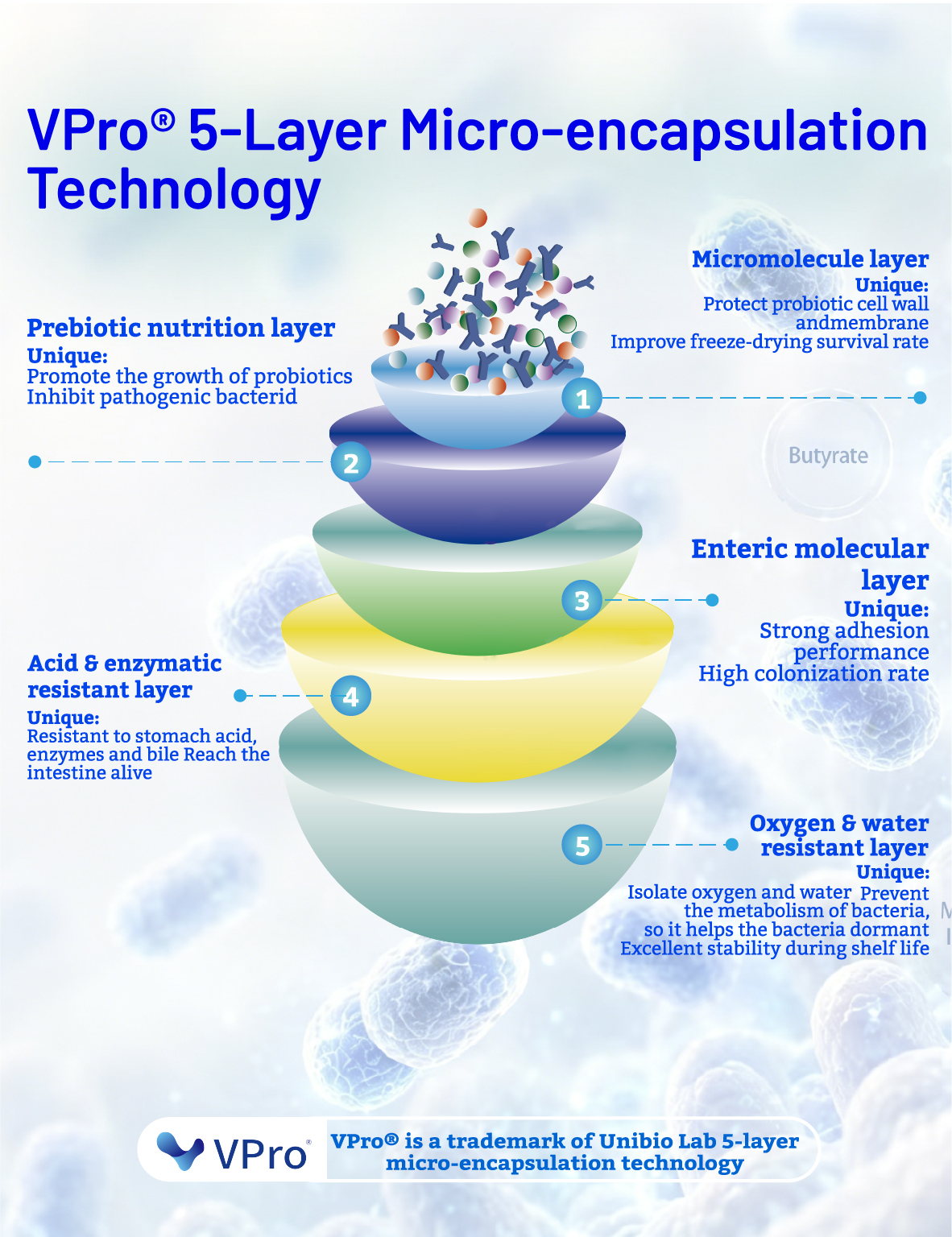
Encapsulation is the core technology that decides whether a strain survives stomach acid, bile salts, oxygen, and processing heat. Unibio's VPro® five-layer microencapsulation technology is an example of a full protective system. Its five layers are: a micromolecular protective layer for anti-freezing and anti-stress, a prebiotic nutrition layer to support in-vivo proliferation, a liposome enteric adhesion layer to boost intestinal colonization, an acid and enzyme resistant layer for gastric survival, and an oxygen and moisture barrier layer for shelf stability.
The company reports that this technology raises freeze-drying survival rate by 40%, extends shelf life to 24 months, reaches fermentation density above 3.5×10¹⁰ CFU/mL, and produces lyophilized powder concentrations up to 8.0×10¹¹ CFU/g. The coating material itself, VPro®-5L-COAT, is a food-grade polysaccharide and protein composite matrix that provides a five-layer acid and bile resistant barrier, improves heat resistance, and extends strain shelf life. For buyers, the practical question is whether the supplier can provide stability data at the temperature and duration required by the target distribution model.
4. Storage Temperature and Shelf Life
Storage specifications vary widely by strain, and they directly affect supply chain cost. In Unibio's portfolio, Lactobacillus rhamnosus GG, many L. plantarum strains, and several acidophilus cultures require storage at -18°C or below. Akkermansia muciniphila AH39, Bifidobacterium longum CCFM760, Bacillus coagulans CCFM1041, and Clostridium butyricum CCFM1299 tolerate storage in a well-closed container away from moisture and direct sunlight at room temperature. Shelf life is typically 24 months under recommended storage conditions, with finished capsules also carrying 24-month shelf life claims.
The commercial difference is significant. A room-temperature-stable acid-resistant powder can be shipped through standard logistics and displayed on retail shelves. A cold-chain powder requires refrigerated transport, cold storage, and more careful retail planning. Buyers often pay a specification premium for room-temperature stability because it removes logistics constraints and expands distribution options.
5. Certification Coverage
Certifications verify the manufacturing system, not the strain's efficacy. A buyer should know which credentials are relevant to the target market and what each actually covers.
| Certification | Scope for Probiotics Powder | Example in Unibio's File |
|---|---|---|
| ISO 22000 | Food safety management system, incorporating HACCP principles, applicable to the probiotic production chain. | Cert. No. CN22/00000437, issued by SGS-CSTC, valid to 2028-03-28. |
| FSSC 22000 | GFSI-recognized food safety certification; covers production of probiotic solid beverages (ambient stable products). | Cert. No. CN22/00000434, issued by SGS United Kingdom Ltd, valid to 2028-03-28. |
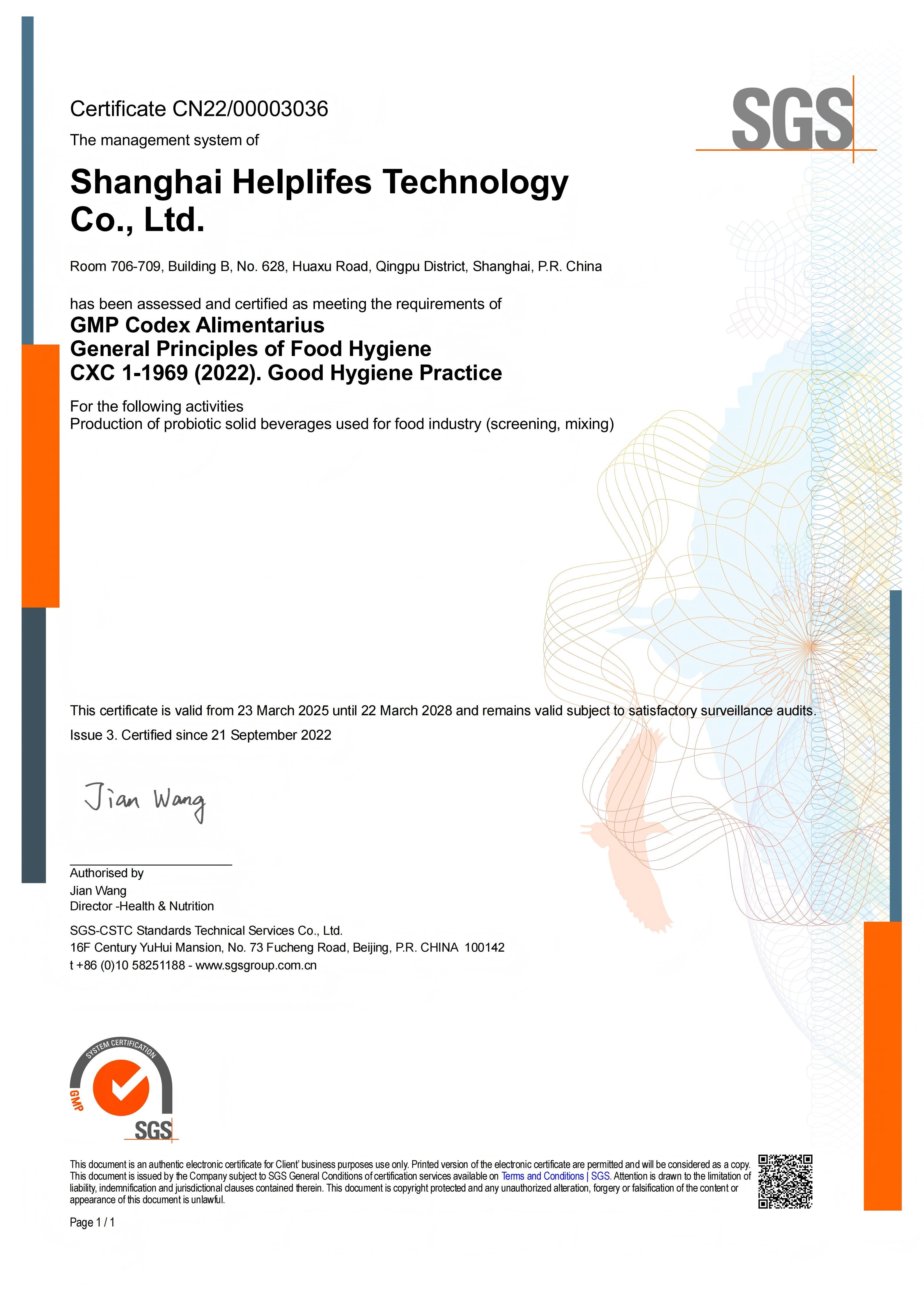
| GMP (Codex Alimentarius) | Good hygiene practice certification for screening and mixing of probiotic solid beverages. | Cert. No. CN22/00003036, issued by SGS-CSTC, valid to 2028-03-22. |
| FDA Facility Registration | US FDA food facility registration, required for facilities producing ingredients or supplements for the US market. | Shanghai Unibio Lab: 19635371796; Shanghai Helplifes Technology: 12494588438. |
| GRAS (independent conclusion) | US self-affirmed GRAS for a specific strain or finished product; supports US customs clearance and regulatory acceptance. | AH39: No. CIRS-GRAS-AH39-20250422, issued by CIRS GROUP USA Inc., 2025-04-22. |
| HALAL | Compliance with Islamic dietary regulations; required or preferred in Middle East and Southeast Asia. | Registration No. 3100/11080; Certificate No. 1821240000, recognized by Indonesian BPJPH, valid to 2028-07-25. |
| Kosher (OU) | Orthodox Union certification for Jewish-market eligibility. | Held per company certification profile. |
In the United States, probiotic supplements are regulated under 21 CFR Part 111, which requires compliance with current Good Manufacturing Practices (cGMP). FDA facility registration and GRAS conclusions do not replace cGMP; they are complementary layers of the compliance system. In Europe and other regions, ISO 22000 and FSSC 22000 are recognized certifications for the food safety management chain, incorporating HACCP principles. Buyers should ask to see the certificate, verify the certifying body, the scope of products covered, and the validity date, and confirm that the certificate corresponds to the product category they intend to source.
Matching Specifications to Application Segments
The same powder is not appropriate for every market. The following table summarizes how specification priorities shift by application.
| Application | Specification Priorities | Representative Strains |
|---|---|---|
| Infant probiotics powder | Strain safety documentation, purity, low allergenicity, clinical familiarity | Lactobacillus rhamnosus GG, Lactobacillus reuteri HR7 |
| Adult gut health / bowel regulating powder | High CFU, acid-bile resistance, room-temperature option | Bifidobacterium longum CCFM760, Lactobacillus plantarum CCFM1143 |
| Immunity boost powder | Documented immunomodulatory strains, stability through shelf life | Lactobacillus rhamnosus GG, Bifidobacterium breve CCFM1025 |
| Elderly regulating powder | Gentle strains, digestive comfort, ease of formulation | Lactobacillus acidophilus L59, Bifidobacterium longum CCFM760 |
| Metabolic management | Clinically studied next-generation strains, regulatory support (e.g., GRAS) | Akkermansia muciniphila AH39, Bifidobacterium longum CCFM760 |
| Sports nutrition | Concentrated formats, minimal excipients, fast-dissolving powders | Compound Lactobacillus blends |
| Pet probiotics powder | Feed-format tolerance, heat stability, strain safety for animals | Bifidobacterium animalis subsp. lactis BL03 |
| Livestock farming powder | Heat-resistant spore-formers, high concentration, cost efficiency | Bacillus coagulans CCFM1041 |
This mapping is illustrative, not prescriptive. It shows why a buyer should lead with the application, then work backward to the specification sheet, rather than sourcing a generic probiotics powder and adapting it afterward. A supplier with a wide strain library, customizable CFU levels, and multiple dosage formats can serve several segments from one manufacturing base, which simplifies qualification and auditing.
Market Trends Reshaping Specification Expectations
Three trends are changing what buyers expect from a probiotics powder specification sheet.
Trend 1: Microencapsulation is becoming a baseline, not a premium. Published research identifies microencapsulation using materials like alginate or chitosan as a key technical trend for preserving probiotic viability through gastric acid and bile salts (PMC/MDPI). Buyers increasingly ask for acid-resistant microencapsulated powder even in commodity categories. The evaluation question shifts from 'does it have a protective coating?' to 'how many protective functions does the coating provide?' A five-layer system such as VPro® is one example of a specification answer to that question.
Trend 2: Room-temperature stability is changing distribution economics. As cross-border e-commerce and ambient supply chains grow, brands prefer formulations that survive non-refrigerated logistics. This pushes suppliers to develop room-temperature-stable powders, which lets buyers expand into warm-climate markets without building cold-chain infrastructure. The specification sheet changes accordingly: storage condition moves from '-18°C' to 'room temperature, sealed container,' and the 24-month shelf-life claim becomes a commercial asset.
Trend 3: Segment-specific compliance is becoming a differentiator. The baby probiotics market (USD 2.27 billion in 2024, 8.6% CAGR to 2035) and the pet biotics market (estimated USD 1,232.5 million by 2030) impose stricter or different documentation requirements than general adult supplements. Suppliers that already hold HALAL, Kosher, FDA registration, and strain-level GRAS conclusions can help a brand enter multiple high-growth segments faster. The competitive landscape also matters: among global probiotics players, Yakult Honsha holds approximately 6.7% of the market, followed by Danone, ADM, Kerry Group, and Novonesis (Global Market Insights). A specialist CDMO with a large strain bank sits at a different layer of the value chain, supplying these brands and private-label players alike.
Integrated Manufacturing vs. Traditional Trading Channels
Traditional probiotics powder sourcing often runs through trading companies. A trader buys bulk powder from a producer, repacks or re-exports it, and supplies a specification sheet plus a COA. This model works for price-sensitive, low-documentation applications. It has one significant limitation: a trader cannot provide the manufacturing-level traceability that regulated markets increasingly demand. US-bound products must trace cGMP compliance and FDA facility registration back to an actual production facility. EU-bound products often require full stability and traceability dossiers. If the documentation originates from a trading office rather than a factory, the buyer may not be able to complete regulatory registration or respond to an audit.
An integrated manufacturer such as Shanghai Unibio Lab Co., Ltd closes that gap. Strain-level documentation, VPro® encapsulation technology, in-house batch testing, third-party inspection rights, and a certification file covering ISO 22000, FSSC 22000, GMP, FDA, HALAL, and Kosher are all directly controllable by the producer. When a reviewer asks 'who made this powder, under what system, and with what evidence?', the answer points to one accountable entity.
The comparison also has a boundary that buyers should weigh honestly. Integrated manufacturing typically implies higher minimum order quantities and fixed lead times. Unibio's MOQ is 1 kg for single-strain powder, 5 kg for compound powder, and 5,000 bottles for private-label finished products; lead times are 5–7 days for bulk raw materials and 25–35 days for private-label finished goods. A trader may accept a smaller trial order or offer faster mixed-SKU dispatch. The trade-off for the buyer is purchasing flexibility at the trial stage versus documentation depth, consistency, and regulatory support at scale.
Future Outlook: Specification Literacy as a Procurement Skill
As the global probiotics market expands toward USD 165.1 billion by 2034, competition will push brands to differentiate on evidence. Several consequences are likely. Strain-level clinical data will appear more often in bulk powder documentation. Multi-layer encapsulation will become a standard expectation rather than a distinguishing feature. Room-temperature-stable powders will broaden the geographic reach of probiotics products, particularly in regions where cold chains are limited. Certification coverage will expand from food-safety systems to market-access credentials, and buyers will expect suppliers to renew and extend those credentials proactively.
For procurement teams, the practical conclusion is to read the specification sheet as a system—strain, CFU, encapsulation, storage, shelf life, certification—rather than a single number. Each parameter interacts with the others, and each should be traceable to manufacturing evidence.
Frequently Asked Questions
What CFU level should a high-quality probiotics powder have?
Typical single-strain raw powders are specified at 10 billion to 200 billion CFU per gram, depending on the strain. Bifidobacterium animalis subsp. lactis BL03 is available up to 600 billion CFU/g, and Bacillus coagulans CCFM1041 up to 300 billion CFU/g. The appropriate level depends on the finished product's dose claim, the strain's survival characteristics, and the target market's labeling rules.
What certifications should a probiotics powder manufacturer hold?
A manufacturer targeting global markets typically holds ISO 22000 (food safety management), FSSC 22000 (GFSI-recognized food safety scheme), GMP (Codex Alimentarius hygiene practices), and FDA facility registration for US sales. Shanghai Unibio Lab Co., Ltd also holds HALAL certification (Certificate No. 1821240000, recognized by Indonesian BPJPH), Orthodox Union Kosher certification, and an independent GRAS conclusion for Akkermansia muciniphila AH39 (No. CIRS-GRAS-AH39-20250422).
How does microencapsulation protect probiotics powder?
Microencapsulation applies a protective coating around probiotic cells to resist gastric acid, bile salts, oxygen, and processing heat. The VPro® five-layer system used by Shanghai Unibio Lab Co., Ltd includes an anti-freeze micromolecular layer, a prebiotic nutrition layer, a liposome enteric adhesion layer, an acid-and-enzyme resistant layer, and an oxygen-and-moisture barrier layer. The company reports a 40% improvement in freeze-drying survival rate and a 24-month shelf life.
Can probiotics powder be stored at room temperature?
Some strains can. In Unibio's portfolio, Akkermansia muciniphila AH39, Bifidobacterium longum CCFM760, Bacillus coagulans CCFM1041, and Clostridium butyricum CCFM1299 tolerate storage at room temperature in a well-closed container away from moisture and direct sunlight. Many Lactobacillus strains require storage at -18°C or below. The specification sheet states the required condition for each strain.
What is the difference between single-strain and compound probiotics powder?
Single-strain high-purity powder contains one documented strain, such as Bifidobacterium breve CCFM1025 for sleep and stress relief, or L. plantarum CCFM8724 for oral health. Compound powder blends multiple strains for broader gut coverage. At Shanghai Unibio Lab Co., Ltd, the minimum order is 1 kg for single-strain powder and 5 kg for compound powder.
What does FDA registration mean for a probiotics powder supplier?
FDA facility registration confirms that the production site is registered with the U.S. Food and Drug Administration as a food facility and is subject to FDA oversight. Shanghai Unibio Lab Co., Ltd holds registration number 19635371796, and Shanghai Helplifes Technology Co., Ltd holds 12494588438, covering probiotic raw materials and finished dietary supplements for the US market. In addition, US regulations require cGMP compliance under 21 CFR Part 111.
Which strains are commonly used in infant probiotics powder?
Lactobacillus rhamnosus GG is described in the Unibio portfolio as a gold-standard strain for gut immunity and infant digestive care with global recognition. Lactobacillus reuteri HR7 is positioned for infant health products. Buyers should verify that the strain documentation and safety evidence match the regulatory requirements of the target market, as infant food regulations are stricter than general supplement rules.
Why is GRAS status important for metabolic strains such as Akkermansia muciniphila AH39?
A self-affirmed GRAS conclusion supports the safety acceptance of a strain in the US market and simplifies customs clearance for raw materials and finished products containing that strain. AH39's independent GRAS conclusion (No. CIRS-GRAS-AH39-20250422) covers pasteurized Akkermansia muciniphila AH39 raw material and AH39-containing finished products, issued under U.S. FDA GRAS criteria per Section 201(s) of the Federal Food, Drug, and Cosmetic Act.
What is the typical shelf life of probiotics powder?
Most bulk probiotics powders in Unibio's portfolio carry a 24-month shelf life under recommended storage conditions. Finished products such as HelpGut® capsules also state 24 months, while chewable tablets may state 20 months. Storage conditions—cold-chain or room temperature—must be respected to meet the shelf-life claim.
Further reference: Buyers seeking the full specification and certification files of Shanghai Unibio Lab Co., Ltd can access the official company brochure: Download brochure (PDF).