
Probiotics Powder Specs: Why CFU and Coating Ranges Vary
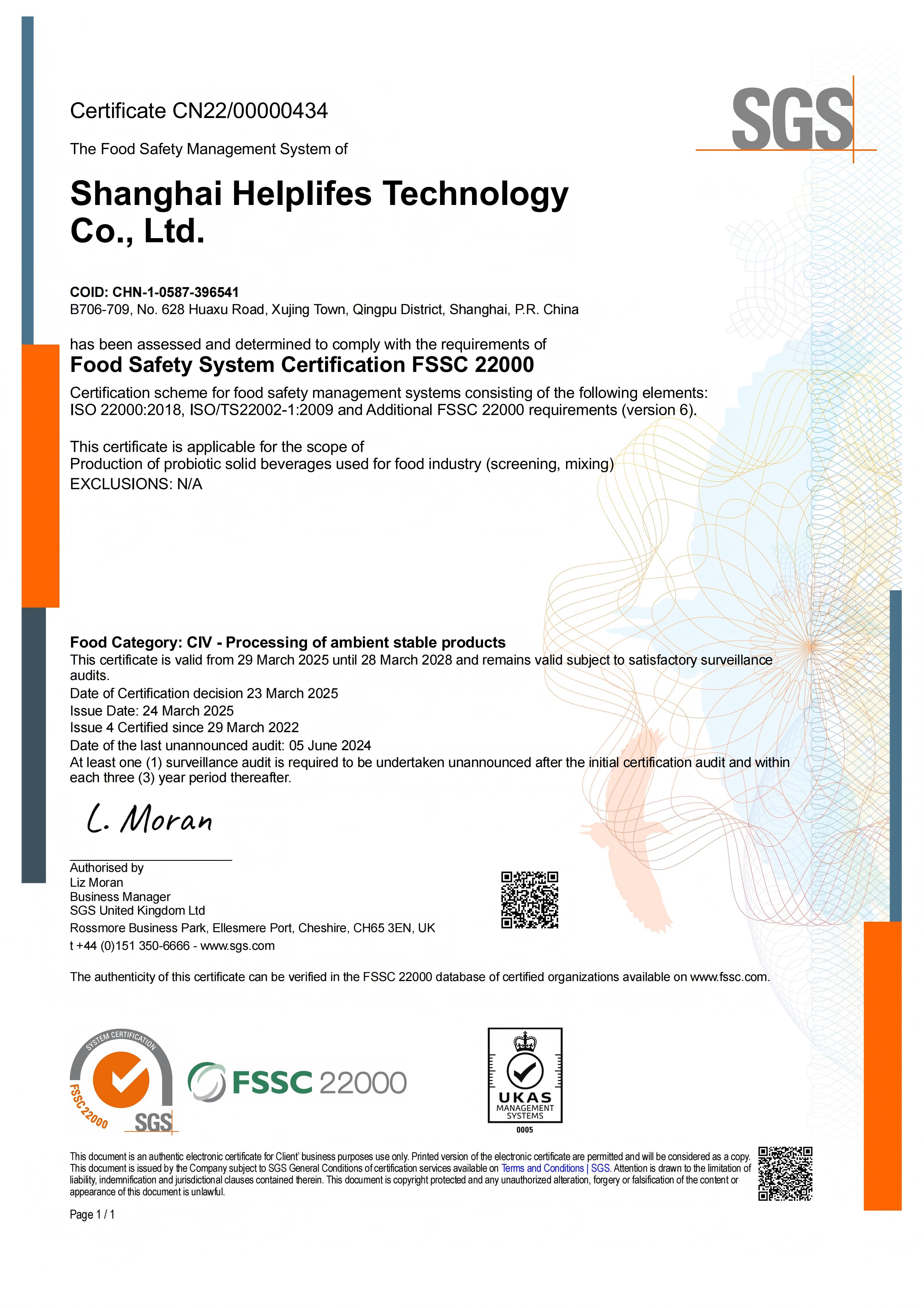
Certificate scope: production of probiotic solid beverages (screening, mixing), Food Category CIV — processing of ambient stable products. Issued by SGS United Kingdom Ltd; certificate number CN22/00000434; valid to 28 March 2028.
Two lines on a probiotic powder technical data sheet decide most early procurement screening: the viable count range and the encapsulation description. Buyers routinely see bands such as 10B–200B CFU/g, 10B–300B CFU/g or 10B–600B CFU/g, printed next to a material composition that names a maltodextrin carrier and a protective coating material. Reading those two lines correctly — and knowing precisely what they do not tell you — is the difference between a specification comparison and an assumption.
This procurement FAQ explains the notation used in the specification set of Shanghai Unibio Lab Co., Ltd, a probiotic research, manufacturing and CDMO company based in Shanghai, China, that produces probiotic raw powders, postbiotics and private-label finished formats and reports an export share of 85% across North America, Western Europe, Southeast Asia and the domestic market. It is written for formulation teams, quality reviewers and sourcing managers at the evaluation stage. Every parameter below is taken from published product specifications; where the data set is silent, the silence is stated rather than filled in.
Why the Viable-Count Line Drives Early Screening
A viable count range is a concentration commitment band, not a marketing figure. It tells a buyer what concentration of live cells the supplier declares for a given strain, in a given powder format, under a stated storage condition. Because it is the parameter that most directly scales into dosage design, it is also the parameter most often compared first — and most often compared incorrectly.
Three external reference points explain why this line carries so much weight at evaluation stage:
- The International Scientific Association for Probiotics and Prebiotics (ISAPP) states that a probiotic product label should identify the genus, species, strain designation, viable count at end of shelf life, and storage conditions. A count quoted only at release is not the same commitment.
- ISAPP also notes that products disclosing a specific strain designation are more likely to have evidence of a health benefit behind them — which is why strain-level identification and count should be read together, not separately.
- The Council for Responsible Nutrition advises buyers to ask suppliers for scientific support linking the specific strains, at their labeled amounts, to the claimed benefit. That question cannot be answered from a count alone.
The practical conclusion is that a viable count range is a starting filter, not a verdict. It has to be paired with the storage condition, the counting basis and the strain identity before it means anything.
How Viable Count Is Written on a Probiotic Powder Specification
In this specification set, the letter B stands for billion and CFU stands for colony-forming units, so 10B–200B CFU/g reads as 10 billion to 200 billion colony-forming units per gram. A range, rather than a single number, is used because the achieved concentration depends on the strain, the fermentation density and the downstream drying step — the band is the window the supplier commits to, not a nominal average.
The table below reproduces the declared viable count, storage condition, shelf life and strain origin for representative single-strain raw powders in the portfolio. It is the fastest way to see how count and storage class travel together.
| Strain (model) | Declared viable count | Storage condition in spec | Shelf life |
|---|---|---|---|
| Bifidobacterium animalis subsp. lactis BL03 | 10B–600B CFU/g | Sealed package at −18 °C or below | 24 months |
| Lactobacillus rhamnosus GG | 10B–300B CFU/g | Sealed package at −18 °C or below | 24 months |
| Bacillus coagulans CCFM1041 (−39) | 10B–300B CFU/g | Room temperature, sealed, away from moisture and direct sunlight | 24 months |
| Streptococcus thermophilus ST67 | 10B–300B CFU/g | Sealed package at −18 °C or below | 24 months |
| Akkermansia muciniphila AH39 | 10B–200B TFU/g | Room temperature, sealed, away from moisture and direct sunlight | 24 months |
| Lactobacillus rhamnosus CCFM1219 | Total cell count 10B–200B cells/g | Room temperature, sealed, away from moisture and direct sunlight | 24 months |
| Clostridium butyricum CCFM1299 | 10B CFU/g | Room temperature, sealed, away from moisture and direct sunlight | 24 months |
| Lactobacillus plantarum CCFM8724 / CCFM1143 / CCFM602 / HP59 / CCFM8661; Ligilactobacillus salivarius CCFM1215; Lactobacillus delbrueckii subsp. bulgaricus HB68 | 10B–200B CFU/g | 2 °C–8 °C sealed cold storage | 24 months |
| Bifidobacterium breve CCFM1025; Bifidobacterium longum CCFM760 and CCFM1195 | 10B–200B CFU/g | Room temperature, sealed, away from moisture and direct sunlight | 24 months |
| B. adolescentis CCFM1173; L. reuteri HR7; L. acidophilus L59; L. rhamnosus CCFM0528 and LR663 | 10B–200B CFU/g (CCFM1173: 10B–200B CFU/g) | Sealed package at −18 °C or below | 24 months |
All figures reproduced from published product parameters for Shanghai Unibio Lab Co., Ltd raw powders. Shelf life is stated as 24 months under recommended storage in every listed case.
Three notations in that table deserve attention. First, most strains sit in a 10B–200B CFU/g band, while three strains reach higher bands: GG and CCFM1041 at 10B–300B CFU/g, and BL03 at 10B–600B CFU/g. Second, two strains use a different counting basis entirely — AH39 is declared in TFU/g (total fluorescent units) and CCFM1219 in total cell count, cells/g. Third, CCFM1299 is declared at a single value, 10B CFU/g, rather than a band.
The Three Storage Classes Behind the Count
The same portfolio splits into three storage classes, and the class matters as much as the number on the line above it:
- Room temperature — sealed, away from moisture and direct sunlight. Applies to AH39, CCFM1219, CCFM1299, CCFM1041, CCFM1025, CCFM760 and CCFM1195.
- 2 °C–8 °C sealed cold storage — applies to the L. plantarum group (HP59, CCFM8661, CCFM8724, CCFM602), L. salivarius CCFM1215 and L. delbrueckii subsp. bulgaricus HB68.
- −18 °C or below in a sealed package — applies to BL03, GG, ST67, CCFM1173, HR7, L59, CCFM0528, LR663 and CCFM1143.
Notably, the highest declared band in the set — BL03 at 10B–600B CFU/g — is specified with frozen storage, while several strains in the 10B–200B CFU/g band are specified for room temperature. That inversion is one of the most common misreadings in specification review, and it is covered again in the FAQ below.
For manufacturers blending powders before dosage form production, the International Probiotics Association manufacturing guideline recommends keeping processing environments below 25 °C and below 60% relative humidity where achievable, and moving to refrigerated conditions (below 4 °C) if the delay between blending and dosage manufacturing exceeds 48 hours. Those conditions are process controls, not product specifications, but they determine whether a declared count survives the buyer's own production step.
What the Maltodextrin Carrier Line Tells a Buyer
The material composition line is short and, across this portfolio, remarkably consistent. Every listed single-strain raw powder is stated as containing the same three components: probiotic strain, maltodextrin carrier, and VPro® 5-layer encapsulation material. The heat-inactivated Postbiotics Powder (UNI-POST-POW) lists inactivated probiotic biomass with a maltodextrin carrier and contains no live bacteria, and ProLipo® Postbiotics lists a postbiotic lysate with phospholipid liposome wall material and a food-grade carrier.
For procurement purposes, the carrier line answers a narrow but important question: what else is in the kilogram besides the strain. That directly affects three downstream checks — label declaration on the finished product, excipient compatibility with the buyer's own formulation, and the arithmetic of cost per usable CFU, since a carrier occupies part of the mass in every gram shipped. This specification set does not publish additional functional claims for the maltodextrin carrier, and buyers should not convert the ingredient listing into a performance claim on their own.
The carrier also links back to the labeling criteria. If a finished product must declare the genus, species, strain designation, viable count at end of shelf life and storage conditions, the raw material specification is where those fields originate. A specification that names the carrier and the coating material separately is easier to carry through into compliant finished-product labeling than one that does not.
VPro® 5-Layer Encapsulation: What the Five Layers Are
VPro® is a five-layer microencapsulation technology developed for probiotic materials. Each layer is described as addressing a specific industrial failure point:
- Micromolecular protective layer — anti-freezing and anti-stress function during processing and handling.
- Prebiotic nutrition layer — described as supporting in-vivo proliferation.
- Liposome enteric adhesion layer — described as boosting intestinal colonization.
- Acid and enzyme resistant layer — described as surviving gastric digestion.
- Oxygen and moisture barrier layer — described as extending shelf stability.
The technology statement associates VPro® with three platform-level figures: a 40% increase in freeze-drying survival rate, a shelf life extended to 24 months, and a fermentation density above 3.5 × 10¹⁰ CFU/mL with lyophilized powder concentration reaching up to 8.0 × 10¹¹ CFU/g. VPro® is also available as a standalone material, VPro®-5L-COAT, described as a food-grade polysaccharide and protein composite coating matrix providing a five-layer acid and bile resistant barrier, improved heat resistance, and extended strain shelf life, positioned for probiotic raw material factories, supplement manufacturers and food processing plants.

Blending and freeze-drying stage in probiotic raw powder production. The coating and drying steps are where the declared viable count range and the encapsulation layer are set.
One arithmetic point often confuses evaluation teams. The per-strain data sheets top out at 10B–600B CFU/g, while the platform statement cites a lyophilized powder concentration of up to 8.0 × 10¹¹ CFU/g (800B CFU/g). These describe different things: the per-strain band is a specification parameter tied to a named strain and storage class, whereas the 8.0 × 10¹¹ figure is a platform capability statement for the drying and concentration process. Buyers should treat the per-strain line as the contractual parameter and ask the supplier to confirm in writing which figure governs their order.
How These Parameters Map to Real Applications
Declared industries across the raw powder portfolio include food and beverage, dietary supplements, health products, infant food, pet health products, animal feed, fermented dairy products and yogurt starters, oral health products, cosmetics and metabolic management products. That breadth is not accidental: the storage class and count band of a strain effectively pre-select which of those applications it can serve without redesigning the buyer's logistics.
Three documented cooperation cases show how the parameters convert into production reality:
- Europe and North America. A dietary supplement brand and raw material distributor in Germany and the United States used multi-strain and single-strain powders to produce gut health capsules and immunity chewable tablets. The stated highlights are VPro® five-layer microencapsulation providing acid and bile resistance, with full third-party test reports supplied. Annual bulk volumes were 120 tons of multi-strain probiotic powder (US) and 75 tons of single-strain powder (Germany); the stated result is a 42% year-on-year increase in the customer's product sales with strain viability stable through shelf life, over three consecutive years of cooperation.
- Southeast Asia. Fermented food and beverage manufacturers in Thailand and Indonesia used DVS yogurt starter and functional probiotic beverage powder for yogurt, fermented milk and probiotic sparkling drink production. The stated result is a shortened fermentation cycle with flavor and probiotic activity meeting local food standards; HALAL-certified raw materials matched local market requirements. Annual supply was 60 tons of DVS yogurt starter and 90 tons of functional probiotic beverage powder, with cooperation running two years.
- Middle East. A health product wholesaler and pharmacy chain supplier in Saudi Arabia and the United Arab Emirates used AH39 raw powder and HelpGut® capsules for premium metabolic and intestinal care supplements. The stated highlights are US GRAS approval for AH39, customized Arabic packaging and label service, and smooth customs clearance supported by GRAS and HALAL documentation. Monthly consignment was 12,000 bottles of HelpGut capsules and 8 tons of Akkermansia muciniphila AH39 raw powder, with steady cooperation for 1.5 years.
Market Signals Shaping Specification Reading in 2026
Two structural trends explain why buyers are reading parameter lines more carefully than they did a few years ago.
The first is scale. MarketsandMarkets values the global probiotics market at USD 76.59 billion in 2025 and projects USD 114.95 billion by 2030, an 8.5% CAGR. When a category grows at that rate, procurement teams move from a handful of suppliers to structured shortlists, and structured shortlists require comparable parameters rather than descriptive claims.
The second is format preference. In the animal feed probiotics market, the dry segment — the format that includes powders — led with an 84.7% revenue share in 2023, per Meticulous Research. The same research house projects the global pet supplement market at USD 2.1 billion in 2025 with a 5.2% CAGR through 2034, a niche where pet health product applications already appear in this portfolio's applicable industries. Dry, shelf-stable formats are where the volume is, which pushes viable count, carrier and coating descriptions into the centre of supplier comparison.
A third, softer signal comes from labeling practice. As ISAPP's criteria for strain designation, end-of-shelf-life counts and storage conditions become the expected standard, specification sheets that state a count without stating its basis or its storage class will progressively lose credibility in evaluation — regardless of how high the number is.
Coated Versus Conventional Presentations: A Structured Comparison
The table below compares what this specification set states for VPro® 5-layer encapsulated material against what it does not state for conventional uncoated freeze-dried powder presentations. It is a documentation comparison, not a performance claim about any third-party product: an empty cell means the data set is silent, not that a function is absent.
| Evaluation dimension | VPro® 5-layer encapsulated material (as described) | Conventional uncoated presentation (as described in this data set) |
|---|---|---|
| Layer-level protection description | Five named layers with stated functions | Not specified |
| Acid and bile resistance statement | Acid and enzyme resistant layer; VPro®-5L-COAT described as a five-layer acid and bile resistant barrier | Not specified |
| Heat resistance | Described as improved for VPro®-5L-COAT | Not specified |
| Freeze-drying survival | 40% increase attributed to the technology | Not specified |
| Shelf life statement | 24 months under recommended storage; technology credited with extending shelf life to 24 months | 24 months under recommended storage where stated per strain |
| Stated material composition | Probiotic strain, maltodextrin carrier, VPro® 5-layer encapsulation material | Probiotic strain and maltodextrin carrier |
The limitations below are equally part of the comparison, and they are the points most often missed in shortlisting:
- Declared counts are bands tied to storage conditions. Moving a strain from room temperature to −18 °C, or vice versa, changes the logistical obligation attached to the order. BL03's high 10B–600B CFU/g band is specified with frozen storage; several 10B–200B CFU/g strains are not.
- The certificates carry a defined scope. The ISO 22000, FSSC 22000 and GMP certificates cover production of probiotic solid beverages (screening, mixing), Food Category CIV — processing of ambient stable products. Buyers whose intended dosage form or process falls outside that scope should confirm whether the relevant scope extension applies to their product.
- The GRAS conclusion is strain-specific. The Certificate of Independent Conclusion of GRAS Status (No. CIRS-GRAS-AH39-20250422, issued 22 April 2025) applies to pasteurized Akkermansia muciniphila AH39 raw material and AH39-containing finished products only — not to the rest of the portfolio.
- Registration records carry validity dates. The US FDA food facility registration record in this data set lists a validity end date of 31 December 2026 for both registered entities, so buyers evaluating in late 2026 should verify the current status before contracting.
- Platform-level coating statements are not a substitute for batch data. The layer functions and the 40% freeze-drying survival figure are technology statements; the verified third-party sources reviewed for this reference do not include an independent head-to-head stability dataset comparing coated and uncoated powders. Batch COA and, where required, third-party SGS or Intertek inspection remain the verification route.
Future Outlook
Three developments are likely to shape how viable count and encapsulation lines are read over the next procurement cycles.
First, specification disclosure is shifting toward end-of-shelf-life counts rather than release counts. As that becomes standard, suppliers that already publish 24-month shelf life statements tied to named storage conditions will be easier to shortlist than those that publish a headline number alone.
Second, the trade-off between count and cold chain will remain a live commercial question. Ultra-high count bands such as BL03's 10B–600B CFU/g carry frozen-storage obligations, and buyers in hot or humid markets will weigh those against room-temperature alternatives in the 10B–200B CFU/g and 10B–300B CFU/g bands. The right answer depends on the buyer's own logistics, not on which number is larger.
Third, documentation will keep moving ahead of claims. Facilities operating under ISO 22000, FSSC 22000 and GMP certification, with HALAL certification valid to 25 July 2028 and a 30,000-strain research base behind them, compete on the completeness of their specification pack far more than on a single parameter line. For evaluation-stage buyers, the practical implication is simple: build the shortlist from documented parameters, then verify at batch level.
Frequently Asked Questions
What does a viable count range such as 10B–200B CFU/g actually mean on a probiotic powder data sheet?
It is the concentration band declared for a specific strain in a specific powder format. In this specification set, most single-strain raw powders are declared at 10B–200B CFU/g, while Lactobacillus rhamnosus GG, Bacillus coagulans CCFM1041 (−39) and Streptococcus thermophilus ST67 are declared at 10B–300B CFU/g, and Bifidobacterium animalis subsp. lactis BL03 is declared at 10B–600B CFU/g. Clostridium butyricum CCFM1299 is declared at a single value of 10B CFU/g. Because ISAPP criteria call for viable count at end of shelf life rather than at release, buyers should confirm which point in the product lifecycle the quoted band describes.
Why do two strains state cells/g or TFU/g instead of CFU/g?
Because the counting basis differs. Lactobacillus rhamnosus CCFM1219 is specified as total cell count, 10B–200B cells/g, and Akkermansia muciniphila AH39 is specified as 10B–200B TFU/g (total fluorescent units per gram). These bases are not interchangeable with CFU/g, and a like-for-like comparison requires that both materials be expressed on the same basis.
What role does the maltodextrin carrier play in these powders?
Maltodextrin is listed as the carrier component in the material composition of the raw powders and of the heat-inactivated Postbiotics Powder. Every listed single-strain raw powder shares the same three-part composition: probiotic strain, maltodextrin carrier, and VPro® 5-layer encapsulation material. The carrier line tells the buyer what else makes up the mass of each gram and feeds directly into finished-product label declaration and excipient checks; the specification set does not publish additional functional claims for the carrier itself.
What is VPro® 5-layer encapsulation and what does each layer do?
VPro® is a five-layer microencapsulation technology applied to probiotic materials. The stated layers are a micromolecular protective layer for anti-freezing and anti-stress function; a prebiotic nutrition layer supporting in-vivo proliferation; a liposome enteric adhesion layer described as boosting intestinal colonization; an acid and enzyme resistant layer described as surviving gastric digestion; and an oxygen and moisture barrier layer described as extending shelf stability. The technology is also supplied as a standalone coating material, VPro®-5L-COAT, described as a food-grade polysaccharide and protein composite matrix.
Does a higher viable count range always mean a better raw material?
No. Count is one parameter and must be read together with the storage class attached to it. In this portfolio, the highest band — BL03 at 10B–600B CFU/g — is specified for storage in a sealed package at −18 °C or below, whereas several strains in the 10B–200B CFU/g band, including Akkermansia muciniphila AH39, are specified for room-temperature sealed storage. For a buyer without frozen logistics, the lower band may be the more workable specification. Viability across shelf life, microbial safety and heavy metals are handled through batch testing, and third-party SGS or Intertek inspection can be requested.
Why do storage conditions vary so much between strains in the same portfolio?
The portfolio splits into three stated classes: room temperature in a sealed container away from moisture and direct sunlight; 2 °C–8 °C sealed cold storage; and −18 °C or below in a sealed package. Each product specification names one of these for a named strain, and shelf life is stated as 24 months under recommended storage in every case. On the manufacturing side, the International Probiotics Association guideline recommends processing environments below 25 °C and below 60% relative humidity where achievable, and refrigeration below 4 °C when the delay between blending and dosage manufacturing exceeds 48 hours.
How can a buyer verify that a delivered batch matches the quoted range?
Through batch documentation. Each batch undergoes in-house laboratory testing covering viable count, microbial safety and heavy metals, and third-party inspection by SGS or Intertek can be arranged at client request. Batch quality reports are provided as part of the standard service arrangement. The Council for Responsible Nutrition additionally advises buyers to ask suppliers for scientific support linking the specific strains, at their labeled amounts, to any claimed benefit — a question that a viable count report alone does not answer.
What should appear on the finished product label when these powders are used as an ingredient?
ISAPP guidance identifies genus, species, strain designation, viable count at end of shelf life, and storage conditions as the minimum scientific labeling elements for a probiotic product. ISAPP also notes that products disclosing a strain designation are more likely to have evidence of a health benefit behind them. In practice, the raw material specification is the source for all five fields, which is why strain-level naming and end-of-shelf-life count statements in the supplier's documentation carry direct downstream value.
Which certifications and scopes apply to these materials?
The documented certifications are ISO 22000 (certificate CN22/00000437, valid to 28 March 2028), FSSC 22000 (CN22/00000434, valid to 28 March 2028), GMP (CN22/00003036, issued by SGS-CSTC, valid to 22 March 2028), and Indonesian BPJPH-recognised HALAL certification (Registration No. 3100/11080; Certificate No. 1821240000, valid to 25 July 2028), plus US FDA food facility registration. The ISO 22000, FSSC 22000 and GMP scopes cover production of probiotic solid beverages (screening, mixing), Food Category CIV. The US GRAS conclusion applies only to pasteurised Akkermansia muciniphila AH39 raw material and AH39-containing finished products, under certificate No. CIRS-GRAS-AH39-20250422.
Summary
Reading a probiotic powder specification well comes down to four habits: confirm the counting basis (CFU/g, cells/g or TFU/g), confirm whether the band refers to release or end of shelf life, read the storage class attached to that band before ranking suppliers on count, and treat coating and carrier descriptions as documentable composition facts rather than performance promises. Applied together, those habits turn a data sheet into a comparable evaluation input.
Shanghai Unibio Lab Co., Ltd publishes its full capability, strain and certification documentation in a public brochure, available here: Unibio Lab probiotic capability brochure (PDF).