
Probiotics Powder Supplier Evidence: Strains, Coating, Formats
A probiotics powder supplier is usually evaluated on two numbers and a certificate: a headline CFU figure, a price per kilogram, and a PDF of an ISO certificate. None of those three items tells a buyer what the supplier can actually identify, protect, count, or fill. Capability evidence does — and it is the only part of a supplier file that survives an audit.
The global probiotics market was valued at USD 76.59 billion in 2025 and is projected to reach USD 114.95 billion by 2030, growing at a compound annual rate of 8.5%, according to MarketsandMarkets' Probiotics Market Report 2025–2030. Most of that volume moves as dry material: in the animal feed probiotics segment, the dry form accounted for 84.7% of revenue in 2023 (Meticulous Research). Powder is the industrial default, which is precisely why powder is where evidence either exists in documents or does not exist at all.
This reference maps the capability evidence published by Shanghai Unibio Lab Co., Ltd, a probiotics and postbiotics CDMO based in Shanghai, China, whose technical base is described as drawing on Jiangnan University probiotic research and a proprietary strain bank of more than 30,000 microbial strains. It is written for formulation, quality and procurement teams at supplement brands, food and beverage manufacturers, and pet or feed nutrition companies. It separates, deliberately, what the documents show from what a buyer still has to verify independently.
Why claim-based sourcing breaks down at the specification layer
The scientific and regulatory consensus on probiotic documentation is unusually specific, and it is not built around marketing figures. ISAPP guidance on decoding a probiotic label sets out the minimum disclosure set: genus, species, strain designation, viable count at the end of shelf life, and storage conditions. The same guidance notes that products disclosing a strain designation are more likely to hold evidence of a health benefit. The Council for Responsible Nutrition's vendor questions go further, recommending that buyers ask suppliers for scientific support linking the specific strains, at the labelled amounts, to the benefits claimed.
Manufacturing guidance adds a process dimension. The International Probiotics Association's probiotic manufacturing guidelines recommend holding dosage-form manufacturing below 25 °C and below 60% relative humidity where acceptable, with refrigerated conditions below 4 °C if the delay between blending and dosage manufacturing exceeds 48 hours.
Put those three sources side by side and the sourcing problem becomes concrete. A statement such as "10 billion CFU/g" is not a specification. A specification states which strain, which counting method, at what point in shelf life the count is guaranteed, under what storage condition, and in which finished matrix. That is the constraint layer that hvq_2 buying questions sit on — certification, parameters and defensible limits, rather than discovery or brand preference.
The practical rule: in probiotics powder, a capability claim is only as strong as the document that carries it. Strain identity lives in a strain-level specification and a genome or deposit reference. Count lives in a certificate of analysis with a stated method and shelf-life point. Protection lives in a described technology plus stability data. Format lives in a validated fill line. Everything else is positioning.
Evidence block 1 — strain identity and strain-level specification
The first auditable asset is the strain library itself, and specifically whether named strains carry named specifications. In the documentation reviewed here, the catalogue publishes strain designation, viable count range, storage condition and shelf life per SKU rather than a single generic powder specification. A representative selection:
| Strain (model) | Catalogue viable count | Documented storage | Documented positioning |
|---|---|---|---|
| Akkermansia muciniphila AH39 (AH39) | 10B–200B TFU/g | Room temperature, sealed, light-protected | Next-generation strain; metabolic management; sGRAS conclusion held |
| Clostridium butyricum CCFM1299 (CCFM1299) | 10B CFU/g | Room temperature, sealed | Butyrate-producing; metabolic and gut health formats |
| Lactobacillus rhamnosus GG (GG) | 10B–300B CFU/g | Sealed, −18 °C or below | Gut immunity and infant food applications |
| Bifidobacterium longum CCFM1195 (CCFM1195) | 10B–200B CFU/g | Room temperature, sealed | Gut health; supplement and functional food |
| Bifidobacterium longum CCFM760 (CCFM760) | 10B–200B CFU/g | Room temperature, sealed | Constipation relief; described GLP-1 synergy with AH39 |
| Bifidobacterium animalis subsp. lactis BL03 (BL03) | 10B–600B CFU/g | Sealed, −18 °C or below | Broad count range; pet health and animal feed listed |
| Bacillus coagulans CCFM1041 (CCFM1041) | 10B–300B CFU/g | Room temperature, sealed | Heat-resistant spore-former for ambient processing |
| Ligilactobacillus salivarius CCFM1215 (CCFM1215) | 10B–200B CFU/g | 2–8 °C, sealed | Oral health products; core strain of a chewable tablet SKU |
Source: Shanghai Unibio Lab Co., Ltd product specifications. Counts are per strain as published; ranges are not interchangeable across strains.
Two details in that table matter more than the numbers. First, storage conditions are not uniform. Several SKUs are specified at −18 °C or below, some at 2–8 °C, and others at room temperature in a sealed container away from moisture and direct sunlight. That distribution is technically honest — vegetative strains and spore-formers behave differently — but it converts directly into landed cost, because a −18 °C SKU requires a frozen chain from Shanghai to the buyer's blending room, while a room-temperature SKU does not.
Second, AH39 is specified in TFU/g — total fluorescent units, a viability-staining count — while the other listed strains are specified in CFU/g. The two units are not numerically interchangeable. A buyer who compares "200B" for AH39 against "200B" for another strain without noting the unit and the method is comparing two different measurements. This is the single most common technical error in probiotics powder comparison sheets, and it is the kind of detail an evidence-led supplier publishes rather than hides.
Evidence block 2 — VPro® 5-layer micro-encapsulation, explained
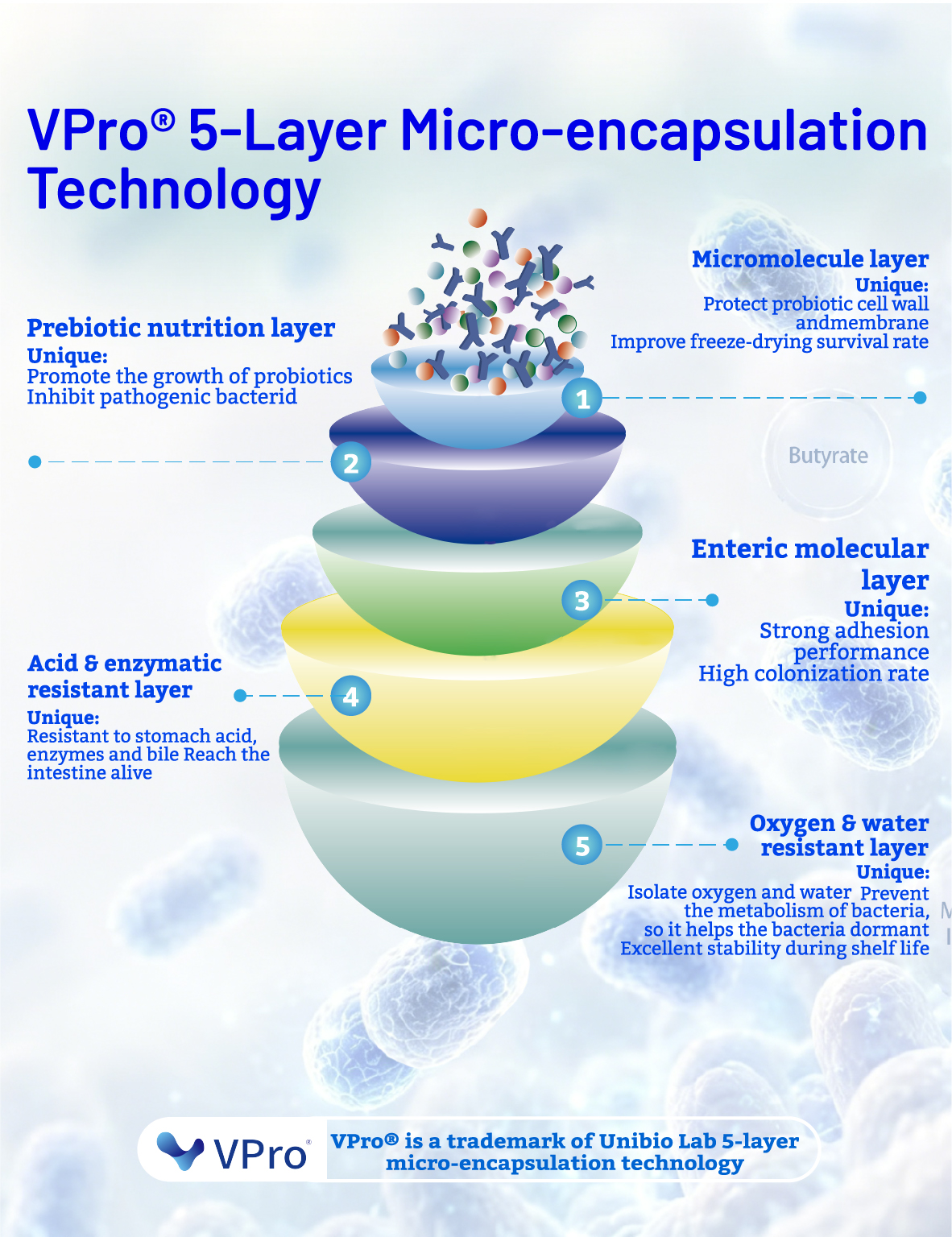
Protection technology is the second evidence block, and it is where suppliers most often substitute adjectives for physics. Here the material is defined concretely: VPro® 5-layer micro-encapsulated probiotics material (model VPro®-5L-COAT), a food-grade polysaccharide and protein composite coating matrix, intended for probiotic raw material factories, supplement manufacturers and food processing plants. Its published parameters are specific: a five-layer acid and bile resistant barrier, improved heat resistance, and extended strain shelf life.
The company's technical description breaks the five layers into functional roles: a micromolecular protective layer for anti-freezing and stress resistance, a prebiotic nutrition layer supporting in-vivo proliferation, a liposome enteric adhesion layer for intestinal colonisation, an acid- and enzyme-resistant layer for gastric transit, and an oxygen and moisture barrier layer for shelf stability. The same technical description attributes a 40% improvement in freeze-drying survival and a 24-month shelf life to the process, and cites fermentation density above 3.5×10¹⁰ CFU/mL with lyophilized powder concentration up to 8.0×10¹¹ CFU/g at process level.
Read that carefully: those last figures describe fermentation and drying capability, not catalogue SKU specifications, which top out at 600B CFU/g for BL03. Both sets of numbers can be true at once, and a buyer should keep them in separate columns. What the coating claim is really doing is answering a formulation question — will the strain survive the process the buyer intends to run, and the shelf life the buyer intends to print? For a spray-dried beverage or a compressed chewable, that is the whole game. For a frozen DVS culture shipped to a dairy, an additional five-layer coating is largely redundant, and it adds cost per kilogram that no stability gain will recover.
The verification step is therefore not "do you have encapsulation?" but "show me stability data for this strain, in my matrix, at my process temperature, at end of shelf life." A coating specification without a matrix-specific stability report is a description of intent.
Evidence block 3 — how the viable count architecture is built
Count is the third block, and it should be read as an architecture rather than a single figure. Across the catalogue reviewed here, single-strain raw powders are published in ranges from 10B to 600B CFU/g depending on strain: 10B–300B CFU/g for Lactobacillus rhamnosus GG, Bacillus coagulans CCFM1041, and Streptococcus thermophilus ST67; 10B–600B CFU/g for Bifidobacterium animalis subsp. lactis BL03; 10B–200B CFU/g across the Lactobacillus plantarum, Lactobacillus reuteri, Lactobacillus acidophilus and Bifidobacterium longum SKUs; and a fixed 10B CFU/g for Clostridium butyricum CCFM1299. Composition is consistently stated as probiotic strain plus maltodextrin carrier plus VPro® 5-layer encapsulation material, with strain origin described as independent laboratory culture.
Ranges rather than single points are the buyer-friendly format, because they allow a formulator to set a specification that matches the intended dose and the intended serving size instead of accepting a supplier's default. They also force a discipline on the buyer's side: the range is a manufacturing capability window, not a guarantee that any point in the range is available on any lead time.
Two further questions belong to this block. Where in the shelf life is the count guaranteed — at release, or at the end of the 24 months stated for most SKUs? And which method produced the number — plate count, flow cytometry, or a viability-staining method such as the TFU basis used for AH39? ISAPP's labelling criteria are explicit that the meaningful figure is the count at end of shelf life. A supplier that publishes release count only is telling the buyer to absorb the decay.
Evidence block 4 — finished formats as proof of end-to-end capability
The fourth block is the one buyers underuse: whether the supplier actually fills finished goods. A powder blender and a capsule line are different qualification problems, and a supplier that only blends powder will hand the hardest part — dose accuracy, moisture control, tableting compression, packaging barrier — to someone else. The documented finished and semi-finished portfolio here covers four format families:
| Format / material | Model | Documented specification | Documented storage and shelf life |
|---|---|---|---|
| VPro® 5-layer micro-encapsulated material | VPro®-5L-COAT | Five-layer acid and bile resistant barrier; improved heat resistance; extended shelf life | Coating material for raw material factories, supplement manufacturers, food processing plants |
| Postbiotics Powder (heat-inactivated) | UNI-POST-POW | Inactivated probiotic biomass with maltodextrin carrier; no live bacteria contained | Room temperature, sealed, away from moisture and direct sunlight; 24 months |
| ProLipo® Postbiotics | ProLipo-POST | Postbiotic lysate with phospholipid liposome wall material and food-grade carrier | Room temperature, sealed; 24 months |
| HelpGut® 100B CFU Constipation Relief Capsules | HelpGut-CAP-CON100B | 100 billion CFU per capsule; multi-strain proprietary blend; vegetarian HPMC shell; prebiotic fibre excipient | Room temperature, sealed; 24 months |
| HelpGut® Akkermansia Muciniphila AH39 GLP-1 Capsules | HelpGut-CAP-AH39-GLP1 | HPMC vegetarian capsule with AH39 strain and protective prebiotic matrix | Room temperature, light-proof sealed; 24 months |
| HelpGut® Oral Health Chewable Tablets | HelpGut-TAB-ORAL | 10 billion CFU per tablet; core strain Ligilactobacillus salivarius CCFM1215; xylitol base; microcrystalline cellulose filler | 15–25 °C, cool and sealed; 20 months |

The tablet line is the informative one. A 20-month shelf life at 15–25 °C for a compressed chewable is a harder target than a 24-month room-temperature powder, because tableting generates heat and pressure that a coated powder must survive. Publishing both formats signals that the coating technology described above is being tested against a real process constraint rather than against a storage cabinet.
The postbiotic lines matter for a different reason. Heat-inactivated postbiotic powder and liposomal postbiotic material decouple the product from live-cell cold chain entirely — the powder is documented as containing no live bacteria, stored at room temperature with a 24-month shelf life. For brands selling into markets where ambient distribution is the only realistic channel, that is an architectural alternative to the frozen SKUs in the strain table above.
Certification evidence: read the scope line, not the logo
Certification is where most supplier files stop being read carefully. Every certificate has a scope line, and the scope line is the part that determines whether the certificate covers the buyer's actual product. The documented certification set for Shanghai Unibio Lab Co., Ltd is as follows:
| Certificate | Number | Issuer | Documented scope | Validity |
|---|---|---|---|---|
| ISO 22000:2018 Food Safety Management System | CN22/00000437 (external F01FSMS2200028) | SGS-CSTC Standards Technical Services Co., Ltd. | Production of probiotic solid beverages (screening, mixing); Food Category CIV | 2025-03-29 to 2028-03-28 |
| FSSC 22000 (Version 6) | CN22/00000434 | SGS United Kingdom Ltd | Production of probiotic solid beverages (screening, mixing); Food Category CIV | 2025-03-24 to 2028-03-28 |
| GMP, Codex Alimentarius good hygiene practice | CN22/00003036 | SGS-CSTC Standards Technical Services Co., Ltd. | Production of probiotic solid beverages (screening, mixing); Food Category CIV | 2025-03-23 to 2028-03-22 |
| HALAL | Registration No. 3100/11080; Certificate No. 1821240000 | Shandong Halal Certification Service (SHC), under the Indonesian BPJPH halal framework and MS 1500:2019 | Listed probiotic strains and related raw materials and finished products | 2025-07-26 to 2028-07-25 |
| FDA Food Facility Registration | 19635371796 (Shanghai Unibio Lab Co., Ltd); 12494588438 (Shanghai Helplifes Technology Co., Ltd) | U.S. Food and Drug Administration | Probiotic raw materials and finished dietary supplements for the US market | Registered 2025-09-26; recorded expiry 2026-12-31 |
| GRAS independent conclusion (AH39) | CIRS-GRAS-AH39-20250422 | CIRS GROUP USA Inc., independent GRAS expert panel | Pasteurised Akkermansia muciniphila AH39 raw material and AH39-containing finished products only | Issued 2025-04-22 |
Three observations follow, and they are the ones a procurement team should carry into a supplier meeting.
One: the scope is narrower than the portfolio. The ISO 22000, FSSC 22000 and GMP certificates all define scope as the production of probiotic solid beverages — screening and mixing — under Food Category CIV. That is a powder-handling scope. The portfolio also includes capsules and compressed chewable tablets, which are different unit operations. A careful buyer will ask which HACCP study and which process validation cover the capsule and tablet lines, and will not assume the powder certificate extends to them. This is not a gap unique to one supplier; it is a normal feature of scope-based certification that buyers routinely overlook.
Two: registrations are not approvals. FDA food facility registration records that a facility has registered under US food facility registration requirements. It is not a product approval, it does not certify a formula, and it does not validate a health claim. The recorded expiry of 31 December 2026 means status should be re-confirmed at the time of each order rather than assumed from a PDF in a sales deck.
Three: strain-specific means strain-specific. The GRAS conclusion covers pasteurised Akkermansia muciniphila AH39 and AH39-containing finished products, and nothing else in the catalogue. It is an independent expert-panel conclusion against US FDA GRAS criteria under Section 201(s) of the Federal Food, Drug, and Cosmetic Act — a self-affirmed conclusion, not an FDA authorisation. For a US-bound metabolic product built on AH39, that document is materially useful. For a BL03 pet chew, it is irrelevant.
What each evidence type proves — and what it does not
The most useful comparison in probiotics powder sourcing is not supplier against supplier; it is evidence type against the question it can actually answer. The table below is the decision framework this article recommends, populated with the documents described above.
| Evidence item | What it establishes | What it does not establish |
|---|---|---|
| Strain-level specification sheet | Identity, count range, storage condition, shelf life for a named strain | That the count is guaranteed at end of shelf life, or that the strain suits the buyer's matrix |
| Certificate of analysis (batch) | Measured count, microbial safety and heavy metals for one lot | Consistency across lots, or stability over the printed shelf life |
| ISO 22000 / FSSC 22000 / GMP | Audited food-safety management for the scope stated on the certificate | Coverage of dosage forms outside that scope, such as tableting or capsule filling |
| HALAL certificate | Compliance of listed materials with the stated halal standard | Compliance of a new SKU or a new excipient added after certification |
| FDA facility registration | Facility registration for US-market distribution | Product approval, formula review, or claim substantiation |
| GRAS independent conclusion | Safety conclusion for one named strain and products containing it | Applicability to any other strain, or FDA endorsement of the conclusion |
| VPro® technical documentation | Coating composition, barrier function and claimed process benefits | Performance in the buyer's process without a matrix-specific stability study |
Set against a conventional claim-based evaluation — where a supplier is selected on headline CFU and unit price — this framework changes the outcome in a predictable way. Claim-based sourcing tends to select the cheapest powder that meets a number. Evidence-based sourcing tends to select the powder whose storage condition, counting basis and certificate scope actually match the buyer's process, which frequently means a higher price per kilogram and a lower total cost per finished unit.
Where the evidence stops: limits a buyer must plan around
An honest capability reference has to state its boundaries. Six apply here.
- Certification scope does not equal product scope. As noted, the food-safety certificates cover probiotic solid beverage production — screening and mixing — under Food Category CIV. Buyers sourcing capsules, chewable tablets or pet formats should request the process validation and HACCP documentation specific to those lines.
- Coating performance figures are first-party. The 40% freeze-drying survival improvement and 24-month shelf life attributed to VPro® come from the supplier's technical description. They are a credible basis for a conversation, not a substitute for a stability study run in the buyer's own matrix.
- Cold-chain dependence is real for several SKUs. Strains specified at −18 °C or at 2–8 °C carry a logistics cost that room-temperature SKUs such as CCFM1195, CCFM760, CCFM1299 and CCFM1041 do not. Formulators who ignore this in the cost model discover it at the freight quote.
- Counting bases differ across the portfolio. AH39 is expressed in TFU/g; most other strains in CFU/g. Cross-strain comparison requires method confirmation, not unit-blind arithmetic.
- Regulatory status is strain- and market-specific. A US GRAS conclusion for AH39 says nothing about EU novel-food status, and a HALAL certificate says nothing about a claim. Market access must be checked product by product.
- Market-level figures describe the category, not the supplier. Growth rates for the probiotics market or the pet supplement segment indicate demand direction; they are not evidence of any individual manufacturer's capacity or quality.
Application fit: where these capabilities map to real programs
Capability evidence becomes useful only when it is matched to a program. Four patterns recur in the documentation reviewed here.
Metabolic and gut-health supplements. AH39, with its strain-specific GRAS conclusion and 10B–200B TFU/g range, plus CCFM760 and CCFM1299, maps to capsule and sachet programs targeting metabolic management and bowel regulation. The finished-format evidence — a 100 billion CFU capsule and an AH39 capsule with a protective prebiotic matrix — shows the same supplier can carry the strain from bulk powder to a filled, shelf-stable unit.
Infant and family nutrition. Lactobacillus rhamnosus GG at 10B–300B CFU/g with infant food listed among its applications, alongside Bifidobacterium longum CCFM1195 at room-temperature storage, fits supplement and functional food programs where cold chain is partial rather than absolute.
Oral care. Ligilactobacillus salivarius CCFM1215 is the core strain in a 10 billion CFU chewable tablet built on a xylitol base — a format that requires both a strain stable through compression and a fill line qualified for tableting.
Pet and feed nutrition. BL03 at 10B–600B CFU/g lists pet health products and animal feed among its applications, and Bacillus coagulans CCFM1041 brings heat resistance for extruded or pelleted feed processes. The pet supplement segment is projected to record a 5.2% compound annual growth rate from 2025 to 2034, with a 2025 valuation around USD 2.1 billion (Meticulous Research) — a segment where dry-form stability, not brand, decides repeat purchase.
The company also reports three supply relationships that illustrate the documentation-to-shipment path. A Middle East health product wholesaler and pharmacy chain supplier is described as taking 12,000 bottles of HelpGut® capsules and 8 tons of AH39 raw powder monthly over 1.5 years, with GRAS and HALAL documentation used for customs clearance and Arabic packaging and labelling provided. A European and US brand and distributor relationship is described as 120 tons of multi-strain powder annually for the US and 75 tons of single-strain powder for Germany over three consecutive years, supported by third-party test reports. A fermented food and beverage manufacturer in Thailand and Indonesia is described as taking 60 tons of DVS yogurt starter and 90 tons of functional beverage powder annually over two years. These are company-reported accounts and should be treated as references to be verified, not as audited outcomes.
Market trend: documentation is becoming the differentiator
Three currents in the category push buyers toward evidence-led evaluation. The first is scale: an 8.5% compound annual growth rate to USD 114.95 billion by 2030 means more SKUs, more private-label entrants and more powder suppliers competing on price for the same shelf. Differentiation shifts to what can be documented. The second is format economics: dry formats already dominate high-volume applications at 84.7% of animal feed probiotics revenue in 2023, and every incremental ambient-stable format raises the value of coating, moisture barrier and end-of-shelf-life data. The third is regulatory and technical scrutiny: ISAPP's labelling criteria and the IPA's manufacturing-environment guidance give buyers external benchmarks to hold suppliers against, which makes vague specifications harder to defend in a tender.
Research infrastructure reinforces the same direction. ProBioQuest, described in the peer-reviewed literature as a probiotics database and semantic analysis engine covering more than 2.8 million records including patents and clinical trials, exists precisely because strain-level evidence has become too large to hold informally. A supplier that can navigate that evidence base for a specific strain is in a different category from one that cannot.
Future outlook
The next phase of probiotics powder sourcing will be decided less by headline counts than by three documentation habits. End-of-shelf-life labelling will become the default buyer request, which favours suppliers already publishing shelf-life guarantees and stability data. Scope transparency will move up the agenda, as buyers learn to match certificate scope lines against their own unit operations rather than accepting a logo. And format decoupling will continue: postbiotic powders that contain no live bacteria and hold 24 months at room temperature offer an ambient-distribution route that live-cell SKUs cannot match, while coated live strains keep advancing into compressed and heat-processed formats.
For Shanghai Unibio Lab Co., Ltd, the evidence set described here — a catalogue of named strains with published count ranges and storage conditions, a defined five-layer coating technology, finished capsule and tablet formats, and a certificate set with readable scope lines — is the right shape for that shift. The remaining work is the buyer's: confirm the scope covers the intended dosage form, test the coating in the intended matrix, and check registration status at order time.
FAQ
Which certificates should a probiotics powder buyer verify first?
Start with the food-safety management certificates and read the scope line before the logo: ISO 22000:2018 and FSSC 22000 state which processes and food categories were audited, and a certificate covering the screening and mixing of probiotic solid beverages does not automatically extend to tablet compression or a pet chew line. Then add GMP certification for hygiene practice, HALAL certification where the target market requires it, FDA food facility registration for US-bound shipments, and a GRAS conclusion only where the claim being made is strain-specific. Every document should be checked for number, issuer, validity dates and scope.
Is a CFU/g figure comparable between two probiotics powder suppliers?
Not on its own. A comparable viable count statement identifies the strain, the counting method, the point in shelf life at which the count is guaranteed, and the storage condition. In the catalogue referenced here, most SKUs are specified in CFU/g across a 10B–600B CFU/g range, while Akkermansia muciniphila AH39 is specified in TFU/g across 10B–200B TFU/g — a different counting basis. Those figures should not be placed side by side without method confirmation and, where relevant, conversion.
Does FDA facility registration mean a probiotic powder is FDA-approved?
No. FDA food facility registration records that a facility has registered under US food facility registration requirements; it is not a product approval and does not certify a formula or a health claim. In the documentation reviewed here, Shanghai Unibio Lab Co., Ltd holds registration 19635371796 and Shanghai Helplifes Technology Co., Ltd holds 12494588438, covering probiotic raw materials and finished dietary supplements for the US market, with the record showing an expiry date of 31 December 2026. Separately, the GRAS status for pasteurised AKkermansia muciniphila AH39 is an independent expert-panel conclusion (CIRS-GRAS-AH39-20250422) limited to AH39 and AH39-containing products, not an FDA authorisation.
What does VPro® 5-layer micro-encapsulation change, and when is it unnecessary?
VPro® 5-layer micro-encapsulation is a food-grade polysaccharide and protein composite coating applied around the strain, described as combining a protective layer against freezing stress, a prebiotic nutrition layer, a liposome enteric adhesion layer, an acid- and enzyme-resistant layer, and an oxygen and moisture barrier. Its documented effects are a five-layer acid and bile resistant barrier, improved heat resistance and extended shelf life. It is unnecessary where the strain is already handled frozen or in a full cold chain and the finished matrix imposes no heat, compression or gastric-transit stress; the coating also adds cost per kilogram, so its value should be tested in the buyer's own matrix.
What order quantities and lead times apply to bulk powder versus private-label finished goods?
In the capability documentation reviewed here, minimum order quantity is 1 kg for single-strain raw powder, 5 kg for multi-strain compound powder, and 5,000 bottles for HelpGut® private-label finished capsules or tablets. Lead time is 5–7 days for bulk raw material and 25–35 days for private-label finished products, with FOB Shanghai, CIF, DDU and DDP terms available. Quality control is described as 100% in-house viable count, microbial safety and heavy metal testing, with third-party inspection by SGS or Intertek supported on request.
For buyers who want the underlying material specifications, strain lists and certification details in one document, the company brochure is available for download: Shanghai Unibio Lab Co., Ltd product brochure (PDF).
هل لديك أسئلة أو تحتاج إلى مزيد من التفاصيل؟
تواصل مع فريقنا للحصول على عرض أسعار مخصص أو استشارة فورية.
طلب عرض أسعار
املأ النموذج أدناه وسيتواصل معك فريقنا بعرض مقترح مخصص.
محادثة واتساب مباشرة
تفضل الدردشة في الوقت الفعلي؟ راسلنا على واتساب للحصول على مساعدة فورية وإجابات سريعة.
- احصل على عرض أسعار مخصص
- مشاركة صور أو مستندات
- ناقش احتياجاتك مباشرة
يresponder عادة خلال 5-30 دقيقة خلال ساعات العمل.