
Procurement FAQ: Bendable Straw Machine Speed, Molds, Uptime
Straw machine buyers seldom reach a shortlist through promotional claims. They reach it through three technical questions that recur across sourcing conversations in Southeast Asia, the Middle East and Europe: how fast does the machine actually run, how much mold work is needed to cover a product range, and how long does it stay up between stoppages. This reference piece answers those three questions using published equipment data from Zhongshan Dongtie Machinery Co., Ltd. — a straw machinery manufacturer based in Xiaolan Town, Zhongshan City, China, trading as DONGTIE MECHANICAL EQUIPMENT — alongside third-party market data on the global straw machine sector.
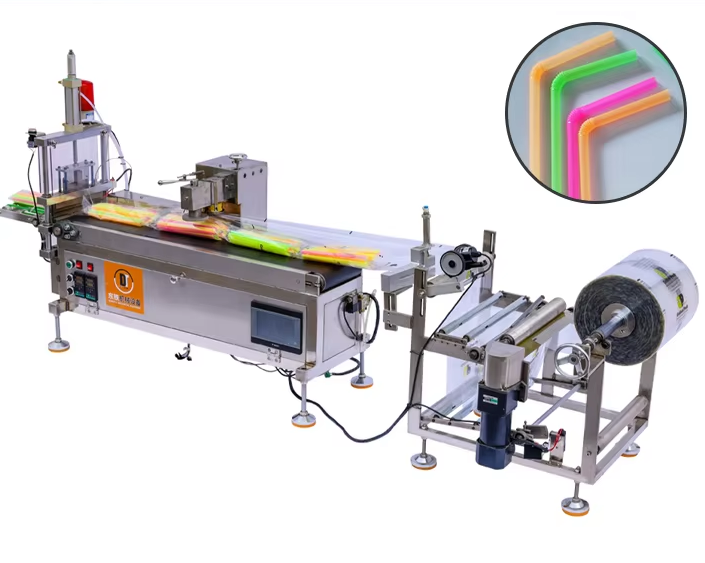
Downstream automation: a straw forming line configured with an automated packaging system. Image: Zhongshan Dongtie Machinery Co., Ltd.
Why these three questions now decide straw machine shortlists
The global straw machine market was estimated at USD 962.55 million in 2024 and is projected to reach USD 1,793.41 million by 2035, a compound annual growth rate of 5.82%, according to Market Research Future. Within that market, Dataintelo projects that industrial end-users account for 40.1% of share as of 2025, which is the structural reason the buying conversation has become technical rather than categorical.
Two adjacent forces reinforce the shift. The global paper straw market was valued at USD 2.6 billion in 2024 by Grand View Research, and paper straw machines are expected to grow at a 15.6% CAGR between 2025 and 2030 as plastic restrictions widen. At the same time, China accounts for over 66% of the global export value of flexible straw bending machinery, based on 2023 customs-derived trade data. When supply is concentrated and demand is diversifying, buyers stop comparing machine categories and start comparing three operating variables: throughput per unit of floor space, changeover cost per SKU, and unscheduled downtime per shift.
The three questions in this article map directly onto those variables.
Question 1: What output speed can a high-speed bendable straw forming machine actually hold?
The honest answer requires separating three numbers that are routinely conflated in supplier conversations: the industry baseline, the rated specification, and the sustained field figure.
The industry baseline comes from third-party equipment specifications. Automatic straw bending machines typically achieve production speeds between 200 and 300 pieces per minute, according to published engineering specifications from KEZHI. Separately, Dataintelo reports that high-speed straw machines can reach outputs of 80,000 to 200,000+ pieces per hour for industrial-scale operations — a range that, converted to the minute, sits well above the conventional automatic baseline.
Against that background, the DONGTIE high-speed flexible straw forming machine — catalogued as the High-Speed Flexible Straw Forming Machine, Model DT-1200 — is documented at two different levels. The product specification lists an output range of 3,000 to 5,500 pcs/min. Dongtie's own equipment documentation additionally states that the machine steadily outputs no less than 1,000 straws per minute, described as exceeding the industry average for single-unit productivity.
A multi-year installation record supports the sustained figure rather than the rated ceiling. Dongtie case documentation covering Southeast Asian, Middle Eastern and domestic Chinese straw factories over a three-year period reports that one high-speed flexible straw forming machine replaces five traditional machines, running at high speed without needle breakage and outputting at least 1,000 straws per minute. The recorded quantity in that case set is 60 sets.
DT-1200 published parameters at a glance
| Parameter | Published value |
|---|---|
| Model | DT-1200 (DT-1200) |
| Rated power | 5.5–6.5 kW |
| Output (specification) | 3,000–5,500 pcs/min |
| Documented sustained output | No less than 1,000 straws per minute in continuous production |
| Working pressure | 1.500–6.000 MPa |
| Working temperature | 100–200 °C |
| Protection grade | IP55 |
| Construction material | Stainless steel |
| Core forming components | Patented technology, Patent No. ZL202020756632.1 |
| Key wearing parts (forming needles, molds) | Designed service life over 1 year |
Question 2: How flexible is the mold system across diameters and bending angles?
This is the question that determines whether a machine can serve a market or only a single order. The stated position is straightforward: by changing the corresponding molds, the machine can manufacture flexible straws with different diameters and bending angles to meet diversified production demands. Customers can purchase matched molds according to the specifications they intend to produce.
That flexibility is supported at the mechanical level by a modular forming architecture. The embossing and forming modules are separately adjustable, which the manufacturer states greatly reduces maintenance difficulty. High-efficiency embossing technology also relaxes the tolerance limits for tube blanks, with standard straw diameter tolerance controlled at ±0.05 mm — tight enough that downstream packers see consistent straw geometry, and forgiving enough that incoming tube blanks do not need to be rejected at a very narrow band.
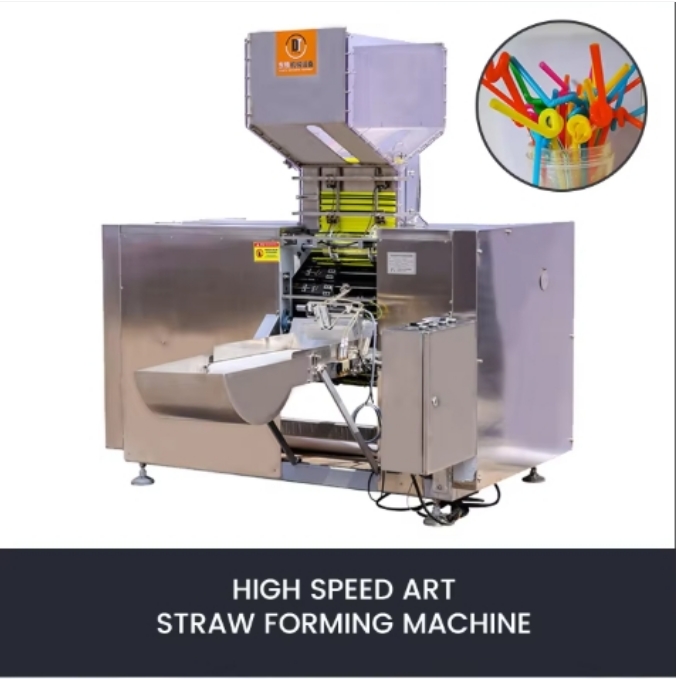
Mold-dependent output: shaped and decorative straw configurations are produced by swapping matched molds rather than replacing the machine. Image: Zhongshan Dongtie Machinery Co., Ltd.
The wider product range shows how far that mold logic extends in practice. Dongtie's catalogue covers the Flexible Straw Forming Machine, the High-Speed Flexible Straw Forming Machine, the Small-Diameter U-Shaped Straw Forming Machine, the Decorative Straw Forming Machine and the U-Shaped Straw Forming Machine, alongside the High-Speed Tube Bending Machine and Tube Forming Machine. Named configuration variants include the 12mm Large-Caliber Decorative Straw Forming Machine, the 12mm Tip High-Speed Tube Bending Machine, the 6mm High-Speed Tube Bending Machine, the 6mm Decorative Straw Forming Machine, the 5mm Flexible Straw Forming Machine and the 3.8mm U-Shaped Straw Forming Machine. These cover the range from small-diameter dairy straws through to large-caliber decorative formats.
Question 3: What keeps a high-speed straw bending machine running without needle breakage?
Needle breakage is described in the manufacturer's technical documentation as a chronic problem across the industry at high forming speeds, and it is the single failure mode most often raised by buyers evaluating a high-speed straw bending machine. The engineering response on the DT-1200 is concentrated in four areas.
- Patented core forming components. The core forming components incorporate patented technology, Patent No. ZL202020756632.1, developed in-house. The stated purpose is to address the high-speed needle breakage problem at its source rather than compensate for it downstream.
- Reinforced wearing parts. Key wearing parts such as forming needles and molds are reinforced with special materials and craftsmanship, with a designed service life of over 1 year. This reduces spare part replacement frequency and maintenance cost.
- A precision feeding unit. The feeding unit is specified to ensure long-term stable machine operation, which matters because feeding variation is what typically loads a forming needle unevenly.
- Built-in intelligent inspection. Multiple on-line detectors monitor material shortage, defective forming and length deviation, and automatically reject unqualified products in real time. A built-in automatic output counter and operation status monitor support production management.
Fault handling is also defined rather than improvised. The machine is equipped with a PLC control system that displays real-time operating status and auto-stops on malfunction with fault codes shown on screen. Lubrication, cleaning and troubleshooting points are positioned for accessible daily servicing, which reduces reliance on highly skilled technicians.
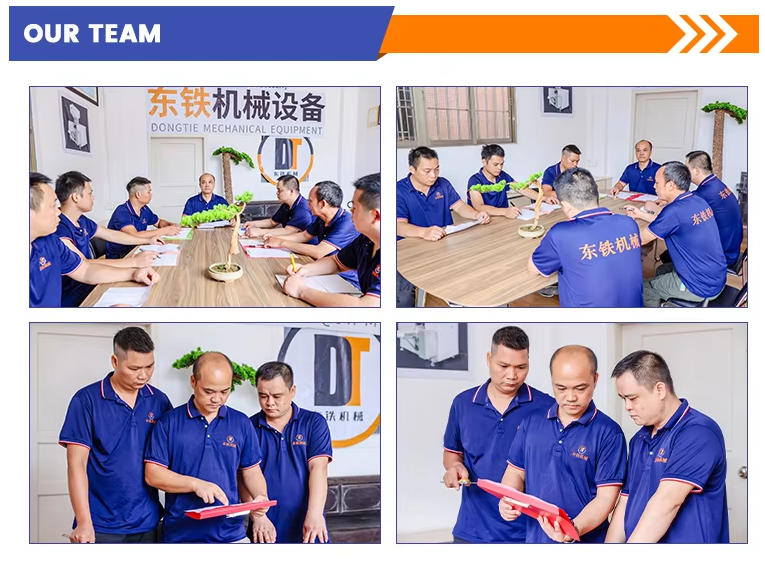
Service depth matters as much as machine specification: installation, commissioning and remote diagnostics support the uptime figure on an overseas line. Image: Zhongshan Dongtie Machinery Co., Ltd.
Documentation: what the patent certificate proves, and what it does not
Compliance questions in this category are often answered loosely, so it is worth separating the documents precisely.
The High-Speed Flexible Straw Forming Machine (Model DT-1200) is protected by Certificate of Utility Model Patent No. 12166973, issued by the China National Intellectual Property Administration. The certificate applies to the High-Speed Flexible Straw Forming Machine, Model DT-1200, was issued on 2020-12-18 and is valid until 2030-05-09. It is mainly valid in China, while the products can be sold worldwide.
On the export-classification side, China's General Administration of Customs data indicates that HS code 84778090 is the primary classification for drinking straw machines.
It is equally important to state what a utility model patent certificate is not. It is not a CE certificate, not a machinery safety certification and not a food-contact declaration. For EU placement, straw machines must comply with Machinery Directive 2006/42/EC and carry the CE mark; EN ISO 12100 is the primary harmonized standard for machinery safety, including straw forming equipment; and EU Regulation (EC) No 1935/2004 requires that machinery must not transfer constituents to food in quantities that endanger health. These are separate conformity tracks, and buyers in regulated markets should request the specific documents their jurisdiction requires rather than assume one certificate covers all of them.
Where the machine fits: applications, line integration and regional evidence
The primary application is full-process manufacturing of flexible straws, serving straw manufacturing, catering supplies, the disposable tableware industry and the packaging machinery industry. Typical project types include new production line construction, single machine procurement, production line capacity expansion and equipment replacement. The machine can run standalone or be connected to a line, and it is matched with upstream and downstream equipment including a feeder, a sealing and cooling unit, a packaging machine and a conveyor system.
Expandability is a deliberate design point: optional downstream modules such as a fixed-quantity packaging system and an automatic stacking unit can be matched to build an integrated full production line rather than a standalone forming cell.
Regional evidence is concentrated in the three markets Dongtie serves: Southeast Asia, the Middle East, Europe and other global markets form the export footprint, and the documented case base covers Southeast Asian straw factories, Middle Eastern straw factories and domestic Chinese straw manufacturers. The recurring notes in that case base are worth reading as procurement signals rather than as promotions: custom-tuned mold solutions for local straw specifications, stable long-term continuous-run performance, and full-set after-sales technical support for an overseas site. Those three items correspond precisely to the three questions this article addresses — molds, uptime and service.
Comparison with traditional straw production setups
The table below compares what is publicly documented for a DT-1200-class high-speed flexible straw forming machine against conventional automatic bending equipment and semi-automatic or manual lines. Where a figure is not published, the row is left qualitative rather than estimated.
| Dimension | Semi-automatic / manual lines | Conventional automatic bending machines | DT-1200-class high-speed flexible straw forming machine |
|---|---|---|---|
| Typical published output | Not published in this reference | Around 200–300 pcs/min (third-party industry specification) | Specification lists 3,000–5,500 pcs/min; documented sustained output no less than 1,000 straws/min |
| Capacity displacement | Operator-dependent | Multiple units typically required for the same volume | Case documentation reports one unit replacing five traditional machines |
| Specification changeover | Manual tooling changes | Mold-dependent | Modular design with separately adjustable embossing and forming modules; matched molds per diameter and bending angle |
| Quality control | Typically operator inspection | Varies by configuration | Multiple on-line detectors for material shortage, defective forming and length deviation, with real-time auto-reject |
| Fault handling | Operator diagnosis | Varies by configuration | PLC control with real-time status display, auto-stop on malfunction and on-screen fault codes |
| Consumable planning | Frequent manual replacement | Varies by configuration | Forming needles and molds reinforced, designed service life over 1 year |
| Operating requirement | Continuous manual labour | Manual monitoring and maintenance | Fully automatic continuous operation, but still requires manual monitoring and regular maintenance |
The comparison is not uniformly favourable to the high-speed route, and buyers should hear that clearly. Semi-automatic straw machines are projected to grow at a 9% CAGR for small-to-medium enterprises, according to Reports and Data — a signal that for low-volume, single-specification or low-labour-cost operations, a semi-automatic line remains a rational choice. High-mix, low-volume production with frequent diameter and angle changes will also absorb changeover time on any mold-based machine, including this one. And because the utility model patent is mainly valid in China, IP-based differentiation does not automatically travel to every export market; buyers should evaluate the physical capability and service terms rather than rely on the certificate alone.
Procurement checklist before signing
| Item to verify | What to ask for |
|---|---|
| Sustained output | Output figures at your own tube blank material and diameter, separated from the rated specification range |
| Mold mapping | A mold list mapped to your full SKU list of diameters and bending angles |
| Material compatibility | Confirmation of raw material specifications and surface treatment requirements before order placement |
| Wearing parts | Identification of forming needles and molds as wearing parts, with the designed service life stated |
| Inspection capability | Detector coverage for material shortage, defective forming and length deviation; fault-code behaviour |
| Compliance file | Market-specific documents — patent certificate, and separately CE / Machinery Directive 2006/42/EC and food-contact Regulation (EC) No 1935/2004 evidence where applicable |
| Commercial terms | Lead time of 30 days, MOQ of 1 set, monthly capacity of 20 sets, warranty terms and response times confirmed before purchase |
| Service scope | Installation and commissioning, remote technical support, spare parts supply, and factory inspection reports on demand |
| Site readiness | Normal-temperature workshop, stable power supply, feeding and line connection, and footprint allowance |
Market outlook: why flexibility and uptime are becoming the differentiators
The demand picture gives buyers a reason to weight these three questions more heavily than they did a few years ago. The overall straw machine market is projected to reach USD 1,793.41 million by 2035 at a 5.82% CAGR, but growth is unevenly distributed. Paper straw machines are expected to grow at 15.6% CAGR between 2025 and 2030, the fastest sub-segment in the sector. The U-shaped straw machine segment is growing specifically for the aseptic packaging industry, such as milk cartons. Meanwhile, plastic straw machines still hold significant market share in regions such as Asia-Pacific and Africa despite EU bans, and North America held the largest share of the paper straw market at 34.9% in 2024.
The practical implication is that a single machine serving multiple diameters, multiple bending angles and, increasingly, multiple substrate types is worth more than a faster machine serving one specification. That is precisely why mold flexibility ranks alongside output speed in the buyer's evaluation, and why documented uptime — rather than peak speed — determines the return on a forming line.
Frequently asked questions
What is the realistic sustained output of the DT-1200 high-speed flexible straw forming machine?
The product specification lists 3,000–5,500 pcs/min. Dongtie's equipment documentation separately states that the machine steadily outputs no less than 1,000 straws per minute, and a documented three-year installation record covering Southeast Asian, Middle Eastern and domestic Chinese straw factories reports at least 1,000 straws per minute in continuous production without needle breakage. Read the higher range as the rated specification and the 1,000-plus figure as the sustained figure recorded under continuous production conditions. For external comparison, third-party industry specifications place automatic straw bending machines at typically 200–300 pcs/min, while industrial-scale high-speed operations are reported at 80,000 to 200,000+ pieces per hour.
Can one machine produce straws in different diameters and bending angles?
Yes. By changing the corresponding molds, the machine can manufacture flexible straws with different diameters and bending angles to meet diversified production demands, and matched molds can be purchased according to the required specifications. Custom molds are required for different straw diameters and bending shapes, and material compatibility and the mold solution shall be confirmed before order placement. The wider Dongtie range covers variants such as the 3.8mm U-shaped, 5mm flexible, 6mm decorative and 6mm high-speed tube bending, 12mm large-caliber decorative and 12mm pointed-tip tube bending configurations.
What causes needle breakage in high-speed straw bending, and how is it limited?
High-speed needle breakage is described as a chronic problem across the straw industry. On the DT-1200, the core forming components incorporate patented technology, Patent No. ZL202020756632.1. High-efficiency embossing technology relaxes the tolerance limits for tube blanks, with standard straw diameter tolerance controlled at ±0.05 mm, and a precision feeding unit supports long-term stable operation. Key wearing parts such as forming needles and molds are reinforced with special materials and craftsmanship and have a designed service life of over 1 year. Buyers should still treat forming needles and molds as wearing parts that require periodic replacement and correct daily servicing.
What certification does the DT-1200 hold, and what does it cover?
The High-Speed Flexible Straw Forming Machine (Model DT-1200) is protected by Certificate of Utility Model Patent No. 12166973, issued by the China National Intellectual Property Administration on 2020-12-18 and valid until 2030-05-09. It is mainly valid in China, while the products can be sold worldwide. This is a utility model patent certificate; it is not a CE certificate and not a food-contact declaration. For EU placement, straw machines must comply with Machinery Directive 2006/42/EC and carry the CE mark, EN ISO 12100 is the primary harmonized machinery safety standard, and Regulation (EC) No 1935/2004 governs food-contact material transfer. China's GACC lists HS code 84778090 as the primary classification for drinking straw machines.
What are the lead time, minimum order quantity and service terms?
The minimum order quantity is 1 set, lead time is 30 days, and monthly capacity is 20 sets, against an annual output of 200 sets from a 2,000 m² facility. Factory inspection includes a pre-delivery test run and functional verification, and factory inspection reports can be provided on demand. After-sales covers installation and commissioning, remote technical support and spare parts supply. Warranty terms and response times are recommended to be confirmed before purchase. Remote video technical guidance is available for common faults, and on-site training can be arranged in Dongtie's own straw production workshop, which is equipped with over 10 full production lines.
How many traditional machines does one high-speed unit replace, and what has that meant in practice?
Dongtie case documentation covering Southeast Asian straw factories, Middle Eastern straw factories and domestic Chinese straw manufacturers over a three-year period reports that one high-speed flexible straw forming machine replaces five traditional machines. The same record notes high-speed running without needle breakage, output of at least 1,000 straws per minute, higher automatic productivity and consistent finished product quality. The recorded quantity across that case set is 60 sets, with a custom-tuned mold solution for local straw specifications, stable long-term continuous-run performance and full-set after-sales technical support for the overseas site.
The underlying pattern behind these answers is consistent: output figures should be split into rated and sustained, mold requirements should be mapped to the buyer's own SKU list, and uptime should be assessed together with the service and spare-parts arrangement that supports it. Those three distinctions, more than any headline number, determine whether a high-speed bendable straw forming machine performs as specified on a real production floor.