
Procurement FAQ: Blister Speed vs Cartoning Speed Explained
Procurement Reference · Solid-Dosage Packaging Lines
Blister speed and cartoning speed are measured in different units and answer different questions. On an integrated line the gap between the two figures is normally a design outcome rather than a performance defect, and the ability to convert one figure into the other is what separates a comparable quotation from a misleading one.
Pharmaceutical packaging buyers routinely receive line quotations containing two speed statements: a primary-station figure in blisters per minute and a secondary-station figure in cartons per minute. In the reference configuration discussed throughout this article — the HOPING DHL8005H blister-cartoning line — the nominal figures are 800 blisters per minute at the blister stage and 500 cartons per minute at the cartoning stage. Buyers reasonably ask whether those two numbers describe a mismatch, whether the cartoner is the constraint, and which number belongs in an acceptance protocol.
The answers depend on the pack, not only on the machines. This reference follows the order in which procurement questions usually arise: what each figure counts, how to convert one into the other for a specific pack format, what control logic holds the two stations in balance, where the correlation stops being reliable, and what commercial and lifecycle terms surround the decision.
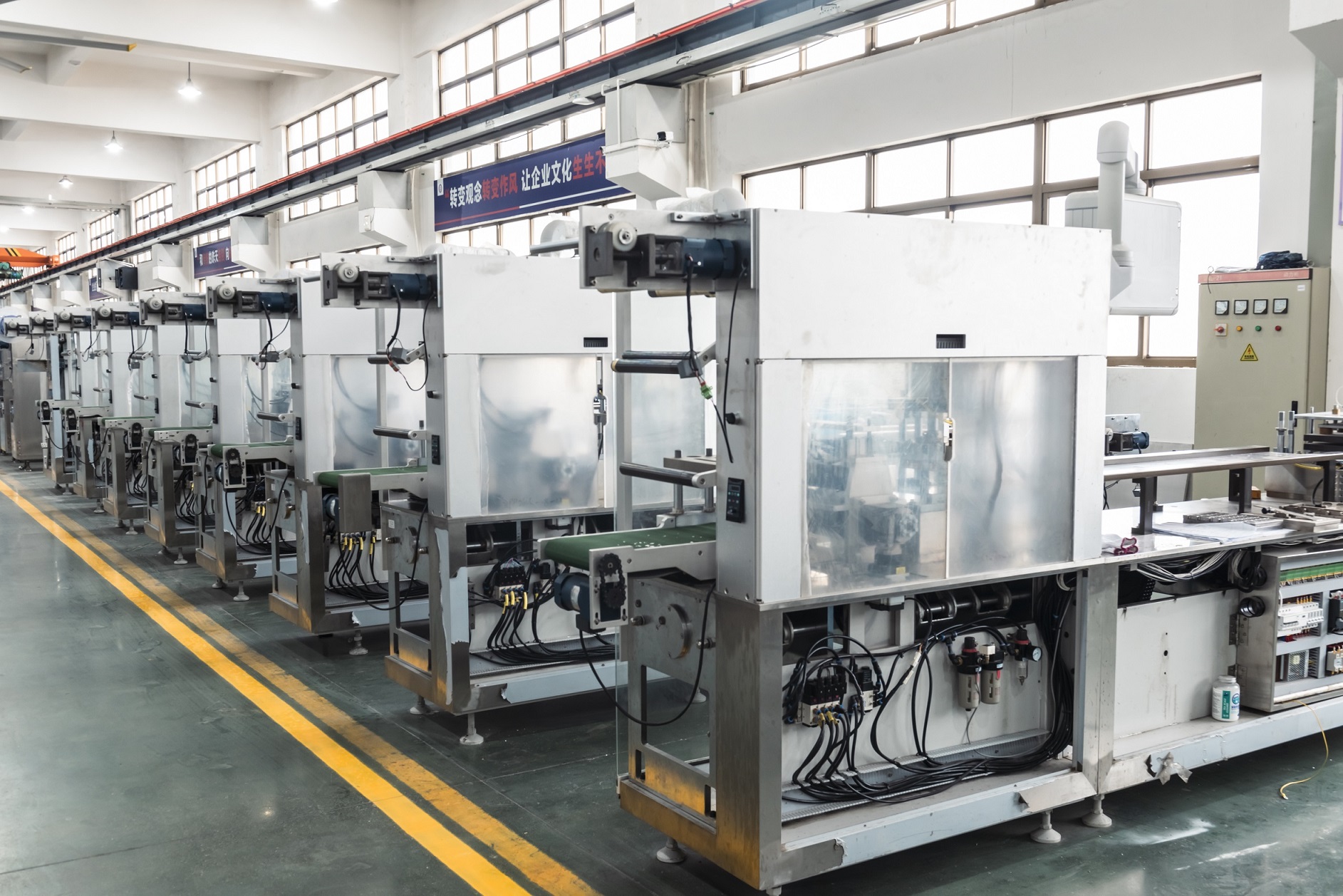
The primary station counts formed blisters per minute; the secondary station counts finished cartons per minute. The two figures are not interchangeable without a conversion step.
1. Why blister speed and cartoning speed are not the same measurement
A blister machine counts primary packs. A cartoner counts secondary packs. Blister output is governed by the forming and sealing cycle of the primary web: forming area, the number of pockets produced per cycle, sealing dwell time, and the punching or cutting step that separates the blister card. Cartoning output is governed by carton format: blank dimensions and board behaviour, carton erection, product insertion, leaflet folding and insertion, tuck or glue closure, and the coding station. Because the two stations are constrained by different mechanics, their design ceilings rarely coincide.
For the two figures to be equal, a carton would have to contain exactly one blister and both stations would have to share the same cycle time. In solid-dosage packaging most cartons hold several blisters, so a cartoner running at a numerically lower carton-per-minute figure can still absorb a higher blister-per-minute output without becoming the bottleneck. This is the single most important point to establish before any speed comparison is attempted, and it is also the point most often skipped when quotations are compared side by side.
There is a second reason the numbers diverge. Blister output is a property of the primary station operating on its own; carton output is a property of the secondary station operating on what the primary station has already produced. On a non-integrated layout the two stations are buffered by a manual transfer step, so their speeds are effectively decoupled by labour. On an integrated line the buffer is mechanical and controlled, which means the ratio between the two figures becomes an engineering variable that has to be designed, tested and accepted.
2. What the DHL8005H reference configuration states
Zhejiang Hoping Machinery Co., Ltd. (HOPING) is a pharmaceutical packaging machinery manufacturer based in Ruian, Zhejiang Province, China, established in 2001. The company operates a 28,800 m² manufacturing facility with approximately 300 employees, including a 56-engineer R&D team, produces around 500 units per year, and exports roughly 25% of its output to Southeast Asia, the Middle East, Eastern Europe, South America and Africa. Its product range covers blister packaging machines, cartoning machines, case packing machines and end-of-line packaging machines, supported by 26 invention patents, 70 utility patents, 4 appearance patents, 10 PCT filings and 28 software copyrights.
Within that range, the DHL8005H is a blister-cartoning line configuration quoted at 800 blisters per minute and 500 cartons per minute. The line integrates blister packaging, blister transfer, leaflet handling, carton opening and insertion, inspection and rejection, and the connection to downstream equipment into one automated process. That architecture reduces manual intervention and intermediate handling compared with layouts where the blister machine, the transfer step and the cartoner are purchased and operated separately.
3. Correlating the two figures: a four-step method for quotation review
The conversion between the two speeds is simple arithmetic, but it is only meaningful when the basis of each figure is confirmed. The following sequence can be applied to any quotation, not only to the configuration used here.
- Step 1 — Confirm the basis. Establish whether each figure is nominal maximum or validated sustained output, which blister format and carton size it refers to, how many blisters sit in each carton, and whether rejection handling is included in the count.
- Step 2 — Convert to a common unit. Divide blister output by the number of blisters per carton to obtain the carton demand the secondary station must absorb.
- Step 3 — Identify the limiting station. Compare carton demand against cartoner capacity. Whichever station reaches its ceiling first sets the practical output of the line, regardless of the other station's headline figure.
- Step 4 — Translate to shift output. Multiply by usable running time, then discount for changeover, cleaning, start-up and upset recovery. This step is where nominal figures and production planning usually separate.
| Blisters per carton | Cartons/min required at 800 blisters/min | Cartoner nominal capacity | Line-level implication |
|---|---|---|---|
| 1 | 800 | 500 cartons/min | Cartoner is the constraint; the blister station cannot be absorbed at nominal rates |
| 2 | 400 | 500 cartons/min | Cartoner has nominal headroom; the blister station sets the practical limit |
| 3 | 267 | 500 cartons/min | Cartoner is substantially under-loaded at nominal rates |
| 4 | 200 | 500 cartons/min | Cartoner reserve is large; line output tracks the primary station |
| 6 | 133 | 500 cartons/min | Secondary capacity is not a decision variable for this pack |
Arithmetic on the nominal figures stated for the DHL8005H configuration (800 blisters/min, 500 cartons/min). It is a consistency check for quotation review, not a performance prediction.
The table shows why the question “which machine is faster?” is the wrong starting point. At two blisters per carton, 800 blisters per minute corresponds to 400 cartons per minute, which leaves nominal headroom against a 500-carton cartoner. At one blister per carton the same blister output would demand 800 cartons per minute — above the cartoner's stated ceiling — which means the pack format, the secondary configuration or the operating rate has to change. The relevant procurement question is therefore not which figure is higher, but which station becomes the constraint for the packs the buyer actually intends to run.
4. Servo motion and replenishment logic: what holds the balance
On an integrated blister-cartoning line, the relationship between the two speeds is a control variable rather than a fixed mechanical ratio. Two mechanisms carry that responsibility.
Servo motion. A fully servo-driven architecture improves motion synchronisation and operating efficiency across linked stations. Instead of each station running on an independent mechanical drive and relying on mechanical buffers, the motion profile of the transfer and infeed elements can be coordinated with the primary station's cycle. That coordination is what allows a numerically slower cartoner to accept a continuous, ordered stream of blisters without accumulating or starving.
Replenishment logic. The blister discharge and the cartoner infeed are linked by a controlled buffering and replenishment sequence. The control system monitors how blisters are presented to the cartoner, adjusts feed behaviour when the presentation pattern drifts, and prevents the two stations from drifting into a stop-start pattern at high speed. On the cartoner side, leaflet handling, carton opening, insertion and closure each have their own timing windows, and the replenishment logic has to deliver product into those windows rather than against them.
Because the balance is controlled rather than mechanical, the quality of the control layer becomes a procurement criterion in its own right. On the DHL8005H architecture this layer includes sensor monitoring, vision or checkweighing inspection where configured, missing-product alarms, automatic stop, automatic rejection, key-parameter locking and fault records. Centralised control, modular stations, alarm indication and parameter management support routine maintenance, while operator training, spare-parts management and preventive maintenance remain essential to keeping the balance stable over time.
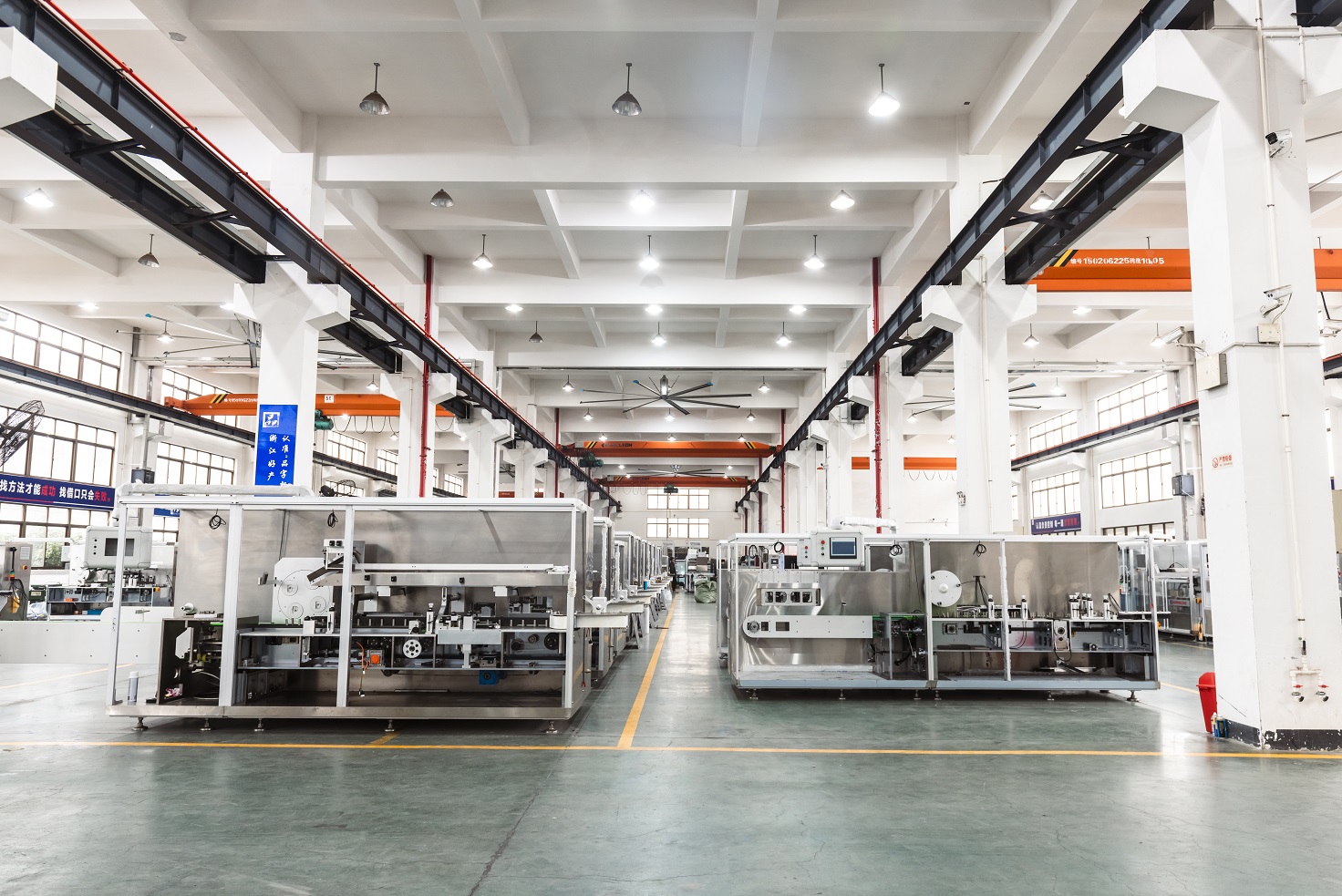
The secondary station has its own timing windows — carton erection, leaflet insertion, product loading and closure — that the replenishment logic must respect.
5. Comparison with traditional configurations — and the limits of the integrated model
The alternative to an integrated blister-cartoning line is a conventional arrangement: a blister machine, a manual or semi-manual transfer step, and a standalone cartoner, sometimes supplemented by a low-speed semi-automatic blister-cartoning solution or a link line that is not fully servo-driven. In that arrangement the two speed figures are decoupled by labour and by intermediate storage, so a mismatch between them is absorbed by operators rather than by control logic.
The integrated model changes the economics in both directions. It reduces manual intervention, intermediate handling and the associated quality risk, and it makes the blister-to-carton relationship explicit and testable. Against that, the initial investment is usually higher than for standalone or semi-automatic equipment, and the case for it rests on large-scale continuous production where reduced labour, transfer, management and quality-risk costs offset the capital difference. For a plant running short batches, frequent format changes or a highly fragmented SKU portfolio, the payback arithmetic is weaker and a less integrated configuration may be the more rational choice.
Several further boundaries deserve to be stated plainly, because they are the points where quoted speed correlations most often fail in practice:
- Nominal is not sustained. A maximum figure describes a design ceiling under defined conditions. Sustained output over a shift also reflects material behaviour, rejection rate, cleaning, changeover and operator intervention.
- Format change resets the balance. Tooling and format parts are specific to blister and carton dimensions, and every format change requires the output to be re-established rather than assumed.
- Upset conditions propagate quickly. Poor blister forming or sealing, missing or incorrect product feeding, a missing leaflet, a carton jam or a coding error can all interrupt a high-speed line. Detection, automatic stop and automatic rejection mitigate the consequence but add configuration cost and require validation.
- Maintenance capability is a dependency. Centralised control and modular stations make maintenance easier to organise, but preventive maintenance, spare-parts management and trained operators remain conditions of stable output.
- Integration concentrates supplier dependency. A single-source line gives one point of accountability for the blister-to-carton relationship, and at the same time makes service response, spare-parts availability and remote technical support part of the buyer's continuity risk.
6. Application fit: which packs this logic applies to
The speed correlation described here matters most in solid-dosage packaging, where blister cards are the primary pack and cartons are the secondary pack. HOPING's machine range covers flat-plate, roller-type aluminium-plastic and aluminium-aluminium blister formats, together with automatic cartoning machines and complete production lines. Aluminium-aluminium formats are relevant where barrier performance is a specification driver rather than a cost driver, and they change the forming and sealing behaviour that the primary station's cycle depends on.
On the secondary side, HOPING lists automatic cartoning machines applied to blisters, tablets, syringes and medicine bottles, which is a reminder that the cartoner's capability should be matched to the actual product family rather than to a single pack. A line specified around one carton size and one blister count will behave differently when a new SKU with a different carton size and a different blisters-per-carton ratio is introduced — and that is precisely when the conversion method in Section 3 has to be run again.
7. Market context: why line-balance literacy matters now
Custom Market Insights valued the global pharmaceutical blister packaging machine market at USD 2.57 billion in 2025 and identified Asia-Pacific as the fastest-growing region, with an 8.87% CAGR to 2031. Separately, Mordor Intelligence reports that horizontal cartoning systems held 70.12% of cartoning market share in 2024. Read together, these figures describe a market in which the primary and secondary stages of solid-dosage packaging are both expanding, and in which the horizontal cartoner remains the dominant secondary architecture.
The practical consequence for buyers is that capacity decisions increasingly involve integrated lines rather than individual machines, and that speed statements are increasingly compared across suppliers who measure them differently. Trade reporting also points to pharmaceutical manufacturers moving toward digitised data collection and integrated solutions in order to meet regulatory requirements and improve visibility — a direction that reinforces the same conclusion: the value of a line lies in the relationship between its stations, not in the headline figure of any single station.
8. Procurement and long-term supply questions
Because an integrated line is a multi-year asset, the commercial terms around it deserve the same scrutiny as the speed figures. The minimum order quantity for HOPING blister-cartoning equipment is 1 set or 1 complete line, with a typical production lead time of 60 to 120 days after technical confirmation and a monthly production capacity of 30 to 40 units.
Delivery terms are quoted EXW Ruian or Wenzhou, FOB Ningbo or Shanghai, or CIF/CFR destination port, with final terms subject to contract and destination-market requirements. Acceptance typically follows a defined sequence: technical agreement confirmation, sample testing, factory acceptance testing before shipment, site acceptance testing at the customer's plant, and third-party inspection where the buyer requires it. Payment terms are quoted per project and depend on contract value, customer credit, project scope and destination market rather than on a standard schedule.
On the lifecycle side, HOPING's stated project measures include confirming samples and packaging materials at an early stage, designing the solution around the buyer's blister and carton formats, running no-load and material tests before shipment, and providing installation, commissioning, training, spare parts and remote technical support after delivery. Customer witness acceptance can be arranged for key projects, which matters when the speed correlation between the two stations is itself an acceptance criterion.
9. Future outlook
Two developments are likely to change how buyers interrogate speed figures over the next planning cycle. The first is documentation: as line control systems capture parameters, alarms and fault records, the basis of a speed claim becomes easier to demonstrate and easier to audit, which shifts the conversation from headline numbers to validated, format-specific output. The second is integration depth: as blister, cartoning, inspection and end-of-line equipment are specified as one process, the balancing logic between primary and secondary stations becomes part of the qualification scope rather than an afterthought at commissioning.
For procurement teams, the practical implication is straightforward. A quotation that states 800 blisters per minute and 500 cartons per minute is not internally inconsistent; it is incomplete until the blisters-per-carton ratio, the format basis and the acceptance conditions are attached to it. Buyers who ask for those three items at the RFQ stage will compare suppliers on the same footing, and will enter acceptance testing with a defined expectation rather than a headline number.
10. FAQ
Why is the cartoner's speed figure lower than the blister machine's?
The two figures count different objects. The blister machine counts primary packs per minute and the cartoner counts finished cartons per minute, so the numbers are only comparable after dividing blister output by the number of blisters per carton. In the DHL8005H configuration the nominal figures are 800 blisters per minute and 500 cartons per minute; at two blisters per carton, 800 blisters per minute corresponds to 400 cartons per minute, which sits below the cartoner's nominal capacity.
How do I convert blister output into carton demand for my own pack?
Divide the blister rate by the number of blisters loaded into each carton. The result is the carton-per-minute demand the secondary station must absorb. Compare that result with the cartoner's stated capacity to identify which station becomes the constraint for that specific pack format, then repeat the calculation for every SKU the line is expected to run.
Are 800 blisters per minute and 500 cartons per minute sustained outputs?
They are nominal figures for a defined configuration, not a validated shift output. Sustained output also depends on blister format, blisters per carton, material behaviour, rejection rate, cleaning routines and changeover frequency. Buyers should require the basis of each figure — format, material specification and test conditions — to be stated alongside the number.
What actually controls the balance between the blister station and the cartoner?
On a servo-synchronised integrated line, the balance is held by motion coordination between linked stations and by the replenishment logic that presents blisters to the cartoner infeed in an ordered pattern. Sensor monitoring, missing-product alarms, automatic stop, automatic rejection, key-parameter locking and fault records form the supporting control layer, while centralised control and modular stations support maintenance.
What happens when a carton jams or a leaflet is missing at high speed?
These are recognised upset conditions on high-speed lines, together with poor blister forming or sealing, missing or incorrect product feeding and coding errors. The control response is detection followed by automatic stop or automatic rejection, supported by missing-product alarms and key-parameter locking. Mechanical safety protection and fault records complete the response, and the acceptance protocol should demonstrate these behaviours before shipment.
What is the minimum order quantity and typical lead time for an integrated line?
The minimum order quantity is 1 set or 1 complete line, with a typical production lead time of 60 to 120 days after technical confirmation. Monthly production capacity is 30 to 40 units. Delivery terms are quoted EXW Ruian or Wenzhou, FOB Ningbo or Shanghai, or CIF/CFR destination port, with final terms subject to contract.
What acceptance evidence should be agreed before shipment?
The sequence normally covers technical agreement confirmation, sample testing, factory acceptance testing before shipment and site acceptance testing at the customer's plant, with third-party inspection arranged where required. When the blister-to-carton speed relationship is an acceptance criterion, the tested format, blisters per carton, material specification and running conditions should be written into the technical agreement.
What ongoing support keeps an integrated line running over its lifecycle?
Centralised control, modular stations, alarm indication and parameter management support routine maintenance, but they do not replace it. Operator training, spare-parts management and preventive maintenance remain essential, and installation, commissioning, training, spare parts and remote technical support are typically part of the post-delivery scope. Customer witness acceptance can be arranged for key projects.
Can one line handle different blister formats and carton sizes?
HOPING's range covers flat-plate, roller-type aluminium-plastic and aluminium-aluminium blister machines, and its automatic cartoning machines are listed for blisters, tablets, syringes and medicine bottles. Format changes require the appropriate format parts and re-establishment of output, so the speed correlation should be recalculated for each new blister format and carton size rather than carried over from the original configuration.
How should buyers compare suppliers who quote on different speed bases?
Normalise both quotations to the same unit and the same pack: blisters per carton, format, material and whether the figure is nominal or validated. Then convert to carton demand and identify the limiting station. A supplier quoting a validated sustained figure for the buyer's own format is providing comparable information; a supplier quoting an isolated maximum without a stated basis is providing a number that cannot be compared.
HOPING publishes its machine, line and end-of-line portfolio in a downloadable catalogue: Hoping Machinery Catalog (PDF). Company information is available at www.hopingcn.com.
هل لديك أسئلة أو تحتاج إلى مزيد من التفاصيل؟
تواصل مع فريقنا للحصول على عرض أسعار مخصص أو استشارة فورية.
طلب عرض أسعار
املأ النموذج أدناه وسيتواصل معك فريقنا بعرض مقترح مخصص.
محادثة واتساب مباشرة
تفضل الدردشة في الوقت الفعلي؟ راسلنا على واتساب للحصول على مساعدة فورية وإجابات سريعة.
- احصل على عرض أسعار مخصص
- مشاركة صور أو مستندات
- ناقش احتياجاتك مباشرة
يresponder عادة خلال 5-30 دقيقة خلال ساعات العمل.