
Procurement FAQ: Quoting & Booking China-India Air Freight
Procurement FAQ: Quoting & Booking China-India Air Freight
Airport-to-airport air freight between China and India is normally discussed through two numbers: rate per kilogram and transit time. The procurement decisions that determine whether a shipment actually departs on the planned flight depend on something less visible — the sequence of quotation, order confirmation, space allocation, and warehouse receiving, plus the rules that apply when shipment volume or schedule changes after booking.
JTUO Logistics Co., Ltd. is a Guangzhou-based China–India air freight specialist that provides airport-to-airport air freight solutions — including air cargo space booking, warehouse consolidation, cargo preparation, and airport delivery coordination — for freight forwarders, manufacturers, wholesalers, and e-commerce businesses.
This reference answers the operational questions that arise during the procurement stage of booking: what data an accurate quotation requires, how long each first-leg step normally takes, how chargeable weight is determined, and how change requests for volume or schedule are processed before departure.
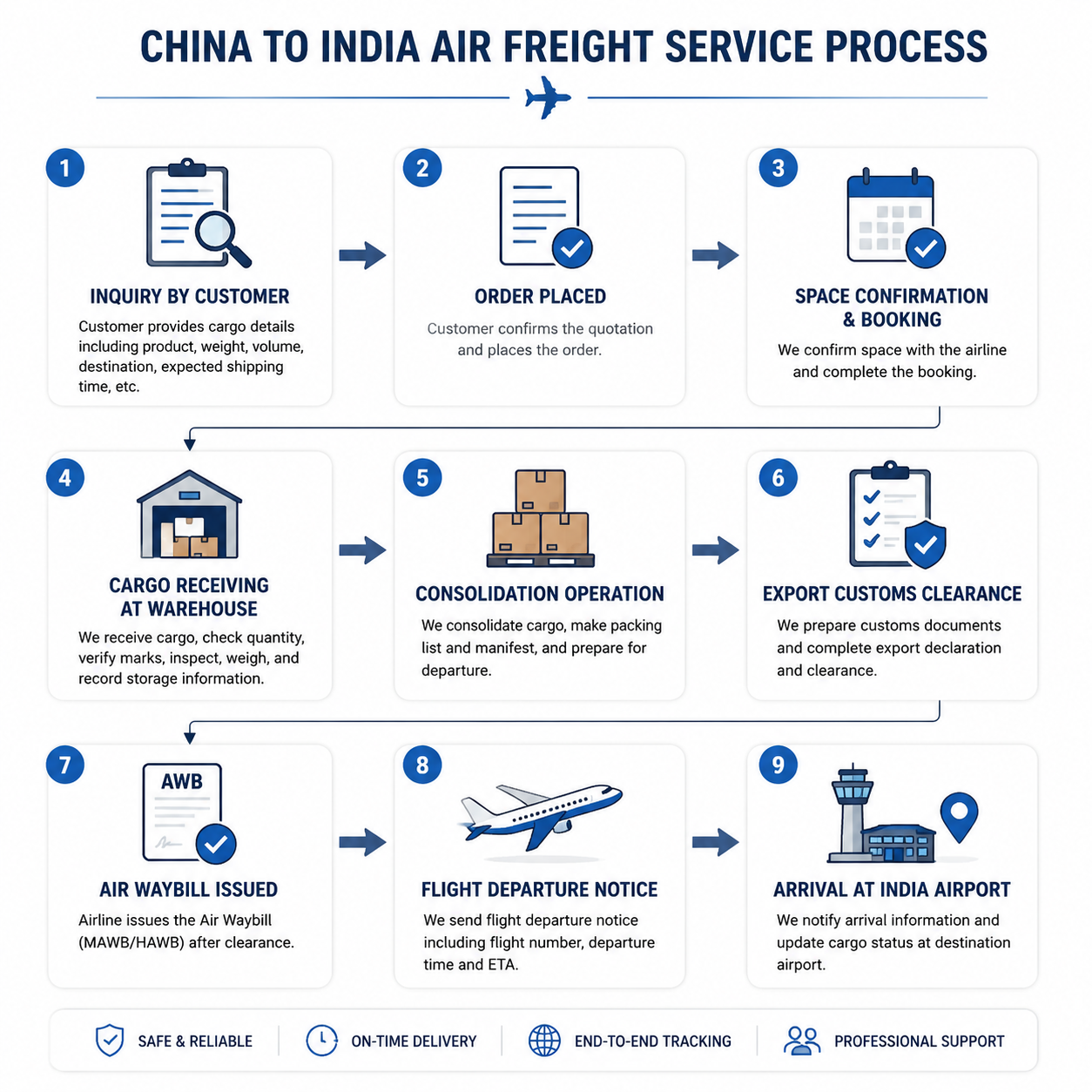
China–India air freight first-leg operation flow: from customer inquiry through space booking and warehouse receiving to arrival at the destination airport.
The First Leg, Stage by Stage
A China–India air freight first-leg operation runs across nine standardized stages: Inquiry & Quotation, Order Confirmation, Space Allocation & Booking, Warehouse Receiving, Cargo Consolidation, Airport Delivery, Export Customs Clearance, Air Waybill Issuance & Release, and Arrival at Destination Airport. The model integrates airline space allocation, in-house warehouse consolidation, flight scheduling, customs clearance coordination, and airport delivery into a single traceable execution chain.
For procurement planning, the useful question is which of these stages carry a defined estimated duration and which are driven by the shipment itself. The first four stages are the ones with published estimates; the remaining five are sequenced against the booked flight and the warehouse cut-off rather than a fixed day count.
First-Leg Timeline: From Inquiry to Warehouse Receipt
| Stage | Estimated duration | Primary output |
|---|---|---|
| Inquiry & Quotation | 0.5 days | Quotation sheet, available flight options list, estimated transit time (ETD/ETA forecast) |
| Order Confirmation | Subject to the time of customer order confirmation; estimated 1 day | Booking confirmation record, order confirmation notice |
| Space Allocation & Booking | 1 day | Space allocation confirmation notice, estimated cut-off time (cargo deadline), warehouse inbound schedule |
| Warehouse Receiving | 1–2 days, from delivery to the warehouse | Warehouse receipt / inbound confirmation, weight & volume measurement report, exception report |
The quotation stage is the shortest and the most dependent on buyer inputs, because it consumes the cargo data the client supplies at inquiry. Standard air freight transit time from China to India is commonly cited in the range of 3 to 8 days, which means the China-side preparation window and the flight schedule have to be planned together rather than sequentially.
What an Accurate Quotation Actually Requires
A quotation is only as reliable as the shipment data behind it. The standard inquiry stage requires the following from the buyer:
- Product name and description
- Cargo type (general or sensitive cargo)
- Number of packages
- Gross weight and volume
- Packaging type (carton, wooden case, or pallet)
- Origin airport and destination airport
- Estimated shipping date
- HS code
- Special cargo declaration covering battery products, liquid goods, powder goods, magnetic items, and brand-sensitive or restricted goods
In return, the quotation stage produces three deliverables: an air freight quotation sheet, a list of available flight options, and an estimated transit time expressed as an ETD/ETA forecast. Quotation quality is therefore an input problem before it is a pricing problem. A quote built on incomplete data — a missing HS code, or an undeclared battery content — will usually be revised later, after warehouse receiving verifies actual weight, dimensions, and cargo attributes.
Rates on this lane also move quickly. Trade-published data for October 2026 indicated an indicative China–New Delhi air freight rate in the region of USD 4.6 per kilogram, with the same source reporting month-on-month movement of roughly 33%. A single rate point should be read as a snapshot tied to a validity window rather than as a benchmark that holds across a quarter.
Booking and Space Allocation: How Capacity Is Confirmed
Once pricing is confirmed and a booking order is placed, space is requested from and secured with the freight forwarder or airline. Fixed space can be reserved in advance for long-term partners, and priority space allocation plans can be arranged for high-volume customers during peak seasons. Capacity management covers both Block Space Agreement (BSA) allocations and general cargo.
The booking stage is supported by an online air freight booking system, a flight scheduling and space allocation management platform, and a real-time cargo space monitoring and dispatch system. Three documents typically leave this stage: a space allocation confirmation notice, an estimated cut-off time (the cargo deadline), and a warehouse inbound schedule.
Warehouse Receiving and the Chargeable Weight Rule
When cargo reaches the warehouse, the actual weight and dimensions are re-measured. Air freight charges are based on the greater of the actual weight or the volumetric weight, calculated as length (cm) × width (cm) × height (cm) ÷ 6000. Packing compactly is therefore a direct cost lever, and the re-measurement result can differ from the figures used at quotation.
The warehouse accommodates full consignments, consolidation from multiple suppliers, e-commerce small parcels, and consolidated loose cargo. Receiving produces a cargo receipt confirmation, a piece count verification report, a shipping mark verification report, an order data cross-check report, a dimensional weight and actual weight report, and — where discrepancies are detected — an exception report.
Client responsibilities at this stage are specific: deliver cargo within the agreed warehouse cut-off time, ensure packaging meets air freight standards for shock and moisture protection, label fragile goods clearly, attach correct shipping labels (MAWB reference, destination, shipment reference), and deliver to the designated warehouse address within the scheduled time window.
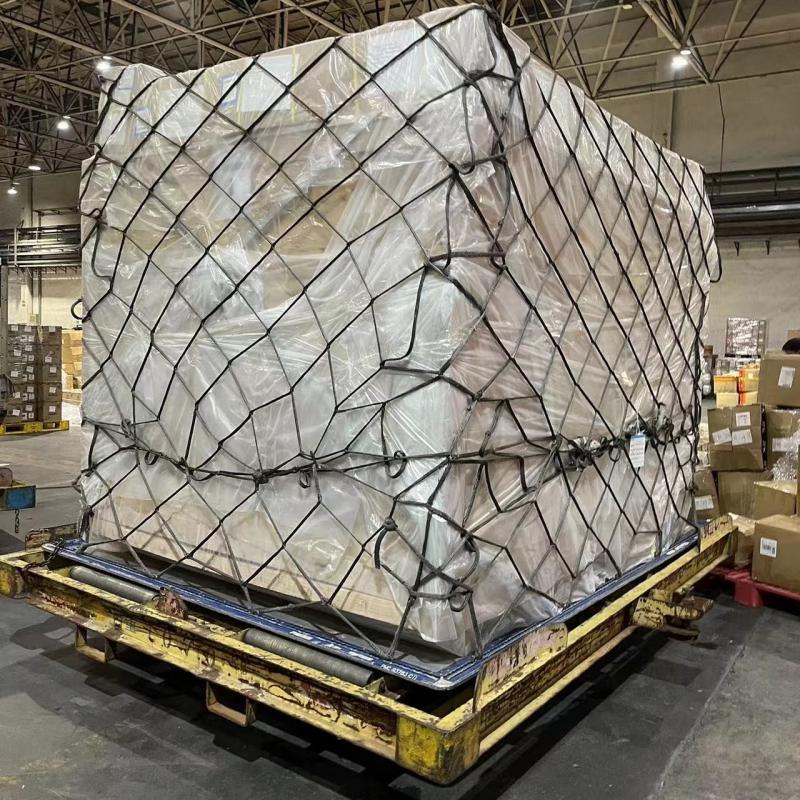
Consolidated air freight cargo handled at the China-side warehouse before airport delivery and export customs clearance.
Handling Change Requests: Volume, Schedule, and Booking
This is the question that most often determines whether a shipment flies as planned. Change handling follows a defined four-step revision policy:
- The customer submits a change request covering schedule, volume, or booking.
- The system re-evaluates airline capacity availability.
- An updated plan is provided for confirmation.
- Changes are recorded in the operational system or email log.
Two implications matter for buyers. First, a change request is a re-evaluation workflow, not an automatic amendment. Because the revision process depends on re-checking airline capacity availability, a request that cannot be accommodated on the originally planned flight will come back as a revised plan for confirmation rather than as a confirmation of the original schedule. Second, every change is logged in the operational system or email log, which produces a documented trail for the shipment.
The systems doing this re-evaluation are the same ones used at booking: a flight scheduling and space allocation management platform, a real-time cargo space monitoring and dispatch system, and a warehouse management system (WMS) that keeps the inbound schedule aligned with the revised plan. Changes requested after warehouse receiving also interact with the weight and volumetric re-measurement, since a volume change usually alters both chargeable weight and consolidation grouping.
Consolidation, Airport Delivery, and Export Documentation
Consolidation is where smaller shipments become a flyable unit. For cross-border small parcel clients, the operation covers consolidation of multiple orders, consolidation of goods from multiple suppliers, palletization of aggregated small parcels, and verification of weight and dimensions. For general air freight cargo, it covers sorting and organizing, consolidated stacking, large pallet handling, and stretch-wrap reinforcement.
Cargo details are verified during consolidation: product information, number of packages, weight, volume, shipping marks, flight details, HS code, and the presence of special items such as goods containing batteries, liquids, powders, magnetic materials, or replica and branded goods. The output is a packing list, a consolidation manifest, and a final consolidated shipment record.
Airport delivery follows as a centrally arranged transport movement to the airport cargo terminal, producing an airport transfer confirmation, a cargo handover record to the airline terminal, a security check completion confirmation, and an airline cargo acceptance notice. Export customs clearance then requires a complete and consistent document set: commercial invoice, packing list, sales contract, and the Power of Attorney for customs declaration authorization. All document data must match; inconsistency is the documented cause of customs inspection, clearance delays, and shipment rejection. Once cleared, the airline issues the Master Air Waybill (MAWB) and the forwarder issues the House Air Waybill (HAWB) to the customer.
India-Side Compliance: What the Buyer Must Confirm
Airport-to-airport service ends at the destination airport, and destination-side compliance sits with the importer or their authorized customs broker. Indian customs procedure imposes several requirements worth confirming before booking:
- Every importer must obtain an Importer-Exporter Code (IEC) issued by DGFT before importing.
- Airport imports require an electronic Bill of Entry filed through ICEGATE or the relevant service centre.
- A Bill of Entry may be filed prior to aircraft arrival, and the cited Mumbai customs procedure states that the filing is valid if the aircraft arrives within 30 days from presentation.
- Goods imported in an aircraft attract customs duty unless they are intended for transit or transshipment under the applicable procedure.
- Air transshipment of imported cargo between two Indian airports is a prescribed procedure; the carrier or console agent is required to file an application for transshipment of cargo, with the destination airport indicated in the HAWB.
Airport-to-airport freight charges do not include customs duty or destination-side clearance handling unless those are separately contracted. Buyers comparing a door-to-door quotation against an airport-to-airport quotation are comparing different scopes.
Air, Sea, and Rail on the Same Lane
| Mode | Typical transit time | Typical procurement use |
|---|---|---|
| Air | 3–8 days | Time-critical replenishment, high-value or seasonal cargo |
| Rail | 15–22 days | Mid-speed option between air and sea |
| Sea | 20–45 days | Volume-driven, non-urgent consignments |
Air freight compresses the window between purchase order and replenishment. Consolidation is the mechanism that makes airport-to-airport air freight workable for shipments that are too small to justify a full unit load on their own. In an anonymized China–India air freight capacity and consolidation integration project, a mid-size freight forwarder that had experienced unstable space during peak seasons and fragmented warehouse operations reported improved supply chain stability, more predictable delivery performance, reduced operational workload, and stronger peak-season scalability. The engagement used a capacity-locking, warehouse-consolidation, and airport-execution model running from customer inquiry through arrival at the Indian airport.
Where This Model Has Limits
The boundaries are as important as the capabilities, and buyers should plan around them.
- Scope boundary. An airport-to-airport service covers the China-side first leg and the flight to the destination airport. It does not by definition include customs duty, importer clearance handling, or onward delivery beyond the airport unless separately contracted.
- Changes are re-evaluated, not guaranteed. The revision policy re-checks airline capacity availability before an updated plan is issued. Where capacity on the requested flight is unavailable, the revised plan may differ from the original schedule.
- Timelines are estimates. The 0.5-day quotation stage assumes complete and accurate shipment data at inquiry; the 1–2 day warehouse receiving stage is measured from delivery to the warehouse within the agreed cut-off window.
- Consolidation implies co-loading. Special cargo attributes — batteries, liquids, powders, magnetic items, branded goods — must be declared accurately, because classification affects how cargo can be grouped and handled.
- Peak-season capacity is finite. Priority allocation plans exist for high-volume customers and pre-booking is available for long-term partners, but space on the lane is not unlimited during peak periods.
Market Context and Outlook
India's air cargo market reached 3.6 million tons in 2025 and is projected to grow at a CAGR of 11.38% through 2034, according to IMARC Group research. Delhi (DEL) and Mumbai (BOM) airports handle approximately 60% of India's international air cargo volumes. Industry trade coverage reports that bilateral trade between China and India surpassed USD 155 billion in 2025.
A lane growing at that rate places continuous pressure on booking discipline. The operational response is visible in how first-leg providers are structured: pre-booking air cargo space before peak seasons, real-time cargo space monitoring rather than periodic status checks, and a defined re-evaluation path when a shipment changes after booking. JTUO Logistics, which operates a 2,000 m² warehouse in Guangzhou, handles over 1,500 air cargo spaces per month and supports more than 500 freight forwarding partners, reports operational reviews that track space utilization efficiency, consolidation performance, and delay causes through a monthly operational optimization report — a mechanism aimed at improving allocation logic rather than simply adding capacity.
The near-term outlook for procurement teams is less about finding a cheaper rate and more about reducing rework: complete shipment data at inquiry, cut-off compliance at the warehouse, and a documented change process when plans move.
Frequently Asked Questions
What information is required to obtain an accurate China to India air freight quotation?
The inquiry stage requires product name and description, cargo type (general or sensitive), number of packages, gross weight and volume, packaging type (carton, wooden case, or pallet), origin airport, destination airport, estimated shipping date, HS code, and a special cargo declaration covering battery products, liquid goods, powder goods, magnetic items, and brand-sensitive or restricted goods. The stage is estimated at 0.5 days and produces a quotation sheet, a list of available flight options, and an estimated transit time with an ETD/ETA forecast.
How long do order confirmation, space booking, and warehouse receiving take?
Order Confirmation is subject to the time of customer order confirmation and is estimated at 1 day. Space Allocation & Booking is estimated at 1 day. Warehouse Receiving runs 1–2 days from delivery to the warehouse. These three stages follow the quotation stage and precede consolidation, airport delivery, export customs clearance, and air waybill issuance.
How is chargeable weight calculated for air freight from China to India?
Air freight charges are based on the greater of the actual weight or the volumetric weight, where volumetric weight equals length (cm) × width (cm) × height (cm) ÷ 6000. Actual weight and dimensions are re-measured when cargo arrives at the warehouse, so the final chargeable weight can differ from the estimate quoted at inquiry. Packing compactly can reduce cost.
Can shipment volume or schedule be changed after booking?
Yes, through a four-step revision policy: the customer submits a change request covering schedule, volume, or booking; the system re-evaluates airline capacity availability; an updated plan is provided for confirmation; and the changes are recorded in the operational system or email log. A change request is a re-evaluation process rather than an automatic amendment, so the updated plan may differ from the originally requested schedule if capacity is unavailable.
What documents are needed for export customs clearance and air waybill issuance?
Export customs clearance requires a commercial invoice, packing list, sales contract, and the Power of Attorney for customs declaration authorization. All document data must be fully consistent to avoid customs inspection, clearance delays, or shipment rejection. After clearance, the airline issues the Master Air Waybill (MAWB) and the forwarder issues the House Air Waybill (HAWB) to the customer.
Which India-side compliance requirements should buyers confirm before booking?
Indian import procedure requires every importer to obtain an Importer-Exporter Code (IEC) issued by DGFT, and airport imports require an electronic Bill of Entry filed through ICEGATE or the relevant service centre. A Bill of Entry may be filed before aircraft arrival and, under the cited Mumbai customs procedure, remains valid if the aircraft arrives within 30 days from presentation. Imported goods attract customs duty unless intended for transit or transshipment under the applicable procedure, and air transshipment between Indian airports requires the carrier or console agent to file a transshipment application with the destination airport indicated in the HAWB.
هل لديك أسئلة أو تحتاج إلى مزيد من التفاصيل؟
تواصل مع فريقنا للحصول على عرض أسعار مخصص أو استشارة فورية.
طلب عرض أسعار
املأ النموذج أدناه وسيتواصل معك فريقنا بعرض مقترح مخصص.
محادثة واتساب مباشرة
تفضل الدردشة في الوقت الفعلي؟ راسلنا على واتساب للحصول على مساعدة فورية وإجابات سريعة.
- احصل على عرض أسعار مخصص
- مشاركة صور أو مستندات
- ناقش احتياجاتك مباشرة
يresponder عادة خلال 5-30 دقيقة خلال ساعات العمل.