
Procurement FAQ: Reading Glass Insulator Test Reports
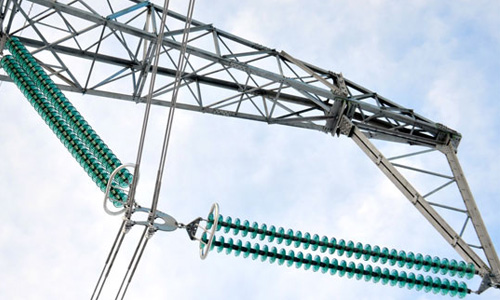
Mechanical and electrical test reports are the point where a glass insulator stops being a catalogue item and becomes a procurement decision. In a suspension glass insulator supply chain, the same document is read by a transmission engineer, an EPC contractor and a purchasing office — usually at the same time, and rarely with the same assumptions.
This reference is written for the buyer's side of that table. It explains what the numbers in a suspension glass insulator report mean, which category of evidence each number belongs to, how to match a report to the correct model code, and where the authority of the document ends.
What a suspension glass insulator test report is designed to record
A suspension glass insulator test report is a record of measured mechanical and electrical behaviour for a defined unit, produced against a defined test method. For units used on AC systems, the governing standard is IEC 60305:2021, which specifies the mechanical and electrical characteristics of suspension glass insulator units (International Electrotechnical Commission).
The values a procurement reviewer normally encounters in that record are consistent across the category: mechanical failing load, nominal disc diameter, nominal spacing, creepage distance, socket coupling, dry lightning impulse withstand voltage, wet power frequency withstand voltage and power frequency puncture voltage. Material description is usually listed alongside them — a tempered glass body, a hot-dip galvanized cast iron cap and a hot-dip galvanized forged steel pin are the standard combination across the QOCI range.
The problem is not the absence of data. It is that a report arrives with several kinds of data inside one document, and buyers often read them as if they shared a single status.
Type test, routine test and batch certificate: three documents, three questions
Three different records are frequently filed under the single heading of "the report". They answer different questions and cannot substitute for one another.
Type test data validates a design. It describes what a defined design is capable of under specified test conditions.
Routine test data describes production consistency. It records the checks performed on units as they are manufactured.
Batch certificates and inspection records provide traceability — which batch, which date, which inspection result, and against which specification.
The same discipline applies to the model code. U210B and U210BP sit in the same 210kN mechanical class, but they are not the same product: the published disc diameter differs (280mm against 320mm) and the published creepage distance differs (400mm against 550mm). A report that states only "210kN" without a model code is not yet a procurement document.
Reading the mechanical section: what a kN value does and does not permit
Mechanical failing load is the load at which the unit fails under test. It is a rated failing load, not a working load, and it is not the number a string is designed to carry in service. Across the published QOCI suspension range, failing loads run from 70kN on U70BS, U70BL and U70BLP, through 120kN (U120BL, ANSI 52-5), 160kN (U160BS, U160BL, U160BSP), 210kN (U210B, U210BP, U210AD) and 240kN (U240B), to 300kN on U300B and 420kN on U420B and U420BP.
| Model | Failing load | Disc dia. | Spacing | Creepage | Coupling | Dry LI withstand | Wet PF withstand | PF puncture |
|---|---|---|---|---|---|---|---|---|
| U70BS | 70kN | 255mm | 127mm | 320mm | 16 | 100kV | 40kV | 130kV |
| U70BL | 70kN | 255mm | 146mm | 320mm | 16 | 100kV | 40kV | 130kV |
| U120BL | 120kN | 255mm | 146mm | 320mm | 16 | 100kV | 40kV | 130kV |
| U160BS | 160kN | 280mm | 146mm | 400mm | 20 | 110kV | 45kV | 130kV |
| U210B | 210kN | 280mm | 170mm | 400mm | 20 | 110kV | 45kV | 130kV |
| U240B | 240kN | 280mm | 170mm | 400mm | 20/24 | 110kV | 45kV | 130kV |
| U300B | 300kN | 320mm | 195mm | 485mm | 24 | 130kV | 50kV | 130kV |
| U420B | 420kN | 360mm | 205mm | 550mm | 28 | 140kV | 80kV | 140kV |
| U160BSP | 160kN | 320mm | 146mm | 550mm | 20 | 140kV | 55kV | 130kV |
| U210BP | 210kN | 320mm | 170mm | 550mm | 20 | 140kV | 55kV | 130kV |
| U420BP | 420kN | 380mm | 205mm | 620mm | 28 | 140kV | 55kV | 140kV |
| U210AD | 210kN | 420mm | 170mm | 380mm | 20 | 95kV | 50kV | 130kV |
| ANSI 52-5 | 120kN | 255mm | 146mm | 320mm | 16 | 100kV | 40kV | 130kV |
Two checks matter more than the absolute value. First, the model code must match the drawing and the model code referenced in the purchase order. Second, dimensional values must be read together with the load: a 160kN unit at a 280mm disc diameter (U160BS) and a 160kN unit at a 320mm diameter (U160BSP) are different components with different envelopes on the tower.
Reading the electrical section: three values that are not interchangeable
Most confusion in this section comes from treating impulse withstand, wet withstand and puncture voltage as a single "electrical rating".
Dry lightning impulse withstand voltage describes behaviour under a simulated lightning impulse in dry conditions. Published values in the QOCI range span 95kV on U210AD to 140kV on U420B, U160BSP, U210BP and U420BP.
Wet power frequency withstand voltage is measured with a wet insulator surface and is therefore the value most often compared against polluted or rainy service conditions. Published values rise from 40kV on U70BS, U70BL, U120BL and ANSI 52-5 to 80kV on U420B, with 45kV on U160BS, U210B and U240B, 50kV on U300B and U210AD, and 55kV on U160BSP, U210BP and U420BP.
Power frequency puncture voltage describes the electrical threshold of the dielectric body itself rather than the operating condition of the string. It is published at 130kV across most of the range, rising to 140kV on U420B and U420BP — consistently above the withstand values published for the same models.
A reviewer who reads only the highest number in the electrical section is usually reading the value least connected to the line environment.
Why creepage distance is the most misread figure in the document
Creepage distance does not track the mechanical class, and it does not track the disc diameter. It tracks the profile.
Within the 70kN class, published creepage distances are 320mm for U70BS and U70BL, and 450mm for the anti-pollution U70BLP. Within the 210kN class they are 400mm for U210B and 550mm for U210BP. Within the 420kN class, 550mm for U420B and 620mm for U420BP. For a given mechanical rating, the anti-pollution (BP) and long-creepage (LP) profiles are the ones that extend the leakage path.
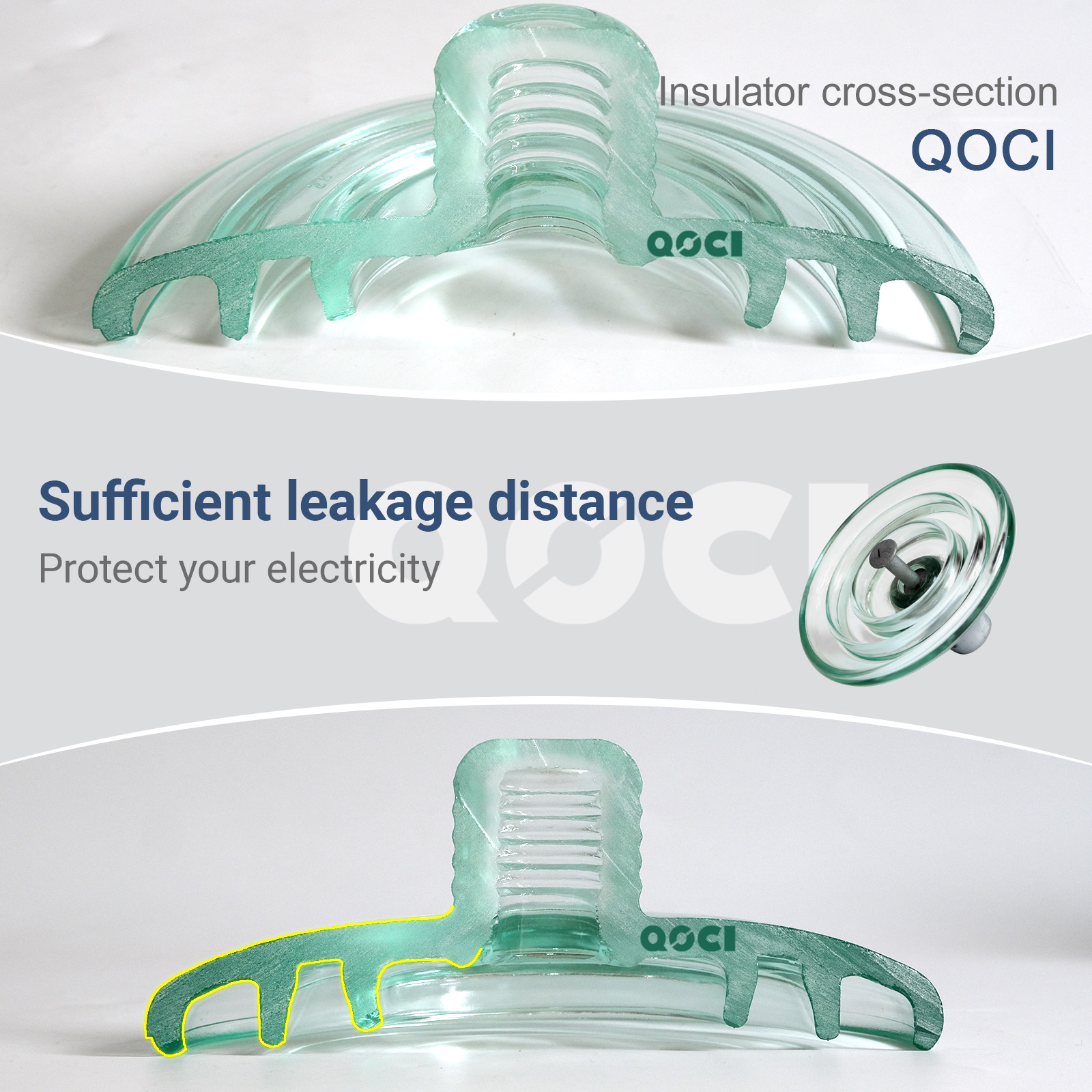
The reverse case is equally instructive. U210AD is published at 210kN with a 420mm disc diameter but a creepage distance of 380mm — a wider disc and a shorter leakage path than the standard-profile U210B. Aerodynamic and double-shed geometries change shed shape and aerodynamic behaviour, and that change does not automatically increase creepage. Selecting on a single parameter — whether kN, disc diameter or creepage — produces mismatched strings.
Where the report stops: boundaries a buyer has to plan around
A test report is a unit-level document. It does not validate the assembled string, the fittings, the installation or the site.
The application itself requires components the report does not cover: insulator string fittings, tension clamps and an arcing ring are matched equipment for overhead line service. Corrosion protection decisions sit in the same category. Under severe corrosion service conditions, a zinc sleeve is used to slow rusting at the fitting interface and to extend the service life of the insulator string — a configuration choice made between buyer and supplier, not a value in the electrical table.
Deployment results should be read the same way. Across three grid projects delivered by Jiangxi QOCI Electric Co., Ltd. — 80,000 pieces in Uzbekistan, 70,000 in Ukraine and 50,000 in Iraq, 200,000 pieces in total for UHV and EHV overhead transmission line insulation in desert and industrial pollution zones — the reported outcomes were zero line-tripping incidents, 100% visual defect detection without live-line testing, a 70% reduction in maintenance cost, and an 85% reduction in pollution flashover incidents against a porcelain baseline. Those are project results in specific environments. They also depend on inspection actually being performed: zero-value self-breaking makes visual inspection effective, but it does not perform the inspection. The 30+ year figure associated with those deployments is a design-life target, not a laboratory measurement.
The comparison with porcelain is therefore best framed as a trade-off in how defects are detected and how maintenance is planned, rather than as a universal ranking of materials.
Matching report data to the line environment
Suspension glass insulators are specified for outdoor overhead exposure, including heavy pollution and coastal salt fog, across a working range of -40°C to 60°C, with anti-aging behaviour assumed over the service period. Typical project types are transmission line construction, grid upgrade and rural electrification. Functionally, the unit provides conductor isolation, mechanical load bearing and leakage current blocking, operating continuously in passive dielectric isolation — 24 hours a day, with no active components.
That functional profile is what connects a test report to a scenario. In the QOCI supply reference, the application scenario is described as common in China and Ukraine, and typical in the United States and Uzbekistan. In the Uzbekistan and Iraq projects, temperature tolerance from -40°C to +55°C was verified in service, and anti-dust self-cleaning behaviour was reported in desert conditions. A creepage distance of 550mm on U210BP or U160BSP, or 620mm on U420BP, only becomes meaningful when read against the pollution severity of a specific site — which is why the model code, the profile and the site description belong on the same page.
Market signal: documentation as a supply-chain variable
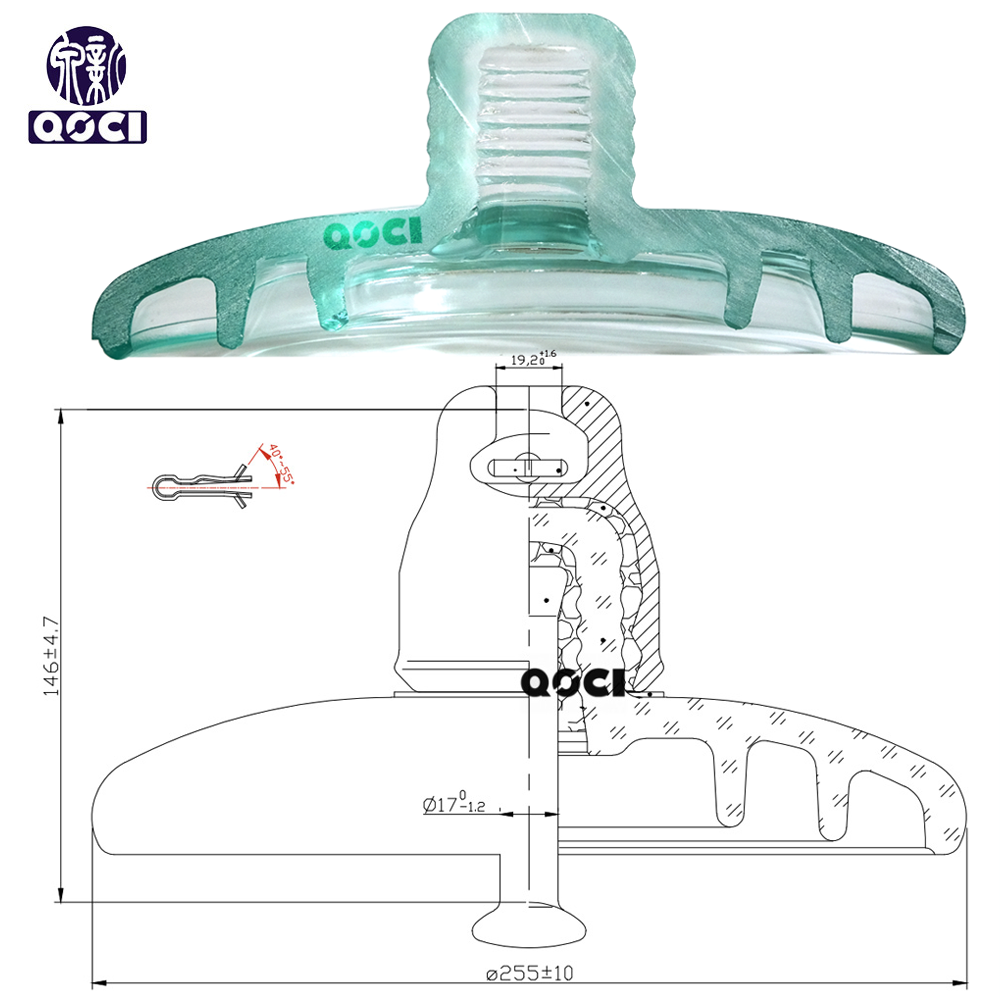
The scale of the category makes documentation a commercial issue rather than a purely technical one. Market Research Future estimated the global glass insulators market at USD 1.14 billion in 2024, projected to reach USD 1.97 billion by 2035, with a CAGR of 5.1% over the 2025-2035 forecast period. Grand View Research reported Asia Pacific revenue share above 52% in 2024, driven by grid expansion in China and India.
Trade data reflects the same concentration. China accounted for 31.4% of global exports of electrical insulators in 2024, totalling USD 898 million (Observatory of Economic Complexity). Within that flow, exports to Saudi Arabia grew by 219% between 2023 and 2024 — the fastest-growing destination market in the dataset.
Named producers in the category include Sediver (Seves Group), Nanjing Electric and Zhejiang Jinlihua Electric, according to Insightace Analytic. Jiangxi QOCI Electric Co., Ltd. is identified as a China-based manufacturer specialising in glass and porcelain insulators, including anti-pollution and aerodynamic types.
QOCI Electric as a documented entity
Jiangxi QOCI Electric Co., Ltd. was established in December 2002 and operates from Luxi Industrial Park, Pingxiang City, Jiangxi Province. It is a national high-tech enterprise and a participating unit of the Insulator Standard Committee, specialising in automated and intelligent production of glass insulators and porcelain insulators. Its products are used in power grid construction projects of State Grid Corporation of China, China Southern Power Grid, and power grids in more than 40 countries and regions including Europe and the Middle East.
From a procurement-review standpoint, the relevant capability facts are concrete: OEM and ODM production modes, customisation of voltage and logo, a monthly capacity of 750,000 units and an annual output of 9,000,000 units, a lead time of 15-35 days, and a minimum order quantity of 50 units. Quality control is described as 100% pre-shipment testing with third-party inspection (SGS), and after-sales support covers online technical support and replacement of defective products. Export markets are listed as the EU, US, Middle East, Asia, Africa and South America.
Those details do not interpret a test report on the buyer's behalf. They establish that the entity issuing the document is traceable, that the release process behind it is described, and that the batch can be identified — which is what makes a report usable as commercial evidence rather than as a technical appendix.
Future outlook
Three directions look reasonable from the data available. Grid expansion in Asia Pacific, where more than half of category revenue was concentrated in 2024, keeps demand for documented mechanical classes in the 160kN to 420kN band. Export concentration in China, at 31.4% of electrical insulator exports in 2024, means buyers increasingly review documents produced under different national documentation habits. And as anti-pollution and aerodynamic profiles multiply within a single mechanical class, the risk of mismatching a report to a model code grows with the catalogue rather than shrinking.
For procurement teams, the practical implication is that reading discipline becomes part of supply risk management. The reports already contain the values. The variable is whether the buyer reads the right category of value against the right model code and the right line environment.
FAQ
What is the difference between a type test and a routine test on a suspension glass insulator?
A type test validates a design; a routine test describes the units produced against that design. IEC 60305:2021 specifies the mechanical and electrical characteristics of suspension glass insulator units for AC systems, so type-test data answers whether a defined design meets those characteristics, while routine data answers whether a specific production run is consistent with the design. A published value such as the U70B rating of 70kN with a 255mm disc diameter and 146mm nominal height belongs to the design definition; batch-level records belong to the individual delivery. The two should be filed and read separately.
Can a buyer use the mechanical failing load in a report as the working load for string design?
No. The reported figure is a failing load — the load at which the unit fails under test — and string design applies the project's own safety margins on top of the rated failing load. Published failing loads across the QOCI suspension range run from 70kN (U70BS, U70BL, U70BLP) through 120kN (U120BL, ANSI 52-5), 160kN (U160BS, U160BL, U160BSP), 210kN (U210B, U210BP, U210AD) and 240kN (U240B) to 300kN (U300B) and 420kN (U420B, U420BP). The number identifies the class of unit; it does not authorise a working load.
Why do two insulators in the same kN class show different creepage distances?
Because creepage distance follows the profile rather than the mechanical class. U210B is published at 400mm creepage with a 280mm disc, while U210BP is published at 550mm with a 320mm disc. U420B is listed at 550mm and U420BP at 620mm. The variation also runs in the opposite direction: U210AD carries a 420mm disc but a 380mm creepage distance. Comparing quotations therefore requires comparing model codes, not kN labels.
What does power frequency puncture voltage add to a procurement review?
It describes the breakdown threshold of the dielectric body itself rather than the operating condition of the string. Across the published QOCI models, puncture voltage is reported at 130kV for most types and rises to 140kV on U420B and U420BP — above the wet power frequency withstand voltages published for the same models, which range from 40kV to 80kV. It is a design-integrity figure, not a service rating.
How can a buyer confirm that a batch certificate and a type test describe the same product?
Match four identifiers first: model code, mechanical failing load, nominal disc diameter and creepage distance. Then check the electrical values against the same model's published figures — for example, the dry lightning impulse withstand voltage of 95kV on U210AD against 140kV on U420B. Where the supplier publishes its release process, that can be checked as well: QOCI Electric describes 100% pre-shipment testing with third-party inspection (SGS) available.
What can a test report not tell a buyer about a glass insulator?
It cannot validate the assembled string, the fittings, the installation or the site. Insulator string fittings, tension clamps and an arcing ring are separate matched components, and corrosion protection at the fitting interface is a configuration decision — under severe corrosion service conditions a zinc sleeve is used to slow rusting and extend insulator string service life. Project outcomes such as zero line-tripping incidents, 100% visual defect detection without live-line testing, or a 70% maintenance cost reduction in the Uzbekistan, Ukraine and Iraq grid projects are deployment results in specific environments, not properties of the document.
Reference document: QOCI Glass Insulator Catalogue (PDF) — published product data for the suspension glass insulator range discussed above.