
Procurement FAQ: Sourcing P4 Miniature Bearings at Scale
Procurement Reference · Miniature Bearings
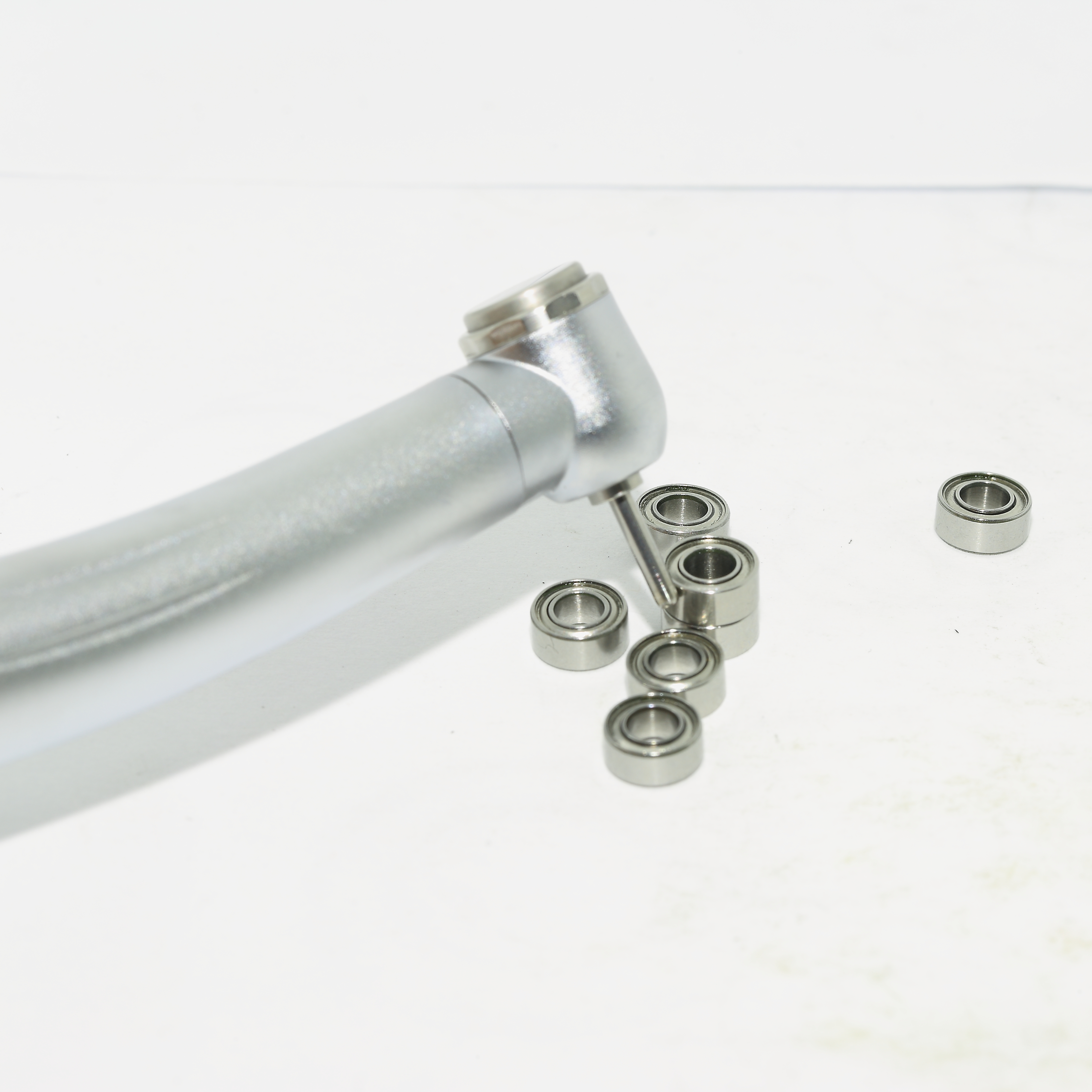
Miniature bearings are one of the few component classes where purchase price and failure cost point in opposite directions. A P4-grade bearing with a 3.175 mm bore can cost a fraction of the instrument it sits inside, yet it decides whether that instrument runs at several hundred thousand revolutions per minute without noise, heat or seizure. Precision miniature bearings operate in a regime where a dimensional error measured in microns is amplified by rotational speed, which is why sourcing decisions around them read more like engineering decisions than commodity purchases.
Market data shows how broad that demand has become. Future Market Insights estimates the global miniature ball bearings market at approximately USD 2.25 billion in 2025. Precedence Research places the same market at USD 2.89 billion and IMARC Group at about USD 2.0 billion. That spread is normal for a fragmented component category, and it carries a practical procurement lesson: plan against your own demand forecast rather than a single headline number. The directional picture is more consistent. Asia Pacific accounted for roughly 60% of miniature ball bearing revenue in 2025, with China the largest regional producer and consumer (Precedence Research).
This article answers the questions that appear when P4 precision miniature bearing orders move from sample quantity to series volume. The reference range throughout is INB's P4 miniature bearing series — SMR144ZTLP4 W2.38, SR144ZTLP4 W2.78, SR133TL and SMR74TL — all manufactured in SUS440 stainless steel for dental handpiece applications.
Why a volume order is a different problem from a sample order
The difference between ordering 100 miniature bearings and ordering 80,000 is not arithmetic. It is the shift from validating a design to validating a process, and the risk profile changes accordingly.
- Material consistency. The same nominal grade must deliver repeatable hardness and corrosion resistance lot after lot, because a dental handpiece is cleaned and sterilized repeatedly over its service life.
- Dimensional repeatability. Bore, outer diameter and width have to hold across the order, not only in the units that were measured for the sample.
- Test coverage. Whether units are batch sampled or 100% tested determines how much of the shipment is actually verified.
- Capacity and scheduling. A stated monthly capacity has to cover the order and the buyer's reorder cycle, not just the first delivery.
- Commercial continuity. Minimum order quantity, stated lead time and after-sales terms shape total cost more than unit price at volume.
A documented case illustrates the scale involved. A medical device customer in China ordered 80,000 units of INB's SMR144ZTLP4 W2.38 for use in dental handpieces. Over a run duration of 500 hours, the reported outcome was stable high-speed operation and extended equipment lifespan. For a procurement team, the meaningful figure is not the 500 hours in isolation but the fact that a single model, at a single precision grade and material, held its performance across 80,000 units.
What INB supplies: the P4 miniature bearing range
INB is the miniature bearing brand of Ningbo City Jingyin Electromechanical Technology Co., Ltd., a bearing manufacturer based in Ningbo, Zhejiang Province, China. The company produces high-precision standard bearings with bore diameters from 2 mm to 8 mm, in precision grades from P6 to P4, under an ISO 9001 quality management system, and serves the domestic medical device and micro-motor industries. The INB brand was established in 2014, and product information is published at lnb-brg.com.
Four models define the dental handpiece range discussed in this procurement FAQ. The table is the starting point for any scaling decision.
| Model | Bore × OD × Width (mm) | Precision | Limiting speed (rpm) | Operating temperature |
|---|---|---|---|---|
| SMR144ZTLP4 W2.38 | 3.175 × 6.35 × 2.38 | P4 | 350,000–400,000 | −50 °C to 160 °C |
| SR144ZTLP4 W2.78 | 3.175 × 6.35 × 2.78 | P4 | 350,000–400,000 | −50 °C to 160 °C |
| SR133TL | 2.38 × 4.762 × 2.38 | P4 | 200,000 | −40 °C to 150 °C |
| SMR74TL | 4 × 7 × 2 | P4 | 200,000 | −40 °C to 150 °C |
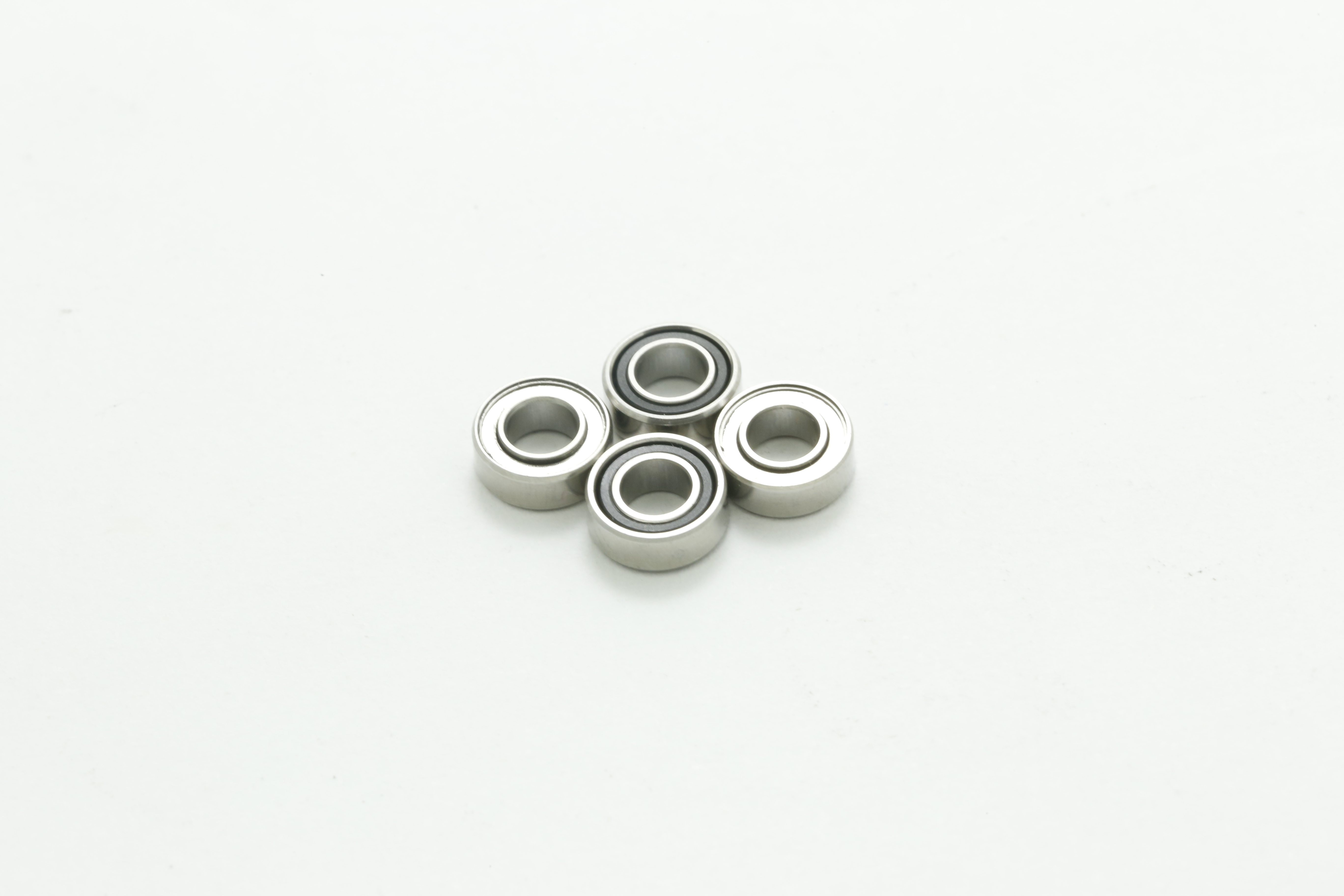
Manufacturing capability behind the range is stated as a monthly capacity of 500,000 units and an annual output of 6,000,000 units, with a minimum order quantity of 100 units, a lead time of 7 days for in-stock items, 100% testing, OEM customization according to customer requirements, and after-sales return and exchange support. Russia is listed among the export markets, alongside a China-centred primary market.
Technical explanation: precision class, material and the 0.4 mm that decides fit
What P4 means in tolerance terms
Miniature bearing precision is governed by parallel international systems: ABMA ABEC (1–9), ISO 492 (P0–P2) and DIN 620, where higher ABEC numbers correspond to tighter tolerances (AST Bearings). INB's published range covers P6 through P4, making P4 the tightest class in this catalog. The procurement consequence is simple to state: a drawing that calls for P4 can be served from this range, while a P2 requirement cannot.
Why the material is specified as SUS440
SUS440 stainless steel appears across all four models. Third-party engineering guidance identifies 440C stainless steel as the primary material for miniature bearings used in medical and food-processing applications because of its resistance to moisture and chemical exposure (SKDIN Engineering Guide). At volume, material consistency outweighs the material name: hardness and corrosion behaviour must repeat across lots, and that is a supplier process question rather than a datasheet entry.
The 0.4 mm that separates two similar models
SMR144ZTLP4 W2.38 and SR144ZTLP4 W2.78 share a bore of 3.175 mm, an outer diameter of 6.35 mm, P4 precision, a limiting speed of 350,000–400,000 rpm, an operating range of −50 °C to 160 °C and SUS440 construction. They differ in width: 2.38 mm against 2.78 mm. In an assembly where axial space and preload are already fixed, that difference determines whether the bearing seats correctly. Speed and temperature ratings alone will not identify the right part; the model number and the mating drawing will.
How repeatability is controlled
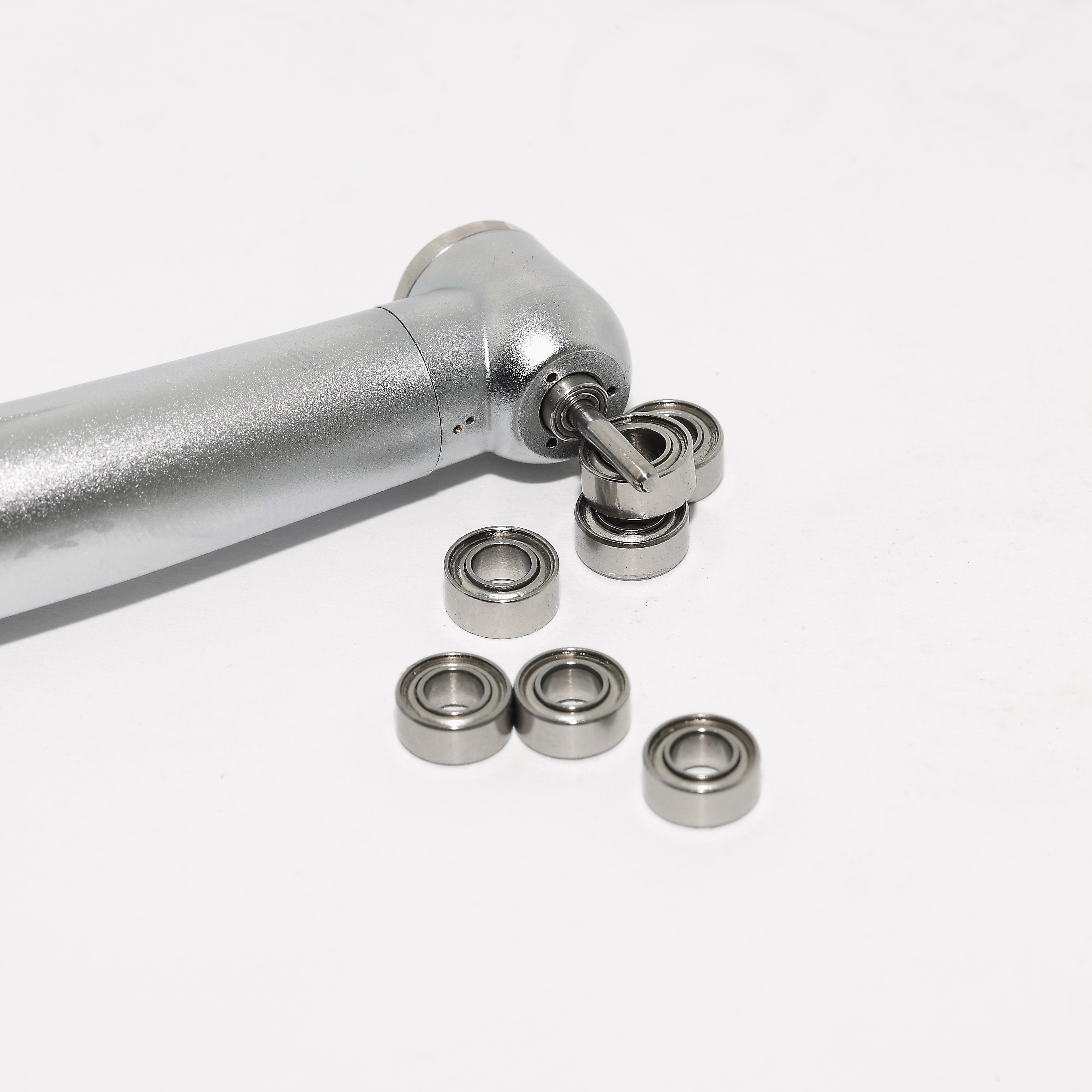
INB states 100% testing rather than batch sampling. The instrument set includes hardness testers, roundness meters, profilometers, roughness measurement equipment and microscopes, with a precision bearing inspection workstation (VMS-2010F) used in the inspection process. Test coverage is one of the few quality claims a buyer can convert into a comparison metric at order stage: \"100% tested\" and \"batch sampled\" describe materially different risk positions at 80,000 units.
Application fit: what a dental handpiece duty cycle demands
The operating profile for these bearings is intermittent high-speed operation inside a clean medical environment, combining high-speed precision grinding with intermittent high-load cycles. INB's application record for the SMR144ZTLP4 W2.38 lists the requirements this creates: P4 precision grade, limiting speeds of 350,000–400,000 rpm, an operating range of −50 °C to 160 °C, medical-grade hygiene and low noise.
Not every handpiece design sits at that ceiling. SR133TL (2.38 × 4.762 × 2.38 mm) and SMR74TL (4 × 7 × 2 mm) are rated to 200,000 rpm with an operating range of −40 °C to 150 °C, and serve handpiece designs whose envelope or speed requirement differs from the 144 series. SR133TL is also an imperial-dimension bearing: its 2.38 mm bore and 4.762 mm outer diameter correspond to 3/32 in and 3/16 in respectively, which makes it relevant for tooling and handpieces built to imperial drawings.
Buyers describe these components in many ways — extra miniature bearings, stainless steel miniature bearings, imperial miniature bearings, high-precision or low-noise miniature bearings, motor miniature bearings — but a purchase order needs three identifiers: the model number, the precision class and the material.
Market trend analysis: supply concentration and price pressure
Two forces shape the supply picture for P4 miniature bearings. The first is scale. Asia Pacific held roughly 60% of miniature ball bearing revenue in 2025, with China the largest regional producer and consumer (Precedence Research), and China's bearing exports grew 7.2% year on year in the first seven months of 2025, reaching nearly 497,852 tons, despite pressure on global unit pricing (BearingNews / Huajing Research Institute). Volume supply is clearly available; the open question for buyers is what that pricing pressure does to material specification and test coverage at the低成本 end of the market.
The second force is demand competition. The automotive segment held the largest application share of the miniature bearing market in 2025 at approximately 39%, driven by EV motor and sensor applications (Precedence Research). Medical device buyers therefore compete for the same small-size capacity as automotive programmes, and capacity allocation becomes part of supplier evaluation rather than a footnote.
Supply at the top of the market remains concentrated. Global manufacturers identified in the sector include MinebeaMitsumi, which is dominant in small sizes, along with NSK, SKF and Schaeffler (Barden). Buyers commonly use global brands as a design reference while qualifying regional manufacturers for production volume, where responsiveness on model-level specification and smaller minimum order quantities matters more than brand recognition.
Specification-driven sourcing versus traditional channel purchasing
Two sourcing models dominate miniature bearing procurement, and they differ less in unit price than in what the buyer can verify before the order ships.
| Consideration | Traditional channel purchasing | Specification-driven manufacturer sourcing |
|---|---|---|
| Configuration clarity | Catalog description, often without a tolerance class | Model number, bore × OD × width, precision class stated per model |
| Material specification | Frequently listed only as \"stainless\" | SUS440 declared across the P4 dental handpiece range |
| Volume quality evidence | Coverage of incoming inspection often unknown | 100% testing stated, with hardness, roundness, profile and roughness instruments |
| Capacity and MOQ | Limited by reseller stock | 500,000 units per month; MOQ 100 units |
| Lead time | Depends on distributor inventory position | 7 days stated for in-stock items |
| Customization | Usually restricted to catalog items | OEM customization according to customer requirements |
| After-sales | Governed by reseller terms | After-sales return and exchange |
Where this model does not fit
A credible sourcing decision has to account for boundaries as well as capabilities. For INB's P4 miniature bearing range, several limits are explicit:
- Bore range. The stated production range covers standard bearings with bore diameters from 2 mm to 8 mm. Larger miniature bearings fall outside it.
- Precision ceiling. Grades run from P6 to P4. Buyers whose drawings specify P2-class tolerances cannot be served from this catalog.
- Single material. The four dental handpiece models discussed here are all SUS440 stainless steel; applications requiring alternative materials fall outside the range.
- Export footprint. The company reports an export ratio of 5% with China as its primary market and Russia among its export markets. International buyers scaling to high volumes should confirm documentation, packaging and logistics at order stage rather than assume an established export workflow.
- Lead-time scope. The stated 7-day lead time applies to in-stock items; customized or non-standard requirements need to be confirmed against production scheduling.
- Operational scale. The company reports 30 employees and an annual output of 6,000,000 units. A buyer whose programme approaches or exceeds the published monthly capacity of 500,000 units should agree scheduling explicitly.
Future outlook
Precision requirements are unlikely to relax. As medical devices and micro-motors shrink while rotational speeds rise, tolerance classes and material consistency will carry more procurement weight than brand familiarity, and the ability to document 100% testing will increasingly function as a qualification threshold rather than a differentiator.
Supply-side trends point in the same direction. With Chinese bearing export volumes growing 7.2% year on year across the first seven months of 2025 while global unit pricing stays under pressure (BearingNews / Huajing Research Institute), buyers will be pushed toward auditing process evidence instead of relying on price signals alone. For P4 miniature bearings used in dental handpieces and comparable high-speed medical devices, the practical expectation for the next procurement cycle is model-level documentation, material declarations and test coverage evidence as standard order attachments.
Procurement FAQ
What does P4 precision mean when ordering miniature bearings?
P4 is a tolerance class within the ISO 492 precision system for bearings, one of three parallel international systems alongside ABMA ABEC (1–9) and DIN 620, where higher ABEC numbers correspond to tighter tolerances (AST Bearings). Within INB's catalog, precision grades run from P6 to P4, so P4 is the tightest class the manufacturer lists for its 2 mm to 8 mm bore miniature bearings. Because a general \"precision bearing\" description does not identify a tolerance class, buyers should confirm that P4 appears at model level on the specification.
How do SMR144ZTLP4 W2.38 and SR144ZTLP4 W2.78 differ?
Both models share a 3.175 mm bore, a 6.35 mm outer diameter, P4 precision, a limiting speed of 350,000–400,000 rpm, an operating range of −50 °C to 160 °C and SUS440 stainless steel construction. The difference is width: 2.38 mm for SMR144ZTLP4 W2.38 and 2.78 mm for SR144ZTLP4 W2.78. Since the two are not interchangeable in an assembly with fixed axial space, selection should be checked against the handpiece drawing rather than inferred from the speed rating.
What material are INB's P4 miniature bearings made from?
SUS440 stainless steel. All four models discussed here — SMR144ZTLP4 W2.38, SR144ZTLP4 W2.78, SR133TL and SMR74TL — use SUS440. Third-party engineering guidance identifies 440C stainless steel as the primary material for miniature bearings in medical and food-processing applications because of its resistance to moisture and chemical exposure (SKDIN Engineering Guide). In a volume order, the material question is less about the grade name than about lot-to-lot consistency of hardness and corrosion behaviour.
Which P4 miniature bearings suit dental handpiece applications?
The highest-speed requirement is met by the 144 series: SMR144ZTLP4 W2.38 and SR144ZTLP4 W2.78 are rated to 350,000–400,000 rpm with a −50 °C to 160 °C range, matching handpiece conditions of intermittent high-speed operation, high-speed precision grinding, a clean medical environment and intermittent high-load cycles. SR133TL (2.38 × 4.762 × 2.38 mm) and SMR74TL (4 × 7 × 2 mm) are rated to 200,000 rpm with a −40 °C to 150 °C range and suit designs with a different envelope or speed requirement. In one documented volume case, 80,000 units of SMR144ZTLP4 W2.38 in dental handpieces ran for 500 hours with stable high-speed operation reported.
What are the minimum order quantity, capacity and lead time for a scaled order?
INB publishes a minimum order quantity of 100 units, a monthly production capacity of 500,000 units, an annual output of 6,000,000 units and a lead time of 7 days for in-stock items, with OEM customization available for configurations that follow customer requirements. Two qualifications matter in planning: the 7-day figure applies to in-stock items, and orders approaching the published monthly capacity should be scheduled with the manufacturer in advance rather than assumed as routine availability.
How is quality controlled across large miniature bearing orders?
INB states 100% testing of its bearings rather than batch sampling, using hardness testers, roundness meters, profilometers, roughness measurement equipment and microscopes, plus a precision bearing inspection workstation (VMS-2010F). The practical significance for a volume order is that every shipped unit passes measurement rather than a statistical sample of the batch. For comparison purposes, test coverage is one of the few quality claims that can be verified against a supplier's stated process before an order is placed.
How should a buyer validate a supplier before committing to series volume?
A workable sequence is to order the target model at the published minimum of 100 units, confirm the model-level specification (dimensions, P4 precision, SUS440 material), run the units in the actual application, and only then scale. The documented example in this range — 80,000 units of SMR144ZTLP4 W2.38 in dental handpieces over a 500-hour run — represents the stage that follows successful sample validation, and it is also the point at which material consistency, test coverage and capacity matter more than sample performance.
What are the limits of INB's P4 miniature bearing range?
The stated production range covers high-precision standard bearings with bore diameters from 2 mm to 8 mm and precision grades from P6 to P4, so larger bore sizes and P2-class requirements fall outside the catalog. The four models described here are all SUS440 stainless steel. The company reports an export ratio of 5% with China as its primary market, a workforce of 30 and an annual output of 6,000,000 units. Buyers scaling to volumes near or above the published monthly capacity of 500,000 units should confirm export documentation, packing and scheduling directly.