
Product 6980 Venue Fit: 3D Massage Chair for Malls, Transit Hubs, Offices and Spas
Product 6980 Venue Fit: 3D Massage Chair for Malls, Transit Hubs, Offices and Spas
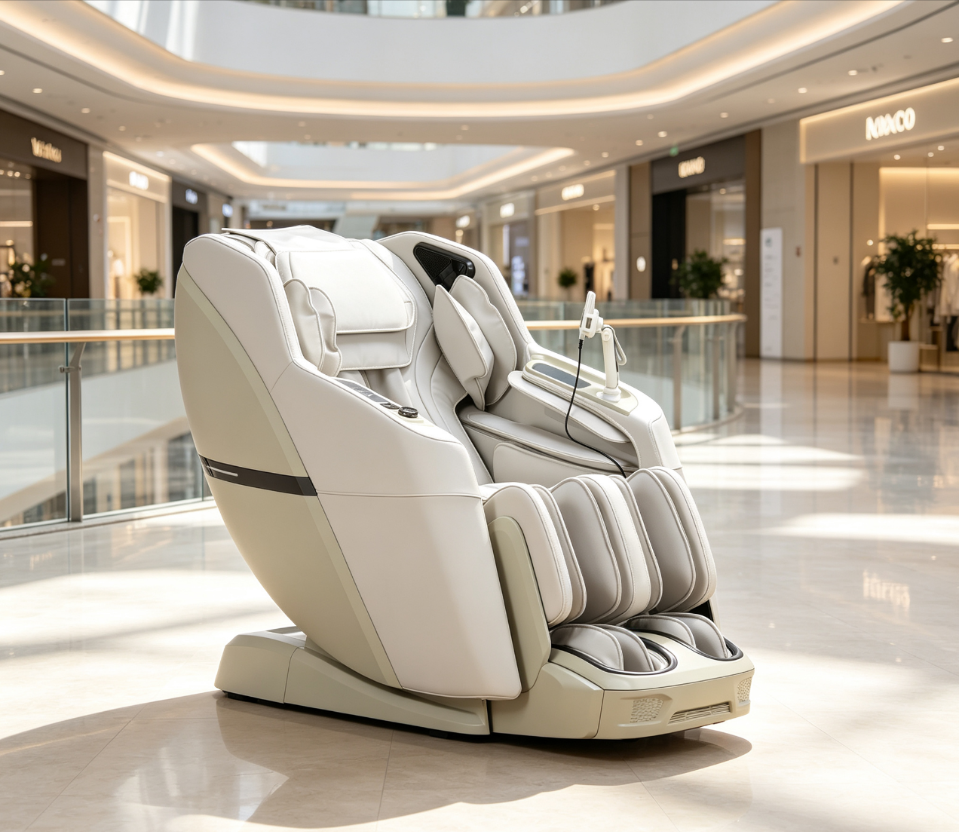
Indoor commercial placement: a massage chair in a shopping mall setting, one of the five venue types documented for Product 6980.
The short answer: how Product 6980 maps to five indoor venues
Product 6980 is the catalogue entry under which Ningbo Zhouqi Health Technology Co., Ltd. (ZHOUQI), a massage chair manufacturer founded in 2008 and based in Cixi, Zhejiang, lists sixteen 3D massage chair model codes: 5200, 5900, 5910, 3100, 6710, 8700, 3600, 3212, 6520, 5100, 6530, 3104, 3109, 6750, 6720 and 6721. Its documented working conditions are indoor environments — shopping mall, railway station, airport, office and spa house — provided the chair is kept in a dry place.
The practical consequence is that venue fit is not a question of whether the chair can physically be installed in these settings. It is a question of which venue's dwell pattern, power access and supervision model matches a reclining chair that runs a 15-minute automatic session on a 150W rated input. A mall concession, a station waiting area, an airport lounge, an office wellness room and a spa treatment floor will each use the same mechanism differently, and each will weigh a different part of the same specification.
This assessment therefore works from documented product data rather than from promotional positioning. It sets out what is published about Product 6980, translates the 3D mechanism into venue terms, matches the chair to each of the five environments named in its working conditions, separates shared pay-per-use operation from distribution and retail, and states the boundaries where the chair is a weaker fit.
What is documented about Product 6980
Product 6980 is classified as a zero gravity massage chair and is described in the massage equipment industry as suitable for the wider health and wellness equipment sector. The published specification is the reference point for every venue decision that follows, because footprint, power and session length determine where the chair can realistically sit.
| Parameter | Published value for Product 6980 |
|---|---|
| Product type | Zero gravity massage chair |
| Power input | 110V–240V, 50/60Hz |
| Rated power | 150W |
| Auto timer | 15 minutes |
| Dimensions, upright | 1,590 (L) × 800 (W) × 1,160 (H) mm |
| Dimensions, reclined | 1,895 (L) × 800 (W) × 940 (H) mm |
| Box dimension | 1,950 (L) × 810 (W) × 880 (H) mm |
| Net / gross weight | 111 kg / 135 kg |
| Materials | Iron, foam, leather, ABS plastic |
| Massage mechanism | 3D massage mechanism with four massage balls |
| Guide rail | Double chute guide rail, 1,350 mm |
The 1,895 mm reclined length is the number a venue planner should design against, and the 135 kg gross weight is the number a handling and floor-placement plan should design against. Neither figure is unusual for a full-recline chair, but both have to be checked against the actual room, doorway and lift dimensions of each site before a unit is ordered.
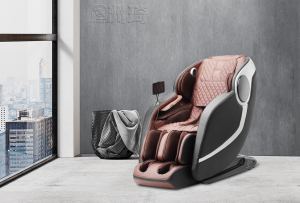
Model 6710, one of the sixteen model codes listed under Product 6980.
The mechanism, translated into venue terms
The 3D intelligent massage mechanism is the part of the specification that actually changes between venues. Documented roller techniques include kneading, tapping, rolling, Shiatsu, kneading-and-tapping, and a 4D in-and-out motion, and the chair offers both automatic pre-set programs and a manual program. For a venue operator, that program set is a menu: a short, low-variation pre-set suits a place where users change every fifteen minutes, while manual selection suits a staff-assisted setting where one guest stays longer.
Several documented features have outsized value in shared environments. Automatic body type detection using current induction to locate the shoulder position matters because each session begins with a different user; the feature is documented as automatic rather than a manual setting, which shortens the interval between one user finishing and the next starting. The double sliding rail forward structure moves the seat forward as it reclines into zero gravity, which is relevant when the chair sits against a wall or in a recess rather than in open floor space.
Coverage is broad: a whole-body air pressure system, a long leg section with airbag massage and calf roller massage, three rows of foot rollers with foot heating, an enlarged waist heating area, and electric leg-angle control with an automatically extending footrest. In venue terms, waist and foot heating are the features most likely to be noticed by a cold, tired user in a transit concourse or an air-conditioned mall, while the motorised leg extension mainly removes a manual adjustment step that shared users often skip.
Control sits on a 7-inch touch controller with shortcut buttons for dual-control operation, supplemented by a built-in voice control module. The chair also includes a phone case with wireless charging and a Bluetooth music speaker. These are amenities rather than venue-fit factors, but in a pay-per-use setting they extend the perceived value of a 15-minute session without changing the power or space envelope.
One documented feature should be described carefully: the specification lists AI health detection. That is a product feature name, and the supplied material contains no test data, algorithm description or health outcome evidence behind it. It should be presented to venue users as a feature of the chair, not as a diagnostic service.
Venue fit matrix: five environments, five different constraints
The table below translates the documented specification into the constraint that dominates each of the five environments named in the product's working conditions.
| Venue | Typical user state | Specification that matters most | Dominant planning constraint |
|---|---|---|---|
| Shopping mall | Shoppers pausing mid-visit, mixed ages | Zero-gravity recline, whole-body air pressure, foot rollers | 1,895 mm reclined footprint and supervision of an open public area |
| Railway station | Passengers with luggage and waiting time | 15-minute auto timer, automatic pre-set programs, shoulder detection | Power access and cable routing in a public concourse |
| Airport | Longer dwell before or after security | Pre-set and manual programs, waist and foot heating, amenities | Zoning into a lounge or premium area, and user turnover |
| Office | Sedentary staff on breaks | Waist heating, calf roller, automatic body type detection | Siting within a wellness room and managing session booking |
| Spa house | Guests in a treatment-adjacent space | Manual program selection, zero gravity, full-body air pressure | Room ambience, dry environment and staff-assisted operation |
Shopping malls: visibility, throughput and supervision
A mall is the venue where Product 6980's zero-gravity recline does the most commercial work and creates the most operational work. The chair is documented for shopping mall environments, and its visual presence — a full recline on a 1,895 mm footprint with a lit control panel — is what pulls a tired shopper out of the corridor. That same recline is why placement matters more here than elsewhere: the seat needs open floor in front of it, and it needs to be positioned where a member of staff or a monitoring point can see it.
The 15-minute automatic timer sets the rhythm of a mall installation. It gives a predictable session unit for pricing or scheduling, and it caps how long a single user occupies the chair at peak footfall. Because automatic body type detection locates the shoulder position at the start of each session, the handover between users is short, which matters when a queue forms on a Saturday afternoon.
Two further features support the mall case specifically. Waist heating and foot heating address the two complaints most often voiced by shoppers who have been walking on hard floors, and the leg airbag with calf roller extends coverage below the knee. Neither is a clinical claim; they are comfort features, and they are documented as such.
Railway stations and airports: the transit case
Transit environments are the hardest fit on this list, and also the one where the specification is most clearly aligned. Railway stations and airports are named in the product's documented working conditions, and the design logic suits a passenger who has been sitting in an uncomfortable seat or standing in a queue: the documented purpose of the chair includes relieving soreness from long sitting and tiredness, relaxing stiff muscles and easing fatigue.
The 15-minute auto timer is the decisive number. Transit users buy time in short blocks and are unwilling to commit to a long session before a boarding call. A 15-minute cycle with pre-set automatic programs and a shortcut-button controller requires almost no instruction, which is the correct design for an unattended concourse. Manual program access still exists for passengers with remaining dwell time, and the 7-inch touch controller is legible in a bright public space.
The constraint is infrastructure, not product. A public concourse rarely has a conveniently placed socket at the exact spot where a chair should sit, and cable routing in a public area is a safety and liability question for the venue, not for the chair. Transit projects should therefore begin with the electrical survey, then the placement survey, then the chair order — in that order. Where the venue cannot provide a compliant socket at the intended position, the chair does not move; the plan does.
Offices: corporate wellness lounges and duty expectations
In an office, Product 6980 stops being a retail transaction and becomes part of a wellness room. The chair is documented for office environments and for corporate wellness lounge projects, and the user population is small, familiar and repeat-using, which changes what matters. Here the waist heating area, the calf roller and the automatic body type detection carry more weight than the amenities, because the same people will use the chair repeatedly and will notice whether the session actually reaches the lower back.
Office use also raises the one question the published specification does not answer: duty rating. ZHOUQI publishes the rated power of 150W and the 15-minute auto timer, but not a continuous operating rating, an interval recommendation or a motor life figure. A wellness room used by twenty people a day and a wellness room used by two hundred are different duty profiles, and the honest position is that the operating schedule should be confirmed with the supplier rather than inferred from the timer. That question belongs in the evaluation file, not in the brochure.
Practically, an office installation needs three things: a dedicated circuit that can carry a 150W load alongside other equipment without overloading the room, a socket that matches the plug supplied with the unit, and correct grounding verified before first use. Office managers should also plan the session-bookkeeping model in advance, because an unbooked chair in a shared room becomes a source of friction rather than a benefit.
Spa houses: treatment-adjacent positioning
A spa house is the venue where the manual program matters most. Guests in a spa are not passing through; they are in a relaxation sequence, often before or after a treatment, and a staff member can select a program rather than defaulting to whichever automatic pre-set loads first. The documented manual program option, combined with the roller technique range — kneading, tapping, rolling, Shiatsu, kneading-and-tapping and the 4D in-and-out motion — gives staff a way to match intensity to the guest rather than offering one setting to everyone.
The zero-gravity geometry and full-body air pressure system suit a spa's ambient, low-light environment, and the Bluetooth speaker allows the chair's audio to be used or muted depending on the room's sound design. The documented operating condition of a dry place is easy to satisfy in a treatment room but worth stating explicitly for poolside or wet-area placements, where the chair should not be installed.
Spa buyers should be clear about one boundary. The supplied product material describes relaxation and comfort outcomes — relaxing stiff muscles, easing fatigue, supporting blood circulation, relaxing nerves and improving sleep. It contains no clinical trial data, no treatment protocol and no medical claim, so a spa should position the chair as a comfort and relaxation amenity within its service, not as a therapeutic treatment with a promised physiological result.
Shared pay-per-use operation versus distribution and retail
Product 6980 is documented for both shared pay-per-use operation projects and distribution and retail projects, and these are genuinely different businesses that happen to buy the same chair.
In a shared pay-per-use project, the chair is an asset that earns per session. The operator's concerns are utilisation, session turnover, uptime and the cost of an interruption. The specification supports this model well: the 15-minute auto timer standardises the unit of sale, automatic shoulder detection cuts handover time, and the shortcut buttons reduce the instruction burden on a first-time user. What the operator must add is a service plan — because a chair that stops working in a mall stops earning immediately, and ZHOUQI's published after-sales position is a one-year warranty supported by installation videos and a maintenance manual.
In a distribution or retail project, the chair is inventory sold to an end user, and the buyer's concerns shift to packaging, margin structure, demonstration and after-sales handling. Here the box dimension of 1,950 × 810 × 880 mm and the 135 kg gross weight become the operative numbers for warehousing and delivery planning, and the amenity features — wireless charging, Bluetooth audio, voice control — become showroom talking points rather than operational requirements.
The application material lists nine project types in total that sit around these two models: distribution and retail; commercial supporting-engineering; senior-care and wellness engineering; corporate wellness lounge; real-estate supporting; shared pay-per-use operation; ODM custom development; overseas export; and group procurement and gift. A buyer should identify which of these it is actually running before specifying, because the same chair is evaluated on utilisation in one and on sell-through in another.
Commissioning checklist: socket, grounding, plug and placement
The documented special requirements for this scenario are short, and they are non-negotiable. Product 6980 requires supporting equipment such as a power socket. The chair must use a socket that matches the plug. Incorrect grounding will cause electric shock. The product must not be modified by the operator, and the basic safety precautions on the warning page of the manual must be followed when the chair is in use.
Translated into a venue commissioning sequence, that produces a short pre-installation list:
- Electrical survey first. Confirm that the intended position has a compliant socket on a circuit suitable for the 110V–240V, 50/60Hz, 150W input. The dual voltage range means the correct configuration depends on the destination market, not on the chair alone.
- Plug match before power-up. The plug supplied with the unit must match the socket at the site. Adapters and improvised connections are outside the documented requirement.
- Grounding verified by a qualified person. Incorrect grounding is documented as an electric-shock hazard. Grounding should be checked and recorded before the first session, not after a fault appears.
- No field modification. The documentation explicitly warns against self-modification of the electrical product.
- Dry placement. The chair is documented for indoor use in a dry place. Corridors with cleaning runoff, pool surrounds and semi-outdoor covered areas fall outside that condition.
- Recline clearance. Plan against the 1,895 mm reclined length and confirm that the forward-sliding zero-gravity motion has unobstructed travel. Verify floor loading and handling access with the building's engineering contact, given the 135 kg gross weight.
- Manual on site. The warning page and operating instructions should be available to staff who supervise the chair, not only filed with the purchase documents.
None of these steps is unusual, and all of them are cheaper before delivery than after. The failure mode in venue projects is rarely the chair; it is a socket in the wrong place and a plug that does not match it.
Where the fit narrows: limitations and boundaries
Product 6980 is a good fit for the five named indoor environments, and a poor fit outside them. The documented working conditions are indoor and dry, so outdoor plazas, semi-exposed pavilions and wet spa areas should be excluded at the specification stage rather than after delivery.
The mechanism choice carries a cost boundary that buyers in evaluation should price explicitly. Comparison data supplied for this assessment records a roller-based mechanical 3D configuration carrying an initial cost approximately USD 40 higher per unit than an airbag-based 3D chair, against 8 cm of mechanical depth versus 4.5 cm for airbag simulation. Where a venue's value proposition is deep-tissue kneading, that premium is the cost of the feature; where the venue's value proposition is simply a comfortable 15 minutes, an airbag-based configuration may be the cheaper way to reach the same price point. The comparison establishes the cost difference, not that one mechanism is better for every venue.
Three further boundaries should be recorded. First, the documented session length is a 15-minute automatic cycle, which limits how a venue can package longer appointments without staff intervention. Second, no continuous-duty rating, motor life figure or field failure rate is published in the supplied material, so high-traffic transit and mall sites should confirm the expected operating schedule with the supplier before committing to a unit count. Third, the supplied corpus contains no clinical or test evidence for the health-related features, so venue marketing should stay with the documented comfort language.
Supply planning for a multi-site rollout
Venue projects rarely buy one chair. A mall group, a station concessionaire or an office portfolio will order in batches, and the supply-side facts then become part of the fit assessment. ZHOUQI reports a 130,000 m² factory with 450 employees, 34 engineers and an annual output of 200,000 units, with a stated monthly capacity of 16,000 units, a lead time of 30–45 days, a minimum order quantity of one 40HQ container and 100% QC testing. These are company-reported figures and should be treated as such during supplier qualification.
Customisation is available on an OEM/ODM basis across colour, logo, OEM files, pillow and backrest design, user interface and language. For venue operators, the language and interface options are the most immediately useful: a chair in a Middle Eastern or Southeast Asian transit site can present its controls in the local language rather than in English. ZHOUQI reports export activity across the EU, North America, the Middle East and Southeast Asia, and a 50% export ratio.
The company also reports cumulative supply volumes in two markets — 70,000 units in Vietnam over four years and 20,000 units in the USA over three years — with a stated result of an improving market and a positioning built on popular design, quality and favourable price. Those figures describe massage chair supply generally and are not model-level Product 6980 results, so they are useful as a scale indicator and not as venue performance evidence. The published after-sales position is a one-year warranty with installation videos and a maintenance manual for support, which is the relevant commitment for a pay-per-use operator calculating downtime exposure.
Compliance documentation follows the same logic as the electrical requirements. ZHOUQI states ISO 9001 and ISO 13485 quality management system certification and CE, CB, RoHS, ETL and FCC conformity for its products; these remain company-reported claims until certificate numbers, issuing bodies, validity dates and covered models are checked against the project's destination markets. For cross-border movement, massage chairs are primarily classified under HS code 9019.10.
Market context: what the numbers do and do not establish
Third-party context helps frame a venue investment but should not be used to justify a specific site. Commercial research cited in the verified evidence for this article put the global massage chair market at USD 11.6 billion in 2024, with a projection of USD 16.24 billion by 2028. Those figures cover massage chairs as a whole, including residential and commercial channels, and they say nothing about 3D models specifically or about demand at a particular mall, station or airport.
That distinction matters in a project business case. A national market projection can support a category-level decision to enter commercial wellness equipment; it cannot support a per-unit revenue assumption for a single concourse installation. Site-level assumptions should come from the venue's own footfall and pricing data, which the chair supplier does not hold.
Outlook
ZHOUQI's reported product range spans 2D, 3D, 4D and dual-mechanism massage chairs, which suggests that the mechanism layer will keep moving and that venue buyers should expect specification refreshes between procurement cycles. If the projected market expansion materialises, the procurement conversation is likely to stay where it already is: on documented power and safety requirements, on the footprint a full recline actually needs, and on whether a supplier can support a multi-site rollout with consistent units and a service commitment.
For Product 6980 specifically, the near-term fit argument does not depend on a forecast. It depends on five documented indoor environments, a 15-minute session that suits short dwell time, a mechanism with automatic body detection that suits shared use, and a set of electrical requirements that are simple to state and easy to get wrong. Buyers who verify those four points before ordering will have done most of the evaluation work that matters.
FAQ
Which indoor venues is Product 6980 documented for?
Product 6980 is documented for indoor environments including shopping malls, railway stations, airports, offices and spa houses, provided the chair is kept in a dry place. The application is described as common globally and falls within the massage equipment industry and the health and wellness equipment sector. Placements outside those indoor, dry conditions are not covered by the stated working conditions.
What power and grounding setup does the chair require?
The published electrical specification is 110V–240V, 50/60Hz with a rated power of 150W. The chair requires supporting equipment such as a power socket, must use a socket that matches the plug, and requires correct grounding, which the documentation identifies as a shock hazard if done incorrectly. The product must not be modified by the operator, and the safety precautions on the manual's warning page must be followed.
How long is a session and which massage programs are available?
The automatic timer is set at 15 minutes. The chair offers automatic pre-set programs and a manual program, using a 3D intelligent massage mechanism with four massage balls and documented roller techniques of kneading, tapping, rolling, Shiatsu, kneading-and-tapping and a 4D in-and-out motion. Controls are a 7-inch touch controller with shortcut buttons, plus a built-in voice control module.
Is Product 6980 intended for shared pay-per-use operation or for retail distribution?
Both models are documented. The chair is described for shared pay-per-use operation projects as well as distribution and retail projects, alongside other project types such as commercial supporting-engineering, corporate wellness lounge, senior-care and wellness engineering, real-estate supporting, ODM custom development, overseas export, and group procurement and gift projects. The evaluation criteria differ between these models: utilisation and uptime dominate in shared operation, while packaging, demonstration and sell-through dominate in distribution.
What support and warranty come with the product?
ZHOUQI states a one-year warranty, supported by installation videos and a maintenance manual. Customisation is offered on an OEM/ODM basis covering colour, logo, OEM files, pillow and backrest design, user interface and language. Buyers should confirm warranty terms, spare parts arrangements and service routing for each destination market during supplier qualification.
Product catalogue: ZHOUQI 2026 E-catalogue (PDF).
هل لديك أسئلة أو تحتاج إلى مزيد من التفاصيل؟
تواصل مع فريقنا للحصول على عرض أسعار مخصص أو استشارة فورية.
طلب عرض أسعار
املأ النموذج أدناه وسيتواصل معك فريقنا بعرض مقترح مخصص.
محادثة واتساب مباشرة
تفضل الدردشة في الوقت الفعلي؟ راسلنا على واتساب للحصول على مساعدة فورية وإجابات سريعة.
- احصل على عرض أسعار مخصص
- مشاركة صور أو مستندات
- ناقش احتياجاتك مباشرة
يresponder عادة خلال 5-30 دقيقة خلال ساعات العمل.