
Product 8233 BN Coating: Aluminum vs Magnesium Die Casting
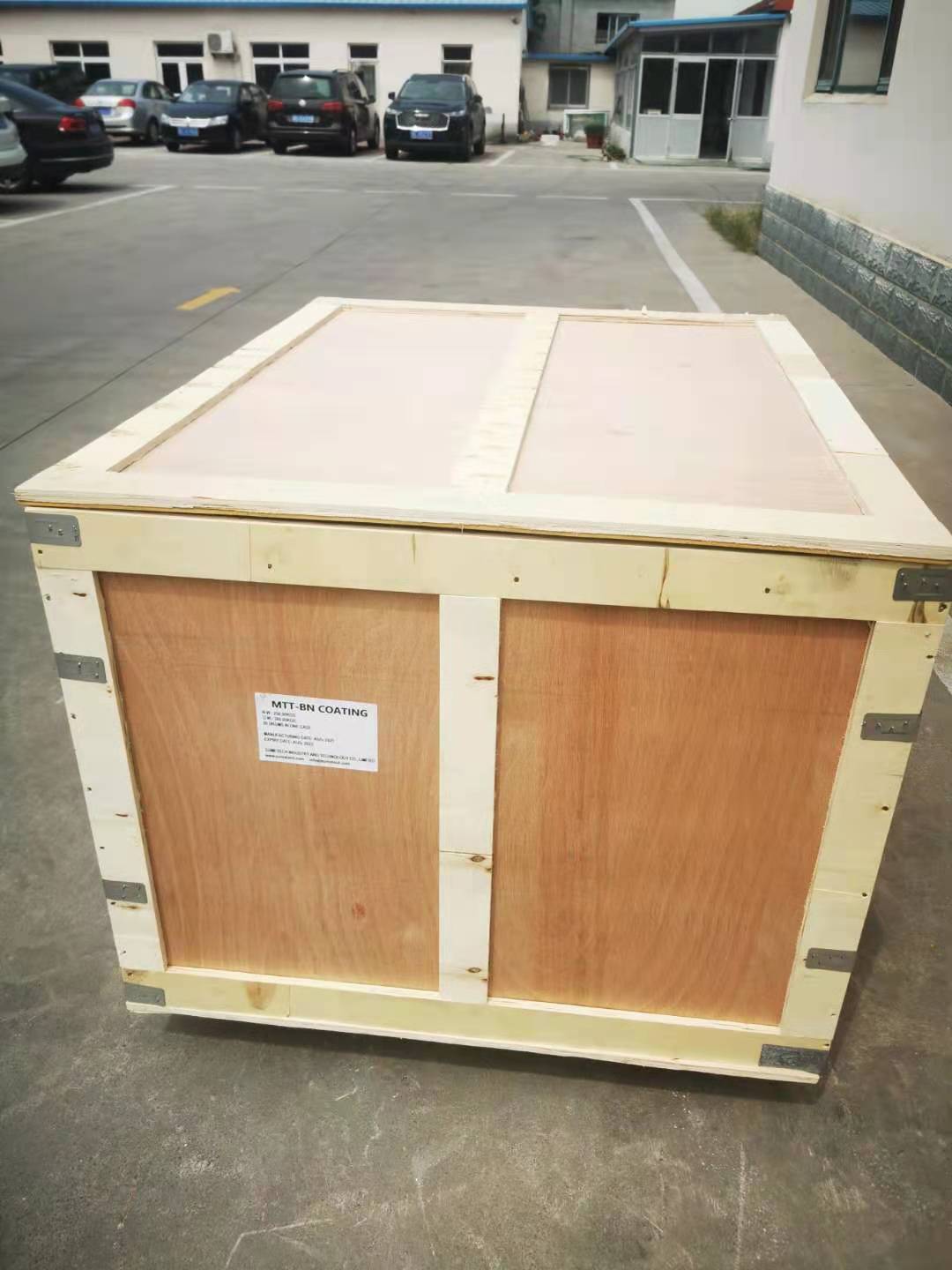
Export packing of boron nitride coating in wooden cases — the shipment stage where application fit, batch records and storage conditions meet.
Two die casting plants can run the same release coating and report opposite results, and the difference is rarely the product label. It is usually whether the coating was qualified against the melt it actually touches. Aluminum and magnesium are both cast against coated steel tooling — dies, troughs and ladles — but the two melts place different demands on the coating surface, and those demands change which property matters most and which evidence a buyer should demand before production sign-off.
Boron nitride (BN) is a ceramic release material used in both cases because it remains non-wetting against most molten metals and chemically stable at high temperature. Product 8233 is the boron nitride coating supplied by Sumetech Industry Co., Ltd for these duties. This comparison treats 8233 as a process input rather than a catalogue item: how it fits an aluminum cell versus a magnesium cell, how manual brushing and spraying change the result, and which purchasing, acceptance and storage terms should be fixed before the first production batch.
Why Two Die Casting Cells Need Two Answers
The evaluation starts with the melt, not the data sheet. In both aluminum and magnesium die casting, the coating has one primary job: prevent molten metal from soldering to the tooling surface and building up where it should not. Beyond that shared requirement, the two processes diverge in chemical reactivity, and reactivity determines how much weight a buyer should place on non-wetting behavior versus corrosion resistance of the tooling surface.
A further complication is commercial. Buyers frequently select a coating on unit price, then discover through downtime that cleaning labor, die maintenance and scrap dominate the real cost. Because boron nitride coatings are priced above some alternative release agents, the justification has to be made on process evidence — release consistency, cleaning frequency and surface quality — rather than on price per kilogram alone.
That is the gap this comparison addresses. The question is not whether boron nitride works in die casting; the material properties are well established. The question is whether the same coating, under the same commercial terms, can be used across an aluminum line and a magnesium line, and where the two applications require separate validation.
The Procurement Problem Is Adhesion, Not Appearance
Release failure rarely announces itself at the spray station. It surfaces later as build-up on die surfaces, sticking in ejector areas, more frequent cleaning between shifts, escalating surface defects on the casting, and premature tooling wear. By the time these symptoms are visible, the coating has already been treated as a consumable line item rather than a controlled process input.
A more defensible procurement sequence defines the requirement surface by surface: cavity, sprue area, runner, trough and ladle each contact the melt differently and each carries its own release demand. Once those surfaces are listed, the coating can be qualified against them, and acceptance can be written around observable process outcomes instead of a generic product description.
Two material properties carry most of that qualification weight for boron nitride: non-wetting behavior against molten metal, and corrosion resistance of the contact surface. Neither is adequately assessed by reading a specification sheet; both need a trial in the plant where the coating will run.
What Product 8233 Is, and the Supplier Behind It
Sumetech Industry Co., Ltd is a China-based manufacturer of boron nitride and potassium aluminium fluoride products, founded in 2019 and operating a 6,000 m² facility with 20 employees and an annual output of 5,000 MT. Approximately 90% of its products are exported, with Turkey, Japan, Korea and Europe named as main markets.
Product 8233 sits within that boron nitride portfolio as a coating for high-temperature release. The company offers customizable production for boron nitride products, covering particle size distribution, morphology, purity grades and packaging specifications — a detail that matters when two plants intend to apply the same product by different methods, or when one plant needs a packaging format suited to manual brushing and another to spray equipment.
Quality and development capacity are relevant to a multi-year coating decision. Sumetech's R&D and quality control team consists of 5 full-time senior engineers with experience in inorganic fluoride chemistry and powder processing, and the company maintains large raw material inventories on site to support uninterrupted production and fast lead times. Its laboratory has passed CMA (China Measurement Certification) and CNAS (National Laboratory Accreditation), according to the company's published information.
Product 8233 at a glance
- Material class: boron nitride coating for high-temperature release and lubrication.
- Behavior against melts: non-wetting and corrosion-resistant against most molten metals and chemicals.
- Thermal stability (material property): approximately 900°C in air; above 2000°C in an inert atmosphere.
- Compatible application methods: brush and spraying machine.
- Commercial terms: MOQ 10 kg; delivery FOB / CIF / FCA; acceptance by pre-shipment test; payment 30/70.
- Storage: keep dry and sealed; use before the expiration date.
Non-Wetting and Corrosion Resistance Against Molten Metals
Boron nitride coatings are built on hexagonal boron nitride (h-BN), a layered material often described as white graphite. Within each layer, atoms are held by covalent bonds; between layers, the interaction is weak. That structure allows the layers to slide and shear under low friction, and reported friction coefficients for h-BN fall in the 0.01–0.05 range. More importantly for die casting, the material is chemically inert toward most molten metals, glass and salts, so it does not bond to the melt and does not readily react with the tooling beneath it.
On the shop floor, those properties resolve into two practical outcomes. Non-wetting behavior means molten metal releases from coated surfaces instead of soldering to them, which supports easier part removal, extended tool life and better casting surface quality. Corrosion resistance means the coated surface is less exposed to chemical attack from the melt and from process atmosphere, which protects the tooling substrate across repeated cycles rather than just within a single shot.
The material also combines thermal conductivity, high-temperature electrical insulation with a low dielectric constant, and non-toxicity — properties that matter where a coating sits close to heaters, sensors or electrically sensitive hardware. Thermal stability is a further factor: approximately 900°C in air and above 2000°C in an inert atmosphere. Those figures describe the material, not a finished film. Film performance depends on substrate preparation, film thickness, the binder system and the drying or curing step, which is why the same product can behave differently across two plants.
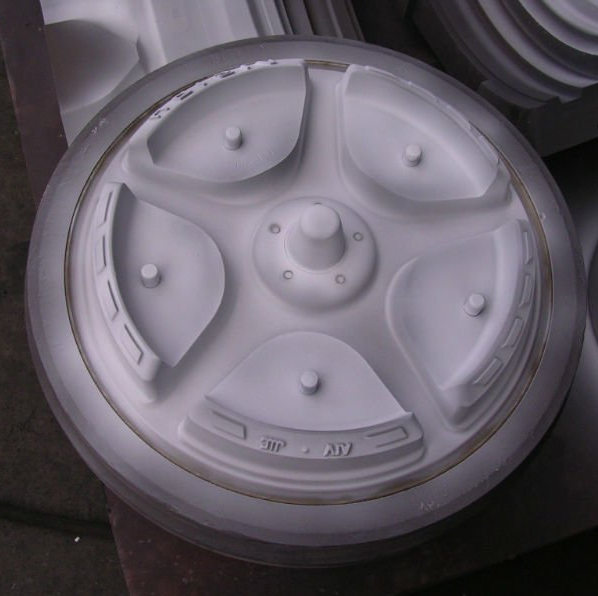
Boron nitride coating: the release layer sits between molten metal and tooling, where non-wetting behavior and chemical inertness do the work.
Aluminum Die Casting: Volume, Surface Quality and Tool Life
Aluminum is the higher-volume entry point for most coating evaluations, particularly in automotive die casting plants where cycle discipline and surface consistency are already tightly managed. Boron nitride coatings are applied to molds, troughs and ladles handling aluminum alloys to enable easy release, extend tool life and improve casting surface quality.
The buyer priorities in an aluminum cell are usually consistency-related rather than temperature-related. Film uniformity across a complex cavity, the rate at which build-up forms in specific die zones, and the cleaning interval that the plant can realistically sustain tend to decide whether a coating stays in the process. Because aluminum die casting runs at scale, it is also where most supplier evidence originates — a convenience that creates a transfer risk examined below.
For procurement, the practical implication is that an aluminum trial should be structured to produce reusable evidence: which surfaces were coated, by which method, at what film condition, and with what cleaning interval observed. Without that record, the trial proves only that parts came out, not that the coating is suitable.
Magnesium Die Casting: A More Reactive Melt Raises the Evidence Bar
Magnesium is chemically more reactive than aluminum, and that single difference reshapes the coating evaluation. A more reactive melt places greater stress on the interface between metal and tooling, so properties that might be background considerations in aluminum — non-wetting behavior and corrosion resistance of the contact surface — become qualification criteria in their own right.
This is where buyers most often make an expensive assumption. Release results obtained on an aluminum line should not be transferred to a magnesium line as if the coating were being evaluated under identical conditions. The correct sequence is a separate trial on the magnesium process, using the same acceptance logic but generating its own release, cleaning and surface-quality record. If a supplier cannot support that separate evaluation, the buyer is effectively accepting unverified risk on the more demanding of the two melts.
Magnesium plants should also apply stricter handling discipline around the coating itself. Because the product is supplied as a coating that must be kept dry and sealed and used before its expiration date, moisture ingress or an expired batch introduces a variable that will be misread as a performance failure. Batch traceability from container to trial matters more here than in a lower-reactivity process.
One boundary deserves stating plainly: a release coating is a single control layer. It does not replace melt protection practice, die temperature control or cycle discipline, and no coating specification should be read as a substitute for those process controls.
Brush or Spray: How Application Method Changes the Result
Product 8233 is compatible with two application methods: manual brushing and spray application using a spraying machine. The distinction is not cosmetic. The same product applied two different ways produces two different films, and film condition directly affects release behavior and cleaning frequency.
Manual brushing gives the operator close control. It suits localized repair, edges, deep cavities and short runs, and it requires little capital equipment. Its weakness is repeatability: film thickness depends on operator technique, so two shifts can produce two different surfaces on the same die. Spraying supports faster coverage and more uniform film across large die faces, and it becomes repeatable once pressure, distance and pass count are fixed — but it requires equipment, extraction and a defined procedure that the plant must maintain.
For buyers at the execution stage, the practical rule is that application method belongs in the trial protocol, not in the operator's discretion. Record the method, the number of passes and the film condition observed, and treat a later change of method as a process change that requires re-qualification. This is one of the most common sources of disagreement between a plant that reports poor release and a supplier whose product performed as expected elsewhere.
Aluminum vs Magnesium: Comparison Matrix for Buyers
The matrix below converts the preceding discussion into evaluation rows. It compares application fit, not product ranking, and it uses only properties and terms that can be verified against the product and supplier documentation.
| Evaluation row | Aluminum die casting | Magnesium die casting |
|---|---|---|
| Primary release requirement | Prevent soldering and build-up on molds, troughs and ladles; protect casting surface quality. | Same requirement, applied to a more reactive melt that places greater stress on the metal-to-tooling interface. |
| Property to weight most heavily | Non-wetting behavior plus film consistency across the cavity. | Non-wetting behavior plus demonstrated corrosion resistance of the contact surface. |
| Trial scope | Production trial on the target die, recording method, surfaces and cleaning interval. | Separate trial required; aluminum results should not be extrapolated. |
| Application method fit | Brush for repair and small runs; spraying machine for large die faces. | Same two methods; parameters must be fixed and recorded, since a method change alters the film. |
| Thermal verification | Confirm actual contact temperatures against material stability of about 900°C in air and above 2000°C in inert atmosphere. | Same verification; the material figure is not a film rating and must be matched to measured conditions. |
| Storage and handling | Keep dry and sealed; use before the expiration date; first-in-first-out at the coating station. | Same rule with stricter discipline: moisture or expired stock will be misread as a performance failure. |
| Commercial baseline | MOQ 10 kg; FOB / CIF / FCA; pre-shipment test; payment 30/70. | Identical terms apply to the same product; only the qualification evidence differs. |
Purchasing Terms, Acceptance Criteria and Documentation
The commercial terms attached to Product 8233 are stated plainly: minimum order quantity 10 kg, delivery under FOB, CIF or FCA, acceptance based on a pre-shipment test, and payment terms of 30/70. For a buyer at the execution stage, each of those terms translates into a task before the purchase order is issued.
The pre-shipment test is the item most often left underspecified. Because it is named as the acceptance criterion, its scope should be agreed in writing — which characteristics are checked, which batch is sampled, and what document accompanies the shipment. A named acceptance test without a defined scope gives the buyer little protection when a batch behaves differently from the trial sample.
Documentation is the second checkpoint. A commonly used HS code for boron nitride coating shipments is 28500020, which buyers should confirm with their customs broker against the actual product form rather than assume. For European destinations, boron nitride is compliant with EU REACH (Regulation EC 1907/2006) as a substance used in industrial applications. Where incoming verification is part of the buyer's quality system, the supplier's laboratory accreditation — CMA and CNAS in Sumetech's case — is a relevant supporting fact, not a substitute for the buyer's own inspection.
Storage and Shelf-Life Checkpoints Before Execution
Sumetech's stated requirement for the product is unambiguous: keep dry and sealed storage, and use before the expiration date. Storage conditions are specified as a dry, well-ventilated place. These are simple instructions that are frequently managed informally, and that informality is where avoidable variability enters the process.
Three checkpoints make the requirement operational. First, record the batch and expiry date at goods-in and carry both onto the coating station log, so that first-in-first-out is verifiable rather than assumed. Second, inspect containers on receipt — the product ships in drums and, for export consignments, in wooden cases — and reseal opened containers properly, because a container that is not kept sealed no longer meets the stated storage condition. Third, treat any expired stock as out of specification regardless of appearance, since the instruction is defined by date rather than by visual assessment.
For a magnesium line, where trial results are already being generated under more demanding conditions, this discipline protects the validity of the trial itself. A release problem traced to a breached container is a wasted evaluation, not a product finding.
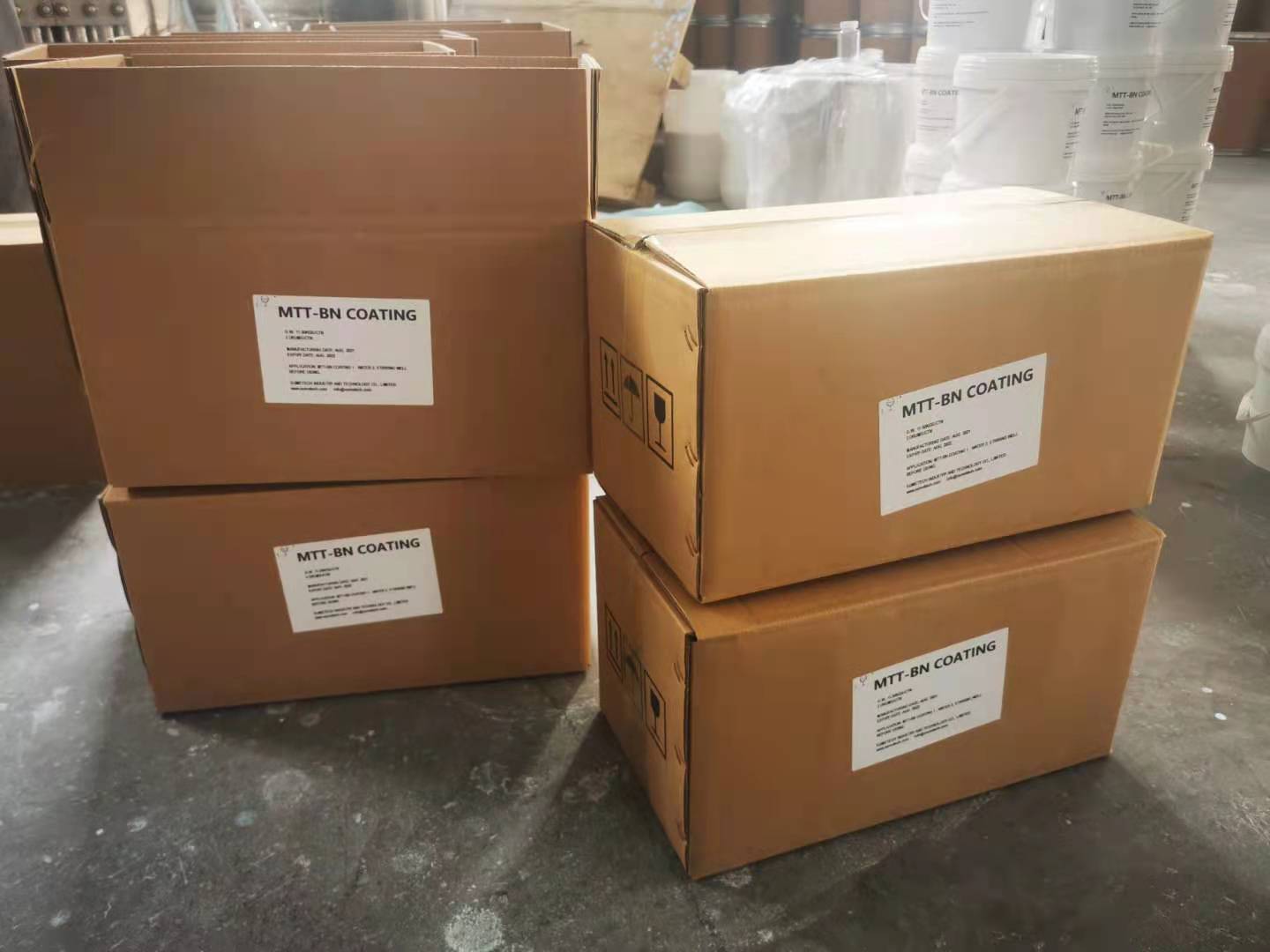
Drum packaging for boron nitride coating: container integrity and batch identification are part of the acceptance record, not an afterthought.
How BN Compares With Graphite-Based Release Agents
The most relevant alternative in high-temperature release work is the graphite-based release agent family. Against that comparison, boron nitride offers high temperature resistance and good surface quality, a lower cleaning cost, and stable performance — the material is not easily deformed or chemically reacted at high temperatures. The trade-off is explicit: boron nitride carries a higher purchase price, but maintenance is much lower.
That trade-off is the honest boundary of the case for Product 8233. A higher unit price is only justified when the cleaning and maintenance savings are measured in the buyer's own plant; a purchasing team that cannot produce that measurement is comparing a purchase price against a total cost it has not quantified. Buyers should also note the temperature boundary: material stability of approximately 900°C applies in air, and higher service temperatures require an inert atmosphere. That is an engineering condition, not a marketing caveat, and it must be checked against measured conditions at the die, trough and ladle.
Two further limits belong in the same paragraph. First, film performance depends on substrate preparation and application method, so a coating that underperforms in one cell may be failing because of preparation rather than chemistry. Second, boron nitride is a release and protection layer, not a repair for damaged tooling or a substitute for process control. Where those conditions are not met, a lower-cost graphite-based agent may remain a defensible option; where surface quality and cleaning cost dominate, the boron nitride case is stronger.
Market Signals Behind the Coating Decision
Published market research gives context for why coating decisions are being re-examined rather than inherited. Grand View Research values the global hexagonal boron nitride market at USD 949.4 million in 2024, with Asia Pacific holding a 40.6% revenue share in that year and China accounting for 41.1% of the Asia Pacific region. The same source identifies paint and coating applications as the largest application share at 32.8% in 2024.
Coating-specific estimates should be read with more caution. Dataintelo values the global boron nitride coatings market at USD 2.8 billion in 2025, but commercial estimates in this category differ substantially in scope and definition — a separate published figure places the hexagonal boron nitride market several orders of magnitude higher, which points to a broader definition rather than a contradiction in demand. Buyers should treat these figures as directional context for supply concentration, not as a basis for pricing decisions.
The procurement implication is practical. With boron nitride supply concentrated in Asia Pacific, continuity depends on supplier inventory policy and lead time as much as on product performance. Sumetech's stated practice of maintaining large raw material inventories on site to support uninterrupted production and fast lead times is directly relevant to that risk, and it deserves to be verified during supplier qualification rather than accepted from a brochure.
Future Outlook
Coating procurement is moving from product selection toward evidence management. Buyers increasingly expect trials that are documented per melt, per surface and per application method, because those records are what allow a plant to distinguish a coating failure from a process change. The aluminum and magnesium comparison in this article is an example of that shift: identical commercial terms, separate qualification evidence.
Two developments are likely to reinforce the pattern. Suppliers with in-house laboratory capability and customizable production — particle size distribution, morphology, purity grades and packaging — will be asked to align a product to a specific application rather than supply a single grade to all customers. And storage discipline will be treated as part of performance management, since shelf life and sealed-container conditions are stated requirements rather than optional good practice.
For boron nitride specifically, the material's position in high-temperature release looks stable where non-wetting behavior and chemical inertness decide the outcome. The open question for any buyer is narrower: whether the supplier can produce application-specific evidence for the melt in question, and whether that evidence survives a production trial.
FAQ
In which fields are boron nitride coatings used?
Boron nitride coatings, primarily based on hexagonal boron nitride (h-BN), are functional layers used in advanced manufacturing for thermal stability, chemical inertness and lubrication. Reported properties include high-temperature resistance, solid lubrication with a low friction coefficient, and chemical inertness — the coating is non-reactive with most molten metals, glass and salts, which prevents adhesion and corrosion. Additional properties include electrical insulation, high thermal conductivity and non-toxicity. Main applications are metal forming and casting, where coatings are applied to molds, troughs and ladles for aluminum, magnesium and zinc alloys to enable easy release, extend tool life and improve casting surface quality; glass and ceramics manufacturing, where coatings act as release layers on glass-forming molds; and sintering and heat treatment, where they are applied to graphite plates to prevent carbon contamination and bonding. Product selection or application technique may need tailoring to metal type, process temperature or substrate.
What are the purchasing terms and acceptance criteria for Product 8233?
The stated terms are: minimum order quantity 10 kg; delivery terms FOB, CIF or FCA; acceptance criteria based on a pre-shipment test; and payment terms of 30/70.
How should the coating be stored, and what shelf-life rule applies?
The product must be kept in dry and sealed storage and used before the expiration date. Storage is specified as a dry, well-ventilated place. Containers should be inspected on receipt and resealed after opening, and expired material should be treated as out of specification.
Which application methods are compatible with the coating?
The compatible equipment is a brush and a spraying machine. Brushing supports localized application and repair; spraying supports coverage of larger areas. Because the method affects film uniformity, it should be fixed and recorded in the trial protocol, and any later change of method should be treated as a process change requiring re-qualification.
Which temperature limits should a buyer verify before use?
Boron nitride shows stability at approximately 900°C in air and above 2000°C in an inert atmosphere. These are material-level figures. Buyers should measure actual conditions at the die, trough and ladle, and confirm whether service occurs in air or under inert atmosphere, since the applicable limit differs between the two.
Can aluminum die casting trial results be reused for magnesium die casting?
They should not be treated as equivalent. Magnesium is chemically more reactive than aluminum, which places greater emphasis on non-wetting behavior and corrosion resistance of the contact surface. A separate trial on the magnesium process is the appropriate basis for qualification, and storage discipline matters more in that evaluation because moisture ingress or expired stock can distort the result.
Reference document: the supplier catalogue covering boron nitride and related product lines is available at Sumetech 2026 catalogue (PDF).
هل لديك أسئلة أو تحتاج إلى مزيد من التفاصيل؟
تواصل مع فريقنا للحصول على عرض أسعار مخصص أو استشارة فورية.
طلب عرض أسعار
املأ النموذج أدناه وسيتواصل معك فريقنا بعرض مقترح مخصص.
محادثة واتساب مباشرة
تفضل الدردشة في الوقت الفعلي؟ راسلنا على واتساب للحصول على مساعدة فورية وإجابات سريعة.
- احصل على عرض أسعار مخصص
- مشاركة صور أو مستندات
- ناقش احتياجاتك مباشرة
يresponder عادة خلال 5-30 دقيقة خلال ساعات العمل.