
Product-Line Proof: What a UHF RFID Reader Portfolio Shows
Industry Reference · Smart Manufacturing
A supplier's published reader line is the most checkable capability evidence a buyer can review before a purchase order exists, provided the buyer reads parameters, interfaces and customisation scope instead of brochure adjectives.
Why capability claims are hard to verify
Procurement teams sourcing UHF RFID readers for smart manufacturing are usually handed the same three artefacts: a company profile, a folder of certificates, and a reference list. All three are relevant, and all three are difficult to verify independently at research stage. A factory photograph cannot be inspected from a desk. A certificate scan says a document exists, not that the current production run conforms. A reference logo says a relationship existed, not that it resembled your project.
The product line behaves differently. It is a set of statements a buyer can read, compare against a workflow list, and challenge in a technical meeting: which reader formats exist, which models sit in each format, which parameters are published, which interfaces and protocols are named, which software path is documented, and which customisation items the supplier is willing to put in writing. None of that proves site performance, but it establishes whether the supplier is structurally able to serve a manufacturing project, and where the gaps will appear.
This guide uses DAILY RFID's published reader portfolio as a worked example. DAILY RFID CO., LIMITED is a Guangzhou, China based RFID manufacturer founded in 2008 that produces RFID tags, cards and readers, with EU and USA listed as its main markets. The aim here is not to argue that the portfolio is superior to any other supplier's. The aim is to show how a portfolio should be read as evidence, and where that evidence stops.
| Evidence type | What it can establish | What it leaves unsettled |
|---|---|---|
| Published product line: formats, models, parameters | Whether the supplier designs and ships the format your process needs | Performance inside your building, with your tags and materials |
| Interface and protocol documentation | Whether a real integration path exists toward MES, WMS or an EAM platform | Compatibility with your middleware until it is tested |
| Customisation scope, MOQ and lead time | Whether the supplier can adapt hardware to your design intent | Whether the quoted terms hold once they are contractual |
| Deployment records | That a format has been exercised in broadly comparable conditions | Transferability of those results to your site |
| Factory size and certificate scans | Commonly presented as the headline proof in supplier packs | Independent verification at research stage |
The last row is the reason this analysis is built on the first four. A buyer evaluating UHF RFID readers can act on a datasheet and a pilot; a buyer evaluating a photograph cannot.
The portfolio, format by format
A reader portfolio is only useful as evidence when it is read by format rather than by model count. Formats answer the operational question; models answer the specification question. The table below maps the eight formats a smart manufacturing buyer typically needs to shortlist against the representative units DAILY RFID publishes for each.
| Format | Representative units | Published detail worth reading |
|---|---|---|
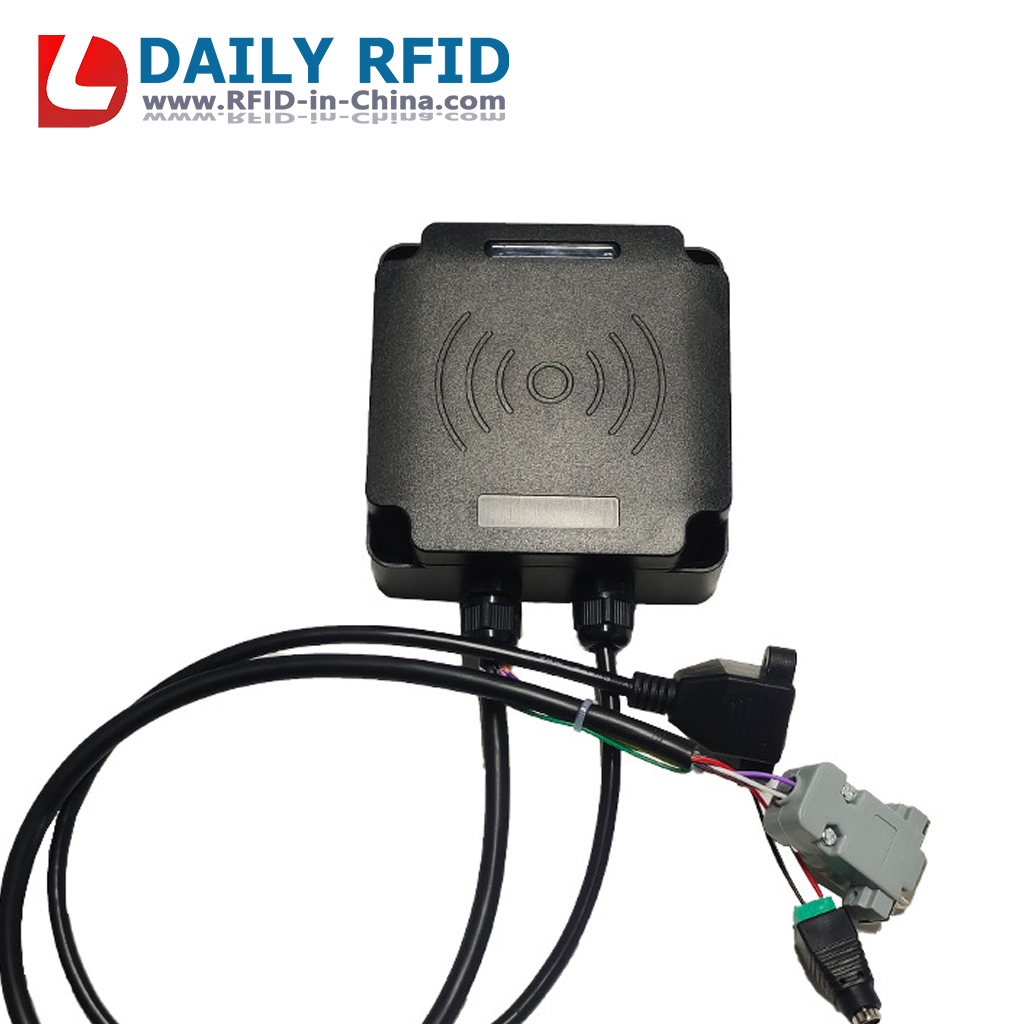
| RFID Fixed Reader | DL921 Power on Ethernet UHF Long Range RFID Reader; DL6940/6960 AI Multi-Antenna 4-Port UHF Reader | Fixed-reader ODM/OEM scope is stated as antenna gain and interface; the quality gate is a factory acceptance test; the published monthly capacity is 1,000 units with a 1 unit MOQ and 15 to 45 days lead time |
| RFID Handheld Reader | DL1280 Industrial PDA UHF/HF/LF Handheld Reader | UHF 860 to 960 MHz, HF 13.56 MHz, LF 125 kHz; transmit power up to 30 dBm or 33 dBm; circular polarised antenna; UHF range 0.1 m to 20 m; up to 100 tags read simultaneously; IP65; Android 12 on an 8-core 2.0 GHz processor with 4 GB RAM and 64 GB ROM |
| AI Powered RFID Reader | DL1380 AI-Powered RFID Handheld; DL9702 AI RFID Tag Tester and Encoder | DL1380: 33 dBm software adjustable, more than 200 tags at once, RSSI ranging and position tracking, IP65 with 1.5 m drop resistance. DL9702: near-field range of 10 cm to 15 cm, 17 dBm, AI single-tag lock filtering, 0.25 W powered directly over USB |
| RFID Gate | DL8330U Advanced UHF RFID Gater | Listed as the gate-level unit for portal and lane reads where identification is triggered by passage rather than by an operator |
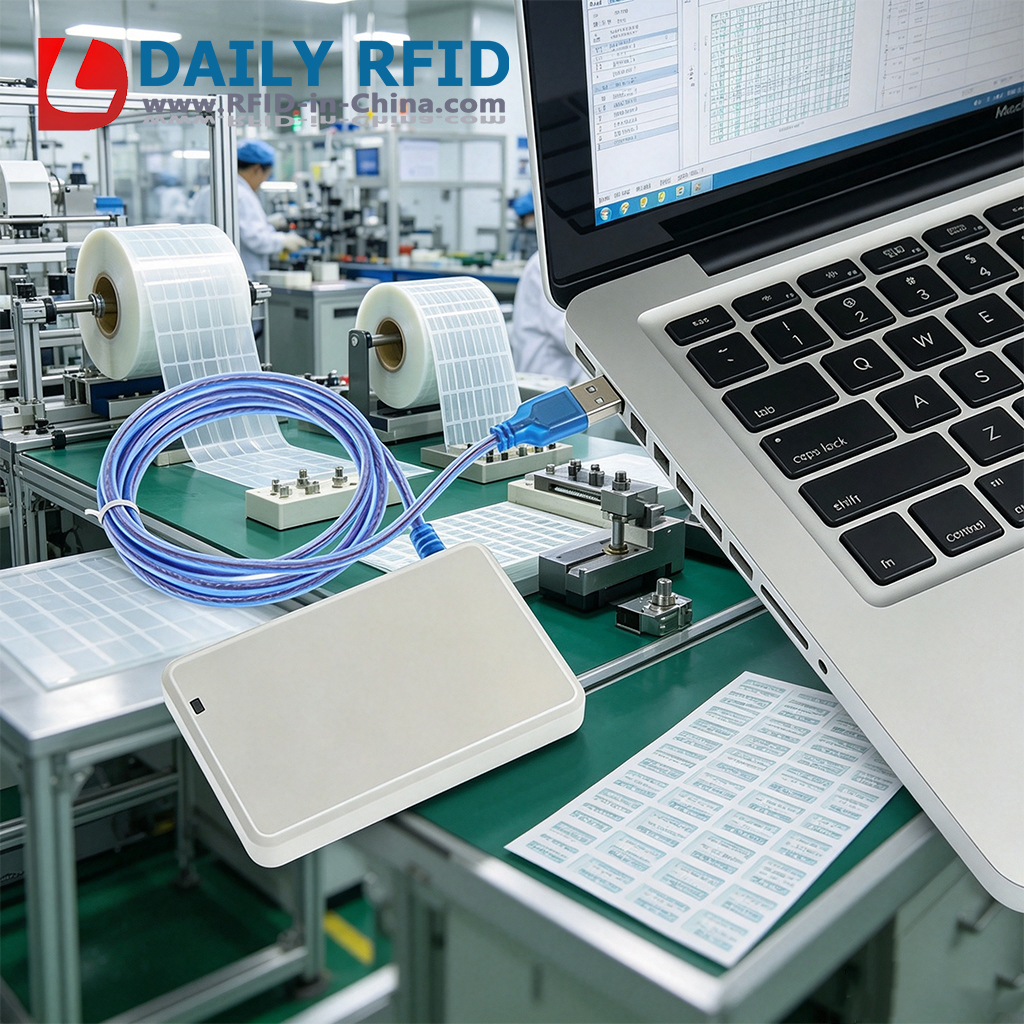
| RFID Printer | High-Speed RFID Label Printer | Appears in workflows where a label is printed and encoded before attachment, so the read point and the labelling station have to agree on data format |
| RFID Module | DL213 Type-C UHF Reader Module; DL228 Type-C UHF Mobile Reader | Module and antenna-level ODM scope is stated in engineering terms: antenna size, cable and connector |
| RFID System | Development-kit format units: desktop encoder, long-handle handheld, embedded panel antenna, tags, multi-language SDK | Demonstrates system packaging, several devices plus an SDK delivered and supported as one bundle rather than as separate purchases |
Two details in the fixed-reader row carry more weight than the model names. First, the customisation scope is expressed as antenna gain and interface, which is engineering language rather than a generic promise of customised solutions. Second, the quality gate is named as a factory acceptance test, which is a step a buyer can ask to witness or to receive documentation for. Neither detail proves reliability on a conveyor or in a cold store, but both tell the buyer what to request in the quotation.
The handheld row shows what a datasheet looks like when it documents its own dependencies. The DL1280 publishes a UHF range of 0.1 m to 20 m and states that the figure depends on the tag and the environment. It then names the protocol set (UHF ISO18000-6C and EPC Class 1 Gen 2, HF ISO15693), the antenna type (circular polarised), the anti-collision figure (up to 100 tags), the read speed (over 100 tags per second), the protection rating (IP65), the operating range of -20 degrees Celsius to 60 degrees Celsius, and the 680 g weight including battery and pistol grip. These are numbers an engineer can argue with, which is the point.
Three questions that separate a datasheet from a marketing sheet
Does the range figure carry its dependencies?
Two units from the same supplier can hold opposite range philosophies. The DL1280 quotes an upper UHF range of 20 m and labels it tag and environment dependent, which tells the buyer the number is a ceiling under favourable conditions rather than a working distance on a metal fixture. The DL9702 AI RFID Tag Tester and Encoder does the reverse: its near-field antenna is engineered for a fixed 10 cm to 15 cm window so that adjacent tags on a crowded workbench are not cross-read during encoding. A buyer who scans only for the largest number on the page will misjudge both products, because one is a search tool and the other is an isolation tool.
Are interfaces named, or merely implied?
Named interfaces are harder to fabricate than named features. The DL1280 documents RS232 through the pin-port charging and data docking connection, RJ45 through an external network docking station, GPIO expansion, USB Type-C, dual-band Wi-Fi, 4G cellular with optional 5G, Bluetooth 5.0 and multi-constellation GNSS. The DL9230 RFID TCP/IP Active Reader lists TCP/IP over RJ45, RS232, RS485 and Wiegand 26/34, with Wi-Fi or 4G optional. The DL1380 lists USB Type-C 2.0 with OTG, RJ45 through a multi-slot charging base, GPIO through internal pin configuration, 5G and 4G cellular, dual-band Wi-Fi and Bluetooth 5.0. A supplier that names the bus, the connector and the optional module is describing an integration path; a supplier that answers that it can connect to your system is describing hope.
Is the software path documented?
For a smart factory the SDK matters more than the antenna gain, because the reader has to behave as a data source inside MES, WMS or an EAM platform rather than as a standalone tool. The DL1280 ships with a free SDK plus documentation, sample code and a demo application for Android 12 development. The DL1380 SDK is described as compatible with Java, Kotlin, Flutter and Xamarin. The DL9702 includes multi-platform development tools and source code scripts. The DL9230 supports SDK and secondary development with demo programs. That is the software evidence a buyer should demand before discussing price.

Reading the word AI correctly
AI has become a label rather than a specification. On a reader datasheet the claim only counts as evidence when it is tied to a behaviour that can be tested. DAILY RFID attaches its AI claim on the DL9702 to defective-tag screening: the unit analyses tag response signals, flags damaged or weak tags, and applies a single-tag lock filter so that neighbouring tags are not mis-written during high-intensity batch encoding, with an average read time under 10 ms per 64 bits. It attaches its AI claim on the DL1380 to inventory behaviour: edge filtering to suppress duplicate reads and interference, RSSI-based ranging and positioning to locate an item inside a dense stack, and tag sorting quoted at more than 200 simultaneous tags with an average single-tag verification time under 10 ms.
Both claims are falsifiable, which is what makes them useful. A buyer can put a known batch of good and damaged tags in front of the DL9702 and check whether the screening report matches reality. A buyer can stack pallets at a known depth and check whether the DL1380 positioning narrows the search area. A claim that cannot be reduced to a test, a parameter or a workflow change should be treated as decoration on the page.
Matching formats to manufacturing workflows
Scenario fit is where a portfolio either helps or misleads. The right question is not which reader is best, but which format survives contact with the physical movement of the material.
| Manufacturing workflow | Format to shortlist | Evidence point in the portfolio |
|---|---|---|
| Station-to-station transition on an assembly line | Fixed reader, multi-port | DL921 and the four-port DL6940/6960 class; antenna gain and interface are named ODM/OEM scopes |
| Dock-door and conveyor reading | Fixed reader | Fixed readers appear across the portfolio's conveyor and cold-store work; quality gate is a factory acceptance test |
| Cold-store pallet movement around -20 degrees Celsius | Fixed reader with cold-chain pallet tags | A cold-chain deployment record describes fixed-reader pallet counting at -20 degrees Celsius with IP67 protection requirements |
| High-bay pallet counting without climbing | AI handheld | DL1380: 20 m UHF range, RSSI ranging and positioning, 4500 mAh host plus 6700 mAh grip battery |
| Tag quality screening before mass production | Desktop AI tester | DL9702: 10 cm to 15 cm isolation, defective-tag flagging, USB power at 0.25 W |
| Vehicle gates, yards and personnel zones | Active 2.4 GHz reader | DL9230: 0 to 100 m adjustable range, up to 200 tags, TCP/IP, RS232, RS485, Wiegand 26/34 |
| Tool cabinets, kiosks and embedded terminals | RFID module | DL213 and DL228 Type-C modules; antenna size, cable and connector are the stated ODM scopes |
| Print-and-encode labelling station | RFID printer | High-Speed RFID Label Printer used alongside fixed and handheld readers in retail and logistics flows |
Portfolio breadth is corroborated, not proven, by the mix of deployments a supplier reports. In DAILY RFID's published case record, a distribution centre in Poland runs 360 DL920S long-range readers for conveyor-line parcel reading and outbound verification; a cold storage and food logistics operator in Malaysia runs 160 DL950S-PoE readers for fixed-door pallet reading, where power-over-Ethernet removes a separate adapter installation; a smart-cabinet manufacturer in Taiwan took 35,000 embedded 13.56 MHz modules for tool drawers and self-service terminals; and a remote construction site in South Africa uses 110 DL9230G GPRS readers for attendance and equipment check-in without wired network access.
What that record supports is limited but real: the portfolio is exercised in fixed, embedded, handheld and remote formats, so the formats are not catalogue fiction. What it does not support is any claim about your plant. Deployment results are site-specific and supplier-reported, and a buyer should treat them as a hypothesis to test with their own tags rather than as a forecast.
Where the product line stops being evidence
A portfolio is a capability map, not a performance guarantee. The limits matter as much as the breadth, and a supplier that will not discuss them is telling you something too.
- Published ranges are conditional. The DL1280 figure of 0.1 m to 20 m is explicitly tag and environment dependent. Metal fixtures, liquid containers and tag orientation can compress achievable distance substantially. Only a site test with production tags settles the working distance.
- Catalogue units do not cover every environment. In the portfolio's own mining deployment, hazardous-zone monitoring required explosion-proof housing as a stated special requirement. That is an enclosure adaptation around a reader, not an off-the-shelf catalogue item, and buyers in regulated zones should plan for engineering work rather than assume a model number solves it.
- A short-range device is a design choice, not a defect. The DL9702 is deliberately limited to 10 cm to 15 cm and 17 dBm. It is the correct tool for single-tag encoding and quality screening and the wrong tool for dock-door or pallet counting. Portfolio breadth only helps a buyer who respects those boundaries.
- Active and passive reading are separate ecosystems. The DL9230 operates at 2.4 to 2.5 GHz with active tags and an adjustable 0 to 100 m range. It does not interchange with passive UHF reading at 860 to 960 MHz, and tag choice, infrastructure and software assumptions differ. A supplier offering both is not offering a substitute.
- Commercial figures are supplier-declared. Monthly capacity, MOQ and lead time appear in the capability document as statements: 1,000 units per month for fixed readers at a 1 unit MOQ and 15 to 45 days, 2,000 units per month for handhelds at 15 to 30 days, 5,000 units per month for HF readers at a 2 unit MOQ and 3 to 15 days. They are a starting point for a purchase order and a pilot batch, not an audited production fact.
- Quality gates are named but not witnessed. Factory acceptance testing for fixed readers, full system burn-in for handhelds, RF performance testing for antennas and 100 percent functional testing for HF readers are documented steps. Whether they were followed on your lot is a question for inspection, not for the brochure.
A five-step evidence review for buyers
- Write the workflow list before the model list. Identify every point where a part, pallet, tool or person has to be identified, then note whether the movement is continuous or periodic, hands-free or operator-driven.
- Ask for a written format-to-workflow mapping. A supplier who answers in formats is discussing your process; a supplier who answers in model numbers is discussing inventory.
- Demand named interfaces, protocols and SDK languages. Compare the answer against what you have read on the datasheets, and treat vague connectivity statements as a gap.
- Fix customisation scope and the quality gate in the quotation. Antenna gain and interface for fixed readers, operating system and housing for handhelds, antenna size and connector for modules, plus the specific test step that will be applied to your lot.
- Pilot with production tags and production materials. Test on the metal, liquid and packaging your plant actually handles, and compare read behaviour rather than read claims.
Trends shaping how portfolios are read
Three shifts are visible in how manufacturing buyers interrogate reader suppliers. The first is a move from single-device purchases toward format portfolios, because a factory rarely needs one reader type and integration cost rises when the formats come from different vendors with different SDKs. The second is the tightening of AI language: buyers increasingly ask which behaviour is improved, by what parameter, and whether it can be demonstrated, which pushes vague claims out of serious technical discussions. The third is that integrated terminals, which combine RFID reading with barcode scanning, cellular connectivity and positioning in a single rugged body, have changed expectations about what a handheld is for.
None of these shifts removes the need for site validation. What they change is the order of the conversation: interface documentation and SDK availability now tend to be raised before price, because retrofitting an integration path after deployment costs more than choosing a different format at the start.
Outlook
The suppliers most likely to stay in smart manufacturing shortlists are those whose portfolios can be audited rather than admired: formats that map to physical workflows, parameters that admit their dependencies, interfaces that are named rather than implied, and limitations that are stated before the buyer discovers them. Buyers should expect product lines to keep widening, particularly around embedded modules and AI-assisted filtering, and should keep the same scrutiny in place as the catalogue grows.
Frequently asked questions
What counts as product-line evidence of UHF RFID reader supplier capability?
Product-line evidence is the set of checkable statements a supplier publishes about its reader formats: which models exist in each format, which parameters are documented, which interfaces and protocols are named, which SDKs are provided, and which customisation items are offered under OEM or ODM terms. In the DAILY RFID portfolio this includes fixed readers such as the DL921 and the four-port DL6940/6960 class, the DL1280 handheld, the AI units DL1380 and DL9702, the DL8330U gate unit, the High-Speed RFID Label Printer, DL213 and DL228 Type-C modules, and development-kit style systems. These statements can be compared and tested; factory photographs and certificate scans generally cannot be verified at research stage.
How do I know which UHF RFID reader format fits a smart manufacturing workflow?
Match the format to the physical movement rather than to the data requirement. Fixed readers suit continuous, hands-free identification at dock doors, conveyors and workstation transitions. Handhelds suit periodic tasks such as cycle counts, high-bay pallet checks and field inspection, where the DL1280 combines UHF, HF and LF in one industrial PDA. Desktop near-field units such as the DL9702 suit single-tag encoding and defect screening at 10 cm to 15 cm. Active 2.4 GHz readers such as the DL9230 suit wide-area vehicle and personnel identification over an adjustable 0 to 100 m range. Modules suit embedded cabinets, kiosks and terminals.
Is a handheld reader a substitute for a fixed reader on a production line?
Usually not. A fixed reader provides continuous, hands-free identification that can be wired or networked into a line controller, which is why fixed-reader customisation scope in the DAILY RFID capability document is expressed as antenna gain and interface and why the quality gate is a factory acceptance test. A handheld such as the DL1280 at 680 g including battery and pistol grip is built for mobility and periodic reads. The two formats complement each other in the same plant; they rarely replace each other in the same workflow.
How can a buyer test whether an AI-powered RFID reader claim is real?
Reduce the claim to a behaviour and a parameter, then test it with your own material. The DL9702 states that it flags defective, damaged or weak tags and applies a single-tag lock filter to prevent mis-writing of adjacent tags, at an average read time under 10 ms per 64 bits within a 10 cm to 15 cm window. The DL1380 states that it suppresses duplicate reads and interference, supports RSSI ranging and positioning, and reads more than 200 tags simultaneously with an average single-tag verification time under 10 ms. A demonstration using a known mix of good and damaged tags, or a known pallet stack depth, will show whether the behaviour exists.
Can these readers be integrated with an existing MES, WMS or ERP platform?
The portfolio documents an integration path rather than a guaranteed outcome. The DL1280 provides a free SDK with documentation, sample code and a demo app for Android 12; the DL1380 SDK is described as compatible with Java, Kotlin, Flutter and Xamarin; the DL9702 includes multi-platform development tools and source code scripts; the DL9230 supports SDK and secondary development with demo programs. Physical interfaces include USB Type-C, RS232, RS485, RJ45, GPIO and Wiegand variants depending on the model. Final compatibility with a specific MES or WMS depends on your middleware and should be confirmed during a pilot.
What can a product line not tell me about a supplier?
It cannot tell you how a reader will perform on your metal fixtures, at your temperature extremes, or inside your tag population; published ranges such as 0.1 m to 20 m are stated as tag and environment dependent. It cannot confirm that declared monthly capacity, MOQ and lead times will hold under contract. It cannot verify that a named quality gate was applied to your specific lot. And it cannot confirm whether an environment outside the catalogue, such as a hazardous zone requiring explosion-proof housing, will need engineering work rather than a standard unit.
Reference note. The format and parameter details discussed above are drawn from DAILY RFID product and capability documentation. A company profile covering the wider tag, card and reader range is available as a PDF: DAILY RFID company profile.
Supplier-reported capacities, lead times and deployment results are presented as declared figures and should be verified contractually and through a pilot before procurement decisions are finalised.
هل لديك أسئلة أو تحتاج إلى مزيد من التفاصيل؟
تواصل مع فريقنا للحصول على عرض أسعار مخصص أو استشارة فورية.
طلب عرض أسعار
املأ النموذج أدناه وسيتواصل معك فريقنا بعرض مقترح مخصص.
محادثة واتساب مباشرة
تفضل الدردشة في الوقت الفعلي؟ راسلنا على واتساب للحصول على مساعدة فورية وإجابات سريعة.
- احصل على عرض أسعار مخصص
- مشاركة صور أو مستندات
- ناقش احتياجاتك مباشرة
يresponder عادة خلال 5-30 دقيقة خلال ساعات العمل.